

SUBSCRIBE TO OUR FREE NEWSLETTER
Daily news & progressive opinion—funded by the people, not the corporations—delivered straight to your inbox.
5
#000000
#FFFFFF
To donate by check, phone, or other method, see our More Ways to Give page.
Daily news & progressive opinion—funded by the people, not the corporations—delivered straight to your inbox.

"Democrats Will Push on Climate Change," declared the lead story on the front page of the November 27 USA Today. (The online version bore the more verbose headline, "Once Democrats Take Charge of the House, Addressing Climate Change Will Become Top Priority Again.")
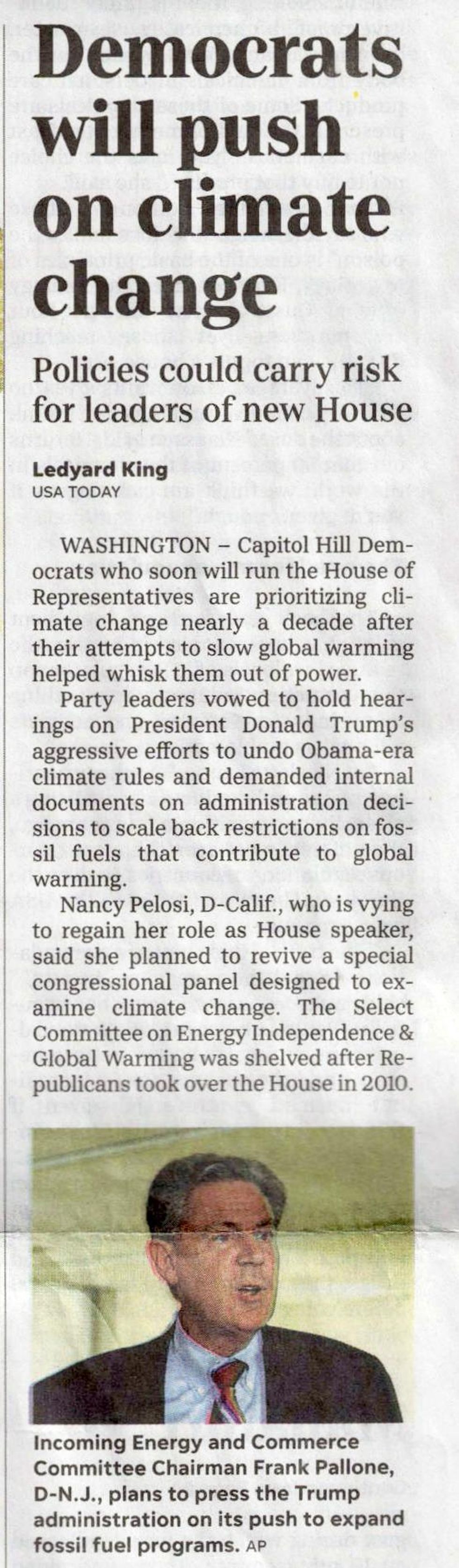
You might think the story was about the Green New Deal, the nascent environmental and social justice agenda that would include a special congressional committee on climate change, championed by incoming Rep. Alexandria Ocasio-Cortez and endorsed by at least a dozen co-sponsors.
You'd be wrong.
The real point of the 925-word story, by Gannett Washington reporter Ledyard King, was conveyed in the print edition's subhead: "Policies Could Carry Risk for Leaders of New House."
Featuring a classic "balance as bias" reporting frame, the piece alternated between dire, scientifically validated descriptions of climate change risks and President Trump's dismissal of them, and between illustrations of Democratic clout and predictions of the futility of their cause.
King led with a warning that set the tone for the rest of the article:
Capitol Hill Democrats who soon will run the House of Representatives are prioritizing climate change nearly a decade after their attempts to slow global warming helped whisk them out of power.
By "attempts to slow global warming," King is referring mainly to the American Clean Energy and Security Act of 2009, the bipartisan carbon cap-and-trade bill known as Waxman/Markey. The legislation, which would have set a national limit on greenhouse gases and created a market to buy and sell emissions permits, passed the House in June 2009, but was not taken up by the Senate. It has lain dormant since Republicans took the House in 2010.
USA Today portrayed today's Democratic leaders, backed by "environmental groups that poured tens of millions of dollars into their campaigns," as challenging the Trump administration's "aggressive efforts to undo Obama-era climate rules." King cited as motivation the release of the latest National Climate Assessment, which warns of "extreme weather, worsening health conditions, the spread of new diseases, increasing drought and famine, and economic decline."
But then the piece veered from this empowerment narrative to sow doubts about the political wisdom of addressing climate change--rejoining Dems' plans with Trumpisms and unattributed (and unchallenged) Republican talking points, a pattern it repeated throughout. King returned to his lead's unsubstantiated assertion that fighting climate change was why Democrats lost power eight years ago:
The quandary for the party leaders when they take back power January 3 is how aggressively to pursue an issue that contributed to the Tea Party wave that fueled the Republican takeover of the House in 2010.
How prepared are they to address opponents' arguments that "alarmist" climate change policies would increase energy prices and reduce consumer choice? How willing are they to take on a president who was elected....on...[a] platform that promised to "bring back coal" as part of an energy independence agenda?
Not so much, he concluded. The Dems are mostly
content to build a case through...the power to subpoena administration records, knowing that any major legislation they could pass probably would be vetoed by the president.
King "balanced" the broad evidence that climate change effects "are already being felt through stronger hurricanes, more intense wildfires, melting glaciers and loss of habitat" with Trump's absurd labeling of global warming as "a hoax perpetrated by China" and his easily refutable quote that the 2017 Paris Accord "is less about the climate and more about other countries gaining a financial advantage over the United States."
The story zigged to quote a climate-change expert explaining the significant power Congress will wield to "force records into the light of day [and] pressure the EPA to withdraw rules or Congress to pass laws" if those records show the agency was unduly influenced by the fossil fuel industry. It then zagged to the ultimate failure of Waxman/Markey, which was "portrayed by opponents as little more than an energy tax that would hit consumers' wallets." For a third time, it raised the specter that that bill and other efforts to address climate change "helped fuel the Tea Party wave that propelled Republicans to take control of the House in 2010."
The piece wrapped up by concluding that "though the effects and predicted consequences [of climate change] have grown more dire...some House Democrats are content with modest efforts to address global warming." King concluded, "Even if the House did pass an aggressive plan, it's doubtful the GOP-controlled Senate would take it up." The not-so-subtext: History, or USA Today's version of it, is bound to repeat itself.
USA Today's piece distorted important facts and lacked historical context. First and foremost was the insistence that the 111th Congress' efforts to forge climate policy had an important role in the rise of the Tea Party and Republicans' victory in the 2010 midterm elections.
The case for climate change having a direct impact on the 2010 election is weak. Most obviously, the Democrats suffered losses because the electorate was older, whiter and less Democratic compared with 2008. When asked what the most important issue facing the country was, 63 percent of voters said it was the economy--understandably, since unemployment was still at 9.8 percent in November 2010 as the effects of the economic crisis lingered on. Eighteen percent more named healthcare as the top issue (with voters split on whether to repeal Obamacare or not); 8 percent picked immigration and 7 percent the Afghan War, accounting for 96 percent of voters.
Ruy Teixeira and John Halpin pointed out in the New Republic (11/5/10) that voters blamed Wall Street (35 percent) for the state of the economy more often than they blamed President Obama (23 percent) or his predecessor, George W. Bush (29 percent). "But these Wall Street-blaming voters supported Republicans by 56-42 percent," Teixeira and Halpin noted--suggesting that Obama's Wall Street bailout (and failure to prosecute bankers) drove independents to vote for Republican candidates.
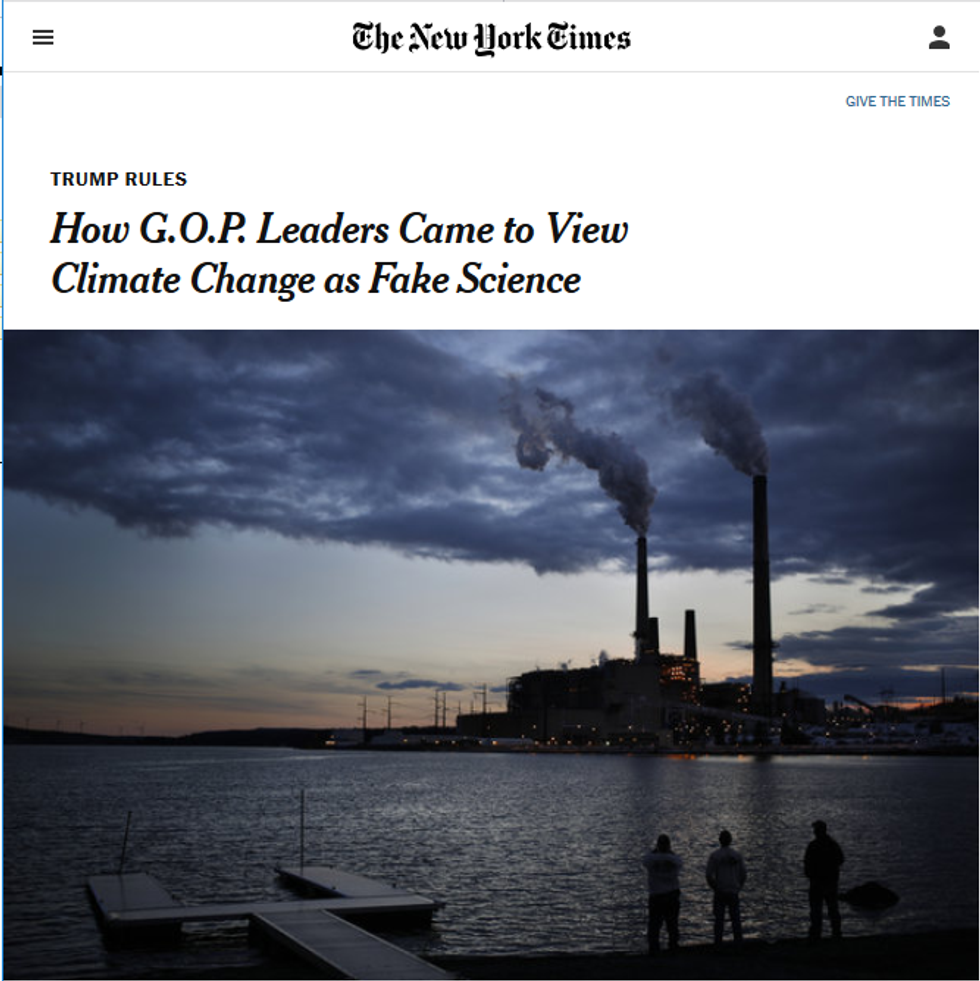
It's true that the attempt to pass climate-change legislation did solidify the Republican Party's climate denial position, as a New York Times investigative piece by Coral Davenport and Eric Lipton ("How GOP Leaders Came to View Climate Change as Fake Science," 6/3/17) documented last year. The billionaire oil baron brothers David and Charles Koch, backers of conservative think tanks and advocacy groups, were galvanized by the cap-and-trade vote to pour their money into campaign support for far-right, fossil fuel-friendly Republicans.
The Koch network, the Times reported,
put pressure on any Republicans who were considering taking climate action or even acknowledging climate change.... Republicans who asserted support for climate change legislation or the seriousness of the climate threat saw their money dry up or worse, a primary challenger arise.
While it's not the case, as the Washington Post (12/2/18) recently claimed, that Donald Trump was responsible for "placing climate change skepticism squarely in the GOP's ideological mainstream"--the George W. Bush administration had a systematic policy of suppressing scientific research that showed humans were warming the planet--it is true that not so long ago, it was possible for a mainstream Republican politician to talk about addressing global warming, as evidenced by 2008 presidential candidate Sen. John McCain, among others. As the Times noted, the Waxman/Markey cap-and-trade bill, far from a radical proposal from the left, was modeled on a market-based, Reagan Era Republican idea. Cap-and-trade was employed successfully to cut smokestack emissions that cause acid rain under the first President Bush.
King writes of the "Tea Party wave" without mentioning the fossil fuel money behind it. But treating that spending against climate action as the definitive cause of the Democrats' defeat is dubious, given that, as Time's Bryan Walsh (11/3/10) noted, "Democrats who voted against cap-and-trade were three times more likely to lose then those who voted for it"--and seven of the eight Republicans who voted for it were re-elected. (The other, Mike Castle of Delaware, retired to make an unsuccessful bid to run for Senate--and was replaced in the House by a Democrat.)
In any case, climate change legislation proposed today--like the bipartisan carbon tax bill introduced November 27--is less likely to meet the same fate, because the political climate has changed. Some 70 percent of American voters believe climate change is real, 61 percent say they are worried about it, and 68 percent favor a carbon tax on fossil fuel companies, according to data from the Yale Program on Climate Change Communication's 2018 Climate Opinion Map.
How could King have answered his own rhetorical questions?
How prepared are they to address opponents' arguments that "alarmist" climate change policies would increase energy prices and reduce consumer choice? How willing are they to take on a president who...promised to "bring back coal" as part of an energy independence agenda?
He could have offset the argument that effective climate change policies are "alarmist" (made by Rep. Tom DeLay in King's own November 27 story on the National Climate Assessment) with the fact that said Climate Assessment was written by scientists working in Trump's own government. Or countered the charge that cap-and-trade schemes will increase energy prices by citing the Congressional Budget Office's economic analysis of Waxman/Markey, which found it would likely have minimal impact on individual household tax bills, and that a refundable energy tax credit would help blunt any rise in energy costs.
The notion of "bringing back coal" is quixotic: As The Economist (11/24/18) recently pointed out, "The environmental regulations that the Trump administration is trying to undo will not restore the coal industry to its glory days, though they might slow its decline." Citing US Energy Administration data, the magazine noted that almost 40 percent of the country's coal-generating capacity "has either been shut down or designated for closure," due to the lower cost of replacements such as natural gas.
As for energy independence, crude oil production has exceeded imports since 2016. And with the rise of fracking, the US is on pace to be a net exporter of energy by 2022, according to the US Energy Department.
Despite the potential shown by proponents of a Green New Deal, the argument that Democrats as a whole "prioritize" climate action is dubious. In USA Today's own article (11/6/18) on Democrats' retaking the House, soon-to-be Speaker Nancy Pelosi "said the new Democratic majority would take 'strong legislative action' to lower the price of prescription drugs, invest in infrastructure and 'drain the swamp of dark interest money.'" There's no mention of climate change.
Just as the environment was at best a minor factor in the Democrats' loss in 2010, it didn't drive most Democratic voters to the polls for their victory this year. As USA Today reported:
According to a Washington Post/Schar School survey...in battleground districts across the country...44 percent of voters said healthcare was the most important factor in casting their ballot, while 43 percent said Trump was the top issue driving their decision.
Curiously, King had penned a very similar piece earlier in the month that was more in line with reality. "Back in Power, Democrats Want Answers on Administration's Environmental Decisions" (USA Today, 11/8/18) led off:
The midterm elections that catapulted Democrats back to power in the House for the first time in eight years have breathed new life into environmental priorities that President Donald Trump has been trying to roll back as the centerpiece of his economic agenda.
It explained how they hope to accomplish these priorities, quoting party leaders directly. "We've been ignored up to this point, but as the majority, we don't need to tolerate that," said Arizona's Rep. Raul Grijalva, incoming chair of the House Natural Resources Committee.
King's November 26 piece seems to backpedal on his earlier one. By continually harping on the challenges the Democratic climate hawks face, based on a questionable, unsubstantiated analysis of the political risks, USA Today's article seems designed to push back on a Democratic push to do anything at all about the climate catastrophe.
Many Americans remain in shock and outrage, unable to grasp how a man who told bald-faced lies, who ridiculed and defamed others, and who boasted of sexual assault could yet ascend to the presidency of the United States.
Despair isn't an option; it's our greatest enemy. We know we must act more boldly than ever. To save the democracy we thought we had, we must take democracy to where it's never been.
Most of us find our courage through acting with others. So we at the Small Planet Institute are launching a Field Guide to the Democracy Movement. Together we can create a vibrant, bipartisan, multicultural "movement of movements."
This Democracy Movement can mobilize people not just online, but face-to-face, creating personal bonds strong enough to carry out historic civic action. To protect and further our democratic institutions, this movement must have strong grass-roots and national coordination. Most importantly, it must be a movement that turns disillusionment and fear into the courage and resolve needed to tackle the deep, systemic roots of the crisis we now face.
And the great news? The pieces are already in place; they just aren't nearly as visible as they must be. To galvanize the millions more who want to act but can't see an entry point, our Field Guide offers plenty of options:
Success in the Democracy Movement -- with human dignity as its foundation -- requires addressing three aspects of American society that contributed to Donald Trump's victory.
1. Rejecting brutal capitalism
Much of Trump's support, we believe, flows from a sense of betrayal. For example, one-fifth of American men aged 20 to 65 had no paid employment last year. Their vulnerability to big but empty promises is surely easy to understand.
But to grasp and tackle the forces leading to Trump means naming and ending the assault on human dignity itself that's built into our peculiar form of capitalism.
We refer to it as "brutal capitalism" to bring attention to the harms inexorably generated in an economy driven largely by a single rule: Go for what brings highest return to existing wealth. In such a deliberately fostered economy, especially since the 1970s, human agency in shaping the rules to protect basic fairness, healthy communities and our commons -- whether oceans, soil or air -- is perceived as interference in a magical marketplace (so named by former President Ronald Reagan). A magical market works on its own without us. It succeeds, we're made to believe, by reducing everything possible to dollar exchange among consumers.
The "magical market" therefore magnifies whatever sells -- and sex and violence sell. So it follows that entertainment, advertising, fashion and even newscasts become increasingly violent, shallow and sexualized. Note that in an earlier era, for example, Barbara Walters was forced to don a Playboy bunny outfit for an investigation she did on NBC News, but she did not have to double as a sex symbol as many contemporary female news anchors do today. Increasingly, the degrading message -- one the president-elect made explicit during his campaign -- is that a woman is only as worthy as her body is sexy.
Underneath it all is this dangerous logic: In an economy valuing highest rate of return above all, wealth accrues relentlessly to wealth. Thus, in an extreme expression of this logic, the United States has easily become the most economically unequal nation in the "advanced" world. (Note: Economic inequality correlates with numerous negative social outcomes, ranging from infant mortality to homicide rates, according to social epidemiologists Richard Wilkinson and Kate Pickett). Such concentrated wealth -- with 20 Americans now controlling as much as half of all of us together -- translates into political power. Thus, a telling study of policy outcomes during the '80s and '90s found virtually no correlation between the views of average Americans about what ought to be done and what law- and policymakers actually did. In a system that's drowning in campaign contributions by people who can write six- and seven-figure checks, outcomes not surprisingly mirror the views of the elite class.
Transforming brutal capitalism, with its multiple assaults on human dignity that contributed to Trump's election, requires democracy to be accountable not to monopolistic corporations but to us, the citizens. Such a democracy could open the door to an economy based on three values around which most Americans could rally: fairness, the protection of the nature of democracy, and the dignity of all.
A truly living democracy -- benefiting and accountable to citizens -- could, for example, maintain a minimum wage that is a livable wage, encourage unions and worker cooperatives giving everyone in a business a real voice, and spread corporate "profit-sharing" with workers. Few Americans know this is precisely the official platform of the Democracy Party, which notes that such change "is linked to higher pay and productivity." Who knows? A real American democracy might even create a US version of Germany's century-old, successful Works Councils, giving workers a say in their firm's decisions.
2. Revaluing the role of government and reinstating government service as an honorable calling
A strong democracy requires reversing Republicans' long and fierce anti-democracy movement -- highly coordinated since the infamous 1971 Lewis Powell memo, a detailed playbook for delegitimizing government and elevating corporate power. Powell, who later served as a Supreme Court Justice, no doubt helped to inspire Reagan's swipe at government in his first inaugural address: "Government is not the solution to our problem; government is the problem."
Beginning in the 1990s, Republican leaders including former House Speaker Newt Gingrich of Georgia and former House Majority Leader Tom DeLay of Texas fostered a take-no-prisoners approach to politics, captured in 1999 by David Horowitz's The Art of Political War. In it, compromise is treason and obstructionism is virtue. Most recently, Republicans have filibustered in an unprecedented fashion to bring Congress to a halt, pushing its approval rating to historical lows. All the while, Democrats failed to stand for a convincing alternative.
And it's all worked like a charm: Republican success in debasing Congress and hamstringing President Barack Obama then became the perfect setup for a bombastic self-promoter who claimed the mantle of outsider to a dysfunctional and rigged system.
3. Reclaiming citizens' power and pride
Too many -- and we're guilty, too -- have failed to grasp the strength of this anti-democracy movement and to fight its assault vigorously enough; for example, the war on voting rights that continued insidiously after passage of the 1965 Voting Rights Act. Then in 2013 the Supreme Court in Shelby County v. Holder actually gutted the law, making it possible for 14 states to implement voter-ID laws in time for the 2016 election -- including in swing states like Wisconsin and Ohio.
Too few of us appreciated this danger. Ari Berman, author of Give Us the Ballot, acknowledges that "[w]e'll never know how many people were kept from the polls by these restrictions." But, he notes, we do know that in Wisconsin Donald Trump's margin of victory was 27,000 votes, while 300,000 registered voters could not cast a ballot because they lacked required IDs, according to a federal court. Turnout in the state hit a 20-year low, falling by 52,000 in Milwaukee, "where 70 percent of the state's African-American population lives."
Berman adds that on Election Day, "there were 868 fewer polling places in states with a long history of voting discrimination, like Arizona, Texas and North Carolina." On average, blacks in 2012 waited twice as long as whites to vote. And, of course, the lower one's income, the greater the time-cost impediment to voting.
And voter suppression is but one example. According to political scientist Michael McDonald, voter turnout plummeted from 62 percent in 2008, the year Obama was first elected, to 42 percent in the following midterm elections. The result? Not enough citizens stayed engaged to build pressure for democratic reforms, and a solidly Republican Congress able to block the president at every turn. In allowing special interests to block reforms Obama demanded, we failed to protect the very people who later voted for Trump.
So we citizens must hold ourselves accountable, too. We helped to set the stage. But today it's a different world. Unprecedented shock and horror at steps Trump is now taking can motivate unprecedented action. As never before, the rise of a diverse, rewarding Democracy Movement is not only possible but essential. Whatever our specific issue-passion, it is urgent that we take to heart the essential lessons of the 2016 election and unite under the banner of democracy itself. Let's dare to act -- together. Check out our Field Guide and join the noble -- and, yes, exhilarating struggle to save our country.
Billionaire Betsy DeVos, a major GOP funder and party activist from Michigan, has been tapped by Donald Trump to become the Secretary of the U.S. Department of Education next year.
Many have decried the choice as a looming disaster for public schools in America, with NEA president Lily Eskelsen Garcia observing that DeVos' "efforts over the years have done more to undermine public education than support students. She has lobbied for failed schemes, like vouchers--which take away funding and local control from our public schools--to fund private schools at taxpayers' expense."
Randi Weingarten, the president of AFT, stated that "Betsy DeVos is everything Donald Trump said is wrong in America--an ultra-wealthy heiress who uses her money to game the system and push a special-interest agenda that is opposed by the majority of voters. Installing her in the Department of Education is the opposite of Trump's promise to drain the swamp."
The choice signals the President-elect's intention to put the expansion of taxpayer-funded charter schools and vouchers for private and religious schools at the center of his national agenda on education.
Through her riches, Betsy DeVos has had a disproportionate influence on national and state policies affecting millions of Americans, helping to force through changes to the law that gut the rights of workers and redirect American tax dollars to fund risky charter school experiments that have repeatedly failed for America's children.
She has also applauded efforts to gut election laws that are designed to prevent corruption, recasting the issue of money in politics as free speech and her right to speak "as loudly as we please." (Her remarks about this and her praise for Tom DeLay's "honesty" begin at the 52-minute mark here.)
Here are five facts to get smart about who Betsy DeVos is and what her nomination could mean for America.
Betsy and her husband Dick DeVos, Jr., have four children they raised in the prosperous town of Ada, Michigan, which is the headquarters of AmWay, the multi-level marketing company that made the DeVos family billionaires. She is also an heir to the Prince Corporation fortune from sun visors and other car parts.
The public elementary, middle, and high school in Ada, a suburb of Grand Rapids, Michigan, are highly ranked, but she did not send her children to public schools. She has said that her two daughters were home-schooled for a number of years.
Instead of sending their children to public schools, for nearly three decades, Betsy and Dick have focused on pushing vouchers for private schools and bankrolling politicians to advance their agenda to redirect American tax dollars away from truly public schools.
In 2004, Betsy DeVos hired Scott Jensen to aid the legislative agenda of her group "American Federation for Children" (AFC), a 501(c)(4) arm of Alliance for School Choice, her 501(c)3), which push so-called education reform measures.
The problem is that in 2002, Jensen had been charged with three felonies and a misdemeanor for misconduct in office--for illegally using his office as the Republican Assembly Speaker to direct that state employees to perform campaign work at public expense. He and the others who were charged challenged the reach of state statutes in court through various appeals from 2002 through 2004, but they lost their efforts to prevent criminal trials.
But, the fact that Jensen was charged with felonies for misusing public tax dollars for partisan political purposes did not deter Betsy DeVos from hiring him in 2004 to advance her personal agenda to change American schools on behalf of AFC.
In 2005, he was tried in state court and convicted on all counts. The presiding judge told Jensen "what you did was a great wrong to the citizens of this state" because "You used your power and your influence to run an illegal campaign funding operation." The judge sentenced Jensen to five years, including 15 months of confinement along with supervised release.
That conviction and public condemnation did not end Jensen's job for Betsy DeVos. Jensen appealed his conviction, and he also lost his office in the legislature, but he had a job with DeVos.
For the next five years, Jensen was a convicted felon and DeVos' point person in pushing her school choice agenda in the states.
In 2010, after changes in the judiciary, Jensen won an appeal of his conviction and agreed to plead guilty to a misdemeanor crime to settle the case.
His conviction for that crime also had no impact on DeVos' decision to keep him on to push school choice.
Accordingly, perhaps it should come as no surprise that while all that was going on, another DeVos family school choice PAC was fined for $5.2 million by the Ohio Elections Board in 2008 for circumventing Ohio campaign finance laws. It was the largest fine for violating election laws in state history.
Do the ends justify the means for Betsy DeVos?
Her particular area of interest is the deregulation and privatization of the education system, initially through the introduction of education "vouchers."
The primary organizations that DeVos has bankrolled to carry out these policy goals are the dark money group, American Federation for Children (AFC), which is a 501(c)(4), and its affiliated 501(c)(3) nonprofit group, Alliance for School Choice. These groups have become major contributors to the right-wing corporate education reform echo chamber.
AFC describes itself as "creating an education revolution" through what is described as "school choice," via vouchers (tax dollars spent on private schools including religious schools), tax credits, and non-taxable "Education Savings Accounts."
AFC has gone through several evolutions since its 1998 founding including name changes. Some of these changes occurred after political controversies such as violations of campaign finance laws in Ohio and Wisconsin, as noted above.
AFC is and always has been a very important player in local state and national politics, helping to strongly support Republican candidates who move her education privatization agenda forward.
For example, AFC invested heavily in Wisconsin's recall elections to protect its political allies, including Republican Governor Scott Walker. Since 2010, AFC has spent at least $4.5 million on independent expenditures and issue ads in Wisconsin. This amount doesn't include the individual donations given by members of the DeVos family, or any spending on dark money groups trying to influence the elections without disclosing their donors.
AFC also aggressively promotes the school privatization agenda via the American Legislative Exchange Council (ALEC), where Jensen has represented AFC's lobbying agenda.
ALEC, describes itself as a voluntary association of state legislators but it operates as a corporate bill mill where the corporations that fund most of ALEC's operations and where corporate lobbyists and special interest representatives get an "equal voice and vote" with elected officials to approve "model" bills without the press or public present. AFC has been a "trustee" level sponsor of ALEC and is a member of ALEC's Education Task Force.
AFC works alongside ALEC to push so-called "model bills" promoting "school choice" and tax changes to subsidize private schools. Essentially, both ALEC and AFC want that national priority to be expanded funding for charter schools, which defunds truly public schools.
The nomination of Betsy DeVos to be the head of the Department of Education is a clear sign that the nation is about to embark on a dangerously extreme national experiment in the privatization of our education system that could deal a death blow to our public schools as we have known them.
There's little doubt that DeVos would use her power to undermine one of America's greatest innovations that helped make our country and economy so strong in the 20th century--quality public schools--and instead, use the idea of 'reform' to further subsidize private schools along with for-profit companies and non-profits operating charter schools.
The expansion of charters has marched forward despite the fact that fly-by-night charter operators that have committed more than $200 million dollars in fraud and waste in recent years, as documented by the Center for Popular Democracy.
Some of that expansion has occurred through for-profit companies, like K12 Inc., getting tax dollars for so-called "virtual schools," to operate as charters or as part of the public school system.
Dick DeVos, in a joint interview with Betsy DeVos, noted that he "commended to homeschoolers to consider is check out K12... Bill Bennett reviews the K12 personally, ... it's very consistent with our Christian world view..."
Like Betsy DeVos' AFC, K12 has had a seat and vote on ALEC's Education Task Force, and K12 has a seat on ALEC's corporate board. K12 has paid its CEO millions in stock in the company, whose revenues come overwhelmingly from public school budgets. CMD has called one of the leaders of K12 the highest paid "teacher" in America.
As the Center for Media and Democracy has detailed, the federal government has spent nearly $4 billion in tax dollarson the charter school experiment advanced by DeVos and other billionaires, like the Kochs and the Walton family.
CMD has also documented how charter schools in the DeVos backyard of Michigan have been embroiled in fraud and scandal, and how the state has even received federal tax dollars for charters that never even opened. That does not include the nearly $1 billion state spending that the Detroit Free Press has documented have gone to charters in that state.
DeVos has approached the issue of education as a religious issue for her personally and as an area which she wants to change the law to reflect her personal views. A long-time partisan activist, she got involved in education "reform" in the early 1990s, around the time that her husband ran for a seat on the Michigan state Board of Education.
After he stepped down from that post, in 1993 she and her husband took on the "Education Freedom Fund," which, she has said, "I would define as ultimately Christian in its nature because in excess of 90% of the parents who receive these scholarships choose Christian schools to go to." EFF provides private funding for private school tuition, and is supported with significant donations from the DeVos family.
Why did she and here husband choose to get involved in the political battles over public education even though they did not send their kids to public schools and they financially support private Christian schools?
In a joint interview for "The Gathering," a group focused on advancing Christian ideology through philanthropy, she and her husband said they decided to focus on reforming public education and funding for private education because the "Lord led us there" and "God led us."
At that meeting, they were asked if it would not have been simpler to fund Christian schools directly rather than fund political efforts like vouchers to get more tax dollars to fund Christian schools, and she replied: "There are not enough philanthropic dollars in America to fund what is currently the need in education versus what is spent every year on education in this country... So, our desire is to confront the culture in ways that will continue to advance God's Kingdom," adding that they want "to impact our culture [in ways] that may have great Kingdom gain in the long-run by changing the way we approach things."
Her husband added: "We are working .... to allow for our Christian worldview, which for us comes from a Calvinist tradition, and to provide for a more expanded opportunity someday for all parents to be able to educate their children in a school that reflects their world view and not each day sending their child to a school that may be reflecting a world view that may be quite antithetical to the worldview they hold in their families."
When asked if they are "against public education," they have denied that charge while trying to reframe the conversation.
Betsy DeVos responded: "No, we are for good education and for having every child have an opportunity for a good education. And having grown up in families that are in the business world, we both believe that competition and choices make everyone better, and that ultimately if the system that prevails in the United States today had more competition, if there were other choices for people to make freely that all of the schools would become better as a result and that excellence would be sought in every setting. So we are very strong proponents of fundamentally changing the way we approach education ... because there are hundreds of thousands and millions of children that are forced to go every day to a school that is not meeting their needs and it's not right."
Her husband added that they are for "public education" but that's not the same as "public schools." He said public funding for education of all kinds is a "laudable concept" that should not be forced to operate through "government-run schools."
He also stated: "In my opinion, the Church has sadly retrenched from its central role in our community, to where now as we look at many communities in our country the church which ought to be in our view far more central to the life in our community has been displaced by the public school as the center for activity the center for what goes on the community...."
He added, "it is certainly our hope that churches would continue no matter what the environment whether there is government funding someday through vouchers or tax credits or some other mechanism...that more and more churches will get more and more active and engaged in education. We just can think of no better way to rebuild our families and our communities than to have that circle of church, school, and family much more tightly focused and being built on a consistent world view."
Betsy DeVos did not disagree with this statement of their shared goals and responded: "If I can just add to that very quickly, I think for many years the church in general has felt that it is important for the children of the congregation to be in the schools to make a difference but in fact I think what has happened in many cases for the last couple of decades is that the schools have impacted the kids more than the kids have impacted the schools. The young children need to have a pretty solid foundation to be able to combat the kind of influences that they are presented with on a daily basis."
(All quotes above are transcribed from their hour-long interview for "The Gathering," available here.)
Betsy DeVos has used her family fortune to distort public policy to suit her personal agenda through direct donations and dark money because, in her own words, she wants a "return on our investment."
The DeVos family is a major funder of the Republican party. In a 1997 op-ed that DeVos wrote for the Capitol Hill newspaper Roll Call, she pointedly admitted, "my family is the largest single contributor of soft money to the national Republican party." She also said that she decided to stop taking offense at the suggestion that they were buying influence and simply concede the point, admitting "we expect a return on our investment," to make America reflect their vision for it.
DeVos has served as chairwoman of the Michigan Republican Party and was the finance chairwoman of the National Republican Senatorial Committee.
In addition to the disclosed and undisclosed political spending for controversial politicians like Tom DeLay--whom Betsy DeVos has called one of the most honest men in politics--the DeVos family through the Richard and Helen DeVos Foundation has been a major funder of many extreme socially conservative organizations such as the Family Research Council, Focus on the Family and Coral Ridge Ministries.
The DeVos family fortune funds pro-education privatization, anti-union and pro-school voucher groups.
In 2011 alone, the DeVos foundation gave $3 million to David Koch's Americans for Prosperity, a conservative group created and funded by the Koch Brothers. The DeVos Foundation gave another $2.5 million to the Koch conduit DonorsTrust from 2009 to 2010.
The DeVos foundation has also contributed millions of dollars to other right wing organizations such as the State Policy Network, Heritage Foundation, the American Enterprise Institute, FreedomWorks, Federalist Society, Mackinac Center for Public Policy, and others.
Betsy and Dick DeVos were featured at a meeting of the ALEC sibling group, the State Policy Network, which gave its highest award in 2014 to the Mackinac Center for pushing the misnamed "right to work" bill into law in Michigan, even though that think tank has claimed to the IRS that it engages in no lobbying.
Their fortune has helped to underwrite Mackinac's operations and agenda, which has included expanding powers for emergency managers to replace elected officials, which helped create the conditions for the Flint, Michigan, tragedy of kids being poisoned by lead in their water, as CMD has detailed in a history of those provision.
In 2015, DeVos money also helped fund the push for adoption of a statewide religious freedom restoration act, or RFRA law, that awards adoption agencies in Michigan the right to claim a religious exemption from having to serve LGBTQ couples. Both the Richard and Helen DeVos Foundation and the Dick and Betsy DeVos Foundation gave money to Bethany Christian Services, which lobbied hard for passage of the controversial RFRA.
Recently, the DeVos family also helped fund two pieces of extreme state legislation in Michigan. The state preemption bill, dubbed the "death star," HB 4052, passed by the legislature in 2015 bans cities from enacting their own laws governing wages and benefits. In one fell swoop, the law preempted local regulation of nine wage and benefit policies ranging from minimum wage to worker training and organizing.
For more on Betsy DeVos and many of the groups mentioned here, visit the Center for Media and Democracy's SourceWatch.org.
Kim Haddow and CMD researchers contributed to this article.
I used to be a serious Republican, moderate and business-oriented, who planned for a public-service career in Republican politics. But I am a Republican no longer.
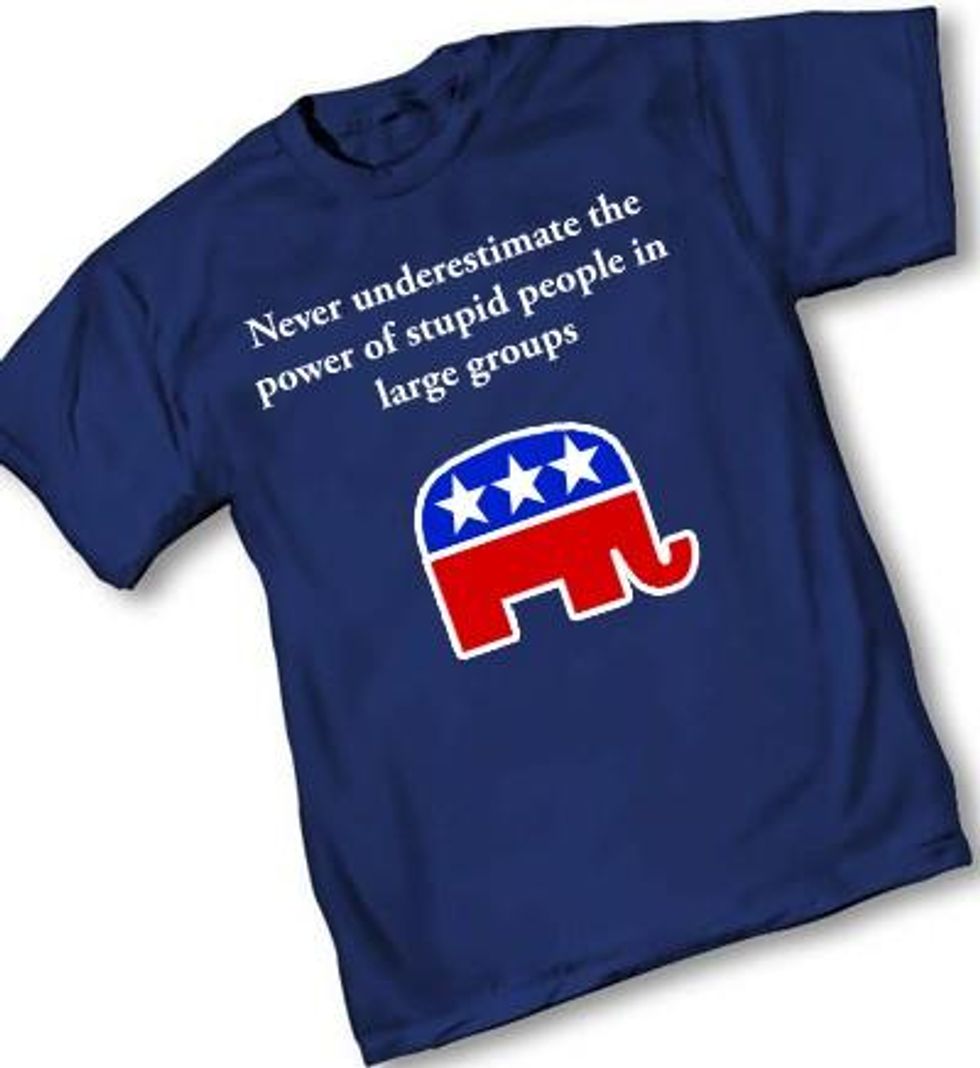
There's an old joke we Republicans used to tell that goes something like this: "If you're young and not a Democrat, you're heartless. If you grow up and you're not a Republican, you're stupid." These days, my old friends and associates no doubt consider me the butt of that joke. But I look on my "stupidity" somewhat differently. After all, my real education only began when I was 30 years old.
This is the story of how in New Orleans after Hurricane Katrina and later in Iraq, I discovered that what I believed to be the full spectrum of reality was just a small slice of it and how that discovery knocked down my Republican worldview.
I always imagined that I was full of heart, but it turned out that I was oblivious. Like so many Republicans, I had assumed that society's "losers" had somehow earned their desserts. As I came to recognize that poverty is not earned or chosen or deserved, and that our use of force is far less precise than I had believed, I realized with a shock that I had effectively viewed whole swaths of the country and the world as second-class people.
No longer oblivious, I couldn't remain in today's Republican Party, not unless I embraced an individualism that was even more heartless than the one I had previously accepted. The more I learned about reality, the more I started to care about people as people, and my values shifted. Had I always known what I know today, it would have been clear that there hasn't been a place for me in the Republican Party since the Free Soil days of Abe Lincoln.
Where I Came From
I grew up in a rich, white suburb north of Chicago populated by moderate, business-oriented Republicans. Once upon a time, we would have been called Rockefeller Republicans. Today we would be called liberal Republicans or slurred by the Right as "Republicans In Name Only" (RINOs).
We believed in competition and the free market, in bootstraps and personal responsibility, in equality of opportunity, not outcomes. We were financial conservatives who wanted less government. We believed in noblesse oblige, for we saw ourselves as part of a natural aristocracy, even if we hadn't been born into it. We sided with management over labor and saw unions as a scourge. We hated racism and loved Dr. Martin Luther King, Jr., particularly his dream that his children would "live in a nation where they will not be judged by the color of their skin but by the content of their character." We worried about the rise of the Religious Right and its social-conservative litmus tests. We were tough on crime, tough on national enemies. We believed in business, full stop.
I intended to run for office on just such a platform someday. In the meantime, I founded the Republican club at my high school, knocked on doors and collected signatures with my father, volunteered on campaigns, socialized at fundraisers, and interned for Senator John McCain and Congressman Denny Hastert when he was House Majority Whip Tom DeLay's chief deputy.
We went to mainstream colleges -- the more elite the better -- but lamented their domination by liberal professors, and I did my best to tune out their liberal views. I joined the Republican clubs and the Federalist Society, and I read the Wall Street Journal and the Economist rather the New York Times. George Will was a voice in the wilderness, Rush Limbaugh an occasional (sometimes guilty) pleasure.
Left Behind By the Party
In January 2001, I was one of thousands of Americans who braved the cold rain to attend and cheer George W. Bush's inauguration. After eight years hating "Slick Willie," it felt good to have a Republican back in the White House. But I knew that he wasn't one of our guys. We had been McCain fans, and even if we liked the compassionate bit of Bush's conservatism, we didn't care for his religiosity or his social politics.
Bush won a lot of us over with his hawkish response to 9/11, but he lost me with the Iraq War. Weren't we still busy in Afghanistan? I didn't see the urgency.
By then, I was at the Justice Department, working in an office that handled litigation related to what was officially called the Global War on Terror (or GWOT). My office was tasked with opposing petitions for habeas corpus brought by Guantanamo detainees who claimed that they were being held indefinitely without charge. The government's position struck me as an abdication of a core Republican value: protecting the "procedural" rights found in the Bill of Rights. Sure, habeas corpus had been waived in wartime before, but it seemed to me that waiving it here reduced us to the terrorists' level. Besides, since acts of terrorism were crimes, why not prosecute them? I refused to work on those cases.
With the Abu Ghraib pictures, my disappointment turned to rage. The America I believed in didn't torture people.
I couldn't avoid GWOT work. I was forced to read reams of allegations of torture, sexual abuse, and cover-ups in our war zones to give the White House a heads-up in case any of made it into the news cycle.
I was so mad that I voted for Kerry out of spite.
How I Learned to Start Worrying
I might still have stuck it out as a frustrated liberal Republican, knowing that the wealthy business core of the party still pulled a few strings and people like Richard Lugar and Olympia Snowe remained in the Senate -- if only because the idea of voting for Democrats by choice made me feel uncomfortable. (It would have been so... gauche.) Then came Hurricane Katrina. In New Orleans, I learned that it wasn't just the Bush administration that was flawed but my worldview itself.
I had fallen in love with New Orleans during a post-law-school year spent in Louisiana clerking for a federal judge, and the Bush administration's callous (non-)response to the storm broke my heart. I wanted to help out, but I didn't fly helicopters or know how to do anything useful in a disaster, so just I sat glued to the coverage and fumed -- until FEMA asked federal employees to volunteer to help. I jumped at the chance.
Soon, I was involved with a task force trying to rebuild (and reform) the city's criminal justice system. Growing up hating racism, I was appalled but not very surprised to find overt racism and the obvious use of racist code words by officials in the Deep South.
Then something tiny happened that pried open my eyes to the less obvious forms of racism and the hurdles the poor face when they try to climb the economic ladder. It happened on an official visit to a school in a suburb of New Orleans that served kids who had gotten kicked out of every other school around. I was investigating what types of services were available to the young people who were showing up in juvenile hall and seemed to be headed toward the proverbial life of crime.
My tour guide mentioned that parents were required to participate in some school programs. One of these was a field trip to a sit-down restaurant.
This stopped me in my tracks. I thought: What kind of a lame field trip is that?
It turned out that none of the families had ever been to a sit-down restaurant before. The teachers had to instruct parents and students alike how to order off a menu, how to calculate the tip.
I was stunned.
Starting To See
That night, I told my roommates about the crazy thing I had heard that day. Apparently there were people out there who had never been to something as basic as a real restaurant. Who knew?
One of my roommates wasn't surprised. He worked at a local bank branch that required two forms of ID to open an account. Lots of people came in who had only one or none at all.
I was flooded with questions: There are adults who have no ID? And no bank accounts? Who are these people? How do they vote? How do they live? Is there an entire off-the-grid alternate universe out there?
From then on, I started to notice a lot more reality. I noticed that the criminal justice system treats minorities differently in subtle as well as not-so-subtle ways, and that many of the people who were getting swept up by the system came from this underclass that I knew so little about. Lingering for months in lock-up for misdemeanors, getting pressed against the hood and frisked during routine traffic stops, being pulled over in white neighborhoods for "driving while black": these are things that never happen to people in my world. Not having experienced it, I had always assumed that government force was only used against guilty people. (Maybe that's why we middle-class white people collectively freak out at TSA airport pat-downs.)
I dove into the research literature to try to figure out what was going on. It turned out that everything I was "discovering" had been hiding in plain sight and had been named: aversive racism, institutional racism, disparate impact and disparate treatment, structural poverty, neighborhood redlining, the "trial tax," the "poverty tax," and on and on. Having grown up obsessed with race (welfare and affirmative action were our betes noirs), I wondered why I had never heard of any of these concepts.
Was it to protect our Republican version of "individual responsibility"? That notion is fundamental to the liberal Republican worldview. "Bootstrapping" and "equality of opportunity, not outcomes" make perfect sense if you assume, as I did, that people who hadn't risen into my world simply hadn't worked hard enough, or wanted it badly enough, or had simply failed. But I had assumed that bootstrapping required about as much as it took to get yourself promoted from junior varsity to varsity. It turns out that it's more like pulling yourself up from tee-ball to the World Series. Sure, some people do it, but they're the exceptions, the outliers, the Olympians.
The enormity of the advantages I had always enjoyed started to truly sink in. Everyone begins life thinking that his or her normal is the normal. For the first time, I found myself paying attention to broken eggs rather than making omelets. Up until then, I hadn't really seen most Americans as living, breathing, thinking, feeling, hoping, loving, dreaming, hurting people. My values shifted -- from an individualistic celebration of success (that involved dividing the world into the morally deserving and the undeserving) to an interest in people as people.
How I Learned to Stop Loving the Bombs
In order to learn more -- and to secure my membership in what Karl Rove sneeringly called the "reality-based community" -- I joined a social science research institute. There I was slowly disabused of layer after layer of myth and received wisdom, and it hurt. Perhaps nothing hurt more than to see just how far my patriotic, Republican conception of U.S. martial power -- what it's for, how it's used -- diverged from the reality of our wars.
Lots of Republicans grow up hawks. I certainly did. My sense of what it meant to be an American was linked to my belief that from 1776 to WWII, and even from the 1991 Gulf War to Kosovo and Afghanistan, the American military had been dedicated to birthing freedom and democracy in the world, while dispensing a tough and precise global justice.
To me, military service represented the perfect combination of public service, honor, heroism, glory, promotion, meaning, and coolness. As a child, I couldn't get enough of the military: toys and models, movies and cartoons, fat books with technical pictures of manly fighter planes and ships and submarines. We went to air shows whenever we could, and with the advent of cable, I begged my parents to sign up so that the Discovery Channel could bring those shows right into our den. Just after we got it, the first Gulf War kicked off, and CNN provided my afterschool entertainment for weeks.
As I got older, I studied Civil War military history and memory. (I would eventually edit a book of letters by Union Gen. Joshua Lawrence Chamberlain.) I thought I knew a lot about war; even if Sherman was right that "war is hell," it was frequently necessary, we did it well, and -- whatever those misinformed peaceniks said -- we made the world a better place.
But then I went to a war zone.
I was deployed to Baghdad as part of a team of RAND Corporation researchers to help the detainee operations command figure out several thorny policy issues. My task was to figure out why we were sort-of-protecting and sort-of-detaining an Iranian dissident group on Washington's terrorist list.
It got ugly fast. Just after my first meal on base, there was a rumble of explosions, and an alarm started screaming INCOMING! INCOMING! INCOMING! Two people were killed and dozens injured, right outside the chow hall where I had been standing minutes earlier.
This was the "surge" period in 2007 when, I was told, insurgent attacks came less frequently than before, but the sounds of war seemed constant to me. The rat-tat-tat of small arms fire just across the "wire." Controlled detonations of insurgent duds. Dual patrolling Blackhawks overhead. And every few mornings, a fresh rain of insurgent rockets and mortars.
Always alert, always nervous, I was only in Iraq for three and a half weeks, and never close to actual combat; and yet the experience gave me many of the symptoms of PTSD. It turns out that it doesn't take much.
That made me wonder how the Iraqis took it. From overhead I saw that the once teeming city of Baghdad was now a desert of desolate neighborhoods and empty shopping streets, bomb craters in the middle of soccer fields and in the roofs of schools. Millions displaced.
Our nation-building efforts reeked of post-Katrina organizational incompetence. People were assigned the wrong roles -- "Why am I building a radio station? This isn't what I do. I blow things up..." -- and given no advance training or guidance. Outgoing leaders didn't overlap with their successors, so what they had learned would be lost, leaving each wheel to be partially reinvented again. Precious few contracts went to Iraqis. It was driving people out of our military.
This incompetence had profound human costs. Of the 26,000 people we were detaining in Iraq, as many as two-thirds were innocent -- wrong place, wrong time -- or, poor and desperate, had worked with insurgent groups for cash, not out of an ideological commitment. Aware of this, the military wanted to release thousands of them, but they didn't know who was who; they only knew that being detained and interrogated made even the innocents dangerously angry. That anger trickled down to family, friends, neighbors, and acquaintances. It was about as good an in-kind donation as the U.S. could have made to insurgent recruitment -- aside from invading in the first place.
So much for surgical precision and winning hearts and minds. I had grown up believing that we were more careful in our use of force, that we only punished those who deserved punishment. But in just a few weeks in Iraq, it became apparent that what we were doing to the Iraqis, as well as to our own people, was inexcusable.
Today, I wonder if Mitt Romney drones on about not apologizing for America because he, like the former version of me, simply isn't aware of the U.S. ever doing anything that might demand an apology. Then again, no one wants to feel like a bad person, and there's no need to apologize if you are oblivious to the harms done in your name -- calling the occasional ones you notice collateral damage ("stuff happens") -- or if you believe that American force is always applied righteously in a world that is justly divided into winners and losers.
A Painful Transition
An old saw has it that no one profits from talking about politics or religion. I think I finally understand what it means. We see different realities, different worlds. If you and I take in different slices of reality, chances are that we aren't talking about the same things. I think this explains much of modern American political dialogue.
My old Republican worldview was flawed because it was based upon a small and particularly rosy sliver of reality. To preserve that worldview, I had to believe that people had morally earned their "just" desserts, and I had to ignore those whining liberals who tried to point out that the world didn't actually work that way. I think this shows why Republicans put so much effort into "creat[ing] our own reality," into fostering distrust of liberals, experts, scientists, and academics, and why they won't let a campaign "be dictated by fact-checkers" (as a Romney pollster put it). It explains why study after study shows -- examples here, here, and here -- that avid consumers of Republican-oriented media are more poorly informed than people who use other news sources or don't bother to follow the news at all.
Waking up to a fuller spectrum of reality has proved long and painful. I had to question all my assumptions, unlearn so much of what I had learned. I came to understand why we Republicans thought people on the Left always seemed to be screeching angrily (because we refused to open our eyes to the damage we caused or blamed the victims) and why they never seemed to have any solutions to offer (because those weren't mentioned in the media we read or watched).
My transition has significantly strained my relationships with family, friends, and former colleagues. It is deeply upsetting to walk on thin ice where there used to be solid, common ground. I wish they, too, would come to see a fuller spectrum of reality, but I know from experience how hard that can be when your worldview won't let you.
No one wants to feel like a dupe. It is embarrassing to come out in public and admit that I was so miseducated when so much reality is out there in plain sight in neighborhoods I avoided, in journals I hadn't heard of, in books by authors I had refused to read. (So I take courage from the people who have done so before me like Andrew Bacevich.)
Many people see the wider spectrum of reality because they grew up on the receiving end. As a retired African-American general in the Marine Corps said to me after I told him my story, "No one has to explain institutional racism to a black man."
Others do because they grew up in families that simply got it. I married a woman who grew up in such a family, for whom all of my hard-earned, painful "discoveries" are old news. Each time I pull another layer of wool off my eyes and feel another surge of anger, she gives me a predictable series of looks. The first one more or less says, "Duh, obviously." The second is sympathetic, a recognition of the pain that comes with dismantling my flawed worldview. The third is concerned: "Do people actually think that?"
On Tuesday, Texas financier Robert Allen Stanford was convicted in a Houston federal court on 13 out of 14 criminal counts of fraud. As The New York Times reported:
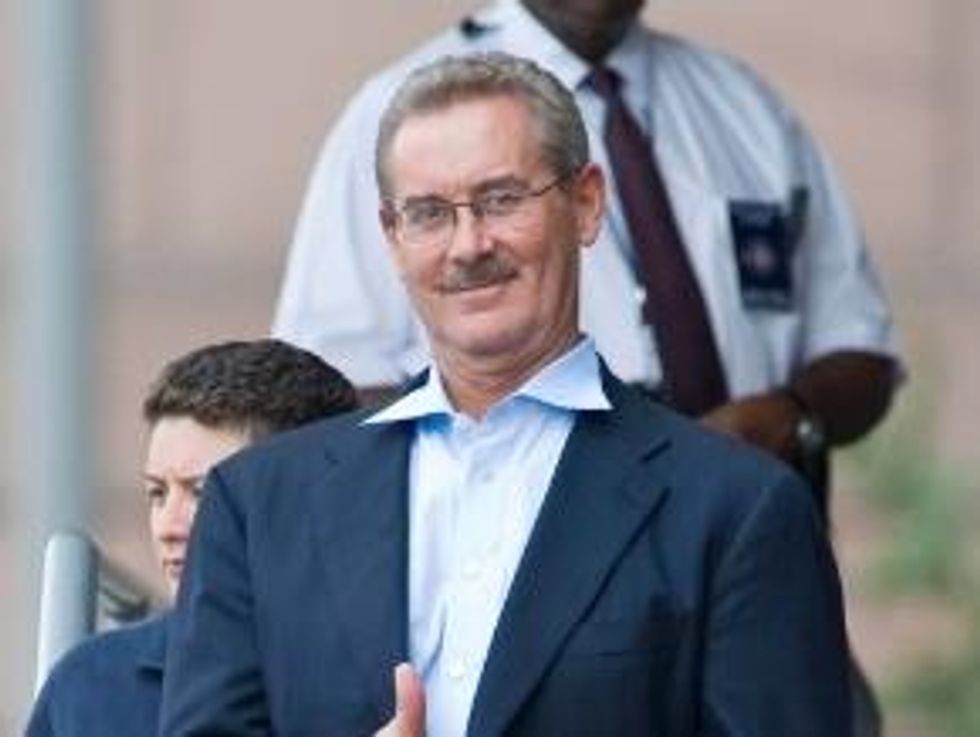
The jury decision followed a six-week trial and came three years after Mr. Stanford was accused of defrauding nearly 30,000 investors in 113 countries in a Ponzi scheme involving $7 billion in fraudulent high-interest certificates of deposit at the Stanford International Bank, which was based on the Caribbean island of Antigua.
Media accounts of Stanford's conviction were filled with stories of his excesses -- mansions, private yachts and jets, and so much money invested in Antigua -- including bribes -- the small island awarded him a knighthood. Among his other indulgences, noted the Reuters news service: "He bought a castle in Florida for one of his girlfriends and his oldest daughter lived in a million-dollar condominium in Houston. He wore custom-made suits and bankrolled a $20 million prize for an international cricket tournament."
But what most of this week's stories failed to mention was the large amount of his clients' cash that was spent on campaign contributions, greasing the corrupt nexus of money and politics for personal gain. Hundreds of thousands of dollars were given to candidates, including Barack Obama, John McCain, John Boehner and Harry Reid; as well as national fundraising committees for the Republican and Democratic parties. The court-appointed receiver charged with returning money to Stanford's investors is trying to get the contributions back. And the committees are resisting.
We first reported on Stanford's political wheeling-and-dealing three years ago on Bill Moyers Journal:
"He bankrolled junkets to [Antigua's] balmy shores for several members of Congress including Texas Republican Senator John Cornyn and New York Democratic Congressman Charlie Rangel, [then] chair of the powerful House Ways and Means Committee. Stanford partied with Nancy Pelosi and Bill Clinton at the Democratic National Convention last summer. And when Tom DeLay was still House Majority Leader, he flew the friendly skies in Stanford's private jet 16 times in three years, including a trip to Houston for DeLay's arraignment on money-laundering charges. I am not making this up!
Sir Allen also showered millions of dollars on political campaigns; much of it in the very year Congress was debating a bill to curb financial fraud. Two of the biggest recipients were Democratic Senator Bill Nelson and Republican John McCain, one of the original Keating Five. Three key Democrats on the Senate Banking Committee got checks from Stanford, too. Surprise, surprise --the reform bill never got out of the Senate."
The non-partisan Center for Responsive Politics elaborated on its Open Secrets blog:
Between its PAC and its employees, Stanford Financial Group has given $2.4 million to federal candidates (including both candidate committees and leadership PACs), parties and committees since 2000, with 65 percent of that going to Democrats. Stanford and his wife, Susan, have given $931,100 out of their own pockets, with 78 percent going to Democrats...
The company gave the most during the 2002 election cycle, when Congress was debating the Financial Services Antifraud Network Act, a bill that would have created a computer network linking the databases of state and federal banking, securities and insurance regulators to curb financial fraud. Lobbying reports indicate that Stanford Financial Group lobbied on the bill, which the House passed but the Senate did not.
On February 13, Murray Waas of Reuters reported, "The court-appointed receiver charged with returning money to Stanford investors obtained a federal court order last June against five Democratic and Republican campaigns. But they haven't returned the money. The Democratic Senatorial Campaign Committee received $950,500; the National Republican Congressional Committee (NRCC), $238,500; the Democratic Congressional Campaign Committee, $200,000; the Republican National Committee $128,500, and the National Republican Senatorial Committee (NRSC) $83,345."
House Speaker Boehner, Senate Majority Leader Reid, Senator McCain and some others already have returned their contributions, but Waas writes, "the roughly $154,000 recovered from elected officials is a fraction of the $1.8 million missing." Others, including President Obama, turned money over to charity -- $4,600 in Obama's case, received directly from Allen Stanford in 2008. Nonetheless, the receivership has asked the Obama campaign to turn the same amount back to investors, and Waas adds, "The total may be as high [as] $31,000 when Stanford's contributions to Obama's other campaign committees are included, along with money from senior Stanford executives, and the Stanford Financial Group's now-defunct PAC, according to campaign finance records and an analysis by the Center for Responsive Politics."
Kevin Sadler, lead counsel for the receivership, told Reuters, "The money was never theirs to begin with," and that taking Stanford's campaign contributions was akin to someone being given cash by "a guy who goes into a Seven Eleven and robs the store."
The national campaign committees are appealing to a higher court a federal judge's order to return Stanford's donations.
We spoke with Kevin Sadler, who said that in the meantime, a federal district judge has just ordered the committees to pay the receivership $370,000 in legal fees, with another $120,000 in fees to come if their appeal is unsuccessful, and yet another $275,000 if the committees take the case to the Supreme Court and lose.
"In light of this," Sadler told us, "and the Stanford guilty verdict, it is a puzzling act of bi-partisanship that all the political committee defendants persist in their fight against the receiver."
Will the Wall Street Occupiers morph into a movement that has as much impact on the Democratic Party as the Tea Party has had on the GOP? Maybe. But there are reasons for doubting it.
Tea Partiers have been a mixed blessing for the GOP establishment - a source of new ground troops and energy but also a pain in the assets with regard to attracting independent voters. As Rick Perry and Mitt Romney square off, that pain will become more evident.
Will the Wall Street Occupiers morph into a movement that has as much impact on the Democratic Party as the Tea Party has had on the GOP? Maybe. But there are reasons for doubting it.
Tea Partiers have been a mixed blessing for the GOP establishment - a source of new ground troops and energy but also a pain in the assets with regard to attracting independent voters. As Rick Perry and Mitt Romney square off, that pain will become more evident.
So far the Wall Street Occupiers have helped the Democratic Party. Their inchoate demand that the rich pay their fair share is tailor-made for the Democrats' new plan for a 5.6 percent tax on millionaires, as well as the President's push to end the Bush tax cut for people with incomes over $250,000 and to limit deductions at the top.
And the Occupiers give the President a potential campaign theme. "These days, a lot of folks who are doing the right thing aren't rewarded and a lot of folks who aren't doing the right thing are rewarded," he said at his news conference this week, predicting that the frustration fueling the Occupiers will "express itself politically in 2012 and beyond until people feel like once again we're getting back to some old-fashioned American values."
But if Occupy Wall Street coalesces into something like a real movement, the Democratic Party may have more difficulty digesting it than the GOP has had with the Tea Party.
After all, a big share of both parties' campaign funds comes from the Street and corporate board rooms. The Street and corporate America also have hordes of public-relations flacks and armies of lobbyists to do their bidding - not to mention the unfathomably deep pockets of the Koch Brothers and Dick Armey's and Karl Rove's SuperPACs. Even if the Occupiers have access to some union money, it's hardly a match.
Yet the real difficulty lies deeper. A little history is helpful here.
In the early decades of the twentieth century, the Democratic Party had no trouble embracing economic populism. It charged the large industrial concentrations of the era - the trusts - with stifling the economy and poisoning democracy. In the 1912 campaign Woodrow Wilson promised to wage "a crusade against powers that have governed us ... that have limited our development ... that have determined our lives ... that have set us in a straightjacket to so as they please." The struggle to break up the trusts would be, in Wilson's words, nothing less than a "second struggle for emancipation."
Wilson lived up to his words - signing into law the Clayton Antitrust Act (which not only strengthened antitrust laws but also exempted unions from their reach), establishing the Federal Trade Commission (to root out "unfair acts and practices in commerce"), and creating the first national income tax.
Years later Franklin D. Roosevelt attacked corporate and financial power by giving workers the right to unionize, the 40-hour workweek, unemployment insurance, and Social Security. FDR also instituted a high marginal income tax on the wealthy.
Not surprisingly, Wall Street and big business went on the attack. In the 1936 campaign, Roosevelt warned against the "economic royalists" who had impressed the whole of society into service. "The hours men and women worked, the wages they received, the conditions of their labor ... these had passed beyond the control of the people, and were imposed by this new industrial dictatorship," he warned. What was at stake, Roosevelt thundered, was nothing less than the "survival of democracy." He told the American people that big business and finance were determined to unseat him. "Never before, in all our history, have these forces been so united against one candidate as they stand today. They are unanimous in their hate for me, and I welcome their hatred!"
By the 1960s, though, the Democratic Party had given up on populism. Gone from presidential campaigns were tales of greedy businessmen and unscrupulous financiers. This was partly because the economy had changed profoundly. Postwar prosperity grew the middle class and reduced the gap between rich and poor. By the mid-1950s, a third of all private-sector employees were unionized, and blue-collar workers got generous wage and benefit increases.
By then Keynesianism had become a widely-accepted antidote to economic downturns - substituting the management of aggregate demand for class antagonism. Even Richard Nixon purportedly claimed "we're all Keynesians now." Who needed economic populism when fiscal and monetary policy could even out the business cycle, and the rewards of growth were so widely distributed?
But there was another reason for the Democrats' increasing unease with populism. The Vietnam War spawned an anti-establishment and anti-authoritarian New Left that distrusted government as much if not more than it distrusted Wall Street and big business. Richard Nixon's electoral victory in 1968 was accompanied by a deep rift between liberal Democrats and the New Left, which continued for decades.
Enter Ronald Reagan, master storyteller, who jumped into the populist breach. If Reagan didn't invent right-wing populism in America he at least gave it full-throated voice. "Government is the problem, not the solution," he intoned, over and over again. In Reagan's view, Washington insiders and arrogant bureaucrats stifled the economy and hobbled individual achievement.
The Democratic Party never regained its populist footing. To be sure, Bill Clinton won the presidency in 1992 promising to "fight for the forgotten middle class" against the forces of "greed," but Clinton inherited such a huge budget deficit from Reagan and George H.W. Bush that he couldn't put up much of a fight. And after losing his bid for universal health care, Clinton himself announced that the "era of big government" was over - and he proved it by ending welfare.
Democrats have not been the ones to engage in class warfare. That was the distinct product of right-wing Republican populism. Anybody recall the Republican ad in the 2004 presidential election describing Democrats as a "tax-hiking, government spending, latte-drinking, sushi-eating, Volvo-driving, New York Times-reading, body-piercing, Hollywood-loving, left-wing freak Show?"
Republicans repeatedly attacked John Kerry as a "Massachusetts liberal" who was part of the "Chardonnay-and-brie set." George W. Bush mocked Kerry for finding a "new nuance" each day on Iraq - drawing out the word "nuance" to emphasize Kerry's French cultural elitism. "In Texas, we don't do nuance," he said, to laughter and applause. House Republican leader Tom DeLay opened his campaign speeches by saying "Good morning or, as John Kerry would say, Bonjour."
The Tea Party has been quick to pick up the same class theme. At the Conservative Political Action Conference of 2010, Minnesota Governor Tom Pawlenty attacked "the elites" who believe Tea Partiers are "not as sophisticated because a lot of them didn't go to Ivy League Schools" and "don't hang out at ... Chablis-drinking, Brie-eating parties in San Francisco." After his son Rand Paul was elected for Kentucky's Senate seat that May, Congressman Ron Paul explained that voters want to "get rid of the power people who run the show, the people who think they're above everyone else."
Which brings us to the present day. Barack Obama is many things but he is as far from left-wing populism as any Democratic president in modern history. True, he once had the temerity to berate "fat cats" on Wall Street, but that remark was the exception - and subsequently caused him endless problems on the Street.
To the contrary, Obama has been extraordinarily solicitous of Wall Street and big business - making Timothy Geithner Treasury Secretary and de facto ambassador from the Street; seeing to it that Bush's Fed appointee, Ben Bernanke, got another term; and appointing GE Chair Jeffrey Immelt to head his jobs council.
Most tellingly, it was President Obama's unwillingness to place conditions on the bailout of Wall Street - not demanding, for example, that the banks reorganize the mortgages of distressed homeowners, and that they accept the resurrection of the Glass-Steagall Act, as conditions for getting hundreds of billions of taxpayer dollars - that contributed to the new populist insurrection.
The Wall Street bailout fueled the Tea Party (at the Utah Republican convention that ousted incumbent Republican Senator Robert Bennett in 2010, the mob repeatedly shouted "TARP! TARP! TARP!"), and it surely fuels some of the current fulminations of Occupy Wall Street.
This is not to say that the Occupiers can have no impact on the Democrats. Nothing good happens in Washington - regardless of how good our president or representatives may be - unless good people join together outside Washington to make it happen. Pressure from the left is critically important.
But the modern Democratic Party is not likely to embrace left-wing populism the way the GOP has embraced - or, more accurately, been forced to embrace - right-wing populism. Just follow the money, and remember history.
The Washington Post Editors work in a city and live in a nation in which huge numbers of poor and minority residents are consigned to cages for petty and trivial transgressions of the criminal law -- typically involving drugs -- and pursuant to processes that are extremely tilted toward the State. Post Editors virtually never speak out against that, if they ever have. But that all changes -- that indiffere
The Washington Post Editors work in a city and live in a nation in which huge numbers of poor and minority residents are consigned to cages for petty and trivial transgressions of the criminal law -- typically involving drugs -- and pursuant to processes that are extremely tilted toward the State. Post Editors virtually never speak out against that, if they ever have. But that all changes -- that indifference disappears -- when political elites are targeted for prosecution, even for serious crimes:
IN COMMUTING I. Lewis Libby's prison sentence yesterday, President Bush took the advice of, among others, William Otis, a former federal prosecutor who wrote on the opposite page last month that Mr. Libby should neither be pardoned nor sent to prison. We agree that a pardon would have been inappropriate and that the prison sentence of 30 months was excessive. . . . Add to that Mr. Libby's long and distinguished record of public service, and we sympathize with Mr. Bush's conclusion "that the prison sentence given to Mr. Libby is excessive."
The Post Editors, October 27, 2007:
The biggest sticking point [in agreeing to a new FISA bill] concerns the question of retroactive immunity from lawsuits for communications providers that cooperated with the administration's warrantless surveillance program. As we have said, we do not believe that these companies should be held hostage to costly litigation in what is essentially a complaint about administration activities.
The Post Editorial Page Editor Fred Hiatt, August 30, 2009:
[T]his is also a nation where two political parties compete civilly and alternate power peacefully. Regimes do not seek vengeance, through the courts or otherwise, as they succeed each other. Were Obama to criminally investigate his predecessor for what George W. Bush believed to be decisions made in the national interest, it could trigger a debilitating, unending cycle. . . . There is a better, though not perfect, solution, one that the administration reportedly considered, rejected and should consider again: a high-level, respected commission to examine the choices made in the wake of Sept. 11, 2001, and their consequences. . . . The alternative, for Obama, is a series of debilitating revelations, prosecutions and arguments that could drip-drip-drip through the full length of his presidency.
The Post Editors, November 28, 2010:
THERE IS LITTLE DOUBT that former House majority leader Tom DeLay (R-Tex.) schemed to get around a Texas law prohibiting corporate contributions to political campaigns . . . .Mr. DeLay's conduct was wrong. It was typical of his no-holds-barred approach to political combat. But when Mr. DeLay, following the conviction, assailed "the criminalization of politics," he had a fair point.
The Post Editors, June 3, 2011:
LET'S STIPULATE: There are very likely good grounds to prosecute deposed Egyptian ruler Hosni Mubarak. . . . The decision by Egypt's ruling military council and state prosecutors to begin a trial of the former strongman on Aug. 3 -- before the country holds its first democratic elections -- is nevertheless a mistake.
[W]e would not be particularly troubled by the effort to impose a fine [onJohn Edwards]. But a criminal case based on this novel application of the law goes too far. . . . Mr. Edwards is a cad, to put it mildly. His deplorable conduct would appear to have ended a once promising political career. It is troubling that the Justice Department would choose to devote its scarce resources to pursuing this questionable case.
In some of these cases (Libby, Mubarak), the Post couches its defense of political elites in terms of concerns about the process while claiming they're receptive to the possibility of punishment. In others (Edwards), the concerns they raise are not invalid. But whatever else is true, Post Editors are deeply and almost invariably disturbed when political elites are subjected to criminal accountability for their wrongful acts, but wholly indifferent -- if not supportive -- when ordinary Americans are mercilessly prosecuted for far less serious wrongdoing.
And it's not just Post Editors, but their stable of Op-Ed columnists, who reflexively defend political elites when they break the law. The late Dean of the Washington Press Corps, David Broder, was one of the first and most vocal advocates of one of the earliest expressions of elite immunity: Gerald Ford's pardon of Richard Nixon, and Broder repeated that defense in 2006 upon Ford's death ("I thought and wrote at the time that he was well justified to spare the country further struggling with the Nixon legacy"). The Post's Broder also vigorously defended President Obama's decision to oppose prosecution of Bush officials: "he was just as right to declare that there should be no prosecution of those who carried out what had been the policy of the United States government. And he was right when he sent out his chief of staff, Rahm Emanuel, to declare that the same amnesty should apply to the lawyers and bureaucrats who devised and justified the Bush administration practices."
Read the rest of the article at Salon...
Early this month, when John Boehner was sworn in as the new speaker of the House of Representatives, he tipped his hat to the teabag activists across the country who had fueled the Republican takeover of the chamber last fall. He almost choked up as he promised to "give the government back to the American people."
Boehner was not choking back tears, however, he literally was choking on the flagrant hypocrisy of his words. You see, the people he's giving the government back to are not tea partiers, but the rapacious corporate lobbyists who ran the Congress during the years when former Majority Leader Tom DeLay ran the show. Apparently, the name "Boehner" is derived from an ancient Teutonic word meaning: business as usual.
Throughout his two decades in Congress, the new speaker has been a reliable ally of corporate interests. In recent years, he has formed unusually tight legislative, political and even social ties with a group of lobbyists for such giants as Citigroup, Coors, Goldman Sachs, Google and R.J. Reynolds.
Of course, most congressional leaders work with lobbyists, so that's not odd, but to have them also be his closest friends and social chums - well, you just want to say, "For heaven's sake, Johnnie, get a life!"
These influence peddlers are now the speaker's inner circle, guiding his legislative decisions. Even before last November's election, Boehner had a private meeting with a flock of top corporate lobbyists to help shape "a new GOP agenda." Forget the tea party. No tea party operative is a Boehner insider. It's the corporate agenda that Republican leaders will be pushing, and to make sure that it stays on track, Boehner has hired a top corporate lobbyist to be his policy director.
So, while tea party regulars are giddy with the thought that their movement took over the U. S. House, they were actually a Trojan horse.
They delivered the votes to make Boehner speaker, which allowed the corporate powers to move inside, quietly take over and return Congress to business as usual.
On opening day of the 112th Congress, beaming members of the new Republican majority entered the House chamber, accompanied by their proud families. But the moment did not belong to members alone.
Also entering the Capitol for the swearing-in ceremonies was David Koch, the multibillionaire industrialist and laissez-faire extremist who bankrolled much of the tea party/GOP victory last fall. What symbolism! The members were taking office, but Koch and his corporate agenda were taking power.
Indeed, many lobbyists for Wall Street banks and big corporations have been hired as top legislative aides for Republican members. As Rep. John Campbell put it, "You want someone with experience." Yeah, experience in corporatizing our government.
In fact, some of the most powerful lawmakers in the House are simply handing their power to corporate interests. For example, Rep. Spencer Bachus of Alabama, the new chairman of the Wall Street oversight committee, declared that his role is to "serve the banks."
The chief comforter of corporate crybabies, however, is Rep. Darrell Issa of California, chair of the wide-ranging government reform committee. He sent letters to 150 corporate interests, asking them to tell him if Obama and his Democratic meanies have imposed any consumer, worker or environmental protections that should be undone. That's like asking a barber if you need a haircut!
The letters unleashed an outpouring of corporate whining - big banks, for example, wailed that their ability to gouge customers with rip-off debit-card fees had been curtailed. There, there, Issa said soothingly, I'm here now. I'll make it all better for you.
Under the guise of giving government back to the people, the House majority is giving it to the corporate powers who finance their campaigns. This is not just business as usual, it's business way more than usual.
For once, I actually agree with something that with Tom DeLay said. The former Republican leader of Congress recently declared in his most somber tone, "The criminalization of politics undermines our very system." Wow, so true, Tommy.
Of course, what I mean by the "criminalization of politics" is very different than what he means. DeLay was bemoaning the stunning fact that a Texas jury had just convicted him on two felony counts of money laundering. He wailed that he was a victim of a political vendetta by Texas Democrats, calling his prosecution "an abuse of power."
Amazing. Here's a guy who became Congress' most powerful member by blatantly using his position of public trust to broker campaign cash from a myriad of corporations in exchange for passing their legislation. He went on worldwide golfing junkets with lobbyists aboard corporate jets, plotted legislative strategy with disgraced lobbyist Jack Abramoff, enjoyed lavish meals on the corporate tab, and collected millions of dollars for the GOP's campaign coffers from lobbyists, all while moving the special-interest agenda of his corporate benefactors through Congress.
Yet, he's whining about "an abuse of power"?
Yes, Tom, politics has been criminalized. It's been turned into a criminal enterprise funded by corporations for corporations. Reprobate politicos like you have turned the People's House into a shameful pay-to-play parlor.
DeLay was so good at hitting up corporate lobbyists for money, then pounding their wish list into law, that he was nicknamed "The Hammer." But now, The Hammer's been nailed--not by Democrats, but by a jury of 12 common citizens, whom his own hot-shot lawyers helped select. These honest people diligently sifted through reams of evidence and ultimately saw him for what he is: a felon.
Tom DeLay, a once-upon-a-time Republican powerhouse, has accumulated an unusual assortment of nicknames in his professional life. As a Texas legislator in the 1980s, he was known as "Hot Tub Tommy," a do-nothing member who preferred partying to lawmaking.
When he went to Congress, however, he was a man on a mission. The former owner of a pest control business, DeLay distinguished himself as a frequent and hyperbolic ranter against EPA regulations, even calling the environmental agency the Gestapo of government. His colleagues laughingly dubbed him "The Exterminator."
Then he found his real calling in politics, becoming an ethics-free floor leader who unabashedly demanded campaign cash for the GOP from corporate lobbyists -- in exchange for moving their legislation. His pay-to-play demands were as subtle as a sledgehammer, but they worked, making him the most powerful and feared member of Congress in the first half of this decade. This earned him another sobriquet: "The Hammer."
The only thing fiercer than the The Hammer's power was his cosmic-scale arrogance. "I AM the federal government," he once barked to a waitress who had requested that he comply with a federal no-smoking rule.
With an ego more voracious than a black hole, DeLay hit upon a dandy idea in 2001 to suck up more power for himself, his party and his corporate co-conspirators. "I'll just run down to Texas," he exclaimed in a eureka moment, "and unilaterally force the legislature to gerrymander the state's congressional districts."
By dictating a crassly partisan re-redistricting of the Lone Star State, he could force six Democrats out of Congress and replace them with Republicans, thereby tightening his grip on the sausage grinder of Washington lawmaking.
To get this dirty deed done, however, he first had to help Texas Republicans win a handful of state legislative seats in the 2002 elections so they could take control of the legislature. No problem -- he simply hammered Sears, Reliant Energy, AT&T and others to put up the $190,000 it took to win those races and take charge.
But there was one little hickey: Texas law bans corporate contributions in state campaigns. Again, no problem -- DeLay and cohorts merrily funneled the corporate cash into the Republican National Committee, which dutifully passed it along to the designated Texas candidates as "legal" donations.
That would have been that, except -- whoopsie daisy -- three forces interrupted Tom's flight of hubris. One was Texas for Public Justice, a feisty research group in Austin that tracks the nefarious nexus of corporate power and public policy. In October of 2002, TPJ noticed that the RNC had taken $190,000 from DeLay's group, then turned around and doled $190,000 to the Texas candidates. Coincidence? TPJ thought not.
Next came Ronnie Earle, the district attorney in Austin with jurisdiction over state electioneering crimes. TPJ asked Earle to investigate. The DA was promptly and loudly advised by both friends and foes to let this political hot potato be. Instead, the day after that 2002 election, Earle picked up the steaming spud, daring to challenge the mighty Hammer.
After three years of political smack and legal dodging by DeLay and his blue-ribbon lawyers, the Little-DA-Who-Could won an indictment against DeLay for money laundering and conspiracy.
Third, after five more years of squealing and squirming by DeLay & Team, the trial finally began on Nov. 1 of this year, and Tom found himself face to face with 12 ordinary citizens he couldn't buy or intimidate: a jury of his peers. Still, throughout the three-week trial, DeLay was cockier than a banty rooster, crowing to the media that there was no way he could be convicted.
At 4:45 p.m. on Thanksgiving eve, however, his crowing stopped. After three days of deliberations, the jurors nailed the Hammer, voting unanimously to convict him on both charges.
As each of the 12 stood to affirm their vote, DeLay was visibly stunned, unable to comprehend that someone of his importance could be treated just like a regular thief.
He'll appeal their judgment, of course, but he'll never escape the final nickname that he has earned: Tom DeLay, "The Felon."