

SUBSCRIBE TO OUR FREE NEWSLETTER
Daily news & progressive opinion—funded by the people, not the corporations—delivered straight to your inbox.
5
#000000
#FFFFFF
To donate by check, phone, or other method, see our More Ways to Give page.
Daily news & progressive opinion—funded by the people, not the corporations—delivered straight to your inbox.
"Conservatives are jumping at the opportunity to take from you and give more to CEOs," said the head of Canada's social democratic political party. "You will pay the price of Poilievre's cuts."
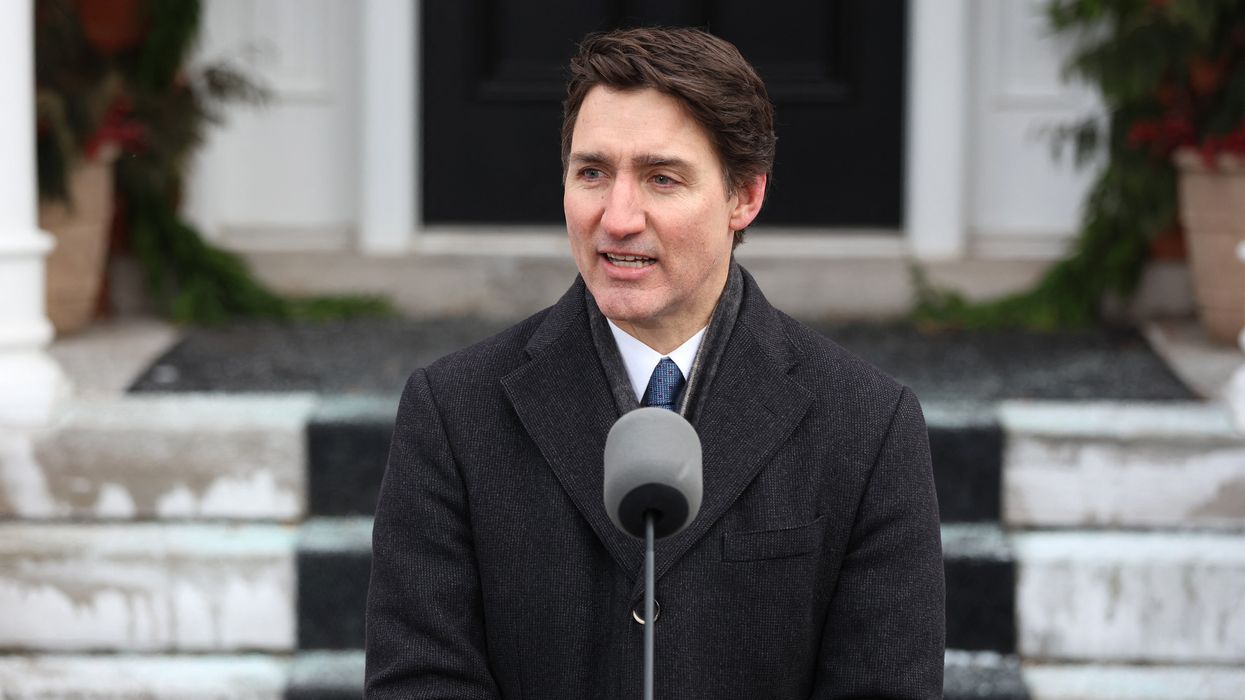
After nearly a decade leading the Canadian government, Prime Minister Justin Trudeau announced Monday that he will resign after his center-right Liberal Party selects a new leader—acquiescing to calls that he should make way for new leadership ahead of a federal election later this year.
Speaking to reporters in Ottawa, Trudeau said "I care deeply about this country and I will always be motivated by what is in the best interests of Canadians. And the fact is, despite best efforts to work through it, parliament has been paralyzed for months after what has been the longest session of a minority parliament in Canadian history." He also added that the country's parliament will be suspended until the end of March while a new leader is chosen.
Trudeau's announcement comes as he faces declining public opinion polling, President-elect Donald Trump's threat of 25% tariffs on Canadian imports, and the departure of the Deputy Prime Minister and Finance Minister Chrystia Freeland less than a month ago.
In her strongly worded resignation letter in December, Freeland wrote that Trudeau had told her he no longer wanted her to serve as finance minister and that she and Trudeau had found themselves "at odds" over the best way forward for Canada.
"The incoming administration in the United States is pursuing a policy of aggressive economic nationalism, including a threat of 25% tariffs. We need to take that threat extremely serious. That means keeping our fiscal powder dry today," Freeland wrote. She also warned against "costly political gimmicks" that the country could "ill afford."
Freeland and Trudeau were reportedly in disagreement over some of the prime minister's proposed policies to tackle the country's cost-of-living crisis. The resignation was followed by calls from across the political spectrum for Trudeau to resign.
That is not the first time Trudeau has faced significant calls to step down in the past 6 months. In October, at a closed-door caucus meeting, Liberal Party members urged him to resign to avoid diminishing the party's chances in the next election.
Jagmeet Singh, the head of Canada's New Democratic Party—a social democratic political party that is to the left of the Liberals—reacted to Trudeau's resignation, writing "Justin Trudeau has let you down, over and over. He let you down on the cost of groceries. He let you down on fixing health care. It doesn't matter who leads the Liberals. They don't deserve another chance."
"Conservatives are jumping at the opportunity to take from you and give more to CEOs," he continued. "You will pay the price of [Conservative Party leader Pierre] Poilievre's cuts."
Polling shows that Poilievre, who has aligned himself with U.S. President-elect's far-right brand of politics, would likely win a majority government elections were held today.
MP Niki Ashton, an NDP lawmaker representing parts of Manitoba, also didn't mourn Trudeau's exit but warned about a Conservative government and the "anti-worker" agenda of Poilievre.
"Trudeau is finished," Ashton said, describing the Liberal leader as one "who only helped people when forced to by the NDP."
"But we know, Poilievre will be a disaster," she added. "We can't let that happen."
With Trudeau out, the Liberal Party must now select an interim leader, followed by.a leadership race to find a permanent replacement, which is expected to feature Freeland. A federal election must be held by October 20, 2025, but could be held sooner if a snap election is called.
Trump reacted to the news of Trudeau's resignation on Truth Social by saying that if Canada merged with the United States then the country would be free from tariffs, taxes would decrease, and it would be secure from what he claimed were threats from China and Russia. "Together, what a great Nation it would be!!!" he wrote.
No one is immune to the impacts of plastic pollution, and we are running out of time.
To the Biden Administration,
Wrapping up the penultimate round of negotiations for a global plastics treaty, the United States Delegation has so far refused to commit to the essential solution to tackle the plastic pollution crisis: global, legally binding, and timebound commitments to reduce plastic production. While the U.S. has now acknowledged that the “lifecycle” of plastic begins with fossil fuel extraction, it has offered no clear plan to address the accumulation of plastics in human bodies and in our shared environment. It has also failed to confront the acute, sustained, and systemic upstream impacts to communities who are overburdened by extraction and the toxic production of plastic precursors and feedstocks.
Further, despite a broad array of existing U.S. laws, including the Clean Air Act, the Clean Water Act, and the Toxic Substances Control Act that empower U.S. negotiators to take a truly ambitious stance, the U.S. Delegation continues to downplay the regulatory authorities of relevant agencies in order to push for an ambitious treaty. So far, the U.S. positions resort to the lowest-common-denominator — an approach that bears far more in common with that of high-powered petrostates like Iran, Russia, and Saudi Arabia than of the larger international community of which the U.S. claims to be a leader.
Every day, frontline communities across the U.S. suffer the impacts of plastic pollution at every stage of the plastic “lifecycle,” and every human in the country and around the world faces mounting exposures to plastic threats. Moral, legal, and scientific obligations demand this problem be tackled at the source. Yet U.S. negotiators continue over-emphasizing failed waste management and recycling schemes, peddling a so-called “circular economy of plastics.” This approach will only accelerate the circulation of thousands of harmful, toxic chemicals in plastics, and continue polluting the environment and our bodies. Only promoting demand-side measures is absurd when it is abundantly clear that the only way to address the plastics crisis is through production reduction.
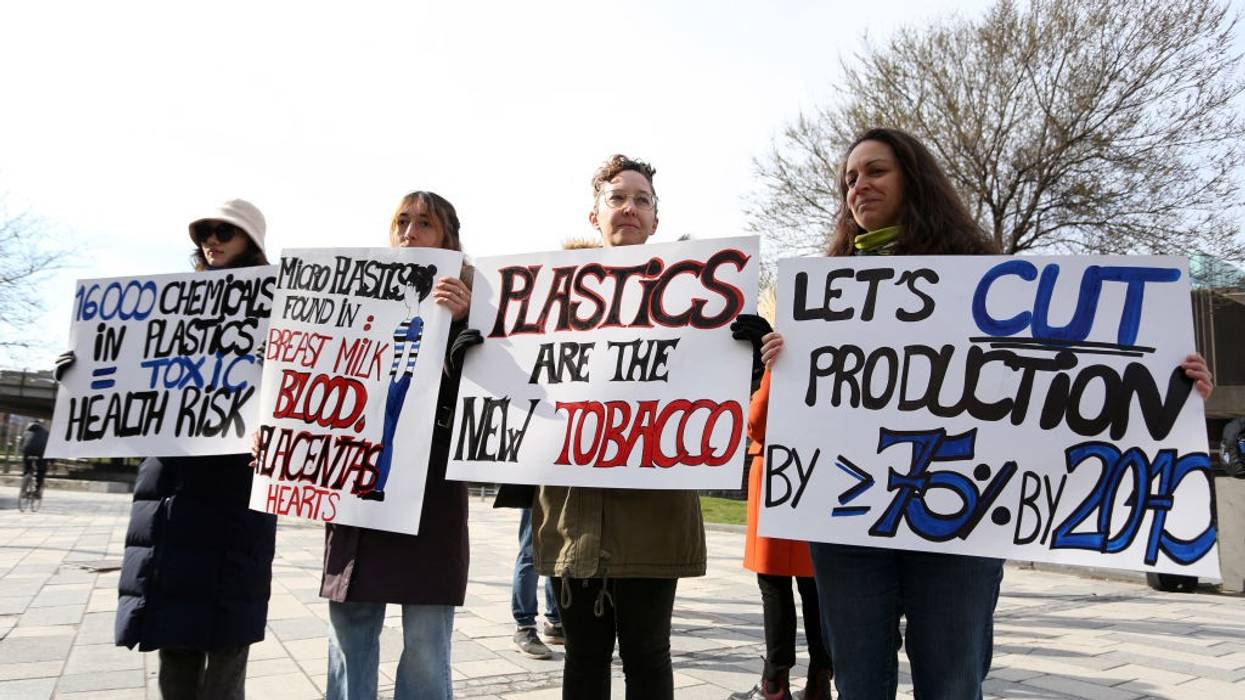
Meanwhile, scientific reports continue to pile up, bearing evidence that these chemicals leach from microplastics, now found in human blood, lungs, stool, placentas, semen, and breast milk, and most recently and troublingly, in human cancer cells. Nor is the threat from plastics limited to human health, human rights, or biodiversity. A recent report from DOE’s Lawrence Berkeley Laboratory demonstrates yet again the critical need to reduce plastic production to meet the 1.5 degrees Celsius climate change imperative.
It is extremely disappointing to see the U.S. Delegation to these vital talks continue to push a position that undermines this administration’s commitments and goals on climate and environmental justice. The current negotiating position of the U.S. would enable the plastics industry to keep expanding production capacity—often incentivized by federal subsidies and tax breaks. This would deepen environmental injustice for communities living on the frontline, and accelerate the climate crisis, extinguishing any hope of remaining beneath 1.5 degrees Celsius or stopping the proliferation of toxic chemicals in our air, water, and soil.
As the world’s largest consumer and exporter of plastic waste, purporting to recognize the severity of the crisis, the U.S. must act decisively on these imperatives rather than negotiating an ineffective treaty that will sacrifice the public health and human rights of all to the interests of the fossil fuel and petrochemical industries. At the very least, it is imperative that the U.S. Delegation to the Global Plastic Treaty:
Frontline groups have repeatedly invited the U.S. State Department and relevant federal agency representatives to travel to communities to witness firsthand the devastating impacts of plastic producing petrochemical plants and the environmental injustice they represent. We invite the President and other senior administration officials to visit, as well. Community leaders are subject matter experts in petrochemical and plastics production and expansion effects, and their lived experiences must be centered in these negotiations.
These treaty negotiations represent a monumental opportunity for the world and the administration. Over 80% of Americans understand that plastic pollution is a major crisis and overwhelmingly support measures to reduce plastic production. But at this stage, the Biden Administration and the U.S. Delegation that implements its orders are failing to provide the leadership necessary to confront the greatest public health crises of our time. If the Biden Administration is serious about leading on climate and environmental justice, then it must prioritize public health and human rights over the interests of the fossil fuel and petrochemical industries.
No one is immune to the impacts of plastic pollution, and we are running out of time.
Break Free From Plastic US
To turn the political tide in Ottawa, we need to take a lesson from the first Earth Day when grassroots activism in the form of 20 million people taking to the streets sparked the first generation of environmental laws.
This year Earth Day, April 22, marks the start of the fourth round of negotiations for a Global Plastics Treaty. Without much public fanfare, delegates from 175 countries—together with hundreds of observers representing industry, academia, health organizations, and environmental groups—will gather in Ottawa to chart the course for the future of plastics and plastic pollution.
The stakes could not be higher.
Plastics have been linked to serious health problems, including cancer, lung disease, and birth defects. Recently researchers found that individuals with heart disease that had microplastics—those tiny particles that pervade our environment—in their tissue had twice the risk of suffering a heart attack or stroke or death within three years. Babies, because of their increased exposure to plastics and vulnerability, are especially at risk.
The details of the potentially influential U.S. position remain undeclared—ironically when the administration is touting its leadership in addressing climate change and promoting environmental justice.
Humans are not the only ones in danger—more than 1 million marine creatures are estimated to be killed by plastics in garbage each year. Eleven million metric tons of plastic waste are flowing into the ocean each year. The World Health Organization report, Tobacco: Poisoning Our Planet, describes the significant risks presented from the 4.5 trillion discarded cigarette butts. Cigarette filters based on cellulose-acetate don’t degrade and continue harming the environment as microplastics that circulate in our marine and freshwater systems. They also release nicotine, heavy metals, and other chemicals which threaten not only coastal fishing communities but also those who consume seafood products.
Moreover, plastics are irrefutably fueling the climate change crisis.
Over 90% of plastics are produced from fossil fuels, and 4% of total greenhouse gas emissions are generated in connection with the production, conversion, and waste management of plastics. And plastics-related emissions are projected to more than double by 2060. With low income and communities of color disproportionately located near petrochemical plants, as well plastic production and waste incineration facilities, they are especially at risk for the harmful environmental and health impacts.
The scale of the problem is only expected to grow. Experts predict that global production of thermoplastics will increase to 445.25 million metric tons in 2025 and continue to increase by more than 30% by 2050.
And notwithstanding increasing government bans and regulation of single-use plastic, between 2019 and 2021 there was an increase annually of 6 million tonnes (6.6 million U.S. tons) per year in single-use plastic production.
Contrary to decades of industry promotion, recycling is not the answer to the plastics challenge. According to a comprehensive analysis and report by Greenpeace, even though the industry has been pushing recycling since the 1990’s, “the vast majority of U.S. plastic waste is still not recyclable.” The report further observed a decline in the rate of recycling in the U.S. from a high of 9.5% in 2014 to 5-6% in 2021. Even new recycling technologies, such as chemical recycling, can produce toxic emissions and hazardous waste.
The Global Plastics Treaty negotiations offer a chance to chart a sustainable course for our planet. We are at the crossroads of moving forward with a treaty that will call for significant reductions not only in single-use plastics but also reduce the overall amount of plastics produced and demand full transparency in the industry.
So far, the prospects for a strong treaty are uncertain at best. While the member countries of the High Ambition Coalition are pushing for the restriction and elimination of problematic plastics as well as reporting and transparency provisions to ensure accountability through the value chain, the so-called “Like Minded Group” representing many fossil fuel countries are advocating for a focus on waste management rather than production limits. And despite a letter from six U.S. senators and more than a dozen U.S. House members calling on Secretary of State Antony Blinken to negotiate “the strongest agreement possible” including binding plastic production limits, the details of the potentially influential U.S. position remain undeclared—ironically when the administration is touting its leadership in addressing climate change and promoting environmental justice.
To turn the political tide in Ottawa, we need to take a lesson from the first Earth Day when grassroots activism in the form of 20 million people from all walks of life taking to the streets sparked the creation of the Environmental Protection Agency, and the first generation of environmental laws. With a myriad of media and communication technologies and platforms available today to share your voice (#PlanetvsPlastics, #EndPlastics, #EarthDay, #GlobalPlasticsTreaty), it’s time to demand that our elected leaders forge a treaty that will free us and our planet from the scourge of plastic and plastic pollution.
I'd like to begin by acknowledging that we're on the traditional territory of the Algonquin people.
I'm delighted to be here today with my colleagues from the Canadian Union of Postal Workers, Idle No More, ACORN, and the Canadian Labour Congress, brought together by our allies from Friends of Public Services.
2016 is a leap year; today, February 29th, is Leap Day. We all enjoy the extra day we add to our calendars every four years to align them with the earth's orbit around the sun.
We do this because it's easier to change our human-created systems than to change the laws of nature. In this way, the leap year is a perfect metaphor for the present moment, in which our political and economic systems badly need updating to accommodate the hard realities of our common home, the Earth.
We see the conflicts all around us. In the gap between what scientists tell us we must do to prevent catastrophic warming, and the emission reduction pledges our government has proposed. In the gap between even those inadequate pledges and the actual policies that would get us there.
We see more gaps between the promise of reconciliation with First Nations in Canada and the gross inequities facing Indigenous communities. We see more gaps still, between the values of inclusion and compassion with which so many Canadians identify--and the economic policies that continue to exile many to the margin.
The gaps are huge and they are many. Too many, in fact, to tackle slowly and one at a time. In a time of overlapping crises, we need visionary policies capable of addressing multiple failures at the same time. So, how do we make the leap?
The Proposal
We're here to launch a concrete proposal for what a post-carbon economy could look like in Canada, one that would touch every community in the country. "Delivering Community Power" lays out a vision for post offices with solar panels on the roof, electric chargers outside, and a low-emissions fleet on the roads.
But this is far from cosmetic. Services provided inside would expand to include food delivery, door-knocking on elders' homes, and perhaps most exciting, affordable banking.With this proposal, the post office once again becomes a community space, where you can come in to mail a letter or make a deposit; organize farm-to-table food delivery for your home; get advice and a loan for rooftop solar panels; invest in a community energy project; and buy products from local businesses.
We believe this is no time to further contract public services. But neither is it a moment to simply protect a static status quo.Rather, our moment calls on us to reimagine what is possible.
And we find ourselves at a critical juncture that makes this kind of visionary change both necessary and entirely possible. The Trudeau government is in the process of unleashing billions of dollars of stimulus to Canada's economy, which is suffering thanks to our ill-advised ride on the oil roller coaster.
What we are saying is that every new public dollar we spend has to do more than simply spur random economic activity. Given the pressing nature of the climate crisis, as well as the many social justice fronts on which this government has pledged to act, that money must fuel the transformation of our economy. Of our energy system. Of our public sphere so that it meets all of today's complex needs.
Canada needs more than stimulus money. We need catalyst money--investments thoughtfully designed so that they bring down emissions, while making Canada a fairer and better place to live, particularly for the most vulnerable.
Which is where today's launch comes in. Progressives often get asked: we know what you're against, what are you for? Well, this is it, or a big piece of it. We encourage everyone to take a look.
Six months ago we launched The Leap Manifesto, a bold proposal for how we can transition Canada off fossil fuels in a way that battles systemic inequalities. We called for a transition grounded in "caring for the planet and one another"--and this proposal from Canada's postal workers turns that principle into a concrete vision for how to boldly retrofit one of our most ubiquitous and beloved brick-and-mortar institutions.
Since we launched The Leap, more than 30,000 people and close to 200 organizations have endorsed the document, and today dozens of groups are hosting teach-ins, sit-ins, rallies, community events and solar installations to celebrate the Leap Year. And not just in Canada: from Zagreb to Copenhagen to the Bronx.
We all have the same message for decision-makers: small steps are not enough; it's time for a leap. So let's get to work. Thank you.
Justin Trudeau is fond of saying, "Canada is back," and in some genuinely gratifying ways, this seems to be the case. But by far, the most important and substantive evidence for this claim is still missing: an indication that the new government is willing to seriously address the issue upon which a genuine return to normal rests. That issue is how we recover from nearly twenty years of systematic looting of the national treasury through reckless tax cuts for high-income earners and large corporations.
Don't get me wrong. I feel the same relief as every other Canadian that public scientists can now speak their minds, that Stephen Harper's war-mongering is history, that we are no longer a pariah on the world stage, overnight that there is at least hope that Ottawa will take aboriginal concerns seriously and that ministers with a passion for their portfolios are more likely to deliver the goods.
However, these initiatives are the low-hanging fruit of the "Canada is back" mantra because they do not cost much money. So far, the only commitment to address the enormous social and other deficits over two decades is a modest tax increase for the highest-income earners. Otherwise, the cupboard is bare, and past Liberal governments helped make it so.
To reverse this ideological recklessness, Justin Trudeau must demonstrate an extraordinary challenge to his party's 20-year commitment to smaller government. The jury is out on whether he wants to —and if he does, whether he is up to the task. One thing is certain: without sustained public pressure, Trudeau's Liberals would be content with administering the fiscal status quo they inherited from Harper.
The first test
Their first test is on the table right now. I am referring to a report produced by the group Canadians for Tax Fairness, or C4TF (disclosure: I am on the board), detailing the Harper government's extensive damage to the Canada Revenue Agency (CRA). The report is unprecedented in that it was produced with the cooperation of 28 (current and recently retired) tax auditors, fraud investigators, and managers of the CRA. According to C4TF, many of them had approached the group over recent years with revelations of Conservative changes that weakened the agency's ability to collect revenue owed to the government.
Detailed in the report are several allegations by the employees, including:
The CRA responded to the allegations in the report by quoting high employee satisfaction surveys and identifying plans to increase "large audit" spending by 12 percent.
In terms of lost revenue, the key finding in the report was the government's systematic gutting of the tax division responsible for investigating offshore tax havens and recovering the revenue lost to the resulting tax evasion and avoidance. C4TF estimates that at least $199 billion in Canadian wealth is hidden in tax havens around the world, resulting in the loss of up to $10 billion in revenue annually.
The report calls on the Trudeau government to fundamentally change the CRA's priorities -- away from harassing charities, NGOs, and ordinary taxpayers making errors and onto the wealthy and large corporations where the vast majority of revenue is lost.
The media, however, is not focusing on the billions in lost revenue and the damage done to the CRA detailed in the report, and instead is highlighting the issue of how the 28 CRA employees who gave information have allegedly violated the ethics rules that they agreed to as part of the oath of office they signed. There is whistleblower legislation, but it does not protect employees who openly criticize public policy.
The Ottawa Citizen quoted Donald Savois, an expert in the area, calling on the government to investigate what he sees as a breach of ethics. It should have written an editorial calling for the government to fix the CRA.
Talking the talk
There are some encouraging signs that the government might prioritize the issue, though it comes not from the economic ministries. Foreign Affairs Minister Stephane Dion has made the most encouraging comments: "I'd like to address the global economy. It seems like each time we address a problem, like the circulation of funds, businesses use tax havens and do things in our countries, but they don't pay taxes. It's an enormous problem. Whenever [it comes up], I'm told, 'Well, that's up to the international level to resolve.' I'd like to see what Canada could do."
Dion is an influential minister concerning Trudeau. Still, Finance Minister Bill Morneau will ultimately decide how much of a priority to make of the tax haven issue. He is aware of it and under enormous pressure to find revenue that doesn't require raising taxes, stating: "We're going to work on this issue and other issues, and through that work, we would expect that we'll ensure that Canadians and Canadian businesses both large and small will pay their appropriate rate of tax."
Morneau has already changed Canada's position regarding corporate tax dodging. The practice of transnational corporations of transfer pricing and tax shifting -- shifting profits made in higher tax countries to low tax locations -- robs global governments of between $100 and $240 billion a year. The new government signed an international agreement negotiated by the OECD and the G20 called Base Erosion and Profit Shifting, aimed at forcing corporations to pay taxes in the countries where the profits are made. Canada ranks as the third largest loser in the G20 in terms of the amount of untaxed corporate revenue.
The government's apparent willingness to go after tax cheats -- corporate and individual -- is good news. But this is just one step in terms of achieving tax justice and fairness and in recovering the over $60 billion a year lost through tax cuts. Letting the need for a genuine national conversation about taxes slip to the back burner would be a mistake. Now that we have a government that says it believes in governing, the question of comprehensive progressive tax reform needs to be front and centre.
Update 2:40 EST:
Two people are confirmed dead from Wednesday's shooting.
The Canadian soldier shot while guarding Canada's War Memorial has reportedly died from his injuries. Furthermore, a "male suspect" is confirmed dead.
Police are reportedly searching cars leaving attempting to travel from Ottawa to Quebec and going door to door in downtown Ottawa, where schools remain on lockdown.
"At an afternoon press conference, [Royal Canadian Mounted Police] would not say whether another gunman was believed at large," CBC reports.
CBC continues:
Ottawa Civic Hospital confirmed three people were taken to hospital. Two are stable, and one has a gunshot wound. The hospital was referring calls on the status of the other victim to the Department of National Defence.
Earlier:
Downtown Ottawa buildings are on lockdown after multiple shots were reportedly fired near Parliament and at soldiers guarding Canada's War memorial on Wednesday morning.
Canadian publication rabble.ca reports:
A gunman shot and very seriously wounded a Canadian Forces soldier at the War Memorial in Ottawa at about 10:00 a.m. this morning, Wednesday, October 22.
According to witnesses, the gunman then hijacked a car, without harming the driver, and drove onto Parliament Hill.
There are reports that the gunman then entered the main entrance of the Centre Block of Parliament and shot repeatedly and indiscriminately.
Journalists who were on the scene at the time report that some people there were gravely injured, but there are no details as to the extent of casualties yet.
Marc Soucy of the Ottawa Police said there were "numerous gunmen" responsible for what witnesses say were dozens of shots, according to CNN.
This footage from inside the Parliament Hill building was captured by a Globe & Mail reporter on the scene at the time:
Inside Parliament in Ottawa during 2014 shootingOn October 22, 2014 a gunman opened fire at the War Memorial in Ottawa and then had a shootout with police inside Centre ...
A Canadian soldier has reportedly been struck by gunfire, and further information about this or other injuries was not immediately available.