SUBSCRIBE TO OUR FREE NEWSLETTER
Daily news & progressive opinion—funded by the people, not the corporations—delivered straight to your inbox.
5
#000000
#FFFFFF
To donate by check, phone, or other method, see our More Ways to Give page.
Daily news & progressive opinion—funded by the people, not the corporations—delivered straight to your inbox.
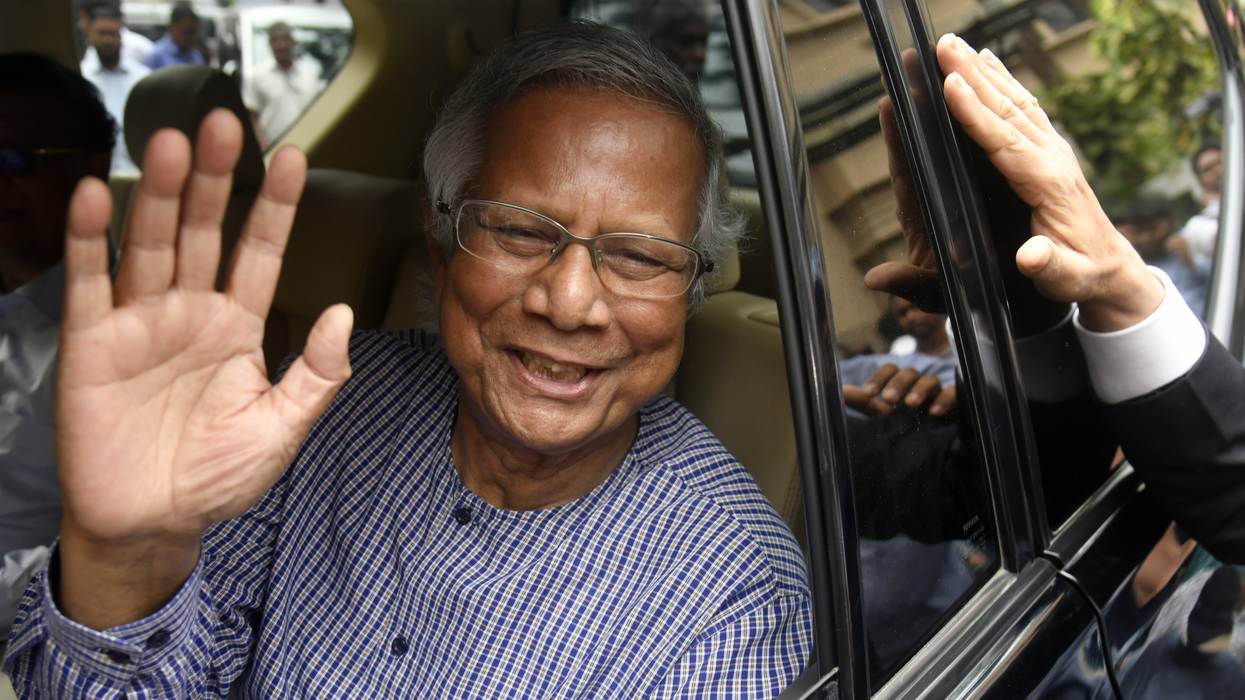
"The courage of this youth is boundless," said the microcredit pioneer known as the banker to the poor. "They have made Bangladesh proud and shown the world our nation's determination against injustice."
The leader of student protests over jobs and economic injustice in Bangladesh in recent weeks said Tuesday that Nobel Peace Prize laureate Muhammad Yunus had accepted the students' call for him to take over the country's interim government, following the resignation of Prime Minister Sheikh Hasina.
A spokesperson for the country's president, Mohammed Shahabuddin, told the Associated Press that Yunus would lead the interim government and that other political leaders would be decided soon.
Yunus, an economist who won the Nobel prize in 2006 for establishing the microcredit institution Grameen Bank, has been called the "banker to the poor" for helping to lift millions of people in Bangladesh out of poverty through small loans.
Nahid Islam, who led the protest movement last month over quotas in government jobs and unemployment, said Tuesday that the movement would not accept a government led by General Waker-uz-Zaman, the chief of army staff who announced on Monday that Hasina had fled the country and stepped down, and who took temporary control of the country.
"We have given our blood, been martyred, and we have to fulfill our pledge to build a new Bangladesh," Islam said. "No government other than the one proposed by the students will be accepted. As we have said, no military government, or one backed by the military, or a government of fascists, will be accepted."
"No government other than the one proposed by the students will be accepted. As we have said, no military government, or one backed by the military, or a government of fascists, will be accepted."
Yunus said he was "honored by the trust of the protesters who wish for me to lead the interim government."
"If action is needed in Bangladesh, for my country and for the courage of my people, then I will take it. The interim government is only the beginning. Lasting peace will only come with free elections. Without elections, there will be no change," said Yunus.
Shahabuddin announced on Tuesday that Parliament had been dissolved and said new elections would soon be held.
The protests began in July in Dhaka, with students outraged over the reinstatement of a job quota policy that reserved 30% of government jobs for descendants of military veterans of Bangladesh's 1971 war for independence from Pakistan—most of whom had ties to Hasina's Awami League party.
About a quarter of jobs were reserved for women, people with disabilities, and ethic minorities, leaving about 3,000 jobs open for 400,000 graduates to compete over.
Bangladesh has a high unemployment rate, with about a fifth of the population of 170 million people out of work, exacerbating anger over the job scheme and economic distress.
Hasina was elected to her fourth term as prime minister in January, but was accused of rigging the election, clamping down on opposition politicians and dissent, and arranging extrajudicial killings. She denied the accusations.
Student protesters took to the streets, chanting, "One, two, three, four, Sheikh Hasina is a dictator."
Police responded by cracking down violently, with more than 180 people killed and hundreds of people hit in the eyes by pellets that security forces deployed—potentially blinding them permanently.
The country's Supreme Court rescinded the job quota policy on July 21, opening jobs to 93% of applicants, but students continued to rally, demanding that Hasina step down.
Yunus expressed pride in the student protesters who led the movement.
"Youth have voiced their need for change in our country," the 84-year-old banker said. "The prime minister heard them by leaving the country. This was a very important first step taken yesterday. The courage of this youth is boundless. They have made Bangladesh proud and shown the world our nation's determination against injustice."
Back from the first global conference on money in politics in Mexico City, I'm bursting with stories that might carry messages of possibility that Americans need right now. Sure worked for me.
In Spain, with one-fifth of its population jobless, the Indignados movement--that paralleled our Occupy-- erupted with protests in 2011. But instead of fading from sight, by early 2014 the Indignados had set the stage for the birth of a new political party: Podemos, "We Can."
In only a few months, Podemos surprised everyone by winning 8 percent of the Spanish vote for the European Parliament, giving it five of 54 Spanish seats. One year later, in coalition with other grassroots movements, Podemos won mayor's races in Barcelona, Madrid and other cities. Today it is Spain's third largest political party. "Unprecedented" declared the pundits.
The Party's aim has been to "capture a desire for transparency and participation in politics" stirred by the Indignados movement, Miguel Ongil, 35, Podemos' point person on finance and transparency explained to me. During the Mexico City conference, I scribbled furiously as he laid out three ways his new party stands against corruption and for social equity.
"Crowdfunding." Miguel described the Spanish system of public campaign financing in which parties typically take out bank loans to pay their bills that are largely refunded later by the government based on the parties' showing at the polls. "But when the parties don't get the expected results, they cannot pay back their debts," Miguel explained later, so the banks then "get more credits to pay for credits..." In effect, these Spanish banks become "shareholders of political parties," another conference attendee quipped to Miguel.
But not Podemos. It wants no "bank donors" to whom it might feel an obligation, Miguel told conference attendees. His new party relies instead on "microcredit" from citizen supporters who are later repaid with public funds. This is our "innovation," he wrote to me later: "how to make your way around without state funding or bank credits, and our answer is simple: collaborative finances, crowdfunding and fresh ideas."
"Radical transparency." The party publishes all its accounts online in real time, Miguel told his audience which represented several dozen nations. Plus, "we are the only party with three external control mechanisms: the Court of Accounts, a second formal external audit, and citizens' control."
"Citizens' control": What does that mean? I asked.
Podemos' "accounts include so much detail, including the actual tickets, that an external audit wouldn't really be required," Miguel wrote later. "Anyone can do it, and they do. One of our publications of accounts had 138,000 views. Newspapers have been trying to nail us. We have so much citizen supervision it becomes a control mechanism in itself."
Radical equity. Miguel didn't use this term but for me it fits: Podemos requires that none of its elected representatives--from the local to the European level--earn more than three times the minimum wage. Any income above this level goes to the Party, where we "spend 50 percent in the Party and 50 percent goes to a fund to which anyone can apply for social projects. The sympathizers of Podemos decide in a 100 percent-participatory mechanism which projects are to be funded."
Clearly, commitment to participation runs deep in Podemos, and that includes some direct guidance from citizens. Podemos uses, for example, web tools to enable people collectively to develop its key documents, with party "synthesizers" weaving together the final versions.
At their height about a thousand Podemos "circles" connected citizens and their party in regular, horizontally-organized, local meetings. Miguel notes that in growing as a party, Podemos is working to find a new balance between in-person and virtual participation, "including electronic mechanisms of direct democracy." For example, citizens have the "possibility to propose 'legislative citizen initiatives,' which require the support of a minimum number of votes or circles. These give circles some weight."
Aligning action with its philosophy, another Podemos touch boils down to postage stamps. The head of the party is long-term activist Pablo Iglesias whose campaign letters were hand delivered to mailboxes, with this explanation:
This letter did not reach you by post, because mailing a letter like this all over the country costs over 2 million Euros. Ask the parties who sent you an election letter by post where they got the money to do so and in exchange for what. "We don't ask for favours from bankers or corrupt [politicians]... If you are reading this it is because someone who lives near you wants to change things for real.
Podemos policy positions range from strengthening the public health system to halting evictions over mortgage defaults to promoting clean energy. But, "underlining the entire platform is a proposed change in political culture, bringing transparency and participative democracy to all institutions," notes what's called a "Dummies Guide" to Podemos--making it as much about how we do politics as about any specific issue.
Since it's the takeover of our democratic process by big money that makes most Americans angry, Podemos is a story from which Americans could take heart. Saying good-bye to Miguel, I sensed his determination and clarity of purpose. I felt fortified to do everything I can to pick up where Occupy left off and to help build a passionate US democracy movement.
Now I hear Miguel whispering in my ear: The Indignados "created a new social majority that no party was able to represent." And now Podemos is determined "to turn that new social majority into a new political majority." Even three years ago, he could not have foreseen how far Podemos has already come. Hmm. Maybe it's not possible to know what's possible.
MALAGA, Spain - Wholemeal rye bread, lettuce and chard are some of the products on offer from the El Caminito urban vegetable garden at the small organic produce market in this southern Spanish city, with prices set in "comunes", one of more than 30 social currencies circulating in the country.
MALAGA, Spain - Wholemeal rye bread, lettuce and chard are some of the products on offer from the El Caminito urban vegetable garden at the small organic produce market in this southern Spanish city, with prices set in "comunes", one of more than 30 social currencies circulating in the country.
"The aim is to find an alternative to the curse of unbridled capitalism and to sow the foundations of a more just and compassionate society," activist David Chapman of the Malaga Comun platform, the network responsible for the market, told IPS.
In the network, more than 700 registered users exchange goods and services using "comunes" as currency and recording transactions on the internet.
In Spain, over 30 local currencies coexist with the euro, and they are "tools empowering communities by means of the exchange of products and services and the creation of parallel markets," economist and writer Julio Gisbert told IPS.
The comun, the lazo and the coin in Malaga, the puma in Seville, the zoquito in Jerez de la Frontera (Cadiz), the pita in Almeria and the justa in Granada - all in the south of Spain - are some of the social currencies created with the shared mission of dynamising local economies and moving toward a more sustainable economic and production model all over the country.
The Puma Social Currency Network was launched a year ago in the Old City of Seville as a people-to-people mutual credit system. It seeks to "relaunch and localise the economy of this part of the city, and create community," local resident Natalia Calzadilla, one of its members and a producer of vegetable jams, told IPS.
Puma users keep a hard copy of their transactions in goods and services on cards. They also upload their offers and requests on the Community Exchange System (CES), a platform created in 2002 in Cape Town, South Africa, which can be used in 56 countries for transactions in social currencies or time exchange.
Madrid has the boniato; in the northern city of Bilbao, the local currrency is the bilbodiru; and in the northeastern town of Girona, the euro-RES.
The euro-RES was created in Belgium over 15 years ago, with the same value as the euro. It is used by a network of some 5,000 small and medium businesses, as well as by individuals, as explained on its web page.
Users of these alternative currencies come from all walks of life: "They are masseuses, doctors, electricians, lawyers, professors... and the quality of what is on offer is amazing," said Chapman.
The Puma Network, which brings together students, the unemployed, professionals and tradespeople, promotes creativity, the development of new skills, moral support and self-esteem for its members, said Calzadilla.
She paid another member 25 pumas (equivalent to 25 euros) for a massage. Now that person is credited with that amount to buy another service or goods in the community. The project organises a monthly market, called Mercapuma, where producers display their wares, and on Mondays a food store sells organic and homemade foods.
Carmela San Segundo offers English, French and Esperanto classes to members of Malaga Comun, and told IPS she paid for painting two rooms in her house and repairing her computer in comunes.
Spain's economic and financial crisis is encouraging experiments in social exchange, which may use alternative currencies, barter or time banking, "because people are seeking different ways of life," said Gisbert, the author of "Vivir sin empleo" (Living Without a Job) and the blog of the same name.
According to Gisbert, there are more than 300 time banks in Spain, so called because they do not bank money but hours. When a person performs a service, he or she is credited with the appropriate number of hours in return.
Although complementary currencies are criticised for not solving the problem of poverty, Gisbert argues that their goal "is not to feed people in need, but to seek mutual help to achieve self-sufficiency and a new and more sustainable social model."
The coin, a currency created in the town of Coin in the province of Malaga, is part of the global transition movement and is intended to serve as an instrument of reaction to and change from "the energy, economic and environmental crisis," according to its web site.
Most of these social currencies, launched by organisations or networks, have no official basis, Gisbert said. However, that does not mean this small-scale phenomenon is illegal.
Alternative currencies are not a new invention, but a global phenomenon that has emerged especially in industrialised countries. There are complementary currencies in the United States, Canada, Germany, Austria, Switzerland, the Netherlands and other countries. For instance, in the multicultural London borough of Brixton, transactions can be made in Brixton Pounds.
The Brixton Pound, which is issued in different bills annually, is one of the most innovative social currencies, Gisbert said.
Meanwhile, groups associated with alternative currencies are becoming interested in providing microcredit. Jose Luis Gamez, the son of the founder of the axarco, which circulates in Axarquia in Malaga province, would like to be able to finance social economy projects in the region with this currency that was created in 1988.
But the silver and copper axarco coins are no longer used because of the cost of minting them. Today, they are collectors' items.
As well as promoting the exchange of goods and services, alternative currencies can be used to put a value on the work of volunteers or those who create learning, according to the philosophy of an international project, tgl ( teaching, giving, learning).
As it makes headway in Spain, tgl is using the social currency L, which is created when people teach or learn skills or knowledge, participate in voluntary projects or carry out social enterprises that generate employment and local wealth.
"L is not a currency to facilitate barter or exchange, but to generate wealth because it injects liquidity into the system. It is created by teaching and learning, volunteer work and social enterprise," Raul Contreras, co-founder of the social change platform Nittua and promoter of the Okonomia popular economics school, where students and tutors are paid in this alternative currency, told IPS.
In the wake of the biggest financial sector collapses in nearly a century, calls for increased regulation are commonplace. And yet the microfinance sector remains almost entirely immune from any oversight. The US general public generously lend to poor people in developing countries via lending platforms and specialized microfinance funds in the belief that their money is being used to help. Evidence to date challenges this belief. While the SEC appeared largely incapable of regulating the financial service sector in the US, it is either ridiculous or naive to the extreme to believe that the microfinance sector is somehow unaffected by the warped motivations that led us to the current mess. Philanthropy may encourage individuals to invest in microfinance, but there is no assurance that those managing the funds are as principled.
Microfinance faces mounting criticism. Mohammed Yunus, the Nobel Peace Prize winner often believed to have founded the microfinance movement, was fired last year from the bank he founded. A string of client suicides and cases of forced prostitution in India under the pressure of aggressive microfinance banks did little to improve the reputation of the industry. The microfinance sectors of entire countries have collapsed, perhaps most spectacularly in Nicaragua. Academic evidence is rapidly disputing the claims of poverty reduction following a $100 loan, and yet the US general public continues to provide the fuel for these fires with zero protection from the SEC, reassured only by the vague promises of self-regulatory bodies largely run and financed by, you guessed it, the microfinance funds. The wolf is guarding the sheep.
If microfinance really is a new asset class it should be regulated as such. Vast profits from over-hyped IPOs, most notably in India and Mexico, have yielded phenomenal returns for a few lucky players. The profit incentive, ever present where Wall Street operates, drives the financial sector of the planet. Regulators intervene to limit the damage such incentives can potentially have on vulnerable or uninformed citizens. The recent financial meltdown demonstrated the damage reckless profiteering can have on individuals, and entire countries. Apparently, when a US citizen lends $100 to a poor Nigerian woman through Kiva or the microfinance fund of some Wall Street behemoth, neither the US citizen nor the Nigerian woman requires regulatory oversight. Is it any surprise abuses occur?
US-based NGO Accion netted a tidy $270 million profit in the IPO of Compartamos, a Mexican microfinance bank that charges up to 195% in interest to the poor women of Mexico. Kiva invested $5 million, predominantly from the US general public, into a Nigerian bank that was charged interest rates of 126% and operating beyond the confines of even Nigerian banking law. Kiva users preferring to finance activities in Latin America could chose businesses as diverse as cock-fighting or coca leaf vendors, despite both being illegal under California State law. In the case of the questionable Nigerian bank, Kiva and various funds did eventually withdraw their investments once the media began investigating. The question is how, and why, did they invest in the bank in the first place? They either knew what was going on, or had no idea - it is not clear which is worse.
That microfinance can be profitable is well known, but less well known is the number of children of so-called micro-entrepreneurs who are removed from school to stack shelves or sell wares in their parents businesses, often in contravention the UN Convention on the Rights of the Child. We are told loans are used to finance entrepreneurial activities. Estimates of the proportion that is used for pure consumption are as high as 90%. Does this appear remotely transparent?
If microfinance is to survive the current wave of criticism, and improve its abysmal track record on poverty reduction, it appears that increased regulation might be a wise place to start. Those most vehemently against such regulation, the free-market devotees, will naturally resist such measures. But if we genuinely believe the poor deserve to participate in the financial services we take for granted, we should afford them the regulatory protection we also take for granted. Regulating the financial services sectors of developing countries is cumbersome, so perhaps instead we should regulate the microfinance funds and lending platforms in Europe and the US. This may reduce the atrocities practiced by the less scrupulous practitioners in the field, if their source of funding is jeopardized each time a client is forced into prostitution to service a loan; and it may reassure the general public that their funds are being deployed wisely rather than exploitatively.
The phrase "brain drain" used to mean, in the 1950s and '60s, the flight of professionally-trained people from dictatorships to find opportunity in the U.S. and other Western countries. Now "brain drain" is used in American media to mean an active U.S. government policy to attract foreign entrepreneurs, scientists, physicians, nurses and other skilled laborers in short supply to the U.S.
The phrase "brain drain" used to mean, in the 1950s and '60s, the flight of professionally-trained people from dictatorships to find opportunity in the U.S. and other Western countries. Now "brain drain" is used in American media to mean an active U.S. government policy to attract foreign entrepreneurs, scientists, physicians, nurses and other skilled laborers in short supply to the U.S.
Behind this push for a "great sucking sound" are companies like Intel, Google, Microsoft, and Pfizer, with their media cheerleaders like Tom Friedman of the New York Times, and members of Congress like Kansas Republican Congressman Jerry Moran and Virginia Democratic Senator Mark Warner.
The arguments for a deliberate "magnet brain drain," are porcine. Our companies need these skills. The foreigners have these skills and we want them here where they can flourish, and create profits and jobs. Never mind that our country has plenty of people waiting to have the same opportunity. By reducing tuition barriers, overcoming historic discrimination (e.g. lack of women engineers), reducing the 40 percent dropout rate from colleges, and working with youngsters on a one-on-one basis so that they are not left behind or skewered by misguided multiple-choice standardized test regimens, are all great ways to reach out to Americans.
Also, what about having ready and able specialists here who may have to be paid more than their overseas counterparts? These Silicon Valley corporations are making huge profits, pay few taxes, and receive subsidies known as R & D tax credits.
Now we see the grossest of contradictions. We have an agency for International Development (USAID), economists and politicians saying that developing countries desperately need these same skills or what they call "human capital." They need engineers for their transportation, hydraulic and soil systems, physicists for their universities and modern industries, physicians for their sick and injured, nurses for hospital care, public health specialists for eradicating systemic diseases, and entrepreneurs to jumpstart businesses that deal directly with the necessities of life. Through many columns, the globetrotting Tom Friedman has urged developing countries to retain such native talent to build their economies. Yet he has also written that students from abroad receiving U.S. PhDs in the hard sciences be given immediate permanent U.S. residence en route to citizenship. Well, you can't have it both ways. There is not a large surplus of such talent that we can drain them from developing countries building their own societies. The U.S. is a major importer of physicians and nurses from places in South Asia, the Middle East and other regions. These are skills far more desperately needed outside the U.S. than here, especially when you consider the undeveloped pool of talent that lies ignored in our country. Is it so much easier to have foreign workers educated in countries like Pakistan, being battered by our overflowing war in Afghanistan, than to rescue Americans from their battered high school and put them on a track toward excellence?
What if the American-made magnet brain drain took the young Mohammed Yunis away from Bangladesh to Wall Street? Would there have been the micro-credit movement there that is currently spreading around the world? What if the magnet to America brought the young Brazilian, Paulo Freire to Harvard? Would he have created and applied his now world-famous literary program in Brazil? Or if the brain drain brought the young Hassan Fathy to our shores, would Egypt's "people's architect" ever been able to show poor Egyptian peasants how to build small elegant homes from the soil under their feet?
Note that the people populating the IMF, the World Bank, USAID, or any of our fabled universities were not able to think up or accomplish these and many other achievements of developing country innovators.
Silicon Valley companies are lobbying Congress to expand the H-1B visas, beyond the 65,000 new visas each year they already receive for various computer-related work. The Wall Street Journal's Gerald Seib, in a recent booster column, bewailed that if there are not more visas granted, these young people who "come here to learn math, science and engineering... would return home and start new high tech companies there." Really! Why would that be so bad?
Already a high percentage of PhDs in the sciences in U.S. universities are granted to foreign students. Guarantee these students a job and more will deplete the ranks back in their developing country. Even fewer U.S. students - say women and deprived minorities - will be given the attention and care they need to fill U.S. job openings.
We live in a society that is known for a deficit of empathy and visualization about societies in other countries that are far below our standard of living. When, for example, medical and other science students from Africa are bid for by higher paying institutions in the U.S., is it any wonder that there are virtually no indigenous scientific laboratories in sub-Saharan Africa pioneering against infectious diseases such as AIDS, malaria and tuberculosis? The same point can be made in other poor nations whose brains we've drained because for decades we neglect our own tens of millions of "poor and huddled masses."
It is the edge of absurdity for the U.S. to urge and modestly assist these societies to build their educational systems and their knowledge industries - for their own future - and then aggressively pull the cream of their crop into our own orchard, while so many of our Americans are neglected.
It's been two years since hell paid Haiti a visit, but for countless women, terror still stalks the ruins. The scars of the January 2010 earthquake are etched on their bodies, in an ever-widening pattern of sexual exploitation.
A crisis of gender-based violence and exploitation is festering--and foreign aid efforts are still failing to protect survivor communities from harm, or to make the criminal justice system more accountable.
It's been two years since hell paid Haiti a visit, but for countless women, terror still stalks the ruins. The scars of the January 2010 earthquake are etched on their bodies, in an ever-widening pattern of sexual exploitation.
A crisis of gender-based violence and exploitation is festering--and foreign aid efforts are still failing to protect survivor communities from harm, or to make the criminal justice system more accountable.
Sexual violence and women's oppression in Haiti predated the disaster. Prior to the quake, surveys showed that gender-based and sexual violence was widespread, and women and children had long bore the brunt of poverty stoked by neoliberal economic policies and political instability. But post-quake conditions have posed unique threats to survivor communities: the lack of safety patrols in camps, the breakdown of an already tattered government structure, and the erosion of social networks that leave women at greater risk. In a recent study of conditions surrounding four internally displaced people's camps, researchers with the Global Justice Center and Center for Human Rights and Global Justice (CHRGJ) estimate that "14 percent of households reported that at least one member of the household had been a victim of sexual violence since the earthquake." Victims were typically young, female, and deprived of access to food, water and sanitation.
While Haiti's recovery plods on amid promises of aid and reforms under the new government, the scourge of sexual abuse seems to have been eclipsed by other priorities. "With so little money going to community-based Haitian organizations that know best the problems they face and the solutions to crises, foreign aid has largely failed to address this crisis," said MADRE's Executive Director Yifat Susskind.
Authorities talk of reconstruction and repairing a broken infrastructure. Yet a large portion of donated aid remains unspent, and the economy is still crippled. The overarching social breakdown leaves women even more vulnerable to victimization.
Another report by researchers with CHRGJ, Center for Gender & Refugee Studies, City University of New York, along with the advocacy groups MADRE and Haiti-based Commission of Women Victims for Victims (KOFAVIV), examines how sexual exploitation weaves into everyday life in the ravaged communities of Port-au-Prince.
"Survival sex" (referring to the trading of sex for basic resources) has become a common way to get by in an economy that traffics in desperation. Last November and December a research team found that many women and girls had "exchanged sex for food, education or other necessities for themselves and their families." Unable to secure decent work or housing, women and girls often turn to selling sex for precious resources like "coupons for aid distributions, access to direct aid distributions, cash for work programs, money, or even a single meal," according to the study. Though many women surveyed said they used survival sex to meet individual needs, some women bartered sex to support their children or pay for schooling. Investigators noted, "Many of the women noted that they would not engage in survival sex if they could find work in either the formal or informal sector."
The report documents the experience of eighteen year-old "Kettlyne," who relied on survival sex for subsistence since losing her husband in the disaster:
[Men] sometimes refuse to pay her and often beat her after sex. Occasionally, they recommend her to other men and beat her if she refuses these men as well. As a result of one exchange, Kettlyne became pregnant and was forced to get an illegalabortion.
Kettlyne had hoped to somehow make enough money so she and her three-year-old daughter could go to school, but day-to-day needs took priority. She told researchers, "if my baby is crying for food, I am obligated to do anything."
Investigators found that gay men engaging in survival sex were especially marginalized, both from the formal economy and their own families and communities.
Countless incidents of assault and exploitation go unreported, as women fear retaliation. Those who dare come forward, according to advocates, run up against unresponsive police and judicial systems that tend to ignore, or even blame victims. Inequities embedded in the aid system lead some women to use survival sex to navigate channels for humanitarian assistance. Researchers observed, "The men who solicit sex are often in positions of power, by virtue of their employment (administering a cash-for-work program, for example) or position on the camp committee [that organizes aid distributions]."
Alongside deep poverty, women in the survival sex trade face severe gaps in the social infrastructure. The earthquake's aftermath underscored longstanding deficits in resources for reproductive healthcare, and for parallel crises like HIV/AIDS and the post-quake cholera epidemic.
According to CHRGJ, the post-quake housing crisis has aggravated brutality against women; hundreds of thousands of Haitians remain cramped in makeshift camps, where women are often extremely vulnerable to violence and abuse. The group has called for a moratorium on evictions from camps and shelters until authorities take essential measures to provide survivors with stable housing and safety protection.
Some international organizations like Oxfam have supported programs serving populations vulnerable to abuse and exploitation. Nonetheless, aid programs are generally hindered by chronic underfunding and haphazard coordination with Haiti's numerous indigenous service groups. Following the disaster, aid agencies tried to coordinate programs to address gender and sexual violence issues. But Sheila Laplanche, a spokesperson for U.N. Women, told The Nation that two years on, funding has waned, and while recovery efforts led by the Haitian government and international groups "are primarily focused on reconstruction and access to housing," acute needs of women and girls remain unmet. UN Women says it is working with state and civil society organizations to target resources toward gender issues, including programs to promote women's economic self-sufficiency and comprehensive social services for survivors. But Laplanche acknowledged "an ongoing need to increase financing for gender equality programs within the context of reconstruction, not only to address the protection needs of women, but also to recognize and support their important contributions to reconstruction and economic development."
Many advocates say bureaucracy and shortsighted planning are major obstacles to sustainable rebuilding, with established agencies often failing to collaborate with community-based organizations. Late last year, a U.N. analysis of funds promised in the March 2010 international donors conference revealed massive gaps between allocated funding and the amount actually disbursed for "social rebuilding" activities, such as education and health. Over one third of the money planned for women and children's needs had not yet been disbursed.
Though foreign aid has lagged, activists on the ground struggle on their own to support women. KOFAVIV, MADRE's Haitian partner organization, runs programs focused on community-based rehabilitation, providing both emergency assistance for traumatized women and youth, and advocacy for victims dealing with law enforcement. Outreach teams for women and men run community workshops on gender-based violence and reproductive health. Another aim is to connect women to financial supports like microcredit programs and educational funds, though such resources are severely strained.
Despite recent efforts by Haiti's government to strengthen policies against gender-based and sexual violence through legislation, KOFAVIV co-founder Marie Eramithe Delva told The Nation that interaction with authorities has been "minimal." She added that recovery efforts would be advanced by closer collaboration between officials and grassroots organizations. KOFAVIV remains a rare voice speaking out about the often hidden struggles of Haitian women. Delva said the staff at the KOFAVIV center make it "a point of refuge and shelter," offering peer support so "the survivors learn that they are not alone. They are taught that they have a value and a purpose in society."
While the shock of the quake still pulses through Haiti's social landscape, it steels the foundational idea of self-reliance that drives groups like KOFAVIV: When institutions collapse, women lean on each other for survival.
After the Durban talks last month, climate realists must face the reality that "shared sacrifice," however necessary eventually, has proven a catastrophically bad starting point for global collaboration. Nations have already spent decades debating who was going to give up how much first in exchange for what.
After the Durban talks last month, climate realists must face the reality that "shared sacrifice," however necessary eventually, has proven a catastrophically bad starting point for global collaboration. Nations have already spent decades debating who was going to give up how much first in exchange for what. So we need to seek opportunities -- arenas where there are advantages, not penalties, for those who first take action -- both to achieve first-round emission reductions and to build trust and cooperation.
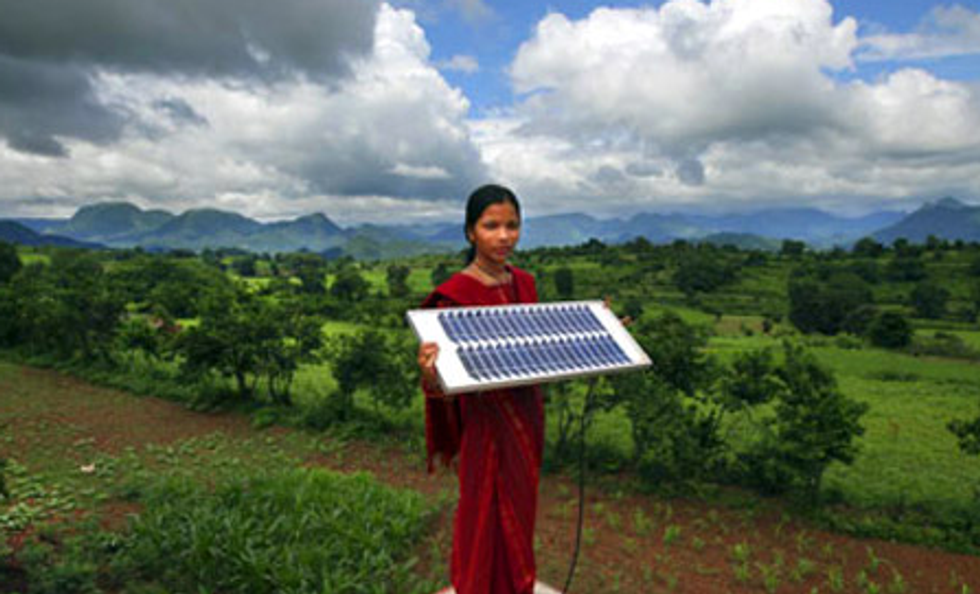
As the accompanying graphs show, the cost of coal and copper -- the ingredients of conventional grid power -- are soaring. Meanwhile, the cost of solar panels and LEDs, the ingredients of distributed renewable power, are racing down even faster.
If we want the poor to benefit from electricity we cannot wait for the grid, and we cannot rely on fossil fuels. The International Energy Agency, historically a grid-centric, establishment voice, admits that half of those without electricity today will never be wired. The government of India estimates that two-thirds of its non-electrified households need distributed power.
Fortunately, the historic barriers to getting distributed renewable power to scale in poor villages and neighborhoods are rapidly being dismantled by progress in technology, finance, and business models. Getting 1.2 billion people local solar power they can afford is within grasp -- if we only think about the problem in a different way. In fact, the world can finish this job by 2020.
The poor already pay for light. They pay for kerosene and candles. And they pay a lot. The poorest fifth of the world pays one-fifth of the world's lighting bill -- but receives only .1 percent of the lighting benefits. Over a decade, the average poor family spends $1,800 on energy expenditures. Replacing kerosene with a vastly superior 40 Wp (Watts peak) home solar system would cost only $300 and provide them not only light, but access to cell-phone charging, fans, computers, and even televisions.
Kerosene costs 25 to 30 percent of a family's income -- globally that amounts to $36 billion a year. The poor do not use kerosene because it is cheap -- they are kept poor in significant part because they must rely on expensive, dirty kerosene.
And the poor pay in other ways. A room lit by kerosene typically can have concentrations of pollution 10 times safe levels. About 1.5 million people, mostly women, die of this pollution every year, in addition to those who die from burns in fires.
So why do the poor use kerosene? Because they can buy a single day's worth in a bottle, if that is all they can afford. For the poor, affordability has three dimensions: total cost, up-front price, and payment flexibility. Solar power comes in a panel that will give ten, or even 20, years of light and power -- but the poor cannot afford a ten-year investment up front. And many cannot handle conventional finance plans, which require fixed payments regardless of their income that month.
Nor, for the record, do the electrified middle class pay for electricity up front. When I moved into my house in San Francisco, I did not get a bill for my share of the power plants and transmission grid that give me power each month. I pay as I go, based on how many kwh's I use that month.
So lighting the lives of 1.2 billion people with off-grid renewable electricity requires three ingredients:
The money is on the table. It's just on the wrong plates. Purchase and finance of solar power for 1.2 billion people would cost about $10 billion a year over a decade. The 11 countries with the largest number of households without electricity spent $80 billion each year subsidizing fossil fuel -- only 17 percent of which benefits the poor. In 2010, the World Bank spent $8 billion on coal-fired power plants, few of which provided meaningful energy access to the poor. The UN's Clean Development Mechanism is proposing to give $4 billion a year to anything-but-clean coal-plants. So there is already far more capital in the system than is needed.
Even five years ago the business models did not exist to enable the poor to afford solar. Solar was much more expensive. The only alternative to buying a solar system with cash was a bank or micro-credit loan for which most of the poor could not qualify.
But the combination of dirt-cheap solar, the cell-phone revolution, and mobile phone banking has changed everything. There are almost 600 million cell-phone customers without electricity -- using their phones very little, still spending $10 billion to charge them in town. There are hundreds of thousands of rural, off-grid cell towers powered by diesel -- at a price of about $0.70/kilowatt hour. All over the world cell-phone towers are being converted from diesel to hybrid renewable power sources. So cell phone companies have a powerful motivation to get renewable power into rural areas, to get electricity to their customers, and to charge for electricity through their mobile phone payment systems.
At least three commercial models have been launched in the last several months. India's Simpa Networks -- in partnership with SELCO in India and DT-Power in Ghana, India and Kenya -- are testing models in which solar distributors can allow customers to pay for electricity through mobile banking "pay as you go" plans. Zimbabwe's Econet Power has launched an even more intriguing model, in which it provides its cell-phone customers with solar power as a customer benefit, charging them only $1 week to use a home solar system provided by Econet, with the bills tied to the customer's cell phone account.
UN Secretary General Ban Ki-moon has proclaimed 2012 the Year of Universal Energy Access. His initiative is keyed not to the UN climate talks, but to the Rio +20 Earth Summit talks scheduled for June.
Imagine that at Rio, instead of embracing business-as-usual solutions to energy access, the world decided to empower the poor with the electricity they can truly afford -- distributed solar?
What would the benefits be? In carbon terms alone, kerosene for lighting emits almost as much greenhouse-gas pollution as the entire British economy. 1.5 million lives a year would be saved from respiratory ailments. The available income for the world's poorest fifth would be increased by 25 to 30 percent -- a pretty big development bang-for-the-buck. Numerous studies have shown that providing basic energy access increases household income by 50 percent or more by providing more time and opportunities for home-based income generation.
"Today, economic power has been captured by a small minority. But it has acquired this power only by accumulating the productive power of others. Their capital is simply the accumulated labor of a millions of working people, in a monetized form. It is this productive power that is the real capital, and it is this power that latently resides in every worker ..." -- Samabayaniti/The Co-operative Principles, 1928.
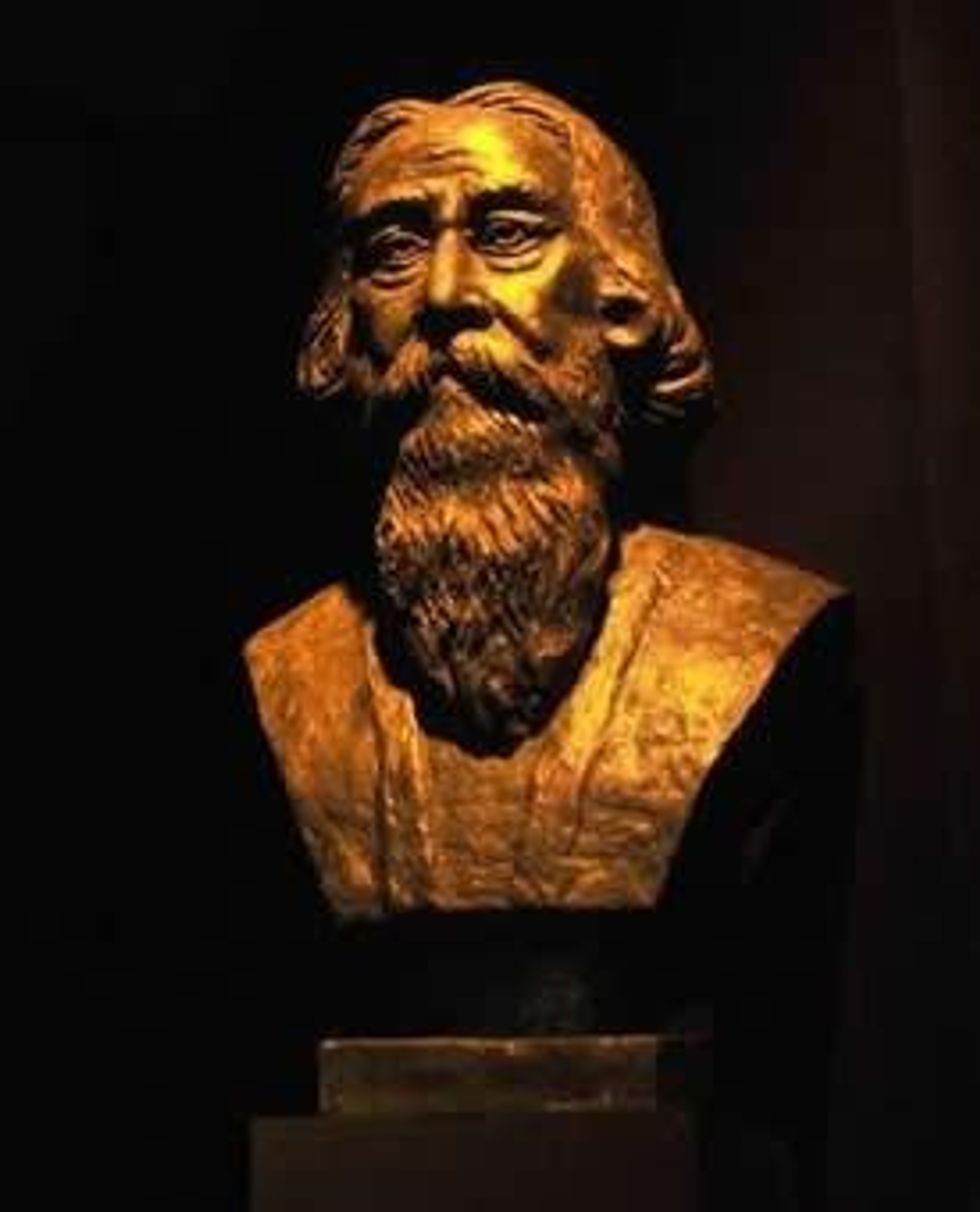
In a compelling set of essays written between 1915 and 1940, Rabindranath Tagore articulated a social vision where exploitation would give way to a just, humane, collectively owned economy. At the core of his thought was the cooperative principle. This is an idea worth revisiting on the International Day of Cooperatives, which this year falls on July 2, and even more so during the lead-up to 2012, which is the United Nations International Year of Cooperatives.
In India, the experience with the century-old cooperative movement has been mixed. There are some stunning successes: Amul, for one. There are others, too, where cooperatives have proved transformational for the marginalized. The problems are also well-known: abuse, politicization, excessive dependence on the state, and so on. But these are mere symptoms. The real disease lies elsewhere. There is little understanding, much less acceptance, of the cooperative principle and its potential. It is yet to enter the core of our social vision, leave alone public policy. Those spaces are dominated, ever more aggressively, by the competitive principle, the scepter of 'efficiency' and private gain. This is why India can emerge as one of the top wealth-generators even as 93 per cent of its working citizens toil in the informal sector. That 93 per cent contributes almost half of India's fast-growing GDP. But it has no say over the way that growth is generated -- or any voice to claim a fairer distribution of the wealth it produces. The same goes for the majority that survives on the agrarian economy.
Written some eight decades ago, Tagore's thoughts stemmed from these concerns: the growing concentration of economic power and the destruction of rural India. He wrote: "Today our villages are half-dead. If we imagine we can just/ continue to live, that would be a mistake. The dying can pull/ the living only towards death." (from The Neglected Villages, 1934).
He was deeply skeptical about the solutions proposed by the elite -- such as charity or moral enlightenment of the wealthy. These were like putting out "a raging fire by blowing at it," he wrote. Instead, he sought an ethical model of production.
What would that entail? Tagore's vision went far beyond notions like 'social responsibility' that are in vogue today. To him, ethical production required that resources (such as land and capital) are collectively owned by producers themselves. This would ensure that the produce is also collectively owned, and that all producers have a say in determining their share of value in the product of their work.
The typical small farmer, indebted and impoverished, was much in need of such a structure. "Imagine if all of our small farmers farmed their land collectively, stored their produce in a common facility and sold them through a common mechanism..." Only then can we prevent profiteering; only then can the farmer recoup the legitimate value of her labor, wrote Tagore.
Without such mechanisms, the farmer would never be able to effectively exercise the right to his land, even if he held the title. Structural conditions would make him powerless. Under these circumstances, giving the small farmer the legal right to land was no more than giving him 'the right to commit suicide.'
Indeed, in the cooperative principle, Tagore saw the possibility of challenging power, of altering power relations. Ordinary people, whose work constituted what was 'the real capital,' could only do so if they collectively owned that 'capital.' Many economists may well reject this as the misplaced idealism of an ill-informed poet. But it will resonate readily with the struggles for producer-ownership in the world today, such as Via Campesina. As the clout of agri-business grows, food inflation rises, and informal work becomes the norm, challenging dominant structures of ownership. And power is the central challenge of these movements.
In India, no amount of tinkering can make growth 'inclusive,' unless people have a say in how that growth is driven. Take the case of cotton textiles, a boom sector that has seen much growth. But has it really benefited those who have produced that growth? The cotton growers, for instance -- the largest single group within the 200,000 farmers who have taken their own lives in the past decade? Or the millions of women who work the long shifts in export factories? Even worse, the drive for profits constantly pits the growers and workers against one another. When, at the peak of the cotton crisis, cotton farmers received price support from the government, export sector workers were threatened with job losses because cotton had become 'too expensive.' (Ironically, the worst off among the cotton growers did not even benefit from price support.) As long as prices are globally determined, we are told, not much can be done to save those at the bottom. Yet, the past few months have seen global prices hit a big high -- and the government sharply restricted cotton exports to favor the textile lobby. This crippled the growers.
This brings us right back to the question of ownership. When global prices fluctuate, who decides how the gains and losses are to be shared? Certainly not the majority of workers and small farmers. But more important, global prices do not operate by magic. They reflect the same concentration of ownership and economic power. Indeed, several movements today urge consumers to use their purchasing power to counter such power. But consumer movements cannot succeed unless the productive economy is differently organized, differently owned.
Can that happen? Yes, if several conditions are in place. First, the competitive principle must be properly applied. Every institution, from schools to universities to hospitals, is increasingly being judged according to that principle, and forced to forgo its social priorities. At the same time, banks and corporations remain blatantly non-competitive, operating like cabals with little discipline or accountability. Second, among the main points of criticism of cooperatives in India has been their need for state resources. But our corporations have been also been heavily subsidized by state resources. While they flourish, cooperatives flounder. Why? Corporations enjoy state support with no interference; cooperatives do not. State support has come with levels of bureaucratic control that are incompatible with a truly autonomous, member-driven movement. Third, cooperatives cannot survive in isolated sectors. Systematic linkages between sectors and across countries are necessary if we are to harness the full political, social, economic power of the cooperative principle.
Here is a story from Peru. From its mountains comes a special brand of coffee called Cafe Femenino, produced by cooperatives of very poor indigenous women. It grew out of the women's struggle to claim their share of the value they produce. As growers of organic Fair Trade coffee they earn a premium over and above the market price. Before Cafe Femenino, the women had no access to this premium, no say in its use. Now they use it to educate their daughters who would otherwise not go to school; more than that they raise awareness against the tremendous gender violence in their communities.
There is more. In Canada, Cafe Femenino is distributed also by a workers' cooperative, creating as a result an entire coffee chain of cooperatives. Finally, as a mark of recognition of the global character of gender violence, Cafe Femenino is distributed free to shelters for abused women in Canada. The Femenino experiment has spread to six countries in Latin America and grows by the day. In India too, various experiments with women's collective enterprises have long been under way, but do not receive the attention they deserve.
As Tagore had foreseen it, the cooperative principle enables the most marginalized people to mobilize their most abundant resource: their productive power and their solidarity. 'Development projects' or paternalistic policy models for 'empowering the poor' cannot achieve this.
The choice is not between textbook theories. The lessons of everyday life have been stark, more so since 2008. The choice is between two different worlds: one driven by hyper-profit and mass distress, the other holding out the promise of shared prosperity and well-being.
UNITED NATIONS - In response to a pelting critique from academics, economists and grassroots organizers worldwide, the 2011 State of the Microcredit Summit Campaign Report plans to address the controversies surrounding a development scheme that many believe to have failed.
The report, which is set to be released Mar. 7 in Washington D.C. to great fanfare, will be presented by the 2006 Nobel Peace Prize Laureate Muhammad Yunus, founder of the Grameen Bank in Bangladesh, a man who has earned himself a reputation as either the Superman of poverty-alleviation or the Judas of social change, depending on who you talk to.
Since Yunus accepted his million-dollar award in 2006, a tempest of questions, censures and confusions has battered at the doors of Micro Finance Institutions (MFIs), whose small-scale loans many are calling "micro band-aids" on the wound of inequality that the world is currently nursing.
The 2010 Global Wealth Report published by the Credit Suisse Research Institute showed that as much as 0.5 percent of the total world population, or approximately 24.5 million people, joined the ranks of the world's dollar millionaires last year. Simultaneously, according to a 2010 report by the United Nations Food and Agriculture Programme, 925 million people are living in abject poverty, surviving on less than a dollar a day.
Speaking at an event last week at the United Nations, the permanent representative of the mission of India to the United Nations, Ambassador Hardeep Singh Puri, said, "Sixty- five years after the U.N. was founded, the global order remains inequitable and the success of some makes the poverty of others in a globalized world look more shameful than ever before."
Representing a country where MFIs have penetrated several thousand villages, but has lost 100,000 destitute farmers to suicide, Puri's words raise serious questions about development policies that do not appear to be working.
Micro Loans Don't Make a Macro Difference
"In 1997, 2,900 people from 137 countries came to Washington D.C. for the first ever Microcredit Summit when we pledged to reach 100 million of the world's poorest families by 2005," Sam Daley-Harris, the director of the Microcredit Summit Campaign, told IPS.
"In homage to our success in Washington, the U.N. declared 2005 as the Year of Microcredit," he added.
Despite reaching their goal two years late, Daley-Harris continues to be optimistic about microcredit's potential as a vehicle out of destitution. However, with poverty on the rise and banks fattening off of interest, scores of observers are taking a very different stand.
"Bangladesh and Bolivia are two countries widely recognized for having the most successful microcredit programs," said Robert Pollin, co-director of the Political Economy Research Institute at the University of Massachusetts, "yet they remain two of the poorest countries in the world."
Farooque Chowdhury, co-author of the 2007 United Nations Development Programme-sponsored report on Bangladesh, has written extensively on the failures of microcredit in the land of its inception, traveling to scores of villages to track the collapse of the program.
"Nothing pro-poor can be based on the philosophy of isolated households competing with their peers," Chowdhury said. "The poor have to unite and face the market's ideology and allies, the onslaught of finance capital and capital's design to subjugate the poor."
According to Chowdhury, one need only trace the origins of microcredit as a profit-making venture to the doorsteps of huge international financial institutions, multinational banks, agencies like the Bretton Woods Institutions and philanthropic organizations to see that any plan which enriches the "big boys" cannot possibly end the structural, cyclical problem of poverty.
The celebrated Indian development journalist P.Sainath noted "the interest rates micro-indebted women are paying in India are far higher than commercial bank lending rates," adding that debt will never amount to emancipation.
Riding on the tails of the week-long World Social Forum in Dakar, an assembly that drew tens of thousands of activists to articulate visions of "Another World", the Microcredit Summit Campaign Report is more vulnerable than ever to denouncement, particularly at a time when citizens of the world are fighting tooth and nail to hold national governments accountable to their people.
"Microcredit was adopted by multinational institutions and advertised as a panacea for poverty alleviation," Omar Dahi, a professor of economic development at Hampshire College, told IPS. "This fits within a neoliberal agenda of arguing that the state should withdraw from being active in development and that the private sector can solve the problem of poverty."
"It can't - in fact it exacerbates the problem," Dahi added. "The most successful microcredit has been when it in fact was complemented with the state doing its job in terms of providing infrastructure, education and health care."
"The other alternative is workers and peasants cooperatives, but that of course, is not microcredit," he concluded.
Microcredit also compliments the neoliberal supposition that the only way out of poverty is for the poor - particularly women, who already strain under the yoke of unpaid domestic labor - to work even harder for a pittance.
This paradigm does not address issues like the loss of land rights or the privatization of fundamental public services such as healthcare and education, in the absence of which poverty will only replicate itself in a vicious cycle.
Political journalist Alex Cockburn notes, "Back in the early 1970s there were huge plans afoot to change the entire relationship of the Third to the First World."
He added, "At the United Nations radical economists were hard at work drafting plans for a New World Economic Order. All that went out the window and here are the caring classes 30 years later, hailing microloans."
Women: Double Victims of Debt
Because women supposedly have a higher loan repayment rate than men, and traditionally use their loans to support their families and communities rather than themselves, MFIs have found it both financially lucrative and highly beneficial to their public-image campaign to pursue women, "the poorest of the poor" in this endeavor.
However, various economists and researches have pointed out that women are easy prey for mammoth multinationals, and are particularly vulnerable to the brutal loan-collection systems that MFIs enable.
Susan F. Feiner, director of Women and Gender Studies at the University of Southern Maine, points out that the 'communal nature' of the microcredit loans creates the problem of 'collective liability', where one woman's failure to repay her loans will result in collective punishment for the whole group.
This dynamic, which has led to women fiercely policing each other, shatters the much-needed solidarity between rural women and stands firmly in the way of more radical, women-centered grassroots organizing against the structural conditions of poverty, she said.
In a study of women borrowers in the southern Indian state of Andhra Pradesh, Sainath points out, "During recent floods in the province, freelance journalists came to a village where everything had been washed away. The first people back in were the microcreditors threatening women, demanding monthly installments from women who had lost everything."
Several other studies have brought to light the methods by which women who fail to repay their loans, at absurd rates of interest, are degraded, assaulted or threatened by local money-collectors in their communities, a system which adds another layer of oppression to the most world's most destitute populations.
"The microloan business is fast becoming a gigantic empire, bringing back into control the very banks and bureaucracies women have been trying to bypass," Cockburn said. "Microcredit is becoming a macro-racket."
For more than twenty years, microcredit has been widely heralded as
the remedy for world poverty. Recent news stories, however, have sullied
microcredit's glowing reputation with reports on scandals, exorbitant
compensation to managers, skyrocketing interest rates, and aggressive
marketing schemes.
Once praised as a universal panacea, microlenders are now being
widely attacked as predatory loan sharks. In December 2010, Sheik Hasina Wazed, the prime minister of Bangladesh and former microcredit advocate, accused microcredit programs of "sucking blood from the poor in the name of poverty alleviation."
What happened?
It turns out there are two very different models of microcredit. As
Muhammad Yunus, winner of the 2006 Nobel Prize, pointed out in his
January 15, 2011 New York Times op-ed,
one type of microcredit program is designed to serve the poor; another
to maximize financial returns to program managers and Wall Street
investors.
The differences raise crucial questions for the future directions of
microfinance. They also help us see where the banking system here in the
United States went off course and how we must restructure it to support prosperous Main Street economies.
In 1983 Yunus founded the Grameen Bank, universally cited as the
inspiration and model for the global microcredit movement. His single
purpose was to improve the lives of millions of poor Bangladeshis by
making small loans to poor women to fund income-generating microbusinesses.
The basis for the Grameen Bank's worldwide renown lies in a number of
key characteristics, many of which are not widely understood.
These features root the Grameen Bank in the community it serves and
keep money, including interest payments, continuously circulating
locally to facilitate productive local exchange and build real community
wealth.
Microcredit programs seeking to replicate the Grameen model have
spread rapidly across the globe. The feature they most commonly
replicate is lending to poor women organized into groups that guarantee
one another's loans. Few provide their members with depository services
or replicate the Grameen Bank's other defining features, though these
features are central to its commitment to community wealth building.
As microlending programs became increasingly focused on repayment
rates and growing the size of their loan portfolios, they looked for new
sources of capital to expand their reach. With encouragement from foreign philanthropists,
many turned to foreign commercial equity investors. Since private
equity conflicts with the nonprofit model, sometime around 2005 many
nonprofit microcredit programs changed their status to for-profit
enterprises and converted their philanthropic nonprofit assets into
private for-profit assets.
One such micro-finance program was Compartamos in Mexico, which in
2007 launched an initial public stock offering. According to a New York Times article,
it charged its borrowers an annual interest rate of near 90 percent,
producing a return on equity of more than 40 percent, nearly three times
the 15 percent average for Mexican commercial banks. This made
Compartamos highly attractive to private equity investors. The public
offering brought in $458 million, of which "private Mexican investors,
including the bank's top executives, pocketed $150 million."
Another example is SKS Microfinance in India, whose initial public
offering in August 2010 raised $358 million from international investors
and yielded its founders stock options worth more than $40 million.
Yunus describes the consequences of such conversions and public sales:
To ensure that the small loans would be profitable for their
shareholders, such banks needed to raise interest rates and engage in
aggressive marketing and loan collection. The kind of empathy that had
once been shown toward borrowers when the lenders were nonprofits
disappeared.
For the groups that turned to Wall Street for financing, the line
between social purpose microcredit and predatory loan sharking began to
disappear, with some programs charging annual interests rates of more
than 100 percent. Programs that had raised philanthropic funding to help
put money into poor communities became vehicles for sucking wealth out
of them to generate financial profits for already wealthy people.
Apologists argue that so long as the Wall Street-funded microcredit
programs charge interest rates lower than the local money lenders, they
still benefit the poor.
Tara Thiagarajan, Chairperson of Madura Micro Finance, a for-profit
microcredit program in India, followed the money and challenged this
premise in a thoughtful and self-critical blog:
The local moneylender ... may charge a higher interest rate, but being
local will probably spend most of that income in the village supporting
the overall village economy. So potentially, local lending at higher
rates could be more beneficial to the village if the money is in turn
spent in the village, compared to lower rates where the money leaves the
village.
Because foreign private equity investors expect to recover their
investment plus a perpetual flow of profits, the contradictions go even
deeper than what Thiagrarajan outlined.
Say an equity investor in the United States buys shares in a
microcredit program in India. The investor pays for the shares in U.S.
dollars and in turn expects to be paid in U.S. dollars. The microlender,
however, does business in Indian rupees.
The dollars, therefore, are exchanged for rupees in the foreign
exchange market and become part of India's foreign exchange pool, which
funds consumer imports, machinery, foreign scholarships, capital flight,
arms imports, foreign travel, and whatever other uses India may have
for dollars--virtually none of which benefit the poor.
If the microlender meets its profit projections, this creates claims
by the foreign investors on India's foreign exchange reserves
potentially many times the amount of the original investment. To fulfill
this obligation, India must produce goods and service for sale abroad
or sell or mortgage additional assets to foreigners, which creates still
greater claims against future foreign exchange earnings. The community
in which the borrowers reside will be dealing only in rupees, but faces a
similar external drain on its resources to meet the borrowers'
obligations to the lending organization.
Say the microlending supported an increase in village food
production. Rather than improving the diets of the workers who produce
it, however, a portion of their additional production must be sold to
outsiders to generate the rupees to repay their debts.
In return for a short-term inflow of money, both India and the village bind themselves to a long-term outflow of money and real wealth.
It is an insidious dynamic that supports a classic pattern of
colonization and wealth concentration long characteristic of foreign
equity investment and loan funded foreign aid. A small short-term
economic gain can come at a large long-term cost when it is funded with
outside debt or equity.
The microcredit experience brings to light a larger principle: the
institutional structure of a financial system determines where money
flows and who benefits. In short, structure determines purpose.
The transformation of microcredit institutions from a model that
serves communities to a model that is "sucking blood from the poor in
the name of poverty alleviation" mirrors a similar transformation of the
U.S. banking system, which occurred through the process of banking
deregulation that began in the United States in 1970s.
Throughout the 1940s, 50s, and 60s the United States had a system of locally owned and strictly regulated community banks,
mutual savings and loans, and credit unions, many of them organized on a
cooperative ownership model much like the Grameen Bank. They were
organized and managed to serve the financial needs of the communities in
which they were located and kept money flowing within the community in
service to community needs.
Banking deregulation over the past 30 years led to a wave of banking
mergers and acquisitions that created too-big-to-fail Wall Street banks
devoted to maximizing financial returns to Wall Street bankers and
financiers. Rather than supporting local wealth creation, the system now
sucks money and real resources out of the community. Both the
microcredit experience and the aftermath of the 2008 Wall Street
financial crash vividly reveal that the values and interests of Wall
Street stand in fundamental opposition to those of Main Street.
Financial institutions can serve communities
in pursuit of a better life for all or they can serve global markets to
maximize financial returns to Wall Street bankers and financiers. They
cannot serve both.
The world does not need more predatory lenders in service to Wall
Street. We all need more local, cooperatively owned community banks on
the model of Grameen.