

SUBSCRIBE TO OUR FREE NEWSLETTER
Daily news & progressive opinion—funded by the people, not the corporations—delivered straight to your inbox.
5
#000000
#FFFFFF
To donate by check, phone, or other method, see our More Ways to Give page.
Daily news & progressive opinion—funded by the people, not the corporations—delivered straight to your inbox.
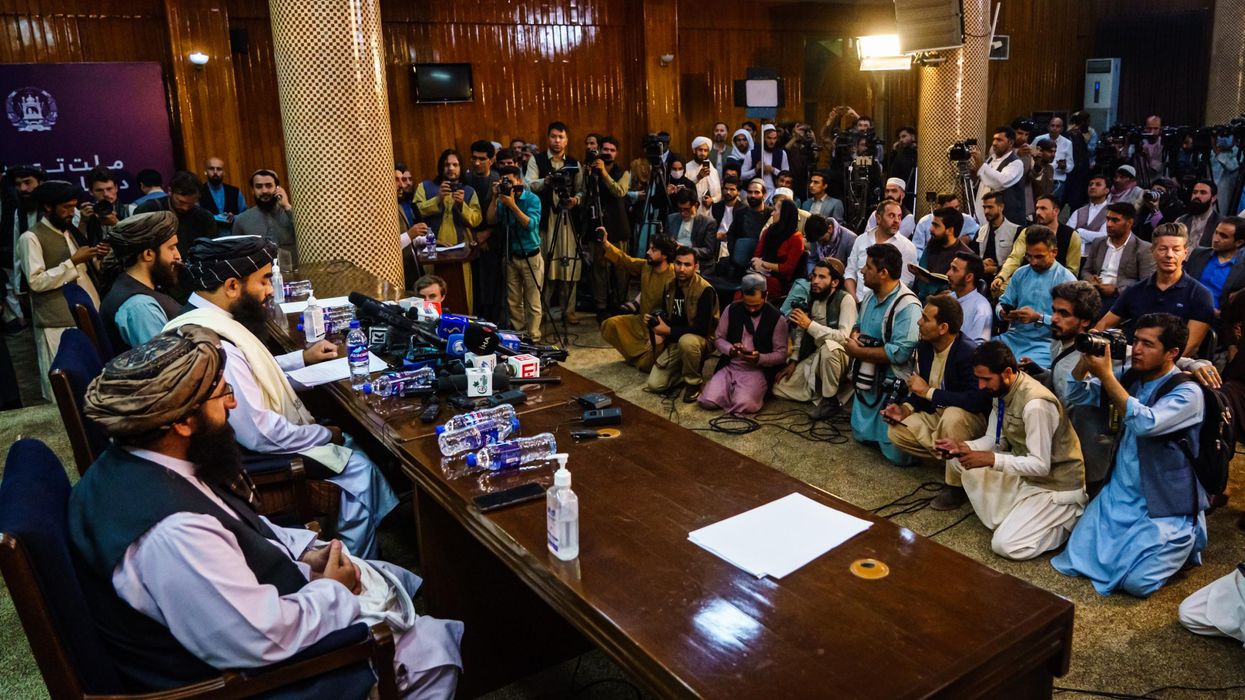
As hundreds of Afghan journalists attempt to flee Afghanistan amid the Taliban's reconquest of their nation, two U.S. lawmakers on Wednesday joined international press freedom advocates in calling on the United States to do more to ensure the safety of media workers, and for the Taliban to honor their vow to not harm them.
Reports Wednesday of Afghan journalists being assaulted by Taliban fighters amid deadly repression of dissent heightened the sense of alarm inside and outside Afghanistan.
According to Ariana News, a reporter and photographer covering an anti-Taliban protest in Jalalabad were beaten by Taliban fighters, who opened fire on demonstrators, reportedly killing three people. The outlet--one of the nation's largest--also reported that another journalist was beaten by Taliban forces at Kabul's international airport on Wednesday.
Also on Wednesday, the New York-based Committee to Protect Journalists (CPJ) reported that "since the Taliban took power in the country earlier this week, militants have searched the homes of at least four journalists and news agency employees."
The state-owned broadcaster Deutsche Welle on Wednesday urged the German government to evacuate its Afghan employees, who network officials said "are under acute threat" and at risk of "torture and death."
Karl Justen, head of DW's broadcasting council, said, "We know reliably that the Taliban have already searched the homes of three of our employees looking for them."
In a Wednesday letter to U.S. President Joe Biden, Rep. Adam Schiff (D-Calif.) and Rep. Steve Chabot (R-Ohio) wrote that Afghan media workers "are in imminent danger."
"Safe passage should be offered to all individuals employed by media organizations," the lawmakers asserted. "We cannot resign those individuals... to violence and death. We must see them to safe harbor."
While some Afghan journalists rushed to destroy as many traces of their professional existence as possible during the Taliban's lightning takeover of their country, others scrambled for elusive safety. CPJ reported Monday that it has "registered and vetted" nearly 300 journalists seeking safe passage, while the cases of hundreds more are under review.
CPJ noted that Afghan journalists working for U.S. media outlets including The New York Times, The Washington Post, and The Wall Street Journal have been unable to leave Afghanistan.
"For the past 20 years, brave Afghan colleagues have worked tirelessly to help... share news and information from the region with the global public," the publishers of the three papers said Monday in a rare joint plea for U.S. assistance. "Now those colleagues and their families are trapped in Kabul, their lives in peril."
The publishers asked for "facilitated and protected access" to a secure airport, "safe passage through a protected access gate" at the airport, and "facilitated air movement out of the country."
CPJ executive director Joel Simon said Monday that "the United States has a special responsibility to Afghan journalists who created a thriving and vibrant information space and covered events in their country for international media. The Biden administration can and should do all within its power to protect press freedom and stand up for the rights of the vulnerable Afghan reporters, photographers, and media workers."
Since 2001, 53 journalists have been killed in Afghanistan, according to CPJ.
Echoing Simon's statement, James Risen, director of First Look Institute's Press Freedom Defense Fund (PFDF), said Wednesday that "the United States must do all in its power to secure the safe exit of Afghans who worked for the U.S. and other Western news media organizations over the past 20 years in Afghanistan."
"Nonprofit organizations are now scrambling to rescue the translators and others who provided critical support to American reporters for the last two decades, but it is critical that the U.S. continues to keep the Hamid Karzai International Airport open to allow for their safe passage," Risen added. "This is a moral imperative for the United States."
"The United States must do all in its power to secure the safe exit of Afghans who worked for the U.S. and other Western news media organizations."
--James Risen, PFDF
Risen's statement followed a Tuesday press conference in Kabul at which Taliban spokesperson Zabihullah Mujahid vowed to respect press freedom and allow journalists--including women--to continue working.
"We are committed to the media within our cultural frameworks," Mujahid said. "Private media can continue to be free and independent. They can continue their activities."
According to Reporters Without Borders' (RSF) most recent World Press Freedom Index, Afghanistan ranked 122nd out of 180 nations in press freedom in 2021.
Mujahid stressed that while journalists will be free to work, "nothing should be against Islamic values," and that "the media should not work against national values, against national unity."
Separately, Mujahid told RSF that the Taliban "will respect freedom of the press, because media reporting will be useful to society and will be able to help correct the leaders' errors."
During the Taliban's previous rule between 1996 and 2001, all media were banned except Voice of Sharia, which according to RSF "broadcast nothing but propaganda and religious programs."
Women were also barred from media--and nearly all--employment. Asked by RSF what was to become of the more than 1,700 Afghan women who work as journalists and in other media jobs, Mujahid said, "Afghan society is Muslim, as you know... Women journalists are also Muslim."
"We will, of course, establish a legal framework for questions of clothing--the use of the hijab--and so that women are not bothered in the street and at their place of work," he added. "But, until these written provisions are enacted, I ask them to stay at home, without stress and without fear. I assure them they will go back to their jobs."
Mujahid's assurances were met with intense skepticism from Afghan and international observers.
"Right now, the Taliban are doing nothing against us but tomorrow?" one Kabul-based journalist asked RSF. "What will happen when the foreigners are gone and their government is installed?"
Steven Butler, CPJ's Asia program coordinator, said in a statement that "the Taliban needs to stand by its public commitment to allow a free and independent media at a time when Afghanistan's people desperately need accurate news and information."
Butler added that "the Taliban must cease searching the homes of journalists, commit to ending the use of violence against them, and allow them to operate freely and without interference."
In one notable development, women at TOLO News, Afghanistan's first 24/7 news network, returned to work after the Taliban takeover. On Tuesday, TOLO anchor Beheshta Arghand interviewed Mawlawi Abdulhaq Hemad, a Taliban spokesperson, with the network claiming it was the first time an Afghan woman has interviewed a senior Taliban official inside Afghanistan.
"We said to them, look, a female is going to interview you," TOLO News founder Saad Mohseni told The Guardian. "And they said fine. They could have easily have said screw you--they run the country, they can do whatever they want."

Speaking from his years of experience being pursued by the Obama Justice Department for simply practicing journalism and refusing to reveal his confidential sources, Intercept reporter James Risen told The Hill on Monday that President Donald Trump is building on his predecessor's war on the free press by "demagoguing" the media "in a way we haven't seen in modern American history."
"Obama tried to put me in jail for seven years... A lot of conservatives try to point to me as an example of Obama on press freedom and I fully agree with the view that he had a terrible record on press freedom," Risen said. "The difference with Trump is that he is demagoguing the issue in a way we haven't seen in modern American history."
Asked if, given his history, he believes the Trump White House is a greater threat to press freedom than the Obama White House was, Risen said, "I didn't think I would get to the point where I would say that, but I do believe that now."
Risen's assessment of Trump's attacks on the press throughout his first two years in office came just after the White House on Monday threatened to revoke CNN reporter Jim Acosta's credentials as soon as the emergency restraining order imposed by a federal judge expires in two weeks.
In a statement, CNN said Trump is continuing to violate the First and Fifth Amendments and that the administration's "actions threaten all journalists and news organizations."
Risen echoed this sentiment in his interview with The Hill, arguing that Trump's attack on Acosta is a "symbol" of his broader war on journalism.
Trump, Risen said, is "going to the people constantly to try to destroy their belief in the press and I think the Acosta incident is really just a symbol of that--it's a symbol of an attempt to discredit not only CNN but the entire press corps in Washington and really more generally the press all over the country."
As Common Dreams reported, in addition to the White House's attacks on CNN, Trump's Justice Department also inadvertently revealed in a court filing that it has secretly charged WikiLeaks founder Julian Assange, who has been living in the Ecuadorian Embassy in London since 2012 to avoid extradition to the U.S. for publishing classified and embarrassing information that the American government was keeping secret from the public.
Journalists and civil liberties advocates immediately decried the unspecified charges as a dire threat to the free press.
"Any prosecution of Mr. Assange for WikiLeaks' publishing operations would be unprecedented and unconstitutional, and would open the door to criminal investigations of other news organizations," Ben Wizner--director of the ACLU's Speech, Privacy, and Technology Project--warned in a statement last Friday.

Donald Trump's real war on the press has finally begun.
Ever since he began his campaign for president, Trump has engaged in a largely rhetorical battle against the press, casting the reporters who cover him as the enemy of the average American and as disseminators of what he calls "fake news." But for the most part, Trump's bark has been worse than his bite. Unlike his predecessor, Barack Obama, Trump was not known to have spied on journalists or tried to jail them - as Obama did with me - for refusing to reveal their sources.
Until now.
Now we know that the Justice Department secretly seized the phone and email records of Ali Watkins, a New York Times reporter, in a leak investigation involving a former Senate staffer. It is the first time the Trump administration is known to have engaged in such an aggressive tactic against a reporter, and it is exactly the kind of press surveillance at which the Obama administration excelled. For years, conservatives attacked Obama for using such tactics to spy on reporters. Of course, there was no outcry from the right on Friday over Trump's willingness to do the same thing.
To be sure, Trump has previously gone after the alleged sources of stories in the press, including former National Security Agency contractor Reality Winner and FBI agent Terry Albury, both of whom have been accused of providing classified information to The Intercept. The Intercept does not comment on its sources. But the targeting of Watkins shows that the Trump administration is willing to attack the press directly.
The Obama administration's ongoing crusade against government whistleblowers -- which culminated last year in the imprisonment of former CIA officer Jeffrey Sterling -- has reignited a debate over the role journalists should play in defending their profession and the sources and networks on which it depends
Sterling is serving a three-and-a-half-year prison term for a conviction based primarily on circumstantial evidence. This is a heavy sentence, though less than the draconian 24 years the government originally sought.
Sterling's alleged crime was divulging a botched CIA operation to New York Times journalist James Risen.
While the Times and other news organizations fought for their own—hiring a team of lawyers to defend Risen against a government subpoena—they did much less to advocate for the rights of whistleblowers or denounce Sterling's severe punishment.
The case highlights the tension among journalists about their larger role in society. Do they merely provide an objective window into the world, or should they advocate for the free flow of information and those who provide sources for their reporting?
Reporters could learn a lesson from free speech and privacy advocates. We see our work as an essential collaboration among "what," "why," and "how" people.
The "what" people are those who first identify a problem in society. They are whistleblowers, like former intelligence officer Edward Snowden, who alerted us to the alarming extent of mass government surveillance.
The "why" people investigate the roots of a problem. Journalist Glenn Greenwald and filmmaker Laura Poitras have devoted their careers to analyzing the rise of the surveillance state. Naturally, a "what" person like Snowden would seek out Greenwald and Poitras to explain the threat of wholesale surveillance to a wider audience.
The "how" people are the advocates who work with the information and analysis to organize the public around a solution. Following Snowden's revelations, a coalition of privacy advocates -- including Access Now, the ACLU, the Electronic Frontier Foundation, and my organization, Free Press -- mobilized public campaigns to try to stop unchecked government spying.
Together, "what," "why," and "how" people form an ecosystem for protecting the flow of information. When one element is missing, the system falls apart.
The world of journalism is made up of "what" and "why" people. While many journalists claim objectivity as a tenet of their trade, they dismiss advocates' "how" work as beyond the realm of "serious" reporting.
This has left a perilous gap when the ecosystem is under threat.
Reporters Without Borders' Press Freedom Index now ranks the United States 49th out of 180 countries. That's a 14-place drop since 2012," says Delphine Halgand, the group's U.S. director.
She adds that President Obama's war on whistleblowers is largely to blame. The Obama administration has prosecuted eight whistleblowers under the Espionage Act of 1917, more than any previous administration combined."
Obama's Justice Department has used the 100-year-old law -- which was intended to go after World War I-era spies -- to convict Sterling and others. This sets a dangerous precedent, intimidates reporters and sources, and cloaks government operations from public scrutiny.
We all need to address this problem, but news organizations, in particular, should take it very seriously.
A more interconnected world has blurred the lines that once separated reporters from whistleblowers and citizen journalists. Each plays a role in a system whose survival relies on the health of its parts.
Journalists must not only defend their own rights but also ask how they can better advocate for the people who are indispensable to their work. Their jobs depend on freeing the flow of information, and so does our democracy.
When the U.S. Department of Defense published a new Law of War Manual (LOW) this past summer, editorialists at the New York Times sat up and took notice. Their concern was that the manual stated that journalists could be deemed "unprivileged belligerents." The editorial explained that as a legal term "that applies to fighters that are afforded fewer protections than the declared combatants in a war." In fact, it is far more insidious than that innocuous description.
Here is the manual's definition: "'Unlawful combatants' or 'unprivileged belligerents' are persons who, by engaging in hostilities, have incurred one or more of the corresponding liabilities of combatant status (e.g., being made the object of attack and subject to detention), but who are not entitled to any of the distinct privileges of combatant status (e.g., combatant immunity and POW status)."
The key phrase here is "being made the object of attack." For slow-witted New York Times editorialists, that means journalists can be killed as can any enemy soldier in wartime. "Subject to detention" means a journalist deemed an unprivileged belligerent will be put into military detention if captured. As with any enemy belligerent, however, if "capture is not feasible," they would be killed if possible, by drone perhaps if in a foreign country.
Currently, most U.S. captives deemed "unprivileged belligerents" are imprisoned in Guantanamo although some may be held in Afghanistan. It must be noted that the United States deems as an "unprivileged belligerent" anyone they target for capture or choose to kill.
That the New York Times' concern only arose with publication of the new LOW manual suggests they may have been in a deep sleep since 9/11 as the Department of Defense (DOD) has openly worked to impose limitations on information sharing and news gathering since that event gave them a pretext. It is now a well-established pattern of the U.S. government to suppress rights guaranteed by the First Amendment whenever they can get by with it, as was seen with the New York Times own James Risen.
But the New York Times colluded with the CIA in censoring Risen's reporting. Furthermore, they seemed to have ignored the U.S. government's momentous argument of the unlimited power of the President to target journalists and activists for "expressive activities," as the Department of Justice stated in the case of Hedges v. Obama, as described below.
It has frequently been noted there's been an ongoing "war" against journalists since 9/11. The new DOD Law of War manual makes that official and potentially takes it to the highest level of conflict. While expressing concern, the Times' editorialist does not seem to realize or care how ominous it is that the DOD now openly declares that journalists may be deemed "unprivileged belligerents," unlawful combatants, as the DOD manual provides, instead of hiding the fact in coded language as done since 2001. Inherent to those classifications is that they represent the "enemy" and can be killed by U.S. officials.
That will come as no surprise to those acquainted with the foreign journalists who have been targeted and killed by drones in places such as Pakistan. Nor will it surprise Sami al-Hajj, the Al Jazeera journalist who was held in Guantanamo for years. But now it is clear that the same fate could be in store for U.S. journalists.
That coded language is embedded in the claim by Military Commissions prosecutors and the Justice Department that there is a "U.S. domestic common law of war." What they claim is entirely based upon martial law orders of the Civil War and the military's orders to remove Japanese-Americans from the their homes on the West Coast in World War II. All the cases they rely on for a "domestic law of war" today were judicially condemned during or almost immediately after the wars in which they were a part of.
U.S. Domestic Common Law of War
U.S. Military Commissions Chief Prosecutor Brig. General Mark Martins and his staff invented what they call the "U.S. domestic common law of war" in filings to the D.C. Circuit Court of Appeals. That invention consists only of the martial law precedents of the U.S. Civil War and the removal of the Japanese-Americans from the West Coast at the direction of General DeWitt. Both were later seen as examples of military despotism.
The American people have been inured by a deliberate effort of the U.S. military to accept invocation of the law of war as a talisman to permit any act by officials which would have been known as illegal before 9/11. But as the manual states: "Although the law of war is generally viewed as 'prohibitive law,' in some respects, especially in the context of domestic law, the law of war may be viewed as permissive or even as a source of authority. For example, the principle of military necessity in the customary law of war may be viewed as justifying or permitting certain acts." (Emphasis added.)
"Military necessity" was the law of war basis for removal of the Japanese-Americans. Military necessity though indisputably a part of the law of war is a totalitarian precept when applied to a civilian population.
The LOW manual explains the object of war by quoting George H. Aldrich, Deputy Legal Adviser to the U.S. Department of State during the Vietnam War. He wrote of "a general acceptance of the view that modern war is aimed not merely at the enemy's military forces but at the enemy's willingness and ability to pursue its war aims. . . . In Viet-Nam political, rather than military, objectives were even more dominant. Both sides had as their goal not the destruction of the other's military forces but the destruction of the will to continue the struggle."
The "destruction of the will" of the adversary is always the object of war, according to Clausewitz and adopted by the U.S. military. But this has a totalitarian element to it; the adversary's reciprocal object is to destroy our will. Consequently, "our" will must be protected by suppressing any dissent which could harm morale and the population's willingness to "continue the struggle."
That was the foundational belief underlying martial law during the Civil War. The Constitution was an obstacle again to suppressing dissent to a degree after the Civil War, but with the invention of a U.S. domestic common law of war and legalistic word play, this obstacle has once again been removed as the Justice Department argued in Hedges v. Obama.
The claim of being at war with internal and external enemies is always made by totalitarian states to justify their suppression of speech and a free press through repression. For a brief period in U.S. history, the Civil War, the U.S. military adopted military repression through martial law to suppress any dissent to its war practices.
Martial law was declared throughout the Union States, the North, on Aug. 8, 1862, by Secretary of War Edwin M. Stanton, at the request of President Abraham Lincoln. Orders were published to "arrest and imprison" any persons "discouraging volunteer enlistments" or "giving aid and comfort to the enemy" or for "any other disloyal practice." A military commission would try the prisoners, and a second order "suspended" the writ of habeas corpus in their cases.
Martial law was more formally declared on Sept. 24, 1862, by President Lincoln himself in addition to suspending the writ of habeas corpus. Lieber's Code was then prepared as the order giving effect to martial law. Contrary to how it is presented by the U.S. Army and credulous human rights commentators, Lieber's Code was primarily a harsh martial law order with Prussian militarist law of war concepts introduced to the U.S. to criminalize any expressions of dissent as "war treason."
Thus, Col. William Winthrop explained that among the greater number of individuals who were brought to trial before the military commissions during the Civil War, the offenses included "hostile or disloyal acts, or publications or declarations calculated to excite opposition to the federal government or sympathy with the enemy, etc."
Whiting's Guidance
Solicitor of the Department of War during the Civil War, William Whiting, gave legal guidance to the Union Commanders for enforcement of martial law. The "guidebook" was his own War Powers of the President. This book could have been used by any militaristic and totalitarian regime, which in fact it was as it was derived from authoritarian principles of martial law from Prussia. Those authoritarian principles remained in force under Prussia's successor state, Germany, during two world wars, and were the legal basis of the infamous People's Court which tried "war treason" cases; cases of "disloyal" expressive acts in most cases without more.
The guidance of Whiting was: "No person in loyal States can rightfully be captured or detained unless he has engaged, or there is reasonable cause to believe he intends to engage, in acts of hostility to the United States -- that is to say, in acts which may tend to impede or embarrass the United States in such military proceedings as the commander-in-chief may see fit to institute." This is the same argument that the U.S. government made in Hedges v. Obama.
What constituted an act of hostility? Whiting defines that to include a sentiment of hostility to the government "to undermine confidence in its capacity or its integrity, to diminish, demoralize . . . its armies, to break down confidence in those who are intrusted with its military operations in the field."
An example of how martial law was to be carried out was in an order to a subordinate commander by the Army Department of the Pacific Commander in response to complaints from the Citizens of Solano County, California, of disloyal "utterances" they were hearing from fellow citizens.
The order read: "The department commander desires you to let the people understand generally that the order of the President suspending the writ of habeas corpus and directing the arrest of all persons guilty of disloyal practices will be rigidly enforced. . . . Practices injurious to the government or offensive to the loyal sentiment of the people will under no circumstances be permitted."
Immediately after the Civil War, when it was freshest in their minds, the Supreme Court had this to say about martial law in Ex Parte Milligan: "What is ordinarily called martial law is no law at all. Wellington, in one of his despatches from Portugal, in 1810, in his speech on the Ceylon affair, so describes it. Let us call the thing by its right name; it is not martial law, but martial rule. And when we speak of it, let us speak of it as abolishing all law, and substituting the will of the military commander, and we shall give a true idea of the thing, and be able to reason about it with a clear sense of what we are doing."
Martial law is a subpart of the Law of War and since it is for application to a domestic population as with the Northern States during the Civil War by the Union Army, it is "moderated" ordinarily from the even harsher provisions of the Law of War which are now invoked in the Law of War manual. Yet precepts of both are being introduced domestically with Section 1021 of the 2012 National Defense Authorization Act and domestically and globally by the "U.S. domestic common law of war" precedents trumpeted by Chief Military Commissions Prosecutor, Brig. Gen. Mark Martins.
It must be noted that this is not to compare the Union unfavorably with the Confederacy. The Confederacy had the highest form of martial law: slavery. But the Defense Department only uses one legal precedent from the Confederacy today, which is "outlawry."
Lieber's Code addressed "outlawry" in Art. 148, which provided, in pertinent part: "The law of war does not allow proclaiming either an individual belonging to the hostile army, or a citizen, or a subject of the hostile government, an outlaw, who may be slain without trial by any captor, . . . on the contrary, it abhors such outrage."
This was adopted in the Hague Regulations and as interpreted in earlier Army Law of Land Warfare manuals, prohibited assassinations as well as any declarations that an individual or group is outside the protection of the law of war, which is what designation as an unprivileged belligerent does. The prohibition of assassination has also been put aside with the routine practice of assassination with drones today by the U.S. military.
The Confederacy committed the offense of outlawry when its leaders declared all captured African-Americans fighting for the Union were outside the protection of the law of war (which did preexist Lieber's Code) and would be placed into the indefinite detention of slavery. After 9/11, the U.S. government did the same with the invention of the unlawful combatant/unprivileged belligerent category and indefinite detention at Guantanamo Bay and any other location U.S. officials chose to place "unprivileged belligerents."
Treason of the Professors and the Media
Ironically, shortly after the New York Times expressed its concern for journalists in early August, the Guardian reported in an article written by William C. Bradford, a recently hired assistant professor in the law department at the U.S. Military Academy at West Point. The article, entitled "Trahison des Professeurs: The Critical Law of Armed Conflict Academy as an Islamist Fifth Column," was published in the National Security Law Journal of George Mason University Law School.
Bradford argued that the U.S. should be more aggressive in attacking Muslims to include attacks which are war crimes under the law of war. But it was his advocacy that the U.S. military attack other "lawful targets" in its war on terrorism, which include "law school facilities, scholars' home offices and media outlets where they give interviews" that caught the most attention. These civilian areas were all places where a "causal connection between the content disseminated and Islamist crimes incited" exist, according to Bradford.
Furthermore, Bradford wrote, "Shocking and extreme as this option might seem, [dissenting] scholars, and the law schools that employ them, are - at least in theory - targetable so long as attacks are proportional, distinguish noncombatants from combatants, employ nonprohibited weapons, and contribute to the defeat of Islamism." In other words, dissenting scholars are unprivileged belligerents and subject to attack, just as journalists are according to the Law of War manual.
Not to defend him but Bradford was articulating the underlying logic of the new Law of War manual's position that dissenting journalists can be targeted as unprivileged belligerents. This, as stated above, is consistent with oppressive extra-constitutional martial law practices which Chief Prosecutor Mark Martins boasts of as "U.S. domestic common law of war."
One has to ask: where are the supposed watchdogs of the press when military officers can so easily slide historical falsehoods past them in destroying freedom of the press? Further, Bradford argued that law professors who criticized the failure of the U.S. to abide by the Geneva Conventions and the Law of War represented a "treasonous" fifth column that could be attacked as enemy combatants.
If there is treason being committed in the United States, it must be seen in the acts of those reconstituting the extra-constitutional martial law cases of the Civil War period. That is, Brig. Gen. Mark Martins and associated government attorneys who, in effect, are engaged in an indirect coup d'etat of the U.S. Constitutional order. In fact, Bradford was alleged to have written in favor of a direct military coup d'etat as well.
As it turned out, Bradford had other ethical issues than just his incitement to commit war crimes and target law professors. A combination of factors led to his resigning his position at the Military Academy and this individual crisis would seem to have passed.
The home page of the National Security Law Journal in which his essay had been published carried a repudiation of it by the incoming editorial board. They summarized his article as follows: "Mr. Bradford's contention that some scholars in legal academia could be considered as constituting a fifth column in the war against terror; his interpretation is that those scholars could be targeted as unlawful combatants."
But substitute "journalists" for "scholars" and you have the position on journalists of the DOD's new Law of War manual.
An insightful article in The Atlantic asks "how a scholar pushing these ideas seems not to have raised red flags any earlier." That's an excellent question. The article was entitled "The Unusual Opinions of William C. Bradford." But here's the point; these opinions are not unusual among some members of the military and right-wing law professors such as Adrian Vermeule of Harvard and Eric Posner of the University of Chicago.
Posner and Vermeule have carved out a niche in American legal discourse in advocating that the U.S. needs to turn to the legal "wisdom" of the German Nazi lawyer, Carl Schmitt. In Terror in the Balance, they suggest that the U.S. may need to adopt censorship for, among other reasons, "antigovernment speech may demoralize soldiers and civilians." For precedent, they point out that "Martial law during the Civil War permitted the military to try and punish people who criticized the Lincoln administration's conduct of the war."
The Attack on 'Lawfare'
Other prominent advocates of authoritarian legal practices present themselves as protecting against disloyal attorney who practice "lawfare," which is defined as a form of "asymmetric warfare" that misuses domestic or international law to damage an opponent through legal actions in a courtroom. For instance, Ben Wittes of lawfareblog.com would seem to espouse this type of animosity toward public-interest lawyers who use the courts to defend First Amendment liberties.
A fallacious argument, made by Wittes in a paper which calls for "balancing" liberty and security, is his idiosyncratic belief that "in American constitutional law, for example, free speech does not exist as a general right of the public to communicate as much or as widely as it desires but as an individual right not to have government restrict one's speech."
This is contrary to the understanding of the Supreme Court which held in First Nat. Bank of Boston v. Bellotti, that: "[T]he First Amendment goes beyond protection of the press and the self-expression of individuals to prohibit government from limiting the stock of information from which members of the public may draw." In other words, the First Amendment guarantees the public's "right to know."
Why does this matter? The Constitution's Framers understood that an informed population was crucial for a Republic. As James Madison put it: "A popular Government, without popular information, or the means of acquiring it, is but a Prologue to a Farce or a Tragedy; or, perhaps both. Knowledge will forever govern ignorance: And a people who mean to be their own Governors, must arm themselves with the power which knowledge gives."
This understanding of the criticality of the free flow of information for wise democratic decision-making is particularly important for national security where ignorance comes with the highest cost. This understanding formed Clausewitz's belief in a broad-based civilian decision-making process in matters of national security strategic policy, and not one driven by military leaders with their one-dimensional thinking process.
The Vietnam War is Exhibit A as proof of this. If it had been left to the Generals to decide, the war would have continued "perpetually" even though wiser heads realized from the beginning that it was unwinnable by U.S. terms of maintaining an unpopular government in South Vietnam. The antiwar movement, whatever the motives of some, proved to be more strategically astute than General William Westmoreland who would have continued the war until the U.S. bankrupted itself in the manner that the Soviet Union would years later in Afghanistan. It was the American antiwar movement which gave effect to Clausewitz's strategy that when a war's costs exceed its "benefits," a way must be found to end it.
Curiously, Wittes accurately notes in Law and the Long War that to claim "the President has all the powers of a normal war yet few of its restraints, that the whole world is his battlefield, and that this state of affairs goes on in perpetuity is really akin to claiming a kind of worldwide martial law." In fact, that's exactly what the Justice Department argued in Hedges v. Obama without the admission as to martial law.
Dissent as Treason
Since the Vietnam War, the belief that the media and other critics of government policies act as fifth columnists has become commonplace in military-oriented journals and with the American authoritarian-oriented political class, expressed in articles such as William Bradford's attack on "treasonous professors."
To the question "how a scholar pushing these ideas" did not raise a red flag, that might best be asked of the National Security Law Journal's previous editorial board. It is worth noting however that the editors who chose to publish Bradford's article are not neophytes in national security issues or strangers to the military or government.
As described on the NSLJ website, the Editor-in-Chief from 2014-2015 has broad experience in homeland and national security programs from work at both the Department of Justice and the Department of Homeland Security and currently serves (at the time of publication of Bradford's article) as the Deputy Director for the Office of Preparedness Integration and Coordination at FEMA. A U.S. government official in other words.
The "Articles Selection Editor" is described as "a family physician with thirty years of experience in the foreign affairs and intelligence communities." Websites online suggest his experience may have been acquired as a CIA employee. The executive editor appears to be a serving Marine Corps officer who attended law school as a military-funded student.
Significantly; Bradford was articulating precepts of the "U.S. common law of war" promoted by Chief Prosecutor Mark Martins because nothing Bradford advocated was inconsistent with William Whiting's guidance to Union Generals. Except Whiting went even further and advised that judges in the Union states who "impeded" the military in any way by challenging their detentions were even greater "public enemies" than Confederate soldiers were.
This "U.S. common law of war" is a prosecution fabrication created by legal expediency in the absence of legitimate legal precedent for what the United States was doing with prisoners captured globally after 9/11. This legal invention came about when military commission prosecutors failed to prove that the offense of Material Support for Terrorism was an international law of war crime. So prosecutors dreamed up a "domestic common law of war." This in fact is simply following the pattern of totalitarian states of the Twentieth Century.
Government-Media-Academic-Complex
The logic of Bradford's argument is the same as that of the Defense Department in declaring that journalists may be deemed "unprivileged belligerents." As quoted above, George H. Aldrich had observed that in Vietnam, both sides had as their goal "the destruction of the will to continue the struggle."
Bradford argued that Islamists must overcome Americans' support for the current war to prevail, and "it is the 'informational dimension' which is their main combat effort because it is U.S. political will which must be destroyed for them to win." But he says Islamists lack skill "to navigate the information battlespace, employ PSYOPs, and beguile Americans into hostile judgments regarding the legitimacy of their cause."
Therefore, according to Bradford, Islamists have identified "force multipliers with cultural knowledge of, social proximity to, and institutional capacity to attrit American political will. These critical nodes form an interconnected 'government-media-academic complex' ('GMAC') of public officials, media, and academics who mould mass opinion on legal and security issues . . . ."
Consequently, Bradford argues, within this triumvirate, "it is the wielders of combat power within these nodes -- journalists, officials, and law professors -- who possess the ideological power to defend or destroy American political will."
While Bradford reserves special vituperation for his one-time fellow law professors, he states the "most transparent example of this power to shape popular opinion as to the legitimacy of U.S. participation in wars is the media."
As proof, Bradford explained how this "disloyalty" of the media worked during the Vietnam War. He wrote: "During the Vietnam War, despite an unbroken series of U.S. battlefield victories, the media first surrendered itself over to a foreign enemy for use as a psychological weapon against Americans, not only expressing criticism of U.S. purpose and conduct but adopting an 'antagonistic attitude toward everything America was and represented' and 'spinning' U.S. military success to convince Americans that they were losing, and should quit, the war. Journalistic alchemists converted victory into defeat simply by pronouncing it."
Space does not permit showing in how many ways this "stab in the back" myth is false. But this belief in the disloyalty of the media in Bradford's view remains today. He wrote: "Defeatism, instinctive antipathy to war, and empathy for American adversaries persist within media."
Targeting Journalists
The right-wing militarist Jewish Institute for National Security Affairs (JINSA), with mostly retired U.S. military officers serving as advisers, has advocated targeting journalists with military attacks. Writing in The Journal of International Security Affairs in 2009, retired U.S. Army Lt. Col. Ralph Peters wrote:
"Today, the United States and its allies will never face a lone enemy on the battlefield. There will always be a hostile third party in the fight, but one which we not only refrain from attacking but are hesitant to annoy: the media . . . . Future wars may require censorship, news blackouts and, ultimately, military attacks on the partisan media." (Emphasis in original.)
The rationale for that deranged thinking was first propounded by Admiral Ulysses S. Grant Sharp and other authoritarian-minded officers after the Vietnam War. Sharp explained, our "will" was eroded because "we were subjected to a skillfully waged subversive propaganda campaign, aided and abetted by the media's bombardment of sensationalism, rumors and half-truths about the Vietnam affair -- a campaign that destroyed our national unity." William C. Bradford apparently adopted and internalized this belief, as have many other military officers.
That "stab in the back" myth was propagated by a number of U.S. military officers as well as President Richard Nixon (as explained here). It was more comfortable to believe that than that the military architects of the war did not understand what they were doing. So they shifted blame onto members of the media who were astute enough to recognize and report on the military's failure and war crimes, such as My Lai.
But those "critical" journalists, along with critics at home, were only recognizing what smarter Generals such as General Frederick Weyand recognized from the beginning. That is, the war was unwinnable by the U.S. because it was maintaining in power its despotic corrupt ally, the South Vietnamese government, against its own people. Whether or not what came later was worse for the Vietnamese people was unforeseeable by the majority of the people. What was in front of their eyes was the military oppression of American and South Vietnamese forces and secret police.
Information Warfare Today
In 1999, the Rand Corporation published a collection of articles in Strategic Appraisal: The Changing Role of Information in Warfare. The volume was edited by Zalmay Khalilzad, the alleged author of the Defense Department's 1992 Defense Planning Guidance, which was drafted when Dick Cheney was Defense Secretary and Paul Wolfowitz was Under Secretary of Defense - and promulgated a theory of permanent U.S. global dominance.
One chapter of Rand's Strategic Appraisal was written by Jeremy Shapiro, now a special adviser at the U.S. State Department, according to Wikipedia. Shapiro wrote that the inability to control information flows was widely cited as playing an essential role in the downfall of the communist regimes of Eastern Europe and the Soviet Union.
He stated that perception management was "the vogue term for psychological operations or propaganda directed at the public." As he expressed it, many observers worried that potential foes could use techniques of perception management with asymmetric strategies with their effect on public opinion to "destroy the will of the United States to wage war."
Consequently, "Warfare in this new political environment consists largely of the battle to shape the political context of the war and the meaning of victory."
Another chapter on Ethics and Information Warfare by John Arquilla makes clear that information warfare must be understood as "a true form of war." The range of information warfare operations, according to Arquilla, extends "from the battlefield to the enemy home front." Information warfare is designed "to strike directly at the will and logistical support of an opponent."
This notion of information warfare, that it can be pursued without a need to defeat an adversary's armed forces, is an area of particular interest, according to Arquilla. What he means is that it necessitates counter measures when it is seen as directed at the U.S. as now provided for in the new LOW Manual.
Important to note, according to Arquilla, is that there is an inherent blurriness with defining "combatants" and "acts of war." Equating information warfare to guerrilla warfare in which civilians often engage in the fighting, Arquilla states "in information warfare, almost anyone can engage in the fighting."
Consequently, the ability to engage in this form of conflict is now in the hands of small groups and individuals, offering up "the prospect of potentially quite large numbers of information warfare-capable combatants emerging, often pursuing their own, as opposed to some state's policies," Arquilla wrote.
Therefore, a "concern" for information warfare at the time of the Rand study in 1999 was the problem of maintaining "noncombatant immunity." That's because the "civilian-oriented target set is huge and likely to be more vulnerable than the related set of military infrastructures . . . . Since a significant aspect of information warfare is aimed at civilian and civilian-oriented targets, despite its negligible lethality, it nonetheless violates the principle of noncombatant immunity, given that civilian economic or other assets are deliberately targeted."
What Arquillo is saying is that civilians who are alleged to engage in information warfare, such as professors and journalists, lose their "noncombatant immunity" and can be attacked. The "blurriness" of defining "combatants" and "acts of war" was removed after 9/11 with the invention of the "unlawful combatant" designation, later renamed "unprivileged belligerent" to mimic language in the Geneva Conventions.
Then it was just a matter of adding the similarly invented "U.S. domestic common law of war" with its martial law precedents and a framework has been built for seeing critical journalists and law professors as "unprivileged belligerents," as Bradford indiscreetly wrote.
Arquilla claims that information warfare operations extend to the "home front" and are designed "to strike directly at the will and logistical support of an opponent." That is to equate what is deemed information warfare to sabotage of the population's psychological will to fight a war, and dissidents to saboteurs.
Perpetual War
But this is a perpetual war driven by U.S. operations, according to a chapter written by Stephen T. Hosmer on psychological effects of information warfare. Here, it is stated that "the expanding options for reaching audiences in countries and groups that could become future U.S. adversaries make it important that the United States begin its psychological conditioning in peacetime." Thus, it is necessary "to begin to soften the fighting will of the potential adversary's armed forces in the event conflict does occur."
As information warfare is held to be "true war," this means that the U.S. is perpetually committing acts of war against those deemed "potential" adversaries. Little wonder that Vladimir Putin sees Russia as under assault by the United States and attempts to counter U.S. information warfare.
This same logic is applied to counter-insurgency. The 2014 COIN Manual, FM 3-24, defines "Information Operations" as information-related capabilities "to influence, disrupt, corrupt, or usurp the decisionmaking of adversaries and potential adversaries while protecting our own."
Those we "protect ourselves from" can logically be seen as the internal enemy, as William Bradford saw it, such as critical law professors and journalists, just as Augusto Pinochet did in Chile with dissidents.
With the totalitarian logic of information-warfare theorists, internalized now throughout much of the U.S. government counter-terrorism community, it should be apparent to all but the most obtuse why the DOD deems a journalist who writes critically of U.S. government war policy an "unprivileged belligerent," an enemy, as in the Law of War manual. William C. Bradford obviously absorbed this doctrine but was indiscreet enough to articulate it fully.
It Has Happened Here!
That's the only conclusion one can draw from reading the transcript of the Hedges v. Obama lawsuit. In that lawsuit, plaintiffs, including journalists and political activists, challenged the authority provided under Sec. 1021 of the 2012 National Defense Authorization for removal out from under the protection of the Constitution of those deemed unprivileged belligerents. That is, civilians suspected of lending any "support" to anyone whom the U.S. government might deem as having something to do with terrorism.
"Support" can be as William Whiting described it in 1862 and as what is seen as "information warfare" by the U.S. military today: a sentiment of hostility to the government "to undermine confidence in its capacity or its integrity, to diminish, demoralize . . . its armies, to break down confidence in those who are intrusted with its military operations in the field."
Reminiscent of the Sinclair Lewis novel It Can't Happen Here where those accused of crimes against the government are tried by military judges as in the U.S. Military Commissions, a Justice Department attorney arguing on behalf of the United States epitomized the legal reasoning that one would see in a totalitarian state in arguing why the draconian "Law of War" is a substitute for the Constitution.
The Court asked Assistant U.S. Attorney Benjamin Torrance if he would agree, "as a principled matter, that the President can't, in the name of the national security of the United States, just decide to detain whomever he believes it is important to detain or necessary to detain to prevent a terrorist act within the United States?"
Rather than giving a straight affirmative answer to a fundamental principle of the U.S. Constitution, Torrance dissembled, only agreeing that that description would seem "quite broad," especially if citizens. But he added disingenuously that it was the practice of the government "not to keep people apprehended in the U.S."
Which is true, it is known that people detained by the U.S. military and CIA have been placed everywhere but in the U.S. so that Constitutional rights could not attach. Under Section 1021, that "inconvenience" to the government would not be necessary.
When asked by the Court if he, the Justice Department attorney, would agree that a different administration could change its mind with respect to whether or not Sec. 1021 would be applied in any way to American citizens, he dissembled again, answering: "Is that possible? Yes, but it is speculative and conjecture and that cannot be the basis for an injury in fact."
So U.S. citizens or anyone else are left to understand that they have no rights remaining under the Constitution. If a supposed "right" is contingent upon who is President, it is not a right and the U.S. is no longer under the rule of law.
In discussing whether activist and journalist Birgitta Jonsdottir, a citizen of Iceland, could be subject to U.S. military detention or trial by military commission, Assistant U.S. Attorney Torrance would only disingenuously answer that "her activities as she alleges them, do not implicate this." Disingenuous because he knew based upon the answer he previously gave that the law of war is arbitrary and its interpretation contingent upon a military commander, whoever that may be, at present or in the future.
What could happen to Ms. Jonsdottir would be completely out of her control should the U.S. government decide to deem her an "unprivileged belligerent," regardless of whether her expressive activities changed positively or negatively, or remained the same. Her risk of detention per the Justice Department is entirely at the sufferance of whatever administration may be in place at any given moment.
Any doubt that the Authorization for the Use of Military Force, along with Section 1021 of the National Defense Authorization Act of 2012, is believed by the U.S. Executive Branch to give it the untrammeled power that Article 48 of the Weimar Germany constitution gave to the German President in 1933 was settled by the arguments made by the Justice Department attorney in Hedges v. Obama.
Setting First Amendment Aside
One does not need to speculate that the U.S. government no longer sees First Amendment activities as protected. Government arguments, which were made in the Hedges v. Obama lawsuit, revealed that the Justice Department, speaking for the Executive Branch, considers protection of the Bill of Rights subordinate to the claim of "war powers" by the Executive. One can only be willfully blind to fail to see this.
By the Justice Department's court arguments and filings, the protections afforded by the U.S. Bill of Rights are no more secure today than they were to Japanese-Americans when Western District military commander General DeWitt decided to remove them from their homes on the West Coast and intern them in what were initially called, "concentration camps."
The American Bar Association Journal reported in 2014 that Justice Antonin Scalia told students in Hawaii that "the Supreme Court's Korematsu decision upholding the internment of Japanese Americans was wrong, but it could happen again in war time." But contrary to Scalia stating that Korematsu had been repudiated, Korematsu has never been overruled.
The court could get a chance to do so, the ABA article stated, in the Hedges v. Obama case "involving the military detention without trial of people accused of aiding terrorism." But that opportunity has passed.
A U.S. District Court issued a permanent injunction blocking the law's indefinite detention powers but that ruling was overturned by the Second Circuit Court of Appeals. A petition to the U.S. Supreme Court asked the justices to overturn Sec. 1021, the federal law authorizing such detentions and stated the justices should consider overruling Korematsu. But the Supreme Court declined to hear the case in 2014, leaving the Appeals Court's ruling intact.
The Supreme Court's decision to not overturn Korematsu allows General DeWitt's World War II decision to intern Japanese-Americans in concentration camps to stand as a shining example of what Brig. General Marks Martins proudly holds up to the world as the "U.S. domestic common law of war."
Newly disclosed National Security Agency documents show that the U.S. government's relationship with telecom giant AT&T has been considered "unique and especially productive," according to a joint investigation by the New York Times and ProPublica published Saturday.
The news organizations, whose journalists included Laura Poitras and James Risen, report that AT&T's cooperation has involved a wide range of classified activities. The revelations are based on a trove of documents provided to the Times and ProPublica by NSA whistleblower Edward Snowden.
According to the report, AT&T has given the NSA access "through several methods covered under different legal rules" to billions of emails, metadata records, and cellphone call records as they have flowed across its domestic networks.
"The NSA's top-secret budget in 2013 for the AT&T partnership was more than twice that of the next-largest such program, according to the documents," the investigation revealed. "The company installed surveillance equipment in at least 17 Internet hubs on American soil, far more than its similarly sized competitor, Verizon. And its engineers were the first to try out new surveillance technologies invented by the eavesdropping agency."
The documents don't explicitly mention AT&T's direct link, as code names refer to the corporate partnerships. However, the article states that the Times and ProPublica's analysis of "Fairview" program documents "reveals a constellation of evidence that points to AT&T as that program's partner. " Several former intelligence officials confirmed that finding.
Privacy rights groups reacted to the news with outrage, if not surprise.
The Electronic Frontier Foundation said the reports "confirm what EFF's Jewel v. NSA lawsuit has claimed since 2008--that the NSA and AT&T have collaborated to build a domestic surveillance infrastructure, resulting in unconstitutional seizure and search of millions, if not hundreds of millions, of Americans' Internet communications."
Furthermore, said EFF executive director Cindy Cohn, the documents "convincingly demolish the government's core response" to the Jewel lawsuit--that EFF cannot prove that AT&T's facilities were used in the mass surveillance.
''It's long past time that the NSA and AT&T came clean with the American people," Cohn declared. "It's also time that the public U.S. courts decide whether these modern general searches are consistent with the Fourth Amendment's guarantee against unreasonable search and seizure."
In response to what it described as a "blockbuster" story, the progressive phone company CREDO Mobile declared: "It's beyond disturbing, though sadly not surprising, what's being reported about a secret government relationship with AT&T that NSA documents describe as 'highly collaborative' and a 'partnership, not a contractual relationship'."
"CREDO Mobile supports full repeal of the illegal surveillance state as the only way to protect Americans from illegal government spying," CREDO vice president Becky Bond continued, "and we challenge AT&T to demonstrate concern for its customers' constitutional rights by joining us in public support of repealing both the Patriot Act and FISA Amendments Act."
Last week CIA whistleblower Jeffrey Sterling went to prison. If he were white, he probably wouldn't be there.
Sterling was one of the CIA's few African-American case officers, and he became the first to file a racial discrimination lawsuit against the agency. That happened shortly before the CIA fired him in late 2001. The official in Langley who did the firing face-to-face was John Brennan, now the CIA's director and a close adviser to President Obama.
Five months ago, in court, prosecutors kept claiming that Sterling's pursuit of the racial bias lawsuit showed a key "motive" for providing classified information to journalist James Risen. The government's case at the highly problematic trial was built entirely on circumstantial evidence. Lacking anything more, the prosecution hammered on ostensible motives, telling the jury that Sterling's "anger," "bitterness" and "selfishness" had caused him to reveal CIA secrets.
But the history of Sterling's conflicts with the CIA has involved a pattern of top-down retaliation. Sterling became a problem for high-ranking officials, who surely did not like the bad publicity that his unprecedented lawsuit generated. And Sterling caused further hostility in high places when, in the spring of 2003, he went through channels to tell Senate Intelligence Committee staffers of his concerns about the CIA's reckless Operation Merlin, which had given Iran some flawed design information for a nuclear weapons component.
Among the U.S. government's advantages at the trial last winter was the fact that the jury did not include a single African American. And it was drawn from a jury pool imbued with the CIA-friendly company town atmosphere of Northern Virginia.
Sterling's long struggle against institutionalized racism is far from over. It continues as he pursues a legal appeal. He's in prison near Denver, nearly 900 miles from his home in the St. Louis area, making it very difficult for his wife, Holly, to visit.
Last week, as Sterling headed to Colorado, journalist Kevin Gosztola wrote an illuminating piece that indicated the federal Bureau of Prisons has engaged in retaliation by placing Sterling in a prison so far from home. Gosztola concluded: "There really is no accountability for BOP officials who inappropriately designate inmates for prisons far away from their families."
With the government eager to isolate Jeffrey Sterling, it's important for him to hear from people who wish him well. Before going to prison, Sterling could see many warmly supportive comments online, posted by contributors to the Sterling Family Fund and signers of the petition that urged the Justice Department to drop all charges against him. Now he can get postal mail at: Jeffrey Sterling, 38338-044, FCI Englewood, Federal Correctional Institution, 9595 West Quincy Ave., Littleton, CO 80123.
(Sterling can receive only letters and cards. "All incoming correspondence is reviewed," the Sterling Family Fund notes. "It is important that all content is of an uplifting nature as any disparaging comments about the government, the trial or any peoples involved will have negative consequences for Jeffrey.")
While it's vital that Sterling hear from well-wishers, it's also crucial that the public hear from him. "The Invisible Man: CIA Whistleblower Jeffrey Sterling," released the day after he was sentenced in mid-May, made it possible for the public to hear his voice. The short documentary (which I produced for ExposeFacts) was directed by Oscar nominee Judith Ehrlich.
More recently, journalist Peter Maass did a fine job with an extensive article, "How Jeffrey Sterling Took on the CIA -- and Lost Everything."
It should be unacceptable that racism helped the government to put Jeffrey Sterling in prison.
A federal court in Alexandria, Virginia sentenced former CIA officer Jeffrey Sterling to three and a half years in prison on Monday in a case that has received widespread condemnation for revealing the "rank hypocrisy" of the U.S. government's war on whistleblowers.
In January, a jury convicted Sterling of violating the Espionage Act and leaking classified information to New York Times journalist James Risen about a botched CIA mission to provide flawed nuclear plans to Iran, known as "Operation Merlin." He was found guilty of nine charges against him and faced as many as 24 years behind bars.
Risen refused to testify against Sterling and many say that the former intelligence official was convicted merely on circumstantial evidence.
Ahead of the sentencing, Sterling's attorneys asked U.S. District Judge Leonie Brinkema to reconsider the proposed terms, arguing that former CIA director and retired general David Petraeus was given a plea deal and shown great leniency despite comparable charges. In March, Petraeus was handed a $40,000 fine and two years probation for leaking troves of classified material to his mistress and biographer Paula Broadwell.
"[Sterling] should be treated similarly to others convicted for the same crimes and not singled out for a long prison sentence because he elected to exercise his right to trial," Sterling's lawyers stated in a pre-sentencing memorandum, noting that Sterling had taken his case to a jury rather than reaching a pre-trial plea bargain with prosecutors. "[T]he court cannot turn a blind eye to the positions the government has taken in similar cases."
Following the announcement on Monday, advocates held that even the lesser sentence revealed the inequalities of the U.S. justice system with dangerous implications for government accountability. Further, the conviction marks the longest sentence delivered to a convicted leaker in a civilian court during Obama's tenure.
"Sterling is the latest casualty in the administration's war on national security whistleblowers," said attorney Jesselyn Radack, who serves as the national security and human rights director for the Government Accountability Project. "Like the other whistleblowers prosecuted under the Espionage Act, Sterling is guilty of embarrassing the government. This case lays bare the government's rank hypocrisy in the prosecution of leaks. If you're loyal to the truth rather than the national security establishment you'll be bludgeoned."
In an emailed statement from the Alexandria courthouse, Norman Solomon, coordinator of whistleblower advocacy organization ExposeFacts.org and executive director of the Institute for Public Accuracy, told Common Dreams: "The only fair trial would have been no trial at all. The only fair sentence would have been no sentence at all. Whistleblowing is a public service, and the government's continuing efforts to criminalize that public service is a double-barreled assault on both journalism and the democracy that it vitally seeks to nurture."
Prior to revealing his concerns about the covert CIA operation, Sterling, a black man, had filed a discrimination lawsuit against the agency. Supporters say he was unfairly targeted because of those claims.
ExposeFacts.org has compiled a history of information about Sterling's trial.
Meanwhile, his supporters have initiated a fundraiser for the Sterling family, which has been forced to depend solely on the income of Sterling's social worker wife after he lost his job.
Following the sentencing, supporters and transparency advocates shared their reactions on Twitter.
Following the late January guilty verdicts in the espionage trial of former CIA officer Jeffrey Sterling, more proof emerged -- if any more were needed -- that many elite mainstream journalists abhor whistleblowers and think they should go to prison when they divulge classified information.
Following the late January guilty verdicts in the espionage trial of former CIA officer Jeffrey Sterling, more proof emerged -- if any more were needed -- that many elite mainstream journalists abhor whistleblowers and think they should go to prison when they divulge classified information.
One would think that a business that has relied on confidential informants for some of the major investigative stories of this and the previous century would applaud whistleblowers who risk everything on behalf of the people's right to know what its government is doing in the shadows. But looking back at cases over the last five years, we see the unedifying spectacle of some of the nation's best-known print and broadcast journalists venting their outrage at whistleblowers' disclosures and expressing their preference for being kept in the dark by the government in the name of national security.
Most recently, Walter Pincus of The Washington Post, and an opinion writer for The Economist both weighed in critically against Sterling after his conviction. Pincus also strongly defended the integrity of the Operation Merlin program -- details of which Sterling was accused of leaking to New York Times reporter James Risen -- and contended that Risen gave an erroneous portrayal of portions of the program in his 2006 book "State of War." (More about these later.)
"If it was up to the government over the last ten years, this surveillance infrastructure would have grown enormously with no public debate whatsoever. And so every time we talk about how someone is a traitor for disclosing something, we have to remember the only reason we're talking about it is because of it." --James Risen, NYT journalist Sterling, who has never admitted leaking any classified information, nevertheless with his conviction joined the ranks of those whistleblowers and conduits for whistleblowers who have come under fire from prominent journalists for disclosing classified information to the press -- e.g., Wikileaks, Julian Assange, Chelsea (formerly Bradley) Manning, Edward Snowden, John Kiriakou, and others.
New York Times columnists Thomas Friedman and David Brooks, Washington Post columnists David Ignatius and Richard Cohen, CNN anchor Wolf Blitzer, NBC's former Meet the Press host David Gregory, and the New Yorker's Jeffrey Toobin. These are among the journalistic heavyweights who have in one instance or another come to the defense of the government's secrecy policies and who have pilloried those making the leaks. And, in the process, they frequently sounded more like government press officers than independent, skeptical watchdogs of the public interest.
Of course, some of these outraged members of press royalty have themselves benefited from "approved" government leaks designed to make the leaking parties look good -- the kind of leaks that don't get prosecuted.
For example, Ignatius, a veteran writer known for his CIA sources and insider information, derided whistleblowers in the aftermath of Snowden's June 2013 National Security Agency mass surveillance revelations as "malcontents and self-appointed do-gooders who may get security clearances." He darkly hinted that Snowden "looks these days more like an intelligence defector, seeking haven in a country hostile to the United States, than a whistleblower."
The ever imaginative Thomas Friedman, in criticizing the NSA leaks, offered up a modern-day version of the Vietnam War's "we had to bomb the village in order to save it" as the reason to condemn Snowden's revelations. Read it here.
In Friedman's telling, Americans must not overly concern themselves about our government spying on citizens and must accept a curtailment of privacy and civil liberties today in order to protect the nation and ward off a repeat of 9-11 -- which, if it occurred, would lead to an even more serious crackdown on civil liberties. As he wrote: "...(W)e don't live in a world any longer where our government can protect its citizens from real, not imagined, threats without using big data...under constant judicial review. It's not ideal. But if one more 9/11-scale attack gets through, the cost to civil liberties will be so much greater." Yes, a little authoritarianism today will forestall really big authoritarianism down the line.
We have even witnessed some journalists suggesting that Glenn Greenwald be charged with crimes for being the primary reporter of Snowden's NSA disclosures -- most notably, NBC's David Gregory. (Gregory has snottily referred to Greenwald as someone who "claims that he's a journalist" -- as if true journalists are only those, like Gregory, who always bow to government authority.) In June 2013, two weeks after the Snowden revelations, Gregory asked Greenwald on Meet the Press: "To the extent that you have aided and abetted Snowden, even in his current movements, why shouldn't you, Mr. Greenwald, be charged with a crime?" See video and read here how Greenwald demolished Gregory.
Over the years, Greenwald, first with Salon and The Guardian and now with The Intercept, has been the most vigilant documenter of the hostility of many in the mainstream press to whistleblowers and their support for secrecy in all matters connected to whatever the government claims involves a national security issue. See, for example, his 2010 column on the reaction of many journalists, politicians and others to the Wikileaks disclosures.
There is also the example of Bill Keller, then executive editor of The New York Times, who famously trashed Julian Assange in the Sunday Times Magazine in early 2011. Although Wikileaks provided a horde of secret documents that the Times used for major news stories, Keller, nevertheless, decided to do a gossipy hit-job on Assange -- certainly one of the most peculiar acts of journalistic ingratitude and dumping of one's source in the modern age.
In Sterling's case, a January 29 article on the "Democracy in America" blog of The Economist came up with a particularly disturbing headline: "Why locking up leakers makes sense." It was signed with the initials D.R., per The Economist's tradition of not disclosing full names in bylines.
The anonymous blogger takes a sort of "I'm-all-right-Jack-f-you" attitude toward whistleblowers in their dealings with reporters. Noting that James Risen was excused by the Justice Department from testifying in the Sterling case after making it clear that he would not name his sources for a botched CIA nuclear-component-designs-for-Iran operation that he described in his 2006 book "State of War," the Economist article stated:
"The conflict between society's desire for a vigorous free press that holds government to account and its need for the state to keep secrets from foreign enemies can never be resolved. But Mr. Risen's reprieve and Mr. Sterling's conviction could shift the balance in the right direction."
Let that sink in: A writer for a magazine adjudged in journalistic circles to be a serious, prestigious publication, says it strikes a nice balance to have a whistleblower go to jail. The writer skims over the fact that this reprieve for Risen was the result of a policy only recently adopted by outgoing Attorney General Eric Holder and that today's policy can change from one administration to the next -- or even from one attorney general to another in the same administration. There was no binding precedent set in Risen being let off the hook; there is no guarantee that the next brave reporter who refuses to name a source in a national security case won't end up in jail. And no guarantee that reporter won't be indicted as a co-conspirator if an attorney general decides to cross that line.
In this regard, the Obama administration has already indicated that reporters who benefit from classified leaks can be considered partners in an illegal activity, as was divulged in 2013 in the investigation of a 2009 national security leak to Fox News reporter James Rosen. Rosen was described as a co-conspirator in a government investigator's affidavit seeking a search warrant to obtain Rosen's personal e-mails in a leaks case involving North Korea's nuclear weapons testing. Stephen Kim, a State Department official with particular expertise in North Korea's nuclear program, was subsequently indicted and pleaded guilty in April 2014 to one count under the Espionage Act of divulging classified information to Rosen. Kim's case marked an especially egregious misuse of the Espionage Act, as reported by Peter Maass in The Intercept here.
Also in the Sterling trial aftermath, Walter Pincus, the Washington Post's veteran national security reporter, weighed in with the journalistic equivalent of an amicus brief in support of the bizarre CIA scheme -- Operation Merlin. The CIA's plan, as Risen's "State of War" discloses, was to give flawed nuclear weapons component designs to the Iranians in the hope the supposedly clueless recipients would waste years going down this wrong path. Pincus asserts, as did CIA witnesses at trial, that Operation Merlin -- far from being botched and possibly even helpful to the Iranians in their nuclear research, as Risen portrayed it -- was really a marvelous success until its cover was blown with the publication of "State of War." His argument that Risen got it wrong dovetails nicely with the CIA's effort to rehabilitate what Risen described as "what may have been one of the most reckless operations in the modern history of the CIA."
A May 2013 Politico article stressed Pincus's closeness to the CIA and that agency's point of view, quoting Post columnist Dana Milbank as saying: "Walter conveys the sense of what the intelligence community is thinking on any given subject." Yes, he does.
Even before the Sterling case came to trial, Pincus had displayed animosity toward whistleblowers and some reporters' dealings with them. He had even said it's fine for the FBI to get secret warrants to rummage through reporters' telephone records in investigating leaks, as was the case with six Associated Press reporters and editors. See here and here.
And in the month after Snowden's June 2013 NSA disclosures, Pincus penned a speculative, innuendo-filled column, the gist of which was what he saw as the sinister possibility that Julian Assange, Wikileaks, Glenn Greenwald and filmmaker Laura Poitras had all colluded with Snowden to leak secret documents for them to publish. Greenwald challenged Pincus's piece over much of a two-day period before the Post finally appended multiple corrections to the article that shot down the key "conspiracy" points Pincus had laid out.
Even at this late date, with a record number of at least eight individuals charged by the Obama administration under the 1917 Espionage Act (compared to three such prosecutions for all of Obama's predecessors combined), many prominent journalists can't see, or won't admit, or don't believe, that an attack on whistleblowers is also an attack on the press and on the First Amendment.
They appear either not to care or to have scant awareness of the chilling effect on the symbiotic relationship between investigative reporters and their sources every time whistleblowers are charged or convicted for crimes that could land them in prison for decades, if not a lifetime.
They also appear to accept at face value the stories spun by the CIA, the NSA, the Pentagon or other members of the vast U.S. national security state apparatus. It matters not to them the number of times those agencies have been shown to be liars, whether it be over non-existent weapons of mass destruction in Iraq or the extent of the vast surveillance operations directed at American citizens and people worldwide.
Why do these stars of the news media so readily brush off concerns about our dangerous warfare/surveillance state revealed by Snowden, Manning and the others? Why do they cheer on the government's crackdown on unauthorized leaks and tell us surveillance and the diminishment of our civil liberties is really for our own good in a scary world -- rather than side with the Bill of Rights and the handful of other journalists and whistleblowers who expose secrets that people in a free society should have the right to know? Why do they sound as if they are angling for a position on the National Security Council or membership in the Council on Foreign Relations, rather than aspiring to be another I.F. Stone (who lived by the tenet, "all governments lie") or Edward R. Murrow or Seymour Hersh?
James Risen, of course, "gets" why whistleblowers are vital to investigative reporting and a free press, as he explained to an unsympathetic David Gregory on Meet the Press shortly after Snowden's disclosures in June 2013. (See cringeworthy video excerpts here of Gregory and correspondent Andrea Mitchell lecturing to one of the premiere investigative reporters of this generation why whistleblowers like Snowden are so dangerous.)
Risen fielded his colleagues' pro-secrecy, anti-whistleblower comments deftly, pointing out to them the obvious: "The only reason we've been having these public debates" over surveillance and civil liberties "and that we're now sitting here talking about this is because of a series of whistleblowers. That the government has never wanted any of this reported, never wanted any of it disclosed. If it was up to the government over the last ten years, this surveillance infrastructure would have grown enormously with no public debate whatsoever. And so every time we talk about how someone is a traitor for disclosing something, we have to remember the only reason we're talking about it is because of it."
Given the co-dependency of confidential sources and journalists, it would be worthwhile to remind mainstream reporters and editors that when it comes to investigative reporting you, too, are a species of whistleblower. And when a whistleblower goes to jail, a part of our press freedom goes to jail, too.
The second-to-last witness in the government's case against Jeffrey Sterling, FBI Special Agent Ashley Hunt, introduced a number of things she had collected over the course of her 7.5 year investigation into James Risen's chapter on Operation Merlin. That included a few things -- most notably two lines from Risen's credit card records from 2004 -- that in no conceivable way incriminated Sterling.
The second-to-last witness in the government's case against Jeffrey Sterling, FBI Special Agent Ashley Hunt, introduced a number of things she had collected over the course of her 7.5 year investigation into James Risen's chapter on Operation Merlin. That included a few things -- most notably two lines from Risen's credit card records from 2004 -- that in no conceivable way incriminated Sterling.
On November 17, 2011, Risen charged EUR158.00 at the Hotel Inter-Continental in Vienna, Austria on his credit card (the provider of which DOJ included in its exhibit). On November 21, 2011, Risen put another EUR215.30 in Inter-Continental charges on his credit card.
What Agent Hunt had proven by highlighting these two details was that James Risen traveled to Vienna as background for a book chapter set in Vienna, and even went to the hotel where Merlin had stayed. None of that did a thing to prove that Sterling leaked Merlin's travel information -- or anything else -- to Risen. But the government decided to gratuitously enter into evidence that they had seized years of Risen's credit card records, and in doing so obtained details of where Risen had traveled (and also, on what days his daughter sent something via FedEx). It wasn't enough that we knew that already from court filings. DOJ still saw the need to introduce gratuitous notice that they had all of Risen's credit card statements into the court record.
"We own you," seemed to be the message to Risen from this flaunting of his credit card records.
But don't worry, Eric Holder generously decided not to call Risen to testify against Sterling after having hounded him -- in this and the warrantless wiretap investigation -- for 6 years already, both Jack Goldsmith and Ben Wittes insist.
Both men seem to vastly underestimate how DOJ's actions in the last decade impact journalism. And both men seem to misunderstand what just happened in the Jeffrey Sterling trial, where DOJ succeeded in exposing a man to 40 years in prison, based largely on metadata, without even having the key pieces of evidence at issue in the case (almost certainly because of CIA's doing, not Sterling's).
Uncharacteristically, Wittes' post is less annoying that Goldsmith's. Sure, as he did with Laura Poitras, Wittes appointed himself the arbiter of what the NYT should and shouldn't tolerate from journalists it pays. I will remember that Wittes believes an employee's intemperate rants on Twitter should get close scrutiny by their employers the next time Wittes makes factually flawed defenses of his torturer buddies on Twitter or complains when Chris Soghoian tweets about Keith Alexander's operational security sloppiness when he rides on Amtrak.
But Goldsmith writes two paragraphs about leak prosecutions that -- while they may bolster Goldsmith's questionable claims about how journalism functions to rein in the Executive -- entirely miss the point. I'll take them in detail here:
Third, Holder could have called Risen to testify in the Sterling case - the law was clearly on his side, and DOJ attorneys wanted him to do it. But Holder directed his lawyers to let Risen off the hook. It is simply wrong to say (as Risen did) that Holder was doing the "bidding of the intelligence community" or sending "a message to dictators around the world that it is okay to crack down on the press and jail journalists." Quite the contrary.
The notion that the trial Holder's DOJ just staged in Eastern District of Virginia was not about "doing the bidding of the intelligence community" makes me tear up I'm laughing so hard. A very key part of the trial was putting Bob S on the stand so he could make claims about Operation Merlin -- which turned out not to be backed up by the documentary evidence or his asset's memory -- so as to be able to claim, "We have demonstrated we did this very carefully." This was a clusterfuck of an operation, but nevertheless DOJ gave Bob S a day and a half to try to claim it wasn't. DOJ offered CIA this favor while playing their classification games (this was, after all, EDVA, an improper venue for almost all of the charges, but a very good place to get favorable treatment for security theater) so as to avoid explaining -- except when it became handy for Condi to blurt something out - why this operation went from being a clandestine information collection operation to something far more sensitive, which is probably the real reason someone other than Sterling leaked the information as the government was trumping up war against Iraq, the next country that got the Merlin treatment.
It's EDVA, Goldsmith!!! The same place Holder went to have John Durham pretend to investigate CIA's obstruction of justice until the statute of limitations expired! The same place Holder went to keep investigating and investigating until DOJ could deliver a head, any head, to punish Gitmo defense attorneys' crazy notion that they might have good reason to want to learn how and who anally raped their clients in the name of rehydration such that they're still bleeding, 12 years later.
EDVA has become, under Holder, where DOJ goes to obtain arbitrary judgments that ensure CIA and other agencies will never be held accountable for crimes, but some low-level leaker will be delivered up anytime CIA's crimes or incompetence get exposed.
Fourth, Risen's complaints about Holder rest in part on the fact that Holder has presided over many more leak prosecutions than any prior Attorney General. I suspect that any Attorney General would have ramped up the leak prosecutions in light of the unprecedented cascade of deep secrets from the government in the last decade.
Here Goldsmith makes the same nonsensical claim that Steven Aftergood made for The Intercept's profile of Stephen Kim. The investigation into James Risen's stories has been going on for twelve years. The investigation into Risen's reporting on Operation Merlin started over four years before Chelsea Manning even joined the Army, much less started the torrent of leaks Goldsmith claims justifies all these investigations.
And the ratio of leak prosecutions to leaks remains tiny.
This line comes right out of Holder's defense of his leak prosecutions the other day. And it's true. But it's a big part of the problem. Thus far, after all, James Cartwright has not been indicted for allegedly leaking a far more sensitive counter-proliferation program targeting Iran than Sterling purportedly leaked. No one is even considering prosecuting Leon Panetta for leaking details of the Osama bin Laden raid (or classified details in his memoir). I doubt David Petraeus will be indicted either for letting his mistress have access to all his most intimate secrets.
The people who get prosecuted -- Jeffrey Sterling, John Kiriakou, Donald Sachtleben, Stephen Kim -- they're not the problem behind this system of leaking and in several cases it's very clear they're not even the key leakers: instead, they're the human detritus the government can dispose of so others will see just how arbitrary the secrecy system really is, by design.
But in any event, it must be true that these prosecutions have had a chilling effect on leakers (i.e. sources) and in that sense made journalists' jobs harder. Of course chilling criminal leaks is the whole point of the prosecutions. They do not "wreck" the First Amendment if they are consistent with the First Amendment, which they are, especially since the prosecutions have not had any noticeable macro effect on the steady flow of secrets out of the government.
I suspect Risen would say this is not the case. I suspect a number of the other journalists targeted by DOJ would say the same. That is, the point is not about stopping leaks (though I think the Insider Threat system will make it easier to pick and choose which human detritus will be the next sacrificed to feed this arbitrary system of control), but often as not burning certain journalists or others who don't play the game.
We own you, investigative journalist, and know what you did in Vienna back in 2004.
Note also that Risen and other journalists tend not to talk about the countervailing norms that have moved dramatically in journalists' favor in the last decade. (I have written about this extensively, here and here and here and here.) Not only has the government significantly raised the bar for going after journalists' sources, but it has also made clear what was not clear a decade ago: it will not prosecute journalists for publishing classified information in clear violation of 18 USC 798.
I think here Goldsmith misses the novel theory the government used to convict Sterling, the one Holder has deemed the model to go after others.
Under this theory, journalists will be treated as empty vehicles, and the "cause to leak" language in the Espionage Act will be blown up, so that even completely unclassified conversations may be deemed the cause of an investigative journalist with sources throughout the CIA publishing a story. And the jurisdiction, too, will be blown up, so that so long as a single hairdresser buys a book in EDVA -- or maybe MD, who cares, really?!?! -- then DOJ can stage their witch hunt in EDVA with all its trappings of security theater.
There are some interesting theories behind the successful prosecution of Sterling for a bunch of metadata. And Goldsmith might at least familiarize himself with where Holder's DOJ is taking the Espionage Act, because it deserves more scrutiny before the Sterling prosecution is deemed to have done no damage to the journalistic process.
Given this change in norms and the structural factors pushing secrets out (size of bureaucracy, digitalization of secrets, and the like), it is very hard to conclude that the advantage on secrecy versus transparency has shifted to the government under Holder.
Again, the underlying problem is the asymmetry involved. The government keeps hiding more and more stuff -- the top officials behind its trust-building CVE program, even! -- behind a veil of secrecy. That amid increasingly absurd claims of secrecy -- and increasingly persistent evidence the secrecy often serves to hide law-breaking or incompetence, as it did with the Merlin caper -- more secrets get out should be no great celebration. It's the structure of it all -- the paranoia, the arbitrariness, and the incompetence behind it all -- that really sours any claim to democratic governance. Goldsmith may take solace we're getting more secrets out, but until we reverse the slide into arbitrariness it heralds, I'm not so sanguine.
During the hearing just after the defense closed in the Sterling trial, there was a fascinating discussion, largely about how DOJ planned to blow up the "cause" language in the Espionage Act to further criminalize just talking to journalists, to criminalize publishing a book and deigning to distribute it in EDVA. The conversation kept coming back to how DOJ had gone from treating Risen as a criminal weeks earlier to treating him as an innocent naif who channeled Sterling's spying to the unwitting citizens of EDVA. Judge Leonie Brinkema at one point said, "If Risen were not protected by the newsman's privilege, I suspect he would have been named as a co-conspirator." "There is no newsman's privilege," defense attorney Edward MacMahon pointed out, laughing at the absurdity of claiming there was after the 3 year battle over just that topic. But the exchange hung there, pregnantly, because ultimately branding Risen a criminal -- or, barring that, branding having even unclassified conversations with Risen as criminal -- was a big part of the point of this trial.
What this prosecution did -- what, I believe, it was designed to do -- was two-fold. First, burn Risen, burn Risen over 12 long years of investigation during which the counterpart investigation even reportedly seized his phone records. But also, to herald a new interpretation of the Espionage Act that will criminalize even having phone calls with a journalist who has reported on completely unclassified stories involving you in the past.