

SUBSCRIBE TO OUR FREE NEWSLETTER
Daily news & progressive opinion—funded by the people, not the corporations—delivered straight to your inbox.
5
#000000
#FFFFFF
To donate by check, phone, or other method, see our More Ways to Give page.
Daily news & progressive opinion—funded by the people, not the corporations—delivered straight to your inbox.

In what environmentalists are calling a major victory for pipeline opponents and the planet, TransCanada announced Thursday that it is abandoning its Energy East pipeline project, which would have carried over a million barrels of crude oil across Canada per day.
"Energy East was a disaster waiting to happen."
--Adam Scott, Oil Change International
Oil Change International (OCI) estimated in an analysis earlier this year that Energy East would produce an additional 236 million tons of carbon pollution each year. For this reason and many others, OCI applauded TransCanada's decision to nix the project, which was first proposed in 2013.
"This is an important day in the fight against climate change in Canada," Adam Scott, senior advisor at OCI, said in a statement on Thursday. "Energy East was a disaster waiting to happen. The pipeline and tanker proposal scheme was utterly incompatible with a world where we avoid the worst impacts of climate change."
Aurore Fauret, Tar Sands Campaign coordinator at 350.org, echoed Scott's celebration and highlighted the grassroots mobilization that brought the pipeline into public view and ultimately helped ensure its defeat.
"We witnessed a People's Intervention that forced the climate costs of Energy East to the forefront of the pipeline review," Fauret said. "Over 100,000 messages were sent to the National Energy Board (NEB) demanding it consider all the emissions the project would generate. Close to 2,000 people applied as intervenors, citing climate change as one of their reasons. Two years later, after the NEB accepted to review the climate costs of the pipeline, TransCanada is calling it quits."
A huge victory for everyone who stood up! Time for Libs to stop spending political capital on pipelines that don't even make economic sense. https://t.co/JHPuQTmmmC
-- Naomi Klein (@NaomiAKlein) October 5, 2017
TransCanada also announced Thursday that it is ditching the Eastern Mainline pipeline project in the face of critical scrutiny from Canadian energy regulators.
Both projects from their inception faced fierce opposition from Indigenous groups and climate activists, who often referred to Energy East as a "ticking time bomb" that posed a tremendous threat to sacred lands and the water supply.
"The end of Energy East shows that extreme energy projects are part of our past not our future."
--Maude Barlow, Council of Canadians"It simply is not worth the risk," Maude Barlow, honorary chairperson with the Council of Canadians, concluded in 2014.
But while the downfall of both Energy East and Eastern Mainline was welcomed by those who worked tirelessly for years to guarantee their defeat, activists issued an urgent reminder that the fight against pipelines in both Canada and the United States has only just begun.
"The end of Energy East shows that extreme energy projects are part of our past not our future," Barlow said in a statement on Thursday. "For all of our sakes, Kinder Morgan, Line 3, Line 10, and Keystone XL must face the same fate."
Grand Chief Serge Simon of the Mohawk Council of Kanesatake agreed, arguing Thursday that "it will be a hollow victory" if any of the many other pipelines under consideration "are allowed to steamroll over Indigenous opposition and serve as an outlet for even more climate-killing tar sands production."
The pipeline giant TransCanada, stymied in its attempt to drive Keystone XL through America's heartland, is facing renewed opposition to its "new and equally misguided proposal" to build the Energy East pipeline across Canada and ship tar sands oil via tankers along the U.S. East Coast to refineries in the Gulf of Mexico.
In partnership with a number of Canadian and U.S. environmental groups, the Natural Resources Defense Council (NRDC)--a major player in the fight to defeat Keystone XL--on Tuesday released a new report outlining how Energy East would "effectively create a waterborne tar sands pipeline with hundreds of new oil tankers traversing the Atlantic coastline, making vast areas of the Eastern Seaboard vulnerable to a dangerous tar sands spill."
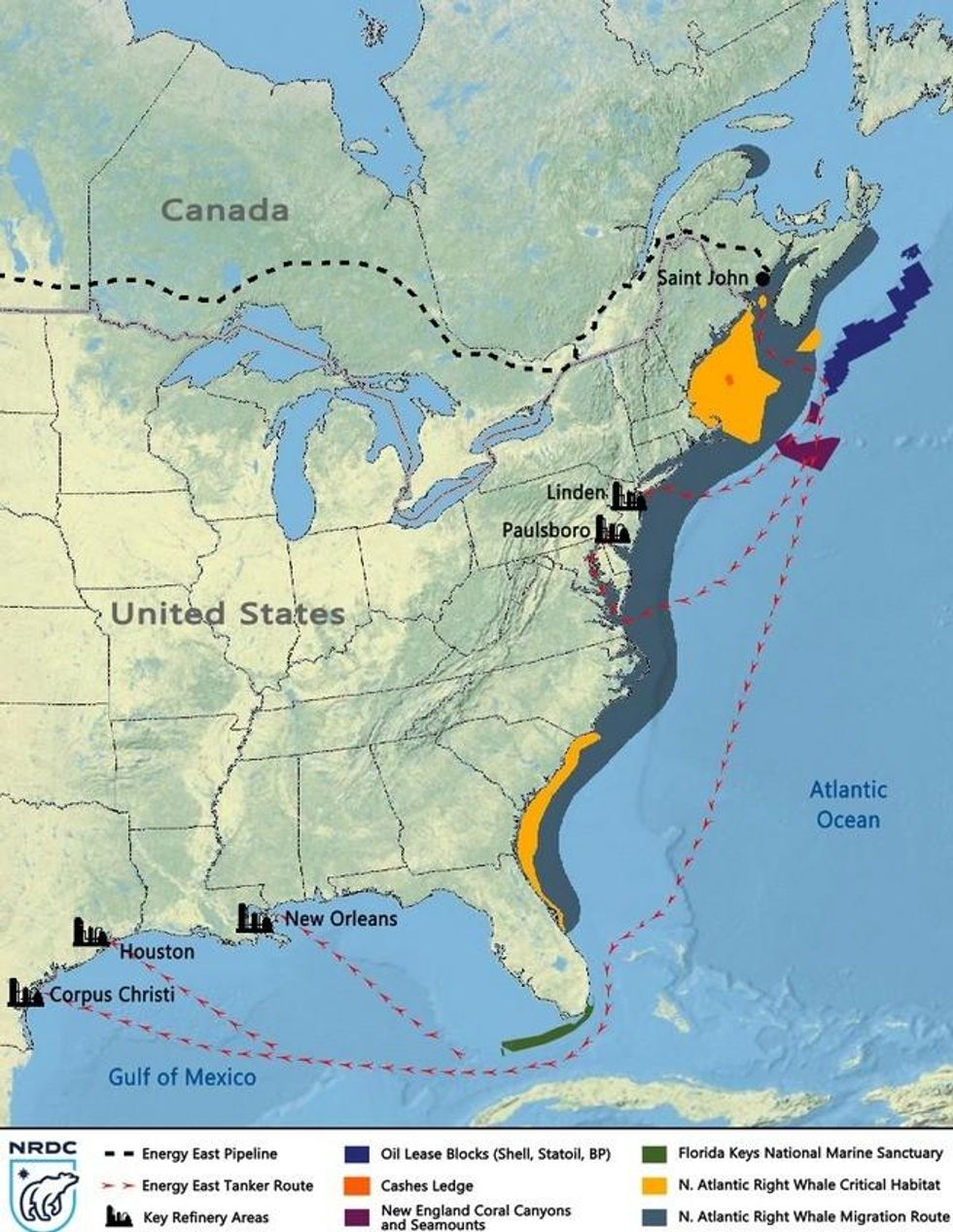
Indeed, the group notes that the Gulf of Maine, Acadia National Park, and the Florida Keys are all in the pipeline's "crosshairs," as well as iconic marine species and billion dollar commercial fisheries on the East Coast, including New England and Atlantic Canada's lobster and sea scallops fisheries.
And that's on top of the pipeline's climate impacts; according to the NRDC analysis, Energy East would bring a significant increase in carbon pollution--equivalent to the annual emissions of as many as 54 million passenger vehicles--and lock in high-carbon infrastructure expected to operate for at least 50 years.
"TransCanada's Energy East proposal is truly Keystone XL on steroids," said Joshua Axelrod, a co-author of the report and NRDC policy analyst. "It's all risk and no reward for millions of Canadians and Americans, iconic landscapes, valuable fisheries and our climate."
With the report, entitled Tar Sands in the Atlantic Ocean: TransCanada's Proposed Energy East Pipeline (pdf), the NRDC joins a chorus of existing Energy East opponents.
The project is currently under consideration by the National Energy Board (NEB), with hearings expected to begin in Saint John, New Brunswick, on August 8.
In making its argument, the NRDC leans on a 2016 study by Canada's National Academy of Sciences (NAS), which found that large portions of diluted bitumen--which Energy East would transport--can be expected to sink if spilled in water. The same report found that current regulations and spill response techniques are incapable of managing the unique behavior and higher risks of tar sands diluted bitumen spill in water.
A press statement (pdf) from Greenpeace Canada notes that the NEB refused to consider the same NAS study in its Kinder Morgan pipeline analysis.
"To be at all credible, the National Energy Board must give the NAS study a central role in its review of Energy East," said Matt Abbott of the Conservation Council of New Brunswick.
Meanwhile, the NRDC is calling for a tar sands oil tanker moratorium in U.S. and Canadian waters until appropriate spill response techniques are developed to address a diluted bitumen spill into water.
But beyond that, many say the pipeline simply should not be built. Pointing to the devastating pipeline leak that flooded the North Saskatchewan River with 200,000 liters of tar sands crude last week, the Council of Canadians on Monday warned that spills are "inevitable and permanent consequences of transporting oil."
"When thinking about the future we want, let us remember that the proposed Energy East pipeline crosses 90 watersheds, nearly 3000 waterways, and puts the drinking water of over 5 million people at risk along its route," wrote energy and climate justice campaigner Daniel Cayley-Daoust.
Since I last visited Canada to share my experiences dealing with TransCanada as a rancher along the proposed Keystone XL path, and as a member of Bold Nebraska, a lot has changed. President Obama has since put the final nail in the coffin of Keystone XL, listening to the voices of ranchers, Indigenous communities and climate activists united in their opposition to the tar sands, or oil sands, pipeline.
I've watched as Energy East has increasingly come under the kind of fire Keystone XL experienced, the most recent example being a Quebec farmers union representing over 41,000 farmers and 28,000 farms which declared their opposition to the project earlier this month.
Many of the same risks we successfully prevented by blocking Keystone XL are inherent to Energy East. And similar to our experience, many of the myths supporting Energy East are beginning to crumble.
When I last visited New Brunswick I saw for myself the beauty of your land, including the many waterways Energy East would cross.
I have since learned the drinking water of over 130,000 New Brunswick residents would be at risk from an Energy East pipeline spill. Energy East would carry 1.1 million barrels per day of tar sands diluted bitumen. The prospect of a spill is daunting.
The U.S. National Academy of Sciences recently released the most comprehensive review of diluted bitumen yet conducted, confirming it sinks quickly and sticks to everything it touches, making cleanup far more expensive and difficult.
Last year a mandatory inspection on TransCanada's Keystone 1 pipeline in the U.S. revealed an area that was 95 per cent corroded, leaving it literally paper thin. The pipeline was not yet two years old! This is consistent with the concerns Evan Vokes, a former TransCanada pipeline engineer come whistleblower, has expressed about TransCanada's sloppy pipeline safety track record.
This is a key reason why I, and many of my neighbours - ranchers, not activists - got involved: to protect our water from a massive tar sands spill. Keystone XL was proposed to pass right through the Nebraska Sandhills, a unique and fragile ecosystem that overlies the Ogallala Aquifer, a critically important water source we all depend on.
We too heard that Keystone XL would reduce dangerous oil-by-rail traffic. However, tar sands crude won't end up on trains because shipping it from Alberta to Saint John by rail is now cost-prohibitive due to dropping oil prices.
This can change, and a rally in the market price for tar sands and U.S. fracked oil would increase pressure for any and all export paths, but ultimately we need to deal with the problem at the source.
That means stopping further expansion and seeing government and industry step up to support just transition programmes for impacted workers to a green economy.
Energy East, like Keystone XL, is about getting tar sands crude to international markets, not serving domestic supply. Irving Oil President Ian Whitcomb recently confirmed in the Financial Post that Energy East would not cause the Saint John refinery to reduce their low-cost imports of oil from Saudi Arabia. An independent report found up to 1 million of the 1.1 million barrels is destined for export.
TransCanada will be quick to talk about all of the jobs it claims its pipeline will create. We discovered pretty quickly that these numbers were inflated and most jobs would be short-term. Recent independent reports commissioned for Ontario and Quebec on Energy East's economic benefits have similarly found TransCanada's promises overblown.
When ranchers started talking to each other we quickly discovered TransCanada representatives were saying one thing to one landowner and something completely different to another. TransCanada threatened some with eminent domain (the U.S. version of land expropriation) to pressure them into signing easement agreements.
Some chose to work towards ensuring easement agreements were as fair and just as possible in protecting landowners' rights. Some refused to sign. Others focused on a legal challenge to the flagrantly unjust so-called right of corporations to take away people's land through eminent domain.
We all stood side by side in our opposition to Keystone XL. We joined forces with Indigenous communities through the Cowboy Indian Alliance and with climate activists to tell Obama Not On Our Land, and Not On Planet Earth - from NIMBY to NOPE. President Obama listened to us. I am heartened to see the same conditions developing in opposition to Energy East.
Indigenous people in Canada are rising up together in greater numbers than ever before to oppose tar sands pipelines on their traditional territory, forming fierce coalitions to oppose pro-oil regional governments and fossil fuel industry officials who are pushing for more tar sands infrastructure.
"An alliance of indigenous nations, from coast to coast, is being formed against all the pipeline, rail and tanker projects that would make possible the continued expansion of tar sands," Grand Chief Serge Otsi Simon of the Mohawk Kanesatake First Nation wrote to the Quebec premier in a letter dated March 9 and obtained this weekend by the Montreal Gazette, which reported on it Monday.
"The Mohawks of Kanesatake will not be brushed aside any longer."
--Grand Chief Serge Otsi SimonThe Mohawk First Nation, located in southwest Quebec, is leading the charge against the controversial Energy East pipeline. The TransCanada pipeline would transport 1.1 million barrels of dirty "dilbit" a day from Alberta's tar sands mines to East Coast ports, making it the largest proposed tar sands pipeline to date.
Simon's letter promised that the Mohawk nation would "do everything legally in its power" to block the pipeline's construction, according to the Montreal Gazette.
The Montreal Gazette reports:
Simon...argues pipeline companies are not to be trusted; their promised automatic spill detection systems have proven unreliable and the number of long term jobs created by such projects exaggerated.
"One need look no further than the Nexan pipeline rupture this past summer, which caused one of the worst spills in Canadian history," Simon writes, adding sections of TransCanada's Keystone 1 pipeline are 95 per cent corroded after only two years in operation.
Simon says the Energy East pipeline would pass directly through Mohawk lands including the Seigneury of the Lake of Two Mountains and the Outaouais River in violation of treaty rights. The risk of toxic spill is significant, he says.
The Mohawk nation's opposition to Energy East might feel particularly resonant to Canadian observers, as the First Nation suffered greatly and made international headlines for its opposition to a private project on its territory over 25 years ago. The Quebec government had allowed a golf course to be built atop a sacred Mohawk burial ground and dismissed on a technicality the First Nation's attempt to go through the courts to protect its land. The resulting 78-day armed standoff, known as the Oka crisis, turned the inadequacies of First Nations consultation into a national concern for the first time in Canada's history.
Today, over 100 First Nations from all over Canada, including some as far away as British Columbia--who are deeply involved in their own pipeline battles--have joined the Mohawk Kanesatake in their fight against Energy East, according to social justice group the Council of Canadians.
"We unanimously oppose the Energy East Pipeline Project in order to protect our non-ceded homeland and waterways, our traditional and cultural connection to our lands, waterways, and air."
--Grand Chief Ron Tremblay, Wolastoq First Nation
"Besides the official opposition of the Assembly of First Nations Quebec and Labrador representing 43 Quebec chiefs," the Montreal Gazette reported, "the list against TransCanada's pipeline now includes the Union of British Columbia Indian Chiefs...and the Iroquois Caucus regrouping Mohawk nations in Quebec and Ontario."
In February of this year, Grand Chief Ron Tremblay of the Wolastoq First Nation said that "As members of the Wolastoq Grand Council we unanimously oppose the Energy East Pipeline Project in order to protect our non-ceded homeland and waterways, our traditional and cultural connection to our lands, waterways, and air." The Walastoq Grand Council "asserts Indigenous Title over the lands and waters within the entire Saint John River watershed," the Council of Canadian observes.
"The Trudeau government has pledged to fully implement the United Nations Declaration on the Rights of Indigenous Peoples," writes Brent Patterson, political director of the Council of Canadians. "That declaration acknowledges the right to 'free, prior and informed consent', which extends beyond the 'duty to consult' with Indigenous peoples. But just last week the Canadian Press reported that federal natural resources minister Jim Carr says he shares a 'common objective' with those who want to see the Energy East pipeline built."
Quebec has been holding a series of environmental hearings for the past week on the Energy East pipeline, during which TransCanada acknowledged that it would take five to 10 years to clean up a groundwater-contaminating spill from the proposed pipeline.
The Mohawks of Kanesatake have publicly opposed the pipeline for several years, and in his letter Simon writes that they have still not been approached or consulted on it by TransCanada.
"One thing for sure," Simon wrote in his March 9 letter, "we the Mohawks of Kanesatake will not be brushed aside any longer and we wish to press upon you that we reserve the right to take legal action if necessary to prevent the abuse of our inherent rights."
Simon discussed his First Nation's opposition to the project in depth in a video released in 2014:
Sparking outcry from environmentalist and Indigenous groups, Justin Trudeau took a pro-oil stance and argued for more controversial pipelines to carry Canada's dirty tar sands oil to coastal ports in comments at a sustainability conference in Vancouver on Wednesday.
"We want the low-carbon economy that continues to provide good jobs and great opportunities for all Canadians," said Canada's Liberal prime minister, as Elizabeth McSheffrey reported in the National Observer. "To get there, we need to make smart strategic investments in clean growth and new infrastructure, but we must also continue to generate wealth from our abundant natural resources to fund this transition to a low-carbon economy."
However, Green party leader Elizabeth May said at the same conference, "If you have an economic strategy for the oilsands that are premised on high volumes of export on the low-value product, you both ship jobs off-shore and drive up greenhouse gases. Those are inconsistent aims."
The Global Series 16 conference centers on sustainability and business, describing itself as "North America's Largest Environmental Business Summit." All of Canada's premiers are attending the talks on sustainability and business from March 2-3.
In contrast to the prime minister's attempt to make an economic argument for pipelines, social justice group the Council of Canadians noted that "the average renewable energy investment creates four times as many jobs as the same investment in the fossil fuel economy," as the group called for more renewable energy jobs on Thursday.
The prime minister's statements were made only months after he declared, "Canada is back, my good friends," to delegates at the COP21 climate conference in Paris in November. This signaled what activists hoped would be a transition to a more sustainable Canada as he signed the historic commitment to keep global warming below 1.5 degrees Celsius.
Trudeau's party's campaign was built on the Liberals' opposition to his pro-oil predecessor, Stephen Harper, who heartily supported the nation's controversial tar sands industry that critics saw as primarily responsible for the country's failure to uphold the terms of previous climate change agreements.
During his campaign, Trudeau emphasized his condemnation of the Northern Gateway pipeline, which would have transported tar sands oil to the B.C. coast. However, activists still lobbied Trudeau to take a stricter position on pipelines after his party ousted Harper's Conservatives in October, as the young prime minister's stance was unclear.
Trudeau did announce harsher environmental reviews for the projects in December. Still, his promises appeared to lack teeth when a federal audit uncovered "systematic failures" within the country's National Energy Board that conducts the pipeline approval process.
The prime minister's talk in Vancouver this week marked a shift from the grand promises made in Paris: "The choice between pipelines and wind turbines is a false one," Trudeau argued, according to the Vancouver Sun. "We need both to reach our goal."
After his talk, the National Observer reported, Trudeau refused to answer reporters' questions about the growth in tar sands mining that would inevitably be fueled by the construction of new pipelines.
A Ricochet editorial charged Thursday:
The prime minister is wrong. Hard choices must be made, between the interests of fossil fuel corporations and the possibility of a decent collective future for Canadians and people all over the world.
First Nations also criticized Trudeau on Wednesday. According to the Aboriginal Peoples Television Network (APTN), Aboriginal leaders stormed out of a climate meeting with the prime minister after it "fell to shambles. " Athabasca Chipewyan First Nation Chief Allan Adam lamented that "the meeting didn't include any talks of taking care of mother earth," APTN reported, and "instead, the focus was placed on economic development and transitioning to a green economy."
On Thursday, the prime minister will meet with Canada's premiers to create a national climate plan. A 350.org campaign manager argued that Canada can achieve a 100% renewable energy economy that honors Indigenous rights, but "only if the government listens to people, not pipeline companies and big polluters."
With the December Paris climate agreement, leaders and experts from around the world showed they overwhelmingly accept that human-caused climate change is real and, because the world has continued to increase fossil fuel use, the need to curb and reduce emissions is urgent.
In light of this, I don't get the current brouhaha over Kinder Morgan, Keystone XL, Northern Gateway or the Energy East pipelines. Why are politicians contemplating spending billions on pipelines when the Paris commitment means 75 to 80 per cent of known fossil fuel deposits must be left in the ground?
Didn't our prime minister, with provincial and territorial premiers, mayors and representatives from non-profit organizations, parade before the media to announce Canada now takes climate change seriously? I joined millions of Canadians who felt an oppressive weight had lifted and cheered mightily to hear that our country committed to keeping emissions at levels that would ensure the world doesn't heat by more than 1.5 C by the end of this century. With the global average temperature already one degree higher than pre-industrial levels, a half a degree more leaves no room for business as usual.
The former government's drive to make Canada a petro superpower distorted the Canadian economy into greater fossil fuel dependence, with catastrophic consequences when the price of oil collapsed. The lesson should have been learned long ago: Heavy dependence on a single revenue stream like fish, trees, wheat, minerals or even one factory or industry is hazardous if that source suffers a reversal in fortune like resource depletion, unanticipated cost fluctuations or stiff competition.
Coal stocks have already sunk to the floor, so why is there talk of building or expanding coal terminals? Low oil prices have pushed oilsands bitumen toward unprofitability, so why the discussion of expanding this carbon-intensive industry? Fracking is unbelievably unsustainable because of the immense amounts of water used in the process, seismic destabilization and escape of hyper-warming methane from wells. Exploration for new oil deposits -- especially in hazardous areas like the deep ocean, the Arctic and the Arctic National Wildlife Refuge and other critical wildlife habitat -- should stop immediately.
Pipeline arguments are especially discouraging, with people claiming Quebec is working against the interests of Alberta and Canada because the leadership of the Montreal Metropolitan Community -- epresenting 82 municipalities and nearly half the province's population -- voted overwhelmingly to reject the proposed Energy East pipeline project, which would carry 1.1 million barrels of oilsands bitumen and other oil products from Alberta to refineries and ports in the east. Some have thrown out the anti-democratic and, frankly, anti-Canadian notion that because Quebec has received equalization payments it should shut up about pipeline projects.
National unity is about steering Canada onto a sustainable track and looking out for the interests of all Canadians. Continuing to build fossil fuel infrastructure and locking ourselves into a future of increasing global warming isn't the way to go about it. Shifting to a twenty-first century clean-energy economy would create more jobs, unity and prosperity -- across Canada and not just in one region -- than continuing to rely on a polluting, climate-altering sunset industry. Leaders in Quebec should be commended for taking a strong stand for the environment and climate -- and for all of Canada.
The Paris target means we have to rethink everything. Energy is at the heart of modern society, but we have to get off fossil fuels. Should we expand airports when aircraft are the most energy-intensive ways to travel? Why build massive bridges and tunnels when we must transport goods and people differently? The global system in which food travels thousands of kilometres from where it's grown to where it's consumed makes no sense in a carbon-constrained world. Agriculture must become more local, so the Peace Valley must serve as the breadbasket of the North rather than a flooded area behind a dam.
The urgency of the need for change demands that we rethink our entire energy potential and the way we live. It makes no sense to continue acting as if we've got all the time in the world to get off the path that created the crisis in the first place. That's the challenge, and for our politicians, it's a huge task as well as a great opportunity.
Elected officials across Canada are locking horns over TransCanada's proposed Energy East tar sands pipeline, after the Montreal Metropolitan Community, which represents 82 municipalities, decided unanimously to fight the project because its economic benefits for Quebec would pale in comparison to the possible clean-up costs of a spill.
The proposed pipeline would take Alberta tar sands oil as far east as an Irving Oil refinery in Saint John, New Brunswick, and would be capable of carrying up to 1.1 million barrels a day from west to east. In a blog post outlining its dangers earlier this week, Natural Resources Defense Council (NRDC) senior policy analyst Danielle Droitsch referred to the project as "Keystone Redux." It faces staunch opposition from environmental groups, First Nations communities, and now, Montreal-area leaders.
"Trudeau already said that pipelines projects must be accepted by the local communities before they get approved,. MMC's decision is a clear no to TransCanada's project, which means that it cannot go forward."
--Patrick Bonin, Greenpeace Canada
"They didn't do their homework, obviously," Montreal Mayor Denis Coderre said of TransCanada, vowing to oppose the company's proposal at hearings by provincial and national energy boards. "They were a bit arrogant, frankly. Let's call a spade a spade: It's a bad project."
On Thursday, Greenpeace Canada climate and energy campaigner Patrick Bonin said (pdf) the Montreal Metropolitan Community's (MMC) decision "proves once more that Energy East is a very risky project that is not acceptable to Quebecers and is incompatible with the plan to build a 100 percent renewable energy future."
As others have been doing all week on the opposite side of the country, Bonin called on Prime Minister Justin Trudeau to "keep his promise to reform the environmental assessment procedures in Canada and ensure that the evaluation of this pipeline will not go forward until the process put in place under the Harper government is reformed."
"Trudeau already said that pipelines projects must be accepted by the local communities before they get approved," Bonin pointed out. "MMC's decision is a clear no to TransCanada's project, which means that it cannot go forward."
According to CBC News on Thursday, "Trudeau's support for Energy East has not been clear."
However, citing public opinion polls that show most residents are now opposed to the pipeline across eastern Canada, Environmental Defence's Adam Scott said the project "appears to be dead in the water, even before the regulatory review has started."
But politicians from three provinces with big stakes in the project--Alberta, Saskatchewan, and New Brunswick--were quick to slam the MMC's decision, with one Alberta party leader accusing Coderre of hypocrisy.
"Montreal buys millions of barrels of foreign oil from dictatorships, but it is rejecting oil from their friends in Confederation," declared Wildrose Leader Brian Jean in a statement. "It's disgraceful!"
"Well, he's wrong, it's as simple as that," Calgary Mayor Naheed Nenshi said of Coderre CBC News Network's Power & Politics.
Meanwhile, Alberta Premier Rachel Notley met on Friday with her Ontario counterpart, Kathleen Wynne, in an attempt to win her support for Energy East.
"This massive pipeline threatens to unleash enough carbon pollution to undo Ontario's progress in phasing out coal. It is entirely incompatible with Prime Minister Trudeau's support for a 1.5 degree limit on global warming affirmed in Paris."
--Andrea Harden-Donahue, Council of Canadians
According to CBC News:
On the topic of pipelines, Notley advocated for the approval of the Energy East pipeline, saying that it is safest and best option, despite the opposition from some Canadian politicians such as Montreal Mayor Denis Coderre.
"Frankly, municipal leaders who don't see that are being short-sighted," said Notley. "This pipeline is part of building a strong Canada, it's part of building a strong economy."
But Environmental Defence took the opportunity to remind Wynne that the "pipeline proposal fails to meet any of the reasonable conditions her own government put in place to safeguard Ontario residents."
"We call on Premier Wynne to follow the example of other Canadian leaders," said Scott. "Last week B.C. Premier Christy Clark publically opposed the Kinder Morgan pipeline and tanker proposal. Yesterday, all Montreal area mayors stood up for the safety and security of the citizens they represent."
He continued: "Energy East is not in the best interests of Ontario and does not meet the conditions set out by Premier Wynne. The majority of Ontarians oppose this project. Ontario should not support this project."
Mark Calzavara, Ontario-Quebec regional organizer with the Council of Canadians, went even further. "Premier Wynne is not listening to Ontarians or the Ontario Energy Board," he said. "Wynne is sweeping legitimate concerns about TransCanada's performance and plans under the rug. The Ontario Energy Board's review of Energy East found the project's risks outweigh the benefits for Ontario."
Added Andrea Harden-Donahue, energy and climate campaigner with the Council of Canadians: "This massive pipeline threatens to unleash enough carbon pollution to undo Ontario's progress in phasing out coal. It is entirely incompatible with Prime Minister Trudeau's support for a 1.5 degree limit on global warming affirmed in Paris."
In the wake of the Paris climate talks, environmental groups on Thursday called for a "People's Injunction" against corporate proposals for major pipelines across Canada, charging that the resultant boom in tar sands extraction would be incompatible with Prime Minister Justin Trudeau's stated commitment to keeping global warming under 1.5 degrees Celsius.
TransCanada announced on Thursday that it "has filed an amendment to its existing application with the National Energy Board" to build the Energy East pipeline that would stretch from eastern to western Canada. The company claims that the proposed changes, at a cost hike of 30 percent, include "route and scope changes that come in direct response to efforts to avoid sensitive environmental areas."
But a coalition of green groups, including Council of Canadians and Ecology Ottawa, declared Thursday that the pipeline must not be built at all.
"Estimates show the upstream production emissions of the pipeline, in Alberta alone, would be as high as 32 million metric tons of [carbon dioxide equivalent] a year, or 7 million new vehicles, while total life-cycle emissions are estimated at a staggering 220 million metric tons per year--more than what's allowable under the new climate pledge," the organizations warned in a joint statement.
"If Canada wants to be taken seriously on the world's stage, then the first step is keeping their climate promises here at home."
--Aurore Fauret, 350.org
"The climate math for building Energy East doesn't add up," said Andrea Harden-Donahue of the Council of Canadians. "Trudeau's Liberal government has agreed with world leaders in Paris to limit warming to 1.5deg Celsius, a target that will require a rapid transition to a fossil free future, definitely not a new massive tar sands pipeline. The action on the ground starts now."
Indigenous communities along the proposed route of Energy East have staged numerous protests and acts of civil disobedience against the pipeline, which would cut through their land and endanger their waterways and public health. "Our Anishinaabe laws and values tell us everything we need to know about Energy East; that is why we say no," Chief Fawn Wapioke of Iskatewizaagegan, Shoal Lake 39 First Nation, declared this summer at an Indigenous march along the proposed route.
Meanwhile, the U.S.-based corporation Kinder Morgan this week filed a written argument to Canadian regulators seeking permission to build the Trans-Mountain Pipeline to ship crude oil from Alberta to British Columbia.
"Whether it's TransCanada's Energy East filing, or Kinder Morgan's pushing for the Trans-Mountain pipeline at the National Energy Board in Calgary... we know that neither project can be built if this government is going to have a shot at keeping temperature rise below 1.5 degrees Celsius," said Aurore Fauret of climate group 350.org in a statement released on Thursday.
"That's why today we're launching the 'People's Injunction' to stop Prime Minister Trudeau and his government from breaking their first big climate promise and allowing these two pipelines to proceed at the National Energy Board without considering their climate impacts and without listening to community voices--especially First Nations," Fauret continued. "If Canada wants to be taken seriously on the world's stage, then the first step is keeping their climate promises here at home."
Just last month, a coalition of climate groups called on Trudeau to immediately halt and address the country's "costly, broken" pipeline review process--a promise he made on the campaign trail.
In a public pledge, organizers warned that if Trudeau doesn't "honor his word by January 15th, then we, the people, will take action to enforce this 'People's Injunction.'"
On the same day that US President Barack Obama rejected the proposed 830,000 barrel per day Keystone XL pipeline, highlighting that approving the pipeline would undermine efforts to curb greenhouse gas emissions, the government of Canadian Prime Minister Justin Trudeau came out in support of the larger 1.1 million barrel per day Energy East pipeline.
Friday began with Obama's comment that Trudeau was "disappointed" in his decision to formally reject Keystone XL.
And then despite the scientific reality that 85 percent of the tar sands must stay in the ground to limit global warming to below 2 degrees Celsius, Foreign Affairs Minister Stephane Dion came out in support of the Energy East pipeline, a further expansion of the tar sands, and said that more rigorous environmental reviews will help facilitate the construction of pipelines and the export of Canadian oil.
The Globe and Mail reports, "Mr. Dion said Ottawa must put in place sufficiently rigorous environmental assessment, and deploy enough clean-energy production, to dispel any impression that the Canadian oil sector is a pariah to be avoided. 'And then our product and goods will be welcome everywhere', he said. ...The Liberals under Mr. Trudeau have supported TransCanada Corp.'s Keystone project, which offered Canadian oil producers a bigger conduit to ship their product to the U.S. market, but Mr. Dion said they also back another TransCanada crude export proposal: the Energy East pipeline."
The newspaper adds, "There has been confusion over the Liberal policy on Energy East, which would ship oil for export to a New Brunswick port terminal, but Mr. Dion said the government is willing to get behind the project. 'We support this ... but we want that to be done properly and it will be difficult to do if we don't strengthen the process itself, the process of consultation with communities and the process of scientific environmental assessment.'"
Reuters also reported, "Canadian foreign minister Dion: disagrees with those environmentalists who oppose any expansion of oil sands; 'We want sustainable development.'" Dion stated, "We didn't say we will close the shop and then we will not have any pollution. We believe in development but it must be sustainable, including for the oil sands. It's a challenge but we'll do it with the industry, with the province of Alberta, we'll do it altogether, we have no choice."
Dion's support for Energy East is significant particularly given he chairs the powerful Environment, Climate Change and Energy cabinet committee.This cabinet committee, "considers issues concerning sustainable development, the stewardship of Canada's natural resources, environment, energy, water and Canada's contribution to addressing climate change."
The Globe and Mail's chief political writer Campbell Clark comments, "Eventually, however, the new Prime Minister will face a domestic version of Keystone's cross-border saga focused on the Energy East pipeline.... And since Mr. Trudeau has more or less said it is his duty to get Alberta oil to tidewater, that increases pressure on him. The route to the Gulf of Mexico is officially out. Mr. Trudeau opposed Northern Gateway, the main route to the Pacific. That leaves only the route to the Atlantic, the proposed Energy East pipeline. And the Keystone-like battles over that project are really just starting."
And Clark highlights, "[Keystone's] proposed route across the Ogallala Aquifer in Nebraska was one spark for local concerns; Energy East would cross several waterways, raising local qualms. Several First Nations oppose it. An Ontario report said the risks outweigh the benefits for the province. And the developer of both pipelines, Trans-Canada Corp., just abandoned plans to build a marine export terminal at Cacouna, Que., prompting Premier Philippe Couillard to suggest it makes the pipeline's approval less likely." He suggests that Trudeau's task now is to strengthen the environmental review process sufficiently to "reassure opponents and increase acceptance of pipelines", while at the same time ensuring that "some pipeline-to-tidewater project will one day get through it."
Clark concludes, "The new Prime Minister can turn the page on Keystone, and use it to back his climate policies and a fresh start with Mr. Obama. But now Mr. Trudeau will bear the responsibility as the centre of high-profile pipeline politics moves from Washington to Ottawa."
The Council of Canadians was committed to stopping the Keystone XL pipeline (which would have produced 22 million tonnes of greenhouse gas emissions a year) and we are equally committed, if not more so, to stopping the Energy East pipeline (which would produce 32 million tonnes of greenhouse gas emissions a year).
The Council of Canadians has called for a freeze on new tar sands extraction projects (no new approvals); the rejection of new infrastructure (pipelines, marine and railway terminals) that would lock us into increased extraction for decades to come; a new Sustainability Assessment Act that would ensure all proposed projects are assessed on the basis of their individual and cumulative impacts, their upstream and downstream climate pollution, and whether or not the project has First Nation consent; and the achievable goal of a 100 clean economy by 2050.
The Council of Canadians will be at the Climate Welcome gathering to remind the Prime Minister about the impacts pipelines and climate change have on waterways across this country.
For more on our campaign to stop Energy East, please click here.
An investigation by CBC News into the relationship between the University of Calgary and Canada's largest pipeline company has revealed "a university bending over backward to accommodate the apparent public relations ambitions of a corporate patron."
According to reporters Kyle Bakx and Paul Haavardsrud, emails obtained from a freedom of information request suggest "a pattern of corporate influence during the bungled attempt to establish a new research center that cost the university top level academic talent and its Haskayne School of Business upwards of a million dollars in corporate sponsorship."
"Most damningly it smacks of us being apologists for the fossil fuel industry rather than independent scholars and teachers doing work in broadly defined area."
--U of C professor Harrie Vredenburg
To establish the Enbridge Center for Corporate Sustainability at U of C, the corporation behind controversial pipeline proposals including Energy East and Northern Gateway reportedly pledged $2.25 million over a 10-year period.
The benefits for the company "seemed straightforward," write Bakx and Haavardsrud:
A series of industry pipeline spills were not doing the company any favours. If the centre could help to win hearts and minds for its existing operations or a major new project like the Northern Gateway pipeline, which was grinding through a controversial regulatory review and months of contentious public hearings, then presumably it would be a few million dollars well spent.
When viewed through the lens of the outrage caused by oil spilling into a pristine Midwest river--one of the largest inland oil spills in U.S. history--a partnership between the U of C and Central Michigan University, which some would argue makes little sense on paper, becomes much more understandable.
What the company wanted in return, however, raised some eyebrows.
CBC reports:
Beyond naming rights, Enbridge sought to influence board memberships, staffing and the type of students that would be considered for awards, the emails show.
The company hired its own public relations firm to publicize the centre's launch, and also wanted "customized opportunities" for Enbridge executives and clients to meet with researchers at the U of C's Haskayne School of Business.
"Enbridge is doing too much tune calling, in my view, to the point that the Center's usefulness to [Haskayne school] academics is being sacrificed to Enbridge's PR objectives," business professor Harrie Vredenburg wrote in a 2012 email complaint to Leonard Waverman, the dean of the Haskayne School of Business at the time.
"Most damningly," Vredenburg added, "it smacks of us being apologists for the fossil fuel industry rather than independent scholars and teachers doing work in broadly defined area."
"I am not sure what we are signing up for," U of C's Svare chair in applied decision research, professor Joe Arvai, wrote in a separate email to Waverman in 2012. "I have the impression that Enbridge sees the centre as a PR machine for themselves, whereas I see it as an academic research centre."
Arvai, who had been tapped to head the new venture, stepped down as the head of the Enbridge center before its launch. He has since left U of C for the University of Michigan.
Based on conversations he had "with many people who were involved, including Joe," climate scientist and former U of C professor David Keith told CBC that Arvai was removed as director of the center "before its formation at the specific request of Enbridge."
Last fall, CBC reports, Enbridge's name was taken off the center--it is now just the Center for Corporate Sustainability. Under a revised agreement, the company also dropped its funding to the school by one million dollars. Enbridge continues to sponsor the center's seminar series, as well as arrangements with several other university departments.
Such conflicts of interest, however, are sure to keep cropping up. As Bakx and Haavardsrud write, "corporate money is becoming a more critical part of the funding model for Canadian universities as they no longer receive the same level of financial support from government as they once did."