

SUBSCRIBE TO OUR FREE NEWSLETTER
Daily news & progressive opinion—funded by the people, not the corporations—delivered straight to your inbox.
5
#000000
#FFFFFF
To donate by check, phone, or other method, see our More Ways to Give page.
Daily news & progressive opinion—funded by the people, not the corporations—delivered straight to your inbox.
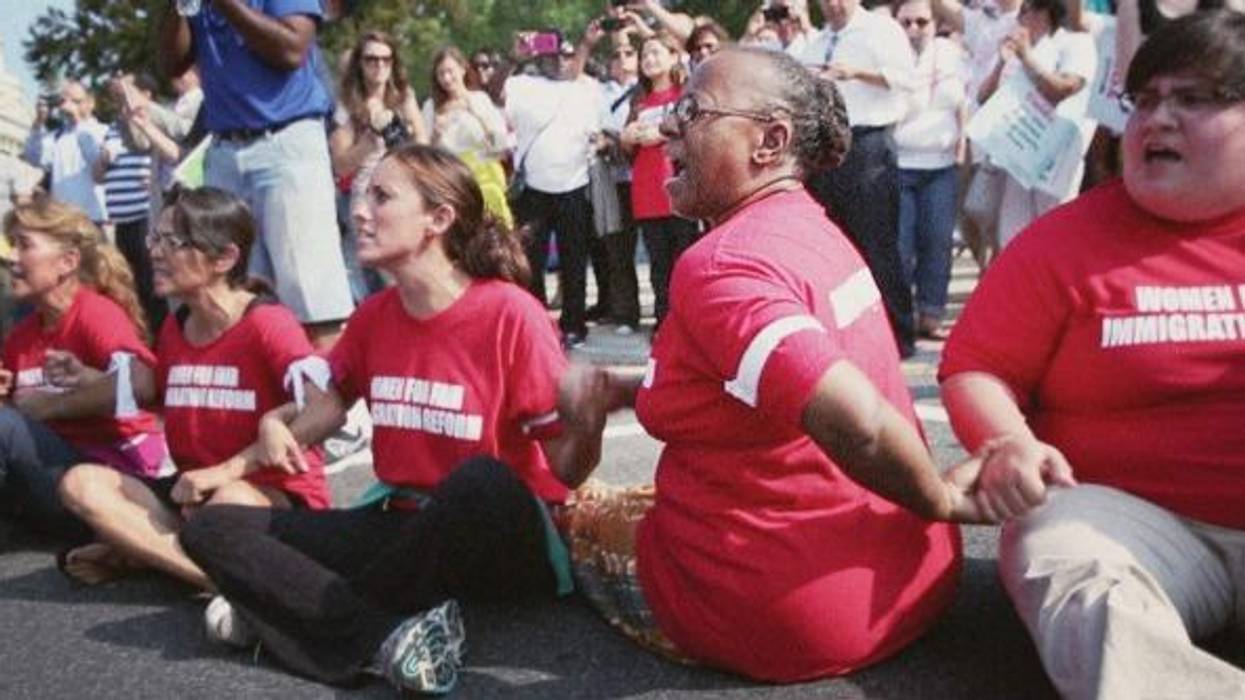
"We need to know the full extent of Senator Obama's relationship with ACORN," said Senator John McCain in his third presidential debate with Barack Obama in October 2008. ACORN, he said, "is now on the verge of maybe perpetrating one of the greatest frauds in voter history in this country, maybe destroying the fabric of democracy."
By early 2010, ACORN had closed its doors, a victim of an orchestrated assault by right-wing media and politicians, as well as some self-inflicted wounds.
Obama had briefly worked with ACORN on voter registration drives when he practiced civil rights law in Chicago. The group's leaders believed that, once Obama was in the White House, ACORN would become an even more influential group. But they hadn't anticipated the fusion of right-wing forces that brought ACORN down.
Had ACORN still been around in 2016, it might have prevented a real threat to democracy--Donald Trump--from becoming president. ACORN had developed a finely honed grassroots approach to registering voters and getting them to the polls. By putting its operation to work in Wisconsin, Pennsylvania, and Michigan--where Trump beat Hillary Clinton by only 77,000 votes to win the Electoral College--ACORN might have changed the outcome.
In their recent documentary ACORN and the Firestorm, Reuben Atlas and Sam Pollard not only reveal how the mighty ACORN fell but also show how the attack on ACORN was a dress rehearsal for our current toxic political culture, including the rise of Donald Trump and the alt-right.
Through archival clips and interviews with ACORN staffers, leaders and members, friendly and hostile politicians, and political analysts, the film recounts the group's history, starting with its founding in Arkansas in 1970 by Wade Rathke, a charismatic and brazen young organizer.
In addition to registering millions of voters, ACORN assisted the working poor to buy homes and avoid foreclosure, challenged banks' racist and predatory lending practices, stopped companies from spewing cancer-causing pollution in low-income neighborhoods, got local governments to fix up abandoned buildings that had become havens for crime, and fought for fair treatment by employers, landlords, insurance companies, and government. ACORN led the campaign to get Congress to strengthen the anti-redlining Community Reinvestment Act. It organized the victims of Hurricane Katrina to gain a voice in the rebuilding of the Gulf Coast. It spearheaded the living-wage movement in more than 100 cities and helped make the federal Earned Income Tax Credit an effective anti-poverty program.
By 2008, ACORN had more than 1,000 staffers and 400,000 dues-paying members, recruited by door-to-door canvassers, with chapters in 110 cities in forty states, making it the largest grassroots anti-poverty organization in the country. In the film, we see ACORN members engaged in protests, civil disobedience, lobbying, voter registration, and meetings with politicians.
Unlike many liberal do-gooders, ACORN didn't assume it knew what poor people wanted or needed. Maude Hurd, an ACORN leader from Boston, recalled her first encounter with an organizer. "People always knocking on my door telling me what the problems were," she said. "ACORN was different. When they knocked on my door, they asked me."
In the film's opening scene, we meet a burly bearded white man named Tavis, who looks like a character in Duck Dynasty and who has a Confederate flag folded across some chairs in the front yard of his house in rural Florida. ("Heritage not hate," he explains. "I don't fly it because I don't want to make nobody mad.") He says he voted for Reagan and Bush, but he swears loyalty to ACORN for helping him save his house from foreclosure after his wife lost her job and they got behind on their mortgage payments.
"The idea of ACORN is to stand up for the oppressed, the poor, the people who were taken advantage of," he explains.
For years, banks, the restaurant and other low-wage industries, and other business groups attacked ACORN, but in the early 2000s they were joined by the Republican establishment and the burgeoning right-wing media. ACORN was unprepared for the onslaught.
When McCain attacked ACORN on national TV in his debate with Obama, ACORN leader Bertha Lewis was thrilled "just to hear our names mentioned," she says in the documentary. "I thought it was great. Well, little did I know. Forty years of work called into question by one little video."
That "one little video"--actually, several videos--was made by two amateur activists, twenty-five-year old James O'Keefe and twenty-year old Hannah Giles, who met via Facebook. Their project was promoted by a little-known right-wing agitator named Andrew Breitbart.
As the documentary describes, O'Keefe and Giles took their undercover hidden camera into at least a half-dozen ACORN offices around the country and sought to lure staffers into agreeing to commit illegal acts. In one office, Giles (dressed up in a bizarre costume and claiming to be a prostitute) and O'Keefe (pretending to be her boyfriend) ask for ACORN's help to buy a house to operate a prostitution business with young girls smuggled from Central America. Whether the ACORN staffers believed the two provocateurs, or just played along with the charade, isn't clear. ACORN and the Firestorm allows the audience to decide for themselves what happened.
But what actually happened didn't matter because their sting operation worked. What most Americans remember about ACORN is what Breitbart wanted them to believe. With his help, O'Keefe and Giles doctored the videos to make ACORN look guilty. For example, as Breitbart was releasing the videos to the media, O'Keefe wore a pimp costume in an interview on Fox News. The show's host said that he was "dressed exactly in the same outfit he wore to these ACORN offices." That was a lie. He wore regular clothes when visiting the ACORN offices, but spliced into the videos scenes of him in the pimp outfit.
Breitbart turned what might have been dismissed as a college-age prank into a national controversy. He orchestrated a sophisticated internet campaign, employing an army of bloggers to keep the misinformation in the news. Fox News, Glenn Beck, Rush Limbaugh, and other conservative media played and discussed the videos night after night, repeating the same anti-ACORN (and anti-Obama) talking points. In the film, we see a collage of conservative media commentators describing ACORN as a "criminal enterprise" and "a socialist outfit," and declaring "Obama is ACORN."
The mainstream media, including the New York Times, CNN, NPR, and even Jon Stewart on Comedy Central, soon picked up on the manufactured controversy and, without fact-checking, acted like a transmission belt for the anti-ACORN allegations. In doing so, they gave Breitbart a louder megaphone and turned him into a conservative cult hero.
ACORN's successful voter registration drives, especially in swing states, had been a nightmare for GOP campaign strategists. Republican governors, state attorneys general, and senior Bush administration officials alike led a fruitless pursuit for incidents of voter fraud by ACORN. In 2004 Karl Rove (President George W. Bush's top political adviser) told several U.S. attorneys to prosecute ACORN for voter fraud. One of them--David Iglesias, the Republican U.S. attorney in New Mexico--refused after finding no evidence of fraud, and was ultimately dismissed. Some local Republican officials nevertheless filed bogus lawsuits, accusing ACORN of voter fraud.
Most Americans had never heard of ACORN until McCain (and Sarah Palin) began attacking the group on the campaign trail. By October 2008, 45 percent of Americans believed ACORN was trying to register people to vote multiple times in violation of election laws. A November 2009 survey found that 52 percent of Republicans believed ACORN had stolen the election for Obama. By linking the group to President Obama, conservatives sought to undermine him and his liberal agenda.
Months after ACORN's demise, the group was exonerated from any wrongdoing by every official and independent investigation that looked into O'Keefe and Giles' accusations, including one by California's attorney general and two federal investigations. But by then it was too late.
As the film shows, ACORN leaders were surprised by the failure of most Democrats and liberal organizations to come to its aid when it was under attack. Many liberal foundations--cautious by nature--dropped ACORN like a hot potato. Even nine months after Obama took office, in an interview with ABC, George Stephanopoulos felt compelled to ask him if he favored cutting off federal funds to ACORN.
These two award-winning directors--Atlas's previous documentaries include Brothers Hypnotic and Sour Grapes; Pollard, who was Spike Lee's longtime editor, has also directed August Wilson: The Ground on Which I Stand, Two Trains Runnin', and Sammy Davis, Jr.: I've Gotta Be Me--have produced an invaluable teaching tool about grassroots organizing, the role of media in politics, and the ongoing battle for the soul of America.
As the film suggests, Trump's attacks on the mainstream media for "fake news," his embrace of the right-wing echo chamber, his racism and attacks the poor and vulnerable, and his claims of widespread "voter fraud" draw on the right's campaign against ACORN a decade ago.
Soon after the 2016 election, Trump claimed that massive "voter fraud" was responsible for his losing the popular vote to Hillary Clinton by nearly 3 million votes. We can expect the GOP to continue its efforts to reduce turnout among poor, minority and younger voters (who, when they vote, tend to support Democratic candidates) during the current election season and in 2020 elections, justifying its actions by perpetuating the myth of widespread "voter fraud." The film reminds us that voter suppression is nothing new for the Republican Party.
The film reveals other parallels between the attack on ACORN and the rise of Trump. After Breitbart died of a heart attack at forty-three in March 2012, a little-known ex-Wall Street banker named Steve Bannon succeeded him as the head of Breitbart News. He turned it into an arm of the 2016 Trump campaign, served as Trump's campaign manager, spent several months inside the White House, and continues to be the president's ally.
With funding from wealthy conservatives for the misnamed Project Veritas, O'Keefe is still plying his sting operation, which he's used against Planned Parenthood, teachers unions, NPR, and Hillary Clinton's campaign.
Atlas and Pollard gained Giles' trust and sought to tell the story of ACORN's demise through her eyes as well as those of her nemesis, Bertha Lewis. The film depicts Giles as an idealistic but naive conservative trying to make sense of the country's political tensions.
"You know, I was a kid," she says in the film, "Just wanted to have some fun." But she admits that the hit job was her idea.
"Andrew Breitbart and I were instant friends," Giles recalled. "Andrew knew and understood the media, and we [she and O'Keefe] had no media smarts whatsoever."
Lewis grew up in a poor family in Philadelphia. After college she worked in the theater business in New York but spent much of her spare time organizing her neighbors against slum landlords and drug dealers. A friend suggested she contact ACORN, telling her "they're looking for organizers." "They pay you for fighting?" Lewis asked.
She joined ACORN in 1995, quickly rose up the ranks, and became an influential player in New York City politics. In 2008 the ACORN board fired founder and top staffer Rathke (who had covered up an embezzlement scheme by his brother, the group's financial director) and replaced him with Lewis.
She believed that, by adding more financial controls and better staff training, ACORN could weather the storm. She went on TV and radio shows to defend ACORN and appealed to foundations to keep their grants coming, but she couldn't staunch the bleeding.
After ACORN folded, some local leaders regrouped and started new independent organizations--such as the Alliance of Californians for Community Empowerment and New York Communities for Change--that have drawn on ACORN's organizing strengths but avoided its management problems. Lewis founded the Black Institute, a think tank on racial issues.
The filmmakers orchestrated a meeting of the two protagonists, Giles and Lewis, seven years after the videos went viral and brought ACORN down--on the steps of the Jefferson Memorial in Washington, D.C., no less.
"So Hannah. This is quite bizarre for me. It must be bizarre for you too, right?" Lewis says.
Giles tells Lewis that she's become so disillusioned with politics that she's retired from activism and doesn't even bother to vote. But her Facebook page reveals that she (along with her husband) is still involved in using videos to expose alleged corruption among liberal groups by recruiting young conservatives to "follow in her footsteps" through a group she founded, the American Phoenix Foundation. Her Facebook handle is @hannahgiles.acorn.
She remains unapologetic about her work with O'Keefe and Breitbart to bring ACORN down. "The idea of helping low-income families is noble," she says, but she still believes that ACORN was corrupted by "power and money." "That makes me sad," Lewis tells her.
Giles and Lewis were talking past each other. They were involved in a political drama that, the film makes clear, was larger than both of them.
ACORN and the Firestorm--inspired by John Atlas's book, Seeds of Change--reminds us that America's current polarization wasn't inevitable. It was manufactured, a product of the web of big business, conservative media entrepreneurs, and right-wing politicians that led to Trump and his efforts to challenge science, the press, civil liberties, and public policy based on evidence.
ACORN was an early victim of that firestorm, but it continues to spread, damaging our democracy.
Originally published in Dissent Magazine.

Fox News Channel has been recognized since its inception in 1996, when it was established by Republican operative Roger Ailes, as a right-leaning news source. But a new study published in the American Economic Review shows just how influential the channel is when it comes to changing viewers' minds, causing them to shift to the right on political issues--and even influencing election outcomes in ways that the outlet's more liberal counterparts don't.
Researchers at Emory and Stanford universities found that watching only three minutes of Fox News coverage per week would make Democratic and centrist voters one percent more likely to vote Republican in the 2008 election.
According to the study, this means that if Fox News hadn't existed in 2004, George W. Bush would have captured nearly four fewer percentage points, making John Kerry the popular vote winner. In 2008, Barack Obama would have won in a landslide if it weren't for Fox, capturing 60 percent of the vote, with John McCain winning 6.34 percent fewer votes.
Notably, the research shows that Fox appears driven by its ability to shift its viewership to the right even more than it's guided by its bottom line. According to Vox, the study finds "that Fox isn't setting its ideology where it ought to, to maximize its viewership. It's much more conservative than is optimal from that perspective. But it's pretty close to the slant that would maximize its persuasive power--that would result in the largest rightward movement among viewers. CNN, by contrast, matched its political stances pretty closely to the viewer-maximizing point, showing less interest in operating as a political agent."
CNN and MSNBC are also not as effective at shaping viewers' opinions. "Fox is substantially better at influencing Democrats than MSNBC is at influencing Republicans," said the authors of the study. While Fox was able to convince 58 percent of Democratic viewers to vote for Bush in 2000, and persuaded sizable minorities of Democrats to vote Republican in the following two elections, MSNBC did not have the same effect on conservative viewers in the same elections.
Fox News Channel "is consistently more effective at converting viewers than is MSNBC which has corresponding estimated persuasion rates of just 16 percent, 0 percent, and 8 percent," said the study.
The study confirms earlier research done after Fox was introduced in 1996, including a 2007 report from Berkeley which found "a significant effect of the introduction of Fox News on the vote share in Presidential elections between 1996 and 2000...Fox News convinced 3 to 28 percent of its viewers to vote Republican."
The newest research confirms what many critics already suspected about Fox News: that it's pushed conservative ideals and Republican agendas since its beginning, serving as a tool used by the GOP establishment to shift viewers to the right--and even swing elections.
The study did not analyze Fox's impact on the 2016 election, but according to a Pew Research poll taken in January, Fox News was the most-watched news source among Trump voters during the campaign, with 40 percent of his supporters relying on the channel for their news.
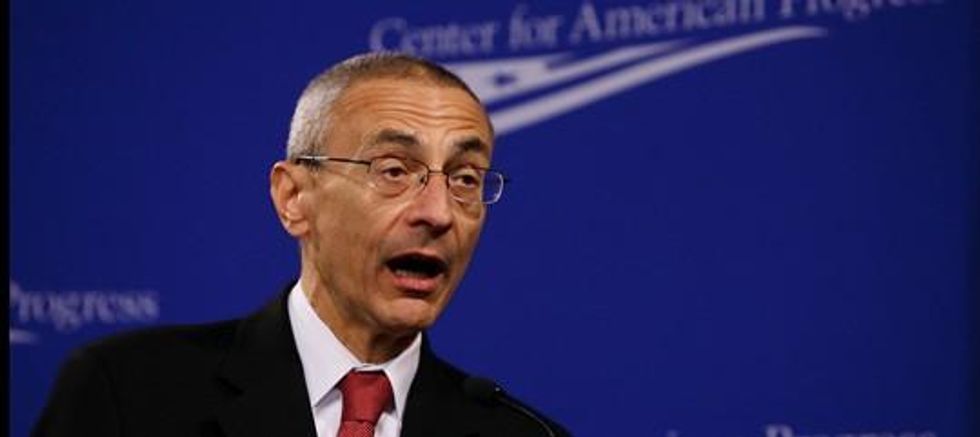
How can President Obama be so right and so wrong in the same moment? On the one hand, he warns us that sharply rising income inequality "is the defining challenge of our time" and pledges to reverse "a dangerous and growing inequality and lack of upward mobility. ..." But then he once again turns to the same hacks in the Democratic Party who helped create this problem to fix it.
His tough speech on income inequality earlier this month was delivered at the Center for American Progress, founded by John Podesta. As chief of staff to Bill Clinton, Podesta helped lead the charge to deregulate Wall Street, which resulted in the banking bubble that wiped out the savings of tens of millions of Americans.
But instead of chastising Podesta for the errors of his ways, Obama in 2008 appointed him to oversee his presidential transition team. That led to the appointment of Lawrence Summers and Timothy Geithner, two former Clinton officials responsible for the banking meltdown, to repair it. Just this past week, it was announced that John Podesta would be reappointed as a senior adviser to the Obama White House.
John Podesta should not be confused with his brother Tony, although both were founding partners of the Podesta Group, a lobbying firm that has represented Walmart, Lockheed Martin, Bank of America and BP along with dozens of other multinational corporations.
Tony still heads the lobbying firm, but John left when he joined the Clinton administration and subsequently founded the Center for American Progress, a think tank that attracts major funding from defense, energy and pharmaceutical companies. Sometimes the Podesta brothers work on opposite sides of the policy street, but both are big contributors to the Democratic Party, and it doesn't hurt for lobbyist Tony to have the same last name as brother John, an Obama insider.
"Some prospective clients, in fact, will contact Mr. [Tony] Podesta because of his brother's ties to Mr. Obama," The New York Times reported in a 2010 profile on Tony. The newspaper quoted him as saying, "People approach us and say, 'Can you call your brother and get him to call the president?' and we'll say, 'No.' It's not what we do. We don't do access lobbying." Sure you don't, but anyway, John, when he periodically moves out of the White House revolving door into the Washington policy swirl, milks the same types of corporate clients as his brother.
As The New York Times reported after John Podesta's recent appointment, he will "arrive at the White House after having run an organization that has taken millions of dollars in corporate donations in recent years and has its own team of lobbyists who have pushed an agenda that sometimes echoes the interests of these corporate supporters."
Podesta will be welcomed at the White House by chief of staff Denis McDonough who was a senior fellow at CAP, and Obama communications director Jennifer Palmieri who was a lobbyist for the organization. They are the faces of the so-called progressive wing of the Democratic Party that, like the president himself, will talk a good game of reducing income inequality, while catering to the interests of the very corporations that have initiated the problem.
The pattern was set by Obama when, in his successful race for the presidency, he decided to shun public financing and instead shamefully courted the Wall Street fat cats who bankrolled him handsomely. It is not surprising then that in his major speech on income inequality, there was no mention of the role of the big banks in fostering this inequality.
Democrats bear as much responsibility as Republicans for allowing our once promising democracy to degenerate into a plutocracy of the irresponsible super-rich. It is they who betrayed the New Deal legacy of Franklin Delano Roosevelt to rein in the Wall Street greed that caused so much suffering for ordinary folks. Obama is great at bemoaning a reality that his party helped establish:
"Since 1979, our economy has more than doubled in size, but most of that growth has flowed to a fortunate few. ... Whereas in the past, the average CEO made about 20 to 30 times the income of the average worker, today's CEO now makes 273 times more. And meanwhile, a family in the top 1 percent has a net worth 288 times higher than the typical family, which is a record for this country."
The Podesta brothers are not your typical family, but Obama hasn't noticed.
In 2008, Barack Obama rekindled faith in the America electoral process for many, and revived the deeper promise of American democracy, bringing to the foreground of the national political experience a brilliant and compassionate African American candidate.
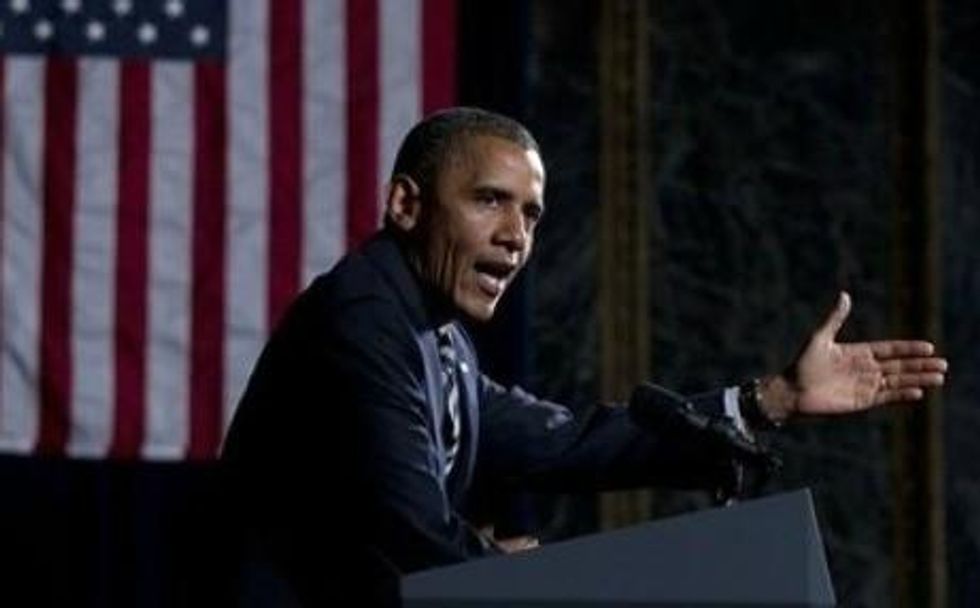
When Obama actually won the presidency, it was one of the exciting political moments in my lifetime, and rather reassuring as a sequel to the dark years of George W. Bush's presidency. Of course, many Americans didn't share such positive feelings, and an important embittered minority believed that the election of a liberal-minded black man was the lowest point ever reached in national politics, challenging this segment of society that now was deeply alienated from the prevailing political current to mobilize their forces so as to win back control of the country on behalf of white Christian Americans, and also a time to indulge such absurd scenarios as an imminent Muslim takeover of the society.
Such polarization, gave rise to an Islamophobic surge that revived the mood of fear and paranoia that followed upon the 9/11 attacks and was reinforced by evangelical enthusiasm for Israel. In this regard, the Obama phenomenon was a mixed blessing as it contributed to a rising tide of rightest politics in the United States that poses unprecedented dangers for the country and the world.
Nevertheless, as mentioned, Obama's campaign and election was at the time a most welcome development, although not entirely free from doubts. From the outset my hopes were tinged with concerns, although I did my best to suspend disbelief. All along I found little evidence that Obama's leadership would liberate the governing process from its threefold bondage to Wall Street, the Pentagon, and Israel. Such a political will to mount such a challenge was never in evidence, and never materialized.
Even in lucid moments, however, I reasoned it was important to elect Obama, despite his endorsement of a woefully deficient set of foreign policy assumptions, because more would be done to give assistance to those impoverished and hit by unemployment and home foreclosures, better judges and diplomats would be appointed, and more attention would be given to climate change. After four years, I continue to believe that these differences matter sufficiently to make it irresponsible not to support Obama and the Democratic Party, especially in so-called swing states.
And if there was excitement in much of America during the 2008 electoral campaigned, it was mild compared with pro-Obama sentiments in the rest of the world four years ago, which reached dizzying heights after his victory. This enthusiasm was a compound of several elements: Obama's success lifted confidence throughout the world that the United States could again play a benevolent role on the global stage and also because it validated that mythic image of America as a country where it was truly possible for anyone in the society, including members of minorities long discriminated against, to reach the pinnacles of wealth and power provided only that they were sufficiently talented and determined, and some would add, lucky. There remains little doubt that if the peoples of the world were allowed to vote in American elections, as might be appropriate in a globalized world, it would have produced a landslide of unprecedented magnitude in Obama's favor.
All at once in 2008 it became evident that an American presidential election was no longer just a national ritual that bemused outsiders watched as a kind of spectacle but a global event that affected the entire world. In fact the selection of a leader for the United States might be in some respects more important for other societies than for America, and further that the outcome of an American election could have a greater impact on a country in Asia, Africa, and Latin America than the effects of their own national elections, a significance reinforced by intense global media coverage of the American election in real time. In this respect, the 2008 election of Barack Obama made many of us aware that 'political globalization' was now as much a part of our experiences as 'economic globalization.' We were no longer living in a world where the standard map based on the borders of territorial sovereign states depicted the essential organization of political life on the planet. Our globalizing world had made the geopolitical cartography of influence much more spatially elusive, almost impossible to depict visually, but no less real.
Overall, the initial candidacy and election of Obama was, despite my qualms, more about hope than fear. There were concerns to be sure that the McCain/Palin Republican opposition would be dangerous for the world, but such anxieties were relatively subdued, and did not extinguish the strong positive expectations generated by Obama. And these hopes seemed somewhat justified in the first months of his presidency. In April Obama delivered a visionary speech in Prague that articulated a strong commitment to work toward a world without nuclear weapons. The newly elected president also seemed determined to carry out his campaign pledge to end the Iraq War in a responsible fashion, although this welcome move was offset by a disquieting hint that such a demilitarizing move in Iraq would be balanced by an increased commitment to prevailing in the ongoing war for the control of Afghanistan.
In June Obama made a relatively forthcoming speech in Cairo promising a new more positive relationship with the Islamic world as a whole and to the Middle East in particular. The president referred to the long ordeal of the Palestinian people and proclaimed his dedication to achieving a peaceful and just resolution of the Israel/Pa;lestine conflict, including a most reasonable call upon Israel to freeze all settlement expansion while peace negotiations were taking place. That this call on Israel to stop unlawful activity during negotiations was treated by the media as such a bold step tells us just how biased the mainstream attitude toward the conflict had become, and when Israel rejected at Obama 's moderate plea it experienced no adverse consequences, although the White House was put on the defensive because it had dared to push Israel to take a step that was against its wishes. This initiative, followed by its withdrawal, demonstrated to the world the extent to which the United States Government was in Israel's corner, was revealed to all who cared to notice that the only superpower in global politics was a paper tiger when it came to the pursuit of a just outcome of the conflict.
As already indicated, I half expected disappointments in 2008. I worried about Obama's typical liberal effort to demonstrate his tough approach to national security including support for a bloated defense budget in the face of a fiscal and employment crisis, about his lame effort to distinguish between Iraq as a bad war and Afghanistan as a war necessary for American security, and hence a good war. Also, I was disturbed by the way Obama dumped Rev. Jeremiah Wright when he became a liability to his electoral campaign, seemed embarrassed by his friendship with the distinguished Palestinian political historian, Rashid Khalidi, and made Rahm Emanuel chief of staff, as his first major appointment. Obama surrounded himself with economic advisors who were the same folks that had collaborated with the banks, hedge funds, and big brokerage houses in the 1990s to facilitate the huge regressive redistribution of wealth in the spirit of 'casino capitalism.' Unfortunately, these telltale signs of weakness of principle and ideology were an accurate foretaste of what was in store for the country during the next four years, although it apparently never dawned on the Nobel Peace Prize Committee to withhold its coveted award until Obama demonstrated that he was a deserving recipient, which sadly he never did.
What happened during the first term of the Obama presidency is definitely disappointing, although it is only fair to acknowledge that extenuating circumstances existed. Obama was dealt 'a bad hand' in the form of the worst economic crisis since the Great Depression of the 1930s. American society was sliding to the right as exhibited by the rise of the Tea Party, and the election of increasingly reactionary politicians as senators and congressmen, creating the most rightwing Congress in memory. It was difficult to govern in such a setting, and Obama compounded the difficulties by moving more than half way to meet the unreasonable demands of the opposition, and continued to do so even in the face of their clear unwillingness to reciprocate in a corresponding manner. Also, the pressures mounted by Israel and its formidable AIPAC lobby led the White House to back pedal awkwardly with respect to its efforts to create an atmosphere conducive to a balanced peace process for Israel and Palestine. On other issues, as well, Obama followed the pollsters and the party insiders more than principle, and failed to do what was best for the country and the world. After promising to take climate change seriously, Obama led an international effort to avoid imposing legal constraints on carbon emissions, and throughout his reelection campaign in 2012 has done his best to avoid the looming challenge of global warming aside from blandly promoting energy independence and green technology. As a result, the near unanimous scientific consensus on the urgent need for mandatory strict limits on carbon emissions has been disastrously pushed further and further into the background of public consciousness.
For me the 2012 elections have a different tone and relevance, that is not less consequential than in 2008, although absent the uplift. I believe this time around the stakes in the presidential election have been reversed. The upcoming election is more about fear than hope. The outcome is as fateful, or possibly more so, for the American people and the world, especially those living in the Middle East, but fateful also in the sense of avoiding the worst, not hoping for the best, or at least something better. Romney's election, even if he means only 50% of what he is saying, could lead to military confrontation with Iran, a completely free hand for Israel, an effort to undermine and control democratic forces in the main Arab countries, a trade war with China, a deepening of the world financial and employment crises, reduced respect for human rights, especially the reproductive rights of women, and a return to the overt lawlessness of the Bush presidency. Obama if reelected would likely be a more prudent leader, although continuing to throw the weight of American influence mostly on 'the wrong side of history.' In this sense, although prudence is to be preferred to recklessness, there are no major principled differences between the candidates when it comes to foreign policy (on domestic policy there is). Romney proposes that the U.S. stay longer in Afghanistan, move closer to an attack mode with Iran, and challenge China more vigorously on economic policy, and Obama agrees with all these positions but pursues them in a more nuanced way, with a greater seeming sensitivity to the risks and pitfalls, but nevertheless adhering to the same misguided and regressive policy options.
When fear rather than hope shapes our political consciousness, the effect on the citizenry is likely to be despair. Such an effect induces collective depression and encourages extremisms. What is also scary is the degree to which those who are making us fearful are being aided and abetted by the deep pockets of extremist billionaires who seem clearly to sense their ability in this period to buy enough votes to distort the will of the citizenry, and if they should be successful will step up to the policy window to cash in their chips, which could produce some disastrous results at home and abroad. In the background, of course, is the disappointment with the political consciousness of the citizenry that seems so receptive to such a dysfunctional and menacing political agenda as is being presented to them by the Republican Party; it does inspire confidence that the democratic way can lead toward sustainability, security, and justice in the years ahead.
With such an understanding why not support the Green Party candidacy of Jill Stein and Cheri Honkala? Their positions seem principled and admirable, and their alignments are with the poor and with the environment. Their platform is inspirational and congenial compared to what the Republicans and Democrats offer the American people. But their capacity to govern is untested, and their level of support is minimal.
I ask myself whether a vote for the Green Party in light of these circumstances would be a wasted vote? It evades the question to observe that in some states, say California or Nebraska, the outcome is so clear that takingsides as between the candidates put forward by the Democrats and Republicans is meaningless. The real test is whether it is worth voting for the Green Party candidates as a matter of principle because they are decent enough not to stoop to the dirty games of money and the accommodation of special interests that are poisoning the political process in the United States. At this point, I am not able to resolve my doubts. Is it irresponsible, given what is at stake, not to vote for the lesser of evils? Is it a misunderstanding of modern democracies to expect clear choices based on principled positions, respect for international law and human rights, dedication to environmental protection, sustainable economic policies, and a commitment to social justice for the entire population? Should we not insist on this misunderstanding to avoid ourselves being entrapped in a demeaning morality that overlooks crimes of state? (for instance, drone terror)
I must admit if living in a swing state I would vote for Obama, not having sufficient courage of my convictions to risk symbolic responsibility for a Romney victory!
Save
America wakes tomorrow to a landscape created by its people. It is a landscape that has been tended over the days, hours and minutes of the last two years by the door-knockers, phone-callers and canvassers, the cake-bakers, the sandwich makers, the lemonade sellers. It is a landscape awash with the work of women and children and men. Out of the ashes of self-loathing and despair that characterized this last decade, despite the obvious drawbacks of his full name, and his dogged determination to claim every part of his personal heritage, from American to Kenya to Indonesia, Barack Hussein Obama built a ground operation that is unparalleled in the history of this country. Never has there been a campaign run so evenly at the top while its foundation, the people who constitute its base, was allowed to, in short, go forth and multiply.
They are mostly small stories, but they were almost always stories of sacrifice, the kind that hurt the individual, the ordinary person, but that, taken together, create the glittering threads out of which history is spun. They are the stories of the ordinary people out of whose lives and actions, citizenship is defined. Sixty workers in Indiana gave up a days pay and risked losing their minimum-wage jobs rather than make incendiary calls about Obama. Taxi drivers in Maine donated their cars to take voters to the polls. A babysitting service in one of Philadelphia's low-income neighborhoods donated their care to help families get through election day.
As I stepped out this afternoon, I met a man ambling along my street, clipboard and leaflets in hand, systematically going up to house, checking the resident off his list, hanging his flyer on their door knob. This was after polling had begun. My neighbor was on hand to watch the polls as a legal authority. The Obama office on Main Street, close by, was filled even yesterday with calm, soft spoken volunteers bringing in food for other volunteers, checking each other in, picking up their lists of phone numbers and sitting down to make calls either on their own cell phones or on borrowed ones, or gathering up sheafs of leaflets and clipboards and heading out into the streets. That office was opened just a week ago, at a time when a different sort of candidate would be beginning to shut things down. Obama has consistently refused to take anything for granted. Certainly not his supporters. This evening, at 5:50pm, there was an email reminding me that polls had not yet closed in Virginia and could I please make a few more calls? I, like hundreds of thousands of other volunteers, did. I clicked a button, was given my list and began making my calls and recording the responses, counting down the time left until that particular person could vote, and telling them exactly where they needed to go to do so.
There was a script, as there was at the campaign office downtown, but it was simply a guideline. The words were mine. They were ours. They were the words of African Americans for Obama, Mothers for Obama, Pennsylvanians for Obama, Writers for Obama, Kids for Obama, yes, also, Sri Lankans for Obama. They were the words of people who had decided to speak up and speak out, loud against the usual American nicety of keeping politics to ourselves. Not this time.
Today, my daughters dressed with particular care as they got ready to accompany me to the polls. They walked into the polling station with me, signed in with me, and huddled behind the curtain with me. They watched me select Barack Obama/Joe Biden for President and Vice President of the United States. They, aged 12, 7 and 5, took turns selecting some of the rest of the candidates for State legislators. Then we walked back home, hailing everybody we knew, checking in, asking if people had voted. Every person, every check out counter clerk, every banker, every meat slicer, every teacher, every doughnut bagger, answered with an enthusiastic affirmative.
Nearly a hundred years ago, the American people's poet, Walt Whitman, wrote these words in honor of the political process of his country:
"If I should need to name, O Western World, your powerfulest scene and show,
'Twould not be you, Niagara--nor you, ye limitless prairies--nor
your huge rifts of canyons, Colorado,
Nor you, Yosemite--nor Yellowstone, with all its spasmic
geyser-loops ascending to the skies, appearing and disappearing,
Nor Oregon's white cones--nor Huron's belt of mighty lakes--nor
Mississippi's stream:
--This seething hemisphere's humanity, as now, I'd name--the still
small voice vibrating--America's choosing day..."
Today, Barack Obama and the passionate engagement he drew from the people he will now lead, gave proof to those words. Yes we did.
Virtually the entire mainstream electronic media drank ACORN Kool-Aid this month brewed up by the Republican National Committee. Almost no one seriously challenged John McCain's comical assertions that ACORN, a grassroots voter registration group, "is now on the verge of maybe perpetrating one of the greatest frauds in voter history in this country, maybe destroying the fabric of democracy."
While the Republicans had the distracted media searching for links between Obama and ACORN, RNC operatives were busily completing one of the most massive voter suppression and purging efforts in American history, stealing hundreds of thousands of Democratic votes across the embattled swing states and striving to arrange chaos and endless lines at the voting booths next week.
First the facts about ACORN. Months ago, we obtained, as part of our investigation for Rolling Stone magazine, the Republican's list the GOP alleged were the very worst cases of vote and registration fraud by ACORN and similar groups. We went through the names the GOP asserted were "obviously, undeniably and clearly fraudulent" voter registrations.
First, there was Melissa Tais, a dubious ACORN registrant. Her two voter registration forms show, admittedly, suspiciously different signatures. Republicans suggested Melissa was part of a massive fraud to allow Democrats to vote twice.
They were wrong. Ms. Tais, a Cerrillos, New Mexico, waitress, told us she had signed one form on a table and one form holding the paper in her hand. Hence, a second, wobbly signature.
Then there was Patricia White, who Republicans claimed was a fictitious voter. When we filmed her at home in Albuquerque, she seemed real enough.
And so on, through the entire GOP list -- not one fraud. And these were their best cases out of the five million "illegal voters" who Republican leaders claim have infiltrated America's voting rolls.
The overblown histrionics about ACORN do not surprise those of us who have been watching the RNC's election manipulation antics. For eight years White House operatives have been trying to gin up press stories about voter fraud. David Iglesias of New Mexico was one of seven U.S. Attorneys fired by the White House for their refusal to bring voter fraud prosecutions. "We took over 100 complaints," from the GOP, he told us, "We investigated for almost 2 years, I didn't find one prosecutable voter fraud case in the entire state of New Mexico."
Iglesias, a McCain supporter, has, for the first time, leveled a new and serious charge: Despite finding none of the 200 voters guilty, he says the White House nevertheless ordered him to illegally prosecute baseless cases against innocent citizens, just to gin up voter fraud publicity. His refusal, he says, cost him his job. "They were looking for politicized -- for improperly politicized US attorneys to file bogus voter fraud cases."
Certainly ACORN collected some bad signatures. But despite McCain's claims, now morphed into media theology, none of ACORN's actions will have any impact on any election. ACORN hired 13,000 canvassers to register new voters. A small number of these workers defrauded ACORN by handing in phony registration forms using names they had invented (e.g. Mickey Mouse), or copied from phone books. In one case ACORN canvassers used cigarettes to bribe a homeless man, now a Fox News regular, to register 17 times. None of these activities constituted voter fraud. It is no crime to register 17 times; only the final registration counts. His multiple registrations would not allow the tobacco lover to vote 17 times. Nor is there any evidence the phone book registrants will cast multiple ballots.
Finally, the removal by GOP officials of hundreds of thousands of legitimate voters from voting rolls over the past year provides ACORN with a sound rationale for obtaining new registrations, even from voters who believe they are already registered.
ACORN took pains to screen its registrations and cull out those it considered dubious. However, federal laws make it a felony for voter registration groups like ACORN to discard registrations even when it believes them fraudulent. So ACORN flagged the forms it considered doubtful and handed them in to the registry. Ironically, it was those flagged forms -- the fruits of ACORN's diligence -- that have been flogged by Republicans as their best evidence of widespread election fraud.
Voter fraud is a phantom according to Lorraine Minnite, an expert on voting crime at Columbia University. Only 24 cases of federal voter fraud have been uncovered between 2002 and 2005 despite massive government efforts devoted to uncovering evidence of a voter fraud crime wave.
The GOP is ginning up hysteria about non-existent vote fraud by Democrats in order to distract the press from its own campaign to disenfranchise millions of American voters.
The Republicans have created an obstacle course of barriers designed to suppress the vote, purge tens of thousands of Democratic voters from voting rolls, create mayhem and delay at voting venues on Election Day, and stop millions of votes from being counted this election cycle.
Jailed GOP activist Jack Abramoff and his fellow convict, Congressman Bob Ney, wrote the most sinister provisions of the Help America Vote Act (HAVA) which Congress passed in 2002 creating a series of diabolically cunning new voting impediments. HAVA, for example, allows state voting officials to purge tens of thousands of voters from the polls using algorithms and voter ID requirements that disproportionately disenfranchise black, Hispanic and minority voters, and other Democratic demographics including senior citizens and young people.
In 2004, highly organized GOP tacticians helped disenfranchise no less than 2.7 million American voters. Almost a million of them were African Americans. The U.S. Election Assistance Commission has found black voters were nine times more likely to have their votes discarded than white voters and that over one-third of the million provisional ballots cast in 2004 -- ballots handed disproportionately to African Americans -- were never counted but simply thrown into dumpsters.
In a technique known as "caging" RNC operatives send millions of first class letters to black voters across the country marked 'do not forward.' Republican operatives armed with lists then invade black precincts on Election Day to challenge those voters whose letters were returned to the RNC because the voter was not home to sign when the mail arrived. That tactic deliberately targets black voters, resurrecting Old Dixie's Jim Crow procedures designed to rid the lists of black voters and create long lines in black precincts.
In this election, new HAVA mandates permit voting officials to precisely match registration form information with the voter's driver's license and Social Security application. While it may sound reasonable, in practice, any change, even a dropped hyphen, is cause for eliminating the voter from the rolls. Since 2004, Colorado's Republican Secretaries of State have purged one out of every five voters from the rolls. The current Secretary of State, Mike Coffman, a Republican also running for office, recently purged an additional 37,000 voters and discarded 6,400 new voter registrations -- overwhelmingly Democratic -- based upon an obscure technical mistake that Coffman's office encouraged voters to make in the first place.
The GOP "anti-fraud" campaign resulted in one in nine New Mexico Democratic voters finding their names had disappeared from voter roles during this year's caucus.
Despite a recent Supreme Court decision upholding Ohio's refusal to disenfranchise 200,000 legitimate voters based on this absurd demand to "match" voter names to databases, White House operatives are still fighting to purge these names from the rolls. President George Bush last week personally asked his Attorney General Mike Mukasey to renew Republican efforts to disenfranchise these voters.
Contrary to Mr. McCain's assertions, the real threat to democracy is from the GOP itself. ACORN has served as a good distraction from Republican efforts to steal the vote from hundreds of thousands of legitimate voters, a genuine threat that has received almost no media attention.
They're stealing your vote, but you can steal it back. Here are some steps you should take to protect your vote. First, avoid the November 4th minefield. Voters, wherever possible, should vote early and in person. Where feasible, avoid mailing in your ballot, many are rejected for flimsy reasons, and first time voters in many states must include a photocopy of ID. However, if you have a mail-in ballot, don't throw it away. Follow directions, use the correct postage (that's an error that cost a hundred thousand votes last time) and, if possible, walk it in to your elections office.
At the polling station, should you find yourself one of the 2.7 million purged, or your ID rejected, then do your best to resist a "provisional" ballot--one third of which are not counted. Return with proper ID, or call 1-800-OUR VOTE for legal assistance. And never just walk away discouraged. That's just what they want you to do.
The other day I went to hear my favorite soldier-scholar, Andrew Bacevich, give a talk at Boston University, where he teaches. A retired colonel and Vietnam veteran, Bacevich's new book is called "The Limits of Power, The end of American Exceptionalism."
Bacevich has migrated from a conservative outlook to what might be called a neo-Niebuhrean position - his thinking being influenced by the theologian Reinhold Niebuhr, whom Bacevich calls "the most clear-eyed of American prophets."
Niebuhr warned against "dreams of managing history," a combination of arrogance and narcissism that posed a moral threat. That's why Niebuhr is often held in contempt by neo-conservatives for whom power is everything. Bacevich's concern is that the dream has become a physical threat that could lead to America's inevitable decline.
There is a mythical American narrative, according to Bacevich, that the United States is a nation "providentially set apart in the New World and wanting nothing more than to tend to its own affairs," only grudgingly responding to calls for global leadership "in order to preserve the possibility of freedom." In reality, the United States has sought expansion, first by pushing west until it reached the sea, then through a brief period of direct colonialism, and more recently through a ruthless if indirect imperial policy of control. It worked spectacularly. The United States became a great power replete with material abundance.
Right around the time of the Vietnam War, Bacevich argues, this began to unravel. Trade imbalances, federal deficits, "mushrooming entitlements, plummeting savings rates, and energy dependence" led us to become a debtor nation, counting on others to foot the bill. "The positive correlation between expansion, power, abundance, and freedom began to become undone . . . Further efforts at expansionism have led to the squandering of American power," according to Bacevich.
The actions of the Bush administration after 9/11 may have been designed to make the United States safe from another attack. But the chosen method was nothing less than to "assert American power throughout the Greater Middle East . . . to transform this region, to employ American power, both hard and soft, to impose order while ensuring stability, order, access, and adherence to American norms - in essence to establish unambiguous US hegemony so that the Islamic world will no longer serve as a breeding ground for terrorists who wish to kill us."
The grand illusion of American power as a transformative agent is evident in what Bush's lieutenants had to say. "We have a choice," said Donald Rumsfeld in September, 2001. Either we change the way we live, "which is unacceptable," or we "change the way they live, and we chose the latter. " Or as Douglas Feith would later put it: America's purpose was to "transform the Middle East and the broader world of Islam generally."
This grand imperial overreach never had a chance. Transforming Islam can only be done by Muslims themselves, in their own due time. The new "liberated" Iraq has not changed the Middle East. The passions of the Middle East have transformed Iraq, perhaps more stable now than a year ago but in no way destined to achieve what Bush, Rumsfeld, Condoleezza Rice, et al wanted and expected.
The net result is that much of the world now looks on the Bush administration's resurrection of Woodrow Wilson's ideals and the expansion of democracy as a cover for coercion and bare-knuckle dominance. As Bacevich says, Bush always confused strategy with ideology.
Militarily, we threw containment and deterrence out the window, banking on the "shock and awe" of preventive war. It hasn't worked. We are bogged down in two wars with an end to neither in sight.
Bacevich doesn't see the November election as necessarily producing a beneficial change. John McCain touts the stalemated Iraq war as a success, while Barack Obama calls for more effort in Afghanistan. In Bacevich's view, it is the entire doctrine of preventive war that has proved a failure. There has to be a better way than occupying Muslim countries.
Both McCain and Obama "implicitly endorse the global war on terror as the essential core of US policy," while in reality it's the entire concept that needs to be rethought.
It might be wishful thinking to believe that the 67.5 million Catholics of this nation (about 24.5 percent of the population) will influence this year's presidential election in Barack Obama's favor. After all, vice presidential hopeful Joe Biden is Catholic. Obama supports universal health care, taxes on the rich, education and job training, helping the poor, ending the war in Iraq-issues all in line with the social justice tradition and teachings of the Church.
It might be wishful thinking to believe that the 67.5 million Catholics of this nation (about 24.5 percent of the population) will influence this year's presidential election in Barack Obama's favor. After all, vice presidential hopeful Joe Biden is Catholic. Obama supports universal health care, taxes on the rich, education and job training, helping the poor, ending the war in Iraq-issues all in line with the social justice tradition and teachings of the Church.
The reason this may not happen? Sarah Palin, a former Catholic gone non-denom, and her running mate, John McCain, are both pro-life.
Much to my own horror, the Christian Science Monitor reported last month that Palin's large family, her cultural conservativism and her Down syndrome child that she chose not to abort clicked well among regular, church-going Catholics, especially women who were looking for someone who represented them.
The question remains: how will the white, non-regular church-going Catholics respond?
David Campbell, a political scientist at the University of Notre Dame in South Bend, Ind., says in the Monitor story that this latter group is concerned about economic and national-security issues but that values issues (i.e., abortion) may be a greater factor in determining their choice for president.
Meanwhile, progressives like Chris Korzen of Catholics United (www.catholics-united.org) and Alexia Kelley of Catholics in Alliance for the Common Good (www.catholicsinalliance.org), have been trying to focus Catholic values voters on broader social justice issues like excessive materialism, hyper-individualism, and the ugly disparity between the rich and poor.
Ironically, both fundamentalist and evangelical Christians care about these same issues, too. Such a large group citizens interested is changing our political, social and cultural scene could be an opportunity for uniting the country by addressing everyone's economic well-being, protecting everyone's basic freedoms, and working on our nation's moral and cultural fiber.
So instead of concentrating on legalistic concerns (i.e., one's right to do or not to do something), attention could be directed to human dignity concerns like what to do with an enfeebled Grandma, a poor neighborhood, the war in Iraq.
Evidence that Obama has adopted the advice of progressive Catholics emerged in the final presidential debate on Wednesday when he said that:
[Abortion is] "always a tragic situation," [and we should] "try to prevent unintended pregnancies by providing appropriate education to our youth, communicating that sexuality is sacred ... and providing options for adoption and helping single mothers if they want to choose to keep the baby. ... Nobody is pro-abortion. ... We should try to reduce these circumstances."
As the naive Catholic that I am, I believed the progressives' line that the American Catholic tradition of justice and the common good could help resolve some important social issues that have nagged at this country for the past 30 years.
However, too many conservative, pro-life Catholics aren't taking the progressive bait. They are actively promoting McCain over Obama on the basis of the abortion issue alone. Then, what we get in our choice for president once again is the same, exhausting, one-issue fortress of grid-lock politics.
For example, the pro-life Catholic propaganda machine is hard at work trying to confuse their brethren, say Korzen and Kelley. In 2004, the presumably nonpartisan group, Catholic Answers (www.catholic.com), distributed the Voter's Guide for Serious Catholics to provide background on five key "nonnegotiable" issues: abortion, same-sex marriage, euthanasia, human cloning and stem cell research, which all happened to favor President Bush's platform-and the right wing conservative agenda.
The U.S. Catholic bishops denounced the Voter's Guide and issued Faithful Citizenship: A Catholic Call to Political Responsibility (www.usccb.org/faithfulcitizenship/bishopStatement.html), which they routinely publish before presidential elections. Faithful Citizenship is grounded in Catholic social teaching and lists 50 "moral priorities for public life" that provide Catholic voters with a "moral framework" for evaluating candidates WITHOUT telling them how to vote.
Then there is Randall A. Terry, founder of pro-life group, Operation Rescue. He attempts to refute the progressive Catholics through his website (www.ahumbleplea.com) where he posts two key brochures. In "Is It Immoral to Vote for Obama?" he says:
At the very least, Obama is an aggressive accomplice of child-killers. He has declared his intention to keep childkilling (abortion) legal; to help child-killers murder the innocent with impunity. He has pledged to sign the Freedom of Choice Act (FOCA) if elected, and to appoint judges to the Supreme Court that will uphold Roe vs. Wade. Obama boasts a 100% proabortion voting record; he is in FAVOR of partial birth abortion, and he opposed a bill in Illinois that would require medical care for a late term baby that survives an abortion.
In "Faithful Catholic Citizenship," he claims that:
This brochure is for Catholics who desire to vote in a manner that best reflects our Catholic Faith. The teaching of the Church herein quoted comes directly from our late Holy Father, John Paul II, as declared in Evangelium Vitae, (The Gospel of Life).
Terry has even found a bishop to support his position: the 85-year-old Rene Henry Gracida, Bishop Emeritus of Corpus Christi, who not only sanctions Terry's blather but encourages him to distribute his brochures "as widely as possible."
Frankly, it is discouraging to me as a white, church-going Catholic and a convert, to see political ideologues pushing this ONE issue as their basis for promoting candidates for elective office when there are so many other problems troubling our nation and our world.
Nevertheless, no matter how Catholics vote, I think a sea change is taking place where our current and by-now obvious economic disaster will put concerns about abortion aside for quite some time.
When you no longer have the cushy comfort of a middle class home under your feet or the security of sound stocks and savings or the prospect that your children and your grandchildren may not get the education they need or the air they must breathe, your thoughts concentrate on providing the basic necessities for your family. Worrying about the unborn, as important it is, may soon prove to have been a luxury item of a past lifestyle in a once-great and wealthy nation.
(BTW, according to Father Thomas Reese, a political scientist at Georgetown University,Barack Obama was educated by nuns in Indonesia and his community organizing in Chicago was funded by many Catholic groups.)
You cannot make this up. Sarah Palin, the best-known hockey mom in the United States, gets booed Saturday at the Philadelphia Flyers hockey game. And the game is played, of all places, at the Wachovia Center. It's all over YouTube: failing candidate, failed bank as corporate sponsor, the kind of anger that cannot be scripted.
The Philly welcome was what New York Times hockey blogger Lynn Zinser described as "resounding (almost deafening) boos from the Flyers crowd." Don't believe the reports that describe "a mix of cheers and boos." There was a mix all right: a mix of boos and piped-in rock music that was like (we have to say it) lipstick on a pig.
You might excuse Governor Palin for thinking this appearance would be a public relations "gimme." It was opening night and the fans would be in well-lubricated good spirits. The announcer's voice on the jumbotron, that twenty-first century altar of truth, intoned, "Flyers fans, show Philadelphia's class and welcome America's number-one hockey mom, Sarah Palin!" And we all know Miss "Pallin' Around with Terrorists" is nothing but classy.
As added insurance, the GOP vice-presidential candidate walked out on the ice with seven-year-old daughter, Piper, who wore a Flyers jersey. Palin acknowledged this strategy beforehand, saying, "I've been warned that Flyers fans, they get so enthused, that they boo everybody at the drop of the puck. But what I thought I'd do is I'd put Piper in a Flyers jersey, bring her out with me. How dare they boo Piper!" Well, they dared, and Sarah Palin once again makes her case for mother of the year.
Maybe Philadelphia fans remembered that several weeks earlier, Palin almost got sent to the political etiquette penalty box for even thinking about jogging on the streets of the City of Brotherly Love dressed in a New York Rangers jersey. Maybe they were repulsed by the hard bigotry that Palin wears on the campaign trail as effortlessly as she wears her sparkly rhinestone flag pin.
Responsibility for this failed political charade starts and ends with Philadelphia Flyers owner Ed Snider, a big-time Republican donor who invited Palin on the mistaken assumption that she would burnish the brands of the sport and his team. This is yet another example why hockey is the worst-marketed game on the planet. It's like inviting PETA to a barbecue. Palin's negatives are almost Bushian. Outside her narrow base of nationalist bigots, the country is recoiling. Yet Snider and the NHL reasoned her presence would be a big publicity coup. All the while, NHL Deputy Commissioner Bill Daly insisted this was not about politics: "Governor Palin is a supporter of the sport, which she has proclaimed publicly. As a public figure who has a very public connection with hockey, her recent associations with the Flyers and other NHL franchises is not surprising and, in our view, not inappropriate."
Flyers fans in Philly were not nearly so giving, but you can understand why Palin chose this venue. As Philadelphia Weekly Executive Editor Liz Spikol said, "Of all the sporting events that could appeal to conservative voters in Philly, hockey would be the Republicans' best bet. But the electorate is changing and not even hockey fans are easy pickings."
For thirty-five years, Gus Koseevos has run a diner in Fishtown, a white, working-class area of Philadelphia currently being gentrified. The diner is filled with Flyers paraphernalia, including two different wall clocks. Koseevos said he didn't like mixing politics with sports and wasn't impressed with Palin's visit; he wouldn't reveal who he planned to vote for. But long-time waitress Mary Kulb didn't object to Palin's puck-dropping stunt; she was just happy to see a woman on the ice. Kulb said she is leaning towards McCain, even though most of her neighbors are voting for Obama. A Hillary Clinton backer in the primaries, Kulb said she doesn't really trust either candidate.
Mark Bradley is a member of Glaziers Local 252 and a dedicated Flyers fan. He said he considers all of Palin's public appearances designed to "make up for the Couric interview." He also said that he wouldn't think it right for any candidate to drop the puck--but added that Joe Biden would have "been more accepted in a working-class town like Philly. The NHL has thirty cities. She should have gone somewhere else. But then again, she might have gotten the same response anywhere."
Bradley said that the whole hockey-mom thing is clearly aimed at white, working-class voters. But with the economy tanking, he said he didn't think the strategy would work. A Google search reveals that Palin may have nearly coined the term "hockey mom," the symbolic value of which contrasts with two other types of mom in the American socio-political imagination: urban black mothers, whose children rarely play hockey, and the latte-drinking, suburban, Democratic-voting soccer moms. But there are hockey moms--and dads--in Philadelphia, far from the American heartland, and on Saturday night, they weren't having any of it.
Commenting on the debacle, Pennsylvania Governor Ed Rendell observed, "This is why I say that sports and politics don't mix." But it's not sports and politics that don't mix. Athletes routinely get torn apart like carrion when they express political views--and that isn't always fair. The problem is the hijacking of sports by wealthy owners and their political puppeteers. Maybe when this campaign is finally over, we can point to a moment when a group of hockey fans in the land of Wachovia said "enough."
I realize that there are conservative pundits who claim that because Sarah Palin did not faint, barf or say "I'll have to get back to ya!" that she knew what she was talking about. Fact is, she did not.The American public tuned in to get to the bottom of the phenomenon from Alaska and only one thing was abundantly clear from the get go and stayed that way right until the very end: the bottom wasn't that far down. If we'd taken a running leap into that swimming pool, we'd all be dead. Unfortunately, if we end up with Palin in the White House, we still could be, sooner rather than later, and so would much of the rest of the world. There we'd be, drilling through this great land just lookin' for some domestic oil, banishing foreign leaders willy nilly from our diplomatic conferences, sending our troops surging through Afghanistan and goodness knows where else, and talking about a two-party solution in Palestine that never once mentions the term "Palestinian," but instead talks giddily about "buildin' our embassy in Jerusalem!" And, of course, catching a daily ferry from the island of Little Diomede so we can hail the people of Big Diomede who might be persuaded to send a carrier pigeon out to Moscow to let Putin know that some folks wanted to tell him something. That'll keep Russian in line.
In the world according to Sarah Palin, there are a few, often contradictory, statements she likes to repeat as though if she said them enough times, people would ignore the evidence of their own eyes, purses and lives, frankly, and believe her. In Sarah Palin land, Americans are gathering around their loaves of bread saying "hey, you, (giggle-wink), government, stop putting those mandates on me." On the one hand, when it comes to the economy, according to Palin, "The barometer there, I think, is going to be resounding that our economy is hurting and the federal government has not provided the sound oversight that we need and that we deserve, and we need reform to that end." On the other, again, Palin, "Patriotic is saying, government, you know, you're not always the solution. In fact, too often you're the problem so, government, lessen the tax burden and on our families and get out of the way and let the private sector and our families grow and thrive and prosper." So which is it, Mrs. Palin? Less goverment or more government? Which, which?! Personally, I've never heard of a resounding barometer. Has anybody? And if you're just hearing voices when you're making these little soliloques to invisible people, just come clean, we'll understand. We've all got problems. It's also okay if you don't wiggle your nose or widen your eyes or wink at me, truly, I'll understand; I'm strong that way. Unlike the fundamentals of our economy.
I'm sending out a small get-happy announcement to all my gay friends that they'll be "tolerated" in Palin's America. Isn't that big of her? Well, how about we all do a little sum'n for her? How about we "tolerate" her pregnant teen? We absolutely tolerate Bristol Palin "choosing a relationships that she deemed best for herself," when she was having unprotected sex with yet another teen within the diverse and nurturing folds of the Palin circle of love. I sure wish I could have heard about how their Black Friend came to dinner too. I'd have felt Palin was winning my heart and mind if she'd only gone there. But she didn't go there. She went nowhere. She went to where she was proud of her party slogan on the campaign trail, "drill, baby drill." She went where she actually urged us to "leave him behind," when referring to her own candidate, John McCain. She went where she said we should hang on to our "energy projects."
When accused by Joe Biden of, along with John McCain, not even knowing that a subprime mortgage crisis was brewing, and asked by Gwen Ifill whether she agreed with Biden's lengthy criticism, Sarah Palin responded thus: "That is not so, but because that's just a quick answer, I want to talk about, again, my record on energy versus your ticket's energy ticket, also. I think that this is important to come back to, with that energy policy plan again that was voted for in '05." Yes, Mrs. Palin, we know that is just a quick answer, but you can't run off and talk gibberish about something else because you don't know enough about the biggest financial crisis this nation has suffered in a century. It might seem unfair, but there's a reason we need your answer: you're asking us to hand over the reigns of power to you.
Mrs. Palin's response when asked to be VP, was, verbatim: "when faced with a challenge, you cannot blink." If you're putting eyedrops or contact lenses in your eye, you don't blink. If someone is asking you to be Vice President of your country, that's when you get the eyelashes going. Bat, baby, bat. And while you're batting your peepers, you ask yourself a few sundry questions. Here's a couple to to get you on the right path:
You get the picture. I hope, though it's a little late in the day since even at this first and last debate your upper cut amounted to nothing more than saying "let's see, I've been on this campaign what, five weeks? so I haven't promised much," as if this lets you off the hook from answering the asked question about which campaign promises would have to be cut back thanks to the mess on Wall Street. It's called a campaign promise because you belong to a campaign. John McCain's campaign. You. Are. Part. Of. His. Campaign.
The pundits can say what they will, Sarah Palin's only claim to fame this evening was that she did not faint, barf or say "I'll get back to ya!" But she almost swung that too. A few more minutes and maybe we'd have got all that too. Frankly, I'm with my second grader who, upon listening to coverage of Sarah Palin remarked, "So...she drills, shoots and lies." Second grader, you get extra credit for that one.