SUBSCRIBE TO OUR FREE NEWSLETTER
Daily news & progressive opinion—funded by the people, not the corporations—delivered straight to your inbox.
5
#000000
#FFFFFF
To donate by check, phone, or other method, see our More Ways to Give page.
Daily news & progressive opinion—funded by the people, not the corporations—delivered straight to your inbox.
Maude Barlow, Honorary Chairperson of the Council of Canadians, delivered the following remarks Thursday at the Seventh Annual Tommy Douglas Institute at George Brown College in Toronto. Her keynote speech explores the interconnections between poverty and populism and its implications for the environment.
It is a great pleasure and honour to be here with you today and to speak in the name of one of my all-time heroes. In reading your on-line description of the moment we are in, I became a bit overwhelmed at our collective task and, frankly, my ability to address it.
You described the "unprecedented display of wealth inequality" both globally and here in Canada; the historic numbers of people fleeing the ravages of war, extreme poverty and human rights violations; the rise of "strong men" bully-boy leaders (my term, not yours); the post-truth reality of fake news; the poisonous use of the internet by hate-filled trolls; and the rise of right-wing populism and its evil older sibling, white supremacy.
All this, you said, "against the backdrop of a planet whose ability to sustain life is daily sacrificed to an unforgiving economic ideology that promotes the cancerous mission of growth for growth's sake, while sacrificing the health and dignity of everything around it. Our industriousness," you note, "has ushered in the anthropocene and the sixth age of mass extinction." Disturbingly and beautifully said.
All this got me thinking about Tommy and what he might have to say to us today. After all, we are not the first people to face huge challenges. Tommy Douglas led his party to power in Saskatchewan just as the Second World War was ending and everywhere there was social and economic collapse.
Only half of Canadians had any kind of health insurance and only the rich could afford true coverage. There are terrible stories of ill people, old people and pregnant women leaving hospitals untreated because they had no money. A farm woman diagnosed with cancer knew her only hope to receive treatment was to sell the family farm, something she refused to do. So she locked herself in the farmhouse every day while her husband tilled the fields and closed all the windows so her neighbours could not hear her screams of pain and died, saving her family from destitution.
Tommy came in on the promise of health care for all regardless of income, ethnicity or state of health and was he up against it! Vigorously opposed were the Saskatchewan College of Physicians and Surgeons who went on strike, the Dental Association, the Chambers of Commerce, the Canadian Medical Association, the American Medical Association, the powerful drug lobby and the major newspapers. The strike was so brutal, two women doctors who came over from Great Britain to help had to be escorted to and from their clinic as they had daily death threats.
Undeterred, Tommy introduced a public health insurance plan that became the blueprint for nation-wide medicare. The Vancouver Sun called Tommy "a good deed in a naughty world, a breath of clean prairie air in a stifling climate of payola and chicanery and double talk and pretence, global and local." My favourite cartoon when Tommy died showed him at the Pearly Gate reluctant to accept a harp from St. Peter unless he was sure that everyone got one.
The Second World War profoundly changed Canada. Returning soldiers were aware that the same governments that couldn't feed, clothe, house or employ people before the war suddenly had all the money they needed to fight a war and they were not going back to work camps. The demand for change was everywhere.
Tommy would have been proud of the post-war consensus that saw the creation of a strong universal social security net, a war on poverty that greatly closed the income inequality gap, growing protections for workers and the rise of the trade union movement. But before he died in 1986, he saw that the post-war social consensus of a "just society" for which he had given his life had started to unravel and the social compromise that had allowed the creation of the welfare state was coming to an end.
In the 1970s and 80s, increasingly aligned with American business interests, Canadian business and industry leaders created corporate lobbies and think tanks to promote their neoliberal message and challenge the very heart of the just society.
Capital was going global and Canadian companies could see how much more money they could make in countries without our minimum wage and social programs.
Deeply influenced by the rise of Margaret Thatcher in Great Britain and Ronald Reagan in the United States, consecutive Canadian federal governments granted tax breaks to corporations and cut unemployment insurance to their workers.
The first thing Brian Mulroney did when he came to power in 1984 was to fly to New York to announce to a blue chip group of American business leaders that Canada was "open for business" and promised to tear down the rules on foreign investment and remove the barriers to our energy, timber and mineral resources. Canada became a leader in promoting economic globalization and promised that its core tenets of deregulation, privatization and free trade would bring prosperity for all.
And what of these promises that unchecked capitalism would raise all boats, big and small? Turns out it was a lie from beginning to end.The key message adopted in rich countries and imposed on poor countries by the World Bank, was that the way to global prosperity was for governments to get out of the way and let the market decide on all things commercial and financial. More than anything else, free trade is about curbing the ability of governments to establish regulations and set standards to protect health, social security, workers rights and the environment.
Not only was global capital free to roam the globe in search of easy profits, corporations were free to eat each other up and become economic superpowers. Of the 100 leading economies in the world today, 69 are corporations and only 31 are countries.
Apple's annual revenues exceed the GDP of two-thirds of the world's nation states. Walmart's annual revenues exceed the GDP of 157countries.
Corporations were given the right to sue governments through enforceable investment treaties. There are now more that 3,500 investor-state dispute settlement treaties between countries and private companies have used these evil deals almost 1,000 times to challenge rules they don't like. The great majority are decided in favour of the corporation; the bigger the company, the bigger the settlement. Some settlements are in the billions and can bankrupt any poor country that dares to stand up to them.
And what of these promises that unchecked capitalism would raise all boats, big and small? Turns out it was a lie from beginning to end. The United Nations now says that three-quarters of the working age population of the world form the Precariat, working in low wage, insecure jobs with no benefits, while last year, the world's 2,000 billionaires pocketed almost $9 trillion.
And I don't have to tell you about the environmental crisis; hardly a day goes by without another alarming report about the state of our planet. We have seen nature as a resource for our pleasure and profit and are now paying a terrible price.
The failure of this economic model has provoked a terrible backlash. It was Donald Trump, not Hilary Clinton, who noted the post-NAFTA devastation in the American rust belt and courted workers the Democrats took for granted. He and his counterparts in Europe say their populism seeks justice for the forgotten people and they have hit a cord.
I feel sure that people turn to right-wing strong men leaders when the promises of liberal politicians fail to address the root causes of unemployment, economic inequality and racism. While Barrack Obama is an inherently decent man, he did not name or confront the true crisis. In fact, like Justin Trudeau in this country, Obama added his charisma and popularity to the very politics of economic globalization that got us here in the first place.
Trump and his contemporaries in Europe, Brazil and many other countries have enabled the rise of right-wing populists, whose solution not only scapegoat "others" - often in a violent way - but aims to destroy the very social state and social programs that are the best equalizers for marginalized people, the poor and workers.
Hence Trump's attacks on workers and unions, his lowering tax for the rich and for corporations, the rollback of Obamacare and his war on the environment, all in the name of making America great again. The very people who elected him are the ones who will pay the price for the institutions he is destroying.
While we in this country do not have a Trump-like leader, we have many of the same problems. The decade post-NAFTA saw the highest rise in child poverty in our history. We also saw a massive loss of manufacturing jobs; in the 1980s, manufacturing accounted for 26% of our GDP. Today it is under 11%, with the result that Canada's economic prosperity depends more than ever on resource extraction.
An economy rife with insecurity, low wages, competition and fear is a breeding ground for those who promote hate, intolerance and the scapegoating of vulnerable "others."We are pock-marking our land with massive mining operations, still building pipelines to carry the dirtiest energy on earth across our waterways, fracking pristine wilderness and drilling for oil offshore ecologically sensitive coastlines. Canada leads the world in the degradation of untouched forests.
And yes here too, alongside the rise of the precarious workforce, we see the rise of right-wing populism, xenophobia, racism and white nationalism. In my view, these twin realities are deeply connected. There has been a steady rise in precarious work in Canada over the last three decades. In fact, over half the workers in Toronto and Hamilton are now temporary. An economy rife with insecurity, low wages, competition and fear is a breeding ground for those who promote hate, intolerance and the scapegoating of vulnerable "others."
So, not surprisingly, now we are seeing a "blue wave" across the country. At least four provinces - Alberta, Saskatchewan, Manitoba and Ontario - have "hard right" governments implementing draconian austerity programs. And Quebec's CAQ is promoting a bill that would discriminate against religious minorities and is already driving up racist incidences in that province.
Here in Ontario, Ford has gone after the most vulnerable with his savage cuts: immigrants, Indigenous peoples, poor people needing legal aid, victims of violence, special needs kids, youth who need help with post secondary education, and so many more. What paved the way for this travesty? Kathleen Wynne's embrace of a business plan to privatize Hydro One. Once again, a leader ran as a progressive, but ruled for private interests. The backlash gave us Doug Ford.
I fear we will see a similar scenario played out again on the federal level this fall. Justin Trudeau, like Obama, is a decent man who was raised to care for human rights. But he never saw a free trade agreement he didn't like and his embrace of the Kinder Morgan pipeline sent totally pro-market signals to the corporate allies who are always ready for a dance with the Liberal Party.
And let's be clear: Andrew Scheer is no Red Tory. This is a man who regularly gave interviews on Ezra Levant's Rebel site and stood on Parliament Hill to address a pro-pipeline crowd that included members of the racist Yellow Vest movement alongside notorious white supremacist Faith Goldy. We may be facing a Canada-wide blue wave sooner than we understand.
So what would Tommy tell us to do? Well first, I believe he would tell us to have hope because hope is a moral imperative. He would tell us that we humans got ourselves into this situation and can change it. He would tell us that it is never too late to make meaningful change and always too soon to give up.
I deeply fear something worse than apathy and that is a feeling that it is all too late and there is nothing to be done. Some call it "disaster fatigue." I can tell you sometimes I see a headline about the oceans or bee decline, or some new study on how much faster the planet is warming than we thought and I don't read the text. It's too much. We are buying a million plastic bottles of water a minute around the world.
But turning away is not the answer. We must reject the politics of despair. A 99 year-old friend asked me just before she died last year if I had a "quiet mind" and I said I sure was trying to find one but that it was really hard for me. She said I will have a quiet mind when I realize that I cannot control everything and must have trust that what I do matters but is only a piece of a whole.
The answer is in having faith that you are not alone and if you do your part, there are others - many others, more than you can ever know - doing theirs, and that together, profound change can happen. Someone asked scientist activist Vandana Shiva how she stays hopeful. She said that she believes you have to do your part without always thinking of the bigness of what you are standing against or you will get overwhelmed.
She detaches herself from the results of what she does because they are not in her hands. The combination of deep passion and commitment to the task but then detachment from the outcome allows her to move on without being crippled by a sense of doom.
Here I quote Vandana," I function like a free being. Getting that freedom is a social duty because we owe it to each other not to burden each other with prescriptions and demands. What we owe each other is a celebration of life and to replace fear and hopelessness with fearlessness and joy."
Second, I bet Tommy would remind us that Canada built "good bones" in terms of withstanding the harsh winds of economic globalization and that we have to fight like crazy to keep them. Toronto labour activist David Bush has written an excellent analysis comparing Canada to the U.S. to try to understand the surge of socialism in the U.S. right now. He says there is urgency for Americans still not felt here because the economic context in the U.S. is more dire for workers than here and the rate of inequality is substantially worse.
Public services and labour protections have been gutted in the U.S., and the continued lack of health coverage for almost 30 million Americans makes workers and families way more vulnerable than here. Student debt levels, while substantial here, are astronomical south of the border and trust in government, in the media and in all institutions in the U.S. are at an all time low.
Bush reminds us that the liberal-labour coalition that once made up the Democratic Party was superseded by the pro-corporate wing of the party. While the same tensions exist in the Liberal party here in Canada, the existence of a social democratic party and a strong labour movement here has acted as a counterbalance.
A stronger working class has also sheltered Canada from some of the worst political upheavals now seen in the U.S. and Great Britain, whose inequality index is second now only to the U.S. among industrialized nations. The Canadian level of unionization is three times that of the U.S.
Turning away is not the answer. We must reject the politics of despair. None of this is to downplay the disgrace of our colonial treatment and abuse of First Nations or to deny racism in our past and present as well as the dispossession of the poor. Nor is it to ignore the signs that there is great pressure for Canada to follow in the footsteps of these countries that have gutted social security and workers' rights so deeply.
But it would be a disservice to Tommy and many others who have fought for these rights not to be grateful to have them and not to fight for them now.
I like to think Tommy would ask us to remember the victories we have had and take some pride in our accomplishments because they are sources of hope. Successive governments have tried to kill universal health care with a death by a thousand cuts. But they have met fierce resistance from nurses unions and other health care workers, the Canadian Health Coalition, and many thousands of activists across the country. Just try to take on Nathalie Mehra of the Ontario Health Coalition, I dare you!
Our fight for fair trade is ongoing and hard. Our movement has been incredibly active and effective given what we are up against and a lack of resources compared to the corporate lobbies on the other side.
We created a continental network and then an international one. We didn't stop NAFTA, but we did stop it being extended to the rest of the Americas. We relentlessly followed and protested the World Trade Organization (WTO) gatherings, starting with the Battle in Seattle 20 years ago and basically brought that institution to its knees.
In the wake of our shutting down the WTO in Seattle, the Pentagon hired the Rand Corporation to find out who the hell we were. The Rand Corporation reported that, best they could tell, we were like a hoard of mosquitoes with no headquarters or leaders - we were everywhere and we really stung.
Canadians led an awesome international alliance to kill the Multilateral Agreement on Investment which would have given corporations hugely expanded rights to sue governments for loss of profit. The Financial Times compared the fear and bewilderment that seized the governments of the industrialized world to a scene from Butch Cassidy and the Sundance Kid as the politicians and diplomats looked behind them at the "horde of vigilantes whose motives and methods are only dimly understood in most capitals."
More recently, we have ISDS on the run, removed from the new NAFTA and so unpopular in Europe, most governments have not yet adopted the investor-state provision of CETA.
We are winning the fight against water privatization. Since 2000, 267 municipalities, including Paris and Berlin, have brought their water services back under public control after having tried the private route. There are now 15 million people living in Blue Community cities here in Canada and in other countries that have pledged to protect water as a human right and public trust and phase out plastic bottled water. Montreal is the latest Canadian city to become a Blue Community and I would sure love it if Toronto could be next!
And since the UN declared water to be a human right in 2010, over four dozen countries have either amended their constitutions to recognize this right, or brought in a new law to do so.
There is a crucial new campaign that I like to think Tommy would have supported. A large, diverse, non-partisan coalition of youth, artists, trade unions, scientists, Indigenous leaders and many organizations has sent out the call for a Green New Deal for Canada and has launched a Canada-wide tour to promote it.
The core demands are to cut emissions in half by 2030, protect critical cultural and biological diversity, create a million jobs, and face the multiple crises we face through a holistic and far-reaching plan that respects the constitutionally enshrined and internationally recognized rights of Indigenous peoples.
What we need is a global Green New Deal movement and it is beginning to flower. CUPE Ontario's Fred Hahn explains that a Green New Deal must be for everyone. "Facing the climate crisis means facing the many other crises - economic inequality, housing insecurity, precarious work, and rising racism - that threaten our communities and social fabric" he says. "We can build universal and far-reaching solutions that transform our economy, create dignified work, prioritize public ownership and make our communities healthier."
What we need is a global Green New Deal movement and it is beginning to flower. We in Canada must also be part of the global campaign to plant a trillion trees, which would cancel out a decade of CO2 emissions. As part of our Green New Deal work here in Ontario, we must stop Ford's plans to gut the tree planting program. Did he miss the fact that we had horrible floods this spring? Did no one ever tell him trees are crucial, not only as carbon sinks but to hold water?
I also think Tommy would tell us to never give up the fight for economic justice. Successive governments keep lowering corporate taxes, leaving us with an insufficient tax base for true social security. I have come to believe alas, that for the corporate elite, social insecurity is not just a by-product of a system that has given them such wealth, but a goal in and of itself.
Here in Ontario, the fight for economic justice is central to all our struggles. The Fight for $15 and Fairness is a powerful network and platform for us all to come behind with its demand for fair wages, paid leave, rules that protect everyone, protections for migrant workers, job security and respect at work, and the right to organize and unionize. Here is a clear vision of economic justice.
But this must be accompanied by a renewed commitment to organize workers. A shocking 86% of private sector workers in this province are not unionized and are far more vulnerable as a result. We need a new form of union organizing that includes precarious workers in a variety of sectors. This is going to be far harder than organizing a factory or a single workplace, but crucial in the fight for class justice.
The fight against the Ford agenda has just begun and it will belong and fierce. We had to organize years ago against Mike Harris and of course at the national level against the Harper government; but when motivated and organized, we are a powerful force. We must build a coalition across sectors and have each others' backs. Don't get discouraged - we will prevail. The polls are already showing that Ford is deeply unpopular.
One major caution however: we are becoming complacent on trade in our movements and many younger activists don't have free trade on their political radar screens at all. This is a real problem and bound to come back to haunt us in ways we don't know.
During the 1980s and 90s, everyone had an opinion on free trade - we were a trade literate movement. We knew that trade and investment treaties are the only international agreements that have enforcement mechanisms. We knew they were written by transnational corporations for transnational corporations.
But now I find people saying, oh you and the Council of Canadians and the CCPA and maybe a few people at some unions are watching this so thanks! Keep us informed! I spent a good part of two years fighting CETA in Europe, where there is powerful and deeply knowledgeable movement on trade. And then I would come home to Canada and no one would know what I was on about.
With every new agreement they change the goal posts. CETA, the TPP and NAFTA 2 all have new language on regulatory cooperation, a process that officially includes private corporations and lobbies to harmonize rules, regulations and standards on everything from health and safety, what chemicals and pesticides to allow, how we grow food and treat animals, GMOs, environmental standards, privatization of services and on and on, across all the signatory countries.
Believe me, they are not seeking the highest common standards. All this gets done quietly behind the scenes by bureaucrats and technicians working for the big drug, chemical, industrial agriculture, energy and mining companies and others. While we are fighting fires here on the ground, they are setting them in boardroom tables in Washington and Brussels.
We have to speak to a vision that calls the young.Pollster Frank Graves says that the upcoming federal election will be what he calls a "vision war." What kind of country do you want to hand off to your children? How do you want us to be seen by the broader world? What values should define our future?
If this is true, then we are in a struggle for the hearts and minds of people, especially young people, who are feeling frightened for their future. We have to speak to a vision that calls the young.
Ed Broadbent tells us to remember that populism does not just belong to the right; that populism has a democratic and pluralist provenance and history in this country that speaks to the concerns of those threatened by inequality, democratic decline and the perceived indifference of political leadership.
Where right-wing populists pursue the vilification of vulnerable groups, fostering political identity founded on exclusion, progressives challenge powerful systems by championing the social and material interests of ordinary people. "They attempt to bring all people together into the fight against inequality, racism and climate change. Far from being the left-wing equivalent of the authoritarian right, the populist left is its democratic antitheses - and its worst nightmare."
I have been doing this work for a long time and I have seen change, both good and bad. I believe with all my heart that we can do this task that is set before us. For the planet, we need deeply to change our relationship to nature, and stop assuming it exists to serve us. It does not. For one another, respect, compassion, humility. We have so much to learn from one another.
Finally, I am sure Tommy would remind us that it is not the single issue we are fighting, but the journey for justice itself. Take joy in your activism and be kind. Plant that tree even though you may never live to sit in its shade.
The great Uruguayan writer Eduardo Galeano wrote a poem called "What is Utopia for?"
She is on the horizon.
I approach two steps and she walks two steps away.
I walk the steps and the horizon moves ten steps away.
No matter how much I walk, I will never reach her.
Then, what is utopia for?
For that purpose, to walk.
I leave you with these words from the Talmud.
Do not be daunted by the enormity of the world's grief.
Do justly, now.
Love mercy, now.
Walk humbly now.
Your are not obligated to complete the work
But neither are you free to abandon it.
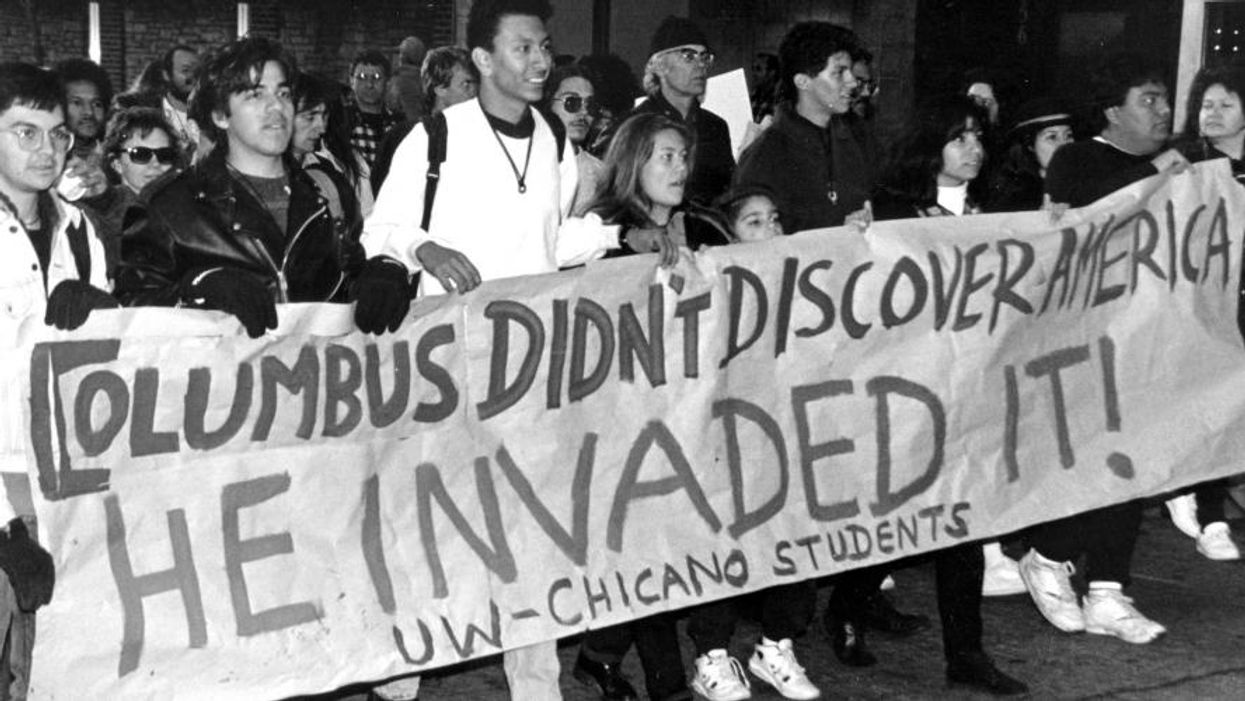
Early in my high school U.S. history classes, I would ask students about "that guy some people say discovered America." All my students knew that the correct answer was Christopher Columbus, and every time I asked this question, some student would break into the sing-song rhyme, "In Fourteen Hundred and Ninety-two, Columbus sailed the ocean blue" -- and others would join in.
"Right. So who did he supposedly discover?" I asked.
In almost 30 years of teaching, the best anyone could come up with was: "Indians."
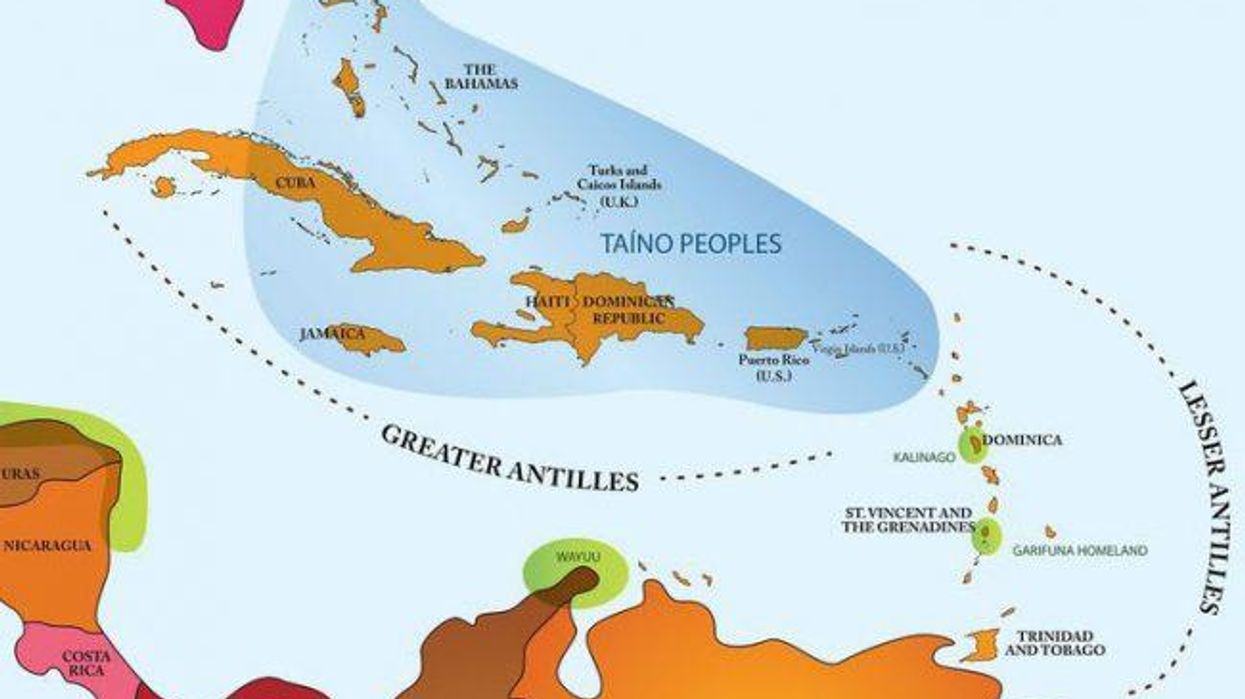
I brushed that answer away: "Yes, but be specific. What were their names? Which nationality?" I never had a student say, "The Tainos."
"So what does this tell us?" I asked. "What does it say that we all know Columbus's name, but none of us knows the nationality of the people who were here first? And there were millions of them."
This erasure of huge swaths of humanity is a fundamental feature of the school curriculum, but also of the broader mainstream political discourse. We usually think about the curriculum as what is taught in school. But as important -- perhaps more important -- is what is nottaught, which includes the lives rendered invisible. Young people, and the rest of us, become inured to the way in which certain people's lives don't count, the way in which the world is cleaved in two: between the worthy and the unworthy, those who matter and those who don't. The "don't matter" people are the ones the Uruguayan writer Eduardo Galeano called los nadies, the nobodies -- "Who speak no languages, only dialects. Who have no religions, only superstitions. Who have no arts, only crafts."
My students and I read and talked about this erasure -- these horrific attacks on Tainos who might dare "to think of themselves as human beings." Because Columbus's policies of enslavement, terrorism, and ultimately, mass murder are so egregious, it's tempting to focus only on Taino deaths.
For the Taino people of the Caribbean, their erasure began almost immediately, with Columbus's arrival. It was not curricular, it was flesh and blood. "With 50 men we could subjugate them all and make them do whatever we want," Columbus wrote in his journal on his third day in the Americas. In 1494, Columbus launched the transatlantic slave trade, sending at least two dozen enslaved Tainos to Spain, "men and women, boys and girls," as he wrote. The next year, 1495, Columbus launched massive slave raids, rounding up 1,600 Tainos, from which the "best" 500, perhaps 550, were selected to be shipped to Spain. Of the hundreds of captives left over, "whoever wanted them could take as many as he pleased," one eyewitness, a Spanish colonist, Michele de Cuneo, wrote, "and this was done."
The Spanish priest Bartolome de las Casas described what he called the "terror" launched by Columbus in his quest for gold and to suppress Taino resistance:
It was a general rule among Spaniards to be cruel; not just cruel, but extraordinarily cruel so that harsh and bitter treatment would prevent Indians as daring to think of themselves as human beings or having a minute to think at all. So they would cut an Indian's hands and leave them dangling by a shred of skin and they would send him on saying, "Go now, spread the news to your chiefs." They would test their swords and their manly strength on captured Indians and place bets on the slicing off of heads or the cutting of bodies in half with one blow. They burned or hanged captured chiefs.
My students and I read and talked about this erasure -- these horrific attacks on Tainos who might dare "to think of themselves as human beings." Because Columbus's policies of enslavement, terrorism, and ultimately, mass murder are so egregious, it's tempting to focus only on Taino deaths. But those deaths can seem abstract and distant, unless we learn something about Taino lives.
It has always struck me that Columbus himself expressed much more curiosity about the Tainos than one finds in corporate-produced textbooks -- although in recent years, no doubt because of Indigenous activism, textbook publishers have discovered the Tainos, if only briefly and superficially. The Tainos were not literate, in the conventional sense, and so wrote nothing about themselves, but Columbus's journal offers intriguing, if limited, details. In the journal of his first voyage, Columbus wrote about the Taino people's homes: "Inside, they were well swept and clean, and their furnishing very well arranged; all were made of very beautiful palm branches." He said there were "wild birds, tamed, in their houses; there were wonderful outfits of nets and hooks and fishing-tackle." Columbus writes that it was a "delight" to see Taino canoas (canoes) that were "very beautiful and carved... it was a pleasure to see its workmanship and beauty." After a little more than three months traveling from island to island, Columbus concluded that the Taino people are "the best people in the world, and beyond all the mildest... a people so full of love and without greed... They love their neighbors as themselves, and they have the softest and gentlest voices in the world, and they are always smiling."
Of course, Columbus's curiosity was grounded in his single-minded quest for gold, and how he might exploit the Tainos to further that mission. As Columbus later wrote King Ferdinand and Queen Isabella: "Gold is a wonderful thing! Whoever owns it is lord of all he wants. With gold it is even possible for souls to open the way to paradise."
After a little more than three months traveling from island to island, Columbus concluded that the Taino people are "the best people in the world, and beyond all the mildest... a people so full of love and without greed... They love their neighbors as themselves, and they have the softest and gentlest voices in the world, and they are always smiling."
Columbus's portrait of the mild, soft, and gentle Taino may conceal that they also tenaciously resisted the Columbus regime, once its exploitative and deadly nature became clear. This resistance has been called the first anti-colonial guerrilla war in the Americas. It began as early as Columbus's first trip back to Spain, when he left 39 Spaniards at his La Navidad settlement, confident that the powerful Spaniards could handle the supposedly timid Tainos. In response to the Spaniards' rapacity, the Tainos killed all 39 Spaniards, and burned their fort.
If Columbus's first trip, with three vessels and maybe 100 men, was an exploratory probe, the second trip, with 17 ships and between 1,200 and 1,500 men, was a full-scale invasion. When slavery turned out not to be profitable on la Espanola (the island that today is Haiti and the Dominican Republic), Columbus instituted a tribute system for the Tainos, demanding quotas of gold and cotton, with sadistic punishments for those who failed to comply. This system was "impossible and intolerable," wrote Bartolome de las Casas.
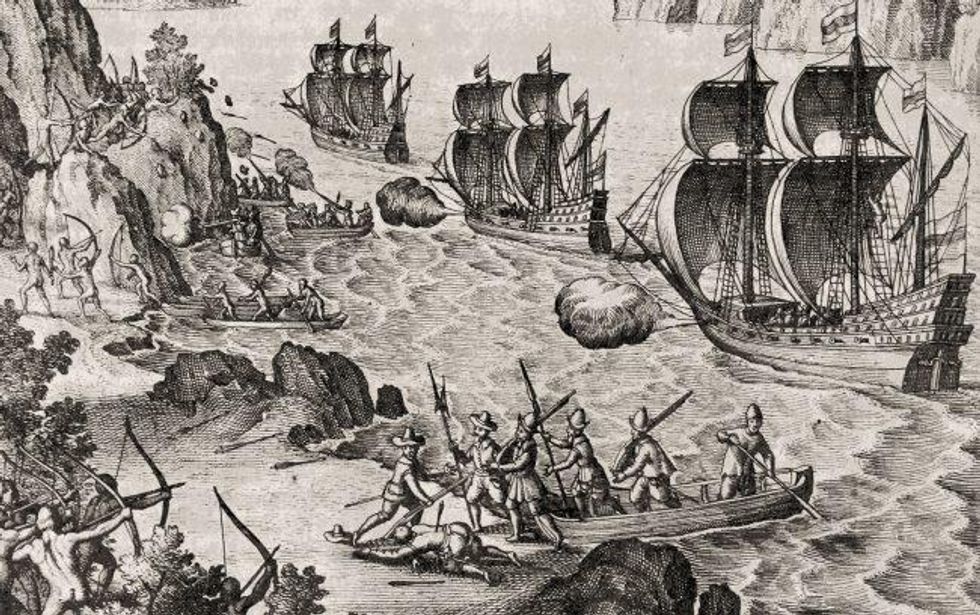
The Tainos fought back, raiding Spanish forts and killing defenders. Taino caciques, leaders, worked to build alliances throughout the island. The Tainos continuously resisted the heavily armed Spaniards for almost a year, from May 1495 to March 1496, but uprisings and resistance continued through 1503. According to Spanish accounts, Tainos also went on strike and turned to sabotage. One Spanish eyewitness wrote that the Tainos "thought they might expel [the Spaniards] by creating a scarcity of food. They therefore decided not only to plant no more crops, but also to destroy and tear up all the various kinds of cereals used for bread which had already been sown." Las Casas adds that the Tainos "would hide in the mountains," but when they "fled the Christians, there went with them disease, death, and misery, and an infinite number of fathers and mothers and children died in anguish."
Ironically, in their quest for a happy ending to this grim first chapter in European colonialism in the Americas, textbook writers also focus on food -- but not on resistance. For example, Houghton Mifflin Harcourt's middle school text United States History Early Years concludes its section on Columbus:
The Columbian Exchange benefited people all over the world. Potatoes from the Americas became an important food for most Europeans. Corn became an important crop in Africa. Sweet potatoes were grown as far away as China. Today, tomatoes, peanuts, and American beans and peppers are grown in many lands.
The sole "review" question asks: "How did the Columbian Exchange change the diet of Europeans?"
This is how the textbook story ends: wondering about the eating habits of Europeans. Let's remember that enslaving Africans and shipping them to the Americas was also a part of the so-called Columbian Exchange. Africa was not only a receptacle for American corn. Columbus was granted the first royal permit to bring enslaved Africans to the Americas in 1501, less than a decade after his arrival.
Despite textbook attempts to conclude the story with a smiley-face, there is no happy ending. But there is a hopeful one -- found in the remarkable resilience of the Taino people. Contrary to some scholarship, the Tainos were not all killed off by Columbus and subsequent occupiers, and today members of the Taino diaspora along with people in the Caribbean who claim Taino ancestry are reviving and celebrating their culture. According to Christina M. Gonzalez, writing in the fall 2018 issue of American Indian, the Taino revival began around the quincentenary of Columbus's arrival. The renaissance focuses on language, art, religion, pharmacology, agriculture, fishing, cooking, and, of course, rethinking Taino history. Gonzalez writes, "Many in the movement call upon embodied memories of traditions and values disseminated across generations, often by family matriarchs, which espoused mindful relations in a world where all things have life, from plants, stones, rivers, forests, caves, sun and moon, to deceased relatives and disincarnate beings inhabiting their islands."
In recent years, genetic research has confirmed the ongoing Taino presence in the Caribbean. According to Jose Barreiro, a scholar and a member of the Taino Nation of the Antilles, genetic research in Cuba has found that almost 35 percent of Cubans have Native American mitochondrial DNA, with some regions as high as 59 percent. A University of Puerto Rico study of 800 randomly selected Puerto Ricans found 61.1 percent of individuals surveyed had mitochondrial DNA of Indigenous origin. But as a friend recently reminded me, people with Taino cultural DNA had no need for scientific confirmation that they are still here -- "hidden in plain sight," as Jose Barreiro subtitled his National Museum of the American Indian article on "Indigenous Cuba."
Columbus's treatment of the Taino people meets the UN definition of genocide. But there has also been a curricular genocide -- erasing the memory of the Taino from our nation's classrooms. How else can we explain students' universal recognition of Columbus and almost total ignorance of the name Taino? As we work to replace Columbus Day with Indigenous Peoples Day in our communities and schools, let's work to remember the people who were here first. Their lives mattered 500 years ago, and they matter today.
Note from TomDispatch editor Tom Engelhardt: If you've never read a book by Eduardo Galeano, believe me, your life has been lacking. Read his first book, read his last book, read something he wrote anyway. I offer you the Engelhardt guarantee: you won't regret it. Start, if you wish, with his final volume, Hunter of Stories, featured in today's post and then work your way back through a writer to remember. I've featured his work many times at this site, always with the deepest pleasure. This, I suspect, is the last time for both of us. The passages below are from his final, touching volume published by Nation Books, Hunter of Stories. And so, let me take this opportunity, one last time, to say goodbye, Eduardo, and thank you for everything, especially for the worlds you captured forever in words.
Free
By day, the sun guides them. By night, the stars.
Paying no fare, they travel without passports and without forms for customs or immigration.
Birds are the only free beings in this world inhabited by prisoners. They fly from pole to pole, powered by food alone, on the route they choose and at the hour they wish, without ever asking permission of officials who believe they own the heavens.
Shipwrecked
The world is on the move.
On board are more shipwrecked souls than successful seafarers.
Thousands of desperate people die en route, before they can complete the crossing to the promised land, where even the poor are rich and everyone lives in Hollywood.
The illusions of any who manage to arrive do not last long.
Monster Wanted
Saint Columba was rowing across Loch Ness when an immense serpent with a gaping mouth attacked his boat. Saint Columba, who had no desire to be eaten, chased it off by making the sign of the cross.
Fourteen centuries later, the monster was seen again by someone living nearby, who happened to have a camera around his neck, and pictures of it and of curious footprints came out in the Glasgow and London papers.
The creature turned out to be a toy, the footprints made by baby hippopotamus feet, which are sold as ashtrays.
The revelation did nothing to discourage the tourists.
The market for fear feeds on the steady demand for monsters.
Foreigner
In a community newspaper in Barcelona's Raval neighborhood, an anonymous hand wrote:
Your god is Jewish, your music is African, your car is Japanese, your pizza is Italian, your gas is Algerian, your coffee is Brazilian, your democracy is Greek, your numbers are Arabic, your letters are Latin.
I am your neighbor. And you call me a foreigner?
The Terrorizer
Back in the years 1975 and 1976, before and after the coup d'etat that imposed the most savage of Argentina's many military dictatorships, death threats flew fast and furious and anyone suspected of the crime of thinking simply disappeared.
Orlando Rojas, a Paraguayan exile, answered his telephone in Buenos Aires. Every day a voice repeated the same thing: "I'm calling to tell you you're going to die."
"So you aren't?" Orlando asked.
The terrorizer would hang up.
A Visit to Hell
Some years ago, during one of my deaths, I paid a visit to hell.
I had heard that in the underworld you can get your favorite wine and any delicacy you want, lovers for all tastes, dancing music, endless pleasure...
Once again, I was able to corroborate the fact that advertising lies. Hell promises a great life, but all I found were people waiting in line.
In that endless queue, snaking out of sight along narrow smoky passages, were women and men of all epochs, from cavemen to astronauts.
All were condemned to wait. To wait for eternity.
That's what I discovered: hell is waiting.
Prophecies
Who was it that a century ago best described today's global power structure?
Not a philosopher, not a sociologist, not a political scientist either.
It was a child named Little Nemo, whose adventures were published in the New York Herald way back in 1905, as drawn by Winsor McCay.
Little Nemo dreamed about the future.
In one of his most unerring dreams, he traveled to Mars.
That unfortunate planet was in the hands of a businessman who had crushed his competitors and exercised an absolute monopoly.
The Martians seemed stupid, because they said little and breathed little.
Little Nemo knew why: the boss of Mars had seized ownership of words and the air.
They were the keys to life, the sources of power.
Very Brief Synthesis of Contemporary History
For several centuries subjects have donned the garb of citizens, and monarchies have preferred to call themselves republics.
Local dictatorships, claiming to be democracies, open their doors to the steamroller of the global market. In this kingdom of the free, we are all united as one. But are we one, or are we no one? Buyers or bought? Sellers or sold? Spies or spied upon?
We live imprisoned behind invisible bars, betrayed by machines that feign obedience but spread lies with cybernetic impunity.
Machines rule in homes, factories, offices, farms, and mines, and also on city streets, where we pedestrians are but a nuisance. Machines also rule in wars, where they do as much of the killing as warriors in uniform, or more.
The Right to Plunder
In the year 2003, a veteran Iraqi journalist named Samir visited several museums in Europe.
He found marvelous texts in Babylonian, heroes and gods sculpted in the hills of Nineveh, winged lions that had flown in Assyria...
Someone approached him, offered to help: "Shall I call a doctor?"
Squatting, Samir buried his face in his hands and swallowed his tears.
He mumbled, "No, please. I'm all right."
Later on, he explained: "It hurts to see how much they have stolen and to know how much they will steal."
Two months later, U.S. troops launched their invasion. The National Museum in Baghdad was sacked. One hundred seventy thousand works were reported lost.
Stories Tell the Tale
I wrote Soccer in Sun and Shadow to convert the pagans. I wanted to help fans of reading lose their fear of soccer, and fans of soccer lose their fear of books. I never imagined anything else.
But according to Victor Quintana, a congressman in Mexico, the book saved his life. In the middle of 1997, he was kidnapped by professional assassins, hired to punish him for exposing dirty deals.
They had him tied up, face down on the ground, and were kicking him to death, when there was a pause before the final bullet. The murderers got caught up in an argument about soccer. That was when Victor, more dead than alive, put in his two cents. He began telling stories from my book, trading minutes of life for every story from those pages, the way Scheherazade traded a story for every one of her thousand-and-one nights.
Hours and stories slowly unfolded.
At last the murderers left him, tied up and trampled, but alive.
They said, "You're a good guy," and they took their bullets elsewhere.
***
Quite a few years ago now, during my time in exile on the coast of Catalonia, I got an encouraging nudge from a girl eight or nine years old, who, unless I'm remembering wrong, was named Soledad.
I was having a few drinks with her parents, also exiles, when she called me over and asked,
"So, what do you do?"
"Me? I write books."
"You write books?"
"Well... yes."
"I don't like books," she declared.
And since she had me against the ropes, she hit me again: "Books sit still. I like songs because songs fly."
Ever since my encounter with that angel sent by God, I have attempted to sing. It's never worked, not even in the shower. Every time, the neighbors scream, "Get that dog to stop barking!"
***
My granddaughter Catalina was ten.
We were walking along a street in Buenos Aires when someone came up and asked me to sign a book. I can't remember which one.
We continued on, the two of us, quietly arm in arm, until Catalina shook her head and offered this encouraging remark: "I don't know why they make such a fuss. Not even I read you."
A New York Times article, following the white supremacist demonstrations in Charlottesville, Virginia, and the murder of anti-racist activist Heather Heyer, described the growing calls to remove monuments that celebrate the Confederacy. The article went on to cite some who balk, however, when "the symbolism is far murkier, like Christopher Columbus."
But there is nothing murky about Columbus' legacy of slavery and terrorism in the Americas. The record is clear and overwhelming. The fact that The New York Times could report this with such confidence -- adding that "most Americans learn rather innocently, in 1492 [Columbus] sailed the ocean blue until he discovered the New World" -- means that educators and activists still have much work to do.
In fact, Christopher Columbus launched the trans-Atlantic slave trade in 1494, when he sent back at least two dozen enslaved Tainos, including children, to Spain. In February of that year, Columbus dispatched 12 of his 17 ships from the Caribbean back to Spain with a letter to be delivered to the king and queen by Antonio de Torres, captain of the returning fleet. Columbus wrote:
There are being sent in these ships some Cannibals, men and women, boys and girls, which Your Highnesses can order placed in charge of persons from whom they may be able better to learn the language while being employed in forms of service, gradually ordering that greater care be given them than to other slaves.
Here, as in so much of world history, violence and exploitation is sprinkled with a perfume of benevolence. Later in the letter, Columbus explains to the king and queen that his plans for colonizing the lands he has "discovered" could be financed by slavery:
These things could be paid for in slaves taken from among these cannibals, who are so wild and well built and with a good understanding of things that we think they will be finer than any other slaves once they are freed from their inhumanity, which they will lose as soon as they leave their own lands.
A year later, in February 1495, Columbus initiated massive slave raids, ordering his men to round up 1,600 Tainos and to bring the captives to La Isabela, on the island of Hispaniola (today's Haiti and the Dominican Republic), where the "best" 500 (some accounts say 550) men and women could be shipped to Spain. One of the colonists, Michele de Cuneo, was an eyewitness to these crimes. "Of the rest who were left," wrote Cuneo, "the announcement went around that whoever wanted them could take as many as he pleased; and this was done."
It's worth pausing to reflect on the terror the Tainos must have experienced being torn from home and families, and packed on ships bound for an uncertain destination -- that is, those who survived Columbus' slavery free-for-all. Where are the monuments to these first victims of the trans-Atlantic slave trade?
Gold. That was the essence of Columbus' "enterprise" -- la empresa -- as he called it. Wrote Columbus: "Gold is a wonderful thing! Whoever owns it is lord of all he wants. With gold it is even possible to open for souls the way to paradise." Later in 1495, to effect this gold lust, Columbus initiated the policy of forcing Tainos throughout Hispaniola to deliver tributes of gold every three months.
The Tainos resisted, of course, but were brutally suppressed by the Columbus regime. The Spanish priest Bartolome de las Casas wrote that to quell the resistance, Columbus ordered his men to "spread terror among the Indians to show them how strong and powerful the Christians were." In sickening detail, Las Casas described some of what it meant for the Spaniards to "spread terror" among the Tainos:
Once the Indians were in the woods, the next step was to form squadrons and pursue them, and whenever the Spaniards found them, they pitilessly slaughtered everyone like sheep in a corral. It was a general rule among Spaniards to be cruel; not just cruel, but extraordinarily cruel so that harsh and bitter treatment would prevent Indians as daring to think of themselves as human beings or having a minute to think at all. So they would cut an Indian's hands and leave them dangling by a shred of skin and they would send him on saying, "Go now, spread the news to your chiefs." They would test their swords and their manly strength on captured Indians and place bets on the slicing off of heads or the cutting of bodies in half with one blow. They burned or hanged captured chiefs.
No, there is nothing murky about Columbus' record of cruelty in the Caribbean. One can read the horrific details even in the biography of Columbus written by his own son Ferdinand. What's murky are any remaining rationales for failing to topple monuments to this brutal exploitation of Indigenous peoples in the Americas, for keeping the Columbus Day holiday, or for failing to address a curriculum that, as The New York Times describes, allows children to learn that Columbus "sailed the ocean blue until he discovered the New World."
Twenty-five years ago, I wrote an article, "Once Upon a Genocide," reviewing the major children's literature about Columbus. My conclusion was that these books teach young readers that colonialism and racism are normal. Consistently, the books presented Columbus coming ashore on the lands he "discovered," planting a flag, claiming it in the name of King Ferdinand and Queen Isabella, and naming the island San Salvador -- erasing the rights and humanity of the original inhabitants. No book I reviewed at that time asked children to reflect on who or what gave Columbus the authority to take over other people's land. These picture books were literary monuments to white European domination, and to the subordination of non-white Others.
Through my work as curriculum editor with Rethinking Schools magazine, I have been in a number of elementary and middle schools over the past couple of years. Sadly, many of the same books I reviewed in the early 1990s still populate school libraries. The good news is that, these days, many more teachers approach the Columbus invasion from the standpoint of the Tainos. One needn't tell young children about people's hands being chopped off for them to realize that it is wrong for people to arrive at your home from far away, claim it as theirs, and demand you work for them.
In classrooms throughout the country, students are putting Columbus on trial -- along with the system of empire that animated his voyages. Instead of reading children's books and textbooks uncritically, teachers are asking students to read for the silences: What important information is missing, whose stories are not being told, whose lives are absent? In some schools, students are writing new children's books that tell a fuller, more accurate history of Columbus' arrival and the people who were here first. (Many of these activities are described at the Zinn Education Project, and in the book I co-edited, Rethinking Columbus: The Next 500 Years.)
And throughout the country, schools, school districts, and cities -- including Berkeley, Seattle, Portland, Denver, Albuquerque, and, most recently, Los Angeles -- have abandoned Columbus Day in favor of Indigenous Peoples Day.
Donald Trump may still -- for the moment -- be president, but he is not president of how we remember the past. Everywhere people of conscience are challenging the iconography of hate, exploitation, racism, and colonial domination. Slowly, we are toppling Confederate monuments -- and others celebrating more contemporary scoundrels like Philadelphia's Frank Rizzo.
When I lead workshops for educators critiquing how the traditional children's literature on Columbus celebrates white lives at the expense of people of color, how this literature endorses the bullying of little nations by big nations, how it teaches that there are two kinds of people in the world, the worthy and the unworthy, I end by asking participants: Why? Why is it that for such a long period of time these books have told a consistent story -- is there some publisher conspiracy to lie to children?
No doubt there are many possible explanations. But the one I find most compelling is that in fundamental ways, Columbus' world is not so different from the world we live in today. Big countries continue to dominate "lesser" nations. The quest for profit is still paramount. The world is still sliced in two between the worthy -- the owning classes, the corporate masters, the generals -- and those the Uruguayan writer Eduardo Galeano called los nadies -- the nobodies. The invaded, the owned, the bombed, the poisoned, the silenced.
So yes, let's pull down the monuments, let's make the holidays more inclusive, let's rewrite the textbooks and children's literature. But let's also challenge the fundamental structures of ownership, power, and privilege that have given us such a skewed constellation of heroes and holidays.
The movement to abolish Columbus Day and to establish in its place Indigenous Peoples Day continues to gather strength, as every month new school districts and colleges take action. This campaign has been given new momentum as Indigenous peoples throughout the Americas assert their treaty and human rights. Especially notable is the inspiring struggle in North Dakota to stop the toxic Dakota Access Pipeline, led by the Standing Rock Sioux.
Dave Archambault, chairperson of the Standing Rock Sioux Tribe, explains that the oil pipeline "is threatening the lives of people, lives of my tribe, as well as millions down the river. It threatens the ancestral sites that are significant to our tribe. And we never had an opportunity to express our concerns. This is a corporation that is coming forward and just bulldozing through without any concern for tribes."
The "bulldozing" of Indigenous lives, Indigenous lands, and Indigenous rights all began with Columbus's invasion in 1492. Columbus's policies toward Indigenous peoples in the Caribbean were genocidal. On the island that became Haiti and the Dominican Republic, Columbus ordered Taino people's hands chopped off if they did not deliver sufficient quantities of gold. His men took women and girls as sex slaves. He had Tainos chased down by vicious dogs. He ordered his men to "spread terror" among Tainos who resisted--and they did resist. And he launched the transatlantic slave trade--from the Americas to Europe, as well as from Africa to the Americas. "Let us in the name of the Holy Trinity go on sending all the slaves that can be sold," he wrote.
Through the conventional story of the "discovery of America," the school curriculum has taught students to celebrate colonialism and racism, and to disregard the lives of the Tainos, and other Indigenous peoples. The Columbus-discovers-America story has long been a kind of secular book of Genesis--"In the beginning there was Columbus..."-- the original Only White Lives Matter myth. And it has played a central role in the curricular erasure of the humanity of Indigenous peoples.
I taught high school social studies for almost 30 years. One of my first activities in my high school U.S. history classes was to steal a student's purse. Yes, I wanted to capture students' attention at the beginning of the school year, but I also wanted them to think about whose lives are valued--and whose aren't--in the traditional curriculum.
I began by loudly calling for everyone to watch carefully, and then I'd snatch a purse off a student's desk. Frankly, purses worked better than backpacks, because they are more personal, and my theft seemed more, well, invasive.
"This is my purse," I would announce to looks of disbelief and annoyance. But annoyance turned to outrage when I opened the purse and started taking things out. (The student who owned this purse, let's call her Maria, knew what was coming, and had agreed to it, but I'd alerted no one else.) "This is my comb. This is my pen. This is my lipstick." And when students protested, I demanded that they prove that the purse was Maria's and not mine. "That's her stuff in there." "We saw you take it." "She knows everything that's in there, and you don't."
"Alright, alright. Then let's say I discovered the purse. That makes it mine, right?"
Students quickly saw where I was going, as we compared my purse-stealing to Columbus's "discovery": The people who were here first--the Tainos--had "stuff" in their land, they had lived there a long time, they knew the land better than Columbus, etc. "So why do some people call it discovery? Why don't we use the same language that you used to describe what I did to Maria's purse? Columbus stole the Tainos' land. He ripped it off. And because he came armed, he invaded it."
At the heart of all our schooling is a narrative about whose lives matter--who counts in the world. Even today, if I stand in front of a class of high school students and start rhyming, "In Fourteen Hundred and Ninety-Two ...," large numbers of students will finish with "... Columbus sailed the Ocean blue." But few of them know the name of the people who were here when Columbus arrived--the Tainos. This tells us that too often our schools still teach young people to celebrate Great White Men and disregard the lives of the "discovered" and dominated.
The Uruguayan writer, Eduardo Galeano, used the term los nadies, the nobodies. Nobodies can be ignored and ruled, removed and slaughtered, without consequence. They are people who don't matter:
Who don't speak languages, but dialects.
Who don't have religions, but superstitions.
Who don't create art, but handicrafts.
Who don't have culture, but folklore.
Who are not human beings, but human resources.
Who do not have faces, but arms.
"With 50 men we can subjugate them all and make them do whatever we want," Columbus boasted in his journal about the Tainos--los nadies, the nobodies--on just his third day in the Americas.
This disregard for the lives and rights of Indigenous peoples has long been mimicked in the school curriculum, and so often it begins with the Columbus-discovers-America myth. Students readily learn whose lives matter and whose don't. Whose lives are they invited to imagine? Whose stories are featured in history classes and the literature read in the language arts curriculum?
The good news is that this is changing. The Black Lives Matter movement has denounced our society's failure to value all lives equally--challenged the continuous war waged especially on Black men, but on people of color more broadly. And high school students, educators, and communities of color are winning demands for more ethnic studies in the schools--curriculum that interrogates racial inequality and features historic struggles to make society more equal.
And that brings us back to Columbus Day. If we are sincere in our claim that all lives have value, then schools need to refuse to honor the first European colonialist of the Americas, the "father of the slave trade." This is not about what went on 500 years ago. It's about what's going on today: an inspiring struggle for rights and dignity. We need to begin to see Indigenous peoples--in the world and in the curriculum.
[Note for TomDispatch Readers: Every now and then, in the quieter days of summer, it feels good and appropriate to feature old friends no longer with us. In that spirit, TomDispatch recently offered an excerpt from Mirrors, the idiosyncratic, late-in-life masterwork of world history by Eduardo Galeano, who died this April. Today, we turn to someone who helped makeTomDispatch special in its early years, Chalmers Johnson, who died in November 2010 and whom I've missed ever since. When our American world offers a particularly outrageous display of militarism, I often wonder: What would Chal think? Fortunately -- or perhaps I mean unfortunately -- in too many cases, we still know what Chal would have thought, since so little has really changed in the behavior of the national security state since 2010. Today, in bringing back a piece on his signature subject, the unique way the U.S. has garrisoned the planet, with a new introduction by Nick Turse who has taken up Chal's role at this site when it comes to the U.S. military, we offer a case in point.
Unfortunately, signed copies of Chal's books are no longer available in return for contributions to this site, but you can still donate and help support the Chalmers Johnsons of the future at TomDispatch. Right now, for instance, you can get a signed, personalized copy of Susan Southard's shocking and moving new book on the nuclear destruction of Nagasaki (featured recently at this site) for a contribution of $100. Do check out our donation page where any number of books are on offer. Tom]
There's a secret world out beyond the horizon, a world of austere airstrips and shadowy commandos, a world of screens filled by streaming full-motion video of armed young men in the backlands of the planet, a world of musty storage depots and warehouses, pallets and fuel drums just waiting for sailors and soldiers and airmen to come calling. It's the American "baseworld," a huge but hidden network of far-flung outposts and tucked-away compounds stretching from North America to the Middle East, Asia to Africa. If you follow the subject, you may not be surprised by some of the sites now mentioned in connection with this empire of bases, like Romania, where a major U.S. military transit hub became fully operational last year; Senegal and Ghana, where the Marine Corps recently established "cooperative security locations"; and Bashur airfield in Iraqi Kurdistan, which was reportedly being turned into a training site for the fight against the Islamic State in 2014. You might, however, be surprised to learn that plans for each of these locales were mentioned more than a decade ago in an article by the late Chalmers Johnson.
After an ideological shift that took him from diehard Cold Warrior to anguished patriot and critic of American militarism, Johnson got in the habit of being ahead of the curve. If you had, for instance, read his groundbreaking book Blowback: The Costs and Consequences of American Empire when it was published, you wouldn't have been shocked when September 11, 2001, rolled around. His 2004 article "America's Empire of Bases" shares the same profound prescience. Some, perhaps most, articles go stale days or weeks after they're published. (Some even expire before they hit the printed page or webpage.) But only now -- nearly five years after his death -- are we finally catching up to one of TomDispatch's greatest oracles and most eloquent writers.
Johnson followed up Blowback -- which became a post-9/11 bestseller -- with his book-length exploration of America's "empire of bases" (as he called it) and its consequences in The Sorrows of Empire: Militarism, Secrecy, and the End of the Republic, before completing his trilogy with a magisterial study of imperial overstretch: Nemesis, The Last Days of the American Republic. All these years later, his books still have the power to shine a bright light into the darkened corners of American militarism. Today, TomDispatch is pleased to whet your appetite for reading (or re-reading) them with "America's Empire of Bases," an article, originally published on January 15, 2004, that -- given America's dedication to maintaining a massive global network of military outposts -- will remain relevant for many years to come. Nick Turse
America's Empire of Bases
By Chalmers Johnson
As distinct from other peoples, most Americans do not recognize -- or do not want to recognize -- that the United States dominates the world through its military power. Due to government secrecy, our citizens are often ignorant of the fact that our garrisons encircle the planet. This vast network of American bases on every continent except Antarctica actually constitutes a new form of empire -- an empire of bases with its own geography not likely to be taught in any high school geography class. Without grasping the dimensions of this globe-girdling Baseworld, one can't begin to understand the size and nature of our imperial aspirations or the degree to which a new kind of militarism is undermining our constitutional order.
Our military deploys well over half a million soldiers, spies, technicians, teachers, dependents, and civilian contractors in other nations. To dominate the oceans and seas of the world, we are creating some thirteen naval task forces built around aircraft carriers whose names sum up our martial heritage -- Kitty Hawk, Constellation, Enterprise, John F. Kennedy, Nimitz, Dwight D. Eisenhower, Carl Vinson, Theodore Roosevelt, Abraham Lincoln, George Washington, John C. Stennis, Harry S. Truman, and Ronald Reagan. We operate numerous secret bases outside our territory to monitor what the people of the world, including our own citizens, are saying, faxing, or e-mailing to one another.
Our installations abroad bring profits to civilian industries, which design and manufacture weapons for the armed forces or, like the now well-publicized Kellogg, Brown & Root company, a subsidiary of the Halliburton Corporation of Houston, undertake contract services to build and maintain our far-flung outposts. One task of such contractors is to keep uniformed members of the imperium housed in comfortable quarters, well fed, amused, and supplied with enjoyable, affordable vacation facilities. Whole sectors of the American economy have come to rely on the military for sales. On the eve of our second war on Iraq, for example, while the Defense Department was ordering up an extra ration of cruise missiles and depleted-uranium armor-piercing tank shells, it also acquired 273,000 bottles of Native Tan sunblock, almost triple its 1999 order and undoubtedly a boon to the supplier, Control Supply Company of Tulsa, Oklahoma, and its subcontractor, Sun Fun Products of Daytona Beach, Florida.
At Least Seven Hundred Foreign Bases
It's not easy to assess the size or exact value of our empire of bases. Official records on these subjects are misleading, although instructive. According to the Defense Department's annual "Base Structure Report" for fiscal year 2003, which itemizes foreign and domestic U.S. military real estate, the Pentagon currently owns or rents 702 overseas bases in about 130 countries and has another 6,000 bases in the United States and its territories. Pentagon bureaucrats calculate that it would require at least $113.2 billion to replace just the foreign bases -- surely far too low a figure but still larger than the gross domestic product of most countries -- and an estimated $591.5 billion to replace all of them. The military high command deploys to our overseas bases some 253,288 uniformed personnel, plus an equal number of dependents and Department of Defense civilian officials, and employs an additional 44,446 locally hired foreigners. The Pentagon claims that these bases contain 44,870 barracks, hangars, hospitals, and other buildings, which it owns, and that it leases 4,844 more.
These numbers, although staggeringly large, do not begin to cover all the actual bases we occupy globally. The 2003 Base Status Report fails to mention, for instance, any garrisons in Kosovo -- even though it is the site of the huge Camp Bondsteel, built in 1999 and maintained ever since by Kellogg, Brown & Root. The Report similarly omits bases in Afghanistan, Iraq, Israel, Kuwait, Kyrgyzstan, Qatar, and Uzbekistan, although the U.S. military has established colossal base structures throughout the so-called arc of instability in the two-and-a-half years since 9/11.
For Okinawa, the southernmost island of Japan, which has been an American military colony for the past 58 years, the report deceptively lists only one Marine base, Camp Butler, when in fact Okinawa "hosts" ten Marine Corps bases, including Marine Corps Air Station Futenma occupying 1,186 acres in the center of that modest-sized island's second largest city. (Manhattan's Central Park, by contrast, is only 843 acres.) The Pentagon similarly fails to note all of the $5-billion-worth of military and espionage installations in Britain, which have long been conveniently disguised as Royal Air Force bases. If there were an honest count, the actual size of our military empire would probably top 1,000 different bases in other people's countries, but no one -- possibly not even the Pentagon -- knows the exact number for sure, although it has been distinctly on the rise in recent years.
For their occupants, these are not unpleasant places to live and work. Military service today, which is voluntary, bears almost no relation to the duties of a soldier during World War II or the Korean or Vietnamese wars. Most chores like laundry, KP ("kitchen police"), mail call, and cleaning latrines have been subcontracted to private military companies like Kellogg, Brown & Root, DynCorp, and the Vinnell Corporation. Fully one-third of the funds recently appropriated for the war in Iraq (about $30 billion), for instance, are going into private American hands for exactly such services. Where possible, everything is done to make daily existence seem like a Hollywood version of life at home. According to the Washington Post, in Fallujah, just west of Baghdad, waiters in white shirts, black pants, and black bow ties serve dinner to the officers of the 82nd Airborne Division in their heavily guarded compound, and the first Burger King has already gone up inside the enormous military base we've established at Baghdad International Airport.
Some of these bases are so gigantic they require as many as nine internal bus routes for soldiers and civilian contractors to get around inside the earthen berms and concertina wire. That's the case at Camp Anaconda, headquarters of the 3rd Brigade, 4th Infantry Division, whose job is to police some 1,500 square miles of Iraq north of Baghdad, from Samarra to Taji. Anaconda occupies 25 square kilometers and will ultimately house as many as 20,000 troops. Despite extensive security precautions, the base has frequently come under mortar attack, notably on the Fourth of July, 2003, just as Arnold Schwarzenegger was chatting up our wounded at the local field hospital.
The military prefers bases that resemble small fundamentalist towns in the Bible Belt rather than the big population centers of the United States. For example, even though more than 100,000 women live on our overseas bases -- including women in the services, spouses, and relatives of military personnel -- obtaining an abortion at a local military hospital is prohibited. Since there are some 14,000 sexual assaults or attempted sexual assaults each year in the military, women who become pregnant overseas and want an abortion have no choice but to try the local economy, which cannot be either easy or pleasant in Baghdad or other parts of our empire these days.
Our armed missionaries live in a closed-off, self-contained world serviced by its own airline -- the Air Mobility Command, with its fleet of long-range C-17 Globemasters, C-5 Galaxies, C-141 Starlifters, KC-135 Stratotankers, KC-10 Extenders, and C-9 Nightingales that link our far-flung outposts from Greenland to Australia. For generals and admirals, the military provides seventy-one Learjets, thirteen Gulfstream IIIs, and seventeen Cessna Citation luxury jets to fly them to such spots as the armed forces' ski and vacation center at Garmisch in the Bavarian Alps or to any of the 234 military golf courses the Pentagon operates worldwide. Defense secretary Donald Rumsfeld flies around in his own personal Boeing 757, called a C-32A in the Air Force.
Our "Footprint" on the World
Of all the insensitive, if graphic, metaphors we've allowed into our vocabulary, none quite equals "footprint" to describe the military impact of our empire. Chairman of the Joint Chiefs of Staff General Richard Myers and senior members of the Senate's Military Construction Subcommittee such as Dianne Feinstein (D-CA) are apparently incapable of completing a sentence without using it. Establishing a more impressive footprint has now become part of the new justification for a major enlargement of our empire -- and an announced repositioning of our bases and forces abroad -- in the wake of our conquest of Iraq. The man in charge of this project is Andy Hoehn, deputy assistant secretary of defense for strategy. He and his colleagues are supposed to draw up plans to implement President Bush's preventive war strategy against "rogue states," "bad guys," and "evil-doers." They have identified something they call the "arc of instability," which is said to run from the Andean region of South America (read: Colombia) through North Africa and then sweeps across the Middle East to the Philippines and Indonesia. This is, of course, more or less identical with what used to be called the Third World -- and perhaps no less crucially it covers the world's key oil reserves. Hoehn contends, "When you overlay our footprint onto that, we don't look particularly well-positioned to deal with the problems we're now going to confront."
Once upon a time, you could trace the spread of imperialism by counting up colonies. America's version of the colony is the military base. By following the changing politics of global basing, one can learn much about our ever larger imperial stance and the militarism that grows with it. Militarism and imperialism are Siamese twins joined at the hip. Each thrives off the other. Already highly advanced in our country, they are both on the verge of a quantum leap that will almost surely stretch our military beyond its capabilities, bringing about fiscal insolvency and very possibly doing mortal damage to our republican institutions. The only way this is discussed in our press is via reportage on highly arcane plans for changes in basing policy and the positioning of troops abroad -- and these plans, as reported in the media, cannot be taken at face value.
Marine Brigadier General Mastin Robeson, commanding our 1,800 troops occupying the old French Foreign Legion base at Camp Lemonnier in Djibouti at the entrance to the Red Sea, claims that in order to put "preventive war" into action, we require a "global presence," by which he means gaining hegemony over any place that is not already under our thumb. According to the right-wing American Enterprise Institute, the idea is to create "a global cavalry" that can ride in from "frontier stockades" and shoot up the "bad guys" as soon as we get some intelligence on them.
"Lily Pads" in Australia, Romania, Mali, Algeria...
In order to put our forces close to every hot spot or danger area in this newly discovered arc of instability, the Pentagon has been proposing -- this is usually called "repositioning" -- many new bases, including at least four and perhaps as many as six permanent ones in Iraq. A number of these are already under construction -- at Baghdad International Airport, Tallil air base near Nasariyah, in the western desert near the Syrian border, and at Bashur air field in the Kurdish region of the north. (This does not count the previously mentioned Anaconda, which is currently being called an "operating base," though it may very well become permanent over time.) In addition, we plan to keep under our control the whole northern quarter of Kuwait -- 1,600 square miles out of Kuwait's 6,900 square miles -- that we now use to resupply our Iraq legions and as a place for Green Zone bureaucrats to relax.
Other countries mentioned as sites for what Colin Powell calls our new "family of bases" include: In the impoverished areas of the "new" Europe -- Romania, Poland, and Bulgaria; in Asia -- Pakistan (where we already have four bases), India, Australia, Singapore, Malaysia, the Philippines, and even, unbelievably, Vietnam; in North Africa -- Morocco, Tunisia, and especially Algeria (scene of the slaughter of some 100,00 civilians since 1992, when, to quash an election, the military took over, backed by our country and France); and in West Africa -- Senegal, Ghana, Mali, and Sierra Leone (even though it has been torn by civil war since 1991). The models for all these new installations, according to Pentagon sources, are the string of bases we have built around the Persian Gulf in the last two decades in such anti-democratic autocracies as Bahrain, Kuwait, Qatar, Oman, and the United Arab Emirates.
Most of these new bases will be what the military, in a switch of metaphors, calls "lily pads" to which our troops could jump like so many well-armed frogs from the homeland, our remaining NATO bases, or bases in the docile satellites of Japan and Britain. To offset the expense involved in such expansion, the Pentagon leaks plans to close many of the huge Cold War military reservations in Germany, South Korea, and perhaps Okinawa as part of Secretary of Defense Rumsfeld's "rationalization" of our armed forces. In the wake of the Iraq victory, the U.S. has already withdrawn virtually all of its forces from Saudi Arabia and Turkey, partially as a way of punishing them for not supporting the war strongly enough. It wants to do the same thing to South Korea, perhaps the most anti-American democracy on Earth today, which would free up the 2nd Infantry Division on the demilitarized zone with North Korea for probable deployment to Iraq, where our forces are significantly overstretched.
In Europe, these plans include giving up several bases in Germany, also in part because of Chancellor Gerhard Schroder's domestically popular defiance of Bush over Iraq. But the degree to which we are capable of doing so may prove limited indeed. At the simplest level, the Pentagon's planners do not really seem to grasp just how many buildings the 71,702 soldiers and airmen in Germany alone occupy and how expensive it would be to reposition most of them and build even slightly comparable bases, together with the necessary infrastructure, in former Communist countries like Romania, one of Europe's poorest countries. Lieutenant Colonel Amy Ehmann in Hanau, Germany, has said to the press "There's no place to put these people" in Romania, Bulgaria, or Djibouti, and she predicts that 80% of them will in the end stay in Germany. It's also certain that generals of the high command have no intention of living in backwaters like Constanta, Romania, and will keep the U.S. military headquarters in Stuttgart while holding on to Ramstein Air Force Base, Spangdahlem Air Force Base, and the Grafenwohr Training Area.
One reason why the Pentagon is considering moving out of rich democracies like Germany and South Korea and looks covetously at military dictatorships and poverty-stricken dependencies is to take advantage of what the Pentagon calls their "more permissive environmental regulations." The Pentagon always imposes on countries in which it deploys our forces so-called Status of Forces Agreements, which usually exempt the United States from cleaning up or paying for the environmental damage it causes. This is a standing grievance in Okinawa, where the American environmental record has been nothing short of abominable. Part of this attitude is simply the desire of the Pentagon to put itself beyond any of the restraints that govern civilian life, an attitude increasingly at play in the "homeland" as well. For example, the 2004 defense authorization bill of $401.3 billion that President Bush signed into law in November 2003 exempts the military from abiding by the Endangered Species Act and the Marine Mammal Protection Act.
While there is every reason to believe that the impulse to create ever more lily pads in the Third World remains unchecked, there are several reasons to doubt that some of the more grandiose plans, for either expansion or downsizing, will ever be put into effect or, if they are, that they will do anything other than make the problem of terrorism worse than it is. For one thing, Russia is opposed to the expansion of U.S. military power on its borders and is already moving to checkmate American basing sorties into places like Georgia, Kyrgyzstan, and Uzbekistan. The first post-Soviet-era Russian airbase in Kyrgyzstan has just been completed forty miles from the U.S. base at Bishkek, and in December 2003, the dictator of Uzbekistan, Islam Karimov, declared that he would not permit a permanent deployment of U.S. forces in his country even though we already have a base there.
When it comes to downsizing, on the other hand, domestic politics may come into play. By law the Pentagon's Base Realignment and Closing Commission must submit its fifth and final list of domestic bases to be shut down to the White House by September 8, 2005. As an efficiency measure, Secretary of Defense Rumsfeld has said he'd like to be rid of at least one-third of domestic Army bases and one-quarter of domestic Air Force bases, which is sure to produce a political firestorm on Capitol Hill. In order to protect their respective states' bases, the two mother hens of the Senate's Military Construction Appropriations Subcommittee, Kay Bailey Hutchison (R-TX) and Dianne Feinstein, are demanding that the Pentagon close overseas bases first and bring the troops now stationed there home to domestic bases, which could then remain open. Hutchison and Feinstein included in the Military Appropriations Act of 2004 money for an independent commission to investigate and report on overseas bases that are no longer needed. The Bush administration opposed this provision of the Act but it passed anyway and the president signed it into law on November 22, 2003. The Pentagon is probably adept enough to hamstring the commission, but a domestic base-closing furor clearly looms on the horizon.
By far the greatest defect in the "global cavalry" strategy, however, is that it accentuates Washington's impulse to apply irrelevant military remedies to terrorism. As the prominent British military historian Correlli Barnett has observed, the U.S. attacks on Afghanistan and Iraq only increased the threat of al-Qaeda. From 1993 through the 9/11 assaults of 2001, there were five major al-Qaeda attacks worldwide; in the two years since then there have been seventeen such bombings, including the Istanbul suicide assaults on the British consulate and an HSBC Bank. Military operations against terrorists are not the solution. As Barnett puts it, "Rather than kicking down front doors and barging into ancient and complex societies with simple nostrums of 'freedom and democracy,' we need tactics of cunning and subtlety, based on a profound understanding of the people and cultures we are dealing with -- an understanding up till now entirely lacking in the top-level policy-makers in Washington, especially in the Pentagon."
In his notorious "long, hard slog" memo on Iraq of October 16, 2003, Defense secretary Rumsfeld wrote, "Today, we lack metrics to know if we are winning or losing the global war on terror." Correlli Barnett's "metrics" indicate otherwise. But the "war on terrorism" is at best only a small part of the reason for all our military strategizing. The real reason for constructing this new ring of American bases along the equator is to expand our empire and reinforce our military domination of the world.
Dear Grandson,
Consider my address book -- and yes, the simple fact that I have one already tells you a good deal about me. All the names, street addresses, email addresses, and phone numbers that matter to me are still on paper, not in a computer or on an iPhone, and it's not complicated to know what that means: I'm an old guy getting older. Going on 71, though I can hardly believe it. And that little book shows all the signs of where I'm headed. It wasn't true a few years ago, but if I start flipping through the pages now, I can't help but notice that the dead, with their addresses and phone numbers still beside them, are creeping up on the living, and that my little address book looks increasingly like a mausoleum.
"In ways I find hard to express, I'm sorry for what is and what may be. It's not the country I imagined for you. It's not the world I wanted to leave you. It's not what you deserve."
Age has been on my mind of late, especially when I spend time with you. This year, my father, your great-grandfather, who died in 1983, would have been 109 years old. And somehow, I find that moving. I feel him a part of me in ways I wouldn't have allowed myself to admit in my youth, and so think of myself as more than a century old. Strangely, this leaves me with a modest, very personal sense of hope. Through my children (and perhaps you, too), someday long after I'm gone, I can imagine myself older still. Don't misunderstand me: I haven't a spiritual bone in my body, but I do think that, in some fashion, we continue to live inside each other and so carry each other onward.
As happens with someone of my age, the future seems to be foreshortening and yet it remains the remarkable mystery it's always been. We can't help ourselves: we dream about, wonder about, and predict what the future might hold in store for us. It's an urge that, I suspect, is hardwired into us. Yet, curiously enough, we're regularly wrong in the futures we dream up. Every now and then, though, you peer ahead and see something that proves -- thanks to your perceptiveness or pure dumb luck (there's no way to know which) -- eerily on target.
The Future Foreseen
Back in 2001, before I even imagined a grandson in my life, I had one of those moments (and wish I hadn't). It was sometime just after the 9/11 attacks when, nationwide, Americans were still engaged in endless rites in which we repeatedly elevated ourselves to the status of the foremost victims on the planet, the only ones that mattered. In those months, you might say, we made ourselves into Earth's indispensible or exceptional victims.
In that extended moment of national mourning (combined with fear bordering on hysteria), the Bush administration geared up to launch its revenge-fueled global wars, while money started pouring into the national security state in a historically unprecedented way. It was a time when the previously un-American word "homeland" was being attached to what would become a second defense department, secrecy was descending like a blanket on the government, torture was morphing into the enhancement of the week in the White House, assassination was about to become a focus (later an obsession) of the executive branch -- and surveillance? Don't even get me started on the massively redundant domestic and global surveillance state that would soon be built on outright illegalities and rubber-stamp legalities of every sort.
In October 2001, I had no way of grasping most of that, but it didn't matter. I peered into the future and just knew -- and what I knew chilled me to the bone. I had mobilized decades earlier as part of the antiwar movement of the Vietnam era, which was in its own way a terrible time, but when I looked at where our country seemed to be heading, as the president promised to kick some ass globally and American bombs began to fall on Afghanistan, I had no doubt that this was going to be the worst era of my life.
I wasn't, of course, thinking about you that October and November. You were then minus 11 years old, so to speak. I was, however, thinking about your mother and your uncle, my children. I was thinking about the world that I and my cohorts and George W. Bush and Dick Cheney and George Tenet and Donald Rumsfeld and the rest of that crew were going to leave them.
In a quiet way I had done good work -- so I felt -- since demobilizing (like so many Americans) from the Vietnam era. In my spare time as a non-academic, I had written a very personal history of the Cold War of which I was proud. I had been a book editor for two publishing houses, specializing in bringing into the world works by what I used to call "voices from elsewhere" (even when they came from here), including, to name just two, Chalmers Johnson's Blowback and Eduardo Galeano's Memory of Fire trilogy.
But when I somehow stumbled into the future in all its grim horror, more of that work didn't seem like an adequate response to what was coming. I had no sense that I could do much, but I felt an urge that seemed uncomplicated: not to hand your mother and uncle such a degraded country, planet, new century without lifting a finger in opposition, without at least trying. I felt the need to mobilize myself in a new way for the future I'd seen.
At that point, however, my knack, such as it was, for previewing the years to come failed me and I had no sense of what to do until TomDispatch more or less smacked me in the face. (But that's a story for another day.) This April, more than 13 years after I first began sending missives to the no-name listserv that turned into TomDispatch, it's clear that, in my own idiosyncratic way, I did manage to mobilize myself to do what I was capable of. Unfortunately, I'd have to add that, all this time later, our world is a far more screwed up, degraded place.
A Fragmenting Reality
Stretch anything far enough and it'll begin to tear, fragment, break apart. That, I suspect, may be a reasonable summary of what's been happening in our twenty-first-century world. Under stress, things are beginning to crack open. Here in the U.S., people sometimes speak about being in a Second Gilded Age, a new era of plutocracy, while our politics, increasingly the arena of billionaires, seem to second that possibility. Looked at another way, however, "our" Second Gilded Age is really a global phenomenon in the sense that ever fewer people own ever more. By 2016, it is estimated that 1% of the people on this planet will control more than 50% of global wealth and own more than the other 99% combined. In 2013, the 85 richest people had as much wealth as the poorest 3.5 billion, while in certain regions inequality seems to be on the rise. (Whether China and India are major exceptions to this is an open question.) Dark money is rampant not just here, but globally.
Though you don't know it yet, you're already living in an increasingly lopsided world whose stresses only seem to be multiplying. Among other things, there is the literal fragmentation going on -- the collapse of social order, of long established national units, even potentially of whole groupings of states. Astonishingly enough, from Ukraine to Greece, Spain to France, that mood of fragmentation even seems to be reaching into Europe. Across much of the Greater Middle East and parts of Africa, fragmentation has, of course, been the story of our moment, with nations collapsing, wars endemic, extremism of every sort on the rise, and whole populations uprooted, in exile, under almost inconceivable pressures -- and for much of this, I'm sad to say, our country bears a painful responsibility.
In these years, I wrote repeatedly (not to say repetitiously) on the subject; about, that is, a group of mad American visionaries who had dreams of establishing a Pax Americana in the Greater Middle East by force of arms and then lording it over the world for generations to come. In the name of freedom and democracy and with a fundamentalist belief in the transformational power of the U.S. military, they blithely invaded Iraq and blew a hole in the heart of the Middle East, from which the fallout is now horrifically apparent in the Islamic State and its "caliphate."
And then, of course, there was our country's endless string of failed wars, interventions, raids, assassination campaigns, and the like; there was, in short, the "global war on terror" that George W. Bush launched to scourge the planet of "terrorists," to (as they then liked to say) "drain the swamp" in 80 countries. It was a "war" that, with all its excesses, quickly morphed into a recruiting poster for the spread of extremist outfits. By now, it has become so institutionalized that it wouldn't surprise me if, in your adulthood, Washington were still pursuing it no less relentlessly or unsuccessfully.
In the process, the president became first a torturer-in-chief and then an assassin-in-chief and, I'm sorry to tell you, few here even blinked. It's been a nightmare of -- to haul out some words you're not likely to learn for a while -- hubris and madness, profits and horrors, inflated dreams of glory and the return, as if from an earlier century, of the warrior corporation and for-profit warfare on a staggering scale.
All of this happened in a country that still bills itself as the wealthiest and most powerful on the planet (though that power and wealth have proven ever harder to apply effectively) and all of it happened, despite obvious and honorable exceptions, without much opposition. If this is a Second Gilded Age -- .01% of Americans, 16,000 families, control 11% of all wealth (as they last did in 1916) and 22% of all household wealth (up from 7% three decades ago) -- it is also, in the words of historian Steve Fraser, an "age of acquiescence."
"As a wonderful writer of my time once pointed out, the darkness of the future is a kind of blessing. It always leaves open the possibility that, against the madness of the moment, the genuine decency, the lovability I see in you, that anyone can see in just about any child, has a shot-in-the-dark chance of making a difference on our planet."This has been true for the return of plutocracy, as well as for the growth of a national security state that has, like those billionaire plutocrats, gained power as the American people lost it. If that state within a state has a motto, it might be this singularly undemocratic one: Americans are safest and most secure when they are most ignorant of what their government is doing. In other words, in twenty-first-century America, "we the people" (a phrase that I hope lasts into your time) are only to know what their government does in their name to the degree that the government cares to reveal it.
That shadow government could never have gained such power if it hadn't been for the trauma of 9/11, the shock of experiencing for one day a kind of violence and destruction that was common enough elsewhere on the planet, and the threat posed by a single phenomenon we call "terrorism." The Islamic extremist groups that come under that rubric do indeed represent a threat to actual human beings from Syria to Pakistan, Somalia to Libya, but they represent next to no threat to what's now called the American "homeland."
Of course, some whacked-out guy could always pick up a gun and, inspired by a bizarre propaganda video, in the name of one extreme organization or another, kill some people here. But mass killings by those with no ideological animus are already, like death-by-toddler, commonplace in this country, and no one thinks to organize trillion dollar "security" systems to prevent them.
That the fear of this one modest danger transformed the national security state into a remarkable center of power, profits, and impunity with hardly a peep from "we the people" has been a kind of bleak miracle of our times. What were we thinking when we let them spend something like a trillion dollars a year on what was called "national security" in order to leave us in a world that may have little security at all? What did we have in mind when we let them fund their blue-skies thinking on the weaponry of 2047, instead of on the schools, energy sources, or infrastructure of that same year? I could pile up such questions endlessly, but if what we ceded to them is still of interest to you 20 or 30 or 40 years from now, and you have the luxury of looking back on our times, on the origins of your troubles, I'm sure you'll find a clearer view of all this in the histories of your moment.
I have no way of imagining what the United States will be like in your adulthood and yet I can sense that this country is changing in unsettling ways. It's being transformed into something that your great-grandfather would have found unrecognizably un-American. If we can't yet speak of "fragmentation" here, phrases like "political polarization" and "gridlock" are already part and parcel of our new billionaire way of life. What exactly all this is leading to, I'm not sure, but it doesn't look either familiar or good to me. It certainly doesn't look like the American world I'd want to turn over to you.
America on the Couch
You haven't set foot in school, barely know how to use one of those ubiquitous silver scooters, and can still embrace the magical thinking of childhood -- of announcing, for instance, that you're "hiding," even in plain sight, and then assuming that you can't be seen. So I know that it's a little early to bring up the seemingly unhinged nature of the affairs of grown-ups.
Still, if this country of mine, and someday yours, could be put on the couch, I suspect it would, in layman's terms, be diagnosed as "disturbed" (on an increasingly disturbed planet). Worst of all, we can evidently no longer see what actually threatens us most, which isn't a bunch of jihadis, but what we are doing to our ourselves and our world.
Put another way, if we're not significantly threatened by what we've dumped all our money and energy into, that hardly means there are no threats to American life. In fact, I haven't even mentioned what worries me most when I think about your future: the increasing stress under which life here and elsewhere is being placed by the exploitation and burning of fossil fuels.
In any case, I had the urge to put all this "on the record," though I have no way of knowing whether that record has any permanence, whether in the world of 2047 you'll even be able to access what I've written. In other words, I have no idea whether you'll ever read this. I do fear, however, that if you do, it will be from a more fragmented, unhinged, stressed-out version of the planet we're both on today, and I'm aware that our responsibility was to provide you and all other children with what you minimally deserve -- a decent place to grow up.
For that record, then, I want to say that, despite my own best (if modest) efforts, I feel I owe you an apology. In ways I find hard to express, I'm sorry for what is and what may be. It's not the country I imagined for you. It's not the world I wanted to leave you. It's not what you deserve.
Nonetheless, I still have hopes for you and your moment. As a wonderful writer of my time once pointed out, the darkness of the future is a kind of blessing. It always leaves open the possibility that, against the madness of the moment, the genuine decency, the lovability I see in you, that anyone can see in just about any child, has a shot-in-the-dark chance of making a difference on our planet.
And more specifically, however much this may be an "age of acquiescence" when it comes to wealth and war, it hasn't proved so on the subject that matters most: climate change. Against the forces of genuine criminality and wealth, despite a tenacious denial of reality funded by companies that have profited in historic ways from fossil fuels, a movement has been forming in this country and globally to save humanity from scouring itself off the planet. From pipelines to divestment, its strength has been rising at the very moment when the price of alternative energy systems is falling rapidly. It's a combination that offers at least a modicum of hope against the worst pressures to fragment and, in the end, simply destroy this planet as a welcoming place for you and your children and their children.
So let me just end this way: someday in the distant future, I hope you'll read this letter and that, given the ingenuity of our species, given the grit to resist madness, given whatever surprises the future holds, you'll smile indulgently at my worst fears. You'll assure me -- or at least whatever trace of me is left in you -- that I had a typically human inability to imagine the unpredictable future, and that in the end things never measured up to my worst fears. I hope, despite what we didn't do, that you have the opportunity for a life of wonders, the kind that everyone on this planet deserves.
Your loving grandpa,
Tom
For the first time in more than half a century, the presidents of the United States and Cuba have had a formal meeting. Barack Obama met with Cuban President Raul Castro at the 7th Summit of the Americas, held this year in Panama City. Cuba's participation has been blocked by the U.S. since the summit began in 1994. This historic moment occurs with some sadness, however: Eduardo Galeano, the great Uruguayan writer who did so much to explain the deeply unequal relations between Latin America and the U.S. and Europe, died as the summit ended.
Galeano's best-known book is "Open Veins of Latin America: Five Centuries of the Pillage of a Continent." It was published in 1971, and was among the first to explain the impact of colonial domination of the hemisphere, across the broad sweep of history. Galeano himself was swept away by events as well. He wrote the book "in 90 caffeinated nights," he said, "to interlink histories that have been before told separately and in this codified language of historians or economists or sociologists. I tried to write it in such a way that it could be read and enjoyed by anyone."
The book's success made him a target, as U.S.-sponsored coups toppled democratic governments in the region. He was imprisoned in Uruguay, then, after release, began a life in exile. He settled in Argentina, where he founded and edited a cultural magazine called Crisis. After the U.S.-backed military coup there in 1976, Galeano's name was added to the list of those condemned by the death squad. He fled again, this time to Spain, where he began his famous trilogy, "Memory of Fire," which rewrites North and South American history.
And now, a piece of that history is being rewritten, between the United States and Cuba. President Obama has sent a State Department report to Congress, which recommends that Cuba be removed from the official U.S. government list of nations that sponsor terrorism. The peace group CODEPINK applauded the move, saying in a statement, "The infamous U.S. terror list includes only three other nations: Iran, Sudan, and Syria and curiously omits North Korea.
Many people around the world found it hypocritical for the United States to single out Cuba while ignoring support for terrorism by U.S. allies such as Saudi Arabia, Pakistan, Egypt and Israel, especially since Cuba is known for exporting doctors, musicians, teachers, artists, and dancers -- not terrorists."
I asked a former Cuban diplomat in Havana, Carlos Alzugaray Treto, for his reaction to the critics of Obama removing Cuba from the terrorism list, like Republican Senator, and now presidential candidate, Marco Rubio, a Cuban-American from Florida. Alzugaray said Rubio "should worry about having terrorists, a terrorist like Luis Posada Carriles, living in Miami. He has the terrorism not 90 miles from Florida; he has one in Miami. He doesn't complain." Luis Posada Carriles was a CIA operative who admitted to masterminding the bombing of a Cubana Airlines jet in 1976, killing all 73 people on board. Venezuela has long sought his extradition, but the U.S. government refuses to comply, leaving Carriles a free man living in Miami.
The U.S. embargo against Cuba, one of the most enduring and punishing relics of the Cold War, remains in place, however. This central pillar of a half-century of hostile U.S. policy toward Cuba is increasingly unpopular here. The U.S. business community is tired of losing out on opportunities that are enjoyed by investors from Canada, Europe, Japan and China. The U.S. Chamber of Commerce hailed President Obama's moves to normalize relations. Businesses like Facebook and Airbnb are in Cuba and planning on expanding, as soon as it is legal to do so. Deputy National Security Adviser Ben Rhodes said recently, "Our Cuba policy, instead of isolating Cuba, was isolating the United States in our own backyard." And President Obama, when announcing his intention to normalize relations with Cuba last December, admitted, "When what you're doing doesn't work for 50 years, it's time to try something new."
The Summit of the Americas has ended, and the trajectory of U.S./Cuban relations is on a new course. When Obama first attended the summit, in 2009, the late Venezuelan President Hugo Chavez handed him a copy of "Open Veins of Latin America." If he hasn't already, Obama should read the book. As British writer John Berger has said of Eduardo Galeano, "To publish Eduardo Galeano is to publish the enemy: the enemy of lies, indifference, above all of forgetfulness. Thanks to him, our crimes will be remembered. His tenderness is devastating, his truthfulness furious."
R.I.P. Eduardo Galeano. There are probably few things that would make him happier than if the embargo were buried as well.
Denis Moynihan contributed research to this column.
I have Eduardo Galeano to thank for helping my partner and I fall in love. His books were the subject of our first serious, in-depth conversations. So it is with an especially heavy heart that I've been reflecting on Galeano's legacy, after word came yesterday that the 74-year-old writer had died from cancer.
My wife is an exile from Chile. Her parents were part of the revolutionary movement and had to flee soon after the 1973 coup against the democratic, socialist government of Salvador Allende. As a young girl, she remembers asking her mother why some of their books, including Galeano's classic Open Veins of Latin America, were so dirty and in such poor condition. Her mother explained that they were forced to bury their books in the yard, because during those years the military regime regularly confiscated and even burned them.
"What Bolivar sought to accomplish with sword, Galeano did with his pen."
Galeano, a precocious talent who started his career as a teenaged journalist in his home country of Uruguay, was a towering figure in Latin American literature and politics. It's hard to overstate his influence. As Tariq Ali put it, "What Bolivar sought to accomplish with sword, Galeano did with his pen." He never quite achieved the same universal fame and recognition as Nobel Prize winning novelist Gabriel Garcia Marquez, but Galeano had an unsurpassed influence on the politics of several generations of politicians and activists in Latin America.
To those unfamiliar with the region's politics, culture and rhetoric, his prose could seem idiosyncratic or even over-the-top--sometimes, for example, reeling off entire paragraphs of aphorisms or humourous, semi-absurd comparisons. His style had few analogues. Among contemporary writers, the political essays of Arundhati Roy sometimes come close, and the witty but scathing denunciations of injustice found in the work of Cherokee author Thomas King sometimes feel Galeano-ish. (This will be a much better world if King's The Inconvenient Indian attains anything near the influence in North America as Open Veins achieved in the South.)
The content and form of his writing came from a deep appreciation of his region's history and its determined resistance movements. Galeano never tired of vividly describing the cruelty of imperialism and colonialism, but his hope in the regeneration of the forces fighting for justice was always at least implicit. Despite the indignation and fury with which he described these atrocities, his prose always conveyed something like optimism. For Galeano, every crime contained the seeds of its undoing. He liked to relate the last words of Indigenous resistance leader Tupac Katari, who died leading a rebellion against the Spanish in what is now Bolivia. Before he was executed, Katari said, "When I return I will be millions."
Galeano was at his most prolific at a time when hope was hard to find, during the years of dictatorship and US-backed death squads in the 1970s and '80s. In a remarkable passage concluding an updated edition of Open Veins in 1978, Galeano predicted the fall of the Pinochet regime and other southern cone dictatorships years before they were dismantled:
"The limitless popular imagination keeps hatching new forms of struggle...and solidarity finds new channels for escape from fear. Numerous unanimous strikes occurred in Argentina through 1977, when fear of losing one's life was as real as the risk of losing one's job. A stroke of the pen can't destroy the power of the response of an organized working class with a long fighting tradition...The system has its paradigm in the immutable society of ants. For that reason it accords ill with the history of humankind, because that is always changing. And because in the history of humankind every act of destruction meets its response, sooner or later, in an act of creation."
In 1978, ten years before the plebiscite that would defeat Pinochet, and still a year before the Sandinista revolution in Nicaragua, many would have seen such hopeful talk as pollyanna naivety. But recent Latin American history has indeed seen the multiplication of acts of creation. Generations of politicians and activists who grew up reading Galeano now hold office in left or centre-left governments, or lead powerful social movements. Images of Tupac Katari now hang on the walls of the presidential palace occupied by Evo Morales, the Indigenous president of Bolivia.
The sea change in the politics of the Americas was brought home by the late Venezuelan President Hugo Chavez, who in 2009 theatrically-gifted U.S. President Obama with a copy of Open Veins in front of the cameras at a Summit of the Americas meeting in Trinidad. In just one day, the book shot up the Amazon.com bestseller list from 54,295th to sixth place.
By the time of Chavez's well executed stunt, the hemispheric contagion of socialism, or at least leftism of various shades, which the United States and its allies had worked so viciously to contain to the island of Cuba, had spread throughout South and Central America. Galeano, as the foremost popularizer of radical ideas, played a big part in helping the Latin American left go viral. Just last week Obama sat down with Raul Castro, signalling the beginning of a new relationship with Cuba and his administration's recognition that Latin America is no longer just a backyard for Uncle Sam to trample.
Eduardo Galeano used his craft as a writer to convey basic principles of social justice with wisdom and compassion, not just denunciation. He hated sterile sloganeering, and was nobody's apparatchik. His honest assessment of Cuba, in fact, written in 2003, annoyed or angered many on the Latin American left.
***
My partner and I would frequently talk about bringing Galeano to speak in Vancouver. We never quite pulled it off. Two years ago, we came close. His tour organizer e-mailed us the bad news: "I am really heartsick to be writing this email, but as you may have heard, Eduardo was ill last Fall. He is recovering nicely, but he has to take it slow, and will sadly have to miss Vancouver and Seattle. He was so looking forward to coming to Vancouver as he has never been there and he has heard how beautiful it is."
A few months later, we decided to incorporate some of Eduardo Galeano's words into our wedding ceremony. It seemed like the least we could do. We chose a passage from his prose poem 'The Right to Dream':
"The United Nations has proclaimed long lists of human rights, but the immense majority of humanity enjoys only the rights to see, hear and remain silent. Suppose we start by exercising the never-proclaimed right to dream? Let's set our sights beyond the abominations of today to divine another possible world:
-in the streets, cars shall be run over by dogs;
-people shall work for a living instead of living for work;
-written into law shall be the crime of stupidity, committed by those who live to have or to win, instead of living just to live like the bird that sings without knowing it and the child who plays unaware that he or she is playing;
-in no country shall young men who refuse to go to war go to jail, rather only those who want to make war;
-economists shall not measure living standards by consumption levels or the quality of life by the quantity of things;
-politicians shall not believe that the poor love to eat promises;
-no one shall be considered a hero or a fool for doing what he believes is right instead of what serves him best;
-the world shall wage war not on the poor but rather on poverty, and the arms industry shall have no alternative but to declare bankruptcy;
-street children shall not be treated like garbage, because there shall be no street children;
-the Church shall proclaim another commandment, the one God forgot: You shall love nature, to which you belong;
-the despairing shall be paired and the lost shall be found, for they are the ones who despaired and lost their way from so much lonely seeking;
-we shall be compatriots and contemporaries for all who have a yearning for justice and beauty, no matter where they were born or where they lived, because the borders of geography and time shall cease to exist."
Eduardo Galeano, presente! Ahora y siempre.
The world has lost one of its great writers. Uruguayan author Eduardo Galeano died on Monday at age 74 in Montevideo. He left a magical body of work behind him, and his reach is as wide as his continent.
During Argentina's 2001-2002 economic crisis, Galeano's words walked down the streets with a life of their own, accompanying every protest and activist meeting. Factories were occupied by workers, neighborhood assemblies rose up, and, for a time, revolutionary talk and action replaced a rotten neoliberal system. Galeano's upside-down view of the world blew fresh dreams into the tear gas-filled air.
"Galeano gives us a language of hope, a way feel to feel rage toward the world while also loving it, a way to understand the past while carving out a better possible future."
In the streets of La Paz, Bolivia, pirated copies of Galeano's classic Open Veins of Latin America are still sold at nearly every book stall. There too, Galeano's historical alchemy added to the fire of many movements and uprisings, where miners of the country's open veins tossed dynamite at right-wing politicians, and the 500-year-old memory of colonialism lives on.
Up the winding mountain roads of Chiapas, past Mexican state military checkpoints, lies the autonomous Zapatista community of Oventic. One day a few years ago, Galeano's familiar voice floated over the foggy, autonomous land, reciting children's stories over stereo speakers.
At a World Social Forum in Porto Alegre, Brazil, Galeano entered a steaming hot tent where hundreds had gathered to hear him speak about the Uruguayan water rights movement in which the people had "voted against fear" to stop privatization. What I remembered most about the talk is how much he made the crowd laugh.
And one night in Paraguay, with the smell of cow manure and pesticides lingering in the air, small farmers besieged by toxic soy crops gathered to tell stories of resistance, stories they linked to Galeano's accounts of the looting of Latin America and struggles against greed and empire that were centuries in the making.
With the small mountain of books and articles he left behind, Galeano gives us a language of hope, a way feel to feel rage toward the world while also loving it, a way to understand the past while carving out a better possible future.
"She's on the horizon," Galeano once wrote of utopia. "I go two steps, she moves two steps away. I walk ten steps and the horizon runs ten steps ahead. No matter how much I walk, I'll never reach her. What good is utopia? That's what: it's good for walking."