

SUBSCRIBE TO OUR FREE NEWSLETTER
Daily news & progressive opinion—funded by the people, not the corporations—delivered straight to your inbox.
5
#000000
#FFFFFF
To donate by check, phone, or other method, see our More Ways to Give page.
Daily news & progressive opinion—funded by the people, not the corporations—delivered straight to your inbox.
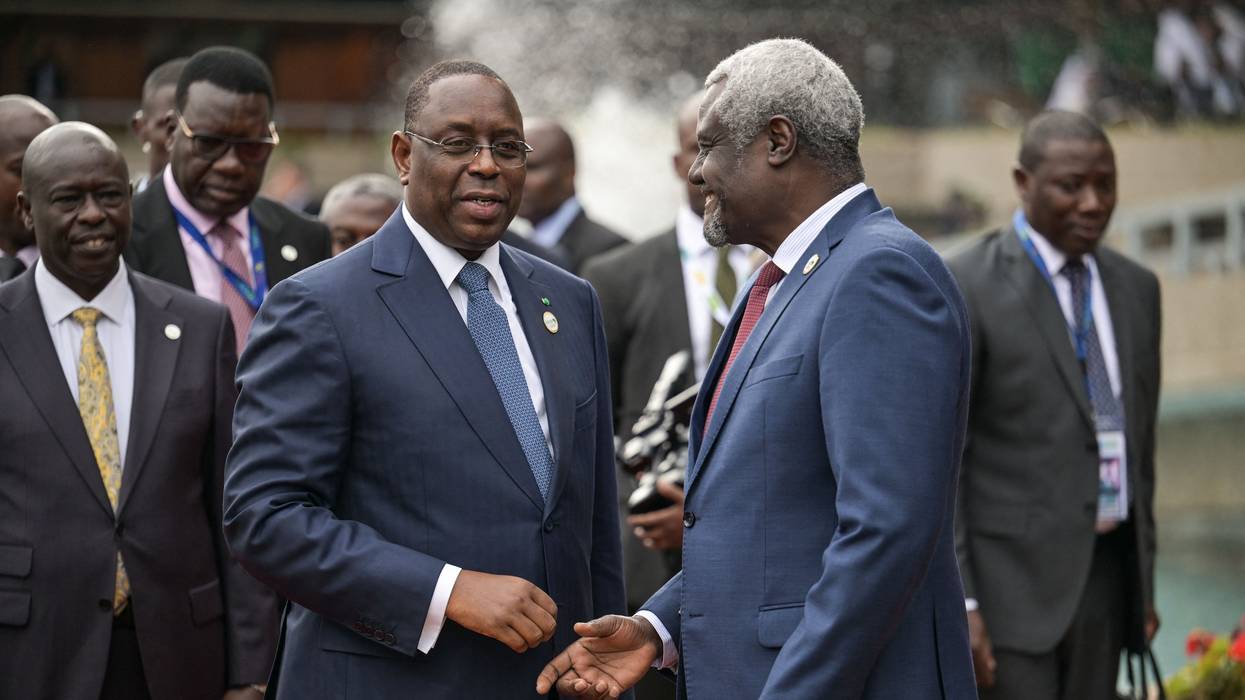
"The solutions do not lie with private capital and the age-old profit driven model," said one advocate.
The historic Africa Climate Summit held in Nairobi, Kenya this week marked the first time leaders from across the continent convened to focus on the climate crisis, but campaigners on Friday said the voices of the most vulnerable were largely silenced during the three-day summit while leaders drafted a declaration that critics say fell prey to "distracting false solutions."
While the Nairobi Declaration on Climate Change and Call to Action was applauded by advocates for its call to boost Africa's renewable energy capacity to 300 gigawatts (GW) by 2030, critics said leaders across the continent showed they are still too eager to bend to the interests and desires of the fossil fuel industry and its financial backers.
The declaration's demands include:
But groups including the think tank Power Shift Africa (PSA) said the commitment of hundreds of millions of dollars by international governments and development banks for carbon markets initiatives were "essentially, a diversion, and even wastage, of money that could go into investment in real climate solutions."
PSA called the African Carbon Market Initiative "a wolf in sheep's clothing" in a report released this month, warning that "polluters and investors" have for decades promoted carbon markets—in which fossil fuel companies claim to "offset" emissions by investing in conservation initiatives or sustainability—but the system enables "the wealthy to continue polluting, while giving an illusion of commensurate carbon neutralization through questionable accounting methodologies."
As Al Jazeera reported, the continent earns less than $10 per ton of carbon removed from the atmosphere in its existing market initiatives, while other regions can receive over $100.
Joab Bwire Okanda, a senior adviser at Christian Aid, welcomed the declaration's call for a global carbon tax but told the BBC that "to make polluters really pay, false solutions like carbon credits that allow polluters a free ride without taking meaningful action need to be consigned to the dustbin."
350.org said the summit should have ended with a renewable energy commitment that was far greater than 300 GW by the end of the decade, calling for 11,000 GW—"the level required to limit global heating to 1.5°C" over preindustrial levels.
"This is a good starting point, but it falls short of expectations," said Charity Migwi, regional campaigner for 350Africa.org. "As Africans grapple with the debilitating impacts of the climate crisis, African leaders engage in rhetoric and false solutions such as fossil gas and carbon markets that seek to delay meaningful climate action and the much-needed just transition away from fossil fuels, that is central to the fight against the climate crisis. African nations must walk the talk in regards to limiting global warming by shunning fossil fuels."
Zaki Mamdoo, campaign coordinator for StopEACOP, which aims to end French oil company TotalEnergies' East African Crude Oil Pipeline (EACOP) project, said the Nairobi Declaration "says little about the need to halt the development of new fossil fuels on the continent," even after a Human Rights Watch report in July showed the project has threatened the homes of more than 100,000 people in Tanzania and Uganda, caused food insecurity, and pushed children to leave school while also likely having "devastating environmental effects."
"This summit has provided a platform for governments to flirt with big business while [advocacy groups], trade unions, [and] youth organizations are confined to the fringes with little influence on the outcome of high-level deliberations," said Mamdoo. "If we are to use the crisis of climate as an opportunity to simultaneously uplift our people out of poverty and ensure the well-being of all—then we need the interests of these groups to be at the forefront of decision-making. The solutions do not lie with private capital and the age-old profit driven model."
Others agreed that "local voices" of people who have been most impacted by the climate emergency were missing from the summit.
"Their stories of hope, perseverance, suffering, and disaster were glaringly absent, hidden away behind security barriers and military armament," said Yegeshni Moodley, climate and energy justice campaign lead for Friends of the Earth South Africa. "The use of top-down, technocratic false solutions negates the value of local knowledge and traditional practices that have sustained generations on their land. We must decry and lament the situation Africa has been placed into, where her lands and riches are once again being sold away to the distress and poverty of her people.”
People across the continent are facing the effects of the climate crisis, which has been blamed for a famine in Madagascar and has forced more than 1 million people in Somalia to leave their homes as a prolonged drought has overtaken the country.
Advocates say that Africa must be recognized as a key ally in providing solutions to the climate emergency rather than cast aside as a victim.
"Our leaders need to know that people across Africa are waking up to what needs to be done," said Essoklnam Pedessi of the Renewable Energy Coalition in Togo. "We are calling for less talk and more action. We need to break away from the failed approaches and distracting false solutions. Africa has abundant wind and solar to power up for 100% renewable energy."
"What it needs," she added, "is climate funding to unlock this potential."

"Without policies such as regulations or taxes on very polluting investments, it's unlikely that wealthy individuals making a lot of money from fossil fuel investments will stop investing in them," says one economist.
The richest tenth of U.S. households are responsible for 40% of all the nation's greenhouse gas emissions, a study published Thursday revealed, underscoring what progressives say is the need for regulations and taxes on carbon-intensive investments.
Published in PLOS Climate, the study—which was led by University of Massachusetts, Amherst sustainability scientist Jared Starr—analyzed 30 years of U.S. household income data and the greenhouse gas emissions generated in creating that income.
"We find significant and growing emissions inequality that cuts across economic and racial lines," the paper notes. "In 2019, fully 40% of total U.S. emissions were associated with income flows to the highest earning 10% of households."
"Among the highest-earning 1% of households (whose income is linked to 15-17% of national emissions), investment holdings account for 38-43% of their emissions," the publication continues. "Even when allowing for a considerable range of investment strategies, passive income accruing to this group is a major factor shaping the U.S. emissions distribution."
"It just seems morally and politically problematic to have one group of people reaping so much benefit from emissions while the poorer groups in society are asked to disproportionately deal with the harms of those emissions."
The study's findings are consistent with research published in 2021 by the Institute for European Environmental Policy and the Stockholm Environment Institute that estimated the wealthiest 1% of humanity was on track to produce 16% of all global CO2 emissions by 2030. Additionally, a 2022 Oxfam report found that a single billionaire produces a million times more carbon emissions than the average person.
Starr told The Washington Post that "as you move up the income ladder, an increasing share of emissions is associated with investments."
According to the Post:
Then there were "super-emitters" with extremely high overall greenhouse gas emissions, corresponding to about the top 0.1% of households. About 15 days of emissions from a super-emitter was equal to a lifetime of emissions for someone in the poorest 10% in America.
The team found that the highest emissions linked to income came from white, non-Hispanic homes, and the lowest came from Black households. Emissions peaked until age 45 to 54, and then declined.
"It just seems morally and politically problematic to have one group of people reaping so much benefit from emissions while the poorer groups in society are asked to disproportionately deal with the harms of those emissions," said Starr.
The study asserts that "results suggest an alternative income or shareholder-based carbon tax, focused on investments, may have equity advantages over traditional consumer-facing cap-and-trade or carbon tax options and be a useful policy tool to encourage decarbonization while raising revenue for climate finance."
Lucas Chancel, a French economist who was not part of the study, told the Post that "all Americans contribute to climate change, but clearly not in the same way."
"Without policies such as regulations or taxes on very polluting investments," he stressed, "it's unlikely that wealthy individuals making a lot of money from fossil fuel investments will stop investing in them."

In the wake of cap-and-trade’s failure to reduce emissions, “the cap-and-ration” approach establishes a cap that declines over time to eliminate dependency “in a way that ensures sufficiency, equity, and justice for all.”
The burning of fossil fuels—oil, coal, natural gas—is responsible for nearly 90% of global carbon emissions. Despite almost-universal recognition of the need to reduce the use of those fossil fuels, the industrialized world is having the hardest time breaking its addiction. The economic rebound from the Covid-19 shutdowns generated the largest ever increase in global emissions from fossil fuels in 2021—around 2 billion tons. The increase in 2022 was considerably more modest—thanks to a surge in renewable energy investments—but it was an increase nonetheless. Meanwhile, subsidies for fossil fuel consumption rose to a record $1 trillion last year.
The prevailing approach to reducing dependency on fossil fuels has been price-based—either by way of a carbon tax or some form of emissions trading scheme. Around two dozen countries levy carbon taxes: establishing a price for carbon and making emitters pay that price per unit of carbon consumed. Meanwhile, under the various “cap-and-trade” systems in place in the European Union and other places, a “cap” on emissions is established through the issuance of permits. But industries can exceed their “cap” by simply paying a penalty, while those that don’t use the full value of their permit can effectively sell their allowance to others.
One problem with the carbon tax is that the price of carbon has traditionally been set too low, so that producers and consumers do not feel the economic push to abandon fossil fuels. The problem with the cap-and-trade mechanism is that it has generally moved carbon emissions around rather than substantially reduce them.
Market-based approaches tend to reinforce the status quo rather than transform the structures that have created the problem in the first place.
“As I’ve explored with colleagues in peer-reviewed work in the past, ‘cap-and-trade’ almost invariably contains no meaningful cap,” explains Shaun Chamberlin, an author and activist who has advised the U.K. government on carbon rationing and was involved with the Transition Towns and Extinction Rebellion movements from the outset. “It always has some form of safety valve mechanism, which basically means that if the price gets out of hand, the cap is ignored.”
Accordingly, the market has failed to guide the global economy to a fossil-fuel-free future in the time frame necessitated by rising temperatures and other effects of climate change. Scientists now estimate that the world will pass the critical threshold of 1.5°C over preindustrial levels in the first half of the 2030s. Market-based approaches tend to reinforce the status quo rather than transform the structures that have created the problem in the first place.
By contrast, in crises characterized by scarcity, one common solution has been to ration valuable resources. During wartime, for instance, many commodities have been rationed, from food to energy. During natural disasters, water might be rationed. Such systems introduce a measure of equity to prevent the rich and the powerful from simply buying up the scarce items and the unscrupulous from engaging in price-gouging to make quick profits. In such circumstances the cap on consumption is obvious since more food, energy, or water is simply not available.
With fossil fuels, the urgency is not around scarcity—there’s still a lot of oil, natural gas, and coal under the ground and ocean (though it’s not limitless). Rather, the international community must act quickly because of the collective harm that fossil fuels produce. As such, the various plans put forward to ration fossil fuel use are not temporary measures that elapse when surpluses return. Rather, “the cap-and-ration” approach establishes a cap that declines over time to eliminate dependency “in a way that ensures sufficiency, equity, and justice for all,” observes Stan Cox, a research fellow in ecosphere studies at the Land Institute. “These policies would include, at a minimum, careful allocation of energy among economic sectors and fair-share rationing for consumers.”
Using rationing to reduce fossil fuel use—especially in the Global North—has already come close to political reality. The U.K. government commissioned a feasibility study of such a rationing system, Tradable Energy Quotas (TEQs), which reported positive findings in 2008, and a significant number of Members of Parliament supported the implementation of a TEQs system in 2011. The idea also attracted interest from the European Commission in 2018, because it offered the means to actually implement and achieve the carbon capping targets set by the politicians.
Since these caps are designed at a national level—based on internationally agreed-upon carbon reduction targets like those of the Paris agreement—they are subject to democratic decision-making. But they don’t necessarily reflect global justice.
“It doesn’t take into account the existing climate debt,” points out Ivonne Yanez, an Ecuadorian environmentalist and founder member of Acción Ecológica and Oilwatch international. “The richer countries have historically ‘occupied’ the atmosphere with their emissions. So, these carbon budgets are calculated without regard to this historic injustice.”
In a March 21 session sponsored by Global Just Transition, Chamberlin, Cox, and Yanez discussed the value of rationing fossil fuels as a method to address the worsening climate crisis.
The United Kingdom has a carbon budget that is legally binding—at least theoretically—and that restricts the amount of carbon emissions the country as a whole can emit over each five-year period. It was the first country to enact such a measure.
“As our government never tires of telling us, here in the U.K. we’ve been ‘leading the world in carbon budgets since 2010,’” Shaun Chamberlin notes. “Our Climate Change Act said we would reduce emissions in the U.K. by 80% by 2050. What we don’t have—and don’t look to have anytime soon—is any reasonable plan for actually delivering on these targets. Instead, we have a Climate Change Committee that regularly puts out reports saying, ‘Actually, we’re nowhere near delivering on what the government promised in its legally binding targets.’”
According to its targets, the U.K. is supposed to cut its carbon emissions by 68% by 2030 (relative to 1990 levels) in order to reach net zero by 2050. But the government has admitted that even in the best of circumstances—should all projected cuts be made and the latest carbon-capture technology actually work—the U.K. will still only hit 92% of its 2030 goal. In other words, their strategy based on carbon pricing continues to fail.
“There’s this impossible tension built into carbon pricing. We need to make carbon sufficiently expensive that it gets driven out of the economy. But at the same time, we need to keep energy affordable.”
“There’s been such a focus, and rightly so, on agreeing to globally appropriate carbon budgets that are sufficiently steep to address the problem of climate change, but also not so demanding that that they destroy economies and lives,” Chamberlin explains. “But there’s been so little focus on the parallel question of how we actually reduce Global North emissions by 90% in 20 years, or whatever we consider to be radical emissions reductions.”
The plan the U.K. almost adopted more than a decade ago—Tradable Energy Quotas or TEQs—would have taken a very different approach. “TEQs emerged from a different paradigm to the whole carbon pricing approach,” Chamberlin explains. “There’s this impossible tension built into carbon pricing. We need to make carbon sufficiently expensive that it gets driven out of the economy. But at the same time, we need to keep energy affordable.”
According to the International Energy Agency, however, about 80% of global energy still comes from fossil fuels, a level that has remained consistent for decades. “So, if our energy is so highly carbonized, it becomes—unsurprisingly—impossibly difficult to raise the carbon price without raising the energy price,” Chamberlin points out. The carbon pricing approach has not been able to square this circle.
“What TEQs would do is turn that on its head,” he continues. “By removing any need to raise carbon prices, it would unify everybody in common purpose around genuinely shared and actually compatible goals—minimizing the destabilization of our climate while striving to keep energy services available and affordable. And it would make the economy exist within a carbon budget, rather than the other way around.”
The TEQs system, established by economist and cultural historian David Fleming in 1996, is a national-level system for capping and then reducing the fossil fuel-based energy consumption of all energy users—individual, institutional, and corporate.
“It’s a national system for implementing national carbon commitments agreed by the government of that country,” Chamberlin explains. “All individuals within that country receive an unconditional, equal, and free entitlement of what are called TEQs units, which you might think of as electronic ration coupons. To purchase any fuel or energy anywhere in the economy, these units have to be surrendered alongside the usual payment of money. So, you go to the gas station, you pay in cash or by credit card, and you also surrender some of these TEQs units.”
He continues, “Your entitlement will be an equal proportion of the national carbon budget. If you use less than that, if you are a below-average energy user, then you’ll have some spare left from your entitlement which you receive each week, and you can sell that spare back to the issuer. So, those who are energy-thrifty get a financial benefit from using less. Those who want to use more than their entitlement can buy those spare units, but of course they’re then effectively paying the more energy-thrifty people for the benefit of doing so.”
“TEQs would move us from this system in which you burn what you can afford, to a system which fairly shares out what we can collectively afford to burn, while facilitating the radical reductions that an understanding of climate science demands.”
The system is administered by a registrar that issues the quotas. “In the U.K., around 40% of emissions come from individuals and households, and around 60% of emissions come from industry and companies and non-household energy users,” Chamberlin says. “In line with those proportions, 40% of the budget goes to individuals while 60% goes via an auction to all other users. Only individuals and households get the free TEQ units; all other energy users need to purchase the units they need, which sets a single national price. The only place that anybody can get their TEQ units is from the registrar. There’s no trading between you and your neighbor directly. If you want to sell some units, you sell them to the registrar. If they want to buy some units, they buy them from the registrar.”
Since TEQs units are necessary for all energy use, and are only issued in line with the national carbon cap, the national carbon cap can’t be exceeded. “As such, carbon pricing is unnecessary—and without that artificial need to raise the price of energy, everyone’s focus can turn to keeping energy as affordable as possible and life as good as possible under the cap,” he continues.
The other key part of the system is a rating system. “The government will assess each energy retailer in the country for the carbon intensity of its fuel,” Chamberlin explains. “For example, if one oil company has a more carbon-efficient refining process than another, their petrol will require fewer TEQs units from the consumer at the point of purchase. This creates an incentive all the way through the economy for lower carbon processes. And of course, relative to any oil producer, renewable energy is going to require vastly fewer TEQs units. Not none, because there is still fossil fuel used in the production of wind turbines or solar panels, but vastly fewer.”
And because the carbon-intensity of energy or fuels is assessed and rated where they enter the economy, there is no need for impossibly complex lifecycle analysis of products. “We don’t need to figure out how much carbon went into every bag of crisps,” Chamberlin continues. “There’s no need to measure the emissions that come out of every chimney or every car exhaust pipe. Instead, the rating system applies upstream, and people engage with it downstream.”
Equity is also built into the system. “At any point, people can go to the registrar to purchase more TEQs units if they feel that they need them, and at any point people can sell,” Chamberlin adds. “Because the number of units issued into the economy is fixed by the carbon budget, the price at any given time is determined by the demand. If lots of people are really struggling to live under the carbon budget, there are going to be lots of people trying to buy TEQs units, which will drive the price up. This creates a very clear message to the whole society that it’s not adapting very well to the budget, which creates a common purpose and real political momentum behind decarbonizing the economy and bringing that price down for everyone. Equally, if the price is dropping, just about everybody’s going to welcome that. Everybody has access to units at the same price at any time. The national price fluctuates in line with national demand. And buying and selling is very straightforward, like topping up a mobile phone.”
“The system we have today is essentially rationing by wealth,” he notes. “There’s only so much energy available and the richest get it. TEQs would move us from this system in which you burn what you can afford, to a system which fairly shares out what we can collectively afford to burn, while facilitating the radical reductions that an understanding of climate science demands.”
TEQs would also generate money through the auctioning of the units to non-household energy users such as industries, which is then used to subsidize consumers who are hardest hit by the price of fuel or to invest in difficult-to-fund infrastructure projects like public transportation.
Gas stations and electricity generators would surrender their TEQs when they purchase from wholesalers. “When they buy their fuel from suppliers or from the drillers or the extractors or the importers, they have to surrender units,” Chamberlin continues. “No matter whether that’s all integrated into one company or whether it’s 20 companies along the line, eventually those units end up with the people who are bringing the energy into the economy, whether they’re extracting it within the national borders or importing it. In order to have their license to operate, they have to surrender those units back to the registrar. So, you have a circular system.”
Chamberlin enumerates the benefits of the system. “It doesn’t take money from people in the way taxation does, so it’s actually improving their situation,” he says. “It benefits the poorer in society, because they tend to use less energy, but also provides assured entitlements to energy for all. It addresses fuel scarcity as well as guaranteeing emissions reductions. It’s not cumbersome or difficult for ordinary people to deal with, but does actively integrate into our daily lives the importance of reducing energy usage. And it provides a new paradigm of leadership for the nation that allows us to actually achieve our climate change targets, by making the economy exist under a carbon cap rather than the other way around.”
The U.K. first funded research into the TEQs system in 2006. Two years later, the government enacted the Climate Change Act, and the government launched a full feasibility study into TEQs. The conclusion, however, was that the TEQs system was “ahead of its time.”
“The government decided instead to focus on what it called international abatement,” Chamberlin laments. “In other words, rather than actually reducing U.K. emissions, the government intended to pay other countries to reduce them on its behalf, because that was more economically efficient. That same year, 2008, the Parliamentary Environmental Audit Committee, which is the official body that reviews Parliament’s proceedings, was incredibly critical of this position, saying that the government should be looking at this much more urgently and pushing forward toward implementation.”
Three years later, an All-Party Parliamentary Group on Climate Change published a report on TEQs that garnered international media coverage, received the endorsements of a number of prominent people, “and again was essentially ignored by the government,” Chamberlin recalls. In 2015, Chamberlin teamed up with two academics to publish a peer-reviewed paper on TEQs in the journal Carbon Management. That year, and again in 2018, the European Commission took up the issue but failed to implement the system.
“If we do again get TEQs anywhere close to political implementation, we’re going to again face a determination to undermine it.”
His experience of the details behind these headlines has made Chamberlin somewhat wary. “If we do again get TEQs anywhere close to political implementation, we’re going to again face a determination to undermine it,” he says. “Let’s imagine a global campaign for TEQs over the next five years that creates irresistible political momentum. There would come a point at which the people within some government department or corporate think tank would say, ‘Yeah, that’s fine but we just need to put in this little safety valve to make sure that prices don’t get too high.’ And the significance of that—essentially changing it back into yet another carbon-pricing policy—will be something that only us policy-wonks will understand. The danger here is that something implemented under the name of TEQs or rationing will not actually be either, and they’ll be able to channel all of that political momentum into something that just maintains the status quo. So, for me that’s a central challenge—how can we defend the core facets of the system as it gets closer to political reality?”
Despite many discussions of clean transitions and dramatic cuts in carbon emissions, the Global North remains a heavy consumer of fossil fuels. The United States, for instance, is the leading consumer of oil and natural gas in the world. (China and India, however, are the leading consumers of coal.)
These consumption rates have not only kept carbon emissions high but have shaped the conversation to focus on carbon budgets—how much is still feasible to emit—rather than simply slashing extraction and consumption as quickly as is feasible. TEQs could be put to work in support of either aim but, as Chamberlin points out, “TEQs offers no help with political agreement on how rapidly nations should cut fossil fuel use—rather it offers the means to make it possible to achieve more radical and rapid energy use reductions in the Global North, when or if that aim is deemed politically acceptable.”
Ivonne Yanez works for Acción Ecológica in Ecuador, which has “worked on climate change for more than 20 years,” she points out. “Also, for more than 20 years, we have supported the idea of leaving fossil fuels in the ground. This is the most important premise that we have to take into account in defining any policy regarding carbon dioxide reductions, regarding energy, or any energy transition or transformation.”
“The reason why countries aren’t willing to say, ‘Yes, we’ll just stop emitting carbon tomorrow’ is because their whole economy is dependent on the fuel that contains that carbon.”
Chamberlin agrees: “Absolutely the priority should be to leave fossil fuels in the ground. Then, the question becomes, how do we get that to happen? One of the things we need to do is for people in the Global North to learn to live without using as much energy as they do, which is where TEQs comes in.”
Yanez points out that carbon budgets are established by national governments. The budgets that count, in terms of having an impact on oil and gas production and consumption, are those of Global North countries. These are the same countries that are responsible for fully half of global emissions since the start of the Industrial Revolution. “So, when a commission establishes the U.K. carbon budget, is it taking into account the current consumption of energy in the country or the 50 less percent energy that the U.K. should be consuming according to a fair calculation of climate justice?” she asks.
“I agree that the idea of a carbon budget is itself problematic,” Chamberlin replies. “To my point of view, there is no acceptable carbon budget left to burn. We’re already at a point where the climate has been destabilized and is having profoundly undesirable effects. We’re torn between the physical reality and the political reality: if I could click my fingers and transform both of those, I would. But the reason why countries aren’t willing to say, ‘Yes, we’ll just stop emitting carbon tomorrow’ is because their whole economy is dependent on the fuel that contains that carbon. And hence we’ve got this huge and very dysfunctional U.N. process of countries trying to negotiate among themselves over what would be an appropriate carbon budget.”
Fossil fuels are quite cheap to use—because governments use subsidies to keep prices low for consumers and because the environmental costs of extraction and use are not factored into the price tag. This means that an increase in fuel prices disproportionately affects the consumers who can least afford to buy solar panels or switch to an electric vehicle. It also means that increasing the price of gas is politically unpopular.
“TEQs and other cap-and-ration systems have solid potential to gain broad political acceptance,” Stan Cox says. “As long as it’s clear that the majority in society under these systems would have guaranteed access to affordable energy to meet their needs and with greater economic security than they may even have today.”
Cox and his colleague Larry Edwards, an engineer and environmental consultant, have developed a system similar to TEQs that they call “Cap and Adapt.” The difference is that the caps and the rations are measured in terms of barrels of oil, cubic meters of gas, and tons of coal, rather than carbon units.
“I think it’s important for society to see that we have to choose between growth or survival, and that if we do what’s necessary for survival, we won’t have growth.”
The rationing in these systems, Cox explains, doesn’t put the burden of emission reductions on individuals in households by limiting their consumption. Rather, it’s the declining cap that ensures the reductions in total emissions. “Such a straight-ahead rationing program is meant to ensure that everyone has enough and that access is equitable,” he says. “In these systems, rationing is not the bully, rationing is your friend. It’s something to make society fairer and ensure sufficiency.”
Such systems would ideally dovetail with “a comprehensive industrial policy that directs energy and other resources toward the production of essential goods and services and away from wasteful and unnecessary production,” he adds. “Such policies, for example, could divert resources away from military production and toward development of green infrastructure and retrofitting buildings. Or away from aircraft and private vehicles and toward public transportation. Or away from the construction of McMansions toward affordable, energy-efficient, durable housing. Or from the production of feed grain for cattle and toward grains and legumes for food. Or, overall, away from luxury goods and towards basic necessities.”
Cox also proposes a more comprehensive approach that goes beyond price controls and rationing: “a system of universal basic services that guarantees every household sufficient access to essential goods and services, including such things as public water and energy supplies, medical services, public education, and transportation, good quality food, affordable housing, green space, clean air, and public safety without repression.” He is quick to clarify. “I don’t mean that everything would be free. But there would be some guarantee that people, no matter what their income, would have access. Could all of this be feasible? Yes, by focusing energy supplies on essential goods and services rather than on wasteful, solely-for-profit production. It would also mean the sacrificing of growth for growth’s sake.”
Movements in the Global South have also been addressing the problem of unrestrained growth. Yanez points out that the term “degrowth” has little resonance “because how can we ask the indigenous people to degrow? I’d rather talk about post-growth or this idea of living well: buen vivir in Spanish or sumac kawsay in Quechua.”
“The degrowth movement is centered mainly in Europe,” Cox concedes, “but it has been very valuable in envisioning what a degrowth or postgrowth society would look like, and pointing out the differences between economic growth and the growth of human well-being. The movement purposely has not gotten into mechanisms to achieve degrowth. But I think it’s important for society to see that we have to choose between growth or survival, and that if we do what’s necessary for survival, we won’t have growth. We in the affluent societies would be better off with less, and in the meantime, there are going to be other solutions in non-affluent societies.”
Although a rationing system for fossil fuels has yet to be implemented by any national governments, several states have joined together to end their dependency on oil and gas. Led by Denmark and Costa Rica, the Beyond Oil and Gas Alliance members have pledged to end new exploration for oil and gas. Under the new leadership of Gustavo Petro, Colombia too wants to join their ranks, which is significant given the country’s economic dependency fossil fuel exports. In 2018, Ireland became the world’s first country to divest from fossil fuel funds.
The Pacific island nations of Tuvalu and Vanuatu, meanwhile, are leading an initiative at the U.N. level to pass a Fossil Fuel Non-Proliferation Treaty that would end the expansion of fossil fuel production, phase out existing fossil fuel infrastructure, and accelerate a just transition to clean energy.
There have also been many initiatives from below to reduce fossil fuel use. One path has been to stop extraction. “For decades, movements of indigenous peoples, campesinos, and fisherfolk have been fighting against climate change,” Ivonne Yanez points out. “And how? They do not talk about carbon emissions or reductions. They just want to stop oil, gas, and coal extraction. Here in Ecuador, for example, there are so many communities resisting oil extraction and being criminalized because of this.”
“They do not talk about carbon emissions or reductions. They just want to stop oil, gas, and coal extraction.”
Yanez also notes that acting together means not only solidarity among peoples but establishing stronger links with the rest of nature. “It would be good to incorporate in the TEQs proposals and debate the point of view of non-humans, including the stones and the spirits,” she proposes.
Chamberlin strongly agrees on both points. “I myself have been arrested in trying to shut down fossil fuel extraction sites, and I was one of the first arrestees with Extinction Rebellion,” he relates. “TEQs is an attempt to translate some of the wisdom of restraint and absolute limits into the language of a sick empire. This is an attempt from within an omnicidal culture to limit some of the damage that it’s doing.”
He continues, “Ultimately, it’s not about the growth or degrowth of the market economy. It’s about getting ready for the moment when the system collapses under the weight of its own unsustainability. We have inherited a system that depends on growth; that growth will end by accident or by design, and soon. After this system fades into history, future systems will again be based on informal relationships between beings on the planet just like they always have been in the past before these few centuries of madness. The older cultures on our planet know how to live in that world and we should absolutely be listening to them more.”
“In the meantime, we would doubtless be wise to slash emissions as drastically as we can,” he concludes. “And it is surely beyond time to move from the endless debates over ‘fair’ carbon budgets to the actual work of reducing fossil fuel consumption in the Global North, in solidarity with the indigenous-led resistance in the Global South working to stop fossil fuel extraction. For this, cap-and-ration—whether TEQs or other closely-related proposals—appears the only policy paradigm suited to cut the paralyzing Gordian knot that carbon pricing has tied us into.”
As the world's media finally allows people to remove their sad masks - replete with frowns and pouting lips: following the burial of Queen Elizabeth II, we are being asked to replace them with masks showing raised eyebrows of fear amidst Putin's threat of nuclear war. While Russians attempt to flee a terrifying military call up, all global citizens should be equally frightened of being called up to take part in the largest experiment ever conducted on planet Earth.
On Monday, new analysis from the non-profit Global Registry of Fossil Fuels showed that we currently have 3.5 trillion tonnes of fossil fuels sitting in our known reserves. This is around seven times more than the global carbon budget (420 billion tonnes) that allows us a 50% chance of halting warming at 1.5degC (2.7degF) - compared to pre-industrial times. Alarmingly, we have almost three times more reserves of fossil fuels than can be burned to have a 50% chance of remaining within 2degC (3.6degF) of warming. According to the new publicly accessible research tool, the United States and Russia alone could push us past 1.5degC (2.7degF) just by burning their own reserves. This means we have to leave 88% of the known reserves in the ground if we are to remain within the 1.5degC (2.7degF)budget. The most frightening aspect of this is that fossil fuel companies are projected to spend $930 billion on new oil and gas developments by 2030.
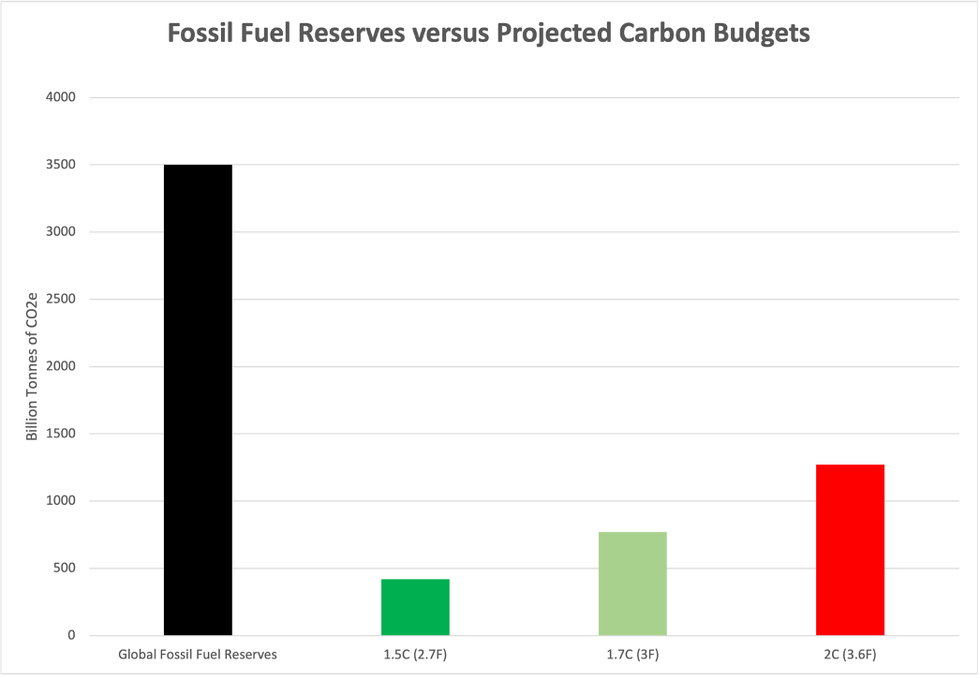
Why are we looking for additional supplies when we can't use 88% of the supplies we currently have?
While allowing these companies to profit massively from tipping the planet into catastrophe, our governments are surely complicit in what will become known as a genocide of the poor. Already, as a third of Pakistan is underwater, there are calls for the major emitters to pay reparations to those already suffering the brunt of the climate crisis. It has been estimated the damage in Pakistan will reach $10 billion: Pakistan has been offered $610 million in aid, but how can you put a price on human suffering and the likely starvation that will follow?
The island state of Antigua and Barbuda is further warning that the increasing sea and air temperatures in the Caribbean could lead to a superstorm that could cost the islands almost $9 billion in the next few years. Due to the increased likelihood of climate caused disasters down the road - caused by increasing greenhouse gas emissions - some of the most vulnerable countries are requesting a "climate-related and justice-based" global tax to help pay for losses and damages. This could be levied on air-travel, fossil fuel extraction or financial transactions.
Now, while it is all very good paying vulnerable countries a tax to help them mitigate against the climate crisis, it is fairly useless if rich nations continue to emit greenhouse gasses at record levels. Payments need to be made, but huge cuts in CO2e (carbon dioxide equivalent) are necessary. As we have seen, fossil fuel companies have no plans to leave 88% of their assets in the ground. Whatever they say publicly, they plan on maximizing their profits - which means burning the lot.
At just 1.2degC (2.1degF) of global warming, we have seen London reach 40.3degC (104.5degF), Canada hit 49.6degC (121.3degF) and Iran record 53degC (127degF). Wildfires have engulfed the United States, Europe, South America and Russia, and the number of people suffering acute hunger has doubled in six years to 48 million, with 18 million now on the brink of starvation.
Biden makes great soundbites about transitioning to renewable sources of energy, as he issues drilling permits at a faster pace that Trump. In the U.K., the new representative of big business - AKA Prime Minister Liz Truss - isn't even bothering with lip service. Here, she is pushing millions into fuel poverty by refusing to place a windfall tax on energy companies making billions from the increase in energy prices. Brexit may come back to haunt the older generation who could have benefited from just such a $138 billion E.U. tax.
It is clear that business as usual is not cutting it. We will reach 1.5degC (2.7degF) of warming within a decade and perhaps much sooner, and our governments have no intention of reining in the fossil fuel companies, or animal ag which is single-handedly destroying the Amazon and turning it into a Savanah, where it can longer sequester the carbon we are emitting.
Without a concerted effort from all concerned citizens on our planet, we are doomed to live on a hostile planet with dwindling freshwater supplies, and a severe lack of food. We need people of all persuasions to take to the streets in a show of solidarity. We need civil disobedience on a scale never before witnessed. Nothing less will suffice in turning the tide.
If civil disobedience is successful, the question will then be raised: what now?
It is abundantly clear that to avoid the worst ravages of the climate crisis and to allow nature to flourish once again, we desperately need a sustainable, more equitable economic system that delivers for all. We need a system that encourages frugality over waste, we need a system that emphasizes society over the self. We need a system that tip toes around the edges of nature: rather than bulldozes right through. We need a system that gets us to zero carbon by 2030 when we still have a chance to avoid runaway climate change that tips us into a hot house Earth scenario where most of humanity perishes.
Once you have accepted the obvious glaring reality: that a system reliant on infinite growth on a planet with extremely finite resources is a physical impossibility, possibilities begin to emerge.
One such possibility is a Global Carbon Allowance Trading System (G-CATS). Presently, the more money you have, the more of the Earth's precious resources you can waste. That's why Bezos, Musk, and Branson et al are building private rockets to take them into space while tens of millions starve. G-CATS prohibits this by placing a rising price on CO2e and introducing carbon allowances for every citizen.
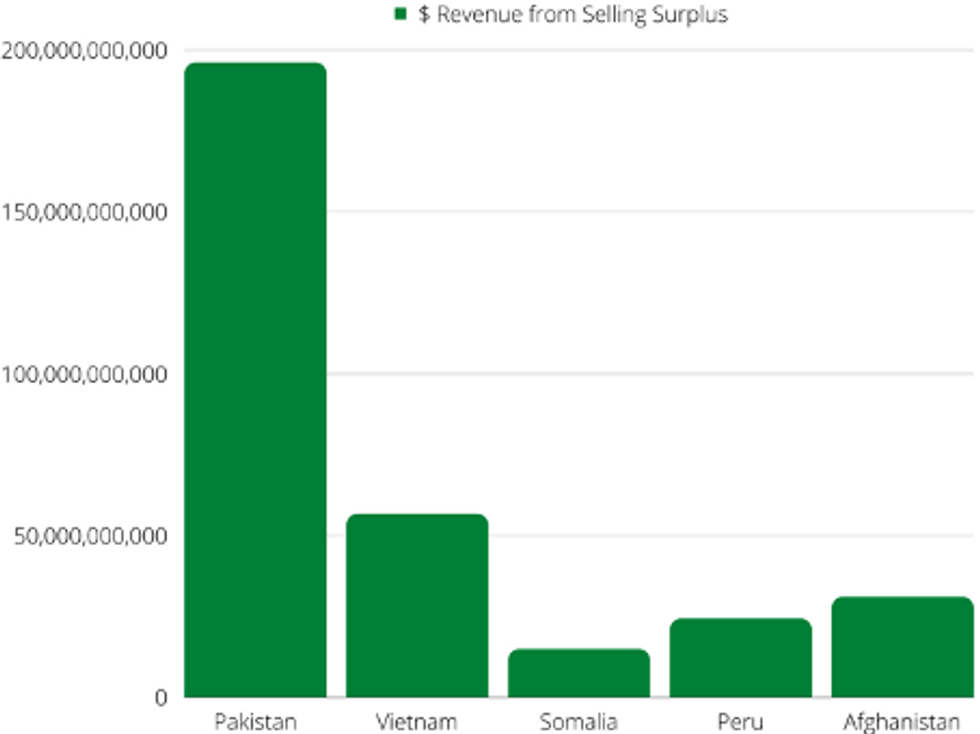
Imagine a price of carbon being set at $160 tCO2e (CO2 equivalent) and then rising each year until the global allowance has been depleted. Then share the planetary carbon allowance with each nation. Low emitting (LE) nations around the world would be able to trade their surplus budgets with high emitting (HE) nations, and in the process raise billions of dollars and reduce global inequality. To give you an idea of the numbers involved, Pakistan would be able to raise around $196 billion by selling its surplus, while the United States would need to spend $785 billion to continue business as usual. This would encourage LE governments to use the surplus dollars to transition to renewable sources of energy, so they could sell more surplus CO2e the next year, or in the case of HE, they would be encouraged to transition so they spend less on purchasing CO2e the following year. This would be a global race to zero emissions.
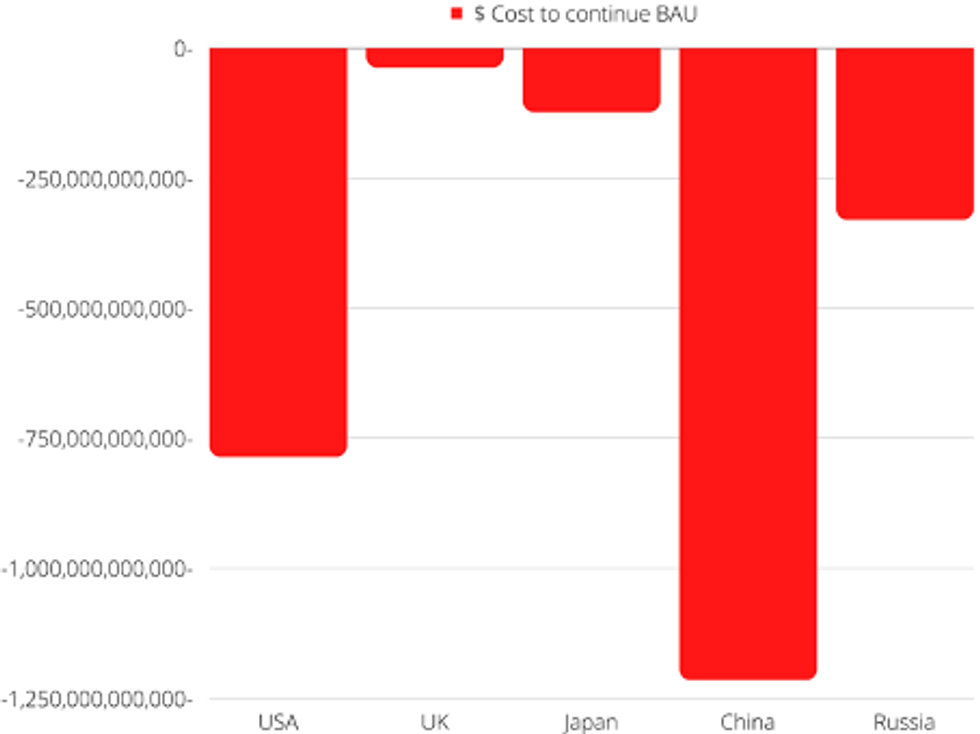
Individually, citizens would be allocated their CO2e allowance and would be able to trade CO2e with each other within borders through an app, and this would further reduce inequality domestically. The app would give citizens up to date information about products/services and each would be given a CO2e score. Being faced with purchasing a slab of red meat at a cost of 20% of the monthly allowance might just incentivize people to purchase beans instead. Likewise, people may take the train when faced with spending 80% of their allowance on a flight. Frugality would be encouraged as citizens attempt to minimize their emissions in order to stay within their allowance.
When it comes to businesses, they would be motivated to produce and provide services with the least amount of materials possible because otherwise their products/services would be outside the allowance of all but the richest. This would encourage a circular economy with the thriftiest businesses who make use of recycled materials the most efficiently becoming the new tycoons. To ensure these new captains of industry don't treat their employees with the disdain we see today, subsidies could be given to those who pay the most in taxes, hire the most employees, and treat those employees well.
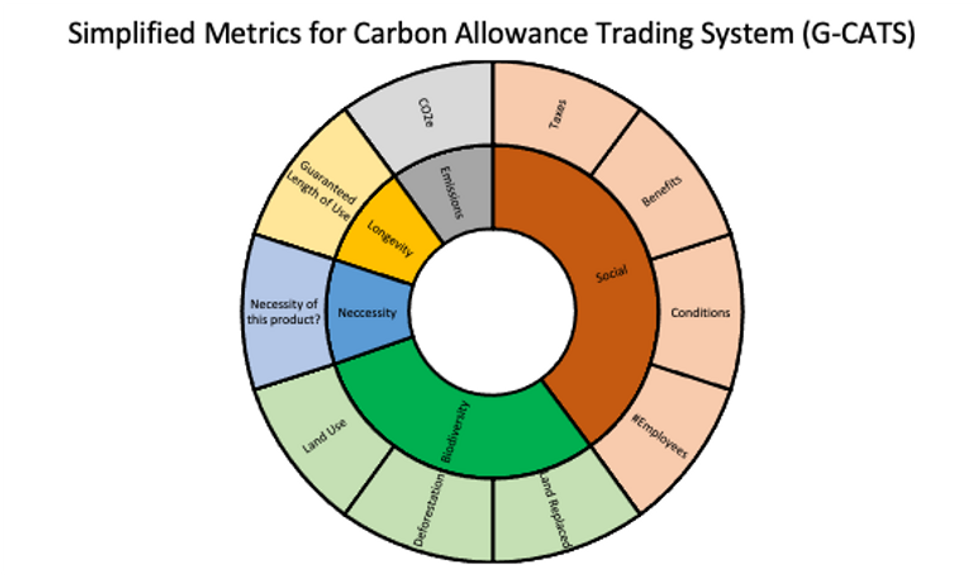
At the end of the financial year, citizens and businesses would be able to sell any surplus CO2e back to the government who would in turn sell it back to the independently run organization who would then calculate the allowances for the following year.
There is a lot of talk about zero-carbon-2050 but no real plan of how to get there. G-CATS offers a road map that involves us all. After all, this is our problem, and as far as the climate scientists go, "Incremental linear changes to the present socioeconomic system are not enough to stabilize the Earth System. Widespread, rapid, and fundamental transformations will likely be required to reduce the risk of crossing the threshold and locking in the Hothouse Earth pathway; these include changes in behavior, technology and innovation, governance, and values."
For too long, our values have been about growth and not much else. Now, we have a chance to reverse this mantra and allow ourselves to be led by what the planet needs, and not billionaires. What the planet needs of us as 7.96 billion human beings is for us to tread lightly. The mechanization to encourage this change could be a Global Carbon Allowance Trading System. But first things first, we need millions of concerned parents, teachers, nurses, doctors, scientists, journalists and children to carry out civil disobedience in the streets - or else the largest experiment ever attempted will make our planet uninhabitable, and human civilization will be lost.
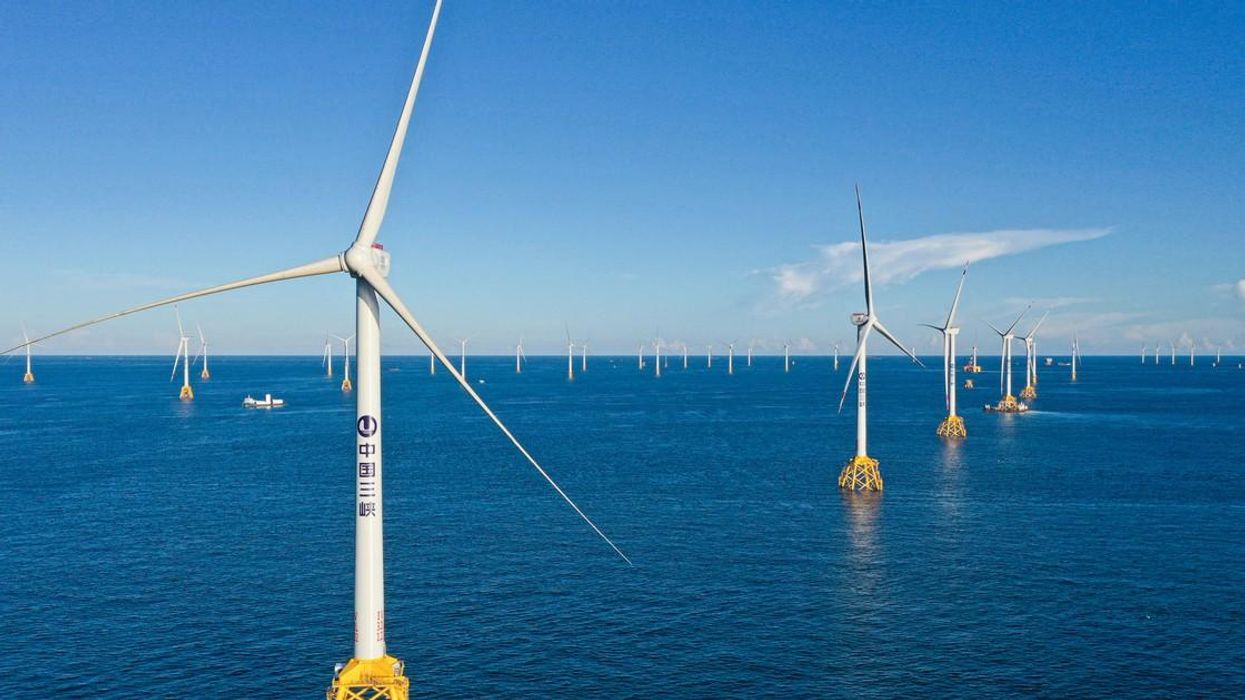
The blades of the wind turbines on the mountain range opposite my window are turning especially energetically today. Last night's storm has abated but high winds continue, contributing extra kilowatts to the electricity grid at precisely zero additional cost (or marginal cost, in the language of the economists). But the people struggling to make ends meet during a dreadful cost-of-living crisis must pay for these kilowatts as if they were produced by the most expensive liquefied natural gas transported to Greece's shores from Texas. This absurdity, which prevails well beyond Greece and Europe, must end.
We need a large-scale Manhattan Project-like investment in the green technologies of the future (such as green hydrogen and large-scale offshore floating windfarms).
The absurdity stems from the delusion that states can simulate a competitive, and thus efficient, electricity market. Because only one electricity cable enters our homes or businesses, leaving matters to the market would lead to a perfect monopoly - an outcome that nobody wants. But governments decided that they could simulate a competitive market to replace the public utilities that used to generate and distribute power. They can't.
The European Union's power sector is a good example of what market fundamentalism has done to electricity networks the world over. The EU obliged its member states to split the electricity grid from the power-generating stations and privatize the power stations to create new firms, which would compete with one another to provide electricity to a new company owning the grid. This company, in turn, would lease its cables to another host of companies that would buy the electricity wholesale and compete among themselves for the retail business of homes and firms. Competition among producers would minimize the wholesale price, while competition among retailers would ensure that final consumers benefit from low prices and high-quality service.
Alas, none of this could be made to work in theory, let alone in practice.
The simulated market faced contradictory imperatives: to ensure a minimum amount of electricity within the grid at every point in time, and to channel investment into green energy. The solution proposed by market fundamentalists was twofold: create another market for permissions to emit greenhouse gases, and introduce marginal-cost pricing, which meant that the wholesale price of every kilowatt should equal that of the costliest kilowatt.
The emission-permit market was meant to motivate electricity producers to shift to less polluting fuels. Unlike a fixed tax, the cost of emitting a ton of carbon dioxide would be determined by the market. In theory, the more industry relied on terrible fuels like lignite, the larger the demand for the EU-issued emission permits. This would drive up their price, strengthening the incentive to switch to natural gas and, ultimately, to renewables.
Marginal-cost pricing was intended to ensure the minimum level of electricity supply, by preventing low-cost producers from undercutting higher-cost power companies. The prices would give low-cost producers enough profits and reasons to invest in cheaper, less polluting energy sources.
To see what the regulators had in mind, consider a hydroelectric power station and a lignite-fired one. The fixed cost of building the hydroelectric station is large but the marginal cost is zero: once water turns its turbine, the next kilowatt the station produces costs nothing. In contrast, the lignite-fired power station is much cheaper to build, but the marginal cost is positive, reflecting the fixed amount of costly lignite per kilowatt produced.
By fixing the price of every kilowatt produced hydroelectrically to be no less than the marginal cost of producing a kilowatt using lignite, the EU wanted to reward the hydroelectric company with a fat profit, which, regulators hoped, would be invested in additional renewable-energy capacity. Meanwhile, the lignite-fueled power station would have next to no profits (as the price would just about cover its marginal costs) and a growing bill for the permits it needed to buy in order to pollute.
But reality was less forgiving than the theory. As the pandemic wreaked havoc on global supply chains, the price of natural gas rose, before trebling after Russia invaded Ukraine. Suddenly, the most polluting fuel (lignite) was not the most expensive, motivating more long-term investment in fossil fuels and infrastructure for LNG. Marginal-cost pricing helped power companies extract huge rents from outraged retail consumers, who realized they were paying much more than the average cost of electricity. Not surprisingly, publics, seeing no benefits - to them or to the environment - from the blades rotating above their heads and spoiling their scenery, turned against wind turbines.
The rise in natural gas prices has exposed the endemic failures that occur when a simulated market is grafted onto a natural monopoly. We have seen it all: How easily producers could collude in fixing the wholesale price. How their obscene profits, especially from renewables, turned citizens against the green transition. How the simulated market regime impeded common procurement that would have alleviated poorer countries' energy costs. How the retail electricity market became a casino with companies speculating on future electricity prices, profiting during the good times, and demanding state bailouts when their bets turn bad.
It's time to wind down simulated electricity markets. What we need, instead, are public energy networks in which electricity prices represent average costs plus a small mark-up. We need a carbon tax, whose proceeds must compensate poorer citizens. We need a large-scale Manhattan Project-like investment in the green technologies of the future (such as green hydrogen and large-scale offshore floating windfarms). And, lastly, we need municipally-owned local networks of existing renewables (solar, wind, and batteries) that turn communities into owners, managers, and beneficiaries of the power they need.

Current strategies to combat climate change aren't working. Carbon emissions are still increasing. But there is a way forward that would actually reduce carbon emissions--a way that's simple and transparent and that would enable long-term planning for policy makers, as well as greater security for the general public. Spoiler alert: there's a hitch.
Before exploring this alternative pathway, let's take a brief look at three current strategies to halt global warming that, despite good intentions, are not working.
Without cap-and-ration, the world's policy makers will most likely continue to dither with proposals that appear to reduce emissions without actually doing so.
Solutions involving energy substitution aren't working. While the world is increasing the levels of solar and wind power in its overall energy mix, annual growth in total energy usage still exceeds these renewable additions except in years of severe economic recession. Solar and wind are just supplementing, not displacing fossil fuels. So, despite significant spending and policy effort, we're pumping more CO2 into the atmosphere now than we were just a few years ago (probably just not quite as much more as we would if no substitution efforts had been undertaken).
Divestment isn't working. The idea is ingenious: if activists can starve the fossil fuel industry of capital by persuading institutional investors to stop buying shares in companies like ExxonMobil, and by talking banks into loaning no more money for extraction projects, then production rates for oil, coal, and natural gas should eventually fall. It's a worthy effort, but in spite of heartening successes at getting pension funds and university endowments to back away from investments in the oil, coal, and gas industries, those industries are finding plenty of money to fund projects.
Finally, taxing carbon isn't working. Nearly 50 countries have some form of price on carbon, either through carbon taxes or emissions trading schemes. Economists generally agree that carbon taxes should eventually work; but, so far, the taxes haven't been high enough, or enacted in enough places, to actually turn the tide. Also, a tax gives no guarantee of actual reduction in fossil fuel usage, since money can simply be created by government borrowing and spending to subsidize the higher cost to fuel purchasers.
Many would argue that these are the best available means for turning the tide against climate change, and that we just need to try harder. Perhaps incremental progress could be made by doubling down on building solar panels, waging divestment campaigns, and lobbying for stiffer carbon taxes. But why not consider a policy that could achieve something beyond incremental success?
Here's an altogether different approach, one that has received little attention from climate scientists, activists, or policymakers. The essence of the plan is simplicity itself: just directly reduce fossil fuel production and consumption. I mentioned at the outset that there's a hitch, and I'll get to that in a moment. But first, let's explore the idea in a little more detail.
Directly reducing global production of oil, coal, and natural gas might best be accomplished through a process with three concurrent elements.
First element: through international treaty, legally cap the total amount of coal, oil, and natural gas that can be produced globally each year. Then allocate (i.e., ration) production volumes to companies and countries proportionally, based on historic production rates using the last ten years' averaged production statistics. Each company or country would have the right to trade or sell any part of its annual production quota to any other company or country; thus, the fuel industry as a whole could adjust its investments to take advantage of higher-grade resources or more efficient production techniques. Production caps would decline annually, with the rate of decline set by a global Committee on Climate Change, whose deliberations would be based on scientific consensus, independent of government. Coal would be phased out fastest, then oil, then natural gas (in view of the relative carbon intensity of these fuels).
Second element: tax windfall profits of the fossil fuel industry globally. With production caps in place, prices for coal, oil, and gas would likely rise, with increasing profits (per unit of output) going to fuel industries. Tax those profits at a high rate, and distribute the revenue as rebates to people with low incomes who have no current alternative to fuel usage, and to crucial commercial energy users such as farmers, to help with higher energy bills; also use the revenue to fund energy-efficient and low-carbon alternative energy infrastructure, supplying it preferentially to countries, communities, and households with low incomes. Also use the money to help localities transition to lower-energy and more resilient ways of meeting people's basic needs for food, housing, and transportation.
Third element: don't just ration production; ration consumption as well--at the national level. This gets more complicated. Rather than diving into the weeds here, I'll briefly describe (at the end of this article) an already well-thought-out energy rationing system. Why ration consumption? Because doing so will make it much easier for individuals, businesses, and governments to adapt fairly to changing energy availability. Rationing has a long and mostly successful history in helping societies adapt in times of scarcity, and as a tool in alleviating poverty.
The details remain to be ironed out, and the general proposal I've just outlined could be modified in various ways. For example, production permits could be sold rather than allocated, with revenue distributed the same way as windfall profit taxes. What's important is the basic mechanism: cap and ration fossil fuel production, while also rationing consumption.
Why is cap-and-ration better than just calling for more funding of green infrastructure? Substitution strategies are based on the underlying assumption that reducing fossil fuel consumption will threaten economic growth, while installing more low-carbon energy sources will support economic growth. But will we in fact be able to maintain economic growth by building more solar panels and wind turbines while cutting fossil fuels usage? That's controversial: many people (including some environmentalists) think renewables aren't up to the job. Others say renewables can power us to a new age of energy abundance. The approach described here does not take sides in that debate. The fact is, burning fossil fuels releases greenhouse gases that are triggering catastrophic climate change. Therefore, the important thing is to reduce fossil fuel extraction and combustion. If we can enjoy solar-and-wind-powered economic expansion at the same time, that would certainly make a lot of people happy. But if we can't, then we should remember that fossil fuels are finite and depleting anyway. We will have to make do with shrinking amounts of them at some point. Why not deliberately engineer the decline now, in time to avert climate catastrophe, and in a way that's controllable, fair, and predictable? Then, if economic pain actually does ensue from living with less oil, coal, and gas, we can cooperatively limit and manage that pain.
By now you probably see the hitch. Getting the world's governments to agree on anything at all is challenging, and negotiating a global agreement typically takes years of hard effort. Getting every country to sign up to produce and use less of the very fuels that have driven economic growth over the past century or two would be extraordinarily difficult. In contrast, current global climate agreements have been easier to forge, because they just focus on pledges to lower emissions--and those pledges are hedged on all sides by carbon trading schemes, carbon offsets, and poorly funded aspirational plans for building renewable-energy or carbon-capture infrastructure. The result: actual emissions keep rising.
The challenges in reaching a global cap-and-ration agreement include, for example, convincing fuel exporting nations like Saudi Arabia to give up significant sources of national revenue, or talking coal-dependent nations like China into agreeing to phase out coal more quickly than other fossil fuels. But those are difficulties that will have to be faced one way or another anyway, if real progress (by whatever means) is to be made in lowering global emissions.
Further, a global cap-and-ration agreement would be harder to achieve than a global carbon tax. Yet, it would be arguably far better than a carbon tax, as there could be no gaming of the system by subsidizing fossil fuels on one hand while taxing them on the other. Emissions would decline because fossil fuel production and usage would decline. Simple and foolproof.
After contemplating the likely roadblocks in gaining universal buy-in to a global cap-and-ration scheme, it's easy to adopt a cynical attitude that says, in effect: "That's what we'd do if we were a rational species able to think ahead and give up immediate gratification in favor of long-term survival. But we're not, so we're headed for climate doom." As I document in my recent book Power, the capacity for self-limitation exists everywhere in nature; further, human societies through the ages have found innumerable ways to restrict population growth and consumption of natural resources in order to stay within environmental limits. Sometimes those efforts have been insufficient and societies collapsed as a result, but self-limitation is always a real option nevertheless. So, if we are capable of restraining aspects of our own behavior that are ultimately self-destructive, why aren't we doing that now with regard to carbon emissions? There are likely many explanations. But one reason may simply be that the single strategy that would actually work to avert catastrophe--cap-and-ration--is not part of the public discussion.
If cap-and-ration is a good idea, then it should occur independently to many people. It already has; in fact, it's difficult to say who came up with it first. Aspects of cap-and-ration can be found in proposals and publications going back decades, including my 2006 book The Oil Depletion Protocol, which suggested a global cap-and-ration scheme as a way to avert economic disruption not just from climate change, but from oil depletion as well (the book was based on a proposal by geologist Colin Campbell). Years earlier, British economist David Fleming came up with an energy rationing system called Tradable Energy Quotas (TEQs), which I'll describe below. However, it really matters little who deserves the credit; what's important is whether the plan is workable.
Current proponents of cap-and-ration (in some form or other) include:
Discussions about cap-and-ration at the governmental level have included officials from Britain and Ireland; but, so far, those talks have been only exploratory, with no commitments for action or even further study.
The purpose of this article is to raise general awareness about cap-and-ration as an option. If there is to be any chance of its implementation, the plan will require the initial buy-in of environmental organizations, then the general public, and finally policy makers.
If cap-and-ration proves to be politically unattainable, then we should be honest with ourselves about the consequences. Without cap-and-ration, the world's policy makers will most likely continue to dither with proposals that appear to reduce emissions without actually doing so. Horrific consequences from those emissions will ensue. And young people around the world, whose lives will be tragically impacted, will give up on policy solutions and look for other strategies. Some may turn to industrial sabotage as a way to save the last vestiges of a livable climate.
A final, timely note: there are currently calls to embargo Russian oil and gas exports in the wake of the Ukraine invasion. Russia produces roughly a tenth of world oil, so such an embargo would have significant economic and geopolitical implications. From a climate standpoint, choking off Russia's exports might accomplish approximately what a global production cap would--though not in a context of cooperation and planning, but rather in one of competition and conflict. And there would likely be no effort toward energy equity via consumption rationing, and no mechanism for further production cuts. In short, it's about as bad a means to cut global oil production as could be imagined, delivering the same pain as a production cap but few of the side benefits and lots of extra risks.
Above, I promised a longer discussion of what might be involved in a national energy consumption rationing program, and that's probably a good way to end this article. Here is a short description of David Fleming's Tradable Energy Quotas (with most of the wording borrowed from the TEQs website).
Tradable Energy Quotas (TEQs): What They Are and How They Would Work
Rationing of fossil fuel consumption at the national level could be done by way of tradable energy quotas, or TEQs, a system initially suggested by the late British economist David Fleming over two decades ago. TEQs have been discussed and researched by the British government. The system would work as follows.
Each adult would be given an equal free entitlement of TEQs units each week. Other energy users (Government, industry, etc.) would bid for units at auction. When buying fuel or electricity, units corresponding to the amount of energy purchased would be deducted from the buyer's TEQs account; they would still need to pay for the energy. All fuels and electricity supplies would carry a "carbon rating" in units, with one unit representing one kilogram of carbon dioxide--or the equivalent in other greenhouse gases--released in the fuel's production and use. This would determine how many units are needed to make an energy purchase (thus giving a competitive advantage to low-carbon energy). If a person used less than their entitlement of units, they could sell the surplus. If they needed more, they could buy them. All buying/selling would take place at a single national price, which would rise and fall in line with demand. The total number of units available would be set out in the annual TEQs Budget, which would be integrated with fossil fuel production caps. Government would itself be bound by the TEQs system; its role would be to support the country in thriving on the available energy. Since the national TEQs price would be determined by national demand, it would be transparently in everyone's interest to reduce their energy demand, and to work together, encouraging a national sense of common purpose.
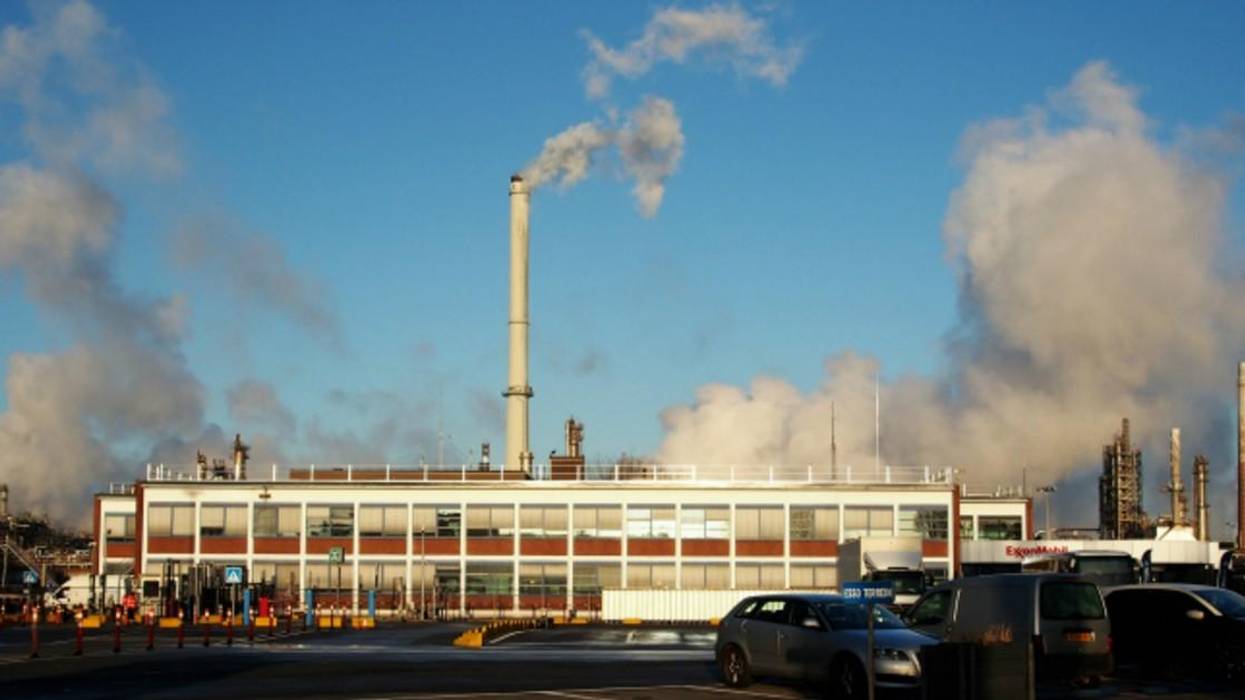
Addressing global warming requires cutting carbon emissions by almost half by 2030! For the Intergovernmental Panel on Climate Change, emissions must fall by 45% below 2010 levels by 2030 to limit warming to 1.5degC, instead of the 2.7degC now expected.
CO2 taxes misrepresent climate change as due to 'market failure', not as a fundamental systemic problem.
Instead, countries are mainly under pressure to commit to 'net-zero' carbon (dioxide, CO2) emissions by 2050 under that deal. Meanwhile, global carbon emissions--now already close to pre-pandemic levels--are rising rapidly despite higher fossil fuel prices.
Emissions from burning coal and gas are already greater now than in 2019. Global oil use is expected to rise as transport recovers from pandemic restrictions. In short, carbon emissions are far from trending towards net-zero by 2050.
False promise
At the annual climate meetings in Glasgow, carbon pricing is being touted as the main means to cut CO2 and other greenhouse gas (GHG) emissions. The European Union President urged, "Put a price on carbon", while Canadian Prime Minister Justin Trudeau advocates a global minimum carbon tax.
Businesses are also rallying behind one-size-fits-all CO2 pricing, claiming it is "effective and fair". But there is little discussion of how revenues thus raised should be distributed among countries, let alone to support poorer countries' adaptation and mitigation efforts.
Carbon pricing supposedly penalizes CO2 emitters for economic losses due to global warming. The public bears the costs of global warming, e.g., damage due to rising sea levels, extreme weather events, changing rainfall, droughts or higher health care and other expenses.
But there is little effort at or evidence of compensation to those adversely affected. Therefore, poorer countries are understandably sceptical, especially as rich countries have failed to fulfil their promise of US$100bn yearly climate finance support.
The CO2 price market solution is said to be "the most powerful tool" in the climate policy arsenal. It claims to deter and thus reduce GHG emissions, while incentivizing investment shifts from fossil-fuel burning to cleaner energy generating technologies.
No silver bullet
Carbon pricing's actual impact has, in fact, been marginal--only reducing emissions by under 2% yearly. Such impacts remain small as 'emitters hardly pay.' Most remain undeterred, still relying on energy from fossil fuel combustion. Also, many easily pass on the carbon tax burden to others whose spending is not price sensitive enough.
Only 22% of GHGs produced globally are subject to carbon pricing, averaging only US$3/ton! Hence, such price incentives alone cannot significantly discourage high GHG emissions, or greatly accelerate widespread use of low-carbon technologies.
Powerful fossil-fuel corporate interests have made sure that carbon prices are not high enough to force users to switch energy sources. Thus, existing CO2 pricing policies are "modest and less ambitious" than they could and should be. Meanwhile, several factors have undermined carbon taxation's ability to speed up 'decarbonization'.
First, carbon taxes have never actually provided much climate finance. Second, CO2 taxes misrepresent climate change as due to 'market failure', not as a fundamental systemic problem. Third, it seeks efficiency, not efficacy! Thus, it does not treat global warming as an urgent threat.
Fourth, market signals from carbon taxation seek to 'optimize' the status quo, rather than to transform systems responsible for global warming. Fifth, it offers a deceptively simplistic 'universal' solution, rather than a policy approach sensitive to circumstances. Sixth, it ignores political realities, especially differences in key stakeholders' power and influence.
Unfair to poor
Even if introduced gradually, the flat carbon tax will burden poorer countries more. Worse, carbon pricing is regressive, hurting the poor more. Thus, the burden of CO2 taxes is heavier on average consumers in poor countries than on poor consumers in 'average' countries.
A UN survey showed a seemingly fair, uniform global carbon tax would burden--as a share of GDP--developing countries much more than developed countries. Thus, although per capita emissions in poorer countries are far less than in rich ones, a flat CO2 tax burdens developing countries much more.
Also, a standard carbon tax burdens low-income groups more, by raising not only energy costs directly, but also those of all goods and services requiring energy use. With this seemingly fair, one-size-fits-all tax, low income households and countries pay much more relatively.
Analytically, such distributional effects can be avoided by differentiated pricing, e.g., by increasing prices to reflect the amount of energy used. Also, compensatory mechanisms--such as subsidies or cash transfers to low-income groups--can help.
But these are administratively difficult, particularly for poor countries, with limited taxation and social assistance systems. Furthermore, effectively targeting vulnerable populations is hugely problematic in practice.
Mission impossible?
Selective investment and technology promotion policies are much more effective in encouraging clean energy and reducing GHG emissions. Huge investments in solar, hydro and wind energy as well as public transport are required, typically involving high initial costs and low returns. Hence, public investment often has to lead.
But most developing countries lack the fiscal capacity for such large public investment programmes. Large increases in compensatory financing, official development assistance and concessional lending are urgently needed, but have not been forthcoming despite much talk.
Climate finance initiatives generally need to improve incentives for mitigation, while funding much more climate adaptation in developing countries. Potentially, a CO2 tax could yield significantly more resources to cover such international funding requirements, but this requires appropriate redistributive measures which have never been seriously negotiated.
Carbon taxes can help
Even without an ostensibly market-determined CO2 price, taxing GHG emissions would make renewable energy more price competitive. The UN advocated a 'global green new deal' in response to the 2008-2009 global financial crisis. It noted a US$50/ton tax would make more renewables commercially competitive, besides mobilizing US$500bn annually for climate finance.
A mid-2021 International Monetary Fund (IMF) staff note has proposed an international carbon price floor. This would "jump-start" emissions reductions by requiring G20 governments to enforce minimum carbon prices. Involving the largest emitting countries would be very consequential while bypassing collective action difficulties among the 195 UN Member States.
The scheme could be pragmatically designed to be more equitable, and for all types of GHGs, not just CO2 emissions. But even a global carbon price of US$75/ton would only cut enough emissions to keep global warming below 2degC--not the needed 1.5degC, the Paris Agreement goal!

Five progressive organizations on Tuesday urged top congressional Democrats to exclude a carbon tax from the sweeping budget reconciliation package they aim to pass this week following reports that the policy is under consideration in the U.S. Senate.
"Carbon taxes... do not reduce emissions, they put a squeeze on working families, and they are embraced by polluters."
--Mitch Jones, Food & Water Watch
Given the Senate's current makeup and Democrats' refusal to abolish the filibuster, passing the Build Back Better package is considered essential to delivering on President Joe Biden's climate pledges. Backed by the latest science, progressives have repeatedly advocated against including "false solutions" that impede a just transition away from fossil fuels and exacerbate the climate emergency.
Climate Justice Alliance, Food & Water Watch, Indigenous Environmental Network, Our Revolution, and Progressive Democrats of America made their case for leaving a carbon tax out of the package in a letter to House Speaker Nancy Pelosi (D-Calif.), House Ways and Means Committee Chair Richard Neal (D-Mass.), Senate Majority Leader Chuck Schumer (D-N.Y.), and Senate Finance Committee Chair Ron Wyden (D-Ore.).
While applauding Democratic leaders' efforts to generate the money necessary to combat the climate emergency, the groups warn of the expected harms of such a policy and argue that repealing fossil fuel subsidies "would provide a simpler and more robust revenue stream."
The letter came amid uncertainty over the fate of both the Build Back Better package and a bipartisan infrastructure bill, and just days after Wyden confirmed to The New York Times that in the face of opposition to the party's tax plan from Sen. Kyrsten Sinema (D-Ariz.), Schumer instructed him to craft legislation that would put a price on carbon emissions but also align with Biden's vow not to raise taxes on households making below $400,000.
As Wyden noted to the Times, a carbon tax remains a heavy push politically even if it comes with a dividend that would return a portion of the money to consumers. Of course, the more money returned to consumers in the form of rebates, the less revenue there is to spend on other programs--the point of instituting a carbon tax.
The potential impact that such a policy could have on families with lower incomes is among the concerns detailed in the groups' letter:
The Build Back Better Act is touted as the best shot to address the climate crisis, but it is also an opportunity to address the injustice and harms that fossil fuels bring to Black, Indigenous nations, and environmental justice communities. Including a carbon tax as a pay-for in this spending plan will further our dependency on fossil fuels and undermine efforts to eliminate and reduce pollution in vulnerable communities. Furthermore, this regressive tax will also undermine a key promise of President Biden to not raise taxes on people making under $400,000 per year, an increase that will be felt hardest among low- and moderate-income households who are least equipped to make investments necessary to avoid carbon emissions and these new taxes.
The organizations explain that fossil fuel interests support carbon taxes because they not only sustain but create more dependence on the industry by making social programs--like those proposed in the Democrats' package--reliant on revenue from polluters.
"This perverse relationship," the letter warns, "will cause us to choose between the health of vulnerable communities and our climate or funding government programs, a dichotomy we should avoid at all costs."
"The inclusion of a carbon tax," the letter continues, "would create an inequitable, discriminatory, ineffective, and ultimately regressive proposal that gives a green light for the biggest climate scofflaws to pay to pollute and maintain a harmful status quo."
Food & Water Watch policy director Mitch Jones echoed the letter's warnings and demands in a statement Tuesday.
"Carbon taxes have fallen out of serious climate discussions for good reasons: They do not reduce emissions, they put a squeeze on working families, and they are embraced by polluters as a ploy to look concerned about climate while continuing business as usual," he said.
"If lawmakers are really concerned about holding the costs of this spending bill," Jones added, "they should get rid of the billions of dollars we waste every year on subsidies to polluters."

Win-win solutions that bring tangible benefits in the present generation while safeguarding the planet for future generations can broaden public support for policies to fight climate change. This is the political intuition behind the Green New Deal, which reframes climate policy as an opportunity to reboot the economy and create millions of jobs. The same logic applies to carbon dividends, a strategy that puts a price on carbon emissions and returns the money straight to the people.
Economically, dividends reduce income inequality and bring net income gains to the majority of people. Politically, dividends pass the win-win test for viable climate policy, bringing here-and-now benefits today while protecting the planet for people tomorrow.
The easiest place to implement an economy-wide carbon price is where corporations bring fossil fuels into the economy. At tanker ports, pipeline terminals and coal-mine heads, the companies would pay for every ton of carbon dioxide that is emitted when the fuel is burned. This becomes part of the cost of doing business, passed on in the prices paid by consumers. Those who consume more pay more; those who consume less pay less. Dividends recycle the revenue in equal payments to every resident, much like stimulus checks during the COVID pandemic. Most households would get more in dividends than they pay in higher fuel prices. The most affluent--who consume more of just about everything, including fossil fuels--would pay more, but they can afford it.
How it works can be illustrated by a parking-lot analogy. Imagine that 1,000 people are employed in an office building whose lot has space for only 300 automobiles. If everyone can park for free, the result is excess demand and congestion. To avoid this, a fee is charged to limit demand to the lot's capacity. Each month the revenue from the parking fees is distributed in equal payments to everyone who works in the building. Those who travel to work by public transport or bicycle come out well ahead: they pay nothing to park and still get their share of the revenue. Those who carpool more-or-less break even. And those who commute daily in a single-occupancy vehicle pay more than they get back. Dividends apply the same logic to parking carbon in the atmosphere.
The Green New Deal aims to curtail carbon emissions by investing in clean energy infrastructure and energy efficiency. Electrification of vehicles, building retrofits and similar measures will trim demand for fossil fuels. But there is no guarantee that the proposed investments will do enough to stave off destabilization of the Earth's climate. To limit the rise in average surface temperatures to 1.5-2 degrees Celsius above the preindustrial level, the target set in the Paris Agreement, the U.S. and other major consumers will have to slash emissions roughly 90 percent by mid-century. Combined with steps to cut emissions from other sources and sequester carbon, this could get us to the "net zero" goal.
In annual terms, this means cutting fossil fuel emissions by 7.5 percent every year for the next 30 years (the math is the magic of compound interest operating in reverse). This is well beyond what any country has achieved so far. Between 2005 and 2019, U.S. emissions from fossil fuel combustion fell by 1.2 percent per year, thanks to climate policies and to the largely market-driven shift from coal to natural gas in electricity generation. Last year's drastic contraction of economic activity triggered by the pandemic provoked an 11 percent drop in emissions, but with this year's rebound the net decline in 2020-2021 is expected to end up as 3 percent per year, less than half of what's needed annually to stabilize the climate.
The reduced demand for fossil fuels brought about by the Green New Deal would put downward pressure on their price, with the countervailing effect of boosting demand. In the most extreme case this could lead to a situation of "Jevons paradox," named for 19th-century English economist William Stanley Jevons, who observed that efficiency improvements in coal combustion could result in increased coal consumption. The same caveat applies to other demand-side policies like fuel economy standards for automobiles.
Partly for this reason, many economists advocate carbon pricing as an additional way to reduce use of fossil fuels. This can be done via a carbon tax or a cap-and-permit system. Higher fuel prices for businesses and consumers result in lower demand in the short run, and spur private investments in alternative energy and efficiency that further reduce demand in the long run. Today carbon prices cover about one fifth of emissions worldwide.
But carbon pricing likewise may not be enough to meet the Paris goal. Its effectiveness depends on the price, and the prices we've seen so far generally are too low to do the job. Worldwide, 95 percent of carbon prices today are less than $40 per ton of CO2. One dollar per ton adds about one cent to the price of a gallon of gasoline, so a $40 price would add roughly 40 cents at the pump. The retail price of gasoline in the U.S. rose more than that between February and July this year. No one believes this solved the climate crisis.
To be sure that we attain the 7.5 percent per year emissions reduction trajectory needed to meet the Paris goal, we must do more to keep fossil fuels in the ground. We need a policy on the supply side of the equation that puts a hard limit--a cap that declines by 7.5 percent each year--on the total fossil carbon we allow into our economy and ultimately into our air.
The problem with a supply-side constraint is that it is almost certain to raise the price of fossil fuels. How much depends on the efficacy of accompanying demand-side policies, but in the U.S. we could see gasoline prices rise to $5/gallon with further increases down the road. The effect would be akin to OPEC's oil supply cuts in the 1970s with one big difference. Back then, the extra money that consumers shelled out at the pump went to the oil producers. With a climate policy-based cap there are superior options, including carbon dividends.
Several bills now before Congress call for carbon dividends, including a House bill backed by the grassroots Citizens' Climate Lobby and a Senate bill sponsored by Chris Van Hollen of Maryland. None are firmly anchored to emissions reduction targets based on the Paris goal because they include ceilings on how fast the carbon price could rise. This flaw could be remedied, however, simply by eliminating the ceilings.
Carbon dividends do not preclude other climate policies. There are good reasons for public investments and smart regulations, too, including rules to ensure air quality gains in communities that bear disproportionate burdens from fossil fuel pollution. A cap could be combined with a carbon tax that would serve as a floor price for permit auctions. If the other policies turn out to be enough to attain the emissions trajectory, the cap turns out to be the best kind of insurance policy, the one where you never need to make a claim. If not, the carbon price that results from keeping fossil fuels in the ground brings with it the here-and-now payoff of carbon dividends.
Philosophically, carbon dividends are founded on the principle that nature's gifts, in this case the atmosphere's limited capacity to absorb emissions, belong in equal and common measure to all, not to corporations or governments. Economically, dividends reduce income inequality and bring net income gains to the majority of people. Politically, dividends pass the win-win test for viable climate policy, bringing here-and-now benefits today while protecting the planet for people tomorrow.

Ahead of September's United Nations Food Systems Summit and this fall's U.N. Climate Summit (COP26) in Glasgow, Scotland, the Carbon Pricing Food Coalition is issuing an open letter calling on the heads of the U.N. member states with the highest meat consumption calling for the application of carbon pricing to meat and dairy products.
"Lower levels of animal protein consumption will not only improve national public health... but will also simultaneously reduce global greenhouse gas emissions and loss of biodiversity."
The Carbon Pricing Food Coalition, which supports this #futurefoodpricing initiative, is concerned about climate change and the lack of political decisiveness for taxing food with a high climate footprint and making climate-friendly food cheaper. World leaders are asked to look closely at a levy on meat and dairy.
The following letter is a call for change, for a better future. The aim is to make world leaders and politicians acquainted with the benefits of a meat tax, a fair meat price. According to surveys, a majority supports this plan, if tax revenues are used to compensate consumers and farmers.
Companies and organizations that already signed the letter come from the Netherlands, Poland, United Kingdom, USA, Switzerland, and other nations. The coalition is calling on advocacy organizations in 50 countries to sign, too.
Dear Head of State,
We are the Carbon Pricing for Food Coalition, a group of companies, non-profit organizations, and U.N. member nations. We are writing to you about your ambitious support to the Paris Climate Agreement and how you can improve your national determined contributions, by applying carbon pricing on food. We suggest starting with meat and dairy and reducing taxes on healthy food.
Lower levels of animal protein consumption will not only improve national public health, thus reducing health costs, but will also simultaneously reduce global greenhouse gas emissions and loss of biodiversity. If global meat and dairy consumption were to expand to higher levels per capita (business as usual) it will become impossible to keep global temperatures from rising to dangerous levels. Meat and dairy production accounts for at least 14.5% of all greenhouse gas (GHG) emissions and is projected to account for up to 81% of the 1.5degC emissions budget by 2050 if consumption continues unabated.
We call on 50 Member States (35 OECD and 15 other countries) engaged in the U.N. Food Systems Summit, CBD Biodiversity Conference, and Climate Change Conference (COP26) in 2021, to:
In your country, meat consumption levels are above (inter)national dietary health guidelines and exceeding the guidelines for food consumption that takes into account planetary boundaries. The EAT Lancet Commission advised a maximum consumption of 300 gram per week, or 16 kilograms of annual meat consumption per capita.
Countries with a meat consumption level above health guidelines should take the lead in reducing meat consumption. Reducing consumption of meat and dairy per capita in the 50 developed countries that have the highest meat consumption levels per capita has become imperative for human and planetary health.
We have already informed your ministers of climate, agriculture and finance. Please accept our proposal to consider or announce carbon pricing of meat and dairy, and reduce prices for healthy food. We propose that you make your announcement before the U.N. Summit for Food, Biodiversity or Climate. Thank you very much for your reply.
With kind regards,
Prof. Pier Vellinga; Chair, True Animal Protein Price Coalition
Jeroom Remmers; Director, True Animal Protein Price Coalition