

SUBSCRIBE TO OUR FREE NEWSLETTER
Daily news & progressive opinion—funded by the people, not the corporations—delivered straight to your inbox.
5
#000000
#FFFFFF
To donate by check, phone, or other method, see our More Ways to Give page.
Daily news & progressive opinion—funded by the people, not the corporations—delivered straight to your inbox.

President Donald Trump said Monday that the genesis of the Mueller probe into alleged Russian election interference and obstruction of justice was "an attempted coup" that amounted to treason.
Speaking to reporters outside the White House, Trump dismissed the report as "phony" and the result of "an illegal investigation."
"Everything about it was crooked," he said. "It was an illegal investigation" launched by "dirty cops."
"This was an attempted coup. This was an attempted take-down of a president."
"This was an illegal witch hunt," he went on to say. Apparently referring to those behind the report, he said, "what they did was treason."
The characterization of the investigation mirrors that recently given by Fox News host and Islamophobe Jeanine Pirro, though the president himself has used the language before.
Last month he suggested those who helped launch the probe had done "treasonous things" and may face retribution. And, back in February, Trump agreed with right wing Fox News guest Dan Bongino's allegation that Deputy Attorney General Rod Rosenstein and former acting FBI Director Andrew McCabe were trying to carry out "an illegal coup attempt."
Attorney General William Barr, however, chose to not echo the president while he was delivering testimony before the Senate Appropriations Committee on Wednesday.
Responding to Sen. Jack Reed's (D-R.I.) question about whether he'd also call it a "witchhunt," Barr said, "I'm not going to characterize. It is what it is."
Last month, Barr issued a summary of the report, and said it did not have provide evidence of collusion.
Barr likely curried favor with Trump when he told the Senate committee, "I think spying did occur" on the Trump campaign during the 2016 campaign.
"The question is whether it was adequately predicated. And I'm not suggesting that it wasn't adequately predicated. But I need to explore that," he said.
Barr told a House subcommittee on Tuesday that a redacted version of Special Counsel Robert Mueller's report would be made public "within the week."

After nearly two years of investigations that spawned dozens of indictments and convictions of a significant number of Donald Trump's close associates and colleagues, the special counsel's inquiry into the 2016 election has come to a close. While the grand jury that Robert Mueller convened is continuing its work, and a number of ongoing investigations have emerged, Mueller's final report has been delivered to the attorney general's office as required. The new AG, William Barr, appears to have done what Trump hoped he would: spin the report's findings as positively as possible. And now America is supposed to simply move on.
As the political battle over making Mueller's report public plays out in the halls of Congress, another war is being fought on the left. Broadly speaking, there have been two schools of thought among liberals and leftists on the special counsel's probe. Many felt that the investigation was a waste of time and that there was no point in placing faith in Mueller using the legal system to end the train wreck of Trump's presidency. Additionally, this faction contended, the special counsel propagated unwarranted anti-Russian views and a new Red Scare. On the other, more centrist end of the spectrum was the idea that Trump is a Russian stooge, bought and paid for by Vladimir Putin, and that the Mueller investigation would save the nation from the treasonous figurehead.
The truth is a bit more complicated.
There is no doubt that Trump had business interests in Russia and was hoping to build a Trump Tower in Moscow. If anything is predictable about Trump, it is that he is driven by money and prestige. Trump has also made no secret of trying to impress Putin, which shouldn't surprise us, given that he has had similar infatuations with other dictatorial figures, such as North Korean leader Kim Jong Un, Saudi Crown Prince Mohammed bin Salman and Philippines President Rodrigo Duterte. There is also ample evidence that Russia attempted to influence the U.S. elections in 2016, resulting in Mueller's indictments of more than a dozen Russian nationals and, as Barr summarized, the special counsel found "two main Russian efforts to influence the 2016 election."
If Richard Nixon represented the worst of American presidential hubris once upon a time, Trump has rewritten government's standards for presidential behavior and redrawn the baseline of tolerance to such an extent that the checks and balances we once proudly touted are now meaningless.
Perhaps the most egregious outcome of the Mueller investigation has been Trump's reaction to the idea of being investigated. Not only did the president, on many occasions, publicly denounce the investigation as a partisan "witch hunt," intended to politically hurt him, he took steps to try to curtail the investigation and install friendly overseers, and made almost no attempt to hide his efforts. As recently as a few weeks ago, he derided his former attorney general, Jeff Sessions, for recusing himself from overseeing the special counsel investigation, saying, "How do you take a job and then recuse yourself? If he would have recused himself before the job, I would have said, 'Thanks, Jeff, but I'm not going to take you.' " And indeed, Trump fired Sessions and replaced him with an AG he could count on: William Barr--a man who has made his allegiance to presidential authority and power quite clear. Trump's attacks on Deputy Attorney General Rod Rosenstein and his firing of FBI Director James Comey also illustrated just how badly he wanted to end the investigation.
And yet Mueller reportedly did not find good enough reason to charge the president with obstruction. The specific quote from the report that Barr chose to share publicly was that "while this report does not conclude that the President committed a crime, it also does not exonerate him." Indeed, reports emerged that Mueller indicated weeks ago to Justice Department officials that there were to be no charges of obstruction.
In an eloquent historical framing of this failure to charge on obstruction, The New York Times' Peter Baker wrote, "Under the theory that Mr. Trump's legal team advanced, the Justice Department and the F.B.I. work for the president and therefore a president can order investigations opened or closed, fire prosecutors, grant pardons or otherwise use his constitutional power even if it seems overtly self-interested or political." Baker added that Mueller's refusal to accuse the president of obstruction even when Trump brazenly threw up numerous rhetorical and political roadblocks means that a president has "almost complete leeway to thwart any effort by federal law enforcement authorities to scrutinize his actions, almost as if he were a king."
The Mueller investigation should never have been considered the sole means by which the Trump presidency would be taken to task. Special counsel regulations are the product of government legislation aimed at exposing nefarious deeds by crooked presidents. They were never meant to address the underlying injustices and rotten political culture that have spawned the terrifyingly abusive executive branch we have today. The corrective to those injustices and that rotten culture lies in the realm of grassroots activism, concerted organizing and meaningful education to create a constructive cultural shift in our nation, so that we never again face a head of state like Trump.
Still, the Mueller investigation should have borne some fruit. If Richard Nixon represented the worst of American presidential hubris once upon a time, Trump has rewritten government's standards for presidential behavior and redrawn the baseline of tolerance to such an extent that the checks and balances we once proudly touted are now meaningless. Perhaps there is some shred of substance in the actual report that we have yet to see. Barring that, what the Mueller debacle shows us is that our current political and legal system is incapable of ensuring that madness never rules the Oval Office.
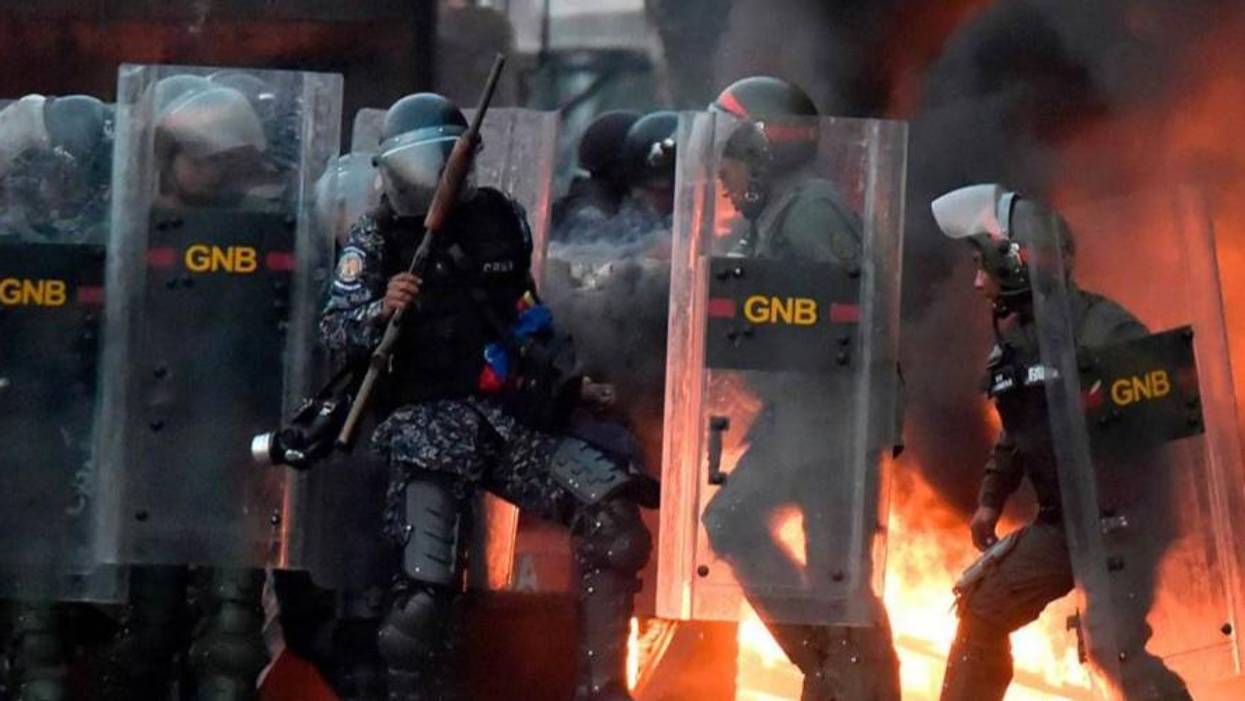
One month after Juan Guaido, the speaker of Venezuela's National Assembly, said he was assuming the powers of the Venezuelan presidency, currently held by Nicolas Maduro, the country's political crisis remains far from over. Tensions have escalated to the point that a full-blown civil war--a seemingly implausible scenario just weeks ago--is now becoming increasingly possible. At least four people died and hundreds were injured in violent clashes at Venezuela's borders last weekend as government forces opened fire on an attempt by the opposition to bring aid convoys into the country.
The Maduro regime is authoritarian, militarized, and ready to kill civilians to maintain power. The society is bitterly divided between the revolutionaries inspired by Hugo Chavez, Maduro's predecessor, and a large and aggrieved opposition. Each side despises the other. The question is therefore a complex and practical one: what to do to help guide Venezuela away from civil war and toward a peaceful and democratic future?
On this great challenge, US President Donald Trump's administration has gravely miscalculated. When the United States chose to recognize Guaido as Venezuela's president - along with a group of Latin American countries - and ban oil trade with the Maduro government, it was betting that the pressure would be sufficient to topple the regime. As a former senior US official told the Wall Street Journal, "they thought it was a 24-hour operation."
"Venezuela's neighbors and world leaders must put aside the US military option. Venezuela needs mediation leading to new elections, not war."
This type of miscalculation predates the Trump administration. In mid-2011, President Barack Obama and Secretary of State Hillary Clinton announced that Syrian President Bashar al-Assad must "step aside." Similarly, in 2003, George W. Bush declared "Mission Accomplished" shortly after the US invasion of Iraq. All of these cases reflect the arrogance of a superpower that repeatedly overlooks local realities.
Maduro's ability to withstand intense US pressure is not a surprise to close observers of Venezuela's military. The centralized structures of command and control of military intelligence, as well as the personal interests of senior officers who control major chunks of the economy, make it highly unlikely that the army will turn on Maduro. US provocation might create a schism between military commanders and more junior officers, but that would only make the plunge into a bloody civil war more likely. To date, there have been no defections among high-ranking officers with direct control of troops.
Faced with the prospect that regime change will not come quickly, the Trump administration and some parts of Venezuela's opposition have begun seriously considering military action. Echoing language recently used in a speech by Trump, Guaido wrote on Saturday that he would formally request the international community to "keep all options open." Similarly, Republican Senator Marco Rubio, who has acted as a self-appointed guru for Trump on Venezuela, warned on Twitter that Maduro's actions had opened the door to "multilateral actions not on the table just 24 hours ago."
Actually, these ideas appear to have been on Trump's mind for some time. As former acting FBI director Andrew G. McCabe revealed recently in his book The Threat, Trump said in a 2017 meeting that he thought the US should be going to war with Venezuela. McCabe quotes Trump as sayin:: "They have all that oil and they're right on our back door." The comments echo Trump's 2011 statement that Obama let himself get "ripped off" by not demanding half of Libya's oil in exchange for US help in overthrowing dictator Muammar el-Qaddafi.
US military interventions are not driven only by economic and business interests. Being tough on Maduro is also highly popular with many Cuban-American and Venezuelan-American voters in Rubio's home state of Florida, which will be a key battleground in the 2020 presidential election.
Advocates of US military intervention regularly cite the cases of Panama and Grenada as precedents for rapid US-led regime change. Yet, in contrast to those two countries, Venezuela has a well-armed military of more than 100,000 soldiers. Of course, the US could defeat the Venezuelan army, but one need not be blind to the atrocities of authoritarian regimes to understand that, as has happened repeatedly in US wars in the Middle East, attempts to overthrow such regimes often end in catastrophe.
Even without military intervention, US sanctions policies, if sustained, are bound to create a famine. By cutting off Venezuela's oil trade with the US and threatening to sanction non-US firms that do business with Venezuela's state-owned oil company, the Trump administration has created one of the most punitive economic sanctions regimes in recent history. But rather than provoking a coup, economically isolating a country that essentially feeds itself with its oil export revenues could lead to mass hunger instead.
Venezuela's neighbors and world leaders must put aside the US military option. Venezuela needs mediation leading to new elections, not war. It also needs an urgent, interim period of political truce in 2019 to end the devastating hyperinflation, restore flows of foodstuffs and medicines, and reconstitute the electoral rolls and institutions for a peaceful and credible election in 2020.
A pragmatic approach might involve the current government continuing to control the army, while technocrats backed by the opposition take control over finances, the central bank, planning, humanitarian relief, health services, and foreign affairs. Both sides would agree to a timeline for a national election in 2020, and to an internationally supervised demilitarization of daily life, with a restoration of civil and political rights and physical security in the country.
The United Nations Security Council should oversee such a solution. Chapter VII of the UN Charter gives the Security Council the mandate to "determine the existence of any threat to the peace, breach of the peace, or act of aggression" and to take actions to "restore international peace and security." The Security Council is also the right venue pragmatically, as the US, China, and Russia all have financial and political interests in finding a peaceful solution in Venezuela. All three countries could readily agree to a path to elections in 2020. Encouragingly, Pope Francis and the governments of Mexico and Uruguay have also offered to help facilitate mediation to find a peaceful way forward.
Trump and other US leaders say that the time for negotiation has passed. They believe in a short, quick war if necessary. World leaders--and those in Latin American countries first and foremost--should open their eyes to the risks of a devastating war, one that could last for years and spread widely.
So why is everyone pretending otherwise?
There are a number of reasons why these superficial narratives take hold, but I'd like to speculate on two of them.
First, the crisis in Venezuela is very real and very daunting. Without litigating who's responsible for what, whether U.S.-led sanctions and economic sabotage are more to blame or the economic policies of Nicolas Maduro, one simple fact is true: The status quo is untenable. Perhaps, then, the instinct to "do something" is understandable. But as with previous crises, both organic and contrived, what that "something" is remains unclear. Liberals--as they did in the build-up to the invasions of Iraq and Libya--are easily pressured into this "do something" posture.
The way these things work, however, is that this vague moral directive often involves a combination of CIA and U.S. military intervention. During the Syrian conflict, for example, it meant U.S.- and NATO-led bombings of Syrian forces and a tacit declaration of war under the guise of "no-fly zones." What's never considered is a reduction or cessation of U.S. involvement, be it CIA weapons running, wide-scale bombing campaigns, or the imposition of sanctions--all of which prolong a given conflict or simply make it more violent.
The fact that the bulk of the international aid community has either distanced itself from this PR stunt or outright opposes it has been widely ignored by the mainstream media.
Because a core tenet of American liberalism is to avoid assigning blame--at worst, its adherents believe, the U.S. is run by a bunch of bumbling do-gooders--what the American empire is actually doing to fuel a conflict cannot be debated, much less censured. And so the notion that we could simply cease our crippling sanctions, which even the pro-opposition Economist acknowledges are designed to "starve" the Venezuelan people, is simply not an option.
The current "something" in Venezuela we're all compelled to "do" is ensure the arrival of a humanitarian aid convoy. The fact that the bulk of the international aid community has either distanced itself from this PR stunt or outright opposes it has been widely ignored by the mainstream media. One exception is NPR, which recently reported this inconvenient truth:
The U.S. effort to distribute tons of food and medicine to needy Venezuelans is more than just a humanitarian mission. The operation is also designed to foment regime change in Venezuela -- which is why much of the international aid community wants nothing to do with it. Humanitarian operations are supposed to be neutral.
That's why the International Committee of the Red Cross, United Nations agencies and other relief organizations have refused to collaborate with the U.S. and its allies in the Venezuelan opposition who are trying to force President Nicolas Maduro from power.
"Humanitarian action needs to be independent of political, military or any other objectives," Stephane Dujarric, the U.N. spokesman, told a press briefing last week in New York. "The needs of the people should lead in terms of when and how humanitarian assistance is used."
In fact, no neutral observer of international aid thinks Bolton and Abrams' convoy is anything but a mechanism to foment civil war and regime change. We know this because high-level administration officials and their allies on the right keep telling us that's the case. As the New York Post recently proclaimed, "U.S. delivers aid to town bordering Venezuela to undermine President Nicolas Maduro."
Determined to maintain U.S. hegemony and control over the world's largest-known oil reserves, the Trump officials plotting this latest coup aren't even bothering to take its humanitarian pretext seriously.
Donald Trump delivered a long and rambling speech in Miami last week and didn't once mention human rights, instead railing against the evils of socialism. Former acting FBI director Andrew McCabe reflects in his new book that Trump has openly fantasized about overthrowing Maduro, something he has discussed in White House meetings. "That's the country we should be going to war with," Trump said, according to McCabe. "They have all that oil, and they're right on our back door."
Determined to maintain U.S. hegemony and control over the world's largest-known oil reserves, the Trump officials plotting this latest coup aren't even bothering to take its humanitarian pretext seriously. Why, then, are purportedly centrist and liberal media outlets?
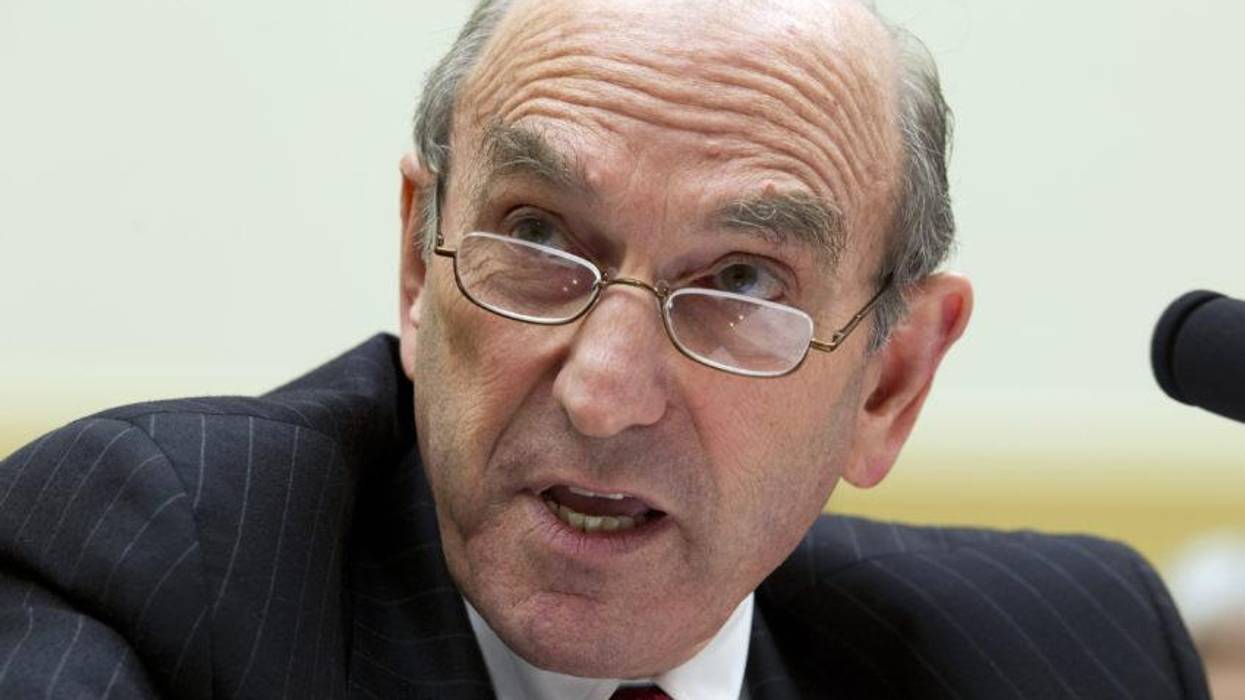
A second matter to consider is how our government has weaponized the public's sense of morality. Since the Spanish-American War, the U.S. has used humanitarian concerns as a shield against criticism or skepticism, and it has more or less worked every time. It's why "aid" organizations like Air America used food transports to ship guns to anti-Communists in Indochina in the 1960s and '70s. (Weapons were code-named "hard rice.") And it's why Elliott Abrams--the current quarterback of this latest affair in Venezuela--used humanitarian aid shipments to smuggle weapons to the Nicaragua's Contras in the '80s. Ultimately, these shipments allow for massive military buildups, without anyone in the media or Congress asking too many questions. After all, what kind of monster is opposed to helping starving people?
It's impossible to know if the current shipments to Venezuela are being used to transport weapons, although Venezuelan authorities say they have intercepted American arms shipments. But given the history of the U.S. (to say nothing of Abrams'), and the fact that the Trump administration is openly calling for Maduro's ouster while amassing forces along the Colombian border, it's not exactly a long shot. Still, our political press dismisses the possibility as tin-foil hat stuff, at least in part because mocking wacky Latin American "conspiracy theories" is a mark of one's seriousness in foreign policy circles.
Unlike a lot of U.S. regime change activities, reports indicate that this latest stunt was exceptionally rushed and slapdash. The Wall Street Journal paints a picture of a U.S. operation its architects believed would work in a day or two:
"The people who devised it in Caracas and sold it here [in Washington], sold it with the promise that if Guaido made a move and [South American countries] and the U.S. came in behind, the military would flip and Maduro would go," said a former senior U.S. official. "They thought it was a 24-hour operation."
Because the large-scale military defections expected never took place (as they almost never do), the U.S. has had to resort to its Plan B for promoting conflict and galvanizing the Venezuelan opposition: On Sat., Feb. 23, President of the National Assembly Juan Guaido will carry out a "humanitarian avalanche" at the Venezuelan border with Colombia and Brazil that, when one reads the fine print, sounds a lot like a U.S.-led invasion. Billionaire Richard Branson is reportedly organizing a "humanitarian aid" concert the night before. But we know this is a fig leaf, and we know this because those running this operation say so again and again. Bolton himself has speculated that Maduro could end up in a "beach area like Guantanamo."
Despite all the evidence before them, MSNBC, CNN and countless other networks and publications across the ideological spectrum refuse to frame this humanitarian gambit as an act of hostility.
Despite all the evidence before them, MSNBC, CNN and countless other networks and publications across the ideological spectrum refuse to frame this humanitarian gambit as an act of hostility. Instead, knowing what they know and who they are covering, they have largely portrayed Trump, Bolton and Abrams as champions of the Venezuelan people.
It goes without saying that hundreds of thousands are suffering in Venezuela, and the instinct to alleviate that suffering is a healthy one. But a craven marketing stunt by far-right Cold Warriors--without any buy-in from actual aid organizations--cannot be taken at face value.
Just as the U.S. military has made calls to high-ranking Venezuelan officials, I am writing directly to the editors, television producers and reporters of our most prominent news outlets. I'm asking you to defect and come to the side of the patently obvious. Unlike the Pentagon, I can't bribe you or promise you amnesty, but I can appeal to your basic sense of integrity and intellectual honesty: At best, you are helping provide cover for a campaign designed to starve the Venezuelan people; at worst, you are enabling a military conflict that will drag on for years.
One does not need to hold any normative opinions about the fate of Venezuela to be able to identify a naked PR campaign when they see one. Journalists with blue checkmarks on Twitter must say so before this gets any further out of hand.

"Why is he so chummy with Vladimir Putin?" Senate Minority Whip Dick Durbin (D-Ill.) said of President Donald Trump's relationship with his Russian counterpart after a series of recent reports provoked more "serious questions" about their interactions, and as public anticipation continues to build over the forthcoming results of Special Counsel Robert Mueller's investigation.
In an interview with ABC's "This Week" on Sunday, Durbin noted key details about Putin's past and his actions as Russia's president: "This man who is a former KGB agent, never been a friend of the United States, invaded our allies, threatens us around the world, and tries his damnedest to undermine our elections. Why is this President Trump's best buddy? I don't get it."
Durbin, a member of the Senate Judiciary Committee, called on Sen. Lindsey Graham (R-S.C.), the new committee chairman, to hold investigative hearings into whether Trump has been "compromised by" Russia. As the senator from Illinois said, "It's within his power to hold these investigations, and he should."
Durbin's remarks come as Mueller is expected to finalize a report as early as next month that will detail his findings from the investigation into alleged Russian interference in the 2016 presidential election, and any collusion or obstruction of justice by Trump's campaign or administration--a report which, as Common Dreams reported this week, the president's attorneys may try to keep out of the hands of federal lawmakers and the public by claiming executive privilege.
The comments also follow a report published Friday by the New York Times that after Trump fired FBI director James Comey, "law enforcement officials became so concerned by the president's behavior that they began investigating whether he had been working on behalf of Russia against American interests." As the Times outlined:
The inquiry carried explosive implications. Counterintelligence investigators had to consider whether the president's own actions constituted a possible threat to national security. Agents also sought to determine whether Mr. Trump was knowingly working for Russia or had unwittingly fallen under Moscow's influence.
The investigation the FBI opened into Mr. Trump also had a criminal aspect, which has long been publicly known: whether his firing of Mr. Comey constituted obstruction of justice.
Days after the FBI launched the investigation, it was taken over by Mueller as part of his broader probe. Trump responded to the Times report in a long series of tweets early Saturday, stringing together a bunch of unfounded claims he's often repeated in attempts to discredit the investigation.
Appearing on "Fox News Sunday," Graham, for his part, said, "I, for one, don't trust what I read in the New York Times," but also that he plans to ask current FBI director Christopher Wray to confirm the details of the reporting.
"I'm going to ask the FBI director was there a counterintelligence investigation opened up regarding the president as being a potential agent of the Russians," Graham said. "I find it astonishing, and to me it tells me a lot about the people running the FBI, [former Deputy Director Andrew] McCabe and that crowd."
"So if this really did happen, Congress needs to know about it," Graham added. "And what I want to do is make sure how could the FBI do that? What kind of checks and balances are there?"
Also this weekend, the Washington Post reported that Trump "has gone to extraordinary lengths to conceal details of his conversations" with Putin from members of his own administration--"including on at least one occasion taking possession of the notes of his own interpreter and instructing the linguist not to discuss what had transpired with other administration officials."
According to the Post:
Trump did so after a meeting with Putin in 2017 in Hamburg that was also attended by then-Secretary of State Rex Tillerson. U.S. officials learned of Trump's actions when a White House adviser and a senior State Department official sought information from the interpreter beyond a readout shared by Tillerson.
The constraints that Trump imposed are part of a broader pattern by the president of shielding his communications with Putin from public scrutiny and preventing even high-ranking officials in his own administration from fully knowing what he has told one of the United States' main adversaries.
As a result, U.S. officials said there is no detailed record, even in classified files, of Trump's face-to-face interactions with the Russian leader at five locations over the past two years. Such a gap would be unusual in any presidency, let alone one that Russia sought to install through what U.S. intelligence agencies have described as an unprecedented campaign of election interference.
Responding to that report during his interview on Sunday, Durbin concluded, "When he takes the interpreter's notes and wants to destroy them so no one can see what was said, and the written transcript... it raises serious questions about the relationship between this president and Putin."
This post has been updated to reflect that Sen. Lindsey Graham (R-S.C.) made his statements on "Fox News Sunday," rather than to The Hill, which reported on the senator's comments on Sunday but did not indicate that he made them during a television interview.
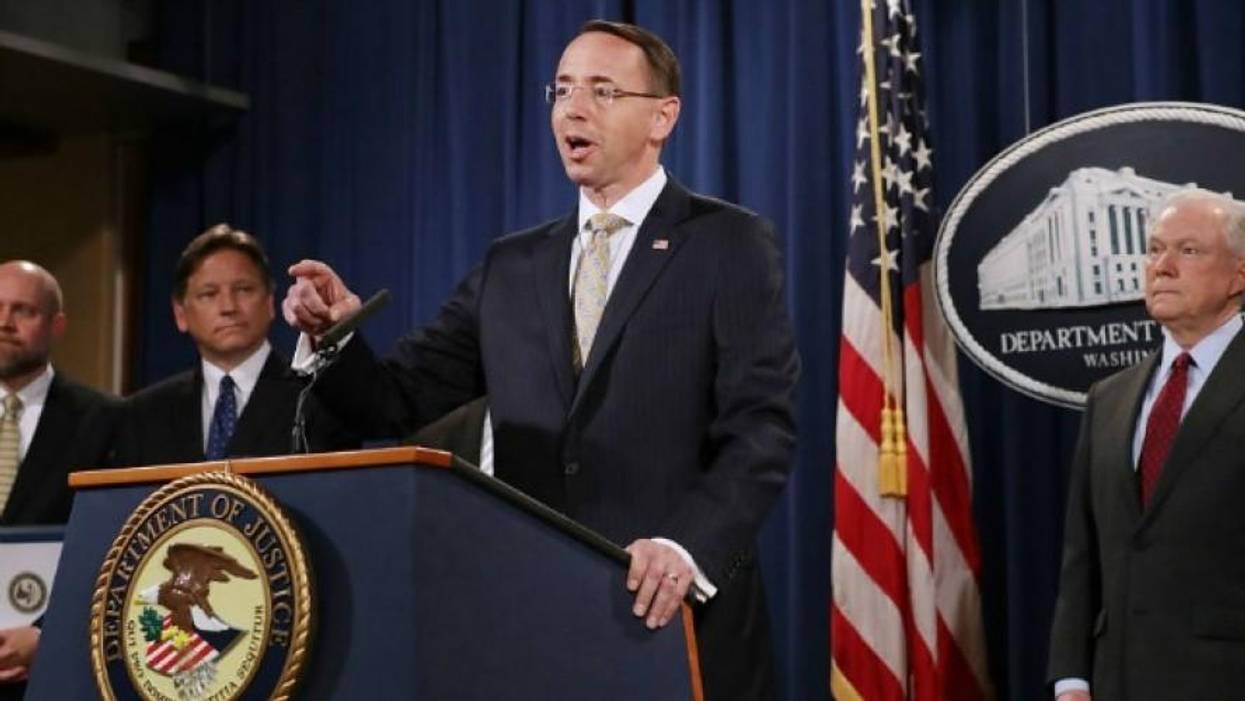
In a humiliating real-life re-run of "The Apprentice," Deputy Attorney General Rod Rosenstein will go to the White House on Thursday to find out if he's been fired. Eager to boost the ratings, President Trump coyly allows he's open to keeping Rosenstein, maybe until after the midterms. Don't believe him? Tune in to find out.
The faux suspense cannot obscure "the slow-motion Saturday Night massacre," the continuing purge of the Justice Department. The intent: killing, or at least defanging, the special prosecutor's investigation of the president's family and entourage. The weapon: public humiliation of civil servants who place the rule of law over loyalty to the president.
Deputy FBI director Andrew McCabe and senior FBI agent Peter Strzok have gotten this treatment. Rosenstein will get it Thursday. Bruce Ohr, leader of the investigation into Trump's ties to Russian organized crime, has become a target and can expect more soon.
Key to this strategy is the weaponization of the idea of transparency, instrumental to the rule of law, in service of undermining the rule of law. It's a familiar tactic of the Trumpian backlash, like deploying the First Amendment provocateurs to sabotage free speech on campus or complaining the big internet platforms discriminate against conservative ideas.
Who can oppose transparency? Not supporters of an open society or executives of internet platforms. Transparency in government is essential to accountability, which enables the rule of law. Transparency in the platform business is essential to keeping market share. Only by disclosing their actions can governments (and internet platforms) gain the consent of the citizenry (or user audience).
By invoking liberal ideas to justify hate speech and humiliation, Trump seeks to force his opposition to compromise their principles (and expose themselves as hypocrites) or to stick to their principles--and legitimize bogus claims of victimization that will mobilize followers.
Since the FBI and CIA have abused their secret powers to disrupt domestic dissent and attack democratic forces abroad, they no longer enjoy the benefit of the doubt from the general public.
This tactic is especially effective with government agencies that rely on secrecy. Since the FBI and CIA have abused their secret powers to disrupt domestic dissent and attack democratic forces abroad, they no longer enjoy the benefit of the doubt from the general public.
The same goes for the internet platforms that played fast and loose with users' data without disclosing their actions. The discourse of the Deep State, grounded in national security realities and shrouded in partisan conspiracy theory, thrives in the culture of secrecy.
The ritualized humiliation of Rosenstein (which the victim seems weirdly willing to participate in) began with Trump's threat to declassify memoranda and text messages of top FBI officials about the Russia investigation, as well as the secret Foreign Intelligence Surveillance Act (FISA) warrants for the wiretapping of minor Trump aide Carter Page.
Even people who don't much like the president welcomed the prospect. Glenn Greenwald rightly scoffed at the idea that release of the information would compromise "national security," as a top former CIA official claimed in the Washington Post.
Declassification of the Page warrant was obviously "politically motivated," said Reason magazine, "but more transparency is still good." And the president's supporters at the Weekly Standard crowed, "Why Is the New York Times Suddenly Opposed to Declassifying the FISA Documents?"
After mounting a pseudo-spectacle of attacking secrecy, Trump then backed off his plan, saying that foreign governments had expressed concern. That suggested that the president had consulted with Secretary of State (and former CIA director) Mike Pompeo. Trump tweeted the inspector general of the Justice Department would "review these documents on an expedited basis," adding, "I can declassify at any time."
Not coincidentally, someone immediately leaked the substance of some of the FBI memos to the New York Times. Anonymous officials "briefed either on the events themselves or on memos written by F.B.I. officials" described a meeting in which Rosenstein commented on the chaos in the White House and offered, in jest or not, to wear a wire when talking to Trump.
While it is hard to fault the Times for running the story, the resulting coverage fed "the Trumpian narrative" that top officials are plotting against him and that more "transparency" is necessary. Trump's opponents in the press thus helped him set the stage for Thursday's reality TV episode in the Oval Office.
Whether Rosenstein keeps his job until after the midterm elections is almost beside the point. Trump's campaign to purge the disloyal has been normalized and justified.
Trump weaponizes transparency because "it works," data researcher Danah Boyd noted in a speech to the Online News Association earlier this month. Boyd documented how reactionary groups sell conspiracy theories online with a three-step cycle: the mounting of a public spectacle, a frame for followers to interpret the spectacle, and the use of "digital martyrdom" to mobilize followers:
"Over the last two years, both social media and news media organizations have desperately tried to prove that they aren't biased. What's at stake is not whether these organizations are restricting discussions concerning free-market economics or failing to allow conservative perspectives to be heard. What's at stake is how fringe groups can pervert the logics of media to spread conspiratorial and hateful messages under their false flag of conservatism."
What Boyd didn't say is that the fringe group is in the White House.
This article was produced by the Deep State, a project of the Independent Media Institute.

The New York Times reports that deputy Attorney General Rod Rosenstein talked about wearing a wire to record Trump's insane prattering, and spoke of invoking the 25th amendment, which allows the cabinet to remove the president if he is incapacitated. Rosenstein's office says that the remarks were facetious. They were recorded in memos by former FBI deputy director Andrew McCabe, that somehow came into the possession of NYT reporters.
Trump has wanted to fire Rosenstein for some time, and this news report (which Rosenstein says is full of inaccuracies) could well push the volatile hotelier over the edge. One reason Trump wants to get rid of the deputy Attorney General is that he oversees Robert Mueller, who is investigating the Trump campaign for evidence of collusion with the Russian Federation in electoral irregularities that may have won Trump the White House.
Trump has speculated about firing Mueller, who has indicted a number of close associates of Trump. But the president cannot fire Mueller. He works for Rosenstein. If, however, you fired Rosenstein and replaced him with a dutiful Trumpie, then the new deputy AG could fire Mueller, or could just bury his investigation.
But that series of events leads to the Great American Apocalypse.
Let's say the Republicans in the Senate put Kavanaugh on the Supreme Court next week.
And let's say Trump fires Rosenstein next week.
The Senate would likely have to confirm any successor appointed by Trump (just as that body confirmed Rosenstein).
So let's say Mitch McConnell can march the appointment through promptly, before the midterms.
The House and the Senate may both fall into Democratic hands in November.
And let's say that Trump has the new guy fire Mueller and discontinue his investigation, and that Mueller's findings are not released.
The new Kavanaugh Supreme Court would back Trump in the firing and suppression of Mueller.
Then I think we're heading to serious steps toward impeachment early in the new year.
But what if Trump, who isn't known for his collegiality or grasp on reality, announces that he won't step down under any circumstances?
What if he tells Mattis to put tanks in the streets to put down building protests, and emulates Lincoln in declaring martial law and a suspension of habeas corpus throughout the United States, this time without Congressional approval and in defiance of Posse Comitatus? (Trump after all doesn't know what that is).
What if Mattis says 'no' and Trump fires *him*?
Since the 25th amendment specifies that the vice president and 14 cabinet members are needed to remove the president for being incapacitated, I doubt that Pence would do it. But if Pence won't do it, does he become implicated in Trump's crimes?
If the Dems have Congress, they could refuse to confirm a replacement for Mattis.
At that point, the fate of the nation would be in the hands of deputy Secretary of Defense Patrick M. Shanahan. He is a civilian who came out of Boeing, rather than a military man. Would he buck Trump if he was ordered to implement national martial law? Would the Joint Chiefs of Staff go along?
Again, the Kavanaugh court would likely prove useless in challenging any Trumpian extra-constitutionality.
Then what if the Dems actually arrange a vote on impeachment? Would some Republicans finally peel off and vote with the Dems to impeach? Would they impeach both Trump and Pence (the latter for refusing to implement the 25th Amendment?)
If so, Nancy Pelosi could be president by next February (the speaker of the house is next in line after the vice president). But then the possibility of a revolt by the Trumpies, who include Neo-Nazis and biker gangs and other criminal elements, rears its ugly head.
And, could Putin stand by and see an administration come to power that might challenge him in the Ukraine and Syria? Would Pelosi need a taster to avoid being poisoned?
Or, a whole new scenario. What if the Dems fail to take either house of Congress in November, and the Republicans go along with the declaration of martial law, and refuse to consider impeachment? And what if the Kavanaugh court sides with Trump that Posse Comitatus is unconstitutional?
Then, game over for the 242-year-old experiment in American democracy.
Thirteen years ago, Tom Friedman of the New York Times so often suggested that "the next six months" would prove fateful for the Iraq War that it was sarcastically called "the Friedman unit."
This time, the Friedman unit will determine the fate of these United States of America.
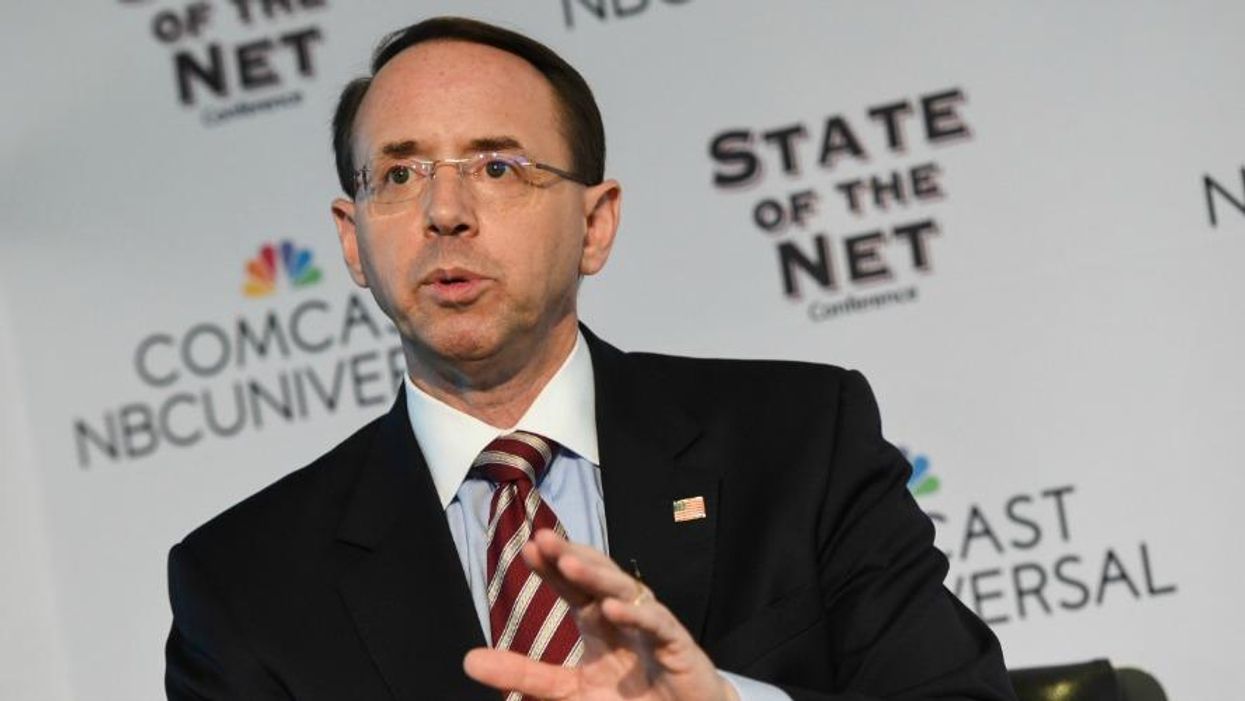
There is a lot to chew over in the blockbuster New York Times story about Deputy Attorney General Rod Rosenstein's erratic behavior in his first few weeks on the job, just after President Trump fired FBI Director Jim Comey on May 9, 2017.
The Times reports that Rosenstein suggested that "he secretly record President Trump in the White House to expose the chaos consuming the administration" and that he "discussed recruiting cabinet members to invoke the 25th Amendment to remove Mr. Trump from office for being unfit." Rosenstein also reportedly told Acting FBI Director Andrew G. McCabe "that he might be able to persuade Attorney General Jeff Sessions and John F. Kelly, then the secretary of homeland security and now the White House chief of staff, to mount an effort to invoke the 25th Amendment." As Drudge summarizes it, with only a tad of unfairness: "Rosenstein Wanted to Wear Wire; Plot To Remove Trump." As the Times makes clear, "None of Mr. Rosenstein's proposals apparently came to fruition."
Rosenstein responded to the story in a statement: "The New York Times's story is inaccurate and factually incorrect. I will not further comment on a story based on anonymous sources who are obviously biased against the department and are advancing their own personal agenda. But let me be clear about this: Based on my personal dealings with the president, there is no basis to invoke the 25th Amendment." But he did not deny the story's claims that he discussed invoking the 25th Amendment and secretly recording the president. And indeed, the Justice Department issued a statement from an anonymous official who said that Rosenstein made his proposal to record the president "sarcastically." Other anonymous officials, however, insisted that Rosenstein "was serious about the idea" and "followed up by suggesting that other F.B.I. officials who were interviewing to be the bureau's director could also secretly record Mr. Trump."
The events the Times describes came on the heels of Rosenstein's unfortunate participation in Comey's firing. As the Times now reports the episode, when Trump informed Rosenstein and Attorney General Sessions of his plan to fire Comey, Rosenstein, to the surprise of White House officials, "embraced the idea, even offering to write the memo about the Clinton email inquiry." (Bob Woodward's recent account of the episode is similar: "Rosenstein told Trump that he thought Comey should be fired. He had no problem writing a memo outlining his reasoning.") After Trump invoked Rosenstein's memo as the basis for firing Comey, Rosenstein "became angry at Mr. Trump" and "grew concerned that his reputation had suffered harm," according to people who spoke with him.
Based on sources who spoke to or witnessed Rosenstein's behavior, the Times reports that Rosenstein was emotionally uneven during this period. Of the Comey firing, the paper says that "Mr. Rosenstein appeared conflicted, regretful and emotional, according to people who spoke with him at the time." (Amazingly, Rosenstein considered calling Comey five days after assisting in his firing in order to seek his judgment about a special counsel.) And people who were with Rosenstein at the time said that his suggestions regarding the 25th Amendment and wearing a wire exemplify "how erratically [Rosenstein] was behaving while he was taking part in the interviews for a replacement F.B.I. director, considering the appointment of a special counsel and otherwise running the day-to-day operations of the more than 100,000 people at the Justice Department."
Wow--what a story. A few quick reactions:
* The Times' story appears to have originated in part in some contemporaneous memoranda written by McCabe, who is under a grand jury investigation by the Justice Department. (The memos have been turned over to special counsel Robert Mueller.) It is not clear how McCabe might benefit from this leak (and McCabe, through a spokesperson, has denied involvement in the story.) Presumably the Times did a thorough assessment of its sources to confirm the validity of the story, especially since the story (as I explain below) so helps the President's narrative. But the story is strangely sourced to people "briefed either on the events themselves or on memos written by F.B.I. officials, including Andrew G. McCabe, then the acting bureau director, that documented Mr. Rosenstein's actions and comments." Companion stories with different emphases are now appearing, but I have not seen anything in these stories that changes the basic story in the Times: Rosenstein discussed recording Trump and the 25th Amendment, and one or two people who were present suggest he was joking about the wire, but others (and seemingly more people) insist he was serious. No one has yet cast doubt on the Times' claim about Rosenstein and the 25th Amendment.*
* This story gives President Trump plenty of legitimate reasons to fire Rosenstein, including: (1) Rosenstein's suggestion of recording Trump; (2) Rosenstein's floating of the idea to decapitate Trump under the 25th Amendment; (3) Rosenstein's plan to consult Comey about who should be appointed special counsel just days after Trump fired Comey; and (4) Rosenstein's related acts of insubordination and disrespect. Trump now has cover should he wish to fire Rosenstein for his appointment and supervision of Robert Mueller. It will be interesting to see how Trump reacts. He could fire Rosenstein immediately. Or he could not fire him and instead use the story to continue to attack Rosenstein's supervision of Mueller. (The current fight over the nomination of Brett Kavanaugh to the Supreme Court might significantly affect the President's calculus.)
* The Justice Department said today that the revelations will have "no bearing on Rosenstein's supervision of Mueller's probe." We'll see. But in any event, the revelations deepen the puzzle that I and others long ago noted about Rosenstein's conflict of interest in supervising the Mueller investigation. The main issue is that Rosenstein appears to be a central witness to Trump's motivation for firing Comey, which appears to be an issue under investigation by Mueller. Rosenstein's personal anger and resentment toward Trump, and his suggestions about secretly recording him and organizing his removal, deepen the conflict.
* Regardless of the legal issue of Rosenstein's conflict of interest, this story will lend enormous credibility to the president's claim that the Mueller investigation is hopelessly compromised. The president can now tell a story about how Rosenstein acted with anger and resentment in appointing Mueller; that the Mueller appointment was part of Rosenstein's larger plan to decapitate the president; and that Rosenstein's 18-month supervision of the Mueller investigation, and the investigation itself, is therefore compromised. I don't think these revelations affect the legality of the Mueller appointment and investigation. But they will surely affect the atmospheric lens through which it is judged.
* The president and his allies will also use this story as confirmation that there is a broader "Deep State" conspiracy to bring down the president. This has always been a hard story to tell about Rosenstein, whom Trump appointed. But the story makes clear that Rosenstein had resentment toward the president and considered taking personal steps to bring him down. The story also suggests that Rosenstein was more bureaucrat than political appointee by noting that he is a "lifelong public servant" and that he considered seriously appointing his former supervisor, President Obama's Deputy Attorney General James M. Cole, to be the special counsel for the Russia investigation.
* The Times story will feed the Trumpian narrative in all of these ways. At the same time, and looking at it from something like the opposite perspective, it's another piece of evidence--on top of large-scale senior-level insubordination, the anonymous Times op-ed writer, and many episodes in Woodward's new book--that senior Trump officials are significantly disenchanted with the president's basic competence and have undertaken very unusual steps to deal with it. Some will worry about a Deep State; others will worry about the stability of our government; yet others will worry about both.
* The Rosenstein revelations are akin to the text messages between Peter Strzok and Lisa Page. They demonstrate bad judgment expressed in what the participants mistakenly thought was a private setting, but that became public and had a devastating impact on the perceived legitimacy of the government's law enforcement efforts. This has happened a lot recently, and it is related to the point I wrote about last year: the institutions that oppose the norm-defying president have often "defied their own norms, and harmed themselves and the nation in the process."
This story will continue to develop, and our understanding of the facts may well change. But for now the story helps Trump a lot.
*After I wrote this, the Washington Post reported that ,"While McCabe's memos assert both the recording and 25th amendment conversations occurred at a meeting within days of Comey's firing, another person at the meeting, speaking on condition of anonymity to discuss internal deliberations, insisted the recording comment was said in a moment of sarcasm, and that the 25th amendment was not discussed." The Post also reports that "a third person familiar with the discussions said McCabe had privately asserted previously that Rosenstein suggested invoking the 25th amendment and the idea of a senior law enforcement officials wearing a wire while talking to Trump."

Rep. Ted Lieu (D-Calif.) warned President Donald Trump against an obvious possible obstruction of justice as Trump hinted at firing Deputy Attorney General Rod Rosenstein at a rally late Friday.
Lieu's comments followed the New York Times' bombshell report Friday afternoon detailing comments Rosenstein reportedly made early in Trump's presidency. According to the Times, the deputy attorney general suggested recording his conversations with the president in 2017 and said that invoking the 25th amendment to remove Trump from office could be possible.
"None of this appeared to have been executed," Lieu told Ari Melber on MSNBC. "He didn't seem to tape anything, he didn't seem to have gone much further with the 25th amendment talk, so this would not be enough to fire Rod Rosenstein. If he did it would be obstruction of justice."
Lieu's interview came as Trump was speaking to a crowd in Springfield, Missouri, where he was endorsing the Senate run of the state's attorney general, Josh Hawley--but where he focused partially on his ongoing feud with the Justice Department over Special Counsel Robert Mueller's investigation into his campaign.
"Look what's being exposed at the Department of Justice and the FBI. You have some real bad ones. You see what's happening at the FBI--they're all gone, they're all gone," Trump said, in a likely reference to former FBI Director James Comey, who he fired in 2017, and former Deputy Director Andrew McCabe, who was fired by Attorney General Jeff Sessions last January.
"But there's a lingering stench and we're going to get rid of that too," Trump added.
The report, and Trump's remarks in Missouri, led to concerns that the president could fire Rosenstein in the near future, provoking government watchdog groups including Public Citizen and MoveOn.org to mobilize their supporters in anticipation of mass protests should Trump dismiss the deputy attorney general.
"If the president [fires Rosenstein], it really would be a pretext to get the Mueller investigation," Lieu said.
The CIA's approval rating among Democrats is sky-high. Former FBI and Justice Department officials are being showered with donations on GoFundMe. And now George W. Bush -- the president who signed the Patriot Act, opened Guantanamo, started the Iraq War, and warrantlessly wiretapped Americans -- is a viral sensation being portrayed as our country's most lovable grandpa.
It's an infuriating and depressing state of affairs for civil liberties advocates, many of whom have fought the CIA, FBI, and Justice Department in the past two presidential administrations.
Everyone expected Trump to be a nightmare for Americans' civil liberties. But very few could have guessed the strange way this nightmare would manifest itself over the past 18 months. Of course, Trump has used his executive power to implement countless cruel and rights-violating policies. But he has also, with an assist from a frenzied media, turned many of the individuals and agencies responsible for creating our unaccountable national security apparatus into folk heroes at the same time.
It's an infuriating and depressing state of affairs for civil liberties advocates, many of whom have fought the CIA, FBI, and Justice Department in the past two presidential administrations as these agencies expanded executive power, restricted privacy rights, and shielded officials from accountability under the guise of "national security" -- the same tools Trump now regularly uses for his benefit.
The nauseating sight this weekend of George W. Bush being deified on social media because he passed a piece of candy to Michelle Obama was only the latest example. The combination of Trump's relentless and inaccurate Twitter feed and the stampede of pundits who instinctively feel the need take the exact opposite view has created a nonstop cycle that has destroyed our ability to see the truth.
The examples come so fast that they are almost impossible to enumerate. In just the past couple weeks, Trump has gone after the FISA court, the Justice Department, and the FBI -- all due to personal grievances or feuds he has because of their perceived role in the Mueller investigation.
Virtually all of Trump's specific criticisms are baseless, but he has an uncanny ability to pick targets for his tweet tirades that should be harshly criticized for entirely different reasons. The FISA court has been radically reinterpreting Fourth Amendment law in complete secrecy since the Bush administration. The FBI, still headquartered in a building named after serial lawbreaker J. Edgar Hoover, has been a civil liberties disaster since its inception and was recently handed increased surveillance authorities under Trump's watch. The Justice Department has repeatedly tipped the scales against the powerless while shielding the powerful.
Why, then, when Trump tweets something idiotic about the Justice Department, do so many pundits have to say something almost as ridiculous in response, like, "The statute of Justice is blindfolded for a reason, it applies to all without fear nor favor"? Try telling that to 500 children still separated from their immigrant parents because of Justice Department policies, or to the other countless victims of Attorney General Jeff Sessions' radical moves since he's taken office.
When Trump criticizes law enforcement or intelligence officials by name, this phenomenon somehow gets worse. His targets are instantly turned into celebrities who must be morally pure, merely because Trump has decided to turn his fire on them on a particular day. The same people the Bush and Obama administration inoculated from accountability for similar transgressions Trump commits on a daily basis -- like lying -- are being turned into liberal icons.
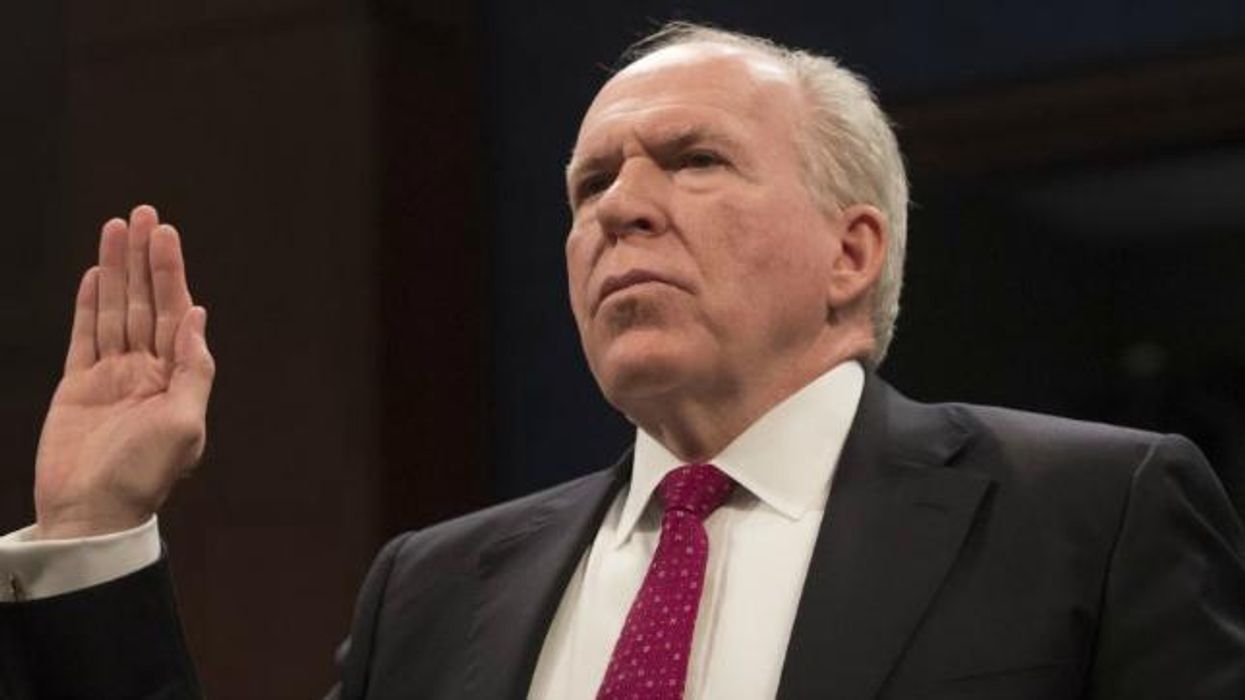
Take former CIA director John Brennan, whose security clearance Trump revoked because he was upset that Brennan was criticizing him. After Trump's announcement, Brennan was lionized by the media as a truth-telling luminary, instantly beloved by all Democrats. How quickly people (pretend to) forget that Brennan, just a few years ago, ordered the CIA to spy on Democratic Senate staffers who were investigating the agency's torture program, and then blatantly lied about it to the public.
Yes, Trump's retaliation against Brennan for criticizing him is concerning, but why do so many pundits feel the need to declare Brennan a "hero"? It is indeed possible to condemn Trump's vengeful actions against people like Brennan without showering these people with unadulterated praise.
Cable news is littered with similar cases. James Clapper, the former director of national intelligence, lied to Congress about the NSA's mass surveillance of Americans before the Snowden revelations. He's now a regular anti-Trump commentator on CNN. Michael Hayden, the former Bush administration NSA and CIA chief who made so many false statements to Congress that they are featured in a stand-alone section in the Senate's 2014 torture report, is regularly seen on television ripping Trump for constant falsehoods. Hayden even has a bestselling new book, The Assault on Intelligence: American National Security in the Age of Lies, lamenting the death of "truth."
It is the height of irony that Trump constantly rants about the "deep state," yet the most coordinated PR campaign involving ex-intelligence officials we've seen in his presidency was in support of one of his major agenda items. It was Brennan, Clapper, and Hayden -- along with dozens of other former intelligence officials -- who banded together and and used their newfound media platforms to lobby for Trump's CIA nominee Gina Haspel, who was personally involved in the agency's appalling torture program after 9/11.
The next time a Trump cabinet official is caught lying under oath but faces no retribution for it -- or when Trump's CIA is involved in its next human rights scandal -- we should save part of the blame for those who paved the way for such an act to go unpunished. By uncritically glorifying law enforcement and intelligence officials who have tramped on civil liberties for decades in the name of fighting Trump, we may damage the cause of civil liberties long after Trump is gone.