SUBSCRIBE TO OUR FREE NEWSLETTER
Daily news & progressive opinion—funded by the people, not the corporations—delivered straight to your inbox.
5
#000000
#FFFFFF
To donate by check, phone, or other method, see our More Ways to Give page.
Daily news & progressive opinion—funded by the people, not the corporations—delivered straight to your inbox.
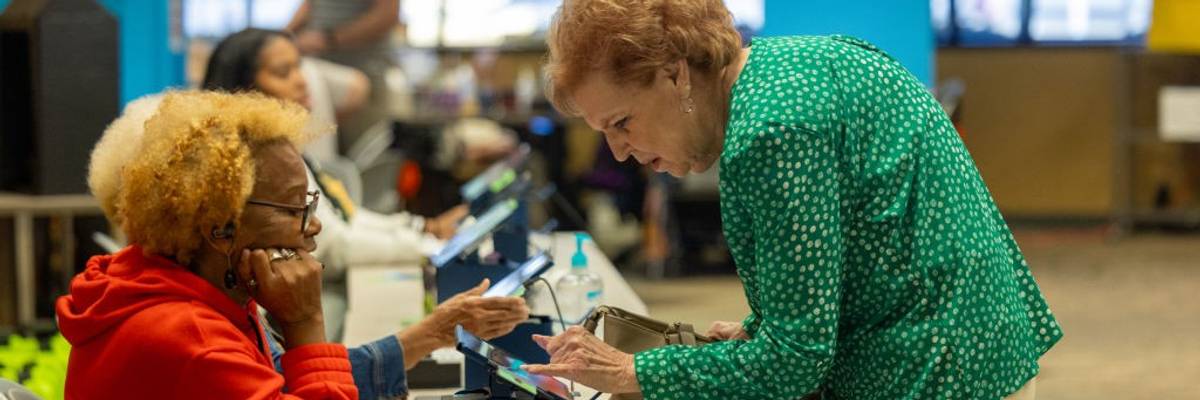
Voters check in at an early voting location in Columbus, Georgia on October 29, 2024 ahead of the general election.
Voting is more than a civic duty. It is a form of empowerment.
A recent UCLA study found that 2 million people with felony convictions have the right to vote, but misinformation and lack of clarity can prevent them from exercising this right. Similar trends are pervasive in other marginalized communities – such as those experiencing homelessness and recent immigrants – which is why social workers are uniquely positioned to help empower citizens to vote this election cycle. As the 2024 presidential and state elections approach, doing so is more important than ever.
Many of the individuals we work with are politically and socially disenfranchised, and thus turn out to the polls in much lower numbers. However, low voter turnout in these communities reinforces a cycle of neglect, as elected officials are less inclined to allocate resources to areas that don’t engage in the political process. It also means that their voice isn’t heard, even when issues that directly impact them are on the line.
Social workers can help break this cycle by showing clients how their personal struggles are linked to policy decisions. For example, as few as 10% of unhoused individuals vote in elections, while this year alone more than 2,000 bills about housing and homelessness were introduced in 48 of 50 states—not to mention the other economic and social policies enacted that affect the state of homelessness and welfare of unhoused individuals. In essence, the clients that we work with are often disproportionately affected by the outcomes of elections—and deserve a voice.
Voting is one of the most direct ways individuals can influence policies on education, healthcare, housing and social services. Research from the University of Connecticut shows that higher voter turnout leads to better health, education and economic outcomes, particularly for low-income populations. When communities vote, they compel elected officials to pay attention. Social workers, as trusted advocates, can help bridge the gap between disempowered individuals and the political system that governs their lives.
Voting is one of the most direct ways individuals can influence policies on education, healthcare, housing and social services.
Doing so means first becoming more informed about the voting process ourselves. For many of the people we serve, voting feels daunting. Some don’t know if they are eligible, how to register, or where to vote. Social workers can demystify the process by providing clear, factual information about registration, poll locations, absentee ballots and early voting. Our role is to ensure our clients know these rules and are prepared to vote.
Armed with information, we can better help clients identify registration deadlines, voting locations and nonpartisan resources on candidates and issues. By integrating voter education into our practice, we can impact voter turnout in communities often overlooked by policymakers.
Beyond registration, social workers can help clients make informed decisions at the ballot box. We can help identify the issues that matter most to them: For instance, many of our clients are directly affected by policy decisions on food assistance, education reform, healthcare access, and criminal justice. Whatever the topic, we can help them find reliable, nonpartisan information about candidates, and encourage thoughtful participation in the election. This isn’t about endorsing any candidate – it’s about ensuring our clients have the information they need to vote for the candidates and policies that align with their best interests.
Voting is more than a civic duty. It is a form of empowerment. When people vote, they have a say in decisions that affect their lives, from local issues like school funding to national debates on healthcare and immigration. For those who have been marginalized or feel disconnected from society, this ability to effect change can be incredibly empowering.
With the 2024 elections nearing, social workers have a crucial role to play in creating a stronger and more inclusive democracy. Many of the people we serve are from marginalized and traditionally underserved communities, and feel disconnected from not just politics, but their civic community. They may have been taught their voice doesn’t matter, and thus believe that voting won’t have an impact—and doesn’t have the power to change their lives. This is where social workers can make a difference.
We have an opportunity to educate and encourage participation in a system that directly affects the well-being of our clients and communities. Our work doesn’t stop with addressing the immediate needs of our clients—it extends to advocating for systemic change that can improve the lives of entire communities. And few actions are as powerful in shaping systems as casting a vote.
Dear Common Dreams reader, It’s been nearly 30 years since I co-founded Common Dreams with my late wife, Lina Newhouser. We had the radical notion that journalism should serve the public good, not corporate profits. It was clear to us from the outset what it would take to build such a project. No paid advertisements. No corporate sponsors. No millionaire publisher telling us what to think or do. Many people said we wouldn't last a year, but we proved those doubters wrong. Together with a tremendous team of journalists and dedicated staff, we built an independent media outlet free from the constraints of profits and corporate control. Our mission has always been simple: To inform. To inspire. To ignite change for the common good. Building Common Dreams was not easy. Our survival was never guaranteed. When you take on the most powerful forces—Wall Street greed, fossil fuel industry destruction, Big Tech lobbyists, and uber-rich oligarchs who have spent billions upon billions rigging the economy and democracy in their favor—the only bulwark you have is supporters who believe in your work. But here’s the urgent message from me today. It's never been this bad out there. And it's never been this hard to keep us going. At the very moment Common Dreams is most needed, the threats we face are intensifying. We need your support now more than ever. We don't accept corporate advertising and never will. We don't have a paywall because we don't think people should be blocked from critical news based on their ability to pay. Everything we do is funded by the donations of readers like you. When everyone does the little they can afford, we are strong. But if that support retreats or dries up, so do we. Will you donate now to make sure Common Dreams not only survives but thrives? —Craig Brown, Co-founder |
A recent UCLA study found that 2 million people with felony convictions have the right to vote, but misinformation and lack of clarity can prevent them from exercising this right. Similar trends are pervasive in other marginalized communities – such as those experiencing homelessness and recent immigrants – which is why social workers are uniquely positioned to help empower citizens to vote this election cycle. As the 2024 presidential and state elections approach, doing so is more important than ever.
Many of the individuals we work with are politically and socially disenfranchised, and thus turn out to the polls in much lower numbers. However, low voter turnout in these communities reinforces a cycle of neglect, as elected officials are less inclined to allocate resources to areas that don’t engage in the political process. It also means that their voice isn’t heard, even when issues that directly impact them are on the line.
Social workers can help break this cycle by showing clients how their personal struggles are linked to policy decisions. For example, as few as 10% of unhoused individuals vote in elections, while this year alone more than 2,000 bills about housing and homelessness were introduced in 48 of 50 states—not to mention the other economic and social policies enacted that affect the state of homelessness and welfare of unhoused individuals. In essence, the clients that we work with are often disproportionately affected by the outcomes of elections—and deserve a voice.
Voting is one of the most direct ways individuals can influence policies on education, healthcare, housing and social services. Research from the University of Connecticut shows that higher voter turnout leads to better health, education and economic outcomes, particularly for low-income populations. When communities vote, they compel elected officials to pay attention. Social workers, as trusted advocates, can help bridge the gap between disempowered individuals and the political system that governs their lives.
Voting is one of the most direct ways individuals can influence policies on education, healthcare, housing and social services.
Doing so means first becoming more informed about the voting process ourselves. For many of the people we serve, voting feels daunting. Some don’t know if they are eligible, how to register, or where to vote. Social workers can demystify the process by providing clear, factual information about registration, poll locations, absentee ballots and early voting. Our role is to ensure our clients know these rules and are prepared to vote.
Armed with information, we can better help clients identify registration deadlines, voting locations and nonpartisan resources on candidates and issues. By integrating voter education into our practice, we can impact voter turnout in communities often overlooked by policymakers.
Beyond registration, social workers can help clients make informed decisions at the ballot box. We can help identify the issues that matter most to them: For instance, many of our clients are directly affected by policy decisions on food assistance, education reform, healthcare access, and criminal justice. Whatever the topic, we can help them find reliable, nonpartisan information about candidates, and encourage thoughtful participation in the election. This isn’t about endorsing any candidate – it’s about ensuring our clients have the information they need to vote for the candidates and policies that align with their best interests.
Voting is more than a civic duty. It is a form of empowerment. When people vote, they have a say in decisions that affect their lives, from local issues like school funding to national debates on healthcare and immigration. For those who have been marginalized or feel disconnected from society, this ability to effect change can be incredibly empowering.
With the 2024 elections nearing, social workers have a crucial role to play in creating a stronger and more inclusive democracy. Many of the people we serve are from marginalized and traditionally underserved communities, and feel disconnected from not just politics, but their civic community. They may have been taught their voice doesn’t matter, and thus believe that voting won’t have an impact—and doesn’t have the power to change their lives. This is where social workers can make a difference.
We have an opportunity to educate and encourage participation in a system that directly affects the well-being of our clients and communities. Our work doesn’t stop with addressing the immediate needs of our clients—it extends to advocating for systemic change that can improve the lives of entire communities. And few actions are as powerful in shaping systems as casting a vote.
A recent UCLA study found that 2 million people with felony convictions have the right to vote, but misinformation and lack of clarity can prevent them from exercising this right. Similar trends are pervasive in other marginalized communities – such as those experiencing homelessness and recent immigrants – which is why social workers are uniquely positioned to help empower citizens to vote this election cycle. As the 2024 presidential and state elections approach, doing so is more important than ever.
Many of the individuals we work with are politically and socially disenfranchised, and thus turn out to the polls in much lower numbers. However, low voter turnout in these communities reinforces a cycle of neglect, as elected officials are less inclined to allocate resources to areas that don’t engage in the political process. It also means that their voice isn’t heard, even when issues that directly impact them are on the line.
Social workers can help break this cycle by showing clients how their personal struggles are linked to policy decisions. For example, as few as 10% of unhoused individuals vote in elections, while this year alone more than 2,000 bills about housing and homelessness were introduced in 48 of 50 states—not to mention the other economic and social policies enacted that affect the state of homelessness and welfare of unhoused individuals. In essence, the clients that we work with are often disproportionately affected by the outcomes of elections—and deserve a voice.
Voting is one of the most direct ways individuals can influence policies on education, healthcare, housing and social services. Research from the University of Connecticut shows that higher voter turnout leads to better health, education and economic outcomes, particularly for low-income populations. When communities vote, they compel elected officials to pay attention. Social workers, as trusted advocates, can help bridge the gap between disempowered individuals and the political system that governs their lives.
Voting is one of the most direct ways individuals can influence policies on education, healthcare, housing and social services.
Doing so means first becoming more informed about the voting process ourselves. For many of the people we serve, voting feels daunting. Some don’t know if they are eligible, how to register, or where to vote. Social workers can demystify the process by providing clear, factual information about registration, poll locations, absentee ballots and early voting. Our role is to ensure our clients know these rules and are prepared to vote.
Armed with information, we can better help clients identify registration deadlines, voting locations and nonpartisan resources on candidates and issues. By integrating voter education into our practice, we can impact voter turnout in communities often overlooked by policymakers.
Beyond registration, social workers can help clients make informed decisions at the ballot box. We can help identify the issues that matter most to them: For instance, many of our clients are directly affected by policy decisions on food assistance, education reform, healthcare access, and criminal justice. Whatever the topic, we can help them find reliable, nonpartisan information about candidates, and encourage thoughtful participation in the election. This isn’t about endorsing any candidate – it’s about ensuring our clients have the information they need to vote for the candidates and policies that align with their best interests.
Voting is more than a civic duty. It is a form of empowerment. When people vote, they have a say in decisions that affect their lives, from local issues like school funding to national debates on healthcare and immigration. For those who have been marginalized or feel disconnected from society, this ability to effect change can be incredibly empowering.
With the 2024 elections nearing, social workers have a crucial role to play in creating a stronger and more inclusive democracy. Many of the people we serve are from marginalized and traditionally underserved communities, and feel disconnected from not just politics, but their civic community. They may have been taught their voice doesn’t matter, and thus believe that voting won’t have an impact—and doesn’t have the power to change their lives. This is where social workers can make a difference.
We have an opportunity to educate and encourage participation in a system that directly affects the well-being of our clients and communities. Our work doesn’t stop with addressing the immediate needs of our clients—it extends to advocating for systemic change that can improve the lives of entire communities. And few actions are as powerful in shaping systems as casting a vote.