

SUBSCRIBE TO OUR FREE NEWSLETTER
Daily news & progressive opinion—funded by the people, not the corporations—delivered straight to your inbox.
5
#000000
#FFFFFF
To donate by check, phone, or other method, see our More Ways to Give page.
Daily news & progressive opinion—funded by the people, not the corporations—delivered straight to your inbox.
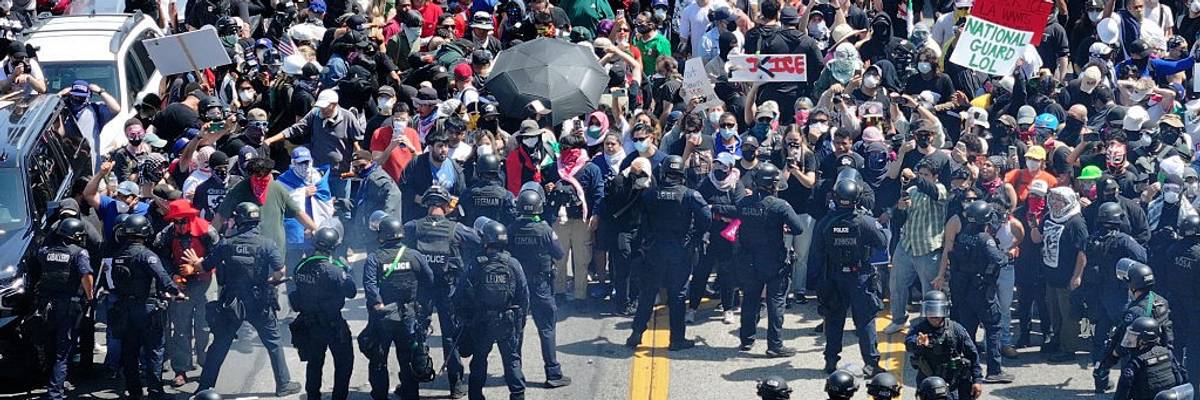
Hundreds of protesters gather to demand an immediate end to Immigration and Customs Enforcement (ICE) workplace raids, as the Trump administration continues its immigration raid operations in California, Los Angeles, United States on June 8, 2025.
This is a critical moment in U.S. history, and it demands that we stand strong in our opposition to the administration’s reckless and unlawful use of military force.
For years, we have warned against the danger of an unchecked president turning the military against American civilians.
In an extraordinary show of force, President Trump has federalized 4,000 members of the California National Guard and deployed 300 of them, in addition to deploying 700 Marines, to quell protests in the Los Angeles area. All over the objections of Gov. Gavin Newsom.
Why this abrupt, camera-ready escalation? White House Deputy Chief of Staff Stephen Miller posted a video of a peaceful protest parade. “If we don’t fix this, we don’t have a country,” he shuddered. “Pass the BBB” — the budget bill now facing turbulence in Congress.
Trump’s administration is spoiling for a fight. It pops out emergency declarations like a Pez dispenser. It is also relying on flimsy legal justifications, as my colleagues have pointed out.
Presidents have deployed troops to control civil unrest only 30 times before in U.S. history. The Posse Comitatus Act generally prohibits federal troops from engaging in civilian law enforcement. Soldiers are trained to defeat an enemy, not to de-escalate protests.
The situation in Los Angeles is bad. What might come next could be worse.
The last time that a president sent in the Guard without a clear request from a state’s governor was 1965, when troops were used to protect the voting rights march from Selma to Montgomery. (And even in that case, George Wallace waffled.)
To be clear, violent protests are not acceptable or productive. The federal government should be unobstructed in carrying out its lawful duties. Of course, the specter of masked ICE agents lurking in the lobbies of immigration courts, as has happened here in New York City, is itself willfully provocative.
In fact, in Los Angeles, protests have been overwhelmingly peaceful. The LAPD — hardly a department of pushovers — has been adamant that it has the situation under control. Not surprisingly, the troops have only fanned the protests. Newsom formally requested that the administration rescind the deployment, saying that it is “inflaming tensions while pulling resources from where they’re actually needed.”
The situation in Los Angeles is bad. What might come next could be worse.
Trump’s executive order authorizes deployment of the Guard “at locations where protests against [ICE] functions are occurring or are likely to occur.” Where might that be? “We’re gonna have troops everywhere,” Trump declared.
As my colleague Elizabeth Goitein notes, “No president has ever federalized the National Guard for purposes of responding to potential future civil unrest anywhere in the country. Preemptive deployment is literally the opposite of deployment as a last resort. It would be a shocking abuse of power and the law.”
The most powerful repressive tool would be the Insurrection Act — a law that lets presidents deploy troops to suppress a rebellion or insurrection or curb domestic violence in extreme scenarios. Trump threatened to invoke it against Democratic-run cities during his 2024 campaign.
The Insurrection Act is, unfortunately, a mess of a law. Key words such as “rebellion” and “insurrection” are left undefined. Courts have given presidents a wide berth. Trump winked at this law by calling the protesters “insurrectionists.”
He has so far chosen to rely on a different law — one that has never been used to quell civil unrest without an accompanying Insurrection Act invocation. The administration claims that it is invoking this law only to protect federal personnel and property. But Homeland Security Secretary Kristi Noem has requested that soldiers be authorized to detain and search protesters, functions normally prohibited by the Posse Comitatus Act.
It’s clear that Trump wants to use this showdown to expand enforcement powers.
The week before he stages a strongman-style military parade along the National Mall — complete with tanks, missiles, and military aircraft — Trump has claimed the right to preemptively authorize deployment of the military all across America.
That should be chilling to most Americans, who have enjoyed a firm line between police and the military as an essential component of our democracy. The deployment of the military against civilians should only be used in the most extreme cases as a last resort. Otherwise, as Elizabeth Goitein notes, “an army turned inward can quickly become an instrument of tyranny.”
Experts have already identified worst-case scenarios. George W. Bush administration official David Frum has sounded the alarm on the possibility of Trump using the military to influence the 2026 election.
If you want to learn more about all of this, here are reports we’ve published in the last few years on emergency powers, the Insurrection Act, the Posse Comitatus Act, the Alien Enemies Act, and martial law.
Once again, in the face of a lawless executive, the courts must now step up. The Supreme Court may want to avoid a conflict, but here, it may have no choice. It is imperative that it uphold checks against the use of military force against civilians.
And now that we know that the existing laws can be used, however tendentiously, to justify provocative military action, we must fix those laws so they cannot be abused again.
The Brennan Center has proposed reforms to the Insurrection Act, including defining the law’s critical terms and enforcing more checks on its use. We have also proposed reforms to strengthen the Posse Comitatus Act. Americans must be adamant, too, that even under existing statutes, presidents lack the power to declare martial law.
This is a critical moment in U.S. history, and it demands that we stand strong in our opposition to the administration’s reckless and unlawful use of military force, in Los Angeles and across the country.
Dear Common Dreams reader, It’s been nearly 30 years since I co-founded Common Dreams with my late wife, Lina Newhouser. We had the radical notion that journalism should serve the public good, not corporate profits. It was clear to us from the outset what it would take to build such a project. No paid advertisements. No corporate sponsors. No millionaire publisher telling us what to think or do. Many people said we wouldn't last a year, but we proved those doubters wrong. Together with a tremendous team of journalists and dedicated staff, we built an independent media outlet free from the constraints of profits and corporate control. Our mission has always been simple: To inform. To inspire. To ignite change for the common good. Building Common Dreams was not easy. Our survival was never guaranteed. When you take on the most powerful forces—Wall Street greed, fossil fuel industry destruction, Big Tech lobbyists, and uber-rich oligarchs who have spent billions upon billions rigging the economy and democracy in their favor—the only bulwark you have is supporters who believe in your work. But here’s the urgent message from me today. It's never been this bad out there. And it's never been this hard to keep us going. At the very moment Common Dreams is most needed, the threats we face are intensifying. We need your support now more than ever. We don't accept corporate advertising and never will. We don't have a paywall because we don't think people should be blocked from critical news based on their ability to pay. Everything we do is funded by the donations of readers like you. When everyone does the little they can afford, we are strong. But if that support retreats or dries up, so do we. Will you donate now to make sure Common Dreams not only survives but thrives? —Craig Brown, Co-founder |
For years, we have warned against the danger of an unchecked president turning the military against American civilians.
In an extraordinary show of force, President Trump has federalized 4,000 members of the California National Guard and deployed 300 of them, in addition to deploying 700 Marines, to quell protests in the Los Angeles area. All over the objections of Gov. Gavin Newsom.
Why this abrupt, camera-ready escalation? White House Deputy Chief of Staff Stephen Miller posted a video of a peaceful protest parade. “If we don’t fix this, we don’t have a country,” he shuddered. “Pass the BBB” — the budget bill now facing turbulence in Congress.
Trump’s administration is spoiling for a fight. It pops out emergency declarations like a Pez dispenser. It is also relying on flimsy legal justifications, as my colleagues have pointed out.
Presidents have deployed troops to control civil unrest only 30 times before in U.S. history. The Posse Comitatus Act generally prohibits federal troops from engaging in civilian law enforcement. Soldiers are trained to defeat an enemy, not to de-escalate protests.
The situation in Los Angeles is bad. What might come next could be worse.
The last time that a president sent in the Guard without a clear request from a state’s governor was 1965, when troops were used to protect the voting rights march from Selma to Montgomery. (And even in that case, George Wallace waffled.)
To be clear, violent protests are not acceptable or productive. The federal government should be unobstructed in carrying out its lawful duties. Of course, the specter of masked ICE agents lurking in the lobbies of immigration courts, as has happened here in New York City, is itself willfully provocative.
In fact, in Los Angeles, protests have been overwhelmingly peaceful. The LAPD — hardly a department of pushovers — has been adamant that it has the situation under control. Not surprisingly, the troops have only fanned the protests. Newsom formally requested that the administration rescind the deployment, saying that it is “inflaming tensions while pulling resources from where they’re actually needed.”
The situation in Los Angeles is bad. What might come next could be worse.
Trump’s executive order authorizes deployment of the Guard “at locations where protests against [ICE] functions are occurring or are likely to occur.” Where might that be? “We’re gonna have troops everywhere,” Trump declared.
As my colleague Elizabeth Goitein notes, “No president has ever federalized the National Guard for purposes of responding to potential future civil unrest anywhere in the country. Preemptive deployment is literally the opposite of deployment as a last resort. It would be a shocking abuse of power and the law.”
The most powerful repressive tool would be the Insurrection Act — a law that lets presidents deploy troops to suppress a rebellion or insurrection or curb domestic violence in extreme scenarios. Trump threatened to invoke it against Democratic-run cities during his 2024 campaign.
The Insurrection Act is, unfortunately, a mess of a law. Key words such as “rebellion” and “insurrection” are left undefined. Courts have given presidents a wide berth. Trump winked at this law by calling the protesters “insurrectionists.”
He has so far chosen to rely on a different law — one that has never been used to quell civil unrest without an accompanying Insurrection Act invocation. The administration claims that it is invoking this law only to protect federal personnel and property. But Homeland Security Secretary Kristi Noem has requested that soldiers be authorized to detain and search protesters, functions normally prohibited by the Posse Comitatus Act.
It’s clear that Trump wants to use this showdown to expand enforcement powers.
The week before he stages a strongman-style military parade along the National Mall — complete with tanks, missiles, and military aircraft — Trump has claimed the right to preemptively authorize deployment of the military all across America.
That should be chilling to most Americans, who have enjoyed a firm line between police and the military as an essential component of our democracy. The deployment of the military against civilians should only be used in the most extreme cases as a last resort. Otherwise, as Elizabeth Goitein notes, “an army turned inward can quickly become an instrument of tyranny.”
Experts have already identified worst-case scenarios. George W. Bush administration official David Frum has sounded the alarm on the possibility of Trump using the military to influence the 2026 election.
If you want to learn more about all of this, here are reports we’ve published in the last few years on emergency powers, the Insurrection Act, the Posse Comitatus Act, the Alien Enemies Act, and martial law.
Once again, in the face of a lawless executive, the courts must now step up. The Supreme Court may want to avoid a conflict, but here, it may have no choice. It is imperative that it uphold checks against the use of military force against civilians.
And now that we know that the existing laws can be used, however tendentiously, to justify provocative military action, we must fix those laws so they cannot be abused again.
The Brennan Center has proposed reforms to the Insurrection Act, including defining the law’s critical terms and enforcing more checks on its use. We have also proposed reforms to strengthen the Posse Comitatus Act. Americans must be adamant, too, that even under existing statutes, presidents lack the power to declare martial law.
This is a critical moment in U.S. history, and it demands that we stand strong in our opposition to the administration’s reckless and unlawful use of military force, in Los Angeles and across the country.
For years, we have warned against the danger of an unchecked president turning the military against American civilians.
In an extraordinary show of force, President Trump has federalized 4,000 members of the California National Guard and deployed 300 of them, in addition to deploying 700 Marines, to quell protests in the Los Angeles area. All over the objections of Gov. Gavin Newsom.
Why this abrupt, camera-ready escalation? White House Deputy Chief of Staff Stephen Miller posted a video of a peaceful protest parade. “If we don’t fix this, we don’t have a country,” he shuddered. “Pass the BBB” — the budget bill now facing turbulence in Congress.
Trump’s administration is spoiling for a fight. It pops out emergency declarations like a Pez dispenser. It is also relying on flimsy legal justifications, as my colleagues have pointed out.
Presidents have deployed troops to control civil unrest only 30 times before in U.S. history. The Posse Comitatus Act generally prohibits federal troops from engaging in civilian law enforcement. Soldiers are trained to defeat an enemy, not to de-escalate protests.
The situation in Los Angeles is bad. What might come next could be worse.
The last time that a president sent in the Guard without a clear request from a state’s governor was 1965, when troops were used to protect the voting rights march from Selma to Montgomery. (And even in that case, George Wallace waffled.)
To be clear, violent protests are not acceptable or productive. The federal government should be unobstructed in carrying out its lawful duties. Of course, the specter of masked ICE agents lurking in the lobbies of immigration courts, as has happened here in New York City, is itself willfully provocative.
In fact, in Los Angeles, protests have been overwhelmingly peaceful. The LAPD — hardly a department of pushovers — has been adamant that it has the situation under control. Not surprisingly, the troops have only fanned the protests. Newsom formally requested that the administration rescind the deployment, saying that it is “inflaming tensions while pulling resources from where they’re actually needed.”
The situation in Los Angeles is bad. What might come next could be worse.
Trump’s executive order authorizes deployment of the Guard “at locations where protests against [ICE] functions are occurring or are likely to occur.” Where might that be? “We’re gonna have troops everywhere,” Trump declared.
As my colleague Elizabeth Goitein notes, “No president has ever federalized the National Guard for purposes of responding to potential future civil unrest anywhere in the country. Preemptive deployment is literally the opposite of deployment as a last resort. It would be a shocking abuse of power and the law.”
The most powerful repressive tool would be the Insurrection Act — a law that lets presidents deploy troops to suppress a rebellion or insurrection or curb domestic violence in extreme scenarios. Trump threatened to invoke it against Democratic-run cities during his 2024 campaign.
The Insurrection Act is, unfortunately, a mess of a law. Key words such as “rebellion” and “insurrection” are left undefined. Courts have given presidents a wide berth. Trump winked at this law by calling the protesters “insurrectionists.”
He has so far chosen to rely on a different law — one that has never been used to quell civil unrest without an accompanying Insurrection Act invocation. The administration claims that it is invoking this law only to protect federal personnel and property. But Homeland Security Secretary Kristi Noem has requested that soldiers be authorized to detain and search protesters, functions normally prohibited by the Posse Comitatus Act.
It’s clear that Trump wants to use this showdown to expand enforcement powers.
The week before he stages a strongman-style military parade along the National Mall — complete with tanks, missiles, and military aircraft — Trump has claimed the right to preemptively authorize deployment of the military all across America.
That should be chilling to most Americans, who have enjoyed a firm line between police and the military as an essential component of our democracy. The deployment of the military against civilians should only be used in the most extreme cases as a last resort. Otherwise, as Elizabeth Goitein notes, “an army turned inward can quickly become an instrument of tyranny.”
Experts have already identified worst-case scenarios. George W. Bush administration official David Frum has sounded the alarm on the possibility of Trump using the military to influence the 2026 election.
If you want to learn more about all of this, here are reports we’ve published in the last few years on emergency powers, the Insurrection Act, the Posse Comitatus Act, the Alien Enemies Act, and martial law.
Once again, in the face of a lawless executive, the courts must now step up. The Supreme Court may want to avoid a conflict, but here, it may have no choice. It is imperative that it uphold checks against the use of military force against civilians.
And now that we know that the existing laws can be used, however tendentiously, to justify provocative military action, we must fix those laws so they cannot be abused again.
The Brennan Center has proposed reforms to the Insurrection Act, including defining the law’s critical terms and enforcing more checks on its use. We have also proposed reforms to strengthen the Posse Comitatus Act. Americans must be adamant, too, that even under existing statutes, presidents lack the power to declare martial law.
This is a critical moment in U.S. history, and it demands that we stand strong in our opposition to the administration’s reckless and unlawful use of military force, in Los Angeles and across the country.

