SUBSCRIBE TO OUR FREE NEWSLETTER
Daily news & progressive opinion—funded by the people, not the corporations—delivered straight to your inbox.
5
#000000
#FFFFFF
To donate by check, phone, or other method, see our More Ways to Give page.
Daily news & progressive opinion—funded by the people, not the corporations—delivered straight to your inbox.
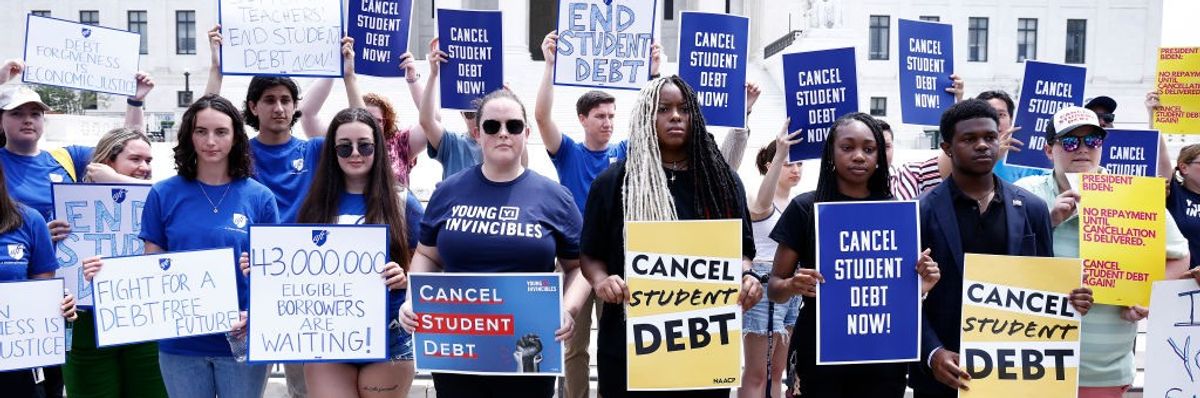
Student loan borrowers demand President Biden use "Plan B" to cancel student debt Immediately at a rally outside of the Supreme Court of the United States on June 30, 2023 in Washington, DC.
The student loan system is broken beyond repair and student debt cancellation is the only viable path forward left. Maybe my story can help explain why.
A common refrain from those who dislike student debt cancellation is, “Pay what you owe! You took out the loans; you should pay them back!” As a borrower and an expert on the student loan system, I am trying to do just that and failing. The student loan system is broken beyond repair and student debt cancellation is the only viable path forward left. Here's why.
After the pause on federal student loan payments ended in August and payments came due in October, I, along with tens of millions of people across the country, was forced to find a way to refit paying my student loan bills back into my monthly budget. It wasn't easy.
Our student loan laws are supposed to ensure that someone like me has a very easy time paying back my student loans. Income-Driven Repayment (IDR) assures that monthly federal student loan bills will be pegged to income and, then in theory, is affordable. Public Service Loan Forgiveness (PSLF) promises that if a borrower dedicates their career to the public good, their student debt will be relieved after ten years.
In what other consumer contract can one party mischarge the other party by an error margin in the thousands of dollars and get away with it?
Unfortunately, these solutions—IDR and PSLF—rely on profit-driven servicing companies and do not work in practice. Admittedly, President Biden has been working hard to improve these programs. When he first took office, PSLF had a 98% denial rate. Now, through broad program fixes, the president has already improved access to PSLF by nearly ten times. Similarly, adjustments he’s made to IDR have given millions more borrowers access to affordable payments and relief. Most recently, the president instituted the Saving on a Valuable Education (SAVE) plan to make repayment even more affordable to more borrowers and stop ballooning loan balances.
Again, in theory, these system fixes should guarantee that someone like me who works in public service (and who happens to have specific expertise in student debt relief programs), should be able to repay my loans without problems. But as anyone who has ever engaged with the student loan system knows, there are always bumps in the road.
When it comes to dealing with the company currently tasked with managing the Public Service Loan Forgiveness Program, MOHELA, those bumps often turn into mountains.
Since repayment started back up, I’ve spent countless hours on the phone with MOHELA just trying to get enrolled in SAVE. MOHELA sent me scary notices threatening to increase my payments to $1100 a month if I didn’t recertify my income, even though the Department of Education explicitly stated that borrowers would not have to recertify until March 2024. Then MOHELA sent me two inaccurate bills for $1500, which should’ve been $268. Even worse, MOHELA tried to withdraw $1500 from my account even after they told me I was on an administrative forbearance. A new bill arrived with $2600 due in June 2024 since I “missed” my May payment, and when I called they finally agreed that until they could process my account I would be placed on an administrative forbearance until the end of July 2024. Now, apparently, my servicing company has changed, and I still haven’t received any notification from my new servicer that this change is taking place.
Meanwhile, ED just announced that it’s transferring the PSLF program away from MOHELA, and there will be a months-long pause on PSLF for processing. To prepare borrowers for this massive transfer, MOHELA told borrowers to “take screenshots” of their PSLF progress because the company does not intend to save their records. In other words, borrowers should expect mistakes and data losses during this process, and screenshots are our only suggested safeguard.
As college prices have skyrocketed, so has the lie that borrowing to get a higher education—no matter the cost—will pay off.
In what other consumer contract can one party mischarge the other party by an error margin in the thousands of dollars and get away with it? Because I help borrowers navigate the student loan system for a living, I knew to laugh at my $1500 bill and demand a correction. Most borrowers don’t have this advantage and too many pay the bill fearing the consequences.
As college prices have skyrocketed, so has the lie that borrowing to get a higher education—no matter the cost—will pay off. Maybe it once did, but it no longer does. Accessing the American Dream without a college degree is even more far-fetched. We’re being forced into a Catch-22 and then held captive to a profiteering, broken student loan industry with no way out. The fact is that lawmakers and policymakers have turned debt-financed higher education into a logical fallacy propped up by a very broken system. And borrowers pay the price.
Student debt cancellation is the way out.
Countless borrowers like me are still blocked from financial stability because of loans we took out decades ago based on false promises and outright lies. If I, an expert on the student loan system, have struggled this much to pay off my loans, the system is far too broken to be fixed with programs like IDR and PSLF. To reconcile the decades now of failures and lies, we must wipe the slate clean for the borrowers suffering today and cancel student debt.
Dear Common Dreams reader, It’s been nearly 30 years since I co-founded Common Dreams with my late wife, Lina Newhouser. We had the radical notion that journalism should serve the public good, not corporate profits. It was clear to us from the outset what it would take to build such a project. No paid advertisements. No corporate sponsors. No millionaire publisher telling us what to think or do. Many people said we wouldn't last a year, but we proved those doubters wrong. Together with a tremendous team of journalists and dedicated staff, we built an independent media outlet free from the constraints of profits and corporate control. Our mission has always been simple: To inform. To inspire. To ignite change for the common good. Building Common Dreams was not easy. Our survival was never guaranteed. When you take on the most powerful forces—Wall Street greed, fossil fuel industry destruction, Big Tech lobbyists, and uber-rich oligarchs who have spent billions upon billions rigging the economy and democracy in their favor—the only bulwark you have is supporters who believe in your work. But here’s the urgent message from me today. It's never been this bad out there. And it's never been this hard to keep us going. At the very moment Common Dreams is most needed, the threats we face are intensifying. We need your support now more than ever. We don't accept corporate advertising and never will. We don't have a paywall because we don't think people should be blocked from critical news based on their ability to pay. Everything we do is funded by the donations of readers like you. When everyone does the little they can afford, we are strong. But if that support retreats or dries up, so do we. Will you donate now to make sure Common Dreams not only survives but thrives? —Craig Brown, Co-founder |
A common refrain from those who dislike student debt cancellation is, “Pay what you owe! You took out the loans; you should pay them back!” As a borrower and an expert on the student loan system, I am trying to do just that and failing. The student loan system is broken beyond repair and student debt cancellation is the only viable path forward left. Here's why.
After the pause on federal student loan payments ended in August and payments came due in October, I, along with tens of millions of people across the country, was forced to find a way to refit paying my student loan bills back into my monthly budget. It wasn't easy.
Our student loan laws are supposed to ensure that someone like me has a very easy time paying back my student loans. Income-Driven Repayment (IDR) assures that monthly federal student loan bills will be pegged to income and, then in theory, is affordable. Public Service Loan Forgiveness (PSLF) promises that if a borrower dedicates their career to the public good, their student debt will be relieved after ten years.
In what other consumer contract can one party mischarge the other party by an error margin in the thousands of dollars and get away with it?
Unfortunately, these solutions—IDR and PSLF—rely on profit-driven servicing companies and do not work in practice. Admittedly, President Biden has been working hard to improve these programs. When he first took office, PSLF had a 98% denial rate. Now, through broad program fixes, the president has already improved access to PSLF by nearly ten times. Similarly, adjustments he’s made to IDR have given millions more borrowers access to affordable payments and relief. Most recently, the president instituted the Saving on a Valuable Education (SAVE) plan to make repayment even more affordable to more borrowers and stop ballooning loan balances.
Again, in theory, these system fixes should guarantee that someone like me who works in public service (and who happens to have specific expertise in student debt relief programs), should be able to repay my loans without problems. But as anyone who has ever engaged with the student loan system knows, there are always bumps in the road.
When it comes to dealing with the company currently tasked with managing the Public Service Loan Forgiveness Program, MOHELA, those bumps often turn into mountains.
Since repayment started back up, I’ve spent countless hours on the phone with MOHELA just trying to get enrolled in SAVE. MOHELA sent me scary notices threatening to increase my payments to $1100 a month if I didn’t recertify my income, even though the Department of Education explicitly stated that borrowers would not have to recertify until March 2024. Then MOHELA sent me two inaccurate bills for $1500, which should’ve been $268. Even worse, MOHELA tried to withdraw $1500 from my account even after they told me I was on an administrative forbearance. A new bill arrived with $2600 due in June 2024 since I “missed” my May payment, and when I called they finally agreed that until they could process my account I would be placed on an administrative forbearance until the end of July 2024. Now, apparently, my servicing company has changed, and I still haven’t received any notification from my new servicer that this change is taking place.
Meanwhile, ED just announced that it’s transferring the PSLF program away from MOHELA, and there will be a months-long pause on PSLF for processing. To prepare borrowers for this massive transfer, MOHELA told borrowers to “take screenshots” of their PSLF progress because the company does not intend to save their records. In other words, borrowers should expect mistakes and data losses during this process, and screenshots are our only suggested safeguard.
As college prices have skyrocketed, so has the lie that borrowing to get a higher education—no matter the cost—will pay off.
In what other consumer contract can one party mischarge the other party by an error margin in the thousands of dollars and get away with it? Because I help borrowers navigate the student loan system for a living, I knew to laugh at my $1500 bill and demand a correction. Most borrowers don’t have this advantage and too many pay the bill fearing the consequences.
As college prices have skyrocketed, so has the lie that borrowing to get a higher education—no matter the cost—will pay off. Maybe it once did, but it no longer does. Accessing the American Dream without a college degree is even more far-fetched. We’re being forced into a Catch-22 and then held captive to a profiteering, broken student loan industry with no way out. The fact is that lawmakers and policymakers have turned debt-financed higher education into a logical fallacy propped up by a very broken system. And borrowers pay the price.
Student debt cancellation is the way out.
Countless borrowers like me are still blocked from financial stability because of loans we took out decades ago based on false promises and outright lies. If I, an expert on the student loan system, have struggled this much to pay off my loans, the system is far too broken to be fixed with programs like IDR and PSLF. To reconcile the decades now of failures and lies, we must wipe the slate clean for the borrowers suffering today and cancel student debt.
A common refrain from those who dislike student debt cancellation is, “Pay what you owe! You took out the loans; you should pay them back!” As a borrower and an expert on the student loan system, I am trying to do just that and failing. The student loan system is broken beyond repair and student debt cancellation is the only viable path forward left. Here's why.
After the pause on federal student loan payments ended in August and payments came due in October, I, along with tens of millions of people across the country, was forced to find a way to refit paying my student loan bills back into my monthly budget. It wasn't easy.
Our student loan laws are supposed to ensure that someone like me has a very easy time paying back my student loans. Income-Driven Repayment (IDR) assures that monthly federal student loan bills will be pegged to income and, then in theory, is affordable. Public Service Loan Forgiveness (PSLF) promises that if a borrower dedicates their career to the public good, their student debt will be relieved after ten years.
In what other consumer contract can one party mischarge the other party by an error margin in the thousands of dollars and get away with it?
Unfortunately, these solutions—IDR and PSLF—rely on profit-driven servicing companies and do not work in practice. Admittedly, President Biden has been working hard to improve these programs. When he first took office, PSLF had a 98% denial rate. Now, through broad program fixes, the president has already improved access to PSLF by nearly ten times. Similarly, adjustments he’s made to IDR have given millions more borrowers access to affordable payments and relief. Most recently, the president instituted the Saving on a Valuable Education (SAVE) plan to make repayment even more affordable to more borrowers and stop ballooning loan balances.
Again, in theory, these system fixes should guarantee that someone like me who works in public service (and who happens to have specific expertise in student debt relief programs), should be able to repay my loans without problems. But as anyone who has ever engaged with the student loan system knows, there are always bumps in the road.
When it comes to dealing with the company currently tasked with managing the Public Service Loan Forgiveness Program, MOHELA, those bumps often turn into mountains.
Since repayment started back up, I’ve spent countless hours on the phone with MOHELA just trying to get enrolled in SAVE. MOHELA sent me scary notices threatening to increase my payments to $1100 a month if I didn’t recertify my income, even though the Department of Education explicitly stated that borrowers would not have to recertify until March 2024. Then MOHELA sent me two inaccurate bills for $1500, which should’ve been $268. Even worse, MOHELA tried to withdraw $1500 from my account even after they told me I was on an administrative forbearance. A new bill arrived with $2600 due in June 2024 since I “missed” my May payment, and when I called they finally agreed that until they could process my account I would be placed on an administrative forbearance until the end of July 2024. Now, apparently, my servicing company has changed, and I still haven’t received any notification from my new servicer that this change is taking place.
Meanwhile, ED just announced that it’s transferring the PSLF program away from MOHELA, and there will be a months-long pause on PSLF for processing. To prepare borrowers for this massive transfer, MOHELA told borrowers to “take screenshots” of their PSLF progress because the company does not intend to save their records. In other words, borrowers should expect mistakes and data losses during this process, and screenshots are our only suggested safeguard.
As college prices have skyrocketed, so has the lie that borrowing to get a higher education—no matter the cost—will pay off.
In what other consumer contract can one party mischarge the other party by an error margin in the thousands of dollars and get away with it? Because I help borrowers navigate the student loan system for a living, I knew to laugh at my $1500 bill and demand a correction. Most borrowers don’t have this advantage and too many pay the bill fearing the consequences.
As college prices have skyrocketed, so has the lie that borrowing to get a higher education—no matter the cost—will pay off. Maybe it once did, but it no longer does. Accessing the American Dream without a college degree is even more far-fetched. We’re being forced into a Catch-22 and then held captive to a profiteering, broken student loan industry with no way out. The fact is that lawmakers and policymakers have turned debt-financed higher education into a logical fallacy propped up by a very broken system. And borrowers pay the price.
Student debt cancellation is the way out.
Countless borrowers like me are still blocked from financial stability because of loans we took out decades ago based on false promises and outright lies. If I, an expert on the student loan system, have struggled this much to pay off my loans, the system is far too broken to be fixed with programs like IDR and PSLF. To reconcile the decades now of failures and lies, we must wipe the slate clean for the borrowers suffering today and cancel student debt.