SUBSCRIBE TO OUR FREE NEWSLETTER
Daily news & progressive opinion—funded by the people, not the corporations—delivered straight to your inbox.
5
#000000
#FFFFFF
To donate by check, phone, or other method, see our More Ways to Give page.
Daily news & progressive opinion—funded by the people, not the corporations—delivered straight to your inbox.
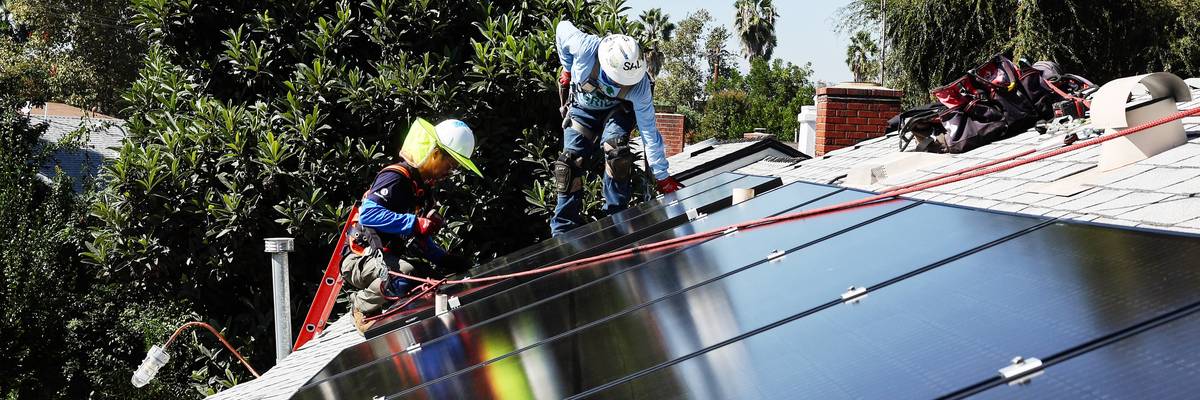
GRID Alternatives employees Tony Chang (L) and Sal Miranda install no-cost solar panels on the rooftop of a low-income household on October 19, 2023 in Pomona, California.
A good investment never did so much good. Eventually, more and more people will realize it.
Many Americans who don’t believe in global warming will opt to invest in solar energy simply because it will save them lots of money.
Unfortunately, not everyone can install solar panels on their roofs. People in apartments or renting will not have that opportunity, though some might cash in through community solar organizations or plug-in solar --- portable panels that can be placed on balconies or in yards.
Even some single-family homes may have roofs aimed the wrong direction or too shaded. But for those with suitable houses, solar panels are increasingly a no-brainer.
In 2019 we installed 32 panels on our home roof at a cost of about $18,000--- about $22,000 in 2025 dollars. However a 30% federal tax credit reduced our out of pocket cost to about $12,600.
Donald Trump’s “Big, Beautiful Bill” repeals the federal tax credit starting in January, but solar panels remain an excellent investment.
In seven years, our panels have generated more than 72,500 kilowatt-hours of electricity. This would have cost us more than $7,250 at the local price of ten cents per kilowatt-hour. Thus, in less than seven years our panels have saved us more than half of what we paid for them. And they should be good for 25 years, or more.
They have generated more than half of the electricity we have used in our all-electric household, including charging up the battery in our electric car, a Chevrolet Bolt EV. To indicate how much energy 72,500 kilowatt-hours represents, that would be enough to drive our electric car about 280,000 miles!
The cost of installing solar panels may come down further. The panels themselves are getting cheaper. And for various reasons, including local building regulations, installation costs in the U.S. are much higher than in some other countries. Many cities are exploring how to make local laws more receptive to solar.
Maximum benefit from solar panels will come if you pay cash for them rather than borrowing the money and paying interest on it. Assuming you have money that you might otherwise invest in a CD, bonds, or stocks, just compare what such investments would earn compared to what the solar panels would save you.
Assuming panels would cost you $20,000, investing that amount instead in a 3% CD would bring in $600 a year in taxable income, so maybe you would have $450 after taxes. In 7 years, after tax interest would come to $3150, less than half of what we have saved during that same period with our solar panels. Of course, with stocks and bonds you very likely have something left at the end of solar panels' lives.
Bond funds currently earn about the same 3% interest, and of course with stocks you never know what they will earn and also face the danger that they will suffer from a Wall Street crash.
And taking taxes into consideration, the money solar panels save you provides the equivalent of tax-free income, so a $7,250 saving over 7 years would leave as much in your pocket as $9600 in taxable income would have, assuming you are in a 25% marginal tax bracket.
Furthermore, remember that the price of electricity will undoubtedly go up. The savings from having solar panels will therefore also increase, making them an even better investment.
I don’t recommend borrowing to pay for solar panels. But if you are considering this, be sure to subtract the interest you would be paying on the loan from the benefits the panels will produce before you sign anything. It may not pencil out.
Check out your solar installer – most are reputable, but perhaps not all. The installer can tell you how well your local utility treats customers with solar panels, which can vary greatly.
And be ultra cautious about anybody offering to install solar panels for “free.” They will retain a property right in the panels until you pay them off, which could scare off buyers if you need to sell the property.
There truly is no free lunch! But solar panels can be the next best thing.
Dear Common Dreams reader, It’s been nearly 30 years since I co-founded Common Dreams with my late wife, Lina Newhouser. We had the radical notion that journalism should serve the public good, not corporate profits. It was clear to us from the outset what it would take to build such a project. No paid advertisements. No corporate sponsors. No millionaire publisher telling us what to think or do. Many people said we wouldn't last a year, but we proved those doubters wrong. Together with a tremendous team of journalists and dedicated staff, we built an independent media outlet free from the constraints of profits and corporate control. Our mission has always been simple: To inform. To inspire. To ignite change for the common good. Building Common Dreams was not easy. Our survival was never guaranteed. When you take on the most powerful forces—Wall Street greed, fossil fuel industry destruction, Big Tech lobbyists, and uber-rich oligarchs who have spent billions upon billions rigging the economy and democracy in their favor—the only bulwark you have is supporters who believe in your work. But here’s the urgent message from me today. It's never been this bad out there. And it's never been this hard to keep us going. At the very moment Common Dreams is most needed, the threats we face are intensifying. We need your support now more than ever. We don't accept corporate advertising and never will. We don't have a paywall because we don't think people should be blocked from critical news based on their ability to pay. Everything we do is funded by the donations of readers like you. When everyone does the little they can afford, we are strong. But if that support retreats or dries up, so do we. Will you donate now to make sure Common Dreams not only survives but thrives? —Craig Brown, Co-founder |
Many Americans who don’t believe in global warming will opt to invest in solar energy simply because it will save them lots of money.
Unfortunately, not everyone can install solar panels on their roofs. People in apartments or renting will not have that opportunity, though some might cash in through community solar organizations or plug-in solar --- portable panels that can be placed on balconies or in yards.
Even some single-family homes may have roofs aimed the wrong direction or too shaded. But for those with suitable houses, solar panels are increasingly a no-brainer.
In 2019 we installed 32 panels on our home roof at a cost of about $18,000--- about $22,000 in 2025 dollars. However a 30% federal tax credit reduced our out of pocket cost to about $12,600.
Donald Trump’s “Big, Beautiful Bill” repeals the federal tax credit starting in January, but solar panels remain an excellent investment.
In seven years, our panels have generated more than 72,500 kilowatt-hours of electricity. This would have cost us more than $7,250 at the local price of ten cents per kilowatt-hour. Thus, in less than seven years our panels have saved us more than half of what we paid for them. And they should be good for 25 years, or more.
They have generated more than half of the electricity we have used in our all-electric household, including charging up the battery in our electric car, a Chevrolet Bolt EV. To indicate how much energy 72,500 kilowatt-hours represents, that would be enough to drive our electric car about 280,000 miles!
The cost of installing solar panels may come down further. The panels themselves are getting cheaper. And for various reasons, including local building regulations, installation costs in the U.S. are much higher than in some other countries. Many cities are exploring how to make local laws more receptive to solar.
Maximum benefit from solar panels will come if you pay cash for them rather than borrowing the money and paying interest on it. Assuming you have money that you might otherwise invest in a CD, bonds, or stocks, just compare what such investments would earn compared to what the solar panels would save you.
Assuming panels would cost you $20,000, investing that amount instead in a 3% CD would bring in $600 a year in taxable income, so maybe you would have $450 after taxes. In 7 years, after tax interest would come to $3150, less than half of what we have saved during that same period with our solar panels. Of course, with stocks and bonds you very likely have something left at the end of solar panels' lives.
Bond funds currently earn about the same 3% interest, and of course with stocks you never know what they will earn and also face the danger that they will suffer from a Wall Street crash.
And taking taxes into consideration, the money solar panels save you provides the equivalent of tax-free income, so a $7,250 saving over 7 years would leave as much in your pocket as $9600 in taxable income would have, assuming you are in a 25% marginal tax bracket.
Furthermore, remember that the price of electricity will undoubtedly go up. The savings from having solar panels will therefore also increase, making them an even better investment.
I don’t recommend borrowing to pay for solar panels. But if you are considering this, be sure to subtract the interest you would be paying on the loan from the benefits the panels will produce before you sign anything. It may not pencil out.
Check out your solar installer – most are reputable, but perhaps not all. The installer can tell you how well your local utility treats customers with solar panels, which can vary greatly.
And be ultra cautious about anybody offering to install solar panels for “free.” They will retain a property right in the panels until you pay them off, which could scare off buyers if you need to sell the property.
There truly is no free lunch! But solar panels can be the next best thing.
Many Americans who don’t believe in global warming will opt to invest in solar energy simply because it will save them lots of money.
Unfortunately, not everyone can install solar panels on their roofs. People in apartments or renting will not have that opportunity, though some might cash in through community solar organizations or plug-in solar --- portable panels that can be placed on balconies or in yards.
Even some single-family homes may have roofs aimed the wrong direction or too shaded. But for those with suitable houses, solar panels are increasingly a no-brainer.
In 2019 we installed 32 panels on our home roof at a cost of about $18,000--- about $22,000 in 2025 dollars. However a 30% federal tax credit reduced our out of pocket cost to about $12,600.
Donald Trump’s “Big, Beautiful Bill” repeals the federal tax credit starting in January, but solar panels remain an excellent investment.
In seven years, our panels have generated more than 72,500 kilowatt-hours of electricity. This would have cost us more than $7,250 at the local price of ten cents per kilowatt-hour. Thus, in less than seven years our panels have saved us more than half of what we paid for them. And they should be good for 25 years, or more.
They have generated more than half of the electricity we have used in our all-electric household, including charging up the battery in our electric car, a Chevrolet Bolt EV. To indicate how much energy 72,500 kilowatt-hours represents, that would be enough to drive our electric car about 280,000 miles!
The cost of installing solar panels may come down further. The panels themselves are getting cheaper. And for various reasons, including local building regulations, installation costs in the U.S. are much higher than in some other countries. Many cities are exploring how to make local laws more receptive to solar.
Maximum benefit from solar panels will come if you pay cash for them rather than borrowing the money and paying interest on it. Assuming you have money that you might otherwise invest in a CD, bonds, or stocks, just compare what such investments would earn compared to what the solar panels would save you.
Assuming panels would cost you $20,000, investing that amount instead in a 3% CD would bring in $600 a year in taxable income, so maybe you would have $450 after taxes. In 7 years, after tax interest would come to $3150, less than half of what we have saved during that same period with our solar panels. Of course, with stocks and bonds you very likely have something left at the end of solar panels' lives.
Bond funds currently earn about the same 3% interest, and of course with stocks you never know what they will earn and also face the danger that they will suffer from a Wall Street crash.
And taking taxes into consideration, the money solar panels save you provides the equivalent of tax-free income, so a $7,250 saving over 7 years would leave as much in your pocket as $9600 in taxable income would have, assuming you are in a 25% marginal tax bracket.
Furthermore, remember that the price of electricity will undoubtedly go up. The savings from having solar panels will therefore also increase, making them an even better investment.
I don’t recommend borrowing to pay for solar panels. But if you are considering this, be sure to subtract the interest you would be paying on the loan from the benefits the panels will produce before you sign anything. It may not pencil out.
Check out your solar installer – most are reputable, but perhaps not all. The installer can tell you how well your local utility treats customers with solar panels, which can vary greatly.
And be ultra cautious about anybody offering to install solar panels for “free.” They will retain a property right in the panels until you pay them off, which could scare off buyers if you need to sell the property.
There truly is no free lunch! But solar panels can be the next best thing.