SUBSCRIBE TO OUR FREE NEWSLETTER
Daily news & progressive opinion—funded by the people, not the corporations—delivered straight to your inbox.
5
#000000
#FFFFFF
To donate by check, phone, or other method, see our More Ways to Give page.
Daily news & progressive opinion—funded by the people, not the corporations—delivered straight to your inbox.
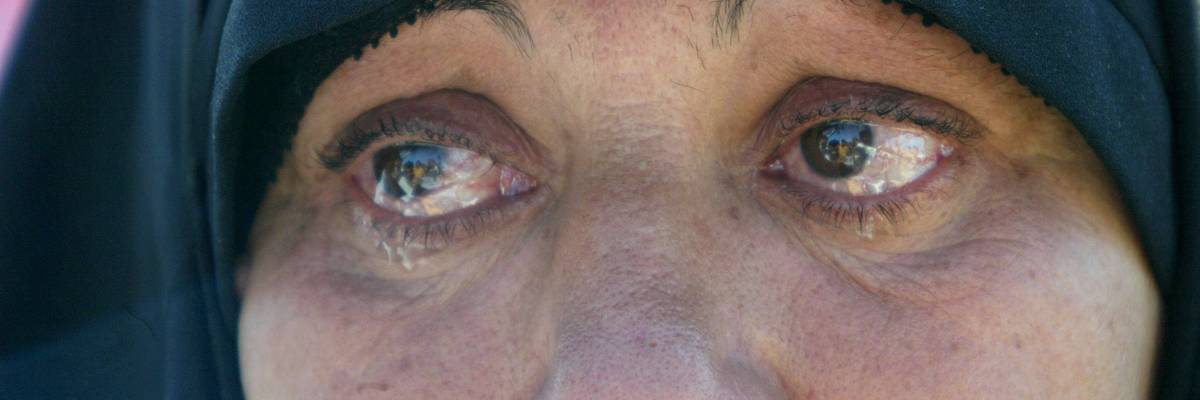
A mother cries after learning that her son Mohammed Nasr was not released along with others from the Abu Ghraib prison, west of Baghdad 14 June 2004.
We're talking about murdering children, for God's sake, annihilating a social structure, driving millions of people out of their homes and shattering their lives. Somehow the term "failed policymaking" doesn't do it justice.
I read the news—invasion of Iraq! twentieth anniversary!—and struggle to transcend the abstraction of my remorse. A million killed? Half a million? The mortality stats vary depending on the source's politics.
But beyond the numbers looms an indifference that defines what is called "news."
"Today, 20 years after the president ordered the airstrikes that rained down on Baghdad on the night of March 20, 2003, the war is widely seen in Washington's power centers as a lesson in failed policymaking, one deeply absorbed if not thoroughly learned."
Just reading those words—a paragraph in a New York Times analysis of the invasion, two decades later—instantly turns a citizen into a spectator. A lesson of failed policymaking! We're talking about murdering children, for God's sake, annihilating a social structure, driving millions of people out of their homes and shattering their lives. Somehow the term "failed policymaking" doesn't do it justice.
And here I am, a writer, a journalist, still wandering through this vast desert of media indifference: the abstraction of human (and all) life into the game of strategic maneuvering, also known as war. Finally it's up to the policymakers whether "the other" lives or dies, and the media lives with this. That's just the way it is—no matter that so many vets wind up committing suicide.
That's called post-traumatic stress disorder, of course—emphasis on the word "disorder." More abstraction! For some reason they became mentally ill during their service; the VA needs to fix them. Any questions?
The non-mainstream—i.e., marginalized—term for PTSD is moral injury: a wound to the soul. Why were they so wounded?
"The most serious blind spot in the reporting on military suicides is an absence of discussions about the moral impact of military training and its implementation in combat," according to the Brite Divinity School, an organization that works with morally injured vets (I quoted them a decade ago). "Soldiers are trained to kill. . . ."
The point I'm trying to make here is that dehumanization, followed by killing, reaps monstrous karma for everyone. And this is utterly and completely ignored in the mainstream media's reportage of war. Participating in a war is the essence of "serving your country"—no matter what your country may ask you to do. It's time to stop playing this game. As I write these words, I am speaking directly to the media—to every individual reporter: Defy the groupthink! Write the truth!
And the truth begins with the value of every person's life.
I acknowledge that this is complex. Sorry, there's no way around it. Indeed, as I wander in the desert of political abstraction, I find my belief in and connection to journalism—to writing itself—starting to disintegrate. It's too easy to build and maintain a false world: one allegedly controlled and run by policymakers, rather than continually created in the moment as we live our lives.
When my wife died of pancreatic cancer—many years ago now—that's when, as I have mentioned in previous columns, the narrative of my life crashed. I had a 12-year-old daughter to raise, so I couldn't just shrug and surrender to grief and somehow recreate myself. I had to keep living a normal life. But I started writing poetry. That became the only sort of writing that could engage me: reaching into the unknown, reaching for fragments of new understanding.
Here's a memory: It was about ten months after her death. And it was her birthday. I was swimming in a poem called "Bubble Bath"—the name a reference to a silly nickname that she had, a play on her actual name: Barbara Beth. The poem was about both her absence and her presence. I was stunned at the how shaken I was by the arrival of her birthday, and I wrote:
. . . My hand closes on yours
and I watch your birthday
come round again
with the mute loyalty
of a riderless horse.
I toss this fragment in for one reason only: This was literally a day's effort. I spent an entire day trying to describe my feelings as her birthday came. When I finally found the words, I was overjoyed. The effort was worth it. This is how "Bubble Bath" ends:
. . . For you, O Bubble Bath,
my missing blue-eyed rider,
I sing the song
and make the wish,
but I can't
blow out the candles.
And now, back to Iraq. Back to war itself. Every lost soul matters. And while I realize reporting on war in such a way would be impossible, I can hardly tolerate less than that. It's one thing to reduce life to an abstract statistic, but far more problematic is quietly aligning with the world of the policymakers and accepting murder—war, especially the unprovoked kind—as a necessary facet of national, let alone human, security.
Dear Common Dreams reader, It’s been nearly 30 years since I co-founded Common Dreams with my late wife, Lina Newhouser. We had the radical notion that journalism should serve the public good, not corporate profits. It was clear to us from the outset what it would take to build such a project. No paid advertisements. No corporate sponsors. No millionaire publisher telling us what to think or do. Many people said we wouldn't last a year, but we proved those doubters wrong. Together with a tremendous team of journalists and dedicated staff, we built an independent media outlet free from the constraints of profits and corporate control. Our mission has always been simple: To inform. To inspire. To ignite change for the common good. Building Common Dreams was not easy. Our survival was never guaranteed. When you take on the most powerful forces—Wall Street greed, fossil fuel industry destruction, Big Tech lobbyists, and uber-rich oligarchs who have spent billions upon billions rigging the economy and democracy in their favor—the only bulwark you have is supporters who believe in your work. But here’s the urgent message from me today. It's never been this bad out there. And it's never been this hard to keep us going. At the very moment Common Dreams is most needed, the threats we face are intensifying. We need your support now more than ever. We don't accept corporate advertising and never will. We don't have a paywall because we don't think people should be blocked from critical news based on their ability to pay. Everything we do is funded by the donations of readers like you. When everyone does the little they can afford, we are strong. But if that support retreats or dries up, so do we. Will you donate now to make sure Common Dreams not only survives but thrives? —Craig Brown, Co-founder |
I read the news—invasion of Iraq! twentieth anniversary!—and struggle to transcend the abstraction of my remorse. A million killed? Half a million? The mortality stats vary depending on the source's politics.
But beyond the numbers looms an indifference that defines what is called "news."
"Today, 20 years after the president ordered the airstrikes that rained down on Baghdad on the night of March 20, 2003, the war is widely seen in Washington's power centers as a lesson in failed policymaking, one deeply absorbed if not thoroughly learned."
Just reading those words—a paragraph in a New York Times analysis of the invasion, two decades later—instantly turns a citizen into a spectator. A lesson of failed policymaking! We're talking about murdering children, for God's sake, annihilating a social structure, driving millions of people out of their homes and shattering their lives. Somehow the term "failed policymaking" doesn't do it justice.
And here I am, a writer, a journalist, still wandering through this vast desert of media indifference: the abstraction of human (and all) life into the game of strategic maneuvering, also known as war. Finally it's up to the policymakers whether "the other" lives or dies, and the media lives with this. That's just the way it is—no matter that so many vets wind up committing suicide.
That's called post-traumatic stress disorder, of course—emphasis on the word "disorder." More abstraction! For some reason they became mentally ill during their service; the VA needs to fix them. Any questions?
The non-mainstream—i.e., marginalized—term for PTSD is moral injury: a wound to the soul. Why were they so wounded?
"The most serious blind spot in the reporting on military suicides is an absence of discussions about the moral impact of military training and its implementation in combat," according to the Brite Divinity School, an organization that works with morally injured vets (I quoted them a decade ago). "Soldiers are trained to kill. . . ."
The point I'm trying to make here is that dehumanization, followed by killing, reaps monstrous karma for everyone. And this is utterly and completely ignored in the mainstream media's reportage of war. Participating in a war is the essence of "serving your country"—no matter what your country may ask you to do. It's time to stop playing this game. As I write these words, I am speaking directly to the media—to every individual reporter: Defy the groupthink! Write the truth!
And the truth begins with the value of every person's life.
I acknowledge that this is complex. Sorry, there's no way around it. Indeed, as I wander in the desert of political abstraction, I find my belief in and connection to journalism—to writing itself—starting to disintegrate. It's too easy to build and maintain a false world: one allegedly controlled and run by policymakers, rather than continually created in the moment as we live our lives.
When my wife died of pancreatic cancer—many years ago now—that's when, as I have mentioned in previous columns, the narrative of my life crashed. I had a 12-year-old daughter to raise, so I couldn't just shrug and surrender to grief and somehow recreate myself. I had to keep living a normal life. But I started writing poetry. That became the only sort of writing that could engage me: reaching into the unknown, reaching for fragments of new understanding.
Here's a memory: It was about ten months after her death. And it was her birthday. I was swimming in a poem called "Bubble Bath"—the name a reference to a silly nickname that she had, a play on her actual name: Barbara Beth. The poem was about both her absence and her presence. I was stunned at the how shaken I was by the arrival of her birthday, and I wrote:
. . . My hand closes on yours
and I watch your birthday
come round again
with the mute loyalty
of a riderless horse.
I toss this fragment in for one reason only: This was literally a day's effort. I spent an entire day trying to describe my feelings as her birthday came. When I finally found the words, I was overjoyed. The effort was worth it. This is how "Bubble Bath" ends:
. . . For you, O Bubble Bath,
my missing blue-eyed rider,
I sing the song
and make the wish,
but I can't
blow out the candles.
And now, back to Iraq. Back to war itself. Every lost soul matters. And while I realize reporting on war in such a way would be impossible, I can hardly tolerate less than that. It's one thing to reduce life to an abstract statistic, but far more problematic is quietly aligning with the world of the policymakers and accepting murder—war, especially the unprovoked kind—as a necessary facet of national, let alone human, security.
I read the news—invasion of Iraq! twentieth anniversary!—and struggle to transcend the abstraction of my remorse. A million killed? Half a million? The mortality stats vary depending on the source's politics.
But beyond the numbers looms an indifference that defines what is called "news."
"Today, 20 years after the president ordered the airstrikes that rained down on Baghdad on the night of March 20, 2003, the war is widely seen in Washington's power centers as a lesson in failed policymaking, one deeply absorbed if not thoroughly learned."
Just reading those words—a paragraph in a New York Times analysis of the invasion, two decades later—instantly turns a citizen into a spectator. A lesson of failed policymaking! We're talking about murdering children, for God's sake, annihilating a social structure, driving millions of people out of their homes and shattering their lives. Somehow the term "failed policymaking" doesn't do it justice.
And here I am, a writer, a journalist, still wandering through this vast desert of media indifference: the abstraction of human (and all) life into the game of strategic maneuvering, also known as war. Finally it's up to the policymakers whether "the other" lives or dies, and the media lives with this. That's just the way it is—no matter that so many vets wind up committing suicide.
That's called post-traumatic stress disorder, of course—emphasis on the word "disorder." More abstraction! For some reason they became mentally ill during their service; the VA needs to fix them. Any questions?
The non-mainstream—i.e., marginalized—term for PTSD is moral injury: a wound to the soul. Why were they so wounded?
"The most serious blind spot in the reporting on military suicides is an absence of discussions about the moral impact of military training and its implementation in combat," according to the Brite Divinity School, an organization that works with morally injured vets (I quoted them a decade ago). "Soldiers are trained to kill. . . ."
The point I'm trying to make here is that dehumanization, followed by killing, reaps monstrous karma for everyone. And this is utterly and completely ignored in the mainstream media's reportage of war. Participating in a war is the essence of "serving your country"—no matter what your country may ask you to do. It's time to stop playing this game. As I write these words, I am speaking directly to the media—to every individual reporter: Defy the groupthink! Write the truth!
And the truth begins with the value of every person's life.
I acknowledge that this is complex. Sorry, there's no way around it. Indeed, as I wander in the desert of political abstraction, I find my belief in and connection to journalism—to writing itself—starting to disintegrate. It's too easy to build and maintain a false world: one allegedly controlled and run by policymakers, rather than continually created in the moment as we live our lives.
When my wife died of pancreatic cancer—many years ago now—that's when, as I have mentioned in previous columns, the narrative of my life crashed. I had a 12-year-old daughter to raise, so I couldn't just shrug and surrender to grief and somehow recreate myself. I had to keep living a normal life. But I started writing poetry. That became the only sort of writing that could engage me: reaching into the unknown, reaching for fragments of new understanding.
Here's a memory: It was about ten months after her death. And it was her birthday. I was swimming in a poem called "Bubble Bath"—the name a reference to a silly nickname that she had, a play on her actual name: Barbara Beth. The poem was about both her absence and her presence. I was stunned at the how shaken I was by the arrival of her birthday, and I wrote:
. . . My hand closes on yours
and I watch your birthday
come round again
with the mute loyalty
of a riderless horse.
I toss this fragment in for one reason only: This was literally a day's effort. I spent an entire day trying to describe my feelings as her birthday came. When I finally found the words, I was overjoyed. The effort was worth it. This is how "Bubble Bath" ends:
. . . For you, O Bubble Bath,
my missing blue-eyed rider,
I sing the song
and make the wish,
but I can't
blow out the candles.
And now, back to Iraq. Back to war itself. Every lost soul matters. And while I realize reporting on war in such a way would be impossible, I can hardly tolerate less than that. It's one thing to reduce life to an abstract statistic, but far more problematic is quietly aligning with the world of the policymakers and accepting murder—war, especially the unprovoked kind—as a necessary facet of national, let alone human, security.