SUBSCRIBE TO OUR FREE NEWSLETTER
Daily news & progressive opinion—funded by the people, not the corporations—delivered straight to your inbox.
5
#000000
#FFFFFF
To donate by check, phone, or other method, see our More Ways to Give page.
Daily news & progressive opinion—funded by the people, not the corporations—delivered straight to your inbox.
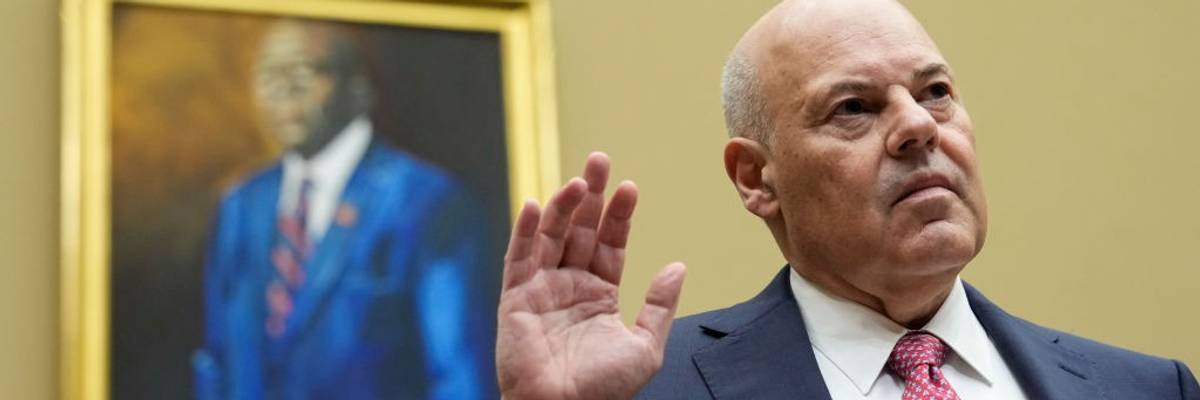
U.S. Postmaster General Louis DeJoy is sworn in during a House Oversight Subcommittee on Government Operations and Federal Workforce hearing on Capitol Hill May 17, 2023 in Washington, D.C.
President Biden has utterly failed to hold DeJoy to account for his internal attack on the US Postal Service.
In a time of historic distrust in government, the United States Postal Service has accomplished something extraordinary: it remains a universally beloved federal agency. Second only to the Parks Service in public favorability (a jaw-dropping 77% approval rating, per Gallup), USPS is arguably also the most frequently-interacted-with component of the federal government: packages and letters are delivered to Americans’ mailboxes six days per week. But these warm feelings – already under threat by Postmaster General Louis DeJoy’s continued destructive leadership – could quickly chill if the Postal Board of Governors has its way.
At least four times per year, the Board (the governing body that votes on DeJoy’s agenda and has the sole power to fire him) holds an open session meeting, its sole formal contact with the public. In recent years, these meetings have concluded with a well-attended public comment period, where in-person and virtual attendees have excoriated DeJoy for embracing a privatization-friendly agenda. Just this year alone, public commenters at Board meetings have decried the mail slow downs and price hikes, demanded changes to DeJoy’s gas-guzzling and union-busting fleet plan, raised serious concerns about transparency of DeJoy’s facility consolidation plans, and pushed DeJoy to expand community services offered at the post office.
The future of the people’s most treasured public institution depends on public participation and feedback
But when the Postal Board of Governors met this week for their final open session of the year, there was one major difference from its previous quarterly meetings: virtual and remote public comments were, without explanation, banned. This abrupt new barrier to public accessibility led the number of public commenters – which in recent meetings has been a double-digit tally – to drop to 4. The decline in attendance was also likely compounded by an unexplained shift in the meeting time: whereas past meetings have been held at 4:00pm ET, Tuesday’s session was held at noon – the middle of the workday.
The Board’s decision to not allow virtual comments at the November 14th meeting follows another alarming recent attempt to suppress public input. At the August 2023 meeting, each public commenter was allotted only 25 seconds to speak, in sharp contrast to the typical 3 minute time limit. And past meetings were not beacons of accountability, either. The Postal Governors never responded to any comments raised by the public, and the comment period itself was always excluded from the official publicly available USPS recording of the formal session.
But next year, the Postal Board’s accountability problem will get even worse. During Tuesday’s meeting, Postal Board Deputy Secretary Lucy Trout explained, starting next year, the Postal Board will only hear public comments once per year in November. In other words, though the next three Postal Board meetings (February, May, and August 2024) are ostensibly “public sessions,” members of the public will have no opportunity to inform the Postal Board about their concerns until a year from now.
And it’s not as if postal workers, customers, and public advocates don’t have anything pressing to alert the Board about. On the contrary, DeJoy has continued to advance a destructive agenda that includes:
President Biden has utterly failed to hold DeJoy to account for any of this, instead inviting him to White House stamp ceremonies and staying silent as the Postmaster General laughably reinvents himself as a “Biden ally” to credulous reporters. This is particularly egregious given the President’s power to nominate members of the Postal Board of Governors:
The Postal Board’s restrictions on public comment are unacceptable. They must reverse course by allowing both in-person AND virtual public comments at ALL open sessions next year, and take further steps to improve accountability by responding to public comments and posting recorded comment sessions to the USPS website. Congressional Democrats and the Biden administration must publicly call out this shameful barrier to transparent government and fast-track filling the Moak and Zollars Postal Board seats with anti-DeJoy, pro-accountability reformers.
The future of the people’s most treasured public institution depends on public participation and feedback–that’s how public service works.
An earlier version of this post misstated the percentage use of nonunion labor for the full USPS next-gen fleet proposal.
Dear Common Dreams reader, It’s been nearly 30 years since I co-founded Common Dreams with my late wife, Lina Newhouser. We had the radical notion that journalism should serve the public good, not corporate profits. It was clear to us from the outset what it would take to build such a project. No paid advertisements. No corporate sponsors. No millionaire publisher telling us what to think or do. Many people said we wouldn't last a year, but we proved those doubters wrong. Together with a tremendous team of journalists and dedicated staff, we built an independent media outlet free from the constraints of profits and corporate control. Our mission has always been simple: To inform. To inspire. To ignite change for the common good. Building Common Dreams was not easy. Our survival was never guaranteed. When you take on the most powerful forces—Wall Street greed, fossil fuel industry destruction, Big Tech lobbyists, and uber-rich oligarchs who have spent billions upon billions rigging the economy and democracy in their favor—the only bulwark you have is supporters who believe in your work. But here’s the urgent message from me today. It's never been this bad out there. And it's never been this hard to keep us going. At the very moment Common Dreams is most needed, the threats we face are intensifying. We need your support now more than ever. We don't accept corporate advertising and never will. We don't have a paywall because we don't think people should be blocked from critical news based on their ability to pay. Everything we do is funded by the donations of readers like you. When everyone does the little they can afford, we are strong. But if that support retreats or dries up, so do we. Will you donate now to make sure Common Dreams not only survives but thrives? —Craig Brown, Co-founder |
In a time of historic distrust in government, the United States Postal Service has accomplished something extraordinary: it remains a universally beloved federal agency. Second only to the Parks Service in public favorability (a jaw-dropping 77% approval rating, per Gallup), USPS is arguably also the most frequently-interacted-with component of the federal government: packages and letters are delivered to Americans’ mailboxes six days per week. But these warm feelings – already under threat by Postmaster General Louis DeJoy’s continued destructive leadership – could quickly chill if the Postal Board of Governors has its way.
At least four times per year, the Board (the governing body that votes on DeJoy’s agenda and has the sole power to fire him) holds an open session meeting, its sole formal contact with the public. In recent years, these meetings have concluded with a well-attended public comment period, where in-person and virtual attendees have excoriated DeJoy for embracing a privatization-friendly agenda. Just this year alone, public commenters at Board meetings have decried the mail slow downs and price hikes, demanded changes to DeJoy’s gas-guzzling and union-busting fleet plan, raised serious concerns about transparency of DeJoy’s facility consolidation plans, and pushed DeJoy to expand community services offered at the post office.
The future of the people’s most treasured public institution depends on public participation and feedback
But when the Postal Board of Governors met this week for their final open session of the year, there was one major difference from its previous quarterly meetings: virtual and remote public comments were, without explanation, banned. This abrupt new barrier to public accessibility led the number of public commenters – which in recent meetings has been a double-digit tally – to drop to 4. The decline in attendance was also likely compounded by an unexplained shift in the meeting time: whereas past meetings have been held at 4:00pm ET, Tuesday’s session was held at noon – the middle of the workday.
The Board’s decision to not allow virtual comments at the November 14th meeting follows another alarming recent attempt to suppress public input. At the August 2023 meeting, each public commenter was allotted only 25 seconds to speak, in sharp contrast to the typical 3 minute time limit. And past meetings were not beacons of accountability, either. The Postal Governors never responded to any comments raised by the public, and the comment period itself was always excluded from the official publicly available USPS recording of the formal session.
But next year, the Postal Board’s accountability problem will get even worse. During Tuesday’s meeting, Postal Board Deputy Secretary Lucy Trout explained, starting next year, the Postal Board will only hear public comments once per year in November. In other words, though the next three Postal Board meetings (February, May, and August 2024) are ostensibly “public sessions,” members of the public will have no opportunity to inform the Postal Board about their concerns until a year from now.
And it’s not as if postal workers, customers, and public advocates don’t have anything pressing to alert the Board about. On the contrary, DeJoy has continued to advance a destructive agenda that includes:
President Biden has utterly failed to hold DeJoy to account for any of this, instead inviting him to White House stamp ceremonies and staying silent as the Postmaster General laughably reinvents himself as a “Biden ally” to credulous reporters. This is particularly egregious given the President’s power to nominate members of the Postal Board of Governors:
The Postal Board’s restrictions on public comment are unacceptable. They must reverse course by allowing both in-person AND virtual public comments at ALL open sessions next year, and take further steps to improve accountability by responding to public comments and posting recorded comment sessions to the USPS website. Congressional Democrats and the Biden administration must publicly call out this shameful barrier to transparent government and fast-track filling the Moak and Zollars Postal Board seats with anti-DeJoy, pro-accountability reformers.
The future of the people’s most treasured public institution depends on public participation and feedback–that’s how public service works.
An earlier version of this post misstated the percentage use of nonunion labor for the full USPS next-gen fleet proposal.
In a time of historic distrust in government, the United States Postal Service has accomplished something extraordinary: it remains a universally beloved federal agency. Second only to the Parks Service in public favorability (a jaw-dropping 77% approval rating, per Gallup), USPS is arguably also the most frequently-interacted-with component of the federal government: packages and letters are delivered to Americans’ mailboxes six days per week. But these warm feelings – already under threat by Postmaster General Louis DeJoy’s continued destructive leadership – could quickly chill if the Postal Board of Governors has its way.
At least four times per year, the Board (the governing body that votes on DeJoy’s agenda and has the sole power to fire him) holds an open session meeting, its sole formal contact with the public. In recent years, these meetings have concluded with a well-attended public comment period, where in-person and virtual attendees have excoriated DeJoy for embracing a privatization-friendly agenda. Just this year alone, public commenters at Board meetings have decried the mail slow downs and price hikes, demanded changes to DeJoy’s gas-guzzling and union-busting fleet plan, raised serious concerns about transparency of DeJoy’s facility consolidation plans, and pushed DeJoy to expand community services offered at the post office.
The future of the people’s most treasured public institution depends on public participation and feedback
But when the Postal Board of Governors met this week for their final open session of the year, there was one major difference from its previous quarterly meetings: virtual and remote public comments were, without explanation, banned. This abrupt new barrier to public accessibility led the number of public commenters – which in recent meetings has been a double-digit tally – to drop to 4. The decline in attendance was also likely compounded by an unexplained shift in the meeting time: whereas past meetings have been held at 4:00pm ET, Tuesday’s session was held at noon – the middle of the workday.
The Board’s decision to not allow virtual comments at the November 14th meeting follows another alarming recent attempt to suppress public input. At the August 2023 meeting, each public commenter was allotted only 25 seconds to speak, in sharp contrast to the typical 3 minute time limit. And past meetings were not beacons of accountability, either. The Postal Governors never responded to any comments raised by the public, and the comment period itself was always excluded from the official publicly available USPS recording of the formal session.
But next year, the Postal Board’s accountability problem will get even worse. During Tuesday’s meeting, Postal Board Deputy Secretary Lucy Trout explained, starting next year, the Postal Board will only hear public comments once per year in November. In other words, though the next three Postal Board meetings (February, May, and August 2024) are ostensibly “public sessions,” members of the public will have no opportunity to inform the Postal Board about their concerns until a year from now.
And it’s not as if postal workers, customers, and public advocates don’t have anything pressing to alert the Board about. On the contrary, DeJoy has continued to advance a destructive agenda that includes:
President Biden has utterly failed to hold DeJoy to account for any of this, instead inviting him to White House stamp ceremonies and staying silent as the Postmaster General laughably reinvents himself as a “Biden ally” to credulous reporters. This is particularly egregious given the President’s power to nominate members of the Postal Board of Governors:
The Postal Board’s restrictions on public comment are unacceptable. They must reverse course by allowing both in-person AND virtual public comments at ALL open sessions next year, and take further steps to improve accountability by responding to public comments and posting recorded comment sessions to the USPS website. Congressional Democrats and the Biden administration must publicly call out this shameful barrier to transparent government and fast-track filling the Moak and Zollars Postal Board seats with anti-DeJoy, pro-accountability reformers.
The future of the people’s most treasured public institution depends on public participation and feedback–that’s how public service works.
An earlier version of this post misstated the percentage use of nonunion labor for the full USPS next-gen fleet proposal.