SUBSCRIBE TO OUR FREE NEWSLETTER
Daily news & progressive opinion—funded by the people, not the corporations—delivered straight to your inbox.
5
#000000
#FFFFFF
To donate by check, phone, or other method, see our More Ways to Give page.
Daily news & progressive opinion—funded by the people, not the corporations—delivered straight to your inbox.
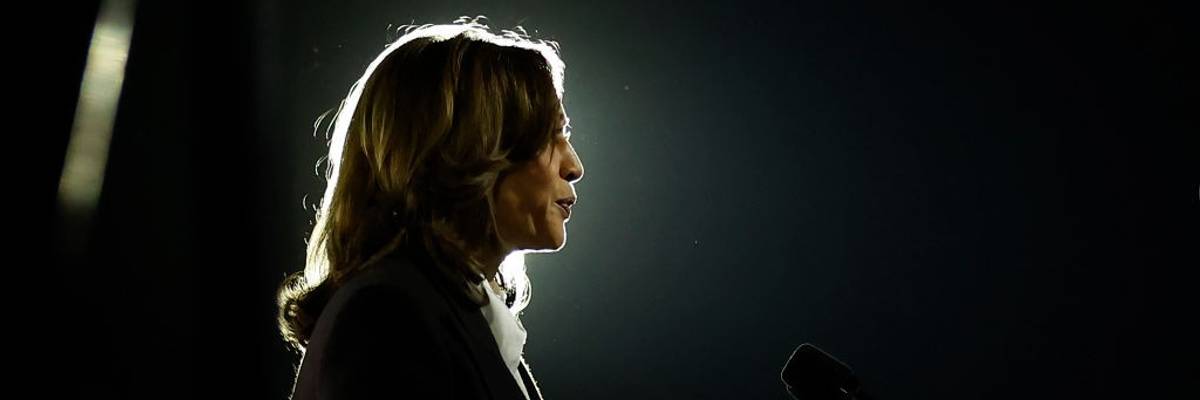
Democratic presidential nominee, U.S. Vice President Kamala Harris, speaks during a campaign rally on the Ellipse on October 29, 2024 in Washington, DC.
Advocating a platform that both protects and expands freedoms, the Democratic nominee has donned the mantle of President Franklin Delano Roosevelt.
On Tuesday evening October 29, 2024, Vice President Kamala Harris spoke at the Ellipse, supplanting—with unifying oratory— Donald Trump’s divisive rhetoric that prompted an attack on the Capitol Building on January 6, 2021. Advocating a platform that both protects and expands freedoms, Harris has donned the mantle of President Franklin Delano Roosevelt.
During the 2024 Democratic National Convention, most media interpreted the repetition of “freedom” as a reclamation of that word from the Republican Party. But what I heard was FDR’s "Four Freedoms Speech," and I still do. That speech was President Roosevelt’s State of the Union address presented to a joint session of Congress on January 6, 1941. Yes, precisely 80 years prior to Donald Trump’s Outrage on the Ellipse and inside the selfsame Capitol Building where MAGA followers tried violently to usurp power. In addition to defining democratic freedoms, Roosevelt denounced dictatorial tyranny in his address, making his words from that January 6th resonate today as a rebuttal to Trumpism.
Before naming freedoms that unite and protect people, Roosevelt painted a picture of the irrational fears that divide. Unlike most State of the Union Addresses, FDR concentrated not on the internal condition of our union but on threats to all democracies. The President broadened his framework because he spoke at a dire moment: Hitler had conquered most of continental Europe and was terrorizing England. In the speech, Roosevelt never names Hitler and Nazism or Mussolini and Fascism but speaks of “dictators” and “tyranny,” making his warnings easily applicable to our own time.
Roosevelt emphasized that dictators succeed by attacking “…the democratic way of life …[with] poisonous propaganda to destroy unity and promote discord,” a prescient portrait of Trump’s language. Autocrats do not offer policies for debate in a public forum; instead, they fill their audience with fear. “Fear” already had a prominent position in Roosevelt’s rhetoric. He had powerfully laid claim to that word in his first Inaugural on March 4, 1933 when he proclaimed that “…the only thing we have to fear is fear itself – nameless, unreasoning, unjustified terror….” In 1933, fear resulted from the Great Depression—a fear of unemployment, of homelessness, of starvation, of bank failure. By 1941, that fear had extended to “…assailants [of democratic life] still on the march.” Fear remains today, and Trump uses it to promote a mythic past with restricted liberties, which provides a narrative to the MAGA mythology.
FDR realized that fear obstructs progress and, in his January 6th, 1941 address, cautioned that it “… paralyzes needed efforts to convert retreat into advance.” Paralyzes!
FDR spoke from intimate experience of how paralysis limits motion. As an antidote, FDR prescribed expanding freedoms. His 1941 State of the Union defined four broad and basic human rights, now known as Freedom of Speech, Freedom of Worship, Freedom from Want, and Freedom from Fear. While FDR’s first two Freedoms were established in the First Amendment, the latter two, “from want” and “from fear,” evoked either the expansions granted by his New Deal (such as Work Projects, Unemployment Insurance, and Social Security, all of which alleviated both want and fear) or FDR’s intentions for further augmentation (such as increased medical coverage, job opportunity, and pay equity). Roosevelt believed his “vision [was not for] a distant millennium… [but] attainable in [his] own time….” Part of what makes his address painfully relevant today is that many of Roosevelt’s goals for further rights remain unfulfilled in this new millennium.
Kamala Harris has now revived those goals. Her policies heed FDR’s warning against tyranny by amplifying his call to expand liberties. Like President Roosevelt, Vice President Harris believes in democratic progress.
On January 6, 1941, Roosevelt described American history as “…a perpetual peaceful revolution … adjusting itself to changing conditions … [as] today’s best is not good enough for tomorrow.” But now we must recognize that 1941’s tomorrow is today. Harris’s enlarged Freedom from Want includes freedom for reproductive health, home ownership, and caregiving, while her aspirations to protect Americans from gun violence, climate change, and voter suppression fall under Freedom from Fear. Kamala Harris could lead our democracy towards a better tomorrow if we the people show up for our “…rendezvous with destiny,” as FDR also once said. To give her that opportunity, it's up to us to elect her—along with a Democratic Congress—on November 5, 2024.
Dear Common Dreams reader, It’s been nearly 30 years since I co-founded Common Dreams with my late wife, Lina Newhouser. We had the radical notion that journalism should serve the public good, not corporate profits. It was clear to us from the outset what it would take to build such a project. No paid advertisements. No corporate sponsors. No millionaire publisher telling us what to think or do. Many people said we wouldn't last a year, but we proved those doubters wrong. Together with a tremendous team of journalists and dedicated staff, we built an independent media outlet free from the constraints of profits and corporate control. Our mission has always been simple: To inform. To inspire. To ignite change for the common good. Building Common Dreams was not easy. Our survival was never guaranteed. When you take on the most powerful forces—Wall Street greed, fossil fuel industry destruction, Big Tech lobbyists, and uber-rich oligarchs who have spent billions upon billions rigging the economy and democracy in their favor—the only bulwark you have is supporters who believe in your work. But here’s the urgent message from me today. It's never been this bad out there. And it's never been this hard to keep us going. At the very moment Common Dreams is most needed, the threats we face are intensifying. We need your support now more than ever. We don't accept corporate advertising and never will. We don't have a paywall because we don't think people should be blocked from critical news based on their ability to pay. Everything we do is funded by the donations of readers like you. When everyone does the little they can afford, we are strong. But if that support retreats or dries up, so do we. Will you donate now to make sure Common Dreams not only survives but thrives? —Craig Brown, Co-founder |
On Tuesday evening October 29, 2024, Vice President Kamala Harris spoke at the Ellipse, supplanting—with unifying oratory— Donald Trump’s divisive rhetoric that prompted an attack on the Capitol Building on January 6, 2021. Advocating a platform that both protects and expands freedoms, Harris has donned the mantle of President Franklin Delano Roosevelt.
During the 2024 Democratic National Convention, most media interpreted the repetition of “freedom” as a reclamation of that word from the Republican Party. But what I heard was FDR’s "Four Freedoms Speech," and I still do. That speech was President Roosevelt’s State of the Union address presented to a joint session of Congress on January 6, 1941. Yes, precisely 80 years prior to Donald Trump’s Outrage on the Ellipse and inside the selfsame Capitol Building where MAGA followers tried violently to usurp power. In addition to defining democratic freedoms, Roosevelt denounced dictatorial tyranny in his address, making his words from that January 6th resonate today as a rebuttal to Trumpism.
Before naming freedoms that unite and protect people, Roosevelt painted a picture of the irrational fears that divide. Unlike most State of the Union Addresses, FDR concentrated not on the internal condition of our union but on threats to all democracies. The President broadened his framework because he spoke at a dire moment: Hitler had conquered most of continental Europe and was terrorizing England. In the speech, Roosevelt never names Hitler and Nazism or Mussolini and Fascism but speaks of “dictators” and “tyranny,” making his warnings easily applicable to our own time.
Roosevelt emphasized that dictators succeed by attacking “…the democratic way of life …[with] poisonous propaganda to destroy unity and promote discord,” a prescient portrait of Trump’s language. Autocrats do not offer policies for debate in a public forum; instead, they fill their audience with fear. “Fear” already had a prominent position in Roosevelt’s rhetoric. He had powerfully laid claim to that word in his first Inaugural on March 4, 1933 when he proclaimed that “…the only thing we have to fear is fear itself – nameless, unreasoning, unjustified terror….” In 1933, fear resulted from the Great Depression—a fear of unemployment, of homelessness, of starvation, of bank failure. By 1941, that fear had extended to “…assailants [of democratic life] still on the march.” Fear remains today, and Trump uses it to promote a mythic past with restricted liberties, which provides a narrative to the MAGA mythology.
FDR realized that fear obstructs progress and, in his January 6th, 1941 address, cautioned that it “… paralyzes needed efforts to convert retreat into advance.” Paralyzes!
FDR spoke from intimate experience of how paralysis limits motion. As an antidote, FDR prescribed expanding freedoms. His 1941 State of the Union defined four broad and basic human rights, now known as Freedom of Speech, Freedom of Worship, Freedom from Want, and Freedom from Fear. While FDR’s first two Freedoms were established in the First Amendment, the latter two, “from want” and “from fear,” evoked either the expansions granted by his New Deal (such as Work Projects, Unemployment Insurance, and Social Security, all of which alleviated both want and fear) or FDR’s intentions for further augmentation (such as increased medical coverage, job opportunity, and pay equity). Roosevelt believed his “vision [was not for] a distant millennium… [but] attainable in [his] own time….” Part of what makes his address painfully relevant today is that many of Roosevelt’s goals for further rights remain unfulfilled in this new millennium.
Kamala Harris has now revived those goals. Her policies heed FDR’s warning against tyranny by amplifying his call to expand liberties. Like President Roosevelt, Vice President Harris believes in democratic progress.
On January 6, 1941, Roosevelt described American history as “…a perpetual peaceful revolution … adjusting itself to changing conditions … [as] today’s best is not good enough for tomorrow.” But now we must recognize that 1941’s tomorrow is today. Harris’s enlarged Freedom from Want includes freedom for reproductive health, home ownership, and caregiving, while her aspirations to protect Americans from gun violence, climate change, and voter suppression fall under Freedom from Fear. Kamala Harris could lead our democracy towards a better tomorrow if we the people show up for our “…rendezvous with destiny,” as FDR also once said. To give her that opportunity, it's up to us to elect her—along with a Democratic Congress—on November 5, 2024.
On Tuesday evening October 29, 2024, Vice President Kamala Harris spoke at the Ellipse, supplanting—with unifying oratory— Donald Trump’s divisive rhetoric that prompted an attack on the Capitol Building on January 6, 2021. Advocating a platform that both protects and expands freedoms, Harris has donned the mantle of President Franklin Delano Roosevelt.
During the 2024 Democratic National Convention, most media interpreted the repetition of “freedom” as a reclamation of that word from the Republican Party. But what I heard was FDR’s "Four Freedoms Speech," and I still do. That speech was President Roosevelt’s State of the Union address presented to a joint session of Congress on January 6, 1941. Yes, precisely 80 years prior to Donald Trump’s Outrage on the Ellipse and inside the selfsame Capitol Building where MAGA followers tried violently to usurp power. In addition to defining democratic freedoms, Roosevelt denounced dictatorial tyranny in his address, making his words from that January 6th resonate today as a rebuttal to Trumpism.
Before naming freedoms that unite and protect people, Roosevelt painted a picture of the irrational fears that divide. Unlike most State of the Union Addresses, FDR concentrated not on the internal condition of our union but on threats to all democracies. The President broadened his framework because he spoke at a dire moment: Hitler had conquered most of continental Europe and was terrorizing England. In the speech, Roosevelt never names Hitler and Nazism or Mussolini and Fascism but speaks of “dictators” and “tyranny,” making his warnings easily applicable to our own time.
Roosevelt emphasized that dictators succeed by attacking “…the democratic way of life …[with] poisonous propaganda to destroy unity and promote discord,” a prescient portrait of Trump’s language. Autocrats do not offer policies for debate in a public forum; instead, they fill their audience with fear. “Fear” already had a prominent position in Roosevelt’s rhetoric. He had powerfully laid claim to that word in his first Inaugural on March 4, 1933 when he proclaimed that “…the only thing we have to fear is fear itself – nameless, unreasoning, unjustified terror….” In 1933, fear resulted from the Great Depression—a fear of unemployment, of homelessness, of starvation, of bank failure. By 1941, that fear had extended to “…assailants [of democratic life] still on the march.” Fear remains today, and Trump uses it to promote a mythic past with restricted liberties, which provides a narrative to the MAGA mythology.
FDR realized that fear obstructs progress and, in his January 6th, 1941 address, cautioned that it “… paralyzes needed efforts to convert retreat into advance.” Paralyzes!
FDR spoke from intimate experience of how paralysis limits motion. As an antidote, FDR prescribed expanding freedoms. His 1941 State of the Union defined four broad and basic human rights, now known as Freedom of Speech, Freedom of Worship, Freedom from Want, and Freedom from Fear. While FDR’s first two Freedoms were established in the First Amendment, the latter two, “from want” and “from fear,” evoked either the expansions granted by his New Deal (such as Work Projects, Unemployment Insurance, and Social Security, all of which alleviated both want and fear) or FDR’s intentions for further augmentation (such as increased medical coverage, job opportunity, and pay equity). Roosevelt believed his “vision [was not for] a distant millennium… [but] attainable in [his] own time….” Part of what makes his address painfully relevant today is that many of Roosevelt’s goals for further rights remain unfulfilled in this new millennium.
Kamala Harris has now revived those goals. Her policies heed FDR’s warning against tyranny by amplifying his call to expand liberties. Like President Roosevelt, Vice President Harris believes in democratic progress.
On January 6, 1941, Roosevelt described American history as “…a perpetual peaceful revolution … adjusting itself to changing conditions … [as] today’s best is not good enough for tomorrow.” But now we must recognize that 1941’s tomorrow is today. Harris’s enlarged Freedom from Want includes freedom for reproductive health, home ownership, and caregiving, while her aspirations to protect Americans from gun violence, climate change, and voter suppression fall under Freedom from Fear. Kamala Harris could lead our democracy towards a better tomorrow if we the people show up for our “…rendezvous with destiny,” as FDR also once said. To give her that opportunity, it's up to us to elect her—along with a Democratic Congress—on November 5, 2024.