

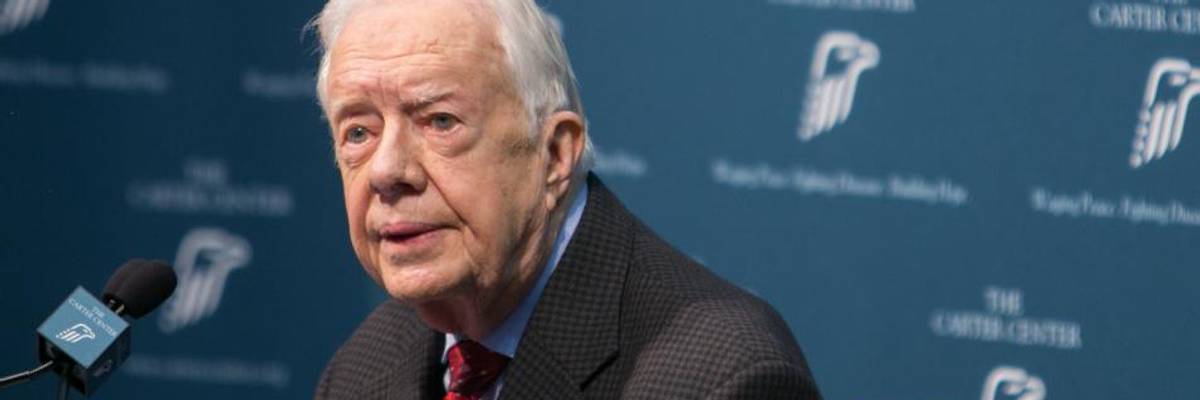
Former President Jimmy Carter speaks during a press conference at the Carter Center on August 20, 2015 in Atlanta, Georgia.
Jimmy Carter Was Pilloried for Worrying About Israeli Apartheid—But He's Been Vindicated by History
Carter has been the only American president with the candor to call out Israel for mirroring apartheid policies of South Africa.
As President Jimmy Carter nears the end in hospice care, we are prompted to revisit his accomplishments and contributions. Carter’s prescient 2006 book Palestine: Peace, Not Apartheid elicited a storm of criticism from many Jewish organizations and leaders. It prompted condemnation from the powerful lobby, the American Israel Public Affairs Council (AIPAC), and leaders such as Alan Dershowitz, who outrageously branded Carter’s judicious book “a foray into bigotry.” Carter has been the only American president with the candor to call out Israel for mirroring apartheid policies of South Africa.
So it’s timely to revisit the message, consequences, and reactions to that book, as his passing approaches. Since AIPAC and Dershowitz have lost the credibility they once had, their branding and character assassination of Carter doesn’t reflect so badly on him, when you consider the source.
Ironically, Carter’s greatest accomplishment was to broker the 1978 Camp David Accords, initiating the first bilateral Israeli-Egyptian relations. It had the effect of neutralizing Egyptian military might and removing the only serious threat to Israel. Though PM Menachem Begin was Israel’s signatory to the Camp David agreements, it was Carter’s long-standing friendship with Israeli PM Yitzhak Rabin, who was Israel’s US ambassador from 1968-‘73, which laid the groundwork. On March 7, 1977, Carter hosted Rabin and his wife for a White House dinner. Sadly, Rabin was forced to resign the following month, because of a right-wing witch hunt into his finances as US Ambassador five years earlier. That paved the way for the Labor Party’s sound defeat, and elevation of Menachem Begin to PM in 1978. Carter never received the gratitude he deserved from the right-wing U.S. Israel lobbies or the Israeli Right. They quickly forgot how shaken Israeli leadership had been by the Egyptian thrust in 1973, such that one Israeli official confessed, “There were a few days there when it seemed that the end of the world was near.”
The Camp David accords were two separate pacts that established the “roadmap to peace,” and framework for further negotiations between Israel and Egypt. It also established an autonomous area for Palestinians within Israel’s contested borders. In 2015, Carter proclaimed the two-state solution to be dead, and candidly blamed Prime Minister Benjamin Netanyahu. In his book, Carter argued that Israel’s ongoing occupation of Palestine was the primary obstacle to peace in the region. On his most recent visit, Carter dispensed with any attempt to contact Netanyahu as a “waste of time,” considering his recent requests were met with non-responses. Carter said that Bibi “does not now and has never sincerely believed in a two-state solution for Israel and Palestine.”
Carter lost in 1980 because of a confluence of bad political dynamics: 1.) Recession brought on by Fed Chairman Paul Volcker’s exorbitant interest rate hike, 2.) The US Boycott of the Soviet Olympics, 3.) The candidacy of John Anderson, who siphoned more votes from Carter than he did from Reagan by a 2-1 margin, 4.) His conflicts with Tip O’Neill who was never crazy about a born-again Christian serving in the White House, and who sabotaged some of Carter’s progressive initiatives out of legislative spite. 5.) Oliver North and the Reagan campaign may have secretly worked against any timely release of the 52 American hostages in Iran, a serious crime if Gary Sick’s allegations are true.
Carter’s book on the dangers of apartheid got him branded as an anti-Semite and bigot by right-wing Jews and their Evangelical supporters. Those people were never cognizant of the fact that, “friends don’t let friends . . . commit political suicide;” which Carter recognized, and did his best to prevent. He branded Israel as an apartheid state, knowing it was provocative and might be counterproductive. But he was compelled by his sense of honor to be truthful, regardless of political cost. Carter’s underlying goal was to stimulate discussion and debate, which makes it an unqualified success. Dershowitz’s response after Carter’s 2006 speech at Brandeis University defending the book, was to distill the complex issues down to simplistic grandstanding sound bites, and attack Carter for not being sufficiently pro-Israel. Suffice to say, Dershowitz's credibility later went out the window with this defense of Trump, if not before.
In recognition of the controversy the book stirred, Carter penned an open letter to the American Jewish Community in 2006. He reminded us that he also formed the President’s Commission on the Holocaust, which was chaired by Elie Weisel. He emphasized that his nomenclature was, ”about conditions and events in the Palestinian territories and not in Israel.” He also acknowledged, his personal, “overwhelming bias for Israel . . .among Christians like me who have been taught since childhood to honor and protect God’s chosen people . . .” Carter’s working definition of “apartheid” was, “the forced segregation of two peoples living in the same land, with one of them dominating and persecuting the other.” Conceptual apartheid is not necessarily based on racism, but “the desire of a minority of Israelis for Palestinian land and the resulting suppression of protests that involve violence.”
Rabin was assassinated in 1995 by a far-far right-wing zealot, who’d been raised on an illegal settlement, and infused with the politics and ideology of the disgraced Rabbi and parliamentarian Mier Kahane. That Rabin’s assassin was not only freed, but treated as a hero by right-wing Israelis, illustrates the grave political evolution Israel has seen since “the Begin Revolution” of the 1970s, which turned the country away from social democracy toward a combination of ethnocracy and plutocracy. It sowed the seeds of the current threat to Israeli democracy under Netanyahu.
Carter’s warnings and teachings were not only ignored but held up to ridicule and defamation from the Israelis he was urgently trying to protect . . . from themselves. With Bibi’s return to power despite being on trial for corruption, it’s as if Camp David never happened. Like Trump, Bibi rose to power with a combination of grandstanding and constructing fictional narratives from the myths that Carter was so dedicated to erasing. With his passing, the new Israeli government is free to pursue its path to political-economic suicide.
Former ADL Director Abraham H. Foxman, once said of the book, “The title is to delegitimize Israel, because if Israel is like South Africa, it doesn’t really deserve to be a democratic state. He’s provoking, he’s outrageous, and he’s bigoted,” Foxman more recently said of the new Likud government, “If Israel ceases to be an open democracy, I won’t be able to support it,” and “If Israel becomes a fundamentalist religious state, a theocratic nationalism state, it will cut Israel off from 70 percent of world Jewry.”
Carter embellished his post-presidential legacy more gracefully than virtually any president in U.S. history. His legendary work for Habitat for Humanity is a poignant reminder of President Carter’s exemplary leadership and devotion to “walking the walk.” President Carter won the Nobel Peace Prize in 2002 for his role in initiating the Camp David accords in 1978. Let that be the defining accomplishment of his legacy.
An Urgent Message From Our Co-Founder
Dear Common Dreams reader, It’s been nearly 30 years since I co-founded Common Dreams with my late wife, Lina Newhouser. We had the radical notion that journalism should serve the public good, not corporate profits. It was clear to us from the outset what it would take to build such a project. No paid advertisements. No corporate sponsors. No millionaire publisher telling us what to think or do. Many people said we wouldn't last a year, but we proved those doubters wrong. Together with a tremendous team of journalists and dedicated staff, we built an independent media outlet free from the constraints of profits and corporate control. Our mission has always been simple: To inform. To inspire. To ignite change for the common good. Building Common Dreams was not easy. Our survival was never guaranteed. When you take on the most powerful forces—Wall Street greed, fossil fuel industry destruction, Big Tech lobbyists, and uber-rich oligarchs who have spent billions upon billions rigging the economy and democracy in their favor—the only bulwark you have is supporters who believe in your work. But here’s the urgent message from me today. It's never been this bad out there. And it's never been this hard to keep us going. At the very moment Common Dreams is most needed, the threats we face are intensifying. We need your support now more than ever. We don't accept corporate advertising and never will. We don't have a paywall because we don't think people should be blocked from critical news based on their ability to pay. Everything we do is funded by the donations of readers like you. When everyone does the little they can afford, we are strong. But if that support retreats or dries up, so do we. Will you donate now to make sure Common Dreams not only survives but thrives? —Craig Brown, Co-founder |
As President Jimmy Carter nears the end in hospice care, we are prompted to revisit his accomplishments and contributions. Carter’s prescient 2006 book Palestine: Peace, Not Apartheid elicited a storm of criticism from many Jewish organizations and leaders. It prompted condemnation from the powerful lobby, the American Israel Public Affairs Council (AIPAC), and leaders such as Alan Dershowitz, who outrageously branded Carter’s judicious book “a foray into bigotry.” Carter has been the only American president with the candor to call out Israel for mirroring apartheid policies of South Africa.
So it’s timely to revisit the message, consequences, and reactions to that book, as his passing approaches. Since AIPAC and Dershowitz have lost the credibility they once had, their branding and character assassination of Carter doesn’t reflect so badly on him, when you consider the source.
Ironically, Carter’s greatest accomplishment was to broker the 1978 Camp David Accords, initiating the first bilateral Israeli-Egyptian relations. It had the effect of neutralizing Egyptian military might and removing the only serious threat to Israel. Though PM Menachem Begin was Israel’s signatory to the Camp David agreements, it was Carter’s long-standing friendship with Israeli PM Yitzhak Rabin, who was Israel’s US ambassador from 1968-‘73, which laid the groundwork. On March 7, 1977, Carter hosted Rabin and his wife for a White House dinner. Sadly, Rabin was forced to resign the following month, because of a right-wing witch hunt into his finances as US Ambassador five years earlier. That paved the way for the Labor Party’s sound defeat, and elevation of Menachem Begin to PM in 1978. Carter never received the gratitude he deserved from the right-wing U.S. Israel lobbies or the Israeli Right. They quickly forgot how shaken Israeli leadership had been by the Egyptian thrust in 1973, such that one Israeli official confessed, “There were a few days there when it seemed that the end of the world was near.”
The Camp David accords were two separate pacts that established the “roadmap to peace,” and framework for further negotiations between Israel and Egypt. It also established an autonomous area for Palestinians within Israel’s contested borders. In 2015, Carter proclaimed the two-state solution to be dead, and candidly blamed Prime Minister Benjamin Netanyahu. In his book, Carter argued that Israel’s ongoing occupation of Palestine was the primary obstacle to peace in the region. On his most recent visit, Carter dispensed with any attempt to contact Netanyahu as a “waste of time,” considering his recent requests were met with non-responses. Carter said that Bibi “does not now and has never sincerely believed in a two-state solution for Israel and Palestine.”
Carter lost in 1980 because of a confluence of bad political dynamics: 1.) Recession brought on by Fed Chairman Paul Volcker’s exorbitant interest rate hike, 2.) The US Boycott of the Soviet Olympics, 3.) The candidacy of John Anderson, who siphoned more votes from Carter than he did from Reagan by a 2-1 margin, 4.) His conflicts with Tip O’Neill who was never crazy about a born-again Christian serving in the White House, and who sabotaged some of Carter’s progressive initiatives out of legislative spite. 5.) Oliver North and the Reagan campaign may have secretly worked against any timely release of the 52 American hostages in Iran, a serious crime if Gary Sick’s allegations are true.
Carter’s book on the dangers of apartheid got him branded as an anti-Semite and bigot by right-wing Jews and their Evangelical supporters. Those people were never cognizant of the fact that, “friends don’t let friends . . . commit political suicide;” which Carter recognized, and did his best to prevent. He branded Israel as an apartheid state, knowing it was provocative and might be counterproductive. But he was compelled by his sense of honor to be truthful, regardless of political cost. Carter’s underlying goal was to stimulate discussion and debate, which makes it an unqualified success. Dershowitz’s response after Carter’s 2006 speech at Brandeis University defending the book, was to distill the complex issues down to simplistic grandstanding sound bites, and attack Carter for not being sufficiently pro-Israel. Suffice to say, Dershowitz's credibility later went out the window with this defense of Trump, if not before.
In recognition of the controversy the book stirred, Carter penned an open letter to the American Jewish Community in 2006. He reminded us that he also formed the President’s Commission on the Holocaust, which was chaired by Elie Weisel. He emphasized that his nomenclature was, ”about conditions and events in the Palestinian territories and not in Israel.” He also acknowledged, his personal, “overwhelming bias for Israel . . .among Christians like me who have been taught since childhood to honor and protect God’s chosen people . . .” Carter’s working definition of “apartheid” was, “the forced segregation of two peoples living in the same land, with one of them dominating and persecuting the other.” Conceptual apartheid is not necessarily based on racism, but “the desire of a minority of Israelis for Palestinian land and the resulting suppression of protests that involve violence.”
Rabin was assassinated in 1995 by a far-far right-wing zealot, who’d been raised on an illegal settlement, and infused with the politics and ideology of the disgraced Rabbi and parliamentarian Mier Kahane. That Rabin’s assassin was not only freed, but treated as a hero by right-wing Israelis, illustrates the grave political evolution Israel has seen since “the Begin Revolution” of the 1970s, which turned the country away from social democracy toward a combination of ethnocracy and plutocracy. It sowed the seeds of the current threat to Israeli democracy under Netanyahu.
Carter’s warnings and teachings were not only ignored but held up to ridicule and defamation from the Israelis he was urgently trying to protect . . . from themselves. With Bibi’s return to power despite being on trial for corruption, it’s as if Camp David never happened. Like Trump, Bibi rose to power with a combination of grandstanding and constructing fictional narratives from the myths that Carter was so dedicated to erasing. With his passing, the new Israeli government is free to pursue its path to political-economic suicide.
Former ADL Director Abraham H. Foxman, once said of the book, “The title is to delegitimize Israel, because if Israel is like South Africa, it doesn’t really deserve to be a democratic state. He’s provoking, he’s outrageous, and he’s bigoted,” Foxman more recently said of the new Likud government, “If Israel ceases to be an open democracy, I won’t be able to support it,” and “If Israel becomes a fundamentalist religious state, a theocratic nationalism state, it will cut Israel off from 70 percent of world Jewry.”
Carter embellished his post-presidential legacy more gracefully than virtually any president in U.S. history. His legendary work for Habitat for Humanity is a poignant reminder of President Carter’s exemplary leadership and devotion to “walking the walk.” President Carter won the Nobel Peace Prize in 2002 for his role in initiating the Camp David accords in 1978. Let that be the defining accomplishment of his legacy.
- South African Parliament Votes to Downgrade Embassy Over Israeli Crimes in Palestine ›
- American Anthropological Association Endorses Academic Boycott of Israeli 'Apartheid Regime' ›
- Opinion | A Framework for Peace in Israel and Palestine | Common Dreams ›
- Opinion | 100-Year-Old Jimmy Carter Shows Us What Courage Looks Like on Israel-Palestine | Common Dreams ›
- Opinion | Jimmy Carter, Middle East Peace, and The Man Who Killed My Dog | Common Dreams ›
- Opinion | Beyond the Myths: Reflecting on Jimmy Carter’s Israel-Palestine Legacy | Common Dreams ›
- Jimmy Carter's Daughter Thanks Writer for Focus on Her Dad's Defense of Palestinian Rights | Common Dreams ›
- Opinion | History Shows Carter Was Right to Warn Against Israeli Apartheid | Common Dreams ›
As President Jimmy Carter nears the end in hospice care, we are prompted to revisit his accomplishments and contributions. Carter’s prescient 2006 book Palestine: Peace, Not Apartheid elicited a storm of criticism from many Jewish organizations and leaders. It prompted condemnation from the powerful lobby, the American Israel Public Affairs Council (AIPAC), and leaders such as Alan Dershowitz, who outrageously branded Carter’s judicious book “a foray into bigotry.” Carter has been the only American president with the candor to call out Israel for mirroring apartheid policies of South Africa.
So it’s timely to revisit the message, consequences, and reactions to that book, as his passing approaches. Since AIPAC and Dershowitz have lost the credibility they once had, their branding and character assassination of Carter doesn’t reflect so badly on him, when you consider the source.
Ironically, Carter’s greatest accomplishment was to broker the 1978 Camp David Accords, initiating the first bilateral Israeli-Egyptian relations. It had the effect of neutralizing Egyptian military might and removing the only serious threat to Israel. Though PM Menachem Begin was Israel’s signatory to the Camp David agreements, it was Carter’s long-standing friendship with Israeli PM Yitzhak Rabin, who was Israel’s US ambassador from 1968-‘73, which laid the groundwork. On March 7, 1977, Carter hosted Rabin and his wife for a White House dinner. Sadly, Rabin was forced to resign the following month, because of a right-wing witch hunt into his finances as US Ambassador five years earlier. That paved the way for the Labor Party’s sound defeat, and elevation of Menachem Begin to PM in 1978. Carter never received the gratitude he deserved from the right-wing U.S. Israel lobbies or the Israeli Right. They quickly forgot how shaken Israeli leadership had been by the Egyptian thrust in 1973, such that one Israeli official confessed, “There were a few days there when it seemed that the end of the world was near.”
The Camp David accords were two separate pacts that established the “roadmap to peace,” and framework for further negotiations between Israel and Egypt. It also established an autonomous area for Palestinians within Israel’s contested borders. In 2015, Carter proclaimed the two-state solution to be dead, and candidly blamed Prime Minister Benjamin Netanyahu. In his book, Carter argued that Israel’s ongoing occupation of Palestine was the primary obstacle to peace in the region. On his most recent visit, Carter dispensed with any attempt to contact Netanyahu as a “waste of time,” considering his recent requests were met with non-responses. Carter said that Bibi “does not now and has never sincerely believed in a two-state solution for Israel and Palestine.”
Carter lost in 1980 because of a confluence of bad political dynamics: 1.) Recession brought on by Fed Chairman Paul Volcker’s exorbitant interest rate hike, 2.) The US Boycott of the Soviet Olympics, 3.) The candidacy of John Anderson, who siphoned more votes from Carter than he did from Reagan by a 2-1 margin, 4.) His conflicts with Tip O’Neill who was never crazy about a born-again Christian serving in the White House, and who sabotaged some of Carter’s progressive initiatives out of legislative spite. 5.) Oliver North and the Reagan campaign may have secretly worked against any timely release of the 52 American hostages in Iran, a serious crime if Gary Sick’s allegations are true.
Carter’s book on the dangers of apartheid got him branded as an anti-Semite and bigot by right-wing Jews and their Evangelical supporters. Those people were never cognizant of the fact that, “friends don’t let friends . . . commit political suicide;” which Carter recognized, and did his best to prevent. He branded Israel as an apartheid state, knowing it was provocative and might be counterproductive. But he was compelled by his sense of honor to be truthful, regardless of political cost. Carter’s underlying goal was to stimulate discussion and debate, which makes it an unqualified success. Dershowitz’s response after Carter’s 2006 speech at Brandeis University defending the book, was to distill the complex issues down to simplistic grandstanding sound bites, and attack Carter for not being sufficiently pro-Israel. Suffice to say, Dershowitz's credibility later went out the window with this defense of Trump, if not before.
In recognition of the controversy the book stirred, Carter penned an open letter to the American Jewish Community in 2006. He reminded us that he also formed the President’s Commission on the Holocaust, which was chaired by Elie Weisel. He emphasized that his nomenclature was, ”about conditions and events in the Palestinian territories and not in Israel.” He also acknowledged, his personal, “overwhelming bias for Israel . . .among Christians like me who have been taught since childhood to honor and protect God’s chosen people . . .” Carter’s working definition of “apartheid” was, “the forced segregation of two peoples living in the same land, with one of them dominating and persecuting the other.” Conceptual apartheid is not necessarily based on racism, but “the desire of a minority of Israelis for Palestinian land and the resulting suppression of protests that involve violence.”
Rabin was assassinated in 1995 by a far-far right-wing zealot, who’d been raised on an illegal settlement, and infused with the politics and ideology of the disgraced Rabbi and parliamentarian Mier Kahane. That Rabin’s assassin was not only freed, but treated as a hero by right-wing Israelis, illustrates the grave political evolution Israel has seen since “the Begin Revolution” of the 1970s, which turned the country away from social democracy toward a combination of ethnocracy and plutocracy. It sowed the seeds of the current threat to Israeli democracy under Netanyahu.
Carter’s warnings and teachings were not only ignored but held up to ridicule and defamation from the Israelis he was urgently trying to protect . . . from themselves. With Bibi’s return to power despite being on trial for corruption, it’s as if Camp David never happened. Like Trump, Bibi rose to power with a combination of grandstanding and constructing fictional narratives from the myths that Carter was so dedicated to erasing. With his passing, the new Israeli government is free to pursue its path to political-economic suicide.
Former ADL Director Abraham H. Foxman, once said of the book, “The title is to delegitimize Israel, because if Israel is like South Africa, it doesn’t really deserve to be a democratic state. He’s provoking, he’s outrageous, and he’s bigoted,” Foxman more recently said of the new Likud government, “If Israel ceases to be an open democracy, I won’t be able to support it,” and “If Israel becomes a fundamentalist religious state, a theocratic nationalism state, it will cut Israel off from 70 percent of world Jewry.”
Carter embellished his post-presidential legacy more gracefully than virtually any president in U.S. history. His legendary work for Habitat for Humanity is a poignant reminder of President Carter’s exemplary leadership and devotion to “walking the walk.” President Carter won the Nobel Peace Prize in 2002 for his role in initiating the Camp David accords in 1978. Let that be the defining accomplishment of his legacy.
- South African Parliament Votes to Downgrade Embassy Over Israeli Crimes in Palestine ›
- American Anthropological Association Endorses Academic Boycott of Israeli 'Apartheid Regime' ›
- Opinion | A Framework for Peace in Israel and Palestine | Common Dreams ›
- Opinion | 100-Year-Old Jimmy Carter Shows Us What Courage Looks Like on Israel-Palestine | Common Dreams ›
- Opinion | Jimmy Carter, Middle East Peace, and The Man Who Killed My Dog | Common Dreams ›
- Opinion | Beyond the Myths: Reflecting on Jimmy Carter’s Israel-Palestine Legacy | Common Dreams ›
- Jimmy Carter's Daughter Thanks Writer for Focus on Her Dad's Defense of Palestinian Rights | Common Dreams ›
- Opinion | History Shows Carter Was Right to Warn Against Israeli Apartheid | Common Dreams ›