
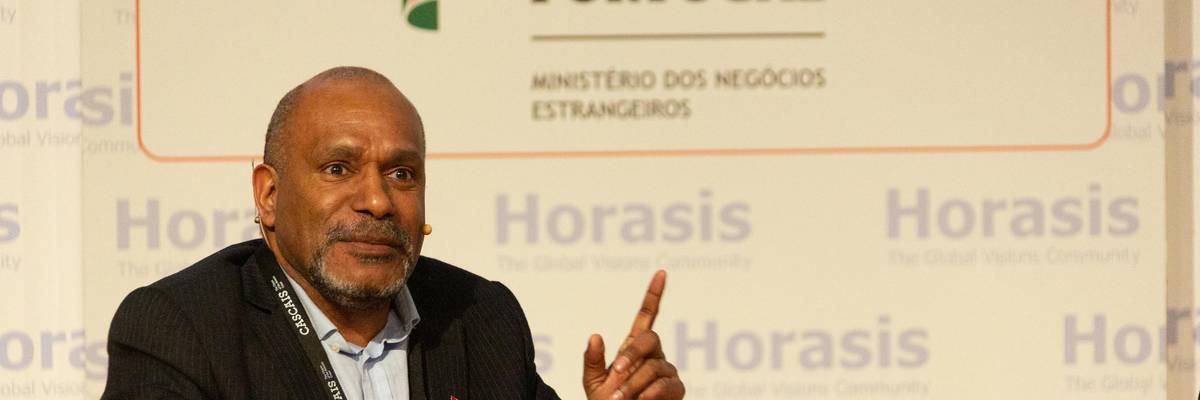
West Papuan independence movement leader Benny Wenda wants to make his nation the world's first "green state."
Indigenous Campaigners Want to Make West Papua 'Earth's First Green State'
Independence activists want to combine the best parts of liberal democracy with Indigenous traditions.
Due to the strength of their diverse indigenous traditions and the unique biodiversity of their lands, it is axiomatic for West Papuans that human life and nature are inseparable.
Now, the leaders of the province’s independence movement have a proposal to make it “Earth’s first green state”.
As Benny Wenda, exiled leader of the United Liberation Movement for West Papua (ULMWP), told a conference at Queen Mary University of London (QMUL) on 9 December: “The forest is our friend, our supermarket, our medical cabin. You cannot separate West Papua from our environment. We have always been at peace with nature.”
Unfortunately, the Indonesian government, which has maintained a bloody and brutal occupation of West Papua for almost 60 years, and the global corporations they invite to “develop” its lands, does not abide by such values.
West Papua, which is home to more than 250 tribes with their own languages and cultures, has the third-largest rainforest in the world. But it is imperiled by gold mines, logging companies, palm oil plantations, and many more forms of resource extraction that strip the land bare. Mine sedimentation kills off plants and natural life for hundreds of kilometers around.
"We have the solution to the global climate crisis. Indigenous people should be able to manage their lands as they have done for thousands of years."
According to Lisa Tilley, a political ecologist at SOAS University of London, these ecological “dead zones” are a “paradise for pathogens”.
“Genetic diversity is usually the firewall which prevents pathogens spreading and making those zoonotic [animal-to-human] shifts,” Tilley says.
The Indonesian government claims to want to be part of an “Opec for the rainforests” – along with the Democratic Republic of Congo and Brazil – a rival to the club of oil-producing nations, promoting conservation rather than fossil fuels. But the reality on the ground is that rainforest destruction is ramping up.
A gold mine the size of Jakarta, the Indonesian capital, is being planned. In the ongoing construction of the Trans-Papua Highway, a forest area the size of Denmark could be cleared by 2036. The BBC reported in 2020 that Korean palm oil giant Korindo has cleared nearly 60,000 hectares of West Papuan forest, an area the size of Seoul.
An eco-revolution in West Papua, to protect this valuable landscape, is in all of our interests.
Wenda and the ULMWP have a plan for such a transformation. The Green State Vision is part of their program for independence.
“The Green State Vision is our offer to the world,” Wenda said. “We have the solution to the global climate crisis. Indigenous people should be able to manage their lands as they have done for thousands of years.”
The Green State Vision was developed based on the values of the indigenous Melanesian tribes of West Papua, where living in balance and harmony with nature are core values, and collectivity is emphasized over individualism. There are “three pillars” to the vision: environmental and social protection; customary guardianship; and democratic governance.
Measures would include making ecocide a serious criminal offense and compelling resource extraction companies to work within an ecologically sustainable framework. Guardianship of the forests, lands, and rivers will be restored to “customary authorities at family, clan and tribal level”.
The political model is an attempt to combine “the best features” of a liberal democratic state – a legislature, an independent judiciary, and so on – with approaches rooted in holistic indigenous practices that prioritize community-based decision-making and collective land rights. Could other parts of the world benefit from a similar approach?
Lessons for the rest of the world
As Joan Martinez-Alier, author of ‘Environmentalism for the Poor’, pointed out at the conference, while 5% of the world population is officially considered to be indigenous, they appear in 40% of known environmental justice disputes in the world.
The fact that indigenous communities tend to live off lands that hitherto have not been the object of ‘development’, and thus tend to be resource-rich, makes them targets for extractivist modes of capital accumulation. As such, environmental violence and resistance usually follow.
“Indigenous people are defending their rights at the extraction frontiers, motivated by their own cultural values and interests – sacredness, identity, and livelihood – against coloniality and racism,” Martinez-Alier added.
But even in the non-indigenous world, where workers have long since been torn from the land and survive via the market, inspiration can be taken from the Green State Vision’s willingness to criminalize ecocide and challenge the apparently sacred ‘right’ of capital to ruthlessly exploit nature.
David Whyte, director of the Centre for Climate Crime and Climate Justice at QMUL, said struggles for environmental justice in West Papua and countries like the UK are more intimately connected than we might think.
“If we don’t protect the world’s major forests from predatory business investors, then we have no chance at all to prevent global warming,” he explained. “Without the Amazon, the Congo, and the New Guinea forests, the world stops breathing. London-based companies are major beneficiaries of this. The likes of BP and Unilever, heavily invested in West Papua, quite literally profit from our asphyxiation.
“The West Papuan Green State Vision offers us a way out of the predatory cycle. It offers the most viable way for us to keep us all breathing and to keep us all alive.”
An Urgent Message From Our Co-Founder
Dear Common Dreams reader, It’s been nearly 30 years since I co-founded Common Dreams with my late wife, Lina Newhouser. We had the radical notion that journalism should serve the public good, not corporate profits. It was clear to us from the outset what it would take to build such a project. No paid advertisements. No corporate sponsors. No millionaire publisher telling us what to think or do. Many people said we wouldn't last a year, but we proved those doubters wrong. Together with a tremendous team of journalists and dedicated staff, we built an independent media outlet free from the constraints of profits and corporate control. Our mission has always been simple: To inform. To inspire. To ignite change for the common good. Building Common Dreams was not easy. Our survival was never guaranteed. When you take on the most powerful forces—Wall Street greed, fossil fuel industry destruction, Big Tech lobbyists, and uber-rich oligarchs who have spent billions upon billions rigging the economy and democracy in their favor—the only bulwark you have is supporters who believe in your work. But here’s the urgent message from me today. It's never been this bad out there. And it's never been this hard to keep us going. At the very moment Common Dreams is most needed, the threats we face are intensifying. We need your support now more than ever. We don't accept corporate advertising and never will. We don't have a paywall because we don't think people should be blocked from critical news based on their ability to pay. Everything we do is funded by the donations of readers like you. When everyone does the little they can afford, we are strong. But if that support retreats or dries up, so do we. Will you donate now to make sure Common Dreams not only survives but thrives? —Craig Brown, Co-founder |
Due to the strength of their diverse indigenous traditions and the unique biodiversity of their lands, it is axiomatic for West Papuans that human life and nature are inseparable.
Now, the leaders of the province’s independence movement have a proposal to make it “Earth’s first green state”.
As Benny Wenda, exiled leader of the United Liberation Movement for West Papua (ULMWP), told a conference at Queen Mary University of London (QMUL) on 9 December: “The forest is our friend, our supermarket, our medical cabin. You cannot separate West Papua from our environment. We have always been at peace with nature.”
Unfortunately, the Indonesian government, which has maintained a bloody and brutal occupation of West Papua for almost 60 years, and the global corporations they invite to “develop” its lands, does not abide by such values.
West Papua, which is home to more than 250 tribes with their own languages and cultures, has the third-largest rainforest in the world. But it is imperiled by gold mines, logging companies, palm oil plantations, and many more forms of resource extraction that strip the land bare. Mine sedimentation kills off plants and natural life for hundreds of kilometers around.
"We have the solution to the global climate crisis. Indigenous people should be able to manage their lands as they have done for thousands of years."
According to Lisa Tilley, a political ecologist at SOAS University of London, these ecological “dead zones” are a “paradise for pathogens”.
“Genetic diversity is usually the firewall which prevents pathogens spreading and making those zoonotic [animal-to-human] shifts,” Tilley says.
The Indonesian government claims to want to be part of an “Opec for the rainforests” – along with the Democratic Republic of Congo and Brazil – a rival to the club of oil-producing nations, promoting conservation rather than fossil fuels. But the reality on the ground is that rainforest destruction is ramping up.
A gold mine the size of Jakarta, the Indonesian capital, is being planned. In the ongoing construction of the Trans-Papua Highway, a forest area the size of Denmark could be cleared by 2036. The BBC reported in 2020 that Korean palm oil giant Korindo has cleared nearly 60,000 hectares of West Papuan forest, an area the size of Seoul.
An eco-revolution in West Papua, to protect this valuable landscape, is in all of our interests.
Wenda and the ULMWP have a plan for such a transformation. The Green State Vision is part of their program for independence.
“The Green State Vision is our offer to the world,” Wenda said. “We have the solution to the global climate crisis. Indigenous people should be able to manage their lands as they have done for thousands of years.”
The Green State Vision was developed based on the values of the indigenous Melanesian tribes of West Papua, where living in balance and harmony with nature are core values, and collectivity is emphasized over individualism. There are “three pillars” to the vision: environmental and social protection; customary guardianship; and democratic governance.
Measures would include making ecocide a serious criminal offense and compelling resource extraction companies to work within an ecologically sustainable framework. Guardianship of the forests, lands, and rivers will be restored to “customary authorities at family, clan and tribal level”.
The political model is an attempt to combine “the best features” of a liberal democratic state – a legislature, an independent judiciary, and so on – with approaches rooted in holistic indigenous practices that prioritize community-based decision-making and collective land rights. Could other parts of the world benefit from a similar approach?
Lessons for the rest of the world
As Joan Martinez-Alier, author of ‘Environmentalism for the Poor’, pointed out at the conference, while 5% of the world population is officially considered to be indigenous, they appear in 40% of known environmental justice disputes in the world.
The fact that indigenous communities tend to live off lands that hitherto have not been the object of ‘development’, and thus tend to be resource-rich, makes them targets for extractivist modes of capital accumulation. As such, environmental violence and resistance usually follow.
“Indigenous people are defending their rights at the extraction frontiers, motivated by their own cultural values and interests – sacredness, identity, and livelihood – against coloniality and racism,” Martinez-Alier added.
But even in the non-indigenous world, where workers have long since been torn from the land and survive via the market, inspiration can be taken from the Green State Vision’s willingness to criminalize ecocide and challenge the apparently sacred ‘right’ of capital to ruthlessly exploit nature.
David Whyte, director of the Centre for Climate Crime and Climate Justice at QMUL, said struggles for environmental justice in West Papua and countries like the UK are more intimately connected than we might think.
“If we don’t protect the world’s major forests from predatory business investors, then we have no chance at all to prevent global warming,” he explained. “Without the Amazon, the Congo, and the New Guinea forests, the world stops breathing. London-based companies are major beneficiaries of this. The likes of BP and Unilever, heavily invested in West Papua, quite literally profit from our asphyxiation.
“The West Papuan Green State Vision offers us a way out of the predatory cycle. It offers the most viable way for us to keep us all breathing and to keep us all alive.”
Due to the strength of their diverse indigenous traditions and the unique biodiversity of their lands, it is axiomatic for West Papuans that human life and nature are inseparable.
Now, the leaders of the province’s independence movement have a proposal to make it “Earth’s first green state”.
As Benny Wenda, exiled leader of the United Liberation Movement for West Papua (ULMWP), told a conference at Queen Mary University of London (QMUL) on 9 December: “The forest is our friend, our supermarket, our medical cabin. You cannot separate West Papua from our environment. We have always been at peace with nature.”
Unfortunately, the Indonesian government, which has maintained a bloody and brutal occupation of West Papua for almost 60 years, and the global corporations they invite to “develop” its lands, does not abide by such values.
West Papua, which is home to more than 250 tribes with their own languages and cultures, has the third-largest rainforest in the world. But it is imperiled by gold mines, logging companies, palm oil plantations, and many more forms of resource extraction that strip the land bare. Mine sedimentation kills off plants and natural life for hundreds of kilometers around.
"We have the solution to the global climate crisis. Indigenous people should be able to manage their lands as they have done for thousands of years."
According to Lisa Tilley, a political ecologist at SOAS University of London, these ecological “dead zones” are a “paradise for pathogens”.
“Genetic diversity is usually the firewall which prevents pathogens spreading and making those zoonotic [animal-to-human] shifts,” Tilley says.
The Indonesian government claims to want to be part of an “Opec for the rainforests” – along with the Democratic Republic of Congo and Brazil – a rival to the club of oil-producing nations, promoting conservation rather than fossil fuels. But the reality on the ground is that rainforest destruction is ramping up.
A gold mine the size of Jakarta, the Indonesian capital, is being planned. In the ongoing construction of the Trans-Papua Highway, a forest area the size of Denmark could be cleared by 2036. The BBC reported in 2020 that Korean palm oil giant Korindo has cleared nearly 60,000 hectares of West Papuan forest, an area the size of Seoul.
An eco-revolution in West Papua, to protect this valuable landscape, is in all of our interests.
Wenda and the ULMWP have a plan for such a transformation. The Green State Vision is part of their program for independence.
“The Green State Vision is our offer to the world,” Wenda said. “We have the solution to the global climate crisis. Indigenous people should be able to manage their lands as they have done for thousands of years.”
The Green State Vision was developed based on the values of the indigenous Melanesian tribes of West Papua, where living in balance and harmony with nature are core values, and collectivity is emphasized over individualism. There are “three pillars” to the vision: environmental and social protection; customary guardianship; and democratic governance.
Measures would include making ecocide a serious criminal offense and compelling resource extraction companies to work within an ecologically sustainable framework. Guardianship of the forests, lands, and rivers will be restored to “customary authorities at family, clan and tribal level”.
The political model is an attempt to combine “the best features” of a liberal democratic state – a legislature, an independent judiciary, and so on – with approaches rooted in holistic indigenous practices that prioritize community-based decision-making and collective land rights. Could other parts of the world benefit from a similar approach?
Lessons for the rest of the world
As Joan Martinez-Alier, author of ‘Environmentalism for the Poor’, pointed out at the conference, while 5% of the world population is officially considered to be indigenous, they appear in 40% of known environmental justice disputes in the world.
The fact that indigenous communities tend to live off lands that hitherto have not been the object of ‘development’, and thus tend to be resource-rich, makes them targets for extractivist modes of capital accumulation. As such, environmental violence and resistance usually follow.
“Indigenous people are defending their rights at the extraction frontiers, motivated by their own cultural values and interests – sacredness, identity, and livelihood – against coloniality and racism,” Martinez-Alier added.
But even in the non-indigenous world, where workers have long since been torn from the land and survive via the market, inspiration can be taken from the Green State Vision’s willingness to criminalize ecocide and challenge the apparently sacred ‘right’ of capital to ruthlessly exploit nature.
David Whyte, director of the Centre for Climate Crime and Climate Justice at QMUL, said struggles for environmental justice in West Papua and countries like the UK are more intimately connected than we might think.
“If we don’t protect the world’s major forests from predatory business investors, then we have no chance at all to prevent global warming,” he explained. “Without the Amazon, the Congo, and the New Guinea forests, the world stops breathing. London-based companies are major beneficiaries of this. The likes of BP and Unilever, heavily invested in West Papua, quite literally profit from our asphyxiation.
“The West Papuan Green State Vision offers us a way out of the predatory cycle. It offers the most viable way for us to keep us all breathing and to keep us all alive.”