SUBSCRIBE TO OUR FREE NEWSLETTER
Daily news & progressive opinion—funded by the people, not the corporations—delivered straight to your inbox.
5
#000000
#FFFFFF
To donate by check, phone, or other method, see our More Ways to Give page.
Daily news & progressive opinion—funded by the people, not the corporations—delivered straight to your inbox.
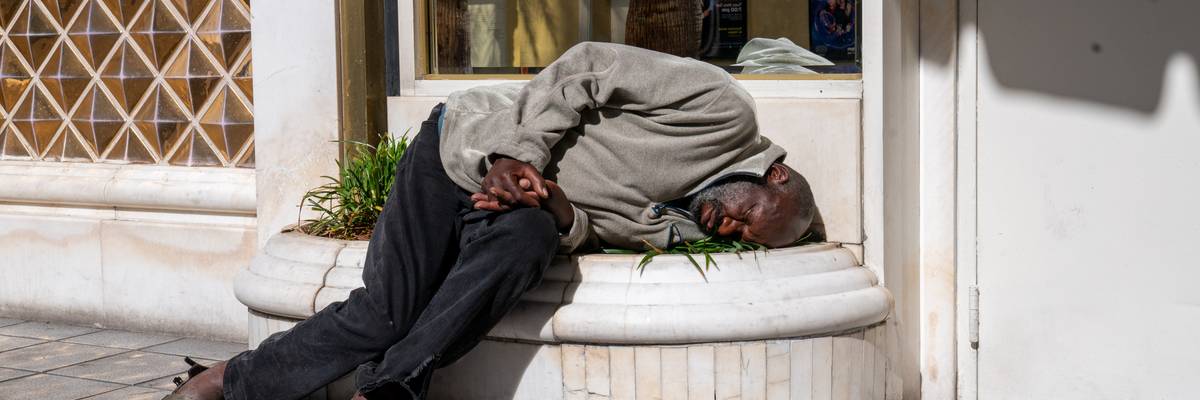
A homeless person sleeps on a sidewalk April 15, 2023 in downtown Las Vegas, Nevada.
A huge swath of the political and media spectrum sees a person living on the street as either an aesthetic nuisance or criminal-in-waiting. We should see them for who they are: a person suffering and vulnerable, deserving of our empathy.
Last month, Fox News’s Brian Kilmeade said of people living with mental illness on our streets: “Involuntary lethal injection… Just kill ’em.” He apologized—after the clip ricocheted across the internet—but the words were said, on air, to millions.
I run a nonprofit that directly serves the homeless. We meet people where they are—under overpasses, on subways, in shelters and supportive housing. I see, daily, how language like “vagrant,” or “zombie” strips people of their personhood. It lowers the public’s guard against cruelty and raises the political ceiling for punitive policies. We cannot afford to pretend that words don’t matter.
“Vagrancy,” once a legal catch‑all used to police and punish poor and Black Americans, is being rehabilitated in public discourse; historians have warned what that signals. And major tabloids routinely label our neighbors “vagrants” in crime headlines, blending poverty status with criminal identity in ways that echo the past.
Even federal policy is now framed around “fighting vagrancy.” That phrase isn’t from a century‑old placard; it’s the heading and premise of a July 2025 executive order, which opens by declaring “endemic vagrancy” a public menace and directs federal agencies to prioritize encampment removals and civil commitment.
The best research shows people experiencing homelessness are far more often victims of violence than perpetrators.
A huge swath of the political and media spectrum sees a person living on the street as either an aesthetic nuisance or criminal-in-waiting. To them, a person living on the street is barely a person at all but rather an indication of broader disorder that must be swept away or removed. But where should they be removed to? What should happen to them when they get there? Those questions are unimportant to certain portions of the media and political ecosystem.
The Supreme Court’s Grants Pass v. Johnson ruling in 2024 cleared the way for cities to punish sleeping outside even when shelter is unavailable. Some jurisdictions have read that as a green light for broader crackdowns rather than investments in housing and health care—turning survival behaviors into ticketable or jailable offenses. The July executive order doubled down, instructing federal agencies to preference grants for jurisdictions that enforce bans on “urban camping and loitering” and to support encampment removals with federal dollars. Words like “vagrancy” aren’t just stigmatizing; they now allocate money and power.
This year we saw what happens when the politics of sweeps outrun basic safety. In January, Cornelius Taylor was killed by a bulldozer during an encampment clearance in Atlanta—first chalked up to overdose, later shown by autopsy to be blunt‑force trauma. And in my home city of New York, Debrina Kawam was fatally set on fire by a stranger while she was sleeping in a subway car. Vocabulary that treats people as nuisances rather than neighbors makes such tragedies more likely.
I know public disorder is real. But I also know—by data and by name—that most of the people you step past on your commute are surviving traumas you don’t see.
The best research shows people experiencing homelessness are far more often victims of violence than perpetrators. In California’s landmark CASPEH study, 38% of participants experienced violence during their current episode of homelessness, and nearly three quarters reported violence at some point in their lives. Mortality data tell the same story of precarity. In Los Angeles County alone, 2,508 people experiencing homelessness died in 2023—an average of nearly seven people every day. The rate remains multiple times higher than that of the general population.
As a sector, we’ll keep doing our part: street outreach, housing navigation, medical and behavioral health care, and prevention. But leaders in government and media must stop normalizing language that primes the public for harm. Phrases like “person without housing” or “person who is homeless” more accurately reflect that homelessness is a temporary status, not an identity or permanent state of being. And in most cases, we can refer to our neighbors in media stories or political policy without any reference to their housing status.
I know public disorder is real. But I also know—by data and by name—that most of the people you step past on your commute are surviving traumas you don’t see. They are sons, daughters, parents, veterans, and caregivers. Some are literally recovering from yesterday’s assault. They are not “vermin.” They are not “zombies.”
Dear Common Dreams reader, It’s been nearly 30 years since I co-founded Common Dreams with my late wife, Lina Newhouser. We had the radical notion that journalism should serve the public good, not corporate profits. It was clear to us from the outset what it would take to build such a project. No paid advertisements. No corporate sponsors. No millionaire publisher telling us what to think or do. Many people said we wouldn't last a year, but we proved those doubters wrong. Together with a tremendous team of journalists and dedicated staff, we built an independent media outlet free from the constraints of profits and corporate control. Our mission has always been simple: To inform. To inspire. To ignite change for the common good. Building Common Dreams was not easy. Our survival was never guaranteed. When you take on the most powerful forces—Wall Street greed, fossil fuel industry destruction, Big Tech lobbyists, and uber-rich oligarchs who have spent billions upon billions rigging the economy and democracy in their favor—the only bulwark you have is supporters who believe in your work. But here’s the urgent message from me today. It's never been this bad out there. And it's never been this hard to keep us going. At the very moment Common Dreams is most needed, the threats we face are intensifying. We need your support now more than ever. We don't accept corporate advertising and never will. We don't have a paywall because we don't think people should be blocked from critical news based on their ability to pay. Everything we do is funded by the donations of readers like you. When everyone does the little they can afford, we are strong. But if that support retreats or dries up, so do we. Will you donate now to make sure Common Dreams not only survives but thrives? —Craig Brown, Co-founder |
Last month, Fox News’s Brian Kilmeade said of people living with mental illness on our streets: “Involuntary lethal injection… Just kill ’em.” He apologized—after the clip ricocheted across the internet—but the words were said, on air, to millions.
I run a nonprofit that directly serves the homeless. We meet people where they are—under overpasses, on subways, in shelters and supportive housing. I see, daily, how language like “vagrant,” or “zombie” strips people of their personhood. It lowers the public’s guard against cruelty and raises the political ceiling for punitive policies. We cannot afford to pretend that words don’t matter.
“Vagrancy,” once a legal catch‑all used to police and punish poor and Black Americans, is being rehabilitated in public discourse; historians have warned what that signals. And major tabloids routinely label our neighbors “vagrants” in crime headlines, blending poverty status with criminal identity in ways that echo the past.
Even federal policy is now framed around “fighting vagrancy.” That phrase isn’t from a century‑old placard; it’s the heading and premise of a July 2025 executive order, which opens by declaring “endemic vagrancy” a public menace and directs federal agencies to prioritize encampment removals and civil commitment.
The best research shows people experiencing homelessness are far more often victims of violence than perpetrators.
A huge swath of the political and media spectrum sees a person living on the street as either an aesthetic nuisance or criminal-in-waiting. To them, a person living on the street is barely a person at all but rather an indication of broader disorder that must be swept away or removed. But where should they be removed to? What should happen to them when they get there? Those questions are unimportant to certain portions of the media and political ecosystem.
The Supreme Court’s Grants Pass v. Johnson ruling in 2024 cleared the way for cities to punish sleeping outside even when shelter is unavailable. Some jurisdictions have read that as a green light for broader crackdowns rather than investments in housing and health care—turning survival behaviors into ticketable or jailable offenses. The July executive order doubled down, instructing federal agencies to preference grants for jurisdictions that enforce bans on “urban camping and loitering” and to support encampment removals with federal dollars. Words like “vagrancy” aren’t just stigmatizing; they now allocate money and power.
This year we saw what happens when the politics of sweeps outrun basic safety. In January, Cornelius Taylor was killed by a bulldozer during an encampment clearance in Atlanta—first chalked up to overdose, later shown by autopsy to be blunt‑force trauma. And in my home city of New York, Debrina Kawam was fatally set on fire by a stranger while she was sleeping in a subway car. Vocabulary that treats people as nuisances rather than neighbors makes such tragedies more likely.
I know public disorder is real. But I also know—by data and by name—that most of the people you step past on your commute are surviving traumas you don’t see.
The best research shows people experiencing homelessness are far more often victims of violence than perpetrators. In California’s landmark CASPEH study, 38% of participants experienced violence during their current episode of homelessness, and nearly three quarters reported violence at some point in their lives. Mortality data tell the same story of precarity. In Los Angeles County alone, 2,508 people experiencing homelessness died in 2023—an average of nearly seven people every day. The rate remains multiple times higher than that of the general population.
As a sector, we’ll keep doing our part: street outreach, housing navigation, medical and behavioral health care, and prevention. But leaders in government and media must stop normalizing language that primes the public for harm. Phrases like “person without housing” or “person who is homeless” more accurately reflect that homelessness is a temporary status, not an identity or permanent state of being. And in most cases, we can refer to our neighbors in media stories or political policy without any reference to their housing status.
I know public disorder is real. But I also know—by data and by name—that most of the people you step past on your commute are surviving traumas you don’t see. They are sons, daughters, parents, veterans, and caregivers. Some are literally recovering from yesterday’s assault. They are not “vermin.” They are not “zombies.”
Last month, Fox News’s Brian Kilmeade said of people living with mental illness on our streets: “Involuntary lethal injection… Just kill ’em.” He apologized—after the clip ricocheted across the internet—but the words were said, on air, to millions.
I run a nonprofit that directly serves the homeless. We meet people where they are—under overpasses, on subways, in shelters and supportive housing. I see, daily, how language like “vagrant,” or “zombie” strips people of their personhood. It lowers the public’s guard against cruelty and raises the political ceiling for punitive policies. We cannot afford to pretend that words don’t matter.
“Vagrancy,” once a legal catch‑all used to police and punish poor and Black Americans, is being rehabilitated in public discourse; historians have warned what that signals. And major tabloids routinely label our neighbors “vagrants” in crime headlines, blending poverty status with criminal identity in ways that echo the past.
Even federal policy is now framed around “fighting vagrancy.” That phrase isn’t from a century‑old placard; it’s the heading and premise of a July 2025 executive order, which opens by declaring “endemic vagrancy” a public menace and directs federal agencies to prioritize encampment removals and civil commitment.
The best research shows people experiencing homelessness are far more often victims of violence than perpetrators.
A huge swath of the political and media spectrum sees a person living on the street as either an aesthetic nuisance or criminal-in-waiting. To them, a person living on the street is barely a person at all but rather an indication of broader disorder that must be swept away or removed. But where should they be removed to? What should happen to them when they get there? Those questions are unimportant to certain portions of the media and political ecosystem.
The Supreme Court’s Grants Pass v. Johnson ruling in 2024 cleared the way for cities to punish sleeping outside even when shelter is unavailable. Some jurisdictions have read that as a green light for broader crackdowns rather than investments in housing and health care—turning survival behaviors into ticketable or jailable offenses. The July executive order doubled down, instructing federal agencies to preference grants for jurisdictions that enforce bans on “urban camping and loitering” and to support encampment removals with federal dollars. Words like “vagrancy” aren’t just stigmatizing; they now allocate money and power.
This year we saw what happens when the politics of sweeps outrun basic safety. In January, Cornelius Taylor was killed by a bulldozer during an encampment clearance in Atlanta—first chalked up to overdose, later shown by autopsy to be blunt‑force trauma. And in my home city of New York, Debrina Kawam was fatally set on fire by a stranger while she was sleeping in a subway car. Vocabulary that treats people as nuisances rather than neighbors makes such tragedies more likely.
I know public disorder is real. But I also know—by data and by name—that most of the people you step past on your commute are surviving traumas you don’t see.
The best research shows people experiencing homelessness are far more often victims of violence than perpetrators. In California’s landmark CASPEH study, 38% of participants experienced violence during their current episode of homelessness, and nearly three quarters reported violence at some point in their lives. Mortality data tell the same story of precarity. In Los Angeles County alone, 2,508 people experiencing homelessness died in 2023—an average of nearly seven people every day. The rate remains multiple times higher than that of the general population.
As a sector, we’ll keep doing our part: street outreach, housing navigation, medical and behavioral health care, and prevention. But leaders in government and media must stop normalizing language that primes the public for harm. Phrases like “person without housing” or “person who is homeless” more accurately reflect that homelessness is a temporary status, not an identity or permanent state of being. And in most cases, we can refer to our neighbors in media stories or political policy without any reference to their housing status.
I know public disorder is real. But I also know—by data and by name—that most of the people you step past on your commute are surviving traumas you don’t see. They are sons, daughters, parents, veterans, and caregivers. Some are literally recovering from yesterday’s assault. They are not “vermin.” They are not “zombies.”