

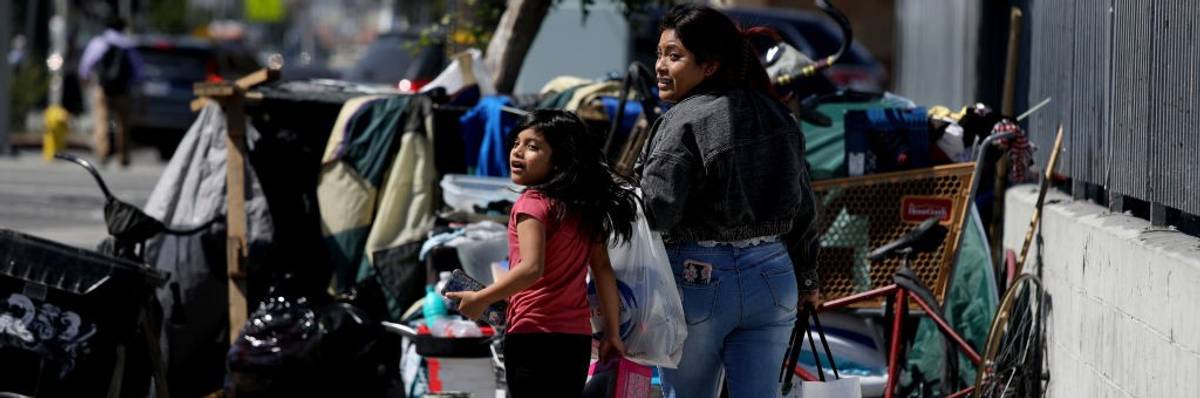
A young girl and a woman look before walking into the street to get around a homeless encampment blocking the sidewalk along the 7200 block of Vermont at Florence in South Central on Thursday, July 6, 2023 in Los Angeles, CA.
Landlord Greed and the Cruel Barbarism of a Housing Lottery for Children
The housing affordability crisis is a moral outrage of the highest order. So why does Los Angeles leave kids and adults to suffer?
For California’s homeless population, it is a multi-generational affair. After decades of inaction and utter indifference, there are now hundreds of homeless children on the streets of Los Angeles.
Dozens of children on Skid Row make the trek to school, making their way past tents, tarp shelters, discarded needles, and human waste. Some are lucky, finding a school bus to avoid the chaos. Others, not so much.
Once again, I ask, when is enough, enough? In a city with a school district that has 1,300 buses, there are homeless kids trekking past needles and feces to reach their classroom. In one of the world’s richest cities, there is poverty unseen anywhere else.
One of America's most famous short stories is “The Lottery” by Shirley Jackson. It is the story of a fictional small town in which the whole community prepares for the annual harvest ritual by holding a random lottery to choose a special person. That one "lucky" person—it later is revealed—is to be stoned to death. When this story was first published in The New Yorker, it was met with outrage.
What is the point of such a barbaric story? It forces us to contemplate why we follow meaningless traditions.
Instead of stoning a single person, we subject tens of thousands of people—children included—to the savagery of homelessness.
California has adopted such a barbaric tradition. Instead of stoning a single person, we subject tens of thousands of people—children included—to the savagery of homelessness, knowing full well it will lead them to addiction, mental illness, and death. We may not literally be throwing the stones, but we nevertheless are exacting the punishment. We tolerate the status quo which perpetuates the tragedy.
The idea of a life-and-death lottery is more than a metaphor. Federal housing vouchers actually are distributed through a lottery system that amounts to a game of musical chairs. Not only are few eligible for these vouchers, but very often, they cannot find a landlord who will take them. The music stops, and they are homeless.
Bad things happen to good people, and good people allow bad things to happen to others. We didn't invent the lottery. Therefore, it isn't our responsibility to fix it—because it isn't happening to us, until it is. When we look back in history and wonder how people could have tolerated terrible things that were done in their name, remember we are witnesses in real time to the mass tragedy of a crippling affordable housing crisis. Mostly, we throw up our hands and think that we are powerless to change it. We are not.
Collectively, we are that quaint town that allows the tradition of stoning to continue.
The housing affordability crisis is a moral outrage of the highest order. None of our leaders who preside over it without fundamentally addressing it deserve to be re-elected. Collectively, we are that quaint town that allows the tradition of stoning to continue.
But there is a difference here. We are not equally culpable. There is a tiny group of multi-billionaires who actually profit spectacularly off the lottery. Stephen Schwarzman—the king of the real estate oligarchs—is worth nearly $40 billion, made from milking tenants. The California Apartment Association amounts to a corporate real estate cartel dedicated to squeezing the last drop of blood from the stone that is the tenant community. Then there are their handmaidens in Sacramento who enable them.
We need an entirely new vision for California that not only restores the California dream, but transforms it for future generations. It is easy to get spoiled when you live in such a land of milk and honey. LA’s physical splendor and gorgeous weather can lull us into a false sense of privilege.
We need an entirely new vision for California that not only restores the California dream, but transforms it for future generations.
A state that boasts 179 billionaires, California is the cultural capital of the world and the birthplace of many of the largest technology companies on the planet. We have no excuse for being so dysfunctional. However, when you have so much, you feel like you can afford to waste—or you just don’t pay attention.
People are fleeing California in droves because they can’t afford to live here. Even if they can afford their rent, the prospect of never owning a home or saving meaningfully is so discouraging that it is easier to flee.
That’s how the doom loop begins to accelerate out of control. Californians are crying for help, and some are barely toddlers.
We don't have to cede our state to a greedy landlord cartel. The time for rent control, tenant protections, and dignified public housing is now—if the people answer the cries for a new California.
We are at a crossroads
This country and this world are at a monumental crossroads. In a few short weeks, US voters will have an opportunity to beat back the forces of fascism and confront the billionaires who are rigging the economy, our media system, and our democracy, making it increasingly impossible for ordinary people to get by. We’re not just talking about the election. We’re talking about what must be done once these fascist elements are vanquished from power. We need a bolder set of solutions than what either major party has so far been willing to offer and a working-class movement ready to fight like hell for it. Trump didn't emerge from nowhere. The conditions that fueled MAGA authoritarianism were created by decades of radical neoliberal economic policies and a corrupt political system dominated by corporate interests. They slashed taxes on the super-rich, promising that the benefits would trickle down. They said giveaways to the corporate titans would make life more affordable for the rest of us. It was all bullshit. And when a bitter, betrayed populace searches for someone to blame, right-wing demagogues have little trouble finding scapegoats. People know when they're being lied to, but you won't hear any of this from the corporate media. Only independent journalism—powered and funded by people who believe in building a better world—can deliver truly trustworthy daily news. Our Fall Campaign is underway, and we need your help. To power our newsroom through the rest of the year, we need to raise $125,000 by midnight on October 31. So if you share our vision, please contribute whatever you can to sustain our work. |
Michael Weinstein is the president of AIDS Healthcare Foundation (AHF), the largest global HIV/AIDS organization, and AHF’s Healthy Housing Foundation.
For California’s homeless population, it is a multi-generational affair. After decades of inaction and utter indifference, there are now hundreds of homeless children on the streets of Los Angeles.
Dozens of children on Skid Row make the trek to school, making their way past tents, tarp shelters, discarded needles, and human waste. Some are lucky, finding a school bus to avoid the chaos. Others, not so much.
Once again, I ask, when is enough, enough? In a city with a school district that has 1,300 buses, there are homeless kids trekking past needles and feces to reach their classroom. In one of the world’s richest cities, there is poverty unseen anywhere else.
One of America's most famous short stories is “The Lottery” by Shirley Jackson. It is the story of a fictional small town in which the whole community prepares for the annual harvest ritual by holding a random lottery to choose a special person. That one "lucky" person—it later is revealed—is to be stoned to death. When this story was first published in The New Yorker, it was met with outrage.
What is the point of such a barbaric story? It forces us to contemplate why we follow meaningless traditions.
Instead of stoning a single person, we subject tens of thousands of people—children included—to the savagery of homelessness.
California has adopted such a barbaric tradition. Instead of stoning a single person, we subject tens of thousands of people—children included—to the savagery of homelessness, knowing full well it will lead them to addiction, mental illness, and death. We may not literally be throwing the stones, but we nevertheless are exacting the punishment. We tolerate the status quo which perpetuates the tragedy.
The idea of a life-and-death lottery is more than a metaphor. Federal housing vouchers actually are distributed through a lottery system that amounts to a game of musical chairs. Not only are few eligible for these vouchers, but very often, they cannot find a landlord who will take them. The music stops, and they are homeless.
Bad things happen to good people, and good people allow bad things to happen to others. We didn't invent the lottery. Therefore, it isn't our responsibility to fix it—because it isn't happening to us, until it is. When we look back in history and wonder how people could have tolerated terrible things that were done in their name, remember we are witnesses in real time to the mass tragedy of a crippling affordable housing crisis. Mostly, we throw up our hands and think that we are powerless to change it. We are not.
Collectively, we are that quaint town that allows the tradition of stoning to continue.
The housing affordability crisis is a moral outrage of the highest order. None of our leaders who preside over it without fundamentally addressing it deserve to be re-elected. Collectively, we are that quaint town that allows the tradition of stoning to continue.
But there is a difference here. We are not equally culpable. There is a tiny group of multi-billionaires who actually profit spectacularly off the lottery. Stephen Schwarzman—the king of the real estate oligarchs—is worth nearly $40 billion, made from milking tenants. The California Apartment Association amounts to a corporate real estate cartel dedicated to squeezing the last drop of blood from the stone that is the tenant community. Then there are their handmaidens in Sacramento who enable them.
We need an entirely new vision for California that not only restores the California dream, but transforms it for future generations. It is easy to get spoiled when you live in such a land of milk and honey. LA’s physical splendor and gorgeous weather can lull us into a false sense of privilege.
We need an entirely new vision for California that not only restores the California dream, but transforms it for future generations.
A state that boasts 179 billionaires, California is the cultural capital of the world and the birthplace of many of the largest technology companies on the planet. We have no excuse for being so dysfunctional. However, when you have so much, you feel like you can afford to waste—or you just don’t pay attention.
People are fleeing California in droves because they can’t afford to live here. Even if they can afford their rent, the prospect of never owning a home or saving meaningfully is so discouraging that it is easier to flee.
That’s how the doom loop begins to accelerate out of control. Californians are crying for help, and some are barely toddlers.
We don't have to cede our state to a greedy landlord cartel. The time for rent control, tenant protections, and dignified public housing is now—if the people answer the cries for a new California.
Michael Weinstein is the president of AIDS Healthcare Foundation (AHF), the largest global HIV/AIDS organization, and AHF’s Healthy Housing Foundation.
For California’s homeless population, it is a multi-generational affair. After decades of inaction and utter indifference, there are now hundreds of homeless children on the streets of Los Angeles.
Dozens of children on Skid Row make the trek to school, making their way past tents, tarp shelters, discarded needles, and human waste. Some are lucky, finding a school bus to avoid the chaos. Others, not so much.
Once again, I ask, when is enough, enough? In a city with a school district that has 1,300 buses, there are homeless kids trekking past needles and feces to reach their classroom. In one of the world’s richest cities, there is poverty unseen anywhere else.
One of America's most famous short stories is “The Lottery” by Shirley Jackson. It is the story of a fictional small town in which the whole community prepares for the annual harvest ritual by holding a random lottery to choose a special person. That one "lucky" person—it later is revealed—is to be stoned to death. When this story was first published in The New Yorker, it was met with outrage.
What is the point of such a barbaric story? It forces us to contemplate why we follow meaningless traditions.
Instead of stoning a single person, we subject tens of thousands of people—children included—to the savagery of homelessness.
California has adopted such a barbaric tradition. Instead of stoning a single person, we subject tens of thousands of people—children included—to the savagery of homelessness, knowing full well it will lead them to addiction, mental illness, and death. We may not literally be throwing the stones, but we nevertheless are exacting the punishment. We tolerate the status quo which perpetuates the tragedy.
The idea of a life-and-death lottery is more than a metaphor. Federal housing vouchers actually are distributed through a lottery system that amounts to a game of musical chairs. Not only are few eligible for these vouchers, but very often, they cannot find a landlord who will take them. The music stops, and they are homeless.
Bad things happen to good people, and good people allow bad things to happen to others. We didn't invent the lottery. Therefore, it isn't our responsibility to fix it—because it isn't happening to us, until it is. When we look back in history and wonder how people could have tolerated terrible things that were done in their name, remember we are witnesses in real time to the mass tragedy of a crippling affordable housing crisis. Mostly, we throw up our hands and think that we are powerless to change it. We are not.
Collectively, we are that quaint town that allows the tradition of stoning to continue.
The housing affordability crisis is a moral outrage of the highest order. None of our leaders who preside over it without fundamentally addressing it deserve to be re-elected. Collectively, we are that quaint town that allows the tradition of stoning to continue.
But there is a difference here. We are not equally culpable. There is a tiny group of multi-billionaires who actually profit spectacularly off the lottery. Stephen Schwarzman—the king of the real estate oligarchs—is worth nearly $40 billion, made from milking tenants. The California Apartment Association amounts to a corporate real estate cartel dedicated to squeezing the last drop of blood from the stone that is the tenant community. Then there are their handmaidens in Sacramento who enable them.
We need an entirely new vision for California that not only restores the California dream, but transforms it for future generations. It is easy to get spoiled when you live in such a land of milk and honey. LA’s physical splendor and gorgeous weather can lull us into a false sense of privilege.
We need an entirely new vision for California that not only restores the California dream, but transforms it for future generations.
A state that boasts 179 billionaires, California is the cultural capital of the world and the birthplace of many of the largest technology companies on the planet. We have no excuse for being so dysfunctional. However, when you have so much, you feel like you can afford to waste—or you just don’t pay attention.
People are fleeing California in droves because they can’t afford to live here. Even if they can afford their rent, the prospect of never owning a home or saving meaningfully is so discouraging that it is easier to flee.
That’s how the doom loop begins to accelerate out of control. Californians are crying for help, and some are barely toddlers.
We don't have to cede our state to a greedy landlord cartel. The time for rent control, tenant protections, and dignified public housing is now—if the people answer the cries for a new California.