
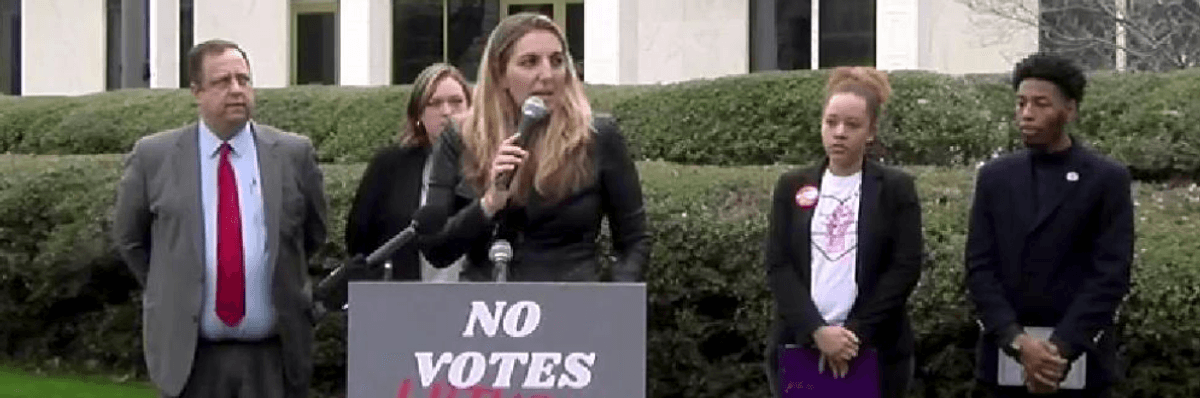
Jessica Jollett of Progress North Carolina spoke at a recent press conference outside of the General Assembly to oppose a temporary House rules change that she and other democracy advocates say undermines the will of the people. She was joined by representatives from the NC League of Conservation Voters, Planned Parenthood South Atlantic, Common Cause North Carolina, the North Carolina Association of Educators, and Equality North Carolina.
The GOP's Grip on Power Undermines Democracy Across the South
GOP leaders in some of state legislatures are using their expanded power to implement rules that undermine the usual deliberative process and allow controversial bills to be fast-tracked.
While Democrats defied historical trends in the 2022 midterm elections by blocking the Republican "red wave" that many pundits predicted would overtake the U.S. Congress, last year's election resulted in significant GOP gains in Southern state legislatures, bolstering their control of the region's politics.
Republicans gained about 55 legislative seats in Southern states in 2022 and now hold majorities in all of the region's legislative chambers except for the Virginia Senate. The GOP's largest gains came from West Virginia and Florida, where they gained 17 and 14 seats respectively.
Now GOP leaders in some of these legislatures are using their expanded power to implement legislative rules that undermine the usual deliberative process and allow controversial bills to be fast-tracked.
Take West Virginia, for instance. The state constitution mandates that a bill be "fully and distinctly read" three times in both the Senate and the House of Delegates "unless in case of urgency" — an exception requiring 80% of members present to suspend the rule. But last month, the state Senate suspended those constitutional rules to allow it to pass bills without having them go through committees, hearings, or debates — or even without making the text of the bills publicly available. On the first day of the legislative session alone, the Senate passed 23 bills this way. Among them was the "Anti-Racism Act of 2023," an updated version of a controversial proposal from last year that limits how subjects like racial discrimination are taught in K-12 public schools.
"This robs the public of the thoughtful, transparent process we are owed," the American Civil Liberties Union of West Virginia wrote on Twitter.
In Tennessee, the Republican House supermajority voted last month to limit debate on legislation, claiming it's for efficiency. The new rules cut the speaking time for any lawmaker recognized on the floor from 10 minutes to five. They also change how special caucus groups are recognized. For example, members of the state's Black Caucus told News Channel 5 that it appears they now will need approval from the speaker, as well as the leaders of both parties.
Democrats blasted the move. "We need more transparency in government, not less," House Democratic Caucus Chair John Ray Clemmons of Nashville told The Tennessee Holler.
'A shameful power grab'
In North Carolina, this year’s legislative session began with a temporary House rules change eliminating the requirement for legislative leaders to give two days' notice before holding a vote to override a veto by Democratic Gov. Roy Cooper, who has vetoed more bills than all of his predecessors combined. This would make it easier for Republicans in the House — where after last year's midterms the GOP is just one seat shy of holding a veto-proof supermajority — to hold override votes without all Democratic members of the chamber being present. Republicans hold a supermajority in the state Senate after gaining two seats last year.
North Carolina's Republican legislative leaders have a history of scheduling proposed veto override votes to frustrate Democrats’ efforts to block them. In 2019, for example, House Republicans were able to override Cooper's veto of their budget plan by taking the vote when some Democrats were missing because a GOP legislative leader told them it would be a non-voting session. That same year, Democrats say GOP lawmakers tried to capitalize on a lawmaker's breast cancer diagnosis to overturn Cooper's veto of an anti-abortion bill.
Noting the previous attempts to ram through controversial limits on abortion, Jillian Riley of Planned Parenthood South Atlantic called the change "a shameful power grab meant to thwart the will of the people,"
A coalition of civil rights organizations and other progressive groups recently held a press conference to protest House Speaker Tim Moore's rules change and demand greater transparency and accountability from the state legislature. Participants said the change will undercut the democratic process and result in the passage of regressive policies on abortion access, LGBTQ rights, and protections for immigrants and the environment.
"Again and again, Speaker Moore has demonstrated that he prefers to do anything necessary to enact his extreme agenda," said Dan Crawford, director of government relations at the NC League of Conservation Voters.
Among the legislation that the opponents of the rules changes are particularly worried about is the so-called "Parents' Bill of Rights", which would prohibit education about sexual orientation and gender identity in K-4 public school curriculum and require schools to notify parents about any changes in the name or pronoun used by their child. Republican lawmakers have also discussed proposals to further restrict abortion and to require voter ID.
A vote on making the temporary rule change permanent is expected in the coming weeks.
We are at a crossroads
This country and this world are at a monumental crossroads. US voters have an opportunity to beat back the forces of fascism and confront the billionaires who are rigging the economy, our media system, and our democracy, making it increasingly impossible for ordinary people to get by. We’re not just talking about the election. We’re talking about what must be done once these fascist elements are vanquished from power. We need a bolder set of solutions than what either major party has so far been willing to offer and a working-class movement ready to fight like hell for it. Trump didn't emerge from nowhere. The conditions that fueled MAGA authoritarianism were created by decades of radical neoliberal economic policies and a corrupt political system dominated by corporate interests. They slashed taxes on the super-rich, promising that the benefits would trickle down. They said giveaways to the corporate titans would make life more affordable for the rest of us. It was all bullshit. And when a bitter, betrayed populace searches for someone to blame, right-wing demagogues have little trouble finding scapegoats. People know when they're being lied to, but you won't hear any of this from the corporate media. Only independent journalism—powered and funded by people who believe in building a better world—can deliver truly trustworthy daily news. Our Fall Campaign is underway, and we need your help. To power our newsroom through the rest of the year, we need to raise $125,000 by midnight on October 31. So if you share our vision, please contribute whatever you can to sustain our work. |
While Democrats defied historical trends in the 2022 midterm elections by blocking the Republican "red wave" that many pundits predicted would overtake the U.S. Congress, last year's election resulted in significant GOP gains in Southern state legislatures, bolstering their control of the region's politics.
Republicans gained about 55 legislative seats in Southern states in 2022 and now hold majorities in all of the region's legislative chambers except for the Virginia Senate. The GOP's largest gains came from West Virginia and Florida, where they gained 17 and 14 seats respectively.
Now GOP leaders in some of these legislatures are using their expanded power to implement legislative rules that undermine the usual deliberative process and allow controversial bills to be fast-tracked.
Take West Virginia, for instance. The state constitution mandates that a bill be "fully and distinctly read" three times in both the Senate and the House of Delegates "unless in case of urgency" — an exception requiring 80% of members present to suspend the rule. But last month, the state Senate suspended those constitutional rules to allow it to pass bills without having them go through committees, hearings, or debates — or even without making the text of the bills publicly available. On the first day of the legislative session alone, the Senate passed 23 bills this way. Among them was the "Anti-Racism Act of 2023," an updated version of a controversial proposal from last year that limits how subjects like racial discrimination are taught in K-12 public schools.
"This robs the public of the thoughtful, transparent process we are owed," the American Civil Liberties Union of West Virginia wrote on Twitter.
In Tennessee, the Republican House supermajority voted last month to limit debate on legislation, claiming it's for efficiency. The new rules cut the speaking time for any lawmaker recognized on the floor from 10 minutes to five. They also change how special caucus groups are recognized. For example, members of the state's Black Caucus told News Channel 5 that it appears they now will need approval from the speaker, as well as the leaders of both parties.
Democrats blasted the move. "We need more transparency in government, not less," House Democratic Caucus Chair John Ray Clemmons of Nashville told The Tennessee Holler.
'A shameful power grab'
In North Carolina, this year’s legislative session began with a temporary House rules change eliminating the requirement for legislative leaders to give two days' notice before holding a vote to override a veto by Democratic Gov. Roy Cooper, who has vetoed more bills than all of his predecessors combined. This would make it easier for Republicans in the House — where after last year's midterms the GOP is just one seat shy of holding a veto-proof supermajority — to hold override votes without all Democratic members of the chamber being present. Republicans hold a supermajority in the state Senate after gaining two seats last year.
North Carolina's Republican legislative leaders have a history of scheduling proposed veto override votes to frustrate Democrats’ efforts to block them. In 2019, for example, House Republicans were able to override Cooper's veto of their budget plan by taking the vote when some Democrats were missing because a GOP legislative leader told them it would be a non-voting session. That same year, Democrats say GOP lawmakers tried to capitalize on a lawmaker's breast cancer diagnosis to overturn Cooper's veto of an anti-abortion bill.
Noting the previous attempts to ram through controversial limits on abortion, Jillian Riley of Planned Parenthood South Atlantic called the change "a shameful power grab meant to thwart the will of the people,"
A coalition of civil rights organizations and other progressive groups recently held a press conference to protest House Speaker Tim Moore's rules change and demand greater transparency and accountability from the state legislature. Participants said the change will undercut the democratic process and result in the passage of regressive policies on abortion access, LGBTQ rights, and protections for immigrants and the environment.
"Again and again, Speaker Moore has demonstrated that he prefers to do anything necessary to enact his extreme agenda," said Dan Crawford, director of government relations at the NC League of Conservation Voters.
Among the legislation that the opponents of the rules changes are particularly worried about is the so-called "Parents' Bill of Rights", which would prohibit education about sexual orientation and gender identity in K-4 public school curriculum and require schools to notify parents about any changes in the name or pronoun used by their child. Republican lawmakers have also discussed proposals to further restrict abortion and to require voter ID.
A vote on making the temporary rule change permanent is expected in the coming weeks.