SUBSCRIBE TO OUR FREE NEWSLETTER
Daily news & progressive opinion—funded by the people, not the corporations—delivered straight to your inbox.
5
#000000
#FFFFFF
To donate by check, phone, or other method, see our More Ways to Give page.
Daily news & progressive opinion—funded by the people, not the corporations—delivered straight to your inbox.
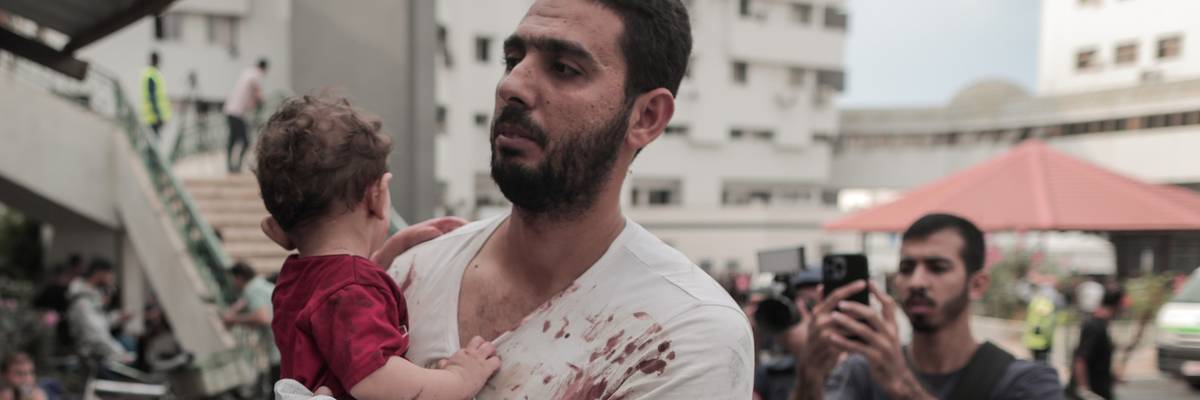
A bloodied Palestinian man carries his baby into Al-Shifa Hospital in Gaza City.
We have to learn to value and connect with one another, even, or especially, when it’s the last thing we can imagine doing.
Humanity’s cancer shows up in Israel and Palestine. Missiles fly, hell makes global headlines, thousands of people die, many of them (oh God, of course) children.
Israeli Defense Minister Yoav Gallant declares: “We are fighting human animals and we act accordingly. . . . We are imposing a complete siege on Gaza. There will be no electricity, no food, no water, no fuel. Everything will be closed.”
That’ll show ’em! Revenge rules. Kill the human animals, even if they’re toddlers.
Here’s the vicious cycle of war: One side commits a heinous crime against humanity — e.g, Hamas fires missiles into Israel, killing more than 700 people. This justifies an even more heinous response from Israel, firing its own (far more sophisticated) missiles into Gaza, declaring war on a trapped population of people in the “open air prison” of Gaza. Both sides feel justified as they continue to commit crimes against humanity — you know, look what they did! The essence of war is dehumanization.
I write these words not to try to “equalize” the wrongs of this conflict or to shrug off its history: the colonization of Palestine in the wake of World War I, the savage destruction of hundreds of its villages in the creation of the state of Israel. As Chris Hedges writes:
“Israel has spoken this blood-soaked language of violence to the Palestinians since Zionist militias seized more than 78 percent of historic Palestine, destroyed some 530 Palestinian villages and cities, and killed about 15,000 Palestinians in more than 70 massacres. Some 750,000 Palestinians were ethnically cleansed between 1947 and 1949 to create the state of Israel in 1948.”
In other words, he asks: What did Israel expect? This latest war is just one more upsurge of retaliation by a suppressed segment of humanity. Hamas, Gaza’s current governing organization, is deemed a terrorist organization — certainly by much of the U.S. media — but here’s the thing: Almost every national government with a military is a terrorist organization, or at least potentially so. The United States certainly is. Terrorism is just another word for war.
We live in a world that remains trapped in the consciousness of war. The only way to deal with harm and danger is to inflict it yourself. They just killed our children, so we’re gonna kill theirs. Whoever kills the most children wins, or so it seems.
Is a different way of thinking possible at the level of geopolitics? Is a world without war possible?
Orly Noy, who is Israeli (editor of the Hebrew-language news magazine Local Call), describes how terrifying it got when Hamas fired its missiles into Israel. Writing in The Guardian, she notes: “The public desire for revenge is both understandable and terrifying, but the erasure of any moral red line is always a frightening thing.
“It is important not to minimize or condone the heinous crimes committed by Hamas. But it is also important to remind ourselves that everything it is inflicting on us now, we have been inflicting on the Palestinians for years. . . . I keep reminding myself that ignoring this context is giving up a piece of my own humanity. Because violence devoid of any context leads to only one possible response: revenge.
And revenge, she writes, “is the opposite of security, it is the opposite of peace, it is also the opposite of justice. It is nothing but more violence.
“. . . we have not only brought Gaza to the brink of starvation, we have brought it to a state of collapse. Always in the name of security. How much security did we get? Where will another round of revenge take us?
“Terrible crimes were committed against Israelis this Saturday, crimes that the mind cannot fathom — and in this time of dark grief, I cling to the one thing I have left to hold on to: my humanity. The absolute belief that this hell is not predestined. Not for us, nor for them.”
How can her understanding of this terrifying moment be multiplied by, oh, let us say, seven billion human minds? Revenge and war don’t work. Even our enemy acts in a context. And conflict can only be understood — and transcended — in the context of all parties that are part of it. This is the creation of peace.
Yes, alas, this is more complicated than simply kicking someone’s ass — winning the game. It’s almost as though there’s a global commercial interest in keeping conflict alive — not just among political hawks and the arms dealers, but . . . well, as a lifelong journalist, I can certainly add my profession to the list: If it bleeds, it leads, as they say. How many headlines do you see that read: “Israel and Palestine (or Russia and Ukraine) Engage in Empathic Dialogue, Find Understanding”?
My God, making connection, even with the enemy? This is not what governments fund. This is not how we understand ourselves. At best, ending war — transcending war — is an unfathomably long, seemingly impossible process, and our understanding of what it will take is minimal, compared to how much we understand, let us say, about the structure of the atom.
Or is it so minimal? Perhaps we know more than we think we do. As the late Marion Woodman, author and Jungian psychologist, wrote: “Power in the sense of controlling somebody else is different from personal presence. That kind of power — patriarchal power — does not value other people. What I strive for instead is empowerment.”
We have to push on. We have to learn to value and connect with one another, even, or especially, when it’s the last thing we can imagine doing. This may well be the primary task of being human. If we don’t end war, it will certainly end us.
Dear Common Dreams reader, It’s been nearly 30 years since I co-founded Common Dreams with my late wife, Lina Newhouser. We had the radical notion that journalism should serve the public good, not corporate profits. It was clear to us from the outset what it would take to build such a project. No paid advertisements. No corporate sponsors. No millionaire publisher telling us what to think or do. Many people said we wouldn't last a year, but we proved those doubters wrong. Together with a tremendous team of journalists and dedicated staff, we built an independent media outlet free from the constraints of profits and corporate control. Our mission has always been simple: To inform. To inspire. To ignite change for the common good. Building Common Dreams was not easy. Our survival was never guaranteed. When you take on the most powerful forces—Wall Street greed, fossil fuel industry destruction, Big Tech lobbyists, and uber-rich oligarchs who have spent billions upon billions rigging the economy and democracy in their favor—the only bulwark you have is supporters who believe in your work. But here’s the urgent message from me today. It's never been this bad out there. And it's never been this hard to keep us going. At the very moment Common Dreams is most needed, the threats we face are intensifying. We need your support now more than ever. We don't accept corporate advertising and never will. We don't have a paywall because we don't think people should be blocked from critical news based on their ability to pay. Everything we do is funded by the donations of readers like you. When everyone does the little they can afford, we are strong. But if that support retreats or dries up, so do we. Will you donate now to make sure Common Dreams not only survives but thrives? —Craig Brown, Co-founder |
Humanity’s cancer shows up in Israel and Palestine. Missiles fly, hell makes global headlines, thousands of people die, many of them (oh God, of course) children.
Israeli Defense Minister Yoav Gallant declares: “We are fighting human animals and we act accordingly. . . . We are imposing a complete siege on Gaza. There will be no electricity, no food, no water, no fuel. Everything will be closed.”
That’ll show ’em! Revenge rules. Kill the human animals, even if they’re toddlers.
Here’s the vicious cycle of war: One side commits a heinous crime against humanity — e.g, Hamas fires missiles into Israel, killing more than 700 people. This justifies an even more heinous response from Israel, firing its own (far more sophisticated) missiles into Gaza, declaring war on a trapped population of people in the “open air prison” of Gaza. Both sides feel justified as they continue to commit crimes against humanity — you know, look what they did! The essence of war is dehumanization.
I write these words not to try to “equalize” the wrongs of this conflict or to shrug off its history: the colonization of Palestine in the wake of World War I, the savage destruction of hundreds of its villages in the creation of the state of Israel. As Chris Hedges writes:
“Israel has spoken this blood-soaked language of violence to the Palestinians since Zionist militias seized more than 78 percent of historic Palestine, destroyed some 530 Palestinian villages and cities, and killed about 15,000 Palestinians in more than 70 massacres. Some 750,000 Palestinians were ethnically cleansed between 1947 and 1949 to create the state of Israel in 1948.”
In other words, he asks: What did Israel expect? This latest war is just one more upsurge of retaliation by a suppressed segment of humanity. Hamas, Gaza’s current governing organization, is deemed a terrorist organization — certainly by much of the U.S. media — but here’s the thing: Almost every national government with a military is a terrorist organization, or at least potentially so. The United States certainly is. Terrorism is just another word for war.
We live in a world that remains trapped in the consciousness of war. The only way to deal with harm and danger is to inflict it yourself. They just killed our children, so we’re gonna kill theirs. Whoever kills the most children wins, or so it seems.
Is a different way of thinking possible at the level of geopolitics? Is a world without war possible?
Orly Noy, who is Israeli (editor of the Hebrew-language news magazine Local Call), describes how terrifying it got when Hamas fired its missiles into Israel. Writing in The Guardian, she notes: “The public desire for revenge is both understandable and terrifying, but the erasure of any moral red line is always a frightening thing.
“It is important not to minimize or condone the heinous crimes committed by Hamas. But it is also important to remind ourselves that everything it is inflicting on us now, we have been inflicting on the Palestinians for years. . . . I keep reminding myself that ignoring this context is giving up a piece of my own humanity. Because violence devoid of any context leads to only one possible response: revenge.
And revenge, she writes, “is the opposite of security, it is the opposite of peace, it is also the opposite of justice. It is nothing but more violence.
“. . . we have not only brought Gaza to the brink of starvation, we have brought it to a state of collapse. Always in the name of security. How much security did we get? Where will another round of revenge take us?
“Terrible crimes were committed against Israelis this Saturday, crimes that the mind cannot fathom — and in this time of dark grief, I cling to the one thing I have left to hold on to: my humanity. The absolute belief that this hell is not predestined. Not for us, nor for them.”
How can her understanding of this terrifying moment be multiplied by, oh, let us say, seven billion human minds? Revenge and war don’t work. Even our enemy acts in a context. And conflict can only be understood — and transcended — in the context of all parties that are part of it. This is the creation of peace.
Yes, alas, this is more complicated than simply kicking someone’s ass — winning the game. It’s almost as though there’s a global commercial interest in keeping conflict alive — not just among political hawks and the arms dealers, but . . . well, as a lifelong journalist, I can certainly add my profession to the list: If it bleeds, it leads, as they say. How many headlines do you see that read: “Israel and Palestine (or Russia and Ukraine) Engage in Empathic Dialogue, Find Understanding”?
My God, making connection, even with the enemy? This is not what governments fund. This is not how we understand ourselves. At best, ending war — transcending war — is an unfathomably long, seemingly impossible process, and our understanding of what it will take is minimal, compared to how much we understand, let us say, about the structure of the atom.
Or is it so minimal? Perhaps we know more than we think we do. As the late Marion Woodman, author and Jungian psychologist, wrote: “Power in the sense of controlling somebody else is different from personal presence. That kind of power — patriarchal power — does not value other people. What I strive for instead is empowerment.”
We have to push on. We have to learn to value and connect with one another, even, or especially, when it’s the last thing we can imagine doing. This may well be the primary task of being human. If we don’t end war, it will certainly end us.
Humanity’s cancer shows up in Israel and Palestine. Missiles fly, hell makes global headlines, thousands of people die, many of them (oh God, of course) children.
Israeli Defense Minister Yoav Gallant declares: “We are fighting human animals and we act accordingly. . . . We are imposing a complete siege on Gaza. There will be no electricity, no food, no water, no fuel. Everything will be closed.”
That’ll show ’em! Revenge rules. Kill the human animals, even if they’re toddlers.
Here’s the vicious cycle of war: One side commits a heinous crime against humanity — e.g, Hamas fires missiles into Israel, killing more than 700 people. This justifies an even more heinous response from Israel, firing its own (far more sophisticated) missiles into Gaza, declaring war on a trapped population of people in the “open air prison” of Gaza. Both sides feel justified as they continue to commit crimes against humanity — you know, look what they did! The essence of war is dehumanization.
I write these words not to try to “equalize” the wrongs of this conflict or to shrug off its history: the colonization of Palestine in the wake of World War I, the savage destruction of hundreds of its villages in the creation of the state of Israel. As Chris Hedges writes:
“Israel has spoken this blood-soaked language of violence to the Palestinians since Zionist militias seized more than 78 percent of historic Palestine, destroyed some 530 Palestinian villages and cities, and killed about 15,000 Palestinians in more than 70 massacres. Some 750,000 Palestinians were ethnically cleansed between 1947 and 1949 to create the state of Israel in 1948.”
In other words, he asks: What did Israel expect? This latest war is just one more upsurge of retaliation by a suppressed segment of humanity. Hamas, Gaza’s current governing organization, is deemed a terrorist organization — certainly by much of the U.S. media — but here’s the thing: Almost every national government with a military is a terrorist organization, or at least potentially so. The United States certainly is. Terrorism is just another word for war.
We live in a world that remains trapped in the consciousness of war. The only way to deal with harm and danger is to inflict it yourself. They just killed our children, so we’re gonna kill theirs. Whoever kills the most children wins, or so it seems.
Is a different way of thinking possible at the level of geopolitics? Is a world without war possible?
Orly Noy, who is Israeli (editor of the Hebrew-language news magazine Local Call), describes how terrifying it got when Hamas fired its missiles into Israel. Writing in The Guardian, she notes: “The public desire for revenge is both understandable and terrifying, but the erasure of any moral red line is always a frightening thing.
“It is important not to minimize or condone the heinous crimes committed by Hamas. But it is also important to remind ourselves that everything it is inflicting on us now, we have been inflicting on the Palestinians for years. . . . I keep reminding myself that ignoring this context is giving up a piece of my own humanity. Because violence devoid of any context leads to only one possible response: revenge.
And revenge, she writes, “is the opposite of security, it is the opposite of peace, it is also the opposite of justice. It is nothing but more violence.
“. . . we have not only brought Gaza to the brink of starvation, we have brought it to a state of collapse. Always in the name of security. How much security did we get? Where will another round of revenge take us?
“Terrible crimes were committed against Israelis this Saturday, crimes that the mind cannot fathom — and in this time of dark grief, I cling to the one thing I have left to hold on to: my humanity. The absolute belief that this hell is not predestined. Not for us, nor for them.”
How can her understanding of this terrifying moment be multiplied by, oh, let us say, seven billion human minds? Revenge and war don’t work. Even our enemy acts in a context. And conflict can only be understood — and transcended — in the context of all parties that are part of it. This is the creation of peace.
Yes, alas, this is more complicated than simply kicking someone’s ass — winning the game. It’s almost as though there’s a global commercial interest in keeping conflict alive — not just among political hawks and the arms dealers, but . . . well, as a lifelong journalist, I can certainly add my profession to the list: If it bleeds, it leads, as they say. How many headlines do you see that read: “Israel and Palestine (or Russia and Ukraine) Engage in Empathic Dialogue, Find Understanding”?
My God, making connection, even with the enemy? This is not what governments fund. This is not how we understand ourselves. At best, ending war — transcending war — is an unfathomably long, seemingly impossible process, and our understanding of what it will take is minimal, compared to how much we understand, let us say, about the structure of the atom.
Or is it so minimal? Perhaps we know more than we think we do. As the late Marion Woodman, author and Jungian psychologist, wrote: “Power in the sense of controlling somebody else is different from personal presence. That kind of power — patriarchal power — does not value other people. What I strive for instead is empowerment.”
We have to push on. We have to learn to value and connect with one another, even, or especially, when it’s the last thing we can imagine doing. This may well be the primary task of being human. If we don’t end war, it will certainly end us.