
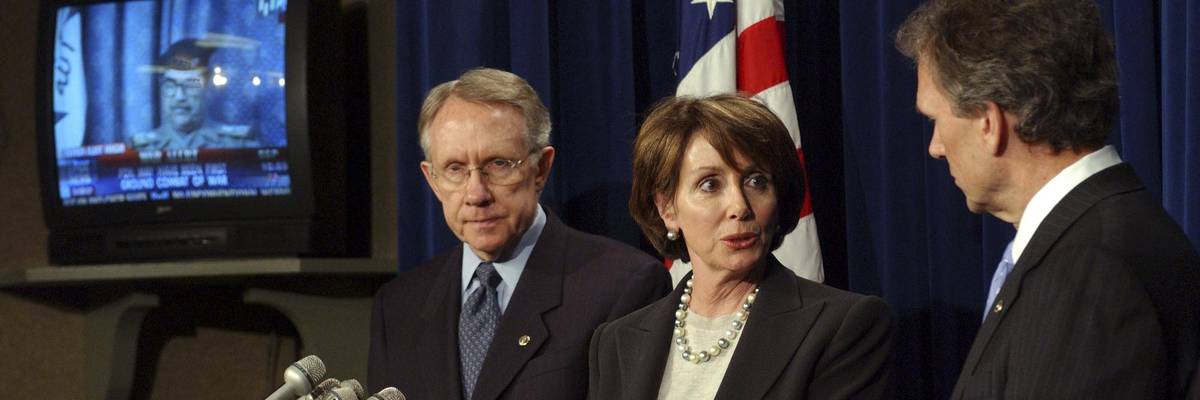
Harry Reid, (D-Nev.), Nancy Pelosi, (D-Calif.), and Tom Daschle, (D-S.D.), during a press conference on the war in Iraq in the Senate Studio of the U.S. Capitol. Saddam Hussein is making his address to the Iraqi people on the TV in the background.
The Debate Democratic Party Should Have Had About the Iraq War 20 Years Ago
Two decades later, it gives me no satisfaction to say that we were right to oppose that disastrous war. It proved to be even more devastating than we feared.
Twenty years ago this month, the U.S. was rushing headlong into war with Iraq—a war that has proven to be one of the most fatal and consequential travesties in modern American history. What follows is the story of how one congressman and I tried and failed to get the Democratic Party on record opposing that war.
After 9/11, neoconservatives began their campaign to invade Iraq. Using everything in their toolbox, they made several arguments: that Saddam Hussein was linked to the 9/11 terrorists; that Iraq had stockpiles of chemical and biological weapons and was secretly buying components to build a nuclear bomb; that the U.S. had only been attacked because our enemies had come to see us as weak and therefore we needed to win a decisive victory somewhere (anywhere) to demonstrate our strength and resolve; and finally (what proved to be the biggest lies of all) a complete victory in Iraq would be quick and easy, require few troops and be welcomed by the Iraqi people, and result in the establishment of a friendly and stable democracy in short order.
All of these were either outright fabrications or, at the very least, matters that should been vigorously debated, but they were not. The mainstream media largely served as an echo chamber for the war hawks and most leading politicians were shy to criticize.
In this context and in advance of the February 2003 meeting of the Democratic National Committee, Representative Jesse Jackson Jr. and I submitted a resolution we hoped might spur a debate on the impending war. Our resolution, using temperate and respectful language, called on our party to urge the Bush administration “to pursue diplomatic efforts to achieve disarmament of Iraq, to clearly define for the American people and Congress the objectives, costs, consequences, terms and length of commitment envisioned by any U.S. engagement or action in Iraq, and to continue to operate in the context of and seek the full support of the United Nations in any effort to resolve the current crisis in Iraq.”
From polling, we knew that the majority of Americans and a supermajority of Democrats supported these positions. And, as we wrote in an op-ed that was published in a number of U.S. newspapers, we also knew that if Democrats failed to challenge the rush to war, we would not only risk losing the support of voters, but also fail to fulfill our responsibility to avert a war we knew would prove devastating to our country and the Middle East region.
At the DNC meeting, party leaders subjected me to intense pressure to withdraw the resolution. They argued that we needed to defer to the Democratic candidates who were running for president. With only one of the major candidates, Howard Dean, vigorously opposed to the war, they claimed that passing such a resolution would make it appear we were supporting his candidacy. And, in their view, opposing the war would make it appear that the party was weak on national defense.
I refused to withdraw the resolution and insisted on my right to introduce it and be heard.
In my remarks to the committee, I warned that it was unconscionable that we send young men and women into a war in a country about which we knew so little in terms of its history, culture, and social composition. I observed that the administration’s miscalculations about Iraq ran the very real danger of beginning “a war without end” and that going to war without UN authorization would risk U.S. legitimacy. I concluded by noting that "raising the right questions, demanding answers and winning allies to our case is not being weak on defense. It's being smart on defense."
After completing my presentation, the chair ruled that there would be no vote and the resolution would be allowed to die, without debate or discussion.
Twenty years later, it gives me no satisfaction to say that we were right to oppose that disastrous war. It proved to be even more devastating than we feared. Thousands of Americans and hundreds of thousands of Iraqis were killed and countless others have had their lives shattered by the consequences of the war. While the neoconservatives told Congress that the war would cost only $2 billion, in fact the price tag is in the trillions and still growing. The war didn’t extinguish extremism. Instead extremism was fueled, metastasizing into ever more virulent forms. And America emerged from the war weaker and less respected, while Iran emerged empowered and emboldened to project its menacing and meddlesome behavior into the broader region.
I know that passing our resolution would not have stopped the Bush administration’s march to war. At least, however, it would have put Democrats on record in opposition, potentially strengthening the resolve of members of Congress to speak out more forcefully and voice their dissent. That’s how a democracy is supposed to work. And when it doesn’t work, we all pay a steep price.
We are at a crossroads
This country and this world are at a monumental crossroads. In a few short weeks, US voters will have an opportunity to beat back the forces of fascism and confront the billionaires who are rigging the economy, our media system, and our democracy, making it increasingly impossible for ordinary people to get by. We’re not just talking about the election. We’re talking about what must be done once these fascist elements are vanquished from power. We need a bolder set of solutions than what either major party has so far been willing to offer and a working-class movement ready to fight like hell for it. Trump didn't emerge from nowhere. The conditions that fueled MAGA authoritarianism were created by decades of radical neoliberal economic policies and a corrupt political system dominated by corporate interests. They slashed taxes on the super-rich, promising that the benefits would trickle down. They said giveaways to the corporate titans would make life more affordable for the rest of us. It was all bullshit. And when a bitter, betrayed populace searches for someone to blame, right-wing demagogues have little trouble finding scapegoats. People know when they're being lied to, but you won't hear any of this from the corporate media. Only independent journalism—powered and funded by people who believe in building a better world—can deliver truly trustworthy daily news. Our Fall Campaign is underway, and we need your help. To power our newsroom through the rest of the year, we need to raise $125,000 by midnight on October 31. So if you share our vision, please contribute whatever you can to sustain our work. |
Twenty years ago this month, the U.S. was rushing headlong into war with Iraq—a war that has proven to be one of the most fatal and consequential travesties in modern American history. What follows is the story of how one congressman and I tried and failed to get the Democratic Party on record opposing that war.
After 9/11, neoconservatives began their campaign to invade Iraq. Using everything in their toolbox, they made several arguments: that Saddam Hussein was linked to the 9/11 terrorists; that Iraq had stockpiles of chemical and biological weapons and was secretly buying components to build a nuclear bomb; that the U.S. had only been attacked because our enemies had come to see us as weak and therefore we needed to win a decisive victory somewhere (anywhere) to demonstrate our strength and resolve; and finally (what proved to be the biggest lies of all) a complete victory in Iraq would be quick and easy, require few troops and be welcomed by the Iraqi people, and result in the establishment of a friendly and stable democracy in short order.
All of these were either outright fabrications or, at the very least, matters that should been vigorously debated, but they were not. The mainstream media largely served as an echo chamber for the war hawks and most leading politicians were shy to criticize.
In this context and in advance of the February 2003 meeting of the Democratic National Committee, Representative Jesse Jackson Jr. and I submitted a resolution we hoped might spur a debate on the impending war. Our resolution, using temperate and respectful language, called on our party to urge the Bush administration “to pursue diplomatic efforts to achieve disarmament of Iraq, to clearly define for the American people and Congress the objectives, costs, consequences, terms and length of commitment envisioned by any U.S. engagement or action in Iraq, and to continue to operate in the context of and seek the full support of the United Nations in any effort to resolve the current crisis in Iraq.”
From polling, we knew that the majority of Americans and a supermajority of Democrats supported these positions. And, as we wrote in an op-ed that was published in a number of U.S. newspapers, we also knew that if Democrats failed to challenge the rush to war, we would not only risk losing the support of voters, but also fail to fulfill our responsibility to avert a war we knew would prove devastating to our country and the Middle East region.
At the DNC meeting, party leaders subjected me to intense pressure to withdraw the resolution. They argued that we needed to defer to the Democratic candidates who were running for president. With only one of the major candidates, Howard Dean, vigorously opposed to the war, they claimed that passing such a resolution would make it appear we were supporting his candidacy. And, in their view, opposing the war would make it appear that the party was weak on national defense.
I refused to withdraw the resolution and insisted on my right to introduce it and be heard.
In my remarks to the committee, I warned that it was unconscionable that we send young men and women into a war in a country about which we knew so little in terms of its history, culture, and social composition. I observed that the administration’s miscalculations about Iraq ran the very real danger of beginning “a war without end” and that going to war without UN authorization would risk U.S. legitimacy. I concluded by noting that "raising the right questions, demanding answers and winning allies to our case is not being weak on defense. It's being smart on defense."
After completing my presentation, the chair ruled that there would be no vote and the resolution would be allowed to die, without debate or discussion.
Twenty years later, it gives me no satisfaction to say that we were right to oppose that disastrous war. It proved to be even more devastating than we feared. Thousands of Americans and hundreds of thousands of Iraqis were killed and countless others have had their lives shattered by the consequences of the war. While the neoconservatives told Congress that the war would cost only $2 billion, in fact the price tag is in the trillions and still growing. The war didn’t extinguish extremism. Instead extremism was fueled, metastasizing into ever more virulent forms. And America emerged from the war weaker and less respected, while Iran emerged empowered and emboldened to project its menacing and meddlesome behavior into the broader region.
I know that passing our resolution would not have stopped the Bush administration’s march to war. At least, however, it would have put Democrats on record in opposition, potentially strengthening the resolve of members of Congress to speak out more forcefully and voice their dissent. That’s how a democracy is supposed to work. And when it doesn’t work, we all pay a steep price.
Twenty years ago this month, the U.S. was rushing headlong into war with Iraq—a war that has proven to be one of the most fatal and consequential travesties in modern American history. What follows is the story of how one congressman and I tried and failed to get the Democratic Party on record opposing that war.
After 9/11, neoconservatives began their campaign to invade Iraq. Using everything in their toolbox, they made several arguments: that Saddam Hussein was linked to the 9/11 terrorists; that Iraq had stockpiles of chemical and biological weapons and was secretly buying components to build a nuclear bomb; that the U.S. had only been attacked because our enemies had come to see us as weak and therefore we needed to win a decisive victory somewhere (anywhere) to demonstrate our strength and resolve; and finally (what proved to be the biggest lies of all) a complete victory in Iraq would be quick and easy, require few troops and be welcomed by the Iraqi people, and result in the establishment of a friendly and stable democracy in short order.
All of these were either outright fabrications or, at the very least, matters that should been vigorously debated, but they were not. The mainstream media largely served as an echo chamber for the war hawks and most leading politicians were shy to criticize.
In this context and in advance of the February 2003 meeting of the Democratic National Committee, Representative Jesse Jackson Jr. and I submitted a resolution we hoped might spur a debate on the impending war. Our resolution, using temperate and respectful language, called on our party to urge the Bush administration “to pursue diplomatic efforts to achieve disarmament of Iraq, to clearly define for the American people and Congress the objectives, costs, consequences, terms and length of commitment envisioned by any U.S. engagement or action in Iraq, and to continue to operate in the context of and seek the full support of the United Nations in any effort to resolve the current crisis in Iraq.”
From polling, we knew that the majority of Americans and a supermajority of Democrats supported these positions. And, as we wrote in an op-ed that was published in a number of U.S. newspapers, we also knew that if Democrats failed to challenge the rush to war, we would not only risk losing the support of voters, but also fail to fulfill our responsibility to avert a war we knew would prove devastating to our country and the Middle East region.
At the DNC meeting, party leaders subjected me to intense pressure to withdraw the resolution. They argued that we needed to defer to the Democratic candidates who were running for president. With only one of the major candidates, Howard Dean, vigorously opposed to the war, they claimed that passing such a resolution would make it appear we were supporting his candidacy. And, in their view, opposing the war would make it appear that the party was weak on national defense.
I refused to withdraw the resolution and insisted on my right to introduce it and be heard.
In my remarks to the committee, I warned that it was unconscionable that we send young men and women into a war in a country about which we knew so little in terms of its history, culture, and social composition. I observed that the administration’s miscalculations about Iraq ran the very real danger of beginning “a war without end” and that going to war without UN authorization would risk U.S. legitimacy. I concluded by noting that "raising the right questions, demanding answers and winning allies to our case is not being weak on defense. It's being smart on defense."
After completing my presentation, the chair ruled that there would be no vote and the resolution would be allowed to die, without debate or discussion.
Twenty years later, it gives me no satisfaction to say that we were right to oppose that disastrous war. It proved to be even more devastating than we feared. Thousands of Americans and hundreds of thousands of Iraqis were killed and countless others have had their lives shattered by the consequences of the war. While the neoconservatives told Congress that the war would cost only $2 billion, in fact the price tag is in the trillions and still growing. The war didn’t extinguish extremism. Instead extremism was fueled, metastasizing into ever more virulent forms. And America emerged from the war weaker and less respected, while Iran emerged empowered and emboldened to project its menacing and meddlesome behavior into the broader region.
I know that passing our resolution would not have stopped the Bush administration’s march to war. At least, however, it would have put Democrats on record in opposition, potentially strengthening the resolve of members of Congress to speak out more forcefully and voice their dissent. That’s how a democracy is supposed to work. And when it doesn’t work, we all pay a steep price.