SUBSCRIBE TO OUR FREE NEWSLETTER
Daily news & progressive opinion—funded by the people, not the corporations—delivered straight to your inbox.
5
#000000
#FFFFFF
To donate by check, phone, or other method, see our More Ways to Give page.
Daily news & progressive opinion—funded by the people, not the corporations—delivered straight to your inbox.
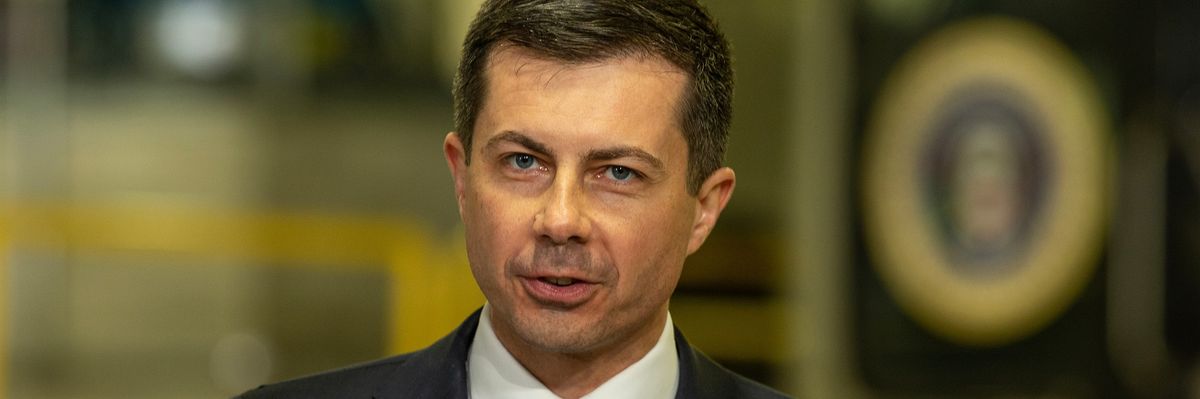
U.S. Secretary of Transportation Pete Buttigieg speaks during an event in New York on January 31, 2023.
Buttigieg not only could have addressed this years ago, not only should have, but was explicitly directed by Congress to do so.
The Biden White House ushered in February with a new salvo of regulation targeting junk fees — those really annoying surcharges that don’t accomplish anything other than making the corporations more money. One particularly cruel example being targeted is a practice of airlines charging parents extra to be seated with their children. President Biden doubled down on the issue in his State of the Union address as well, saying that “airlines can’t treat your child like a piece of baggage.” Some airlines would charge customers to sit next to their children who were still in diapers.
Already, President Biden’s efforts are seeing results; United announced this week that it would no longer charge families extra to sit with their children. While this is certainly a welcome development, it is also an extremely overdue one. Secretary Pete Buttigieg not only could have addressed this years ago, not only should have, but was explicitly directed by Congress to do so. Banning these kinds of abusive business practices is unquestionably a good thing, but asking why it took so long is also imperative to holding the government responsible for fulfilling its most basic duty: protecting the citizens it was designed to serve, especially those who are most vulnerable to the ploys of powerful elites.
A 2020 Consumer Reports investigation found that children as young as one year old were being forced to sit alone on flights, even long ones, if their parents or guardians couldn’t pay the fees to keep families together. This is obviously immoral and dangerous for young children, especially those with medical conditions that require specialized attention, like autism, or who are simply too young to be in a new, loud, and uncomfortable experience without a trusted guardian. Kids need care, and it shouldn’t be up to the kindness of strangers to provide it. Where most of us see a moral prerogative, airlines see a money-making opportunity.
Congress agreed years ago that these fees should be banned. In 2016, the FAA Extension, Safety, and Security Act included language directing the Secretary of Transportation to move to prohibit them. Elaine Chao, Donald Trump’s Secretary of Transportation and vehement deregulator, unsurprisingly, never used her authority to spare families from these outrageous fees.
(Last autumn, when reached for comment on airline regulation, DOT’s spokesperson denied that such instruction was ever provided. However, the FAA Extension Act section 2309 says “DOT shall review and, if appropriate, establish a policy to require all air carriers to establish a policy that enables a child, age 13 or under on a scheduled flight, to be seated in a seat adjacent to the seat of an accompanying family member over age 13, except when assignment to an adjacent seat would require an upgrade to another cabin class or a seat with extra legroom or seat pitch for an additional charge.” So, DOT’s spokesperson is correct only if the department believes keeping children safe on flights is not “appropriate.”)
One would expect an ambitious Democrat trying to burnish a public image as a detail-oriented, empathetic politician would leap at this opportunity. But Buttigieg did not prohibit these family separation fees. In the fall, DOT announced it would begin a new rulemaking process around fee transparency, which doesn’t address the core of the problem—that these fees should not be allowed at all.
In response to a question about why Buttigieg did not initiate a rulemaking to block these fees, DOT’s spokesperson said:
Rulemaking can be lengthy so DOT is working to secure better service from airlines right now – while also preserving rulemaking as an option. Under Sec. Buttigieg, DOT issued for the first time a notice urging airlines to do everything that they can to enable young children to be seated next to an accompanying adult at no additional cost. The notice provided airlines a four month period to improve and make changes to their policies and warned that the DOT would take additional action if its review, which is currently underway, reveals that airlines’ seating policies and practices are barriers to a child sitting next to a parent or other adult family member.
The spokesperson provided no explanation for why the existing measures and rulemaking could not have been done concurrently. Also, note that Buttigieg “urged” airlines, not “required”. That’s because, absent an actual rule, he lacks the authority to force the airlines’ hands. Plus, those “additional actions” that might be taken are probably rulemaking. The upshot of this entire argument is that Buttigieg delayed creating a rule to block exploitative fees that target children in an attempt to play nice with CEOs. It was a waste of nearly two years of opportunity.
Interestingly, though, this exact rulemaking is one of the things that the White House’s fact sheet announced. So, because of inaction at DOT, a rule that could have been finalized in the next couple of months will instead take until next year, quite possibly after the 2024 elections. Worse, it is entirely plausible that such a rule cannot be finalized until after the winner of the 2024 presidential election is inaugurated. If Democrats lose, this rule could be scrapped before it ever hits the books. Maybe Republicans would see it through, but their last transportation secretary refused to implement the reform called for by Congress in 2016, which is why it fell on Secretary Buttigieg’s shoulders in the first place.
One possible explanation is that DOT is simply understaffed; according to Buttigieg, the airline consumer protection staff has only thirty people to regulate the entire industry. That is certainly a serious issue that should be addressed this year when Congress takes up FAA reauthorization. However, given that a rulemaking will be required anyway, it seems like the end result of the DOT’s plodding approach was just to make more work for that small staff.
The fact that this is coming from the White House is also telling. President Biden did not need to give Buttigieg the authority to start this rulemaking. This could have come straight from DOT’s Office of the Secretary, but it didn’t. Some of that might be related to Buttigieg’s apparent distaste for fighting major airlines. This way, the trade associations and lobbyists are up in arms at the entire administration and not Secretary Pete personally. Intentional or not, it certainly provides a degree of political cover.
Still, Buttigieg was probably heavily involved in the decision to begin the new rulemaking, which will take meaningful action to protect consumers. He deserves some kudos for good work there. But you can’t turn in good work two years late and still expect full marks.
Dear Common Dreams reader, It’s been nearly 30 years since I co-founded Common Dreams with my late wife, Lina Newhouser. We had the radical notion that journalism should serve the public good, not corporate profits. It was clear to us from the outset what it would take to build such a project. No paid advertisements. No corporate sponsors. No millionaire publisher telling us what to think or do. Many people said we wouldn't last a year, but we proved those doubters wrong. Together with a tremendous team of journalists and dedicated staff, we built an independent media outlet free from the constraints of profits and corporate control. Our mission has always been simple: To inform. To inspire. To ignite change for the common good. Building Common Dreams was not easy. Our survival was never guaranteed. When you take on the most powerful forces—Wall Street greed, fossil fuel industry destruction, Big Tech lobbyists, and uber-rich oligarchs who have spent billions upon billions rigging the economy and democracy in their favor—the only bulwark you have is supporters who believe in your work. But here’s the urgent message from me today. It's never been this bad out there. And it's never been this hard to keep us going. At the very moment Common Dreams is most needed, the threats we face are intensifying. We need your support now more than ever. We don't accept corporate advertising and never will. We don't have a paywall because we don't think people should be blocked from critical news based on their ability to pay. Everything we do is funded by the donations of readers like you. When everyone does the little they can afford, we are strong. But if that support retreats or dries up, so do we. Will you donate now to make sure Common Dreams not only survives but thrives? —Craig Brown, Co-founder |
The Biden White House ushered in February with a new salvo of regulation targeting junk fees — those really annoying surcharges that don’t accomplish anything other than making the corporations more money. One particularly cruel example being targeted is a practice of airlines charging parents extra to be seated with their children. President Biden doubled down on the issue in his State of the Union address as well, saying that “airlines can’t treat your child like a piece of baggage.” Some airlines would charge customers to sit next to their children who were still in diapers.
Already, President Biden’s efforts are seeing results; United announced this week that it would no longer charge families extra to sit with their children. While this is certainly a welcome development, it is also an extremely overdue one. Secretary Pete Buttigieg not only could have addressed this years ago, not only should have, but was explicitly directed by Congress to do so. Banning these kinds of abusive business practices is unquestionably a good thing, but asking why it took so long is also imperative to holding the government responsible for fulfilling its most basic duty: protecting the citizens it was designed to serve, especially those who are most vulnerable to the ploys of powerful elites.
A 2020 Consumer Reports investigation found that children as young as one year old were being forced to sit alone on flights, even long ones, if their parents or guardians couldn’t pay the fees to keep families together. This is obviously immoral and dangerous for young children, especially those with medical conditions that require specialized attention, like autism, or who are simply too young to be in a new, loud, and uncomfortable experience without a trusted guardian. Kids need care, and it shouldn’t be up to the kindness of strangers to provide it. Where most of us see a moral prerogative, airlines see a money-making opportunity.
Congress agreed years ago that these fees should be banned. In 2016, the FAA Extension, Safety, and Security Act included language directing the Secretary of Transportation to move to prohibit them. Elaine Chao, Donald Trump’s Secretary of Transportation and vehement deregulator, unsurprisingly, never used her authority to spare families from these outrageous fees.
(Last autumn, when reached for comment on airline regulation, DOT’s spokesperson denied that such instruction was ever provided. However, the FAA Extension Act section 2309 says “DOT shall review and, if appropriate, establish a policy to require all air carriers to establish a policy that enables a child, age 13 or under on a scheduled flight, to be seated in a seat adjacent to the seat of an accompanying family member over age 13, except when assignment to an adjacent seat would require an upgrade to another cabin class or a seat with extra legroom or seat pitch for an additional charge.” So, DOT’s spokesperson is correct only if the department believes keeping children safe on flights is not “appropriate.”)
One would expect an ambitious Democrat trying to burnish a public image as a detail-oriented, empathetic politician would leap at this opportunity. But Buttigieg did not prohibit these family separation fees. In the fall, DOT announced it would begin a new rulemaking process around fee transparency, which doesn’t address the core of the problem—that these fees should not be allowed at all.
In response to a question about why Buttigieg did not initiate a rulemaking to block these fees, DOT’s spokesperson said:
Rulemaking can be lengthy so DOT is working to secure better service from airlines right now – while also preserving rulemaking as an option. Under Sec. Buttigieg, DOT issued for the first time a notice urging airlines to do everything that they can to enable young children to be seated next to an accompanying adult at no additional cost. The notice provided airlines a four month period to improve and make changes to their policies and warned that the DOT would take additional action if its review, which is currently underway, reveals that airlines’ seating policies and practices are barriers to a child sitting next to a parent or other adult family member.
The spokesperson provided no explanation for why the existing measures and rulemaking could not have been done concurrently. Also, note that Buttigieg “urged” airlines, not “required”. That’s because, absent an actual rule, he lacks the authority to force the airlines’ hands. Plus, those “additional actions” that might be taken are probably rulemaking. The upshot of this entire argument is that Buttigieg delayed creating a rule to block exploitative fees that target children in an attempt to play nice with CEOs. It was a waste of nearly two years of opportunity.
Interestingly, though, this exact rulemaking is one of the things that the White House’s fact sheet announced. So, because of inaction at DOT, a rule that could have been finalized in the next couple of months will instead take until next year, quite possibly after the 2024 elections. Worse, it is entirely plausible that such a rule cannot be finalized until after the winner of the 2024 presidential election is inaugurated. If Democrats lose, this rule could be scrapped before it ever hits the books. Maybe Republicans would see it through, but their last transportation secretary refused to implement the reform called for by Congress in 2016, which is why it fell on Secretary Buttigieg’s shoulders in the first place.
One possible explanation is that DOT is simply understaffed; according to Buttigieg, the airline consumer protection staff has only thirty people to regulate the entire industry. That is certainly a serious issue that should be addressed this year when Congress takes up FAA reauthorization. However, given that a rulemaking will be required anyway, it seems like the end result of the DOT’s plodding approach was just to make more work for that small staff.
The fact that this is coming from the White House is also telling. President Biden did not need to give Buttigieg the authority to start this rulemaking. This could have come straight from DOT’s Office of the Secretary, but it didn’t. Some of that might be related to Buttigieg’s apparent distaste for fighting major airlines. This way, the trade associations and lobbyists are up in arms at the entire administration and not Secretary Pete personally. Intentional or not, it certainly provides a degree of political cover.
Still, Buttigieg was probably heavily involved in the decision to begin the new rulemaking, which will take meaningful action to protect consumers. He deserves some kudos for good work there. But you can’t turn in good work two years late and still expect full marks.
The Biden White House ushered in February with a new salvo of regulation targeting junk fees — those really annoying surcharges that don’t accomplish anything other than making the corporations more money. One particularly cruel example being targeted is a practice of airlines charging parents extra to be seated with their children. President Biden doubled down on the issue in his State of the Union address as well, saying that “airlines can’t treat your child like a piece of baggage.” Some airlines would charge customers to sit next to their children who were still in diapers.
Already, President Biden’s efforts are seeing results; United announced this week that it would no longer charge families extra to sit with their children. While this is certainly a welcome development, it is also an extremely overdue one. Secretary Pete Buttigieg not only could have addressed this years ago, not only should have, but was explicitly directed by Congress to do so. Banning these kinds of abusive business practices is unquestionably a good thing, but asking why it took so long is also imperative to holding the government responsible for fulfilling its most basic duty: protecting the citizens it was designed to serve, especially those who are most vulnerable to the ploys of powerful elites.
A 2020 Consumer Reports investigation found that children as young as one year old were being forced to sit alone on flights, even long ones, if their parents or guardians couldn’t pay the fees to keep families together. This is obviously immoral and dangerous for young children, especially those with medical conditions that require specialized attention, like autism, or who are simply too young to be in a new, loud, and uncomfortable experience without a trusted guardian. Kids need care, and it shouldn’t be up to the kindness of strangers to provide it. Where most of us see a moral prerogative, airlines see a money-making opportunity.
Congress agreed years ago that these fees should be banned. In 2016, the FAA Extension, Safety, and Security Act included language directing the Secretary of Transportation to move to prohibit them. Elaine Chao, Donald Trump’s Secretary of Transportation and vehement deregulator, unsurprisingly, never used her authority to spare families from these outrageous fees.
(Last autumn, when reached for comment on airline regulation, DOT’s spokesperson denied that such instruction was ever provided. However, the FAA Extension Act section 2309 says “DOT shall review and, if appropriate, establish a policy to require all air carriers to establish a policy that enables a child, age 13 or under on a scheduled flight, to be seated in a seat adjacent to the seat of an accompanying family member over age 13, except when assignment to an adjacent seat would require an upgrade to another cabin class or a seat with extra legroom or seat pitch for an additional charge.” So, DOT’s spokesperson is correct only if the department believes keeping children safe on flights is not “appropriate.”)
One would expect an ambitious Democrat trying to burnish a public image as a detail-oriented, empathetic politician would leap at this opportunity. But Buttigieg did not prohibit these family separation fees. In the fall, DOT announced it would begin a new rulemaking process around fee transparency, which doesn’t address the core of the problem—that these fees should not be allowed at all.
In response to a question about why Buttigieg did not initiate a rulemaking to block these fees, DOT’s spokesperson said:
Rulemaking can be lengthy so DOT is working to secure better service from airlines right now – while also preserving rulemaking as an option. Under Sec. Buttigieg, DOT issued for the first time a notice urging airlines to do everything that they can to enable young children to be seated next to an accompanying adult at no additional cost. The notice provided airlines a four month period to improve and make changes to their policies and warned that the DOT would take additional action if its review, which is currently underway, reveals that airlines’ seating policies and practices are barriers to a child sitting next to a parent or other adult family member.
The spokesperson provided no explanation for why the existing measures and rulemaking could not have been done concurrently. Also, note that Buttigieg “urged” airlines, not “required”. That’s because, absent an actual rule, he lacks the authority to force the airlines’ hands. Plus, those “additional actions” that might be taken are probably rulemaking. The upshot of this entire argument is that Buttigieg delayed creating a rule to block exploitative fees that target children in an attempt to play nice with CEOs. It was a waste of nearly two years of opportunity.
Interestingly, though, this exact rulemaking is one of the things that the White House’s fact sheet announced. So, because of inaction at DOT, a rule that could have been finalized in the next couple of months will instead take until next year, quite possibly after the 2024 elections. Worse, it is entirely plausible that such a rule cannot be finalized until after the winner of the 2024 presidential election is inaugurated. If Democrats lose, this rule could be scrapped before it ever hits the books. Maybe Republicans would see it through, but their last transportation secretary refused to implement the reform called for by Congress in 2016, which is why it fell on Secretary Buttigieg’s shoulders in the first place.
One possible explanation is that DOT is simply understaffed; according to Buttigieg, the airline consumer protection staff has only thirty people to regulate the entire industry. That is certainly a serious issue that should be addressed this year when Congress takes up FAA reauthorization. However, given that a rulemaking will be required anyway, it seems like the end result of the DOT’s plodding approach was just to make more work for that small staff.
The fact that this is coming from the White House is also telling. President Biden did not need to give Buttigieg the authority to start this rulemaking. This could have come straight from DOT’s Office of the Secretary, but it didn’t. Some of that might be related to Buttigieg’s apparent distaste for fighting major airlines. This way, the trade associations and lobbyists are up in arms at the entire administration and not Secretary Pete personally. Intentional or not, it certainly provides a degree of political cover.
Still, Buttigieg was probably heavily involved in the decision to begin the new rulemaking, which will take meaningful action to protect consumers. He deserves some kudos for good work there. But you can’t turn in good work two years late and still expect full marks.