SUBSCRIBE TO OUR FREE NEWSLETTER
Daily news & progressive opinion—funded by the people, not the corporations—delivered straight to your inbox.
5
#000000
#FFFFFF
To donate by check, phone, or other method, see our More Ways to Give page.
Daily news & progressive opinion—funded by the people, not the corporations—delivered straight to your inbox.
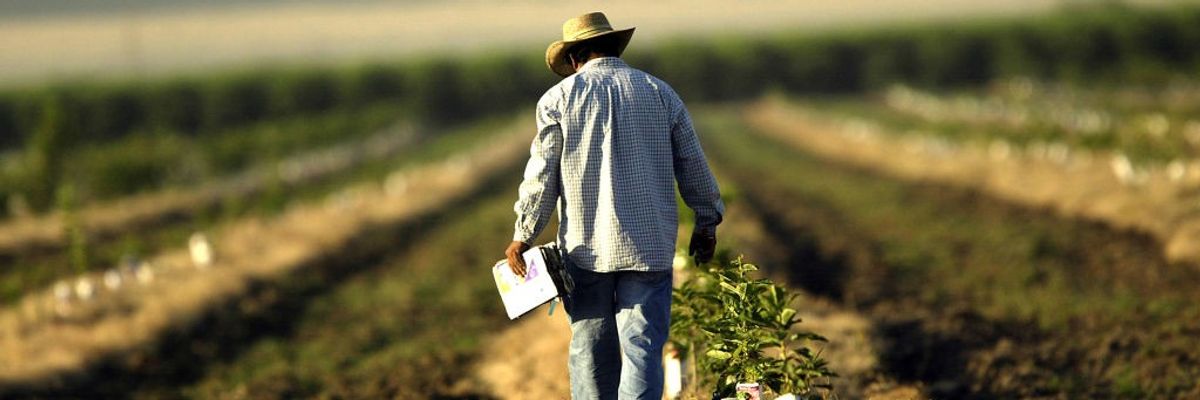
A farm worker labors in a field near the town of Arvin, southeast of Bakersfield, California.
If bad policy decisions got us into this mess, good policies will get us out. America’s farmers, consumers and the environment need a fair Farm Bill for all.
The United States’ food system is facing a crisis eerily similar to what we experienced almost 100 years ago: A corporate-dominated marketplace, strangled by an elite few, that holds farmers and consumers hostage to greed.
At the time, lawmakers responded by creating the first Farm Bill, establishing federal policies to level the playing field. This fall, Congress has an opportunity to tackle these issues anew as it negotiates the 19th Farm Bill.
Since the last Farm Bill in 2018, the cost to feed a family of four on a thrifty food plan has increased 51 percent while top meat and poultry companies have raked in skyrocketing profits. This is not inevitable—and it is not a mistake.
If bad policy decisions got us into this mess, good policies will get us out.
Big Agriculture has turned the food system into a cash cow for the powerful few by undermining small farmers and encouraging operators to “get big or get out.” The Farm Bill, which began as seminal New Deal social safety net legislation, has become corporate welfare, plain and simple.
If bad policy decisions got us into this mess, good policies will get us out. America’s farmers, consumers and the environment need a fair Farm Bill for all.
A fair Farm Bill stops mega-mergers. Decades of lax antitrust enforcement has created a food system defined by consolidation. In 2022, the largest four companies in each sector controlled more than 85 percent of the market for beef, 70 percent for pork, 69 percent for groceries, and 54 percent for poultry. Just three dairy cooperatives account for 83 percent of all milk sales. This level of control gives companies the power to decide the standards, prices and values under which our food is produced.
Thankfully, there is substantial political pushback; in a rare display of bipartisanship, support for reining in Big Ag’s power has united the Biden Administration and Congressmembers on both sides of the aisle.
A fair Farm Bill gives sustainable, humane farmers a fair shot by halting new and expanding factory farms. Factory farms are the instrument of Big Ag’s control; a single operation can displace dozens of smaller farms. There are at least 1,157 more large factory farms today than when the last Farm Bill was passed just five years ago (and this is likely an underestimate). In Iowa, home to more than double the number of large factory farms of the next highest state, nearly 90 percent of the state’s hog farms shuttered in the thirty-five years prior to the 2018 Farm Bill due to being unable to compete.
A fair Farm Bill cuts the flow of taxpayer dollars toward Big Ag lobbying. Checkoff programs wherein farmers pay into a fund designed to market their agricultural products have funneled billions into bolstering the biggest players. The majority of the roughly $4 billion paid into the Dairy Checkoff program from 2005 to 2018 promoted export policies that benefited enormous producers but sent milk prices plummeting in volatile international markets. Since 2000, the average U.S. dairy farm has managed to turn a profit just twice.
A fair Farm Bill ensures that federal programs support small and medium-sized farms. Big Ag has hijacked programs, like the Environmental Quality Incentives Program, that pay farmers for climate-friendly practices. Grants from the program include a misguided requirement that 50 percent of projects fund livestock operations, diverting taxpayer money towards dirty boondoggles like factory farm biogas. The biggest players win while tens of thousands of smaller farmers are sent packing. Instigating funding caps and removing the livestock requirement can help.
The first Farm Bill was crafted to respond to a crisis of corporate consolidation and influence—today’s lawmakers must heed the same call. It’s time to pass a fair Farm Bill for all.
Dear Common Dreams reader, It’s been nearly 30 years since I co-founded Common Dreams with my late wife, Lina Newhouser. We had the radical notion that journalism should serve the public good, not corporate profits. It was clear to us from the outset what it would take to build such a project. No paid advertisements. No corporate sponsors. No millionaire publisher telling us what to think or do. Many people said we wouldn't last a year, but we proved those doubters wrong. Together with a tremendous team of journalists and dedicated staff, we built an independent media outlet free from the constraints of profits and corporate control. Our mission has always been simple: To inform. To inspire. To ignite change for the common good. Building Common Dreams was not easy. Our survival was never guaranteed. When you take on the most powerful forces—Wall Street greed, fossil fuel industry destruction, Big Tech lobbyists, and uber-rich oligarchs who have spent billions upon billions rigging the economy and democracy in their favor—the only bulwark you have is supporters who believe in your work. But here’s the urgent message from me today. It's never been this bad out there. And it's never been this hard to keep us going. At the very moment Common Dreams is most needed, the threats we face are intensifying. We need your support now more than ever. We don't accept corporate advertising and never will. We don't have a paywall because we don't think people should be blocked from critical news based on their ability to pay. Everything we do is funded by the donations of readers like you. When everyone does the little they can afford, we are strong. But if that support retreats or dries up, so do we. Will you donate now to make sure Common Dreams not only survives but thrives? —Craig Brown, Co-founder |
The United States’ food system is facing a crisis eerily similar to what we experienced almost 100 years ago: A corporate-dominated marketplace, strangled by an elite few, that holds farmers and consumers hostage to greed.
At the time, lawmakers responded by creating the first Farm Bill, establishing federal policies to level the playing field. This fall, Congress has an opportunity to tackle these issues anew as it negotiates the 19th Farm Bill.
Since the last Farm Bill in 2018, the cost to feed a family of four on a thrifty food plan has increased 51 percent while top meat and poultry companies have raked in skyrocketing profits. This is not inevitable—and it is not a mistake.
If bad policy decisions got us into this mess, good policies will get us out.
Big Agriculture has turned the food system into a cash cow for the powerful few by undermining small farmers and encouraging operators to “get big or get out.” The Farm Bill, which began as seminal New Deal social safety net legislation, has become corporate welfare, plain and simple.
If bad policy decisions got us into this mess, good policies will get us out. America’s farmers, consumers and the environment need a fair Farm Bill for all.
A fair Farm Bill stops mega-mergers. Decades of lax antitrust enforcement has created a food system defined by consolidation. In 2022, the largest four companies in each sector controlled more than 85 percent of the market for beef, 70 percent for pork, 69 percent for groceries, and 54 percent for poultry. Just three dairy cooperatives account for 83 percent of all milk sales. This level of control gives companies the power to decide the standards, prices and values under which our food is produced.
Thankfully, there is substantial political pushback; in a rare display of bipartisanship, support for reining in Big Ag’s power has united the Biden Administration and Congressmembers on both sides of the aisle.
A fair Farm Bill gives sustainable, humane farmers a fair shot by halting new and expanding factory farms. Factory farms are the instrument of Big Ag’s control; a single operation can displace dozens of smaller farms. There are at least 1,157 more large factory farms today than when the last Farm Bill was passed just five years ago (and this is likely an underestimate). In Iowa, home to more than double the number of large factory farms of the next highest state, nearly 90 percent of the state’s hog farms shuttered in the thirty-five years prior to the 2018 Farm Bill due to being unable to compete.
A fair Farm Bill cuts the flow of taxpayer dollars toward Big Ag lobbying. Checkoff programs wherein farmers pay into a fund designed to market their agricultural products have funneled billions into bolstering the biggest players. The majority of the roughly $4 billion paid into the Dairy Checkoff program from 2005 to 2018 promoted export policies that benefited enormous producers but sent milk prices plummeting in volatile international markets. Since 2000, the average U.S. dairy farm has managed to turn a profit just twice.
A fair Farm Bill ensures that federal programs support small and medium-sized farms. Big Ag has hijacked programs, like the Environmental Quality Incentives Program, that pay farmers for climate-friendly practices. Grants from the program include a misguided requirement that 50 percent of projects fund livestock operations, diverting taxpayer money towards dirty boondoggles like factory farm biogas. The biggest players win while tens of thousands of smaller farmers are sent packing. Instigating funding caps and removing the livestock requirement can help.
The first Farm Bill was crafted to respond to a crisis of corporate consolidation and influence—today’s lawmakers must heed the same call. It’s time to pass a fair Farm Bill for all.
The United States’ food system is facing a crisis eerily similar to what we experienced almost 100 years ago: A corporate-dominated marketplace, strangled by an elite few, that holds farmers and consumers hostage to greed.
At the time, lawmakers responded by creating the first Farm Bill, establishing federal policies to level the playing field. This fall, Congress has an opportunity to tackle these issues anew as it negotiates the 19th Farm Bill.
Since the last Farm Bill in 2018, the cost to feed a family of four on a thrifty food plan has increased 51 percent while top meat and poultry companies have raked in skyrocketing profits. This is not inevitable—and it is not a mistake.
If bad policy decisions got us into this mess, good policies will get us out.
Big Agriculture has turned the food system into a cash cow for the powerful few by undermining small farmers and encouraging operators to “get big or get out.” The Farm Bill, which began as seminal New Deal social safety net legislation, has become corporate welfare, plain and simple.
If bad policy decisions got us into this mess, good policies will get us out. America’s farmers, consumers and the environment need a fair Farm Bill for all.
A fair Farm Bill stops mega-mergers. Decades of lax antitrust enforcement has created a food system defined by consolidation. In 2022, the largest four companies in each sector controlled more than 85 percent of the market for beef, 70 percent for pork, 69 percent for groceries, and 54 percent for poultry. Just three dairy cooperatives account for 83 percent of all milk sales. This level of control gives companies the power to decide the standards, prices and values under which our food is produced.
Thankfully, there is substantial political pushback; in a rare display of bipartisanship, support for reining in Big Ag’s power has united the Biden Administration and Congressmembers on both sides of the aisle.
A fair Farm Bill gives sustainable, humane farmers a fair shot by halting new and expanding factory farms. Factory farms are the instrument of Big Ag’s control; a single operation can displace dozens of smaller farms. There are at least 1,157 more large factory farms today than when the last Farm Bill was passed just five years ago (and this is likely an underestimate). In Iowa, home to more than double the number of large factory farms of the next highest state, nearly 90 percent of the state’s hog farms shuttered in the thirty-five years prior to the 2018 Farm Bill due to being unable to compete.
A fair Farm Bill cuts the flow of taxpayer dollars toward Big Ag lobbying. Checkoff programs wherein farmers pay into a fund designed to market their agricultural products have funneled billions into bolstering the biggest players. The majority of the roughly $4 billion paid into the Dairy Checkoff program from 2005 to 2018 promoted export policies that benefited enormous producers but sent milk prices plummeting in volatile international markets. Since 2000, the average U.S. dairy farm has managed to turn a profit just twice.
A fair Farm Bill ensures that federal programs support small and medium-sized farms. Big Ag has hijacked programs, like the Environmental Quality Incentives Program, that pay farmers for climate-friendly practices. Grants from the program include a misguided requirement that 50 percent of projects fund livestock operations, diverting taxpayer money towards dirty boondoggles like factory farm biogas. The biggest players win while tens of thousands of smaller farmers are sent packing. Instigating funding caps and removing the livestock requirement can help.
The first Farm Bill was crafted to respond to a crisis of corporate consolidation and influence—today’s lawmakers must heed the same call. It’s time to pass a fair Farm Bill for all.