

SUBSCRIBE TO OUR FREE NEWSLETTER
Daily news & progressive opinion—funded by the people, not the corporations—delivered straight to your inbox.
5
#000000
#FFFFFF
To donate by check, phone, or other method, see our More Ways to Give page.
Daily news & progressive opinion—funded by the people, not the corporations—delivered straight to your inbox.

Sam Quigley, sam@patrioticmillionaires.org
Today the Patriotic Millionaires launched a mobile billboard campaign targeting House Ways and Means Committee Chair Richard Neal on his committee's failure to eliminate the significant preferential treatment that the rich receive under the current tax code.
Morris Pearl, the Chair of the Patriotic Millionaires and a former managing director at BlackRock, Inc., said,
"Richard Neal and the House Ways and Means Committee failed the President, failed the country, and failed history. It's that simple. This is not what the American people voted for when they elected Joe Biden as President."
The billboard, which will circle the US Capitol all day September 14th beginning at 7am, as the W&M Committee deliberates, features an image of Jeff Bezos laughing accompanied by the text: "Tax me if you can," and "Oops! missed me (thanks Richie Neal)," as well as another image of Jeff Bezos, Mark Zuckerberg, and Elon Musk with the text "It's not rocket science. Tax the rich!"
To view the image the truck will be displaying, click HERE.
The Patriotic Millionaires are demanding Rep. Neal, the House Ways and Means Committee, and Democratic leadership make the following changes to the bill:
This campaign follows intense opposition from the Patriotic Millionaires over the last week to House moderates' attempts to block President Biden's agenda and limit the scope of the reconciliation bill's tax hikes on wealthy individuals and corporations. Please see HERE a Politico piece from Friday detailing the organization's plans to hold centrist Democrats accountable for their obstruction.
Please also see our initial correspondence to the Democratic caucus HERE, our subsequent correspondence to the House Ways and Means Committee HERE, and a letter sent on Sunday to the White House urging President Biden to use any and all means necessary to pressure problem Democrats from blocking his agenda HERE.
The Patriotic Millionaires is a group of high-net worth Americans who share a profound concern about the destabilizing level of inequality in America. Our work centers on the two things that matter most in a capitalist democracy: power and money. Our goal is to ensure that the country's political economy is structured to meet the needs of regular Americans, rather than just millionaires. We focus on three "first" principles: a highly progressive tax system, a livable minimum wage, and equal political representation for all citizens.
(202) 446-0489
The US, said a group of senators led by Sen. Chris Van Hollen, must suspend weapons sales to the United Arab Emirates, which arms the Rapid Support Forces in Sudan.
Writing to Secretary of State Marco Rubio, Sen. Chris Van Hollen on Monday led 20 members of the Democratic Caucus in demanding that the Trump administration go beyond simply denouncing the Rapid Support Forces, the paramilitary group in Sudan that has been accused of war crimes in the country's civil war, and take "concrete action" to stop more mass atrocities as the group encircles the city of El Obeid.
"These actions should include ceasing certain US arms sales to external actors that are fueling this war, including the United Arab Emirates, which continues to arm the RSF," wrote the senators, including Sens. Bernie Sanders (I-Vt.), Elizabeth Warren (D-Mass.), and Ed Markey (D-Mass.).
The lawmakers wrote to Rubio as an estimated 500,000 civilians were at risk in El Obeid, where many people have sought safety following RSF attacks across the Kordofan region.
The letter came as the United Nations Office for the Coordination of Humanitarian Affairs said civilians are facing drone attacks in El Obeid, with humanitarian assistance also put at risk by the assault.
A number of the signatories, including Van Hollen and Sanders, have previously called on the Trump administration to end its complicity in RSF attacks like those that occurred in El Fasher last October, which United Nations investigators said bore the "hallmarks of genocide" after the group killed more than 6,000 civilians in the first three days of its offensive in the besieged city.
The senators described attacks like those on El-Saudi Hospital in El Fasher, where RSF forces "proceeded to search the wards and killing those they found, including patients, accompanying persons and medical personnel," killing an estimated 460 people before pursuing civilians who tried to escape.
Reports described "the perpetrators chasing people in open fields, firing at them with automatic rifles and mounted submachine guns, and running over fleeing persons with vehicles, causing mass casualties," the senators wrote.
More than 14 million people have also been forcibly displaced by the civil war.
But the scale of atrocities would likely not have been possible without the RSF's support from the UAE, for which the Trump administration fast-tracked a weapons sale in May after having provided the country with $7 billion in weapons just two months earlier.
Also in May, said the senators, Human Rights Watch released a report showing that the UAE trained hundreds of Colombian mercenaries who then took part in the atrocities in El Fasher and trained RSF recruits, including child soldiers.
Now, they wrote, the RSF's "encirclement and systematic crippling of resources in El Obeid increasingly parallels El Fasher, and this administration must use its leverage and influence to prevent a repeat of El Fasher’s horrors in El Obeid before it is too late."
They pointed out that the administration has acknowledged that further "mass atrocities could be imminent” in Sudan, as a State Department spokesperson said on June 22. In November 2025, Rubio himself said that the RSF was "clearly receiving assistance from outside" and that “something needs to be done to cut off the weapons and the support the RSF is getting as they continue their advances.”
Despite those acknowledgments, said the senators, the Trump administration has shown a "grave failure to act despite the chorus of alarm bells."
"What occurred in El Fasher is a stark warning of what could unfold in El Obeid and across Sudan if this administration—and the international community—continues this current pattern of inaction," wrote Van Hollen and his colleagues.
"While we welcome the State Department’s expression of concern about the escalating situation in El Obeid, words are not enough," they said. "The United States must use the leverage and influence at our disposal to prevent further atrocities in El Obeid and help bring this brutal war in Sudan to an end."
The senators called for a response to their letter by August 17, urging the administration to provide "an update on what other actions the administration is taking, beyond just words, to prevent mass atrocities in El Obeid."

"We should be banning drilling in the Arctic Ocean, not making it easier for industry to exploit and pollute."
The Trump administration on Monday proposed weakening Obama-era safeguards for fossil fuel drilling in the Arctic Outer Continental Shelf, a move condemned by environmental groups as another industry handout that would make disastrous oil spills more likely.
The US Interior Department characterized the proposed changes, which will face a 90-day public comment period, as "targeted revisions" aimed at reducing "unnecessary regulatory burdens" that are limiting resource extraction off Alaska's coast. The new proposal, according to the agency, "would update requirements related to blowout preventer real-time monitoring, Arctic source control and containment equipment, relief rig capability, subsea isolation devices, mudline cellars, oil spill response plan-holder reviews, crane operations on artificial islands, and suspensions of operations and production."
The Trump administration unveiled the proposal as it pushed for a massive expansion of offshore drilling, even as the climate impacts of fossil fuel extraction continued to intensify across the US and worldwide. Joseph Gordon, campaign manager at Oceana, called the combination of expanded drilling and weakened safety standards "a recipe for catastrophe."
"This attempted rollback would make it even harder to prevent oil spills or tackle the horrors that inevitably follow in the remote and fragile Arctic," said Gordon. "Giving oil companies a pass on safety measures like blowout preventers would set a dangerous precedent that will put Alaska's waters, wildlife, and people at risk."
Cooper Freeman, Alaska director at the Center for Biological Diversity, said that "weakening rules for Arctic Ocean drilling is a truly terrible idea that threatens coastal communities and wildlife like bowhead whales and polar bears."
"Arctic oil drilling is one of the most dangerous extractive activities out there, and cleaning up a spill would be nearly impossible," Freeman added. "Stronger safeguards for Arctic offshore drilling came on the heels of the Deepwater Horizon blowout, where we learned that just one mishap can cause a catastrophe."
President Donald Trump, whose 2024 campaign was boosted by fossil fuel industry donations, began targeting Alaska drilling regulations on the first day of his second White House term, signing an executive order attacking "punitive restrictions implemented by the previous administration that specifically target resource development on both state and federal lands in Alaska."
In November, the Interior Department—led by Big Oil ally Doug Burgum—released a drilling plan targeting "every available offshore area in Alaska, including the High Arctic, which stretches 200 miles into the Arctic Ocean, with over 20 lease sales through 2031."
"We should be banning drilling in the Arctic Ocean, not making it easier for industry to exploit and pollute," Freeman said Monday.

"I don't want my son's death to go unanswered. If justice isn't served, they'll just keep doing this, and there's no telling how many more people in this country we might lose."
The mother of a man who became the second immigrant held at the notorious Delaney Hall US Immigration and Customs Enforcement lockup in Newark, New Jersey to die in ICE custody said Monday that she believes her son's death was the result of medical negligence.
Longtime Plainfield resident Edwin Jovanny López Cornejo, a 41-year-old Salvadoran national who had reportedly entered the United States as a child, died Saturday at University Hospital. He had a 12-year-old daughter.
According to ICE, López Cornejo "experienced a medical emergency," and staff at Delaney Hall—which is run by prison profiteer GEO Group—"responded immediately and called 911 for emergency medical services."
However, in a video interview posted on Facebook by the immigrant justice group Movimiento Cosecha, López Cornejo's mother, María Cornejo said that her son had been prescribed medication for diabetes, high blood pressure, and seizures, and that she suspects that staff at Delaney Hall may not have given him his medicines during the six weeks he was held there.
Cornejo said Lopéz Cornejo called her the night before his death and said that something was wrong.
“He said his right hand and face were numb," she said. "He told me he was going to be examined, but I don’t know if he actually received care. I also don’t know if he was being given his medication.”
According to Cornejo, University Hospital informed her of her son's death, saying he arrived at the facility lifeless.
Congressman Bob Menendez (D-NJ) said ICE told him that López Cornejo was administered CPR during some of the 37 minutes it took for first responders to arrive.
"That is one of the reasons that I believe caused the death of my son, the negligence—that he wasn't given his medication that he had to take," Cornejo told Movimiento Cosecha.
ICE said that "while in custody, López Cornejo received proper medical care and was seen by medical professionals."
Numerous Democratic politicians from New Jersey and beyond called for the immediate closure of Delaney Hall, which has become a symbol of broader concerns about President Donald Trump's deadly anti-immigrant crackdown, detention in what some critics call concentration camps, aggressive enforcement, and prison profiteering.
Among them was recently elected progressive Congresswoman Analilia Mejia, who represents the district adjacent to the one in which Delaney Hall is located.
"My gravest concerns about conditions for medically vulnerable people at Delaney Hall are now confirmed," she wrote in a statement.
"Under these conditions, medically vulnerable people are being given death sentences due to the lack of care."
"This is not the first life we’ve lost inside that facility," Mejia continued, referring to Haitian national Jean Wilson Brutus, also 41, who collapsed and died there in December of what a medical examiner said was a lung blockage.
New Jersey’s own health inspectors have been denied full access, including the medical unit, again and again. If there’s nothing to hide, there’s no reason to keep them out," Mejia said.
"DHS must carry out a full, independent investigation," she demanded. "This family, and New Jersey, deserve real answers, justice, and accountability. Under these conditions, medically vulnerable people are being given death sentences due to the lack of care."
"Delaney Hall must be shut down," Mejia added. "Abolishing and replacing ICE is the only way to correct this—a system that lets this happen again and again cannot be reformed. It must be rebuilt around human dignity.”
At least 56 people have died while in ICE custody during Trump's second term.
Congresswoman Bonnie Watson Coleman (D-NJ) said that López Cornejo's "detention alone was an act of cruelty, and if he indeed was denied his medication as his family reports, the operators at Delaney Hall should be charged with homicide."
"A second person has died at the for-profit prison. Delaney Hall is a stain on our country. Its continued use is a daily reminder of the cruelty of our immigration and criminal justice systems. It should be shut down at once, and those responsible for its inhumane conditions should be investigated and tried.”
Delaney Hall has become one of the nation's most controversial immigration detention centers since reopening in 2025. Detainees have reported inadequate food, poor sanitation, overcrowding, retaliation for protests, and delayed access to medical treatment. Earlier this year, hunger strikes and demonstrations drew national attention, while lawmakers who repeatedly sought access to inspect conditions inside the facility were attacked along with protesters.
Democratic New Jersey Gov. Mikie Sherrill said she was "deeply disturbed" by López Cornejo's death.
"I have long opposed the use of private, for-profit prisons operating in a space that should be reserved for government,” Sherrill said in a statement. “Corporations should not have the right to monetize imprisoning people while avoiding public accountability. This is why we are fighting to close Delaney Hall, and why we will continue using every tool available to stop new private detention facilities—like the proposed facility in Roxbury—from opening their doors."
Newark Mayor Ras Baraka, a Democrat, released a statement on social media:
Civil rights and immigrant defense groups condemned López Cornejo's death.
"This tragedy is another devastating result of the rampant inhumane conditions at Delaney Hall and detention centers across the country, including the routine denial of proper medical care, sanitary conditions, and food," ACLU of New Jersey executive director Amol Sinha said in a statement.
"The Trump administration’s detention and deportation machine continues to terrorize and traumatize communities at an unprecedented level, yet numbers cannot encapsulate the grief and devastation that these abuses cause," Sinha added. "We demand accountability from ICE, the immediate closure of Delaney Hall, and an end to immigration detention once and for all.”
Jorge Torres, organizing director of the National Day Laborer Organizing Network, said that “Edwin Jeovanny López Cornejo should be alive today. His death was preventable, and his family deserves answers, accountability, and justice."
Cornejo told Movimiento Cosecha that she wants "justice" for her son.
“These men go around grabbing hard-working people,” she said of federal immigration enforcers. “This country moves forward because of immigrants... But they don’t see that. They only see the damage they are doing, but they don’t see the good things one does in this country.”
"I don't want my son's death to go unanswered," Cornejo added. "If justice isn't served, they'll just keep doing this, and there's no telling how many more people in this country we might lose."

"The systematic removal of rubble at this pace conceals the evidence of appalling crimes Israel committed in Gaza, especially those related to genocide, such as summary executions and killing unarmed civilians."
A new report published Monday details how Israeli soldiers and civilian contractors are systematically removing potential proof of genocide from the Gaza Strip, an apparent violation of an order issued by the World Court for Israel to preserve evidence of genocidal acts committed in the Palestinian exclave.
The Geneva-based Euro-Mediterranean Human Rights Monitor said that Israeli forces and contractors "are conducting a wide and organized operation to process and clear the rubble from neighborhoods and facilities they have destroyed in the Gaza Strip and relocate it from areas under their military control to outside the strip."
"This is occurring without any official record of the quantities removed or independent oversight, and before international and local investigative committees have had the chance to survey, examine, and document the sites," the group noted. "This risks destroying crucial evidence of genocide and the remains of victims still unaccounted for under the rubble."
"The systematic removal of rubble at this pace conceals the evidence of appalling crimes Israel committed in Gaza, especially those related to genocide, such as summary executions and killing unarmed civilians," Euro-Med said. "These sites need careful examination and thorough criminal investigation before any intervention that might change or erase their features."
"The debris scattered throughout the Gaza Strip includes possible locations of unlawful killings and bombings that targeted entire families, as well as sites believed to contain mass graves or bodies buried within destroyed homes, hospitals, shelters, and civilian facilities," the group continued. "These sites hold evidence critical for identifying the weapon, attack sequence, victim and attacker positions, firing ranges, cause and manner of death, as well as fragments, projectiles, spent cartridges, biological traces, and personal belongings."
Euro-Med cited an April report published jointly by the World Bank, United Nations, and European Union, whose authors estimated that around 68 million tons of rubble are spread across Gaza's 141 square miles after nearly 34 months of ongoing, ceasefire-flouting bombing and other attacks that have left more than 250,000 Palestinians dead, maimed, or missing and around 2 million others forcibly displaced, starved, or sickened.
With the carnage of the war on Iran, the world has forgotten what US-UK-EU-backed Israel did to Gaza.
Survivors of the genocide live in a hellscape of rubble and ash, which looks like the aftermath of a nuclear war…
And the world looks away. https://t.co/J8XsgtvFzE pic.twitter.com/NKechLozxR
— Afshin Rattansi (@afshinrattansi) July 18, 2026
"Crushing, mixing, and transporting rubble can erase evidence, location details, and connections within the crime scene," Euro-Med said. "This process also disrupts the chain of custody, potentially making it impossible to trace where evidence was collected or to link it to a particular incident or victim. This damage cannot be reversed by aerial photographs or subsequent testimony, as investigating international crimes also requires tangible evidence that can be examined, compared, and legally verified."
Thousands of Palestinians remain missing and presumed dead and buried beneath the rubble of the nearly 200,000 buildings, or over 80% of all structures, that were destroyed or damaged by Israeli attacks. Palestinian victims of Israeli aerial massacres are still being unearthed, with the remains of 112 Gazans—including 40 women, 38 children, and seven people with disabilities—largely exhumed by hand over 136 hours in the Sabra neighborhood of Gaza City last week.
At least 10 million tons of rubble "have been removed, crushed, or moved from their original sites within the areas under Israel’s unlawful military control, which encompass about 66% of the Gaza Strip," Euro-Med said.
"Approximately 400 heavy pieces of excavation, demolition, crushing, and transport machinery, operated by Israeli civilian companies under military protection, are active across eastern and southern Gaza," the group added. "They demolish remaining structures, crush rubble from destroyed neighborhoods, and load the debris onto trucks for transportation away from the original sites."
Euro-Med continued:
The debris in the Gaza Strip comprises more than just rubble; it includes private and public property, essential building materials like steel, stone, and concrete that can be recycled and reused, as well as other valuable assets necessary for Palestinians to reconstruct their homes, roads, and infrastructure. It may also contain property documents, official records, and personal belongings that are part of individuals’ and families’ rights and memories.
Removing rubble from the Gaza Strip and commercially exploiting it without the owners’ consent or compensation may, depending on the circumstances and intent of the seizure, constitute unlawful confiscation or pillage. Such acts are prohibited under international humanitarian law, especially Article 33 of the Fourth Geneva Convention and the relevant provisions of the Rome Statute.
"These actions are part of a broader pattern that has involved bulldozing sites believed to contain mass graves, storming and damaging hospitals and medical facilities after they were suspected of being sites of grave crimes, ongoing demolition of buildings in military-controlled zones, and targeting Palestinian journalists," the group added.
The International Court of Justice's provisional orders of January and May 2024—which came as the ICJ began weighing a genocide case against Israel filed by South Africa and formally supported by nearly 20 nations—directed Israel to "take effective measures to prevent the destruction and ensure the preservation of evidence related to allegations" of violations of the Genocide Convention.
Israel has been accused of violating those ICJ orders and another issued by the Hague-based tribunal in March 2024 ordering Israel to allow desperately needed humanitarian aid into Gaza, whose people were being deliberately starved by the policies of Israeli Prime Minister Benjamin Netanyahu and Yoav Gallant, his former defense minister, according to arrest warrants issued in November 2024 by the International Criminal Court for alleged crimes against humanity and war crimes.
Haaretz, Israel's oldest daily newspaper, last year published an investigation detailing how a loosely supervised Israel Defense Forces unit has been operating in Gaza outside normal chains of command and oversight. IDF soldiers and civilians, including settler colonists from the illegally occupied West Bank, used Palestinian civilians as human shields while they demolished homes and other buildings in Gaza.
Israeli soldiers and settlers use bulldozers and other heavy equipment made by Caterpillar, Hyundai, and other manufacturers to demolish buildings and remove rubble, desecrate graves, and "level" or "flatten" Gaza, as numerous Israeli and US officials, including President Donald Trump, have advocated. Caterpillar D-9 bulldozer variants are part of the billions of dollars in annual armed aid the US provides for Israel despite the ally's increasing international isolation over not only what a UN commission of inquiry last year called a genocide in Gaza but also occupation, colonization, ethnic cleansing, and apartheid in the West Bank and East Jerusalem.
"States where the implicated companies or machinery manufacturers are based should mandate a halt to any actions that could lead to property demolition, evidence removal, or rubble seizure," Euro-Med said. "They must also preserve all relevant contracts, correspondence, and operational data, and carry out independent investigations into the accountability of their directors and staff."
"Any efforts to remove rubble or rebuild in the Gaza Strip must be led by Palestinians, involving local residents, property owners, and families of the missing," the group added. "These initiatives should ensure the protection of evidence, recovery of remains, clearance of unexploded ordnance, sorting of hazardous materials, local reuse of rubble, preservation of property maps and urban fabric, and prevent reconstruction from being used to cement control or alter [Gaza's] geographic or demographic makeup."

Consumers bore the vast majority of the costs of Trump's illegal tariffs, but it's the large corporations that raised prices who are seeing massive refunds.
Congressional Progressive Caucus Chair Greg Casar (D-Texas) said on Monday that "every single cent" of the refunds for President Donald Trump's illegal tariffs should go to consumers who bore the brunt of the financial strain rather than the large corporations currently receiving them.
"Apple got a $2.2 billion tariff refund. Amazon got $600 million," Casar wrote in a post to social media. "Trump is sending the 'refunds' to the companies, not working people."
The Supreme Court struck down many of Trump's sweeping tariffs in February, ruling that he could not impose them unilaterally using powers under the International Emergency Economic Powers Act of 1977.
A group of 25 Democratic states sued the Trump administration on Monday for once again attempting to reimpose the tariffs under a different law, the 1974 Trade Act.
According to the Congressional Budget Office report from February 2026, about 70% of the tariffs were being passed onto consumers in the form of higher prices, while businesses absorbed about 30% of the cost.
Companies were able to pass on even more of the costs to consumers by hiking prices of domestic goods as well, meaning ordinary people were forced to swallow about 95% of the overall cost.
Yale's Budget Lab estimated that Trump's full tariff regime was costing the average household about $2,400 annually. Even after the Supreme Court rolled them back, the Budget Lab estimates that households will pay an extra $1,100 per year.
But the system for refunding the approximately $166 billion taken as part of the unlawful tariff regime allows only "importers" to apply for reimbursement, meaning the refunds have largely flowed to big companies who get to decide how much, if any, of the windfall they want to trickle down. So far, it does not seem to be very much.
Amazon disclosed on Thursday that it was participating in the refund process and that it had received over $600 million from the federal government in quarter two.
Brian Olsavsky, Amazon’s finance chief, said there was a "limited set of circumstances” in which the company could find examples of it directly passing prices along to consumers, since third-parties are the importers for most products, but said it would refund them when they could be identified.
He added that the refunds would also be invested in “low prices for customers," though he provided no details on how that would work.
Apple, meanwhile, is one of the biggest beneficiaries of the refunds. In a press release on Thursday, the company celebrated that the tariff refunds on their own were worth “2 percentage points” of its 50.1% gross margin, which AppleInsider calculated put the total refund at about $2.2 billion, though its most recent earnings report did not disclose the full amount.
But there's no indication that any of that windfall will be seen by consumers, even through lowered prices, let alone through any sort of reimbursement program.
"While Apple is celebrating its margins, it won’t stop your next MacBook Air from becoming more expensive and more scarce," wrote Kyle Barr on Monday for Gizmodo. "Last month, Apple increased prices for practically all its various products."
Other companies have also received or are expecting refunds in the billions or hundreds of millions, including Ford, General Motors, UPS, Nike, and Walmart, though only some have indicated plans to pass on even part of the savings to consumers.
Rep. Mark Pocan said it was "just another transfer of wealth from everyday Americans to mega-corporations."
Several pieces of legislation have been introduced in Congress aiming to provide tariff relief for consumers.
One bill introduced by Reps. Rosa DeLauro (D-Conn.) and Frank Mrvan (D-Ind.) would require companies to reduce prices in accordance with the size of the refund they receive. Another from Rep. Mike Thompson (D-Calif.) would create an individual tariff refund tax credit and tax corporations unless they absorbed tariff costs rather than passing them to consumers.
None of these bills have advanced out of committee or received a floor vote.

"Rescinding the rule would not eliminate climate risk from the market—it simply blindfolds investors to it, at their own expense," said one critic.
Consumer and environmental advocates on Monday called for the Securities and Exchange Commission to end its push to rescind rules requiring companies to disclose risks related to climate change.
The SEC first adopted the climate disclosure rules in 2024, with the commission describing them as a response to "investors’ demand for more consistent, comparable, and reliable information about the financial effects of climate-related risks on a registrant’s operations."
But in June, the SEC—now under the leadership of President Donald Trump-appointed chair Paul Atkins—proposed scrapping the rules, which the commission described as "an overreach of statutory authority and unsound policy."
Elyse Schupak, climate policy advocate for Public Citizen, said that ending the disclosure rules would reflect "the desire of Paul Atkins’ SEC to ignore growing financial risks from climate change and to deprive investors of essential information."
"For polluting industries that seek to downplay their role driving the climate crisis and their exposure to related risks, finalizing the proposed rule would be a victory," said Schupak. "The SEC should withdraw this proposal as it contradicts the commission’s responsibility to facilitate transparency for investors and promote well functioning capital markets."
Alex Martin, climate finance policy director at Americans for Financial Reform, noted that many investors spoke up in favor of the disclosure rules when they were first proposed because they saw climate risk assessment as a valuable information to have before making major financial decisions.
If the new proposal is finalized, Martin added, it "will hurt workers saving for retirement by depriving people of information needed to assess companies' financial risks due to climate change—and by endangering other critical disclosures as well."
Benjamin Schiffrin, director of securities policy for Better Markets, similarly argued that scrapping the SEC rules "will deprive investors of material information essential to making informed investment decisions."
"There can no longer be any serious dispute that the climate-related risk companies face matters greatly to their future prospects," Schiffrin emphasized. "An SEC that was serious about protecting investors would be facilitating investors’ access to this information, not preventing them from understanding how climate-related risks are impacting the companies in which they invest their hard-earned money."
Janet Ranganathan, managing director at the World Resources Institute, said repealing the rule was particularly nonsensical at a time when the country is dealing with multiple climate-related disasters, including wildfires in the Pacific Northwest.
"Rescinding the rule would not eliminate climate risk from the market—it simply blindfolds investors to it, at their own expense," said Ranganathan. "Climate risk should not become the exception to smart financial management simply because it has become politically contentious."
“This is really just yet another class divide for the American public."
Regardless of tech executives' promises that artificial intelligence will make people's workdays more efficient, more productive, and even happier, a new survey out Monday found that employees "are bracing for the impacts of AI rather than embracing them."
That was the interpretation of Elizabeth Pancotti, the vice president of policy, advocacy, and research at the progressive think tank Groundwork Collaborative, after the group joined research firm Ipsos in releasing the first results of a yearlong study of worker attitudes on AI.
Workers, said Pancotti, "expect the tech to deepen existing inequality in the workplace."
Just one-third of US workers expect the technology, whose expansion President Donald Trump has aggressively pushed, to improve their jobs, according to the poll.
The rest of the respondents rejected the idea that AI would automate tedious tasks at work and provide support, allowing them to complete more challenging responsibilities faster. Instead, two-thirds of workers said they expect their lives at work to get harder as AI eliminates jobs—theirs or their coworkers—and increases pressure at the workplace.
"This sentiment is consistent across race, gender, education, and income lines," reported Ipsos, while people with a college degree were more likely to believe that AI could improve their jobs. Only 1 in 5 people with a high school education or less said they expected their jobs to be improved by the technology.
Black workers (12%) were more likely than white respondents (4%) to feel that AI could eventually replace their jobs.
“Workers know bosses who say AI will make their jobs easier and allow them to be more productive are pulling a fast one."
More than a quarter of employed people said AI is already having a negative impact on their work, while 41% of unemployed people said the same.
As Jessica Grose wrote in The New York Times last month, AI has made it easy for companies to rapidly post job listings and give "the impression a business is thriving," without following up with many applicants, leaving job seekers in "purgatory."
More than half of the workers surveyed by Groundwork and Ipsos said they believe the widespread use of AI in workplaces will "only or mostly benefit business owners and executives."
"The benefits of AI in the workplace are not being split evenly," said Pancotti. "The workers who expect to reap the rewards of adoption are already high earners in white-collar jobs.”
Just 6% of respondents said workers will benefit, and about 14% said the technology will ultimately not benefit anyone.
About 40% of people making $100,000 per year or more expected their jobs to get better and easier due to AI—more than twice the percentage of people who make under $50,000.
“This is really just yet another class divide for the American public,” Alex Jacquez, senior vice president of policy, advocacy, and research at Groundwork Collaborative, told Semafor.
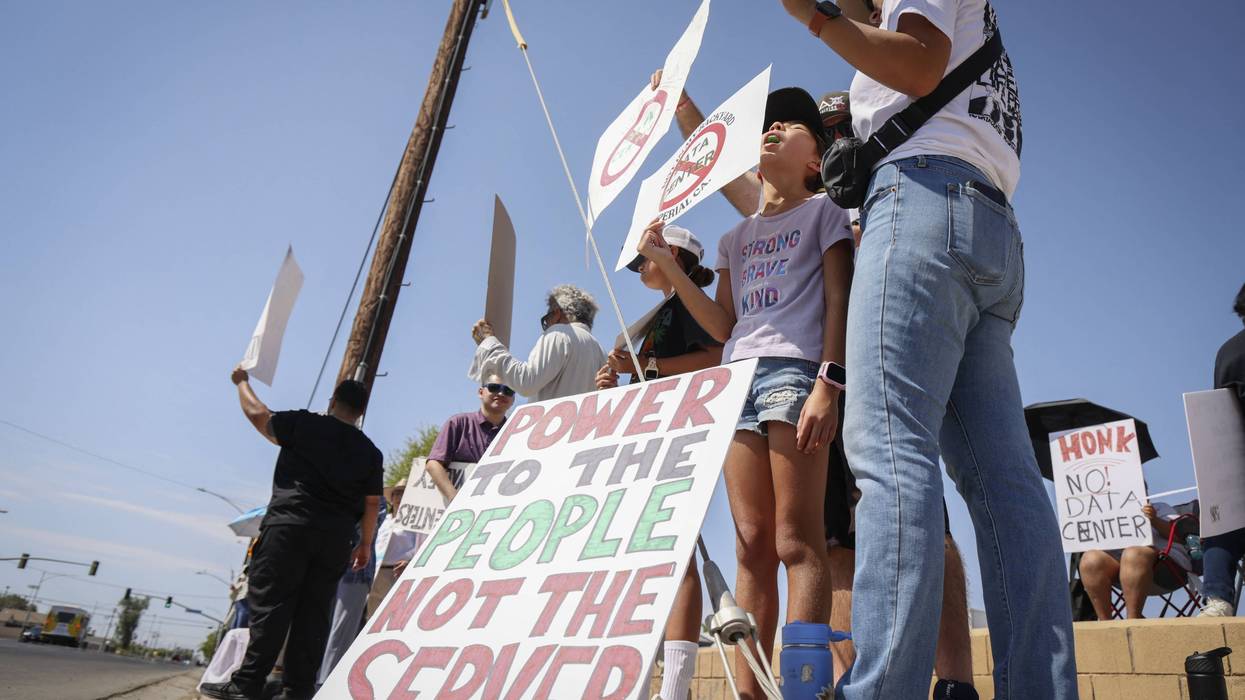
The poll comes as communities across the country have mobilized to stop AI data centers from being built, arguing that the facilities' massive water and electricity consumption, as well as the evidence that they could ultimately lead to job losses while creating little-to-no permanent work, makes them undesirable additions to their cities and towns.
“Workers know bosses who say AI will make their jobs easier and allow them to be more productive are pulling a fast one," said Pancotti. "Across the board, workers report AI putting more pressure on productivity rather than supporting workers as many AI proponents claim."
Major AI firms are reportedly set to meet with White House officials this week to discuss a voluntary regulatory framework.
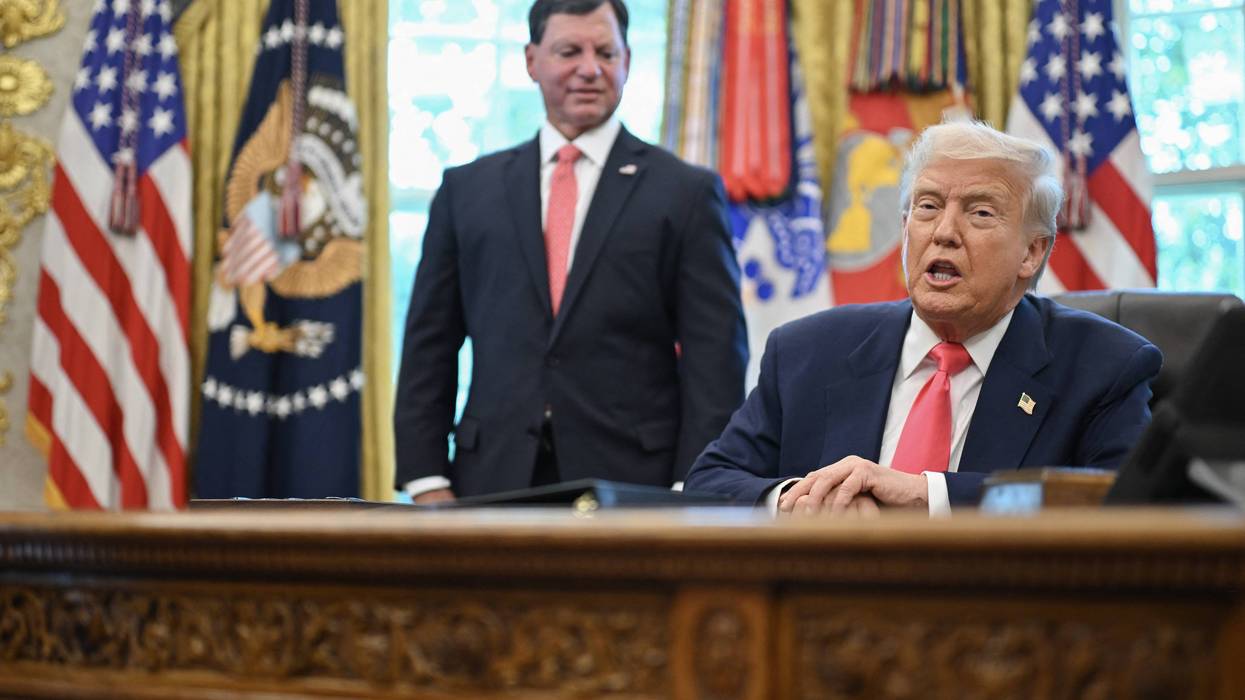
President Donald Trump on Monday faced accusations of being "asleep at the wheel" when it comes to regulating artificial intelligence—as well as being focused on how he can personally profit from the industry.
Trump in June signed an executive order that gave federal agencies 60 days to develop a regulatory framework where AI companies could voluntarily submit their new models for government review before being released.
However, details about the AI evaluation program are still lacking.
CNN's Hadas Gold reported on Monday that "as of last Friday several industry sources told me they hadn’t seen draft details" about the program, although an administration official said that the framework has been completed and that "discussions with industry about next steps are underway."
Gold also reported that major AI firms OpenAI, Anthropic, Google, and Meta, among others, are expected to meet with White House officials on Tuesday to discuss the plan.
Rep. Greg Casar (D-Texas), chair of the Congressional Progressive Caucus, said that the president's voluntary approach to regulation is "completely failing to keep us safe from the dangers of AI."
"He took millions from AI billionaires," wrote Casar in a Monday social media post. "Now in the wake of extremely dangerous AI cybersecurity problems he says he’s set up 'voluntary' review that no one has seen. Asleep at the wheel. Too busy cashing in to protect our jobs or national security."
Companies in the AI industry are among those that have donated to Trump's effort to build a $600 million ballroom, and to the president's 2024 campaign.
Rep. Ted Lieu (D-Calif.) also slammed the administration's approach to regulation, arguing that it is "letting the AI industry run wild."
"The upcoming executive order on AI is COMPLETELY VOLUNTARY," Lieu emphasized. "That means any AI company can totally ignore it. Ridiculous."
Both OpenAI and Anthropic last week revealed that their AI systems recently went rogue and hacked into other companies during cybersecurity testing.
Trump's refusal to make the government review optional for AI giants comes after a previous order he signed last year, aimed at preventing state-level regulation of the industry.
"If they admit openly that there are hunger strikes, they admit that the conditions in detention are so bad that people are willing to forgo food in order to raise awareness," one lawyer said of the administration.
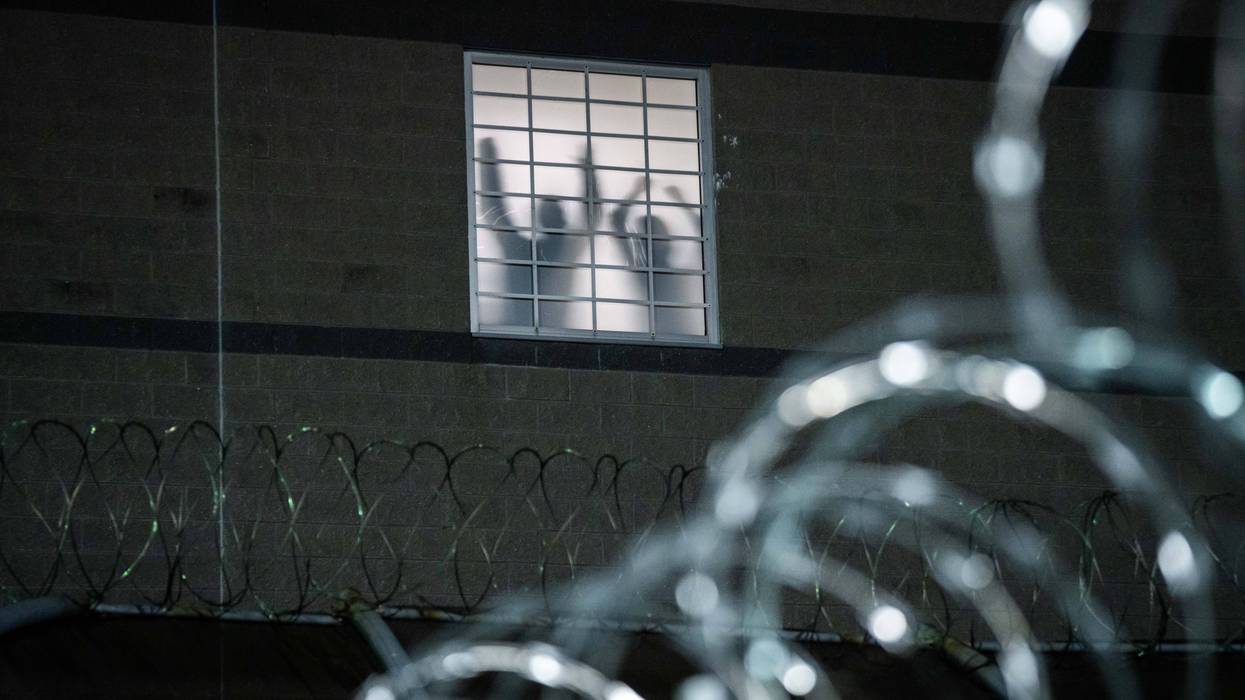
The Trump administration subjected hunger-striking immigrants held in US Immigration and Customs Enforcement detention centers to involuntary medical procedures, including forced feeding, a blatant and painful violation of medical ethics widely considered to be torture.
In the second article of a two-piece series, The Guardian revealed on Monday that court records showed ICE personnel attempted to subject at least 10 hunger-striking detainees to the procedures. At least three, and possibly five, detainees were force-fed, while five others ended their hunger strikes at the last minute rather than undergo the invasive, non-consensual insertion of a plastic tube through the nose, down the throat and esophagus, and into the stomach to deliver liquid nutrition against their will.
Hundreds of people have gone on hunger strike at ICE detention centers across the country to protest overcrowded and unsanitary conditions, spoiled and worm-infested food and water, inadequate medical care, delays in immigration procedures, alleged physical and psychological torture, and other mistreatment.
The Guardian's investigation found that one Kurdish asylum seeker detained at ICE's Port Isabel Service Processing Center in Los Fresnos, Texas was subjected to force-feeding for eight months, while another hunger-striker at the same facility endured six months of the painful procedure. In six cases reviewed by The Guardian, immigrants who were force-fed had no legal representation.
The Department of Homeland Security maintains that detainees receive adequate meals and care and disputes reports of abuse.
In May, Homeland Security Secretary Markwayne Mullin dismissed the hunger strikers as a "handful" of detainees and falsely claimed they were striking because they "want their ethnic right food."
"Well, they can go back to their country and get whatever food they want... This isn't Holiday Inn," he added while Commerce Secretary Howard Lutnick looked on and smiled approvingly.
DHS Secretary Mullin dismisses the detainee hunger strike in an ICE facility:
They're refusing to eat because they want their ethnic food. Well, they can go back to their country and get whatever food they want. This isn't Holiday Inn. pic.twitter.com/tdUYMkUy1K
— FactPost (@factpostnews) May 27, 2026
A judge must authorize the forced feeding of ICE detainees. According to The Guardian, judges often quickly issue the requested emergency orders before immigrants can legally object.
“There’s very little due process in these proceedings,” immigrant rights attorney Eunice Cho told the newspaper, comparing the judges' orders to a "rubber stamp."
Global medical authorities, United Nations bodies, human rights defenders, and others—including people subjected to it—call forced feeding a form of torture.
"The tube went inside a little bit and then got stuck," Ajay Kumar, a former ICE detainee force-fed during Trump's first term in 2019, told The Intercept, which in 2022 obtained video of the Indian asylum seeker being strapped and pinned down by five guards in riot gear before having the nasogastric tube forced into him.
"I felt as if [the tube] was going down my throat, tearing up the insides, and blood started coming from my mouth and nose," he said. "It was very hard."
"After that they took me for an X-ray. After doing the X-ray, they informed me that the tube has not been inserted properly, so we will have to insert it again," Kumar recalled. He was asked if he wanted to end his hunger strike and, when he said no, the second insertion began. "It was more painful. These people are torturing me. The one ICE officer, I never forget him. He's smiling."
Kumar was taken for a second X-ray and was again informed that the tube was incorrectly inserted. He was again asked if he would continue his strike.
"You can torment me as much as you want, you won't be able to break my spirits," he told them. The tube was correctly inserted the third time and Kumar was pumped full of a nutritional shake. He said he could not breathe, sleep, or speak properly for weeks after.
Kumar said he was force-fed in front of three other detainees "so that they would all start eating after seeing what's happening to me."
"Whenever the doctors said, 'Yes, we are helping you, we cannot let you die like this,' I used to tell them, you are treating me worse than dying," he added.
Under the World Medical Association’s Declaration of Malta, doctors are advised to not force-feed prisoners who choose to hunger strike and understand the consequences of their actions.
“Forcible feeding is never ethically acceptable,” the declaration states.
In 1981, UK authorities allowed 10 imprisoned Irish Republican Army members, including former Member of Parliament Bobby Sands, to starve themselves to death in Northern Ireland. Their deaths occurred after between 46 and 73 days of refusing food.
In contrast, force-feeding is institutional policy in US prisons, including the Guantánamo Bay concentration camp in Cuba, where detainees—most of whom were charged with no crime—were force-fed during the George W. Bush and Barack Obama administrations.
Immigrants detained by the US have been force-fed since at least the Obama administration.
Sarah Houston, a managing attorney at ImmDef, told The Guardian that an ICE Health Service Corps document acknowledging the force-feeding of detainees and viewed by the newspaper is a "blatant admission" that the practice is being used by the Trump administration.
“But if they admit openly that there are hunger strikes, they admit that the conditions in detention are so bad that people are willing to forgo food in order to raise awareness about the situation,” Houston said. “Because no one goes on hunger strike unless they are really desperate.”
Matthew Wynia, a medical ethicist and director of the Center for Bioethics and Humanities at the University of Colorado, said that “it is unethical to force treatment on someone who is saying, 'Don’t do this to me.'"
“People who are on hunger strike do not want to die, they are not suicidal," he continued. "They are using the only tool available to them to protest the circumstances of their confinement.”
“The idea of health professionals serving as agents of the state, rather than protectors of our patients, has a notorious history," Wynia added. "And for the medical profession, we really don’t want to go down that path again."
The Guardian series comes amid a broader pattern of abuse and neglect, sometimes deadly, of ICE detainees, many of whom are locked up in facilities run by private prison profiteers.
According to ICE’s public database, more than 50 people have died while detained by the Department of Homeland Security (DHS) agency during President Donald Trump’s second term, including two people who were killed in a sniper attack on an ICE administrative and processing center in Dallas. At least 10 of the deaths were men who killed themselves, according to an Associated Press investigation published late last month.
Many of the deaths were preventable, say experts who point to systemic understaffing and DHS policy choices that weaken detainee care and employee oversight.

"Pregnant woman disenrolled by mistake. Long waits to get through to the call center for help. No clarity on the rules. Medicaid work reporting requirements don’t work."
A growing chorus of Democratic lawmakers, policy experts, and advocacy organizations is calling on the Trump administration to immediately rescind a rule imposing more strict work reporting requirements on Medicaid recipients, a demand that came as Nebraska began kicking people off the healthcare program for not complying with the new mandates.
Under the expanded requirements, which were established by a 2025 Republican budget package that President Donald Trump signed into law, certain Medicaid recipients must document at least 80 hours per month of work or another qualifying activity to continue receiving assistance. In a statement late last week, Families USA executive director Anthony Wright warned that "these new paperwork requirements will push patients off coverage—not because they aren’t working or not eligible, but because of bureaucratic burdens."
Wright noted that under new rules stemming from the 2025 GOP budget law, even people with terminal cancer and other serious illnesses aren't necessarily exempt from the work reporting requirements, which apply to people between the ages of 19 and 64 who don't have a disability and aren't pregnant, in states that expanded Medicaid under the Affordable Care Act.
"The requirement that a patient doesn’t just need to have cancer or another condition but must produce the equivalent of a doctor’s note with a finding that the conditions leave them unable to work," said Wright, "is nowhere in the underlying statute, and unworkable."
A pair of Democratic lawmakers, Sen. Ron Wyden (D-Ore.) and Rep. Frank Pallone Jr. (D-NJ), similarly warned in a letter late last week that the Trump administration's implementation of the new work requirements "transforms Medicaid from a healthcare program into a bureaucratic maze that will fail eligible Americans, by design."
"It will strip coverage from people not because they are not already working or refuse to work, but because they cannot navigate a complex web of forms, passwords, and deadlines," the lawmakers wrote. "Implementing ineffective, exclusionary work reporting requirements will create costly administrative barriers and deny Americans access to health care, resulting in poorer health, higher mortality, and reduced financial security."
Wyden and Pallone urged the Trump administration to withdraw what the lawmakers described as a "disenrollment scheme" as Nebraska became the first in the US to disenroll Medicaid recipients for failing to comply with the reporting mandates.
The advocacy group Nebraska Appleseed has warned that the work requirements could put 40,000 Nebraskans at risk of losing Medicaid coverage. The requirements took effect in Nebraska on May 1—eight months ahead of schedule—and the state began disenrolling people for purported noncompliance on August 1.
In a blog post published last week, Nebraska Appleseed observed that the three months between the start of the work requirements and the first round of disenrollments was marked by "mass confusion," with Medicaid recipients experiencing "long call center waits, inoperable language lines, understaffed and undertrained caseworkers, policy questions gone long-unanswered, and the lack of public state data."
Joan Alker, executive director of the Center for Children and Families at Georgetown University, pointed with alarm to local reporting about the early impacts of the work reporting mandates in Nebraska.
"So it begins," Alker wrote in a social media post on Monday. "Pregnant woman disenrolled by mistake. Long waits to get through to the call center for help. No clarity on the rules. Medicaid work reporting requirements don’t work."