SUBSCRIBE TO OUR FREE NEWSLETTER
Daily news & progressive opinion—funded by the people, not the corporations—delivered straight to your inbox.
5
#000000
#FFFFFF
To donate by check, phone, or other method, see our More Ways to Give page.
Daily news & progressive opinion—funded by the people, not the corporations—delivered straight to your inbox.
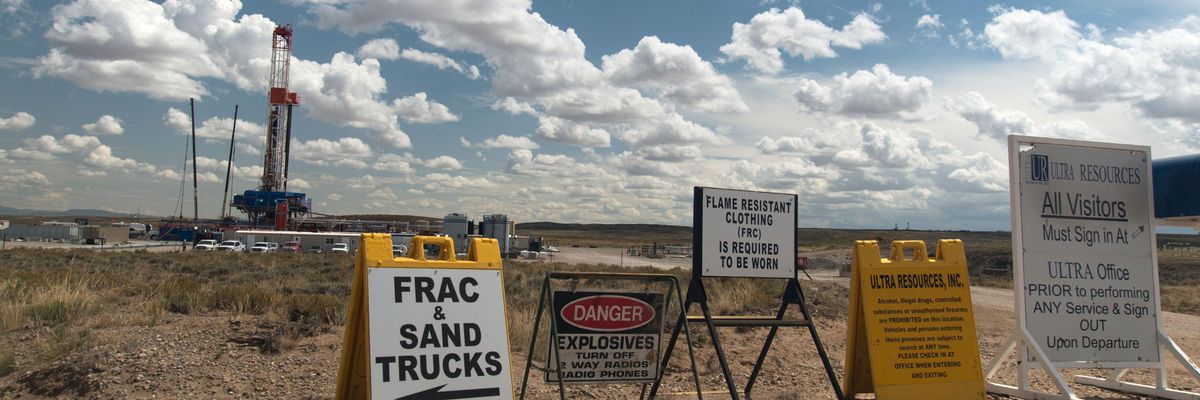
The Pinedale Anticline natural gas field is seen in Sublette County, Wyoming.
"This is a huge victory for the protection of our public lands," said Friends of the Earth.
The U.S. Bureau of Land Management will have to reevaluate the wildlife and public health impacts of a major 2022 oil and gas lease sale in Wyoming after a federal judge ruled Friday that the agency had overlooked "what is widely regarded as the most pressing environmental threat facing the world today" when it moved forward with leasing 120,000 of federal land.
U.S. District Judge Christopher Cooper ruled in Washington, D.C. that the BLM did not halt the lease sale even after it acknowledged that oil and gas drilling on the federal lands could result in the same negative environmental and social impacts as the addition of hundreds of thousands of cars to U.S. roads each year.
Moving forward with one of the Biden administration's largest lease sales despite its likely environmental harm, said Cooper, was illegal under the National Environmental Policy Act and other laws.
Representing The Wilderness Society and Friends of the Earth (FOE), environmental legal group Earthjustice sued BLM over its leasing plans' potential impact on the greater sage grouse, an endangered bird species, and other wildlife, as well as groundwater impacts.
The judge found BLM did not complete a sufficiently detailed review of drilling impacts on the greater sage grouse, and relied too heavily on outdated and overly broad analyses of oil and gas drilling in Wyoming.
While the agency has been attempting to "stop the bleeding" of the greater sage grouse, whose population has declined nearly 40% since 2002, the BLM still refused to postpone leasing in a critical habitat for the bird.
The Biden administration also did not adequately explain its analysis of potential groundwater harms, said the ruling.
Despite some conservation strides by the Biden administration, The Wilderness Society's Ben Tettlebaum said the court's decision "affirms that much work remains" to be done. The BLM, he added, "must fully account for the serious impacts of its oil and gas program on groundwater, wildlife, and the climate."
Tettlebaum said the ruling also proves the agency is required to "factor into its leasing decisions the enormous costs that greenhouse gas emissions stemming from its oil and gas program impose on public land resources and on the communities that depend on them for clean air and water."
Hallie Templeton, legal director for FOE, added that the federal government "simply cannot ignore climate, wildlife, and water impacts when analyzing the myriad risks of oil and gas leasing, whether in Wyoming or across the country," as the ruling makes clear.
"We are beyond pleased with this outcome," said Templeton.
The ruling "should be another wake up call for the Bureau of Land Management to at long last address the damage caused from federal oil and gas development," said Alexandra Schluntz, senior associate attorney for Earthjustice. "It is time to make fossil fuel leasing on our public lands a thing of the past."
Dear Common Dreams reader, It’s been nearly 30 years since I co-founded Common Dreams with my late wife, Lina Newhouser. We had the radical notion that journalism should serve the public good, not corporate profits. It was clear to us from the outset what it would take to build such a project. No paid advertisements. No corporate sponsors. No millionaire publisher telling us what to think or do. Many people said we wouldn't last a year, but we proved those doubters wrong. Together with a tremendous team of journalists and dedicated staff, we built an independent media outlet free from the constraints of profits and corporate control. Our mission has always been simple: To inform. To inspire. To ignite change for the common good. Building Common Dreams was not easy. Our survival was never guaranteed. When you take on the most powerful forces—Wall Street greed, fossil fuel industry destruction, Big Tech lobbyists, and uber-rich oligarchs who have spent billions upon billions rigging the economy and democracy in their favor—the only bulwark you have is supporters who believe in your work. But here’s the urgent message from me today. It's never been this bad out there. And it's never been this hard to keep us going. At the very moment Common Dreams is most needed, the threats we face are intensifying. We need your support now more than ever. We don't accept corporate advertising and never will. We don't have a paywall because we don't think people should be blocked from critical news based on their ability to pay. Everything we do is funded by the donations of readers like you. When everyone does the little they can afford, we are strong. But if that support retreats or dries up, so do we. Will you donate now to make sure Common Dreams not only survives but thrives? —Craig Brown, Co-founder |
The U.S. Bureau of Land Management will have to reevaluate the wildlife and public health impacts of a major 2022 oil and gas lease sale in Wyoming after a federal judge ruled Friday that the agency had overlooked "what is widely regarded as the most pressing environmental threat facing the world today" when it moved forward with leasing 120,000 of federal land.
U.S. District Judge Christopher Cooper ruled in Washington, D.C. that the BLM did not halt the lease sale even after it acknowledged that oil and gas drilling on the federal lands could result in the same negative environmental and social impacts as the addition of hundreds of thousands of cars to U.S. roads each year.
Moving forward with one of the Biden administration's largest lease sales despite its likely environmental harm, said Cooper, was illegal under the National Environmental Policy Act and other laws.
Representing The Wilderness Society and Friends of the Earth (FOE), environmental legal group Earthjustice sued BLM over its leasing plans' potential impact on the greater sage grouse, an endangered bird species, and other wildlife, as well as groundwater impacts.
The judge found BLM did not complete a sufficiently detailed review of drilling impacts on the greater sage grouse, and relied too heavily on outdated and overly broad analyses of oil and gas drilling in Wyoming.
While the agency has been attempting to "stop the bleeding" of the greater sage grouse, whose population has declined nearly 40% since 2002, the BLM still refused to postpone leasing in a critical habitat for the bird.
The Biden administration also did not adequately explain its analysis of potential groundwater harms, said the ruling.
Despite some conservation strides by the Biden administration, The Wilderness Society's Ben Tettlebaum said the court's decision "affirms that much work remains" to be done. The BLM, he added, "must fully account for the serious impacts of its oil and gas program on groundwater, wildlife, and the climate."
Tettlebaum said the ruling also proves the agency is required to "factor into its leasing decisions the enormous costs that greenhouse gas emissions stemming from its oil and gas program impose on public land resources and on the communities that depend on them for clean air and water."
Hallie Templeton, legal director for FOE, added that the federal government "simply cannot ignore climate, wildlife, and water impacts when analyzing the myriad risks of oil and gas leasing, whether in Wyoming or across the country," as the ruling makes clear.
"We are beyond pleased with this outcome," said Templeton.
The ruling "should be another wake up call for the Bureau of Land Management to at long last address the damage caused from federal oil and gas development," said Alexandra Schluntz, senior associate attorney for Earthjustice. "It is time to make fossil fuel leasing on our public lands a thing of the past."
The U.S. Bureau of Land Management will have to reevaluate the wildlife and public health impacts of a major 2022 oil and gas lease sale in Wyoming after a federal judge ruled Friday that the agency had overlooked "what is widely regarded as the most pressing environmental threat facing the world today" when it moved forward with leasing 120,000 of federal land.
U.S. District Judge Christopher Cooper ruled in Washington, D.C. that the BLM did not halt the lease sale even after it acknowledged that oil and gas drilling on the federal lands could result in the same negative environmental and social impacts as the addition of hundreds of thousands of cars to U.S. roads each year.
Moving forward with one of the Biden administration's largest lease sales despite its likely environmental harm, said Cooper, was illegal under the National Environmental Policy Act and other laws.
Representing The Wilderness Society and Friends of the Earth (FOE), environmental legal group Earthjustice sued BLM over its leasing plans' potential impact on the greater sage grouse, an endangered bird species, and other wildlife, as well as groundwater impacts.
The judge found BLM did not complete a sufficiently detailed review of drilling impacts on the greater sage grouse, and relied too heavily on outdated and overly broad analyses of oil and gas drilling in Wyoming.
While the agency has been attempting to "stop the bleeding" of the greater sage grouse, whose population has declined nearly 40% since 2002, the BLM still refused to postpone leasing in a critical habitat for the bird.
The Biden administration also did not adequately explain its analysis of potential groundwater harms, said the ruling.
Despite some conservation strides by the Biden administration, The Wilderness Society's Ben Tettlebaum said the court's decision "affirms that much work remains" to be done. The BLM, he added, "must fully account for the serious impacts of its oil and gas program on groundwater, wildlife, and the climate."
Tettlebaum said the ruling also proves the agency is required to "factor into its leasing decisions the enormous costs that greenhouse gas emissions stemming from its oil and gas program impose on public land resources and on the communities that depend on them for clean air and water."
Hallie Templeton, legal director for FOE, added that the federal government "simply cannot ignore climate, wildlife, and water impacts when analyzing the myriad risks of oil and gas leasing, whether in Wyoming or across the country," as the ruling makes clear.
"We are beyond pleased with this outcome," said Templeton.
The ruling "should be another wake up call for the Bureau of Land Management to at long last address the damage caused from federal oil and gas development," said Alexandra Schluntz, senior associate attorney for Earthjustice. "It is time to make fossil fuel leasing on our public lands a thing of the past."