SUBSCRIBE TO OUR FREE NEWSLETTER
Daily news & progressive opinion—funded by the people, not the corporations—delivered straight to your inbox.
5
#000000
#FFFFFF
To donate by check, phone, or other method, see our More Ways to Give page.
Daily news & progressive opinion—funded by the people, not the corporations—delivered straight to your inbox.
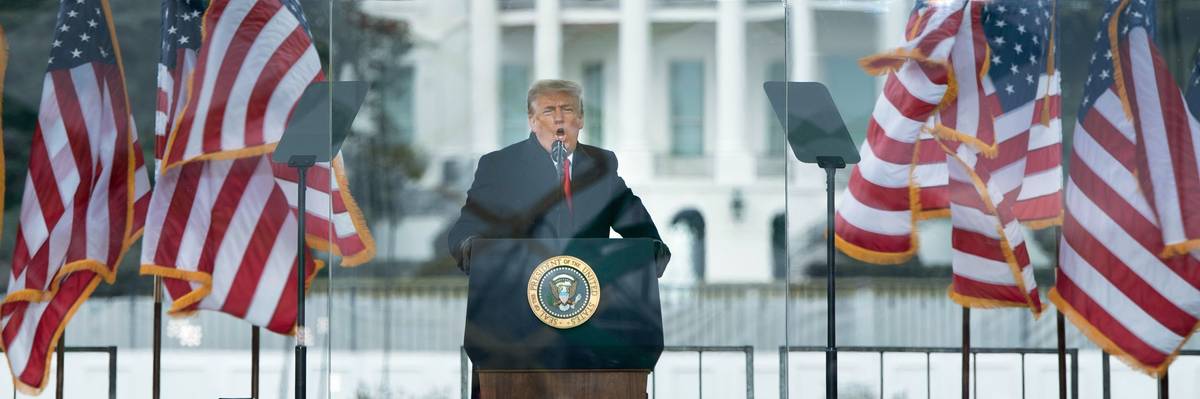
Then-U.S. President Donald Trump speaks to supporters near the White House on January 6, 2021, in Washington, D.C.
"Today was not the end of this effort, but another step along the way," said CREW president Noah Bookbinder, who vowed to appeal the technicality-based ruling.
A Colorado judge on Friday ruled that former U.S. President Donald Trump "engaged in insurrection" on January 6, 2021 but allowed him to remain on the state's 2024 presidential ballot due to a disupted technicality that critics hope will be reversed on appeal.
Judge Sarah Wallace's 102-page ruling states that Trump's January 6 speech near the White House "incited imminent lawless
violence."
"Trump did so explicitly by telling the crowd repeatedly to 'fight' and to 'fight like hell,' to 'walk down to the Capitol,' and that they needed to take back our country' through 'strength,'" she wrote. "He did so implicitly by encouraging the crowd that they could play by 'very different rules' because of the supposed fraudulent election."
Wallace continued:
In the context of the speech as a whole, as well as the broader context of Trump's efforts to inflame his supporters through outright lies of voter fraud in the weeks leading up to January 6, 2021 and his longstanding pattern of encouraging political violence among his supporters, the court finds that the call to 'fight' and 'fight like hell' was intended as, and was understood by a portion of the crowd as, a call to arms.
The court further finds, based on the testimony and documentary evidence presented, that Trump's conduct and words were the factual cause of, and a substantial contributing factor to, the January 6, 2021 attack on the United States Capitol.
The advocacy group Citizens for Responsibility and Ethics in Washington (CREW) and two law firms representing a group of Colorado voters had argued in their suit that "Trump is constitutionally ineligible to assume the office of the president" because he "knowingly and voluntarily aided and incited the insurrection" before and on January 6.
Enacted after the Civil War, Section 3 of the 14th Amendment—known as the insurrection clause—bars from public office any "officer of the United States" who takes an oath to uphold the Constitution and subsequently participates in an insurrection or rebellion against the U.S. government.
Wallace found that Trump, who was still president at the time, was not "an officer of the United States," and therefore could not be proscribed from holding office under the insurrection clause. This, despite citing examples in her ruling of times when the president has been considered an "officer."
Legal experts said that the technicality could be overturned on appeal. Former U.S. Defense Department special counsel Ryan Goodman wrote on social media that Trump "shouldn't be comfortable" with Wallace's decision.
CREW president Noah Bookbinder said in a statement that "when we filed this case, we knew it likely would not end at the district court level."
"We will be filing an appeal to the Colorado Supreme Court shortly," he added. "Today was not the end of this effort, but another step along the way."
Wallace's decision follows a Tuesday ruling in a Michigan 14th Amendment case in which the judge declined to address Trump's conduct while arguing that only Congress can decide whether a presidential candidate fails to meet constitutional qualifications for office, and last week's dismissal of a similar case in Minnesota.
In closing arguments in the Colorado case, Scott Gessler, an attorney for Trump—who is far and away the frontrunner in the GOP presidential primary race—argued there is "an emerging consensus here within the judiciary across the United States."
However as Ron Fein, legal director at the advocacy group Free Speech for People, noted after the Minnesota ruling, the state Supreme Court "explicitly recognized that the question of Donald Trump's disqualification for engaging in insurrection against the U.S. Constitution may be resolved at a later stage."
Dear Common Dreams reader, It’s been nearly 30 years since I co-founded Common Dreams with my late wife, Lina Newhouser. We had the radical notion that journalism should serve the public good, not corporate profits. It was clear to us from the outset what it would take to build such a project. No paid advertisements. No corporate sponsors. No millionaire publisher telling us what to think or do. Many people said we wouldn't last a year, but we proved those doubters wrong. Together with a tremendous team of journalists and dedicated staff, we built an independent media outlet free from the constraints of profits and corporate control. Our mission has always been simple: To inform. To inspire. To ignite change for the common good. Building Common Dreams was not easy. Our survival was never guaranteed. When you take on the most powerful forces—Wall Street greed, fossil fuel industry destruction, Big Tech lobbyists, and uber-rich oligarchs who have spent billions upon billions rigging the economy and democracy in their favor—the only bulwark you have is supporters who believe in your work. But here’s the urgent message from me today. It's never been this bad out there. And it's never been this hard to keep us going. At the very moment Common Dreams is most needed, the threats we face are intensifying. We need your support now more than ever. We don't accept corporate advertising and never will. We don't have a paywall because we don't think people should be blocked from critical news based on their ability to pay. Everything we do is funded by the donations of readers like you. When everyone does the little they can afford, we are strong. But if that support retreats or dries up, so do we. Will you donate now to make sure Common Dreams not only survives but thrives? —Craig Brown, Co-founder |
A Colorado judge on Friday ruled that former U.S. President Donald Trump "engaged in insurrection" on January 6, 2021 but allowed him to remain on the state's 2024 presidential ballot due to a disupted technicality that critics hope will be reversed on appeal.
Judge Sarah Wallace's 102-page ruling states that Trump's January 6 speech near the White House "incited imminent lawless
violence."
"Trump did so explicitly by telling the crowd repeatedly to 'fight' and to 'fight like hell,' to 'walk down to the Capitol,' and that they needed to take back our country' through 'strength,'" she wrote. "He did so implicitly by encouraging the crowd that they could play by 'very different rules' because of the supposed fraudulent election."
Wallace continued:
In the context of the speech as a whole, as well as the broader context of Trump's efforts to inflame his supporters through outright lies of voter fraud in the weeks leading up to January 6, 2021 and his longstanding pattern of encouraging political violence among his supporters, the court finds that the call to 'fight' and 'fight like hell' was intended as, and was understood by a portion of the crowd as, a call to arms.
The court further finds, based on the testimony and documentary evidence presented, that Trump's conduct and words were the factual cause of, and a substantial contributing factor to, the January 6, 2021 attack on the United States Capitol.
The advocacy group Citizens for Responsibility and Ethics in Washington (CREW) and two law firms representing a group of Colorado voters had argued in their suit that "Trump is constitutionally ineligible to assume the office of the president" because he "knowingly and voluntarily aided and incited the insurrection" before and on January 6.
Enacted after the Civil War, Section 3 of the 14th Amendment—known as the insurrection clause—bars from public office any "officer of the United States" who takes an oath to uphold the Constitution and subsequently participates in an insurrection or rebellion against the U.S. government.
Wallace found that Trump, who was still president at the time, was not "an officer of the United States," and therefore could not be proscribed from holding office under the insurrection clause. This, despite citing examples in her ruling of times when the president has been considered an "officer."
Legal experts said that the technicality could be overturned on appeal. Former U.S. Defense Department special counsel Ryan Goodman wrote on social media that Trump "shouldn't be comfortable" with Wallace's decision.
CREW president Noah Bookbinder said in a statement that "when we filed this case, we knew it likely would not end at the district court level."
"We will be filing an appeal to the Colorado Supreme Court shortly," he added. "Today was not the end of this effort, but another step along the way."
Wallace's decision follows a Tuesday ruling in a Michigan 14th Amendment case in which the judge declined to address Trump's conduct while arguing that only Congress can decide whether a presidential candidate fails to meet constitutional qualifications for office, and last week's dismissal of a similar case in Minnesota.
In closing arguments in the Colorado case, Scott Gessler, an attorney for Trump—who is far and away the frontrunner in the GOP presidential primary race—argued there is "an emerging consensus here within the judiciary across the United States."
However as Ron Fein, legal director at the advocacy group Free Speech for People, noted after the Minnesota ruling, the state Supreme Court "explicitly recognized that the question of Donald Trump's disqualification for engaging in insurrection against the U.S. Constitution may be resolved at a later stage."
A Colorado judge on Friday ruled that former U.S. President Donald Trump "engaged in insurrection" on January 6, 2021 but allowed him to remain on the state's 2024 presidential ballot due to a disupted technicality that critics hope will be reversed on appeal.
Judge Sarah Wallace's 102-page ruling states that Trump's January 6 speech near the White House "incited imminent lawless
violence."
"Trump did so explicitly by telling the crowd repeatedly to 'fight' and to 'fight like hell,' to 'walk down to the Capitol,' and that they needed to take back our country' through 'strength,'" she wrote. "He did so implicitly by encouraging the crowd that they could play by 'very different rules' because of the supposed fraudulent election."
Wallace continued:
In the context of the speech as a whole, as well as the broader context of Trump's efforts to inflame his supporters through outright lies of voter fraud in the weeks leading up to January 6, 2021 and his longstanding pattern of encouraging political violence among his supporters, the court finds that the call to 'fight' and 'fight like hell' was intended as, and was understood by a portion of the crowd as, a call to arms.
The court further finds, based on the testimony and documentary evidence presented, that Trump's conduct and words were the factual cause of, and a substantial contributing factor to, the January 6, 2021 attack on the United States Capitol.
The advocacy group Citizens for Responsibility and Ethics in Washington (CREW) and two law firms representing a group of Colorado voters had argued in their suit that "Trump is constitutionally ineligible to assume the office of the president" because he "knowingly and voluntarily aided and incited the insurrection" before and on January 6.
Enacted after the Civil War, Section 3 of the 14th Amendment—known as the insurrection clause—bars from public office any "officer of the United States" who takes an oath to uphold the Constitution and subsequently participates in an insurrection or rebellion against the U.S. government.
Wallace found that Trump, who was still president at the time, was not "an officer of the United States," and therefore could not be proscribed from holding office under the insurrection clause. This, despite citing examples in her ruling of times when the president has been considered an "officer."
Legal experts said that the technicality could be overturned on appeal. Former U.S. Defense Department special counsel Ryan Goodman wrote on social media that Trump "shouldn't be comfortable" with Wallace's decision.
CREW president Noah Bookbinder said in a statement that "when we filed this case, we knew it likely would not end at the district court level."
"We will be filing an appeal to the Colorado Supreme Court shortly," he added. "Today was not the end of this effort, but another step along the way."
Wallace's decision follows a Tuesday ruling in a Michigan 14th Amendment case in which the judge declined to address Trump's conduct while arguing that only Congress can decide whether a presidential candidate fails to meet constitutional qualifications for office, and last week's dismissal of a similar case in Minnesota.
In closing arguments in the Colorado case, Scott Gessler, an attorney for Trump—who is far and away the frontrunner in the GOP presidential primary race—argued there is "an emerging consensus here within the judiciary across the United States."
However as Ron Fein, legal director at the advocacy group Free Speech for People, noted after the Minnesota ruling, the state Supreme Court "explicitly recognized that the question of Donald Trump's disqualification for engaging in insurrection against the U.S. Constitution may be resolved at a later stage."