SUBSCRIBE TO OUR FREE NEWSLETTER
Daily news & progressive opinion—funded by the people, not the corporations—delivered straight to your inbox.
5
#000000
#FFFFFF
To donate by check, phone, or other method, see our More Ways to Give page.
Daily news & progressive opinion—funded by the people, not the corporations—delivered straight to your inbox.
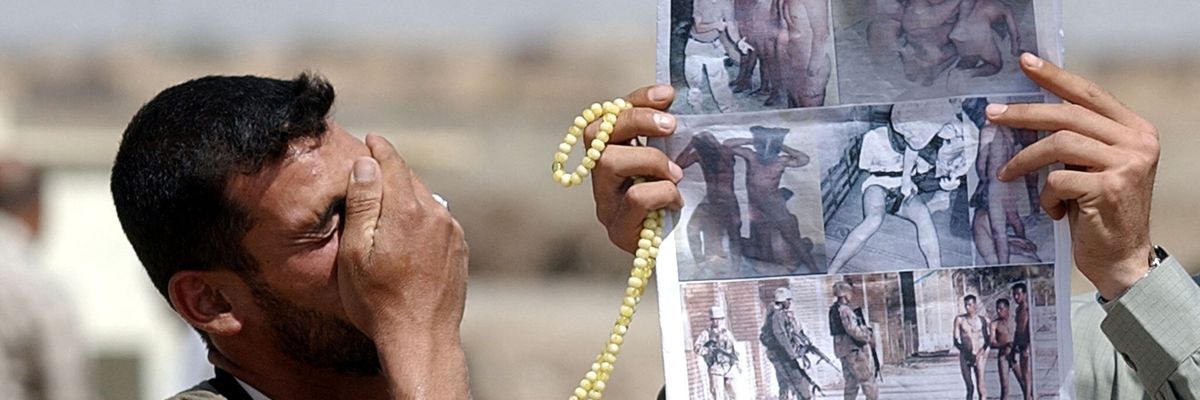
A relative of an Iraqi prisoner held by US authorities at the Abu Ghraib prison holds his hand to his face on May 8, 2004 as another shows a newspaper featuring photos of U.S. soldiers abusing detainees.
"Iraqis who were tortured by U.S. personnel still have no clear path for filing a claim or receiving any kind of redress or recognition from the U.S. government."
Iraqis tortured by American forces two decades ago during the disastrous U.S. occupation of their country have yet to receive any sort of compensation from the U.S. government as they suffer lasting physical and psychological trauma, according to a report released Monday by Human Rights Watch.
The group interviewed an Iraqi who was detained at Abu Ghraib prison—which U.S. forces used as a detention facility—between November 2003 and March 2005.
Taleb al-Majli, who was released without charge after 16 months, told HRW that he was one of the detainees in the infamous photo of naked, hooded Iraqi prisoners whom U.S. forces piled on top of each other to form a human pyramid. In the photo, two U.S. soldiers are behind the prisoners smiling, and one of them is flashing a thumbs-up.
"This one year and four months changed my entire being for the worse," said al-Majli, who told the human rights group that he started biting his hands and wrists as a coping mechanism while he was imprisoned—something he still does to this day.
"It destroyed me and destroyed my family," al-Majli said of his detention. "It's the reason for my son's health problems and the reasons my daughters dropped out of school. They stole our future from us."
HRW noted that al-Majli has spent the nearly two decades since his release pursuing redress for the abuse he endured at the hands of U.S. soldiers, to no avail. When the group wrote to the Pentagon earlier this year detailing al-Majli's case and asking for any information on plans to compensate Iraqis who were tortured by U.S. forces, it did not get a response.
"Twenty years on, Iraqis who were tortured by U.S. personnel still have no clear path for filing a claim or receiving any kind of redress or recognition from the U.S. government," Sarah Yager, HRW's Washington director, said in a statement. "U.S. officials have indicated that they prefer to leave torture in the past, but the long-term effects of torture are still a daily reality for many Iraqis and their families."
"The U.S. should provide compensation, recognition, and official apologies to survivors of abuse and their families."
During a 2004 congressional hearing convened days after reporting by veteran investigative journalist Seymour Hersh and others uncovered the grotesque torture that U.S. forces were perpetrating at Abu Ghraib, then-U.S. Secretary of Defense Donald Rumsfeld—a key architect of the Iraq invasion—said he was "seeking a way to provide appropriate compensation to those detainees who suffered such grievous and brutal abuse and cruelty at the hands of a few members of the U.S. military."
"It's the right thing to do," Rumsfeld added.
But HRW said Monday that it has "found no evidence that the U.S. government has paid any compensation or other redress to victims of detainee abuse in Iraq, nor has the United States issued any individual apologies or other amends."
"Some victims have attempted to apply for compensation using the U.S. Foreign Claims Act (FCA)," the group observed. "Human Rights Watch was unable to find public evidence that payments have been made under this law as compensation for detainee abuse, including torture. In 2007, the American Civil Liberties Union obtained documents detailing 506 claims made under the Foreign Claims Act: 488 in Iraq and 18 in Afghanistan. The majority of claims relate to harm or deaths caused by shootings, convoys, and vehicle accidents."
"The only case of a Foreign Claims Act payment relating to detention in those documents was for a claimant who was paid US$1,000 for being unlawfully detained in Iraq, with no mention of other abuse," HRW added. "Five other claims were for abuse in detention, but they are among eleven claims that do not contain the outcome, including whether payment was made."
Attempts by some Iraqis to pursue redress through the U.S. court system have also failed. According to HRW, "the U.S. Justice Department has repeatedly dismissed such cases using a 1946 law that preserves U.S. forces' immunity for 'any claim arising out of the combatant activities of the military or naval forces, or the Coast Guard, during time of war.'"
Yager argued that the heads of the Pentagon and Justice Department "should investigate allegations of torture and other abuse of people detained by the U.S. abroad during counterinsurgency operations linked to its 'Global War on Terrorism.'"
"U.S. authorities should initiate appropriate prosecutions against anyone implicated, whatever their rank or position," said Yager. "The U.S. should provide compensation, recognition, and official apologies to survivors of abuse and their families."
Dear Common Dreams reader, It’s been nearly 30 years since I co-founded Common Dreams with my late wife, Lina Newhouser. We had the radical notion that journalism should serve the public good, not corporate profits. It was clear to us from the outset what it would take to build such a project. No paid advertisements. No corporate sponsors. No millionaire publisher telling us what to think or do. Many people said we wouldn't last a year, but we proved those doubters wrong. Together with a tremendous team of journalists and dedicated staff, we built an independent media outlet free from the constraints of profits and corporate control. Our mission has always been simple: To inform. To inspire. To ignite change for the common good. Building Common Dreams was not easy. Our survival was never guaranteed. When you take on the most powerful forces—Wall Street greed, fossil fuel industry destruction, Big Tech lobbyists, and uber-rich oligarchs who have spent billions upon billions rigging the economy and democracy in their favor—the only bulwark you have is supporters who believe in your work. But here’s the urgent message from me today. It's never been this bad out there. And it's never been this hard to keep us going. At the very moment Common Dreams is most needed, the threats we face are intensifying. We need your support now more than ever. We don't accept corporate advertising and never will. We don't have a paywall because we don't think people should be blocked from critical news based on their ability to pay. Everything we do is funded by the donations of readers like you. When everyone does the little they can afford, we are strong. But if that support retreats or dries up, so do we. Will you donate now to make sure Common Dreams not only survives but thrives? —Craig Brown, Co-founder |
Iraqis tortured by American forces two decades ago during the disastrous U.S. occupation of their country have yet to receive any sort of compensation from the U.S. government as they suffer lasting physical and psychological trauma, according to a report released Monday by Human Rights Watch.
The group interviewed an Iraqi who was detained at Abu Ghraib prison—which U.S. forces used as a detention facility—between November 2003 and March 2005.
Taleb al-Majli, who was released without charge after 16 months, told HRW that he was one of the detainees in the infamous photo of naked, hooded Iraqi prisoners whom U.S. forces piled on top of each other to form a human pyramid. In the photo, two U.S. soldiers are behind the prisoners smiling, and one of them is flashing a thumbs-up.
"This one year and four months changed my entire being for the worse," said al-Majli, who told the human rights group that he started biting his hands and wrists as a coping mechanism while he was imprisoned—something he still does to this day.
"It destroyed me and destroyed my family," al-Majli said of his detention. "It's the reason for my son's health problems and the reasons my daughters dropped out of school. They stole our future from us."
HRW noted that al-Majli has spent the nearly two decades since his release pursuing redress for the abuse he endured at the hands of U.S. soldiers, to no avail. When the group wrote to the Pentagon earlier this year detailing al-Majli's case and asking for any information on plans to compensate Iraqis who were tortured by U.S. forces, it did not get a response.
"Twenty years on, Iraqis who were tortured by U.S. personnel still have no clear path for filing a claim or receiving any kind of redress or recognition from the U.S. government," Sarah Yager, HRW's Washington director, said in a statement. "U.S. officials have indicated that they prefer to leave torture in the past, but the long-term effects of torture are still a daily reality for many Iraqis and their families."
"The U.S. should provide compensation, recognition, and official apologies to survivors of abuse and their families."
During a 2004 congressional hearing convened days after reporting by veteran investigative journalist Seymour Hersh and others uncovered the grotesque torture that U.S. forces were perpetrating at Abu Ghraib, then-U.S. Secretary of Defense Donald Rumsfeld—a key architect of the Iraq invasion—said he was "seeking a way to provide appropriate compensation to those detainees who suffered such grievous and brutal abuse and cruelty at the hands of a few members of the U.S. military."
"It's the right thing to do," Rumsfeld added.
But HRW said Monday that it has "found no evidence that the U.S. government has paid any compensation or other redress to victims of detainee abuse in Iraq, nor has the United States issued any individual apologies or other amends."
"Some victims have attempted to apply for compensation using the U.S. Foreign Claims Act (FCA)," the group observed. "Human Rights Watch was unable to find public evidence that payments have been made under this law as compensation for detainee abuse, including torture. In 2007, the American Civil Liberties Union obtained documents detailing 506 claims made under the Foreign Claims Act: 488 in Iraq and 18 in Afghanistan. The majority of claims relate to harm or deaths caused by shootings, convoys, and vehicle accidents."
"The only case of a Foreign Claims Act payment relating to detention in those documents was for a claimant who was paid US$1,000 for being unlawfully detained in Iraq, with no mention of other abuse," HRW added. "Five other claims were for abuse in detention, but they are among eleven claims that do not contain the outcome, including whether payment was made."
Attempts by some Iraqis to pursue redress through the U.S. court system have also failed. According to HRW, "the U.S. Justice Department has repeatedly dismissed such cases using a 1946 law that preserves U.S. forces' immunity for 'any claim arising out of the combatant activities of the military or naval forces, or the Coast Guard, during time of war.'"
Yager argued that the heads of the Pentagon and Justice Department "should investigate allegations of torture and other abuse of people detained by the U.S. abroad during counterinsurgency operations linked to its 'Global War on Terrorism.'"
"U.S. authorities should initiate appropriate prosecutions against anyone implicated, whatever their rank or position," said Yager. "The U.S. should provide compensation, recognition, and official apologies to survivors of abuse and their families."
Iraqis tortured by American forces two decades ago during the disastrous U.S. occupation of their country have yet to receive any sort of compensation from the U.S. government as they suffer lasting physical and psychological trauma, according to a report released Monday by Human Rights Watch.
The group interviewed an Iraqi who was detained at Abu Ghraib prison—which U.S. forces used as a detention facility—between November 2003 and March 2005.
Taleb al-Majli, who was released without charge after 16 months, told HRW that he was one of the detainees in the infamous photo of naked, hooded Iraqi prisoners whom U.S. forces piled on top of each other to form a human pyramid. In the photo, two U.S. soldiers are behind the prisoners smiling, and one of them is flashing a thumbs-up.
"This one year and four months changed my entire being for the worse," said al-Majli, who told the human rights group that he started biting his hands and wrists as a coping mechanism while he was imprisoned—something he still does to this day.
"It destroyed me and destroyed my family," al-Majli said of his detention. "It's the reason for my son's health problems and the reasons my daughters dropped out of school. They stole our future from us."
HRW noted that al-Majli has spent the nearly two decades since his release pursuing redress for the abuse he endured at the hands of U.S. soldiers, to no avail. When the group wrote to the Pentagon earlier this year detailing al-Majli's case and asking for any information on plans to compensate Iraqis who were tortured by U.S. forces, it did not get a response.
"Twenty years on, Iraqis who were tortured by U.S. personnel still have no clear path for filing a claim or receiving any kind of redress or recognition from the U.S. government," Sarah Yager, HRW's Washington director, said in a statement. "U.S. officials have indicated that they prefer to leave torture in the past, but the long-term effects of torture are still a daily reality for many Iraqis and their families."
"The U.S. should provide compensation, recognition, and official apologies to survivors of abuse and their families."
During a 2004 congressional hearing convened days after reporting by veteran investigative journalist Seymour Hersh and others uncovered the grotesque torture that U.S. forces were perpetrating at Abu Ghraib, then-U.S. Secretary of Defense Donald Rumsfeld—a key architect of the Iraq invasion—said he was "seeking a way to provide appropriate compensation to those detainees who suffered such grievous and brutal abuse and cruelty at the hands of a few members of the U.S. military."
"It's the right thing to do," Rumsfeld added.
But HRW said Monday that it has "found no evidence that the U.S. government has paid any compensation or other redress to victims of detainee abuse in Iraq, nor has the United States issued any individual apologies or other amends."
"Some victims have attempted to apply for compensation using the U.S. Foreign Claims Act (FCA)," the group observed. "Human Rights Watch was unable to find public evidence that payments have been made under this law as compensation for detainee abuse, including torture. In 2007, the American Civil Liberties Union obtained documents detailing 506 claims made under the Foreign Claims Act: 488 in Iraq and 18 in Afghanistan. The majority of claims relate to harm or deaths caused by shootings, convoys, and vehicle accidents."
"The only case of a Foreign Claims Act payment relating to detention in those documents was for a claimant who was paid US$1,000 for being unlawfully detained in Iraq, with no mention of other abuse," HRW added. "Five other claims were for abuse in detention, but they are among eleven claims that do not contain the outcome, including whether payment was made."
Attempts by some Iraqis to pursue redress through the U.S. court system have also failed. According to HRW, "the U.S. Justice Department has repeatedly dismissed such cases using a 1946 law that preserves U.S. forces' immunity for 'any claim arising out of the combatant activities of the military or naval forces, or the Coast Guard, during time of war.'"
Yager argued that the heads of the Pentagon and Justice Department "should investigate allegations of torture and other abuse of people detained by the U.S. abroad during counterinsurgency operations linked to its 'Global War on Terrorism.'"
"U.S. authorities should initiate appropriate prosecutions against anyone implicated, whatever their rank or position," said Yager. "The U.S. should provide compensation, recognition, and official apologies to survivors of abuse and their families."