SUBSCRIBE TO OUR FREE NEWSLETTER
Daily news & progressive opinion—funded by the people, not the corporations—delivered straight to your inbox.
5
#000000
#FFFFFF
To donate by check, phone, or other method, see our More Ways to Give page.
Daily news & progressive opinion—funded by the people, not the corporations—delivered straight to your inbox.
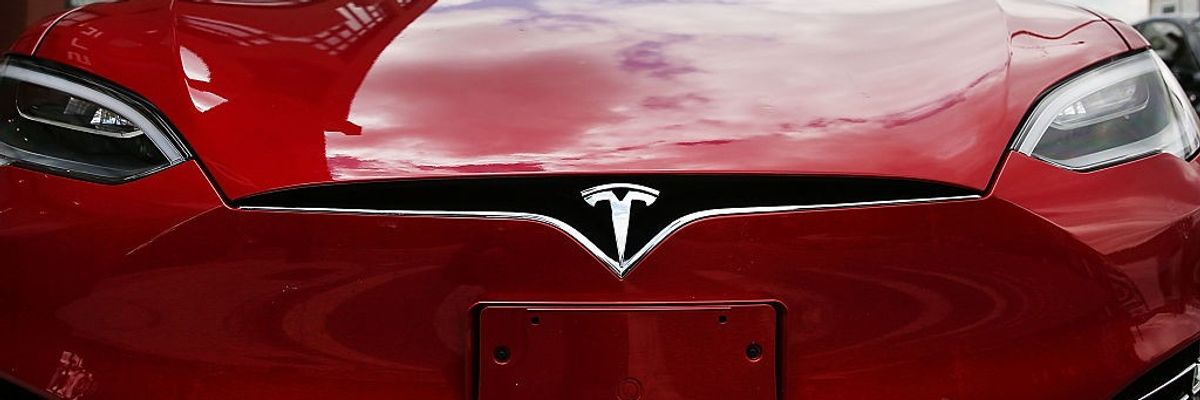
A Tesla model S sits parked outside of a new Tesla showroom and service center in Red Hook, Brooklyn on July 5, 2016 in New York City.
"Tesla is having more severe—and fatal—crashes than people in a normal data set," one expert said.
Cars using Tesla's Autopilot mode have been involved with 736 crashes causing 17 deaths since 2019, an analysis from The Washington Post revealed Saturday.
The Post said that their numbers, taken from National Highway Traffic Safety Administration (NHTSA) data, were higher than previously reported and reflected a significant uptick in both crashes, serious injuries, and deaths over the last four years.
" Tesla is having more severe—and fatal—crashes than people in a normal data set," former NHTSA senior safety adviser Missy Cummings, who is now a professor at George Mason University's College of Engineering and Computing, told The Washington Post of the findings.
NHTSA began monitoring crashes involving vehicles using driver-assistance technology in 2021, after a federal order mandating companies report these incidents. The fact that a crash occurred does not mean the new technology was to blame, NHTSA said.
Tesla by far leads the industry in both crashes and deaths involving driver-assistance technology, accounting for the "vast majority" of the first and "almost all" of the latter, The Washington Post observed. A graph shared by the Post shows Tesla's bar towering over all other car makers combined.
"Those complaining about the media focusing too much on Tesla crashes should examine this graph," David Zipper, a visiting fellow at the Harvard Kennedy School who focuses on mobility, cities, and technology, tweeted in response to the findings.
Tesla CEO Elon Musk did not respond to requests for comment from the Post or Insider. In the past, Musk has said that cars in Autopilot mode are safer than those entirely controlled by humans.
"At the point of which you believe that adding autonomy reduces injury and death, I think you have a moral obligation to deploy it even though you're going to get sued and blamed by a lot of people," Musk said in 2022, as the Post reported.
However, experts told the Post that Musk's decision to push the new tech—such as the expansion of Full Self Driving—could be a factor in the number of incidents.
"The fact that… anybody and everybody can have it… Is it reasonable to expect that might be leading to increased accident rates? Sure, absolutely."
"The fact that… anybody and everybody can have it… Is it reasonable to expect that might be leading to increased accident rates? Sure, absolutely." Cummings said.
Other experts have cast doubt on Tesla's ability to deliver a fully self-driving car, as the company has repeatedly promised, telling Insider that the technology still makes too many errors.
"Tesla keeps saying next year, and I still don't see any reason to believe that promise," Phil Koopman, an engineering professor and autonomous vehicle expert at Carnegie Mellon University, told Insider. "There's no reason to believe that something magic will happen this year that failed to happen the year before and the year before and the year before."
This isn't the first time that Musk's attempts to roll out innovations have raised safety concerns. A SpaceX rocket launch in April caused an explosion that sent a dust cloud much farther than the company had predicted, coating communities in particulates and threatening endangered species.
Dear Common Dreams reader, It’s been nearly 30 years since I co-founded Common Dreams with my late wife, Lina Newhouser. We had the radical notion that journalism should serve the public good, not corporate profits. It was clear to us from the outset what it would take to build such a project. No paid advertisements. No corporate sponsors. No millionaire publisher telling us what to think or do. Many people said we wouldn't last a year, but we proved those doubters wrong. Together with a tremendous team of journalists and dedicated staff, we built an independent media outlet free from the constraints of profits and corporate control. Our mission has always been simple: To inform. To inspire. To ignite change for the common good. Building Common Dreams was not easy. Our survival was never guaranteed. When you take on the most powerful forces—Wall Street greed, fossil fuel industry destruction, Big Tech lobbyists, and uber-rich oligarchs who have spent billions upon billions rigging the economy and democracy in their favor—the only bulwark you have is supporters who believe in your work. But here’s the urgent message from me today. It's never been this bad out there. And it's never been this hard to keep us going. At the very moment Common Dreams is most needed, the threats we face are intensifying. We need your support now more than ever. We don't accept corporate advertising and never will. We don't have a paywall because we don't think people should be blocked from critical news based on their ability to pay. Everything we do is funded by the donations of readers like you. When everyone does the little they can afford, we are strong. But if that support retreats or dries up, so do we. Will you donate now to make sure Common Dreams not only survives but thrives? —Craig Brown, Co-founder |
Cars using Tesla's Autopilot mode have been involved with 736 crashes causing 17 deaths since 2019, an analysis from The Washington Post revealed Saturday.
The Post said that their numbers, taken from National Highway Traffic Safety Administration (NHTSA) data, were higher than previously reported and reflected a significant uptick in both crashes, serious injuries, and deaths over the last four years.
" Tesla is having more severe—and fatal—crashes than people in a normal data set," former NHTSA senior safety adviser Missy Cummings, who is now a professor at George Mason University's College of Engineering and Computing, told The Washington Post of the findings.
NHTSA began monitoring crashes involving vehicles using driver-assistance technology in 2021, after a federal order mandating companies report these incidents. The fact that a crash occurred does not mean the new technology was to blame, NHTSA said.
Tesla by far leads the industry in both crashes and deaths involving driver-assistance technology, accounting for the "vast majority" of the first and "almost all" of the latter, The Washington Post observed. A graph shared by the Post shows Tesla's bar towering over all other car makers combined.
"Those complaining about the media focusing too much on Tesla crashes should examine this graph," David Zipper, a visiting fellow at the Harvard Kennedy School who focuses on mobility, cities, and technology, tweeted in response to the findings.
Tesla CEO Elon Musk did not respond to requests for comment from the Post or Insider. In the past, Musk has said that cars in Autopilot mode are safer than those entirely controlled by humans.
"At the point of which you believe that adding autonomy reduces injury and death, I think you have a moral obligation to deploy it even though you're going to get sued and blamed by a lot of people," Musk said in 2022, as the Post reported.
However, experts told the Post that Musk's decision to push the new tech—such as the expansion of Full Self Driving—could be a factor in the number of incidents.
"The fact that… anybody and everybody can have it… Is it reasonable to expect that might be leading to increased accident rates? Sure, absolutely."
"The fact that… anybody and everybody can have it… Is it reasonable to expect that might be leading to increased accident rates? Sure, absolutely." Cummings said.
Other experts have cast doubt on Tesla's ability to deliver a fully self-driving car, as the company has repeatedly promised, telling Insider that the technology still makes too many errors.
"Tesla keeps saying next year, and I still don't see any reason to believe that promise," Phil Koopman, an engineering professor and autonomous vehicle expert at Carnegie Mellon University, told Insider. "There's no reason to believe that something magic will happen this year that failed to happen the year before and the year before and the year before."
This isn't the first time that Musk's attempts to roll out innovations have raised safety concerns. A SpaceX rocket launch in April caused an explosion that sent a dust cloud much farther than the company had predicted, coating communities in particulates and threatening endangered species.
Cars using Tesla's Autopilot mode have been involved with 736 crashes causing 17 deaths since 2019, an analysis from The Washington Post revealed Saturday.
The Post said that their numbers, taken from National Highway Traffic Safety Administration (NHTSA) data, were higher than previously reported and reflected a significant uptick in both crashes, serious injuries, and deaths over the last four years.
" Tesla is having more severe—and fatal—crashes than people in a normal data set," former NHTSA senior safety adviser Missy Cummings, who is now a professor at George Mason University's College of Engineering and Computing, told The Washington Post of the findings.
NHTSA began monitoring crashes involving vehicles using driver-assistance technology in 2021, after a federal order mandating companies report these incidents. The fact that a crash occurred does not mean the new technology was to blame, NHTSA said.
Tesla by far leads the industry in both crashes and deaths involving driver-assistance technology, accounting for the "vast majority" of the first and "almost all" of the latter, The Washington Post observed. A graph shared by the Post shows Tesla's bar towering over all other car makers combined.
"Those complaining about the media focusing too much on Tesla crashes should examine this graph," David Zipper, a visiting fellow at the Harvard Kennedy School who focuses on mobility, cities, and technology, tweeted in response to the findings.
Tesla CEO Elon Musk did not respond to requests for comment from the Post or Insider. In the past, Musk has said that cars in Autopilot mode are safer than those entirely controlled by humans.
"At the point of which you believe that adding autonomy reduces injury and death, I think you have a moral obligation to deploy it even though you're going to get sued and blamed by a lot of people," Musk said in 2022, as the Post reported.
However, experts told the Post that Musk's decision to push the new tech—such as the expansion of Full Self Driving—could be a factor in the number of incidents.
"The fact that… anybody and everybody can have it… Is it reasonable to expect that might be leading to increased accident rates? Sure, absolutely."
"The fact that… anybody and everybody can have it… Is it reasonable to expect that might be leading to increased accident rates? Sure, absolutely." Cummings said.
Other experts have cast doubt on Tesla's ability to deliver a fully self-driving car, as the company has repeatedly promised, telling Insider that the technology still makes too many errors.
"Tesla keeps saying next year, and I still don't see any reason to believe that promise," Phil Koopman, an engineering professor and autonomous vehicle expert at Carnegie Mellon University, told Insider. "There's no reason to believe that something magic will happen this year that failed to happen the year before and the year before and the year before."
This isn't the first time that Musk's attempts to roll out innovations have raised safety concerns. A SpaceX rocket launch in April caused an explosion that sent a dust cloud much farther than the company had predicted, coating communities in particulates and threatening endangered species.