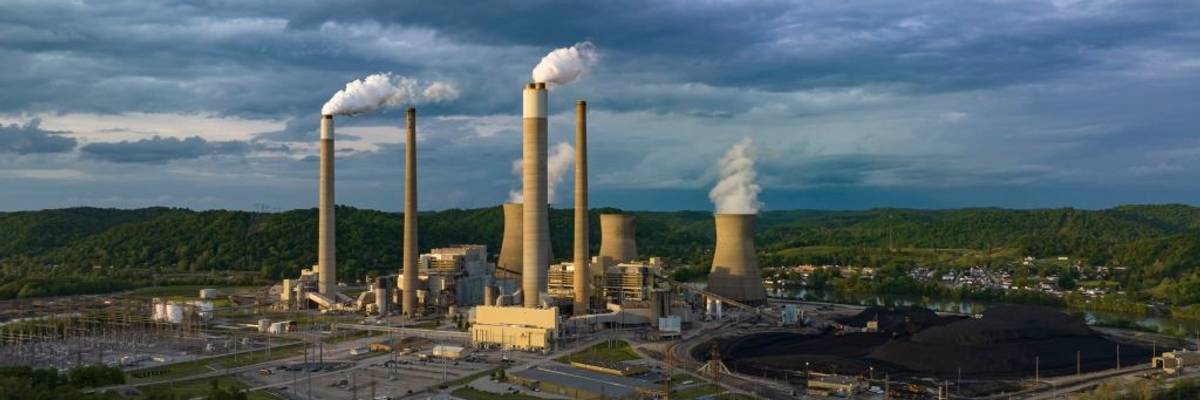
A power plant emits smoke in West Virginia, one of the states challenging the Environmental Protection Agency's ozone regulations.
Supreme Court Puts Countless 'Lives at Risk' by Ruling Against Clean Air
"With this decision, the Supreme Court has abandoned any pretense of neutrality in cases involving environmental regulations," an expert said.
Health and environmental groups decried a U.S. Supreme Court decision on Thursday that suspended an air pollution rule with far-reaching implications set by the Environmental Protection Agency.
The justices ruled 5-4 in Ohio v. EPA to nullify the rule, designed to protect people in states downwind from smog-forming pollution, until the case can be decided on its merits in federal court, siding with the industrial polluters and upwind states who'd petitioned them to do so.
"With this decision, the Supreme Court has abandoned any pretense of neutrality in cases involving environmental regulations," Sam Sankar, a senior vice president at Earthjustice, an environmental law firm, said in a statement.
"The court's order puts thousands of lives at risk, forces downwind states to regulate their industries more tightly, and tells big polluters that it's open season on our environmental laws," he added.
A coalition of health and environmental groups, including Earthjustice, agreed that the ruling would have devastating effects.
"Today's decision is deeply disappointing," the coalition wrote in a joint statement. "It will result almost immediately in pollution that endangers the health of millions of people."
Initial thoughts on Ohio v. EPA - Justice Gorsuch's majority opinion reflects two longstanding trends in his environmental law jurisprudence: deep skepticism of agency experts and emphasis on state authority over environmental protection. You can read my analysis of these trends…
— Rachel Rothschild (@ProfRRothschild) June 27, 2024
The legal dispute stems from the EPA's 2015 ozone pollution regulations. States were required to issue plans showing compliance, and last year the EPA determined that 23 of the plans were insufficient, issuing its own plan for those states. The agency said that in 2026 alone, the multi-state plan would prevent about 1,300 premature deaths.
The EPA plan set off a flurry of legal challenges by fossil fuel companies, power companies, and related trade associations, as well as upwind states. Some challenges were successful in getting federal courts to temporarily suspend the EPA rules in individual states. However, the consolidated case, Ohio v. EPA, hasn't yet been heard by the Court of Appeals for the District of Columbia Circuit, and that court denied a request for a suspension of the rule in the meantime.
The plaintiffs then sought emergency relief from the rule at the Supreme Court, arguing that it could cost "hundreds of millions if not billions of dollars in costs over the next 12 to 18 months." The Supreme Court normally dismisses such relief requests, but in this case not only accepted the case onto its shadow docket, but took the unusual step of hearing oral arguments, which most shadow docket cases don't have, as they tend to deal with stays and injunctions, and not the fully-fledged merits of a case.
At the oral arguments, in February, Justice Ketanji Brown Jackson expressed concern that the case was even before the court, given that it hadn't even been heard on its merits by the D.C. Circuit court.
"What I’m a little concerned about is that really your argument is just boiling down to we think we have a meritorious claim and we don't want to have to follow the law while we’re challenging it," Jackson said to the plaintiffs' legal team. "And I don’t understand why every single person who is challenging a rule doesn’t have the same set of circumstances."
Jackson is one of three liberal justices on the court, but it was in fact conservative Justice Amy Coney Barrett who authored what The New York Times called a "spirited" dissent to Justice Neil Gorsuch's majority opinion.
"The court today enjoins the enforcement of a major Environmental Protection Agency rule based on an underdeveloped theory that is unlikely to succeed on the merits," Barrett wrote. "In so doing, the court grants emergency relief in a fact-intensive and highly technical case without fully engaging with both the relevant law and the voluminous record."
Rachel Rothschild, a law professor at the University of Michigan, wrote on social media that Gorsuch's opinion drew on his "deep skepticism of agency experts and emphasis on state authority over environmental protection."
The conservative justices' aversion to agency expertise was also evident in both its 2022 ruling against the EPA's climate change rules and its 2023 ruling against the EPA's water pollution rules.
The Center for American Progress wrote in February that a loss in Ohio v. EPA would be another "devastating reversal" for the EPA as the agency struggles to assert "the authorities that Congress has explicitly granted it."
We are at a crossroads
This country and this world are at a monumental crossroads. In a few short weeks, US voters will have an opportunity to beat back the forces of fascism and confront the billionaires who are rigging the economy, our media system, and our democracy, making it increasingly impossible for ordinary people to get by. We’re not just talking about the election. We’re talking about what must be done once these fascist elements are vanquished from power. We need a bolder set of solutions than what either major party has so far been willing to offer and a working-class movement ready to fight like hell for it. Trump didn't emerge from nowhere. The conditions that fueled MAGA authoritarianism were created by decades of radical neoliberal economic policies and a corrupt political system dominated by corporate interests. They slashed taxes on the super-rich, promising that the benefits would trickle down. They said giveaways to the corporate titans would make life more affordable for the rest of us. It was all bullshit. And when a bitter, betrayed populace searches for someone to blame, right-wing demagogues have little trouble finding scapegoats. People know when they're being lied to, but you won't hear any of this from the corporate media. Only independent journalism—powered and funded by people who believe in building a better world—can deliver truly trustworthy daily news. Our Fall Campaign is underway, and we need your help. To power our newsroom through the rest of the year, we need to raise $125,000 by midnight on October 31. So if you share our vision, please contribute whatever you can to sustain our work. |
Health and environmental groups decried a U.S. Supreme Court decision on Thursday that suspended an air pollution rule with far-reaching implications set by the Environmental Protection Agency.
The justices ruled 5-4 in Ohio v. EPA to nullify the rule, designed to protect people in states downwind from smog-forming pollution, until the case can be decided on its merits in federal court, siding with the industrial polluters and upwind states who'd petitioned them to do so.
"With this decision, the Supreme Court has abandoned any pretense of neutrality in cases involving environmental regulations," Sam Sankar, a senior vice president at Earthjustice, an environmental law firm, said in a statement.
"The court's order puts thousands of lives at risk, forces downwind states to regulate their industries more tightly, and tells big polluters that it's open season on our environmental laws," he added.
A coalition of health and environmental groups, including Earthjustice, agreed that the ruling would have devastating effects.
"Today's decision is deeply disappointing," the coalition wrote in a joint statement. "It will result almost immediately in pollution that endangers the health of millions of people."
Initial thoughts on Ohio v. EPA - Justice Gorsuch's majority opinion reflects two longstanding trends in his environmental law jurisprudence: deep skepticism of agency experts and emphasis on state authority over environmental protection. You can read my analysis of these trends…
— Rachel Rothschild (@ProfRRothschild) June 27, 2024
The legal dispute stems from the EPA's 2015 ozone pollution regulations. States were required to issue plans showing compliance, and last year the EPA determined that 23 of the plans were insufficient, issuing its own plan for those states. The agency said that in 2026 alone, the multi-state plan would prevent about 1,300 premature deaths.
The EPA plan set off a flurry of legal challenges by fossil fuel companies, power companies, and related trade associations, as well as upwind states. Some challenges were successful in getting federal courts to temporarily suspend the EPA rules in individual states. However, the consolidated case, Ohio v. EPA, hasn't yet been heard by the Court of Appeals for the District of Columbia Circuit, and that court denied a request for a suspension of the rule in the meantime.
The plaintiffs then sought emergency relief from the rule at the Supreme Court, arguing that it could cost "hundreds of millions if not billions of dollars in costs over the next 12 to 18 months." The Supreme Court normally dismisses such relief requests, but in this case not only accepted the case onto its shadow docket, but took the unusual step of hearing oral arguments, which most shadow docket cases don't have, as they tend to deal with stays and injunctions, and not the fully-fledged merits of a case.
At the oral arguments, in February, Justice Ketanji Brown Jackson expressed concern that the case was even before the court, given that it hadn't even been heard on its merits by the D.C. Circuit court.
"What I’m a little concerned about is that really your argument is just boiling down to we think we have a meritorious claim and we don't want to have to follow the law while we’re challenging it," Jackson said to the plaintiffs' legal team. "And I don’t understand why every single person who is challenging a rule doesn’t have the same set of circumstances."
Jackson is one of three liberal justices on the court, but it was in fact conservative Justice Amy Coney Barrett who authored what The New York Times called a "spirited" dissent to Justice Neil Gorsuch's majority opinion.
"The court today enjoins the enforcement of a major Environmental Protection Agency rule based on an underdeveloped theory that is unlikely to succeed on the merits," Barrett wrote. "In so doing, the court grants emergency relief in a fact-intensive and highly technical case without fully engaging with both the relevant law and the voluminous record."
Rachel Rothschild, a law professor at the University of Michigan, wrote on social media that Gorsuch's opinion drew on his "deep skepticism of agency experts and emphasis on state authority over environmental protection."
The conservative justices' aversion to agency expertise was also evident in both its 2022 ruling against the EPA's climate change rules and its 2023 ruling against the EPA's water pollution rules.
The Center for American Progress wrote in February that a loss in Ohio v. EPA would be another "devastating reversal" for the EPA as the agency struggles to assert "the authorities that Congress has explicitly granted it."
- The Supreme Court's Anti-Climate Decision in West Virginia v. EPA Impacts All of Us ›
- Right-Wing US Supreme Court Delivers 'Catastrophic Loss for Water Protections' ›
- Opinion | 4 Ways the Supreme Court Made It Harder to Protect the Environment | Common Dreams ›
- Opinion | An Overlooked SCOTUS Case Could Decide the Future of Nuclear Power | Common Dreams ›
Health and environmental groups decried a U.S. Supreme Court decision on Thursday that suspended an air pollution rule with far-reaching implications set by the Environmental Protection Agency.
The justices ruled 5-4 in Ohio v. EPA to nullify the rule, designed to protect people in states downwind from smog-forming pollution, until the case can be decided on its merits in federal court, siding with the industrial polluters and upwind states who'd petitioned them to do so.
"With this decision, the Supreme Court has abandoned any pretense of neutrality in cases involving environmental regulations," Sam Sankar, a senior vice president at Earthjustice, an environmental law firm, said in a statement.
"The court's order puts thousands of lives at risk, forces downwind states to regulate their industries more tightly, and tells big polluters that it's open season on our environmental laws," he added.
A coalition of health and environmental groups, including Earthjustice, agreed that the ruling would have devastating effects.
"Today's decision is deeply disappointing," the coalition wrote in a joint statement. "It will result almost immediately in pollution that endangers the health of millions of people."
Initial thoughts on Ohio v. EPA - Justice Gorsuch's majority opinion reflects two longstanding trends in his environmental law jurisprudence: deep skepticism of agency experts and emphasis on state authority over environmental protection. You can read my analysis of these trends…
— Rachel Rothschild (@ProfRRothschild) June 27, 2024
The legal dispute stems from the EPA's 2015 ozone pollution regulations. States were required to issue plans showing compliance, and last year the EPA determined that 23 of the plans were insufficient, issuing its own plan for those states. The agency said that in 2026 alone, the multi-state plan would prevent about 1,300 premature deaths.
The EPA plan set off a flurry of legal challenges by fossil fuel companies, power companies, and related trade associations, as well as upwind states. Some challenges were successful in getting federal courts to temporarily suspend the EPA rules in individual states. However, the consolidated case, Ohio v. EPA, hasn't yet been heard by the Court of Appeals for the District of Columbia Circuit, and that court denied a request for a suspension of the rule in the meantime.
The plaintiffs then sought emergency relief from the rule at the Supreme Court, arguing that it could cost "hundreds of millions if not billions of dollars in costs over the next 12 to 18 months." The Supreme Court normally dismisses such relief requests, but in this case not only accepted the case onto its shadow docket, but took the unusual step of hearing oral arguments, which most shadow docket cases don't have, as they tend to deal with stays and injunctions, and not the fully-fledged merits of a case.
At the oral arguments, in February, Justice Ketanji Brown Jackson expressed concern that the case was even before the court, given that it hadn't even been heard on its merits by the D.C. Circuit court.
"What I’m a little concerned about is that really your argument is just boiling down to we think we have a meritorious claim and we don't want to have to follow the law while we’re challenging it," Jackson said to the plaintiffs' legal team. "And I don’t understand why every single person who is challenging a rule doesn’t have the same set of circumstances."
Jackson is one of three liberal justices on the court, but it was in fact conservative Justice Amy Coney Barrett who authored what The New York Times called a "spirited" dissent to Justice Neil Gorsuch's majority opinion.
"The court today enjoins the enforcement of a major Environmental Protection Agency rule based on an underdeveloped theory that is unlikely to succeed on the merits," Barrett wrote. "In so doing, the court grants emergency relief in a fact-intensive and highly technical case without fully engaging with both the relevant law and the voluminous record."
Rachel Rothschild, a law professor at the University of Michigan, wrote on social media that Gorsuch's opinion drew on his "deep skepticism of agency experts and emphasis on state authority over environmental protection."
The conservative justices' aversion to agency expertise was also evident in both its 2022 ruling against the EPA's climate change rules and its 2023 ruling against the EPA's water pollution rules.
The Center for American Progress wrote in February that a loss in Ohio v. EPA would be another "devastating reversal" for the EPA as the agency struggles to assert "the authorities that Congress has explicitly granted it."
- The Supreme Court's Anti-Climate Decision in West Virginia v. EPA Impacts All of Us ›
- Right-Wing US Supreme Court Delivers 'Catastrophic Loss for Water Protections' ›
- Opinion | 4 Ways the Supreme Court Made It Harder to Protect the Environment | Common Dreams ›
- Opinion | An Overlooked SCOTUS Case Could Decide the Future of Nuclear Power | Common Dreams ›