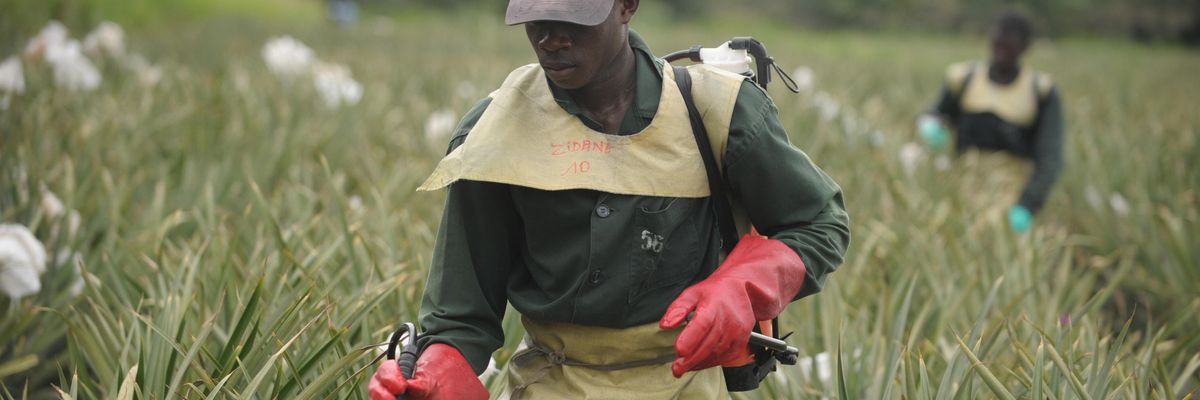
A man sprays pesticides at a pineapple plantation on April 28, 2009 near the Ivorian town of Aboisso, some 100 kms east of Abidjan.
'Appalling': US Funded Secret Industry Network Targeting Pesticide Critics
"It's one thing to have an industry come after you after publishing a critical article. This happens all the time in journalism," said writer Michael Pollan, one of those featured in the corporate files. "But to have your own government pay for it is outrageous."
New reporting published Friday exposes how U.S. taxpayer money was used to fund an elaborate effort by pesticide industry insiders to create detailed dossiers on public critics and environmentalist activists opposed to the widespread pollution created by agrochemical corporations.
The investigation was spearheaded by the nonprofit outlet Lighthouse Reports in collaboration with numerous outlets from around the globe, including The Guardian, Le Monde, The New Lede, ABC News, and the New Humanitarian. It details how outspoken critics of the pesticide paraquat—described as "among the most toxic agricultural chemicals ever produced"—were targeted by an "influence machine that works to suppress opposition to an $78 billion global industry."
While use of paraquat is banned in the European Union, it is still actively sold and applied on fields and farms in much of the world despite the documented harms it produces.
The year-long investigation, according to Lighthouse,
managed to penetrate a PR operation that casts those who raise the alarm, from pesticide critics to environmental scientists or sustainability campaigners, as an anti-science "protest industry," and used U.S. government money to do so.
The U.S.-based PR firm, v-Fluence, built profiles on hundreds of scientists, campaigners and writers, whilst coordinating with government officials, to counter global resistance to pesticides. These profiles are published on a private social network, which grants privileged entry to 1,000 people. The network's membership roster is a who's-who of the agrochemical industry and its friends, featuring executives from some of the world's largest pesticide companies alongside government officials from multiple countries.
These members can access profiles on more than 3,000 organisations and 500 people who have been critical of pesticides or Genetically Modified Organisms (GMOs). They come from all over the world and include scientists, U.N. human right experts, environmentalists, and journalists. Many of the profiles divulge personal details about the subjects, such as their home addresses and telephone numbers, and spotlight criticisms that disparage their work. Lawyers have told us this goes against data privacy laws in several countries.
The investigative team also released this video on Instagram detailing their findings:
Environmental writer and activist George Monbiot called the revelations "deeply shocking and appalling," and described the story as one which detailed how the U.S. government "funded attacks, denial, and outright lies to protect the pesticides industry from its critics."
The Guardian's reporting details how v-Influence—founded by former Monsanto executive Jay Byrne—received U.S. taxpayer dollars by subcontracting with another group that received a large USAID grant:
Public spending records show the USAID contracted with the International Food Policy Research Institute (IFPRI), a non-governmental organization that manages a government initiative to introduce GM crops in African and Asian nations.
In turn, IFPRI paid v-Fluence a little more than $400,000 from roughly 2013 through 2019 for services that included counteracting critics of "modern agriculture approaches"in Africa and Asia.
v-Fluence was to set up the "private social network portal" that would, among other things, provide "tactical support" for efforts to gain acceptance for the GM crops.
The reporting noted that prominent food writers, including Michael Pollan and Mark Bittman (both of whom have written critically of industrial agriculture), were among those listed in the private network to which industry heavyweights were given invite-only access.
"It's one thing to have an industry come after you after publishing a critical article. This happens all the time in journalism," Pollan told the Guardian. "But to have your own government pay for it is outrageous. These are my tax dollars at work."
We are at a crossroads
This country and this world are at a monumental crossroads. In a few short weeks, US voters will have an opportunity to beat back the forces of fascism and confront the billionaires who are rigging the economy, our media system, and our democracy, making it increasingly impossible for ordinary people to get by. We’re not just talking about the election. We’re talking about what must be done once these fascist elements are vanquished from power. We need a bolder set of solutions than what either major party has so far been willing to offer and a working-class movement ready to fight like hell for it. Trump didn't emerge from nowhere. The conditions that fueled MAGA authoritarianism were created by decades of radical neoliberal economic policies and a corrupt political system dominated by corporate interests. They slashed taxes on the super-rich, promising that the benefits would trickle down. They said giveaways to the corporate titans would make life more affordable for the rest of us. It was all bullshit. And when a bitter, betrayed populace searches for someone to blame, right-wing demagogues have little trouble finding scapegoats. People know when they're being lied to, but you won't hear any of this from the corporate media. Only independent journalism—powered and funded by people who believe in building a better world—can deliver truly trustworthy daily news. Our Fall Campaign is underway, and we need your help. To power our newsroom through the rest of the year, we need to raise $125,000 by midnight on October 31. So if you share our vision, please contribute whatever you can to sustain our work. |
New reporting published Friday exposes how U.S. taxpayer money was used to fund an elaborate effort by pesticide industry insiders to create detailed dossiers on public critics and environmentalist activists opposed to the widespread pollution created by agrochemical corporations.
The investigation was spearheaded by the nonprofit outlet Lighthouse Reports in collaboration with numerous outlets from around the globe, including The Guardian, Le Monde, The New Lede, ABC News, and the New Humanitarian. It details how outspoken critics of the pesticide paraquat—described as "among the most toxic agricultural chemicals ever produced"—were targeted by an "influence machine that works to suppress opposition to an $78 billion global industry."
While use of paraquat is banned in the European Union, it is still actively sold and applied on fields and farms in much of the world despite the documented harms it produces.
The year-long investigation, according to Lighthouse,
managed to penetrate a PR operation that casts those who raise the alarm, from pesticide critics to environmental scientists or sustainability campaigners, as an anti-science "protest industry," and used U.S. government money to do so.
The U.S.-based PR firm, v-Fluence, built profiles on hundreds of scientists, campaigners and writers, whilst coordinating with government officials, to counter global resistance to pesticides. These profiles are published on a private social network, which grants privileged entry to 1,000 people. The network's membership roster is a who's-who of the agrochemical industry and its friends, featuring executives from some of the world's largest pesticide companies alongside government officials from multiple countries.
These members can access profiles on more than 3,000 organisations and 500 people who have been critical of pesticides or Genetically Modified Organisms (GMOs). They come from all over the world and include scientists, U.N. human right experts, environmentalists, and journalists. Many of the profiles divulge personal details about the subjects, such as their home addresses and telephone numbers, and spotlight criticisms that disparage their work. Lawyers have told us this goes against data privacy laws in several countries.
The investigative team also released this video on Instagram detailing their findings:
Environmental writer and activist George Monbiot called the revelations "deeply shocking and appalling," and described the story as one which detailed how the U.S. government "funded attacks, denial, and outright lies to protect the pesticides industry from its critics."
The Guardian's reporting details how v-Influence—founded by former Monsanto executive Jay Byrne—received U.S. taxpayer dollars by subcontracting with another group that received a large USAID grant:
Public spending records show the USAID contracted with the International Food Policy Research Institute (IFPRI), a non-governmental organization that manages a government initiative to introduce GM crops in African and Asian nations.
In turn, IFPRI paid v-Fluence a little more than $400,000 from roughly 2013 through 2019 for services that included counteracting critics of "modern agriculture approaches"in Africa and Asia.
v-Fluence was to set up the "private social network portal" that would, among other things, provide "tactical support" for efforts to gain acceptance for the GM crops.
The reporting noted that prominent food writers, including Michael Pollan and Mark Bittman (both of whom have written critically of industrial agriculture), were among those listed in the private network to which industry heavyweights were given invite-only access.
"It's one thing to have an industry come after you after publishing a critical article. This happens all the time in journalism," Pollan told the Guardian. "But to have your own government pay for it is outrageous. These are my tax dollars at work."
New reporting published Friday exposes how U.S. taxpayer money was used to fund an elaborate effort by pesticide industry insiders to create detailed dossiers on public critics and environmentalist activists opposed to the widespread pollution created by agrochemical corporations.
The investigation was spearheaded by the nonprofit outlet Lighthouse Reports in collaboration with numerous outlets from around the globe, including The Guardian, Le Monde, The New Lede, ABC News, and the New Humanitarian. It details how outspoken critics of the pesticide paraquat—described as "among the most toxic agricultural chemicals ever produced"—were targeted by an "influence machine that works to suppress opposition to an $78 billion global industry."
While use of paraquat is banned in the European Union, it is still actively sold and applied on fields and farms in much of the world despite the documented harms it produces.
The year-long investigation, according to Lighthouse,
managed to penetrate a PR operation that casts those who raise the alarm, from pesticide critics to environmental scientists or sustainability campaigners, as an anti-science "protest industry," and used U.S. government money to do so.
The U.S.-based PR firm, v-Fluence, built profiles on hundreds of scientists, campaigners and writers, whilst coordinating with government officials, to counter global resistance to pesticides. These profiles are published on a private social network, which grants privileged entry to 1,000 people. The network's membership roster is a who's-who of the agrochemical industry and its friends, featuring executives from some of the world's largest pesticide companies alongside government officials from multiple countries.
These members can access profiles on more than 3,000 organisations and 500 people who have been critical of pesticides or Genetically Modified Organisms (GMOs). They come from all over the world and include scientists, U.N. human right experts, environmentalists, and journalists. Many of the profiles divulge personal details about the subjects, such as their home addresses and telephone numbers, and spotlight criticisms that disparage their work. Lawyers have told us this goes against data privacy laws in several countries.
The investigative team also released this video on Instagram detailing their findings:
Environmental writer and activist George Monbiot called the revelations "deeply shocking and appalling," and described the story as one which detailed how the U.S. government "funded attacks, denial, and outright lies to protect the pesticides industry from its critics."
The Guardian's reporting details how v-Influence—founded by former Monsanto executive Jay Byrne—received U.S. taxpayer dollars by subcontracting with another group that received a large USAID grant:
Public spending records show the USAID contracted with the International Food Policy Research Institute (IFPRI), a non-governmental organization that manages a government initiative to introduce GM crops in African and Asian nations.
In turn, IFPRI paid v-Fluence a little more than $400,000 from roughly 2013 through 2019 for services that included counteracting critics of "modern agriculture approaches"in Africa and Asia.
v-Fluence was to set up the "private social network portal" that would, among other things, provide "tactical support" for efforts to gain acceptance for the GM crops.
The reporting noted that prominent food writers, including Michael Pollan and Mark Bittman (both of whom have written critically of industrial agriculture), were among those listed in the private network to which industry heavyweights were given invite-only access.
"It's one thing to have an industry come after you after publishing a critical article. This happens all the time in journalism," Pollan told the Guardian. "But to have your own government pay for it is outrageous. These are my tax dollars at work."