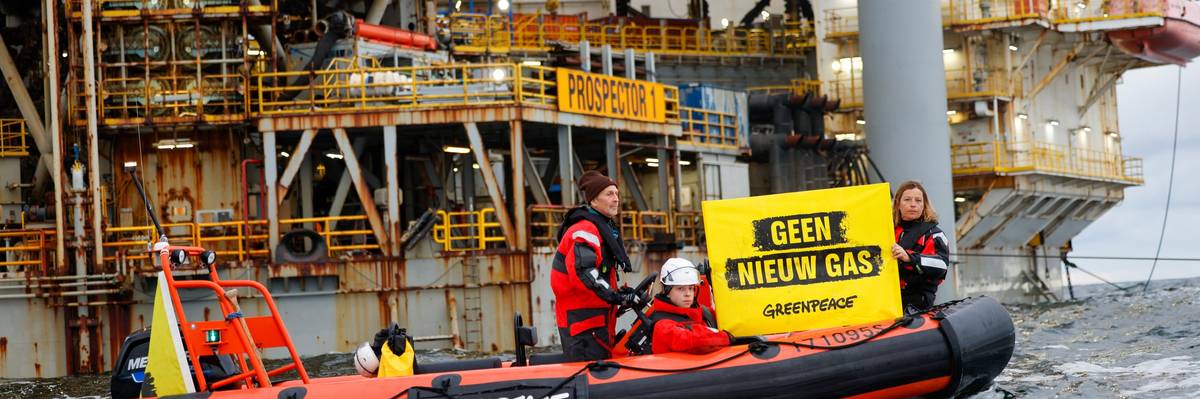
Greenpeace activists from Germany and the Netherlands hold up a "No New Gas" placard next to an gas drilling platform that they occupied on June 4, 2024.
'Victory': Gas Drilling Project Paused After Greenpeace Occupies Platform in North Sea
"Today's events show that people power works!" a campaigner said. "Whether it is occupying a gas rig or challenging it in court, people will not be silent, we are standing up to the fossil fuel industry."
A Dutch court on Tuesday ordered a pause to a gas drilling initiative in the North Sea after Greenpeace activists occupied a platform owned by the company behind the project, leading the environmental group to declare "victory" as it pushes for an end to new fossil fuel infrastructure in Europe.
The activists sought to disrupt the work of Dutch energy company ONE-Dyas, which had just received the go-ahead for offshore drilling from the Dutch government last week and quickly sent the drilling platform to the site, which is about 12 miles from the German island of Borkum and straddles Dutch and German waters.
"The science is clear, we must stop digging and drilling for fossil fuels if we are to avoid the worst of climate chaos," Mira Jaeger, energy expert from Greenpeace Germany, said in a statement released earlier on Tuesday, before the court decision. "We cannot afford any new fossil fuel extraction projects. Not in the North Sea or anywhere else."
"Today's events show that people power works!" Jaeger said in another statement following the ruling. "Whether it is occupying a gas rig or challenging it in court, people will not be silent, we are standing up to the fossil fuel industry."
🔊VICTORY: The gas drilling platform currently occupied by @greenpeace_de and @greenpeaceNL activists has been ordered to stop their drilling activities by a Dutch court.
Resistance WORKS! #StopFossilGas https://t.co/MRhJZ2ZXiQ pic.twitter.com/5d6x2jzO6l
— Greenpeace International (@Greenpeace) June 4, 2024
Greenpeace, an environmental group that engages in nonviolent direct action, has previously occupied oil and gas rigs in the North Sea and elsewhere. Last year, the group's campaigners occupied a platform contracted by Shell, a multinational oil and gas company, as it made its way to work in U.K. waters.
The planned Borkum drilling project, which Greenpeace has said would threaten rocky reefs and a local nature reserve, has been the subject of a legal and regulatory fight in recent years. Environmental and community groups filed a lawsuit against it in Dutch court, and a judge halted the project for over a year starting in April 2023. However, following court-ordered changes, the Dutch state secretary for economic affairs and climate approved the project last week. On Monday, Offshore Energy, a trade publication, declared that the project, which it said involves an investment of more than $500 million, had "no more legal woes" and would produce gas by the end of the year. A Dutch official noted the importance of a domestic supply of natural gas in approving the project, Offshore Energy reported.
With the company moving quickly, Greenpeace activists aimed to block the installation of the platform on Tuesday. Five of the 21 who went to sea for the action occupied the platform, called Prospector 1, and tied themselves to pillars, according to Greenpeace. The occupation lasted 8 hours, ending when news came of the court ruling.
Tuesday's ruling suspended the approval granted by the Dutch state secretary for economic affairs, and is to be followed by a hearing on June 12. The decision came at the request of environmental and community groups, which submitted an application on Friday for "provisional relief." The groups aim to block the drilling initiative entirely, arguing that ONE-Dyas should abandon its "legal tricks" and "accept reality and abandon the project."
Greenpeace, which was one of the plaintiffs in the application, reiterated its demand on Tuesday that the project be permanently canceled, while calling for the E.U. to abandon all fossil fuel infrastructure projects.
"The Borkum project is just the tip of the iceberg: in Europe, fossil fuel companies are pushing European states into such massive, unnecessary investments just like TotalEnergies’ LNG terminal in France, or OMV’s Neptun Deep gas drilling project in Romania," the first Greenpeace statement said. "But the European Union can and must put its member states on a path away from fossil fuels, by banning new fossil fuel projects and investing in an energy system based on renewables and energy sufficiency."
We are at a crossroads
This country and this world are at a monumental crossroads. In a few short weeks, US voters will have an opportunity to beat back the forces of fascism and confront the billionaires who are rigging the economy, our media system, and our democracy, making it increasingly impossible for ordinary people to get by. We’re not just talking about the election. We’re talking about what must be done once these fascist elements are vanquished from power. We need a bolder set of solutions than what either major party has so far been willing to offer and a working-class movement ready to fight like hell for it. Trump didn't emerge from nowhere. The conditions that fueled MAGA authoritarianism were created by decades of radical neoliberal economic policies and a corrupt political system dominated by corporate interests. They slashed taxes on the super-rich, promising that the benefits would trickle down. They said giveaways to the corporate titans would make life more affordable for the rest of us. It was all bullshit. And when a bitter, betrayed populace searches for someone to blame, right-wing demagogues have little trouble finding scapegoats. People know when they're being lied to, but you won't hear any of this from the corporate media. Only independent journalism—powered and funded by people who believe in building a better world—can deliver truly trustworthy daily news. Our Fall Campaign is underway, and we need your help. To power our newsroom through the rest of the year, we need to raise $125,000 by midnight on October 31. So if you share our vision, please contribute whatever you can to sustain our work. |
A Dutch court on Tuesday ordered a pause to a gas drilling initiative in the North Sea after Greenpeace activists occupied a platform owned by the company behind the project, leading the environmental group to declare "victory" as it pushes for an end to new fossil fuel infrastructure in Europe.
The activists sought to disrupt the work of Dutch energy company ONE-Dyas, which had just received the go-ahead for offshore drilling from the Dutch government last week and quickly sent the drilling platform to the site, which is about 12 miles from the German island of Borkum and straddles Dutch and German waters.
"The science is clear, we must stop digging and drilling for fossil fuels if we are to avoid the worst of climate chaos," Mira Jaeger, energy expert from Greenpeace Germany, said in a statement released earlier on Tuesday, before the court decision. "We cannot afford any new fossil fuel extraction projects. Not in the North Sea or anywhere else."
"Today's events show that people power works!" Jaeger said in another statement following the ruling. "Whether it is occupying a gas rig or challenging it in court, people will not be silent, we are standing up to the fossil fuel industry."
🔊VICTORY: The gas drilling platform currently occupied by @greenpeace_de and @greenpeaceNL activists has been ordered to stop their drilling activities by a Dutch court.
Resistance WORKS! #StopFossilGas https://t.co/MRhJZ2ZXiQ pic.twitter.com/5d6x2jzO6l
— Greenpeace International (@Greenpeace) June 4, 2024
Greenpeace, an environmental group that engages in nonviolent direct action, has previously occupied oil and gas rigs in the North Sea and elsewhere. Last year, the group's campaigners occupied a platform contracted by Shell, a multinational oil and gas company, as it made its way to work in U.K. waters.
The planned Borkum drilling project, which Greenpeace has said would threaten rocky reefs and a local nature reserve, has been the subject of a legal and regulatory fight in recent years. Environmental and community groups filed a lawsuit against it in Dutch court, and a judge halted the project for over a year starting in April 2023. However, following court-ordered changes, the Dutch state secretary for economic affairs and climate approved the project last week. On Monday, Offshore Energy, a trade publication, declared that the project, which it said involves an investment of more than $500 million, had "no more legal woes" and would produce gas by the end of the year. A Dutch official noted the importance of a domestic supply of natural gas in approving the project, Offshore Energy reported.
With the company moving quickly, Greenpeace activists aimed to block the installation of the platform on Tuesday. Five of the 21 who went to sea for the action occupied the platform, called Prospector 1, and tied themselves to pillars, according to Greenpeace. The occupation lasted 8 hours, ending when news came of the court ruling.
Tuesday's ruling suspended the approval granted by the Dutch state secretary for economic affairs, and is to be followed by a hearing on June 12. The decision came at the request of environmental and community groups, which submitted an application on Friday for "provisional relief." The groups aim to block the drilling initiative entirely, arguing that ONE-Dyas should abandon its "legal tricks" and "accept reality and abandon the project."
Greenpeace, which was one of the plaintiffs in the application, reiterated its demand on Tuesday that the project be permanently canceled, while calling for the E.U. to abandon all fossil fuel infrastructure projects.
"The Borkum project is just the tip of the iceberg: in Europe, fossil fuel companies are pushing European states into such massive, unnecessary investments just like TotalEnergies’ LNG terminal in France, or OMV’s Neptun Deep gas drilling project in Romania," the first Greenpeace statement said. "But the European Union can and must put its member states on a path away from fossil fuels, by banning new fossil fuel projects and investing in an energy system based on renewables and energy sufficiency."
- 'Stop Drilling and Start Paying': Greenpeace Activists Occupy Shell Oil Platform ›
- At Least 32 Casualties in Fiery North Sea Collision Between Oil Tanker and Cargo Ship | Common Dreams ›
A Dutch court on Tuesday ordered a pause to a gas drilling initiative in the North Sea after Greenpeace activists occupied a platform owned by the company behind the project, leading the environmental group to declare "victory" as it pushes for an end to new fossil fuel infrastructure in Europe.
The activists sought to disrupt the work of Dutch energy company ONE-Dyas, which had just received the go-ahead for offshore drilling from the Dutch government last week and quickly sent the drilling platform to the site, which is about 12 miles from the German island of Borkum and straddles Dutch and German waters.
"The science is clear, we must stop digging and drilling for fossil fuels if we are to avoid the worst of climate chaos," Mira Jaeger, energy expert from Greenpeace Germany, said in a statement released earlier on Tuesday, before the court decision. "We cannot afford any new fossil fuel extraction projects. Not in the North Sea or anywhere else."
"Today's events show that people power works!" Jaeger said in another statement following the ruling. "Whether it is occupying a gas rig or challenging it in court, people will not be silent, we are standing up to the fossil fuel industry."
🔊VICTORY: The gas drilling platform currently occupied by @greenpeace_de and @greenpeaceNL activists has been ordered to stop their drilling activities by a Dutch court.
Resistance WORKS! #StopFossilGas https://t.co/MRhJZ2ZXiQ pic.twitter.com/5d6x2jzO6l
— Greenpeace International (@Greenpeace) June 4, 2024
Greenpeace, an environmental group that engages in nonviolent direct action, has previously occupied oil and gas rigs in the North Sea and elsewhere. Last year, the group's campaigners occupied a platform contracted by Shell, a multinational oil and gas company, as it made its way to work in U.K. waters.
The planned Borkum drilling project, which Greenpeace has said would threaten rocky reefs and a local nature reserve, has been the subject of a legal and regulatory fight in recent years. Environmental and community groups filed a lawsuit against it in Dutch court, and a judge halted the project for over a year starting in April 2023. However, following court-ordered changes, the Dutch state secretary for economic affairs and climate approved the project last week. On Monday, Offshore Energy, a trade publication, declared that the project, which it said involves an investment of more than $500 million, had "no more legal woes" and would produce gas by the end of the year. A Dutch official noted the importance of a domestic supply of natural gas in approving the project, Offshore Energy reported.
With the company moving quickly, Greenpeace activists aimed to block the installation of the platform on Tuesday. Five of the 21 who went to sea for the action occupied the platform, called Prospector 1, and tied themselves to pillars, according to Greenpeace. The occupation lasted 8 hours, ending when news came of the court ruling.
Tuesday's ruling suspended the approval granted by the Dutch state secretary for economic affairs, and is to be followed by a hearing on June 12. The decision came at the request of environmental and community groups, which submitted an application on Friday for "provisional relief." The groups aim to block the drilling initiative entirely, arguing that ONE-Dyas should abandon its "legal tricks" and "accept reality and abandon the project."
Greenpeace, which was one of the plaintiffs in the application, reiterated its demand on Tuesday that the project be permanently canceled, while calling for the E.U. to abandon all fossil fuel infrastructure projects.
"The Borkum project is just the tip of the iceberg: in Europe, fossil fuel companies are pushing European states into such massive, unnecessary investments just like TotalEnergies’ LNG terminal in France, or OMV’s Neptun Deep gas drilling project in Romania," the first Greenpeace statement said. "But the European Union can and must put its member states on a path away from fossil fuels, by banning new fossil fuel projects and investing in an energy system based on renewables and energy sufficiency."
- 'Stop Drilling and Start Paying': Greenpeace Activists Occupy Shell Oil Platform ›
- At Least 32 Casualties in Fiery North Sea Collision Between Oil Tanker and Cargo Ship | Common Dreams ›