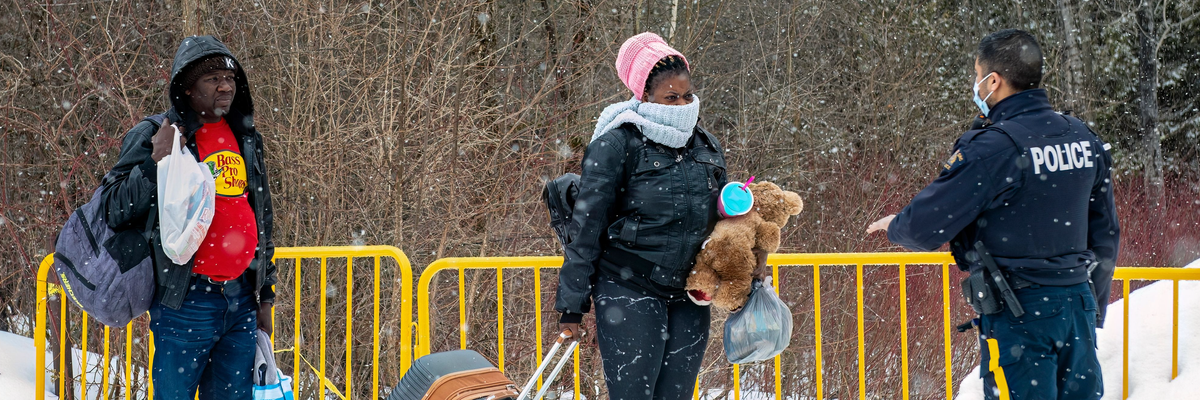
An officer speaks to migrants as they arrive at the Roxham Road border crossing in Roxham, Quebec, Canada, on March 2, 2023
'Speechless': US, Canada Agree on Plan to Turn Away Asylum-Seekers
"We're simply creating the worst scenario possible" for migrants, said one activist.
In a move that critics say will push people to attempt more dangerous border crossings, the United States and Canada on Friday are expected to announce an agreement allowing both countries to block migrants from seeking asylum at unofficial points of entry.
Canadian Prime Minister Justin Trudeau is hosting U.S. President Joe Biden Friday in Ottawa, where the leaders are expected to announce the deal. The agreement will allow Canada to turn back migrants at Roxham Road, a popular unofficial crossing between Clinton County, New York and Saint-Bernard-de-Lacolle, Quebec. Canada will also establish a new legal refugee program for 15,000 Latin American and Caribbean migrants.
Trudeau told CNN Thursday that while Canada is "welcoming people from around the world," the country must "make sure we are doing it in responsible proper ways to continue to have our citizens positive towards immigration as Canadians always are."
"Everyone has the right to seek and to enjoy in other countries asylum from persecution."
However, Stéphanie Valois, president of the Quebec Association of Immigration Lawyers (AQAADI), asserted that refugees "should not be returned to a country where they face serious threats to their life or freedom."
"It seems completely counterproductive to me," she told CBC.
The new deal is an amendment to the 2004 Safe Third Country Agreement (STCA), which compels migrants to claim asylum in the first "safe" country they reach, unless they qualify for certain exceptions. The STCA allows U.S. and Canadian authorities to turn away asylum-seekers at official border crossings—but not unofficial ones like Roxham Road.
François Legault, Quebec's center-right premier, has demanded that Trudeau's Liberal government resettle refugees in other Canadian provinces. Both Legault and Conservative Party Leader Pierre Poilievre have urged the closure of the Roxham Road crossing, which was used by 40,000 asylum-seekers to enter Canada last year.
"The intention behind the sudden announcement of this deal, which was negotiated in secret, is clear: To limit the ability of some of the world's most vulnerable people to find lifesaving protection in North America," Danilo Zak, associate director for policy and advocacy at Church World Service, an interdenominational Christian humanitarian group based in New York City, said in a statement.
"Time and time again, the Biden administration has taken steps to block the movement of people fleeing violence and persecution," he continued.
Zak added:
We should not stand by while policy after policy tears apart our nation's commitment to welcome. Given the assault on access to legal protection for the most vulnerable migrants arriving at our borders, it's questionable whether the United States still qualifies as a "safe third country." We urge President Biden to strongly reconsider this deal and to work with Congress to restore access to asylum and support policies that recognize the dignity of all those arriving at our borders.
Frantz André of the Comité d'Action des Sans Statut (Action Committee of the People without Status, or CAPSS) told CityNews Montreal that "I'm afraid there might be some kind of a stampede before the closure of Roxham Road."
In a separate CBC interview, André said that "we're simply creating the worst scenario possible" for migrants.
Robert Weissman, president of the consumer advocacy group Public Citizen, pointed to Article 14 of the Universal Declaration of Human Rights, to which both Canada and the United States are signatories: "Everyone has the right to seek and to enjoy in other countries asylum from persecution."
Many Latin American and Caribbean migrants are fleeing poverty and political or criminal violence and repression in their home countries, some of it caused by decades of U.S. imperial policies and actions in the region. Others come from as far afield as Asia and the Middle East, including countries like Afghanistan and Yemen that have suffered from years or even decades of war waged or backed by the United States.
An Urgent Message From Our Co-Founder
Dear Common Dreams reader, It’s been nearly 30 years since I co-founded Common Dreams with my late wife, Lina Newhouser. We had the radical notion that journalism should serve the public good, not corporate profits. It was clear to us from the outset what it would take to build such a project. No paid advertisements. No corporate sponsors. No millionaire publisher telling us what to think or do. Many people said we wouldn't last a year, but we proved those doubters wrong. Together with a tremendous team of journalists and dedicated staff, we built an independent media outlet free from the constraints of profits and corporate control. Our mission has always been simple: To inform. To inspire. To ignite change for the common good. Building Common Dreams was not easy. Our survival was never guaranteed. When you take on the most powerful forces—Wall Street greed, fossil fuel industry destruction, Big Tech lobbyists, and uber-rich oligarchs who have spent billions upon billions rigging the economy and democracy in their favor—the only bulwark you have is supporters who believe in your work. But here’s the urgent message from me today. It's never been this bad out there. And it's never been this hard to keep us going. At the very moment Common Dreams is most needed, the threats we face are intensifying. We need your support now more than ever. We don't accept corporate advertising and never will. We don't have a paywall because we don't think people should be blocked from critical news based on their ability to pay. Everything we do is funded by the donations of readers like you. When everyone does the little they can afford, we are strong. But if that support retreats or dries up, so do we. Will you donate now to make sure Common Dreams not only survives but thrives? —Craig Brown, Co-founder |
In a move that critics say will push people to attempt more dangerous border crossings, the United States and Canada on Friday are expected to announce an agreement allowing both countries to block migrants from seeking asylum at unofficial points of entry.
Canadian Prime Minister Justin Trudeau is hosting U.S. President Joe Biden Friday in Ottawa, where the leaders are expected to announce the deal. The agreement will allow Canada to turn back migrants at Roxham Road, a popular unofficial crossing between Clinton County, New York and Saint-Bernard-de-Lacolle, Quebec. Canada will also establish a new legal refugee program for 15,000 Latin American and Caribbean migrants.
Trudeau told CNN Thursday that while Canada is "welcoming people from around the world," the country must "make sure we are doing it in responsible proper ways to continue to have our citizens positive towards immigration as Canadians always are."
"Everyone has the right to seek and to enjoy in other countries asylum from persecution."
However, Stéphanie Valois, president of the Quebec Association of Immigration Lawyers (AQAADI), asserted that refugees "should not be returned to a country where they face serious threats to their life or freedom."
"It seems completely counterproductive to me," she told CBC.
The new deal is an amendment to the 2004 Safe Third Country Agreement (STCA), which compels migrants to claim asylum in the first "safe" country they reach, unless they qualify for certain exceptions. The STCA allows U.S. and Canadian authorities to turn away asylum-seekers at official border crossings—but not unofficial ones like Roxham Road.
François Legault, Quebec's center-right premier, has demanded that Trudeau's Liberal government resettle refugees in other Canadian provinces. Both Legault and Conservative Party Leader Pierre Poilievre have urged the closure of the Roxham Road crossing, which was used by 40,000 asylum-seekers to enter Canada last year.
"The intention behind the sudden announcement of this deal, which was negotiated in secret, is clear: To limit the ability of some of the world's most vulnerable people to find lifesaving protection in North America," Danilo Zak, associate director for policy and advocacy at Church World Service, an interdenominational Christian humanitarian group based in New York City, said in a statement.
"Time and time again, the Biden administration has taken steps to block the movement of people fleeing violence and persecution," he continued.
Zak added:
We should not stand by while policy after policy tears apart our nation's commitment to welcome. Given the assault on access to legal protection for the most vulnerable migrants arriving at our borders, it's questionable whether the United States still qualifies as a "safe third country." We urge President Biden to strongly reconsider this deal and to work with Congress to restore access to asylum and support policies that recognize the dignity of all those arriving at our borders.
Frantz André of the Comité d'Action des Sans Statut (Action Committee of the People without Status, or CAPSS) told CityNews Montreal that "I'm afraid there might be some kind of a stampede before the closure of Roxham Road."
In a separate CBC interview, André said that "we're simply creating the worst scenario possible" for migrants.
Robert Weissman, president of the consumer advocacy group Public Citizen, pointed to Article 14 of the Universal Declaration of Human Rights, to which both Canada and the United States are signatories: "Everyone has the right to seek and to enjoy in other countries asylum from persecution."
Many Latin American and Caribbean migrants are fleeing poverty and political or criminal violence and repression in their home countries, some of it caused by decades of U.S. imperial policies and actions in the region. Others come from as far afield as Asia and the Middle East, including countries like Afghanistan and Yemen that have suffered from years or even decades of war waged or backed by the United States.
- Inhumane Border Policing Only Exacerbates Displacement and Suffering ›
- Opinion | Americans Shouldn't Fear Asylum-Seekers, But the Consequences of Turning Them Away | Common Dreams ›
- Child Refugees Hit Record in Latin America, Caribbean as Climate Crisis, Poverty Grip Region ›
- Congress Urged to Reject 'Unconscionable' Asylum Changes in Funding Talks ›
In a move that critics say will push people to attempt more dangerous border crossings, the United States and Canada on Friday are expected to announce an agreement allowing both countries to block migrants from seeking asylum at unofficial points of entry.
Canadian Prime Minister Justin Trudeau is hosting U.S. President Joe Biden Friday in Ottawa, where the leaders are expected to announce the deal. The agreement will allow Canada to turn back migrants at Roxham Road, a popular unofficial crossing between Clinton County, New York and Saint-Bernard-de-Lacolle, Quebec. Canada will also establish a new legal refugee program for 15,000 Latin American and Caribbean migrants.
Trudeau told CNN Thursday that while Canada is "welcoming people from around the world," the country must "make sure we are doing it in responsible proper ways to continue to have our citizens positive towards immigration as Canadians always are."
"Everyone has the right to seek and to enjoy in other countries asylum from persecution."
However, Stéphanie Valois, president of the Quebec Association of Immigration Lawyers (AQAADI), asserted that refugees "should not be returned to a country where they face serious threats to their life or freedom."
"It seems completely counterproductive to me," she told CBC.
The new deal is an amendment to the 2004 Safe Third Country Agreement (STCA), which compels migrants to claim asylum in the first "safe" country they reach, unless they qualify for certain exceptions. The STCA allows U.S. and Canadian authorities to turn away asylum-seekers at official border crossings—but not unofficial ones like Roxham Road.
François Legault, Quebec's center-right premier, has demanded that Trudeau's Liberal government resettle refugees in other Canadian provinces. Both Legault and Conservative Party Leader Pierre Poilievre have urged the closure of the Roxham Road crossing, which was used by 40,000 asylum-seekers to enter Canada last year.
"The intention behind the sudden announcement of this deal, which was negotiated in secret, is clear: To limit the ability of some of the world's most vulnerable people to find lifesaving protection in North America," Danilo Zak, associate director for policy and advocacy at Church World Service, an interdenominational Christian humanitarian group based in New York City, said in a statement.
"Time and time again, the Biden administration has taken steps to block the movement of people fleeing violence and persecution," he continued.
Zak added:
We should not stand by while policy after policy tears apart our nation's commitment to welcome. Given the assault on access to legal protection for the most vulnerable migrants arriving at our borders, it's questionable whether the United States still qualifies as a "safe third country." We urge President Biden to strongly reconsider this deal and to work with Congress to restore access to asylum and support policies that recognize the dignity of all those arriving at our borders.
Frantz André of the Comité d'Action des Sans Statut (Action Committee of the People without Status, or CAPSS) told CityNews Montreal that "I'm afraid there might be some kind of a stampede before the closure of Roxham Road."
In a separate CBC interview, André said that "we're simply creating the worst scenario possible" for migrants.
Robert Weissman, president of the consumer advocacy group Public Citizen, pointed to Article 14 of the Universal Declaration of Human Rights, to which both Canada and the United States are signatories: "Everyone has the right to seek and to enjoy in other countries asylum from persecution."
Many Latin American and Caribbean migrants are fleeing poverty and political or criminal violence and repression in their home countries, some of it caused by decades of U.S. imperial policies and actions in the region. Others come from as far afield as Asia and the Middle East, including countries like Afghanistan and Yemen that have suffered from years or even decades of war waged or backed by the United States.
- Inhumane Border Policing Only Exacerbates Displacement and Suffering ›
- Opinion | Americans Shouldn't Fear Asylum-Seekers, But the Consequences of Turning Them Away | Common Dreams ›
- Child Refugees Hit Record in Latin America, Caribbean as Climate Crisis, Poverty Grip Region ›
- Congress Urged to Reject 'Unconscionable' Asylum Changes in Funding Talks ›