SUBSCRIBE TO OUR FREE NEWSLETTER
Daily news & progressive opinion—funded by the people, not the corporations—delivered straight to your inbox.
5
#000000
#FFFFFF
To donate by check, phone, or other method, see our More Ways to Give page.
Daily news & progressive opinion—funded by the people, not the corporations—delivered straight to your inbox.
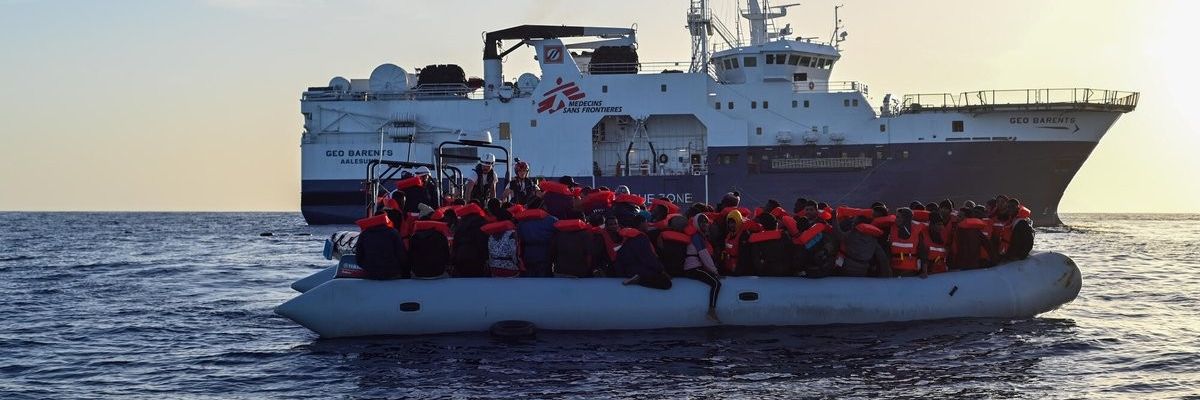
On December 5, 2022, 90 people, including 35 minors, were rescued from an overcrowded rubber boat in distress in international waters off the Libyan coast by the Geo Barents team.
"How many more deaths in the Central Mediterranean will the European states wait for before they halt their hostile and inhumane approach?" asked a search-and-rescue representative.
Doctors Without Borders on Wednesday called out European countries for "dangerous" policies and practices that have already made 2023 the deadliest year for migration in the Central Mediterranean since 2017.
The group, known globally as Médecins Sans Frontières (MSF), put out "No One Came to Our Rescue": The human costs of European migration policies in the Central Mediterranean, a report featuring medical and operational data as well as testimonies of people saved at sea.
"MSF has been running search-and-rescue (SAR) activities since 2015 as a direct response to European Union (E.U.) policies of disengagement and nonassistance along this stretch of the sea," the report states. The organization launched operations with the ship Geo Barents in May 2021 and has since saved at least 9,411 lives as of September.
"For more than two years, MSF teams on board Geo Barents have treated the physical and mental health impacts of European migration policies," said SAR representative Juan Matias Gil. "Patients' wounds and stories reflect the scale of violence to which they were subjected in their country of origin and along their journey, including in Libya and Tunisia."
"We documented numerous cases in which Italy and Malta failed to lawfully coordinate rescues and ensure assistance to those at risk of drowning, leading to delayed rescues or no rescue at all."
Of 3,660 medical consultations conducted on the ship this year, most patients had "conditions directly related to long journeys at sea," but MSF also saw 273 people affected by serious violence, with "scars from gunshot wounds, broken and severed limbs, and scars and bruises caused by recurrent violent beatings with metal bars, electric cables, baseball bats, machetes, and knives," according to the report.
"In addition to physical injuries," the publication continues, "these conditions include mental health conditions and the direct consequences of sexual and gender-based violence such as sexually transmitted infections (STIs), unwanted pregnancies, and female genital mutilation (FGM), among others."
The report says that "our teams have seen firsthand the manifold ways in which E.U. states have gradually withdrawn from their SAR obligations and have simultaneously enabled third countries to forcibly return people to unsafe places such as Libya, where many are either trapped in inhumane conditions or have no choice but to take to the sea due to a lack of safe and legal options."
A 19-year-old from Cameroon, rescued by MSF in June 2022, told the group that the previous November, the Libyan Coast Guard "caught me at sea and sold me to the jail of Roshofana." There, guards beat prisoners, "and they were filming and taking pictures while doing so," said the man, who worked for his freedom. "Sometimes, when people were wounded, they piled them up in one place and filmed them."
Europe has given the Libyan government millions of euros, and "since 2017, more than 120,000 people have been intercepted at sea by the E.U.-trained Libyan Coast Guard with E.U.-donated vessels, and illegally pushed back to Libya," MSF pointed out.
"Tunisia has overtaken Libya as the main departure point for people on the move, with nearly five times more arrivals than last year," the group noted. In response, the E.U. has "expanded its Libya strategy," providing millions of euros to "curb undocumented migration—including through incentives, trainings, and material support to increase interceptions at sea."
MSF highlighted that along with enabling interceptions, E.U. governments have directly neglected and hampered SAR efforts.
"In 2022 and 2023, we documented numerous cases in which Italy and Malta failed to lawfully coordinate rescues and ensure assistance to those at risk of drowning, leading to delayed rescues or no rescue at all," the group said. "They have left a deadly void in which people at risk of drowning are either left to drown or forcefully returned to unsafe countries."
While MSF and other groups "have faced frequent harassment by the authorities, including criminal charges, inspections, and prolonged detainment," the publication explains, "November 2022 marked the beginning of a new phase of escalation in the obstruction of NGO-led search-and-rescue activities" led by a new Italian government.
"Italian authorities prohibited Geo Barents and two other SAR ships from stopping in their territorial waters, and eventually facilitated only those considered most vulnerable to disembark," the document details. "The 'selective' disembarkation lasted for three days and eventually, following intense media coverage, political pressure, and the intervention of medical specialists on board the rescue ships, all survivors could eventually disembark in Italy."
Then, in January, "the Italian government introduced a new set of rules applying exclusively to civilian rescue vessels," which "has had a very tangible effect on the presence of NGO ships at sea and their ability to rescue," the report adds. Gil stressed that "while the new Italian rules target NGOs, the real price is paid by those fleeing across the Central Mediterranean, who are left without assistance."
"How many more deaths in the Central Mediterranean will the European states wait for before they halt their hostile and inhumane approach?" he asked. "We urge the European Union and its member states, especially Italy and Malta, to immediately change course in order to prioritize the safety of those seeking sanctuary at European shores."
Dear Common Dreams reader, It’s been nearly 30 years since I co-founded Common Dreams with my late wife, Lina Newhouser. We had the radical notion that journalism should serve the public good, not corporate profits. It was clear to us from the outset what it would take to build such a project. No paid advertisements. No corporate sponsors. No millionaire publisher telling us what to think or do. Many people said we wouldn't last a year, but we proved those doubters wrong. Together with a tremendous team of journalists and dedicated staff, we built an independent media outlet free from the constraints of profits and corporate control. Our mission has always been simple: To inform. To inspire. To ignite change for the common good. Building Common Dreams was not easy. Our survival was never guaranteed. When you take on the most powerful forces—Wall Street greed, fossil fuel industry destruction, Big Tech lobbyists, and uber-rich oligarchs who have spent billions upon billions rigging the economy and democracy in their favor—the only bulwark you have is supporters who believe in your work. But here’s the urgent message from me today. It's never been this bad out there. And it's never been this hard to keep us going. At the very moment Common Dreams is most needed, the threats we face are intensifying. We need your support now more than ever. We don't accept corporate advertising and never will. We don't have a paywall because we don't think people should be blocked from critical news based on their ability to pay. Everything we do is funded by the donations of readers like you. When everyone does the little they can afford, we are strong. But if that support retreats or dries up, so do we. Will you donate now to make sure Common Dreams not only survives but thrives? —Craig Brown, Co-founder |
Doctors Without Borders on Wednesday called out European countries for "dangerous" policies and practices that have already made 2023 the deadliest year for migration in the Central Mediterranean since 2017.
The group, known globally as Médecins Sans Frontières (MSF), put out "No One Came to Our Rescue": The human costs of European migration policies in the Central Mediterranean, a report featuring medical and operational data as well as testimonies of people saved at sea.
"MSF has been running search-and-rescue (SAR) activities since 2015 as a direct response to European Union (E.U.) policies of disengagement and nonassistance along this stretch of the sea," the report states. The organization launched operations with the ship Geo Barents in May 2021 and has since saved at least 9,411 lives as of September.
"For more than two years, MSF teams on board Geo Barents have treated the physical and mental health impacts of European migration policies," said SAR representative Juan Matias Gil. "Patients' wounds and stories reflect the scale of violence to which they were subjected in their country of origin and along their journey, including in Libya and Tunisia."
"We documented numerous cases in which Italy and Malta failed to lawfully coordinate rescues and ensure assistance to those at risk of drowning, leading to delayed rescues or no rescue at all."
Of 3,660 medical consultations conducted on the ship this year, most patients had "conditions directly related to long journeys at sea," but MSF also saw 273 people affected by serious violence, with "scars from gunshot wounds, broken and severed limbs, and scars and bruises caused by recurrent violent beatings with metal bars, electric cables, baseball bats, machetes, and knives," according to the report.
"In addition to physical injuries," the publication continues, "these conditions include mental health conditions and the direct consequences of sexual and gender-based violence such as sexually transmitted infections (STIs), unwanted pregnancies, and female genital mutilation (FGM), among others."
The report says that "our teams have seen firsthand the manifold ways in which E.U. states have gradually withdrawn from their SAR obligations and have simultaneously enabled third countries to forcibly return people to unsafe places such as Libya, where many are either trapped in inhumane conditions or have no choice but to take to the sea due to a lack of safe and legal options."
A 19-year-old from Cameroon, rescued by MSF in June 2022, told the group that the previous November, the Libyan Coast Guard "caught me at sea and sold me to the jail of Roshofana." There, guards beat prisoners, "and they were filming and taking pictures while doing so," said the man, who worked for his freedom. "Sometimes, when people were wounded, they piled them up in one place and filmed them."
Europe has given the Libyan government millions of euros, and "since 2017, more than 120,000 people have been intercepted at sea by the E.U.-trained Libyan Coast Guard with E.U.-donated vessels, and illegally pushed back to Libya," MSF pointed out.
"Tunisia has overtaken Libya as the main departure point for people on the move, with nearly five times more arrivals than last year," the group noted. In response, the E.U. has "expanded its Libya strategy," providing millions of euros to "curb undocumented migration—including through incentives, trainings, and material support to increase interceptions at sea."
MSF highlighted that along with enabling interceptions, E.U. governments have directly neglected and hampered SAR efforts.
"In 2022 and 2023, we documented numerous cases in which Italy and Malta failed to lawfully coordinate rescues and ensure assistance to those at risk of drowning, leading to delayed rescues or no rescue at all," the group said. "They have left a deadly void in which people at risk of drowning are either left to drown or forcefully returned to unsafe countries."
While MSF and other groups "have faced frequent harassment by the authorities, including criminal charges, inspections, and prolonged detainment," the publication explains, "November 2022 marked the beginning of a new phase of escalation in the obstruction of NGO-led search-and-rescue activities" led by a new Italian government.
"Italian authorities prohibited Geo Barents and two other SAR ships from stopping in their territorial waters, and eventually facilitated only those considered most vulnerable to disembark," the document details. "The 'selective' disembarkation lasted for three days and eventually, following intense media coverage, political pressure, and the intervention of medical specialists on board the rescue ships, all survivors could eventually disembark in Italy."
Then, in January, "the Italian government introduced a new set of rules applying exclusively to civilian rescue vessels," which "has had a very tangible effect on the presence of NGO ships at sea and their ability to rescue," the report adds. Gil stressed that "while the new Italian rules target NGOs, the real price is paid by those fleeing across the Central Mediterranean, who are left without assistance."
"How many more deaths in the Central Mediterranean will the European states wait for before they halt their hostile and inhumane approach?" he asked. "We urge the European Union and its member states, especially Italy and Malta, to immediately change course in order to prioritize the safety of those seeking sanctuary at European shores."
Doctors Without Borders on Wednesday called out European countries for "dangerous" policies and practices that have already made 2023 the deadliest year for migration in the Central Mediterranean since 2017.
The group, known globally as Médecins Sans Frontières (MSF), put out "No One Came to Our Rescue": The human costs of European migration policies in the Central Mediterranean, a report featuring medical and operational data as well as testimonies of people saved at sea.
"MSF has been running search-and-rescue (SAR) activities since 2015 as a direct response to European Union (E.U.) policies of disengagement and nonassistance along this stretch of the sea," the report states. The organization launched operations with the ship Geo Barents in May 2021 and has since saved at least 9,411 lives as of September.
"For more than two years, MSF teams on board Geo Barents have treated the physical and mental health impacts of European migration policies," said SAR representative Juan Matias Gil. "Patients' wounds and stories reflect the scale of violence to which they were subjected in their country of origin and along their journey, including in Libya and Tunisia."
"We documented numerous cases in which Italy and Malta failed to lawfully coordinate rescues and ensure assistance to those at risk of drowning, leading to delayed rescues or no rescue at all."
Of 3,660 medical consultations conducted on the ship this year, most patients had "conditions directly related to long journeys at sea," but MSF also saw 273 people affected by serious violence, with "scars from gunshot wounds, broken and severed limbs, and scars and bruises caused by recurrent violent beatings with metal bars, electric cables, baseball bats, machetes, and knives," according to the report.
"In addition to physical injuries," the publication continues, "these conditions include mental health conditions and the direct consequences of sexual and gender-based violence such as sexually transmitted infections (STIs), unwanted pregnancies, and female genital mutilation (FGM), among others."
The report says that "our teams have seen firsthand the manifold ways in which E.U. states have gradually withdrawn from their SAR obligations and have simultaneously enabled third countries to forcibly return people to unsafe places such as Libya, where many are either trapped in inhumane conditions or have no choice but to take to the sea due to a lack of safe and legal options."
A 19-year-old from Cameroon, rescued by MSF in June 2022, told the group that the previous November, the Libyan Coast Guard "caught me at sea and sold me to the jail of Roshofana." There, guards beat prisoners, "and they were filming and taking pictures while doing so," said the man, who worked for his freedom. "Sometimes, when people were wounded, they piled them up in one place and filmed them."
Europe has given the Libyan government millions of euros, and "since 2017, more than 120,000 people have been intercepted at sea by the E.U.-trained Libyan Coast Guard with E.U.-donated vessels, and illegally pushed back to Libya," MSF pointed out.
"Tunisia has overtaken Libya as the main departure point for people on the move, with nearly five times more arrivals than last year," the group noted. In response, the E.U. has "expanded its Libya strategy," providing millions of euros to "curb undocumented migration—including through incentives, trainings, and material support to increase interceptions at sea."
MSF highlighted that along with enabling interceptions, E.U. governments have directly neglected and hampered SAR efforts.
"In 2022 and 2023, we documented numerous cases in which Italy and Malta failed to lawfully coordinate rescues and ensure assistance to those at risk of drowning, leading to delayed rescues or no rescue at all," the group said. "They have left a deadly void in which people at risk of drowning are either left to drown or forcefully returned to unsafe countries."
While MSF and other groups "have faced frequent harassment by the authorities, including criminal charges, inspections, and prolonged detainment," the publication explains, "November 2022 marked the beginning of a new phase of escalation in the obstruction of NGO-led search-and-rescue activities" led by a new Italian government.
"Italian authorities prohibited Geo Barents and two other SAR ships from stopping in their territorial waters, and eventually facilitated only those considered most vulnerable to disembark," the document details. "The 'selective' disembarkation lasted for three days and eventually, following intense media coverage, political pressure, and the intervention of medical specialists on board the rescue ships, all survivors could eventually disembark in Italy."
Then, in January, "the Italian government introduced a new set of rules applying exclusively to civilian rescue vessels," which "has had a very tangible effect on the presence of NGO ships at sea and their ability to rescue," the report adds. Gil stressed that "while the new Italian rules target NGOs, the real price is paid by those fleeing across the Central Mediterranean, who are left without assistance."
"How many more deaths in the Central Mediterranean will the European states wait for before they halt their hostile and inhumane approach?" he asked. "We urge the European Union and its member states, especially Italy and Malta, to immediately change course in order to prioritize the safety of those seeking sanctuary at European shores."