SUBSCRIBE TO OUR FREE NEWSLETTER
Daily news & progressive opinion—funded by the people, not the corporations—delivered straight to your inbox.
5
#000000
#FFFFFF
To donate by check, phone, or other method, see our More Ways to Give page.
Daily news & progressive opinion—funded by the people, not the corporations—delivered straight to your inbox.
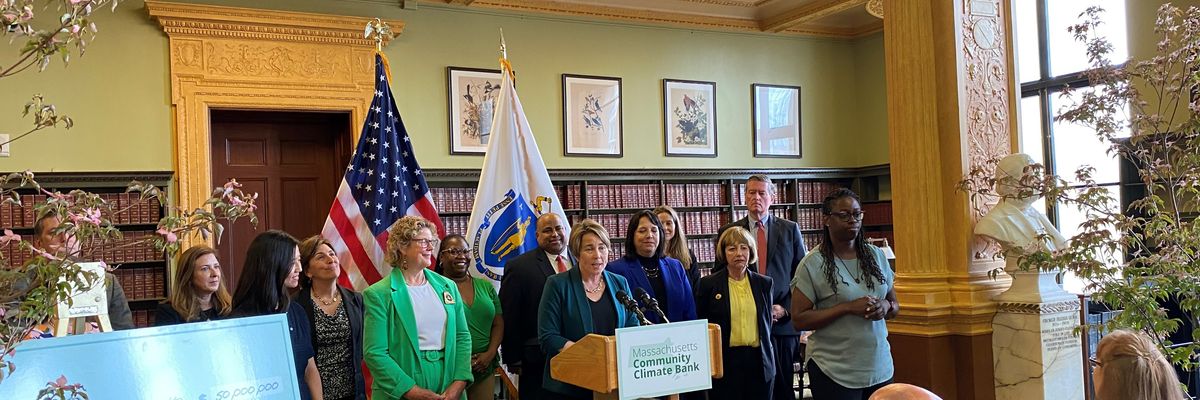
Democratic Gov. Maura Healey announced the Massachusetts Community Climate Bank on June 13, 2023.
The state "has a visionary plan to lead the country on electrifying affordable housing" that "will be a model nationwide for making sure that climate action and equity go hand-in-hand," said professor Leah Stokes.
In a move heralded as a model for others to follow, Democratic Gov. Maura Healey announced Tuesday that the state is "launching the Massachusetts Community Climate Bank—a financial engine for cutting emissions and improving health, equity, and economic security."
"This first-of-its-kind initiative is going to make our state more competitive, affordable, and equitable—and it's going to show that in Massachusetts, we can lead the world by leading with our values and leaving no community behind," Healey said of the country's only green bank focused on affordable housing.
The initiative is located within MassHousing, the state's affordable housing finance and investment bank. While it is seeded with $50 million from the Massachusetts Department of Environmental Protection, the Healey administration hopes to "attract private sector capital and federal funds available under the Inflation Reduction Act to finance building retrofits aligned with the state's long-term climate objectives and new construction of decarbonized buildings."
Massachusetts' climate plan calls for nearly halving planet-heating emissions from residential heating during this decade and achieving a 95% reduction by 2050.
To help reach those targets, the governor's office explained, the bank "aims to take advantage of the periodic cycle of affordable housing refinance to finance heat pumps, building envelopes (i.e., efficiency upgrades to windows and walls), heat pump water heaters, high-efficiency appliances, and solar panels as a part of the same process as other affordable housing renovation measures."
Climate, housing, labor, and political leaders across the state applauded the initiative—including Massachusetts AFL-CIO secretary-treasurer Chrissy Lynch, who said that the bank "will help our state tackle the dual crises of climate change and inequality, allowing us to harness federal investments under the Inflation Reduction Act to invest in our communities, cut pollution, and create high-quality union jobs throughout Massachusetts."
Democratic Boston Mayor Michelle Wu stressed that "this work is critical and will complement our efforts in Boston to retrofit our housing stock and create opportunities for small property owners to build and renovate greener, healthier buildings for residents to thrive."
The bank's creation also won praise beyond Massachusetts. Author and climate campaigner Bill McKibben said that "we need more homes, and we need efficient homes—here's a way of getting at two of our most important goals at once. It's the kind of innovative thinking and doing that sets the Healey administration apart."
University of California, Santa Barbara associate professor and Rewiring America senior policy counsel Leah Stokes declared that "Massachusetts has a visionary plan to lead the country on electrifying affordable housing."
"The Massachusetts Community Climate Bank will be a model nationwide for making sure that climate action and equity go hand-in-hand," she said, adding that "it's thrilling" to see the state's leadership with bank and expressing hope that it will secure more funding.
U.S. Sen. Ed Markey (D-Mass.), a leading climate champion in Congress and author of the National Climate Bank Act, also celebrated the move to establish "a one-of-a-kind engine that will serve on the frontlines of our state's compounding housing and climate crises by empowering communities to build affordable, climate-resilient, and energy-efficient housing and improvement projects all across the commonwealth."
"I've been fighting for national climate bank funding for years, and now that we've secured billions in funding in the Inflation Reduction Act, we can supercharge a clean energy revolution and unlock billions in federal dollars for Massachusetts and other states to leverage," Markey said.
The bank "will ensure public and private investment reach frontline and environmental justice communities," he added, "and I thank Gov. Healey and her administration for bringing this investment to life and building a brighter, more livable, and more affordable future."
Dear Common Dreams reader, It’s been nearly 30 years since I co-founded Common Dreams with my late wife, Lina Newhouser. We had the radical notion that journalism should serve the public good, not corporate profits. It was clear to us from the outset what it would take to build such a project. No paid advertisements. No corporate sponsors. No millionaire publisher telling us what to think or do. Many people said we wouldn't last a year, but we proved those doubters wrong. Together with a tremendous team of journalists and dedicated staff, we built an independent media outlet free from the constraints of profits and corporate control. Our mission has always been simple: To inform. To inspire. To ignite change for the common good. Building Common Dreams was not easy. Our survival was never guaranteed. When you take on the most powerful forces—Wall Street greed, fossil fuel industry destruction, Big Tech lobbyists, and uber-rich oligarchs who have spent billions upon billions rigging the economy and democracy in their favor—the only bulwark you have is supporters who believe in your work. But here’s the urgent message from me today. It's never been this bad out there. And it's never been this hard to keep us going. At the very moment Common Dreams is most needed, the threats we face are intensifying. We need your support now more than ever. We don't accept corporate advertising and never will. We don't have a paywall because we don't think people should be blocked from critical news based on their ability to pay. Everything we do is funded by the donations of readers like you. When everyone does the little they can afford, we are strong. But if that support retreats or dries up, so do we. Will you donate now to make sure Common Dreams not only survives but thrives? —Craig Brown, Co-founder |
In a move heralded as a model for others to follow, Democratic Gov. Maura Healey announced Tuesday that the state is "launching the Massachusetts Community Climate Bank—a financial engine for cutting emissions and improving health, equity, and economic security."
"This first-of-its-kind initiative is going to make our state more competitive, affordable, and equitable—and it's going to show that in Massachusetts, we can lead the world by leading with our values and leaving no community behind," Healey said of the country's only green bank focused on affordable housing.
The initiative is located within MassHousing, the state's affordable housing finance and investment bank. While it is seeded with $50 million from the Massachusetts Department of Environmental Protection, the Healey administration hopes to "attract private sector capital and federal funds available under the Inflation Reduction Act to finance building retrofits aligned with the state's long-term climate objectives and new construction of decarbonized buildings."
Massachusetts' climate plan calls for nearly halving planet-heating emissions from residential heating during this decade and achieving a 95% reduction by 2050.
To help reach those targets, the governor's office explained, the bank "aims to take advantage of the periodic cycle of affordable housing refinance to finance heat pumps, building envelopes (i.e., efficiency upgrades to windows and walls), heat pump water heaters, high-efficiency appliances, and solar panels as a part of the same process as other affordable housing renovation measures."
Climate, housing, labor, and political leaders across the state applauded the initiative—including Massachusetts AFL-CIO secretary-treasurer Chrissy Lynch, who said that the bank "will help our state tackle the dual crises of climate change and inequality, allowing us to harness federal investments under the Inflation Reduction Act to invest in our communities, cut pollution, and create high-quality union jobs throughout Massachusetts."
Democratic Boston Mayor Michelle Wu stressed that "this work is critical and will complement our efforts in Boston to retrofit our housing stock and create opportunities for small property owners to build and renovate greener, healthier buildings for residents to thrive."
The bank's creation also won praise beyond Massachusetts. Author and climate campaigner Bill McKibben said that "we need more homes, and we need efficient homes—here's a way of getting at two of our most important goals at once. It's the kind of innovative thinking and doing that sets the Healey administration apart."
University of California, Santa Barbara associate professor and Rewiring America senior policy counsel Leah Stokes declared that "Massachusetts has a visionary plan to lead the country on electrifying affordable housing."
"The Massachusetts Community Climate Bank will be a model nationwide for making sure that climate action and equity go hand-in-hand," she said, adding that "it's thrilling" to see the state's leadership with bank and expressing hope that it will secure more funding.
U.S. Sen. Ed Markey (D-Mass.), a leading climate champion in Congress and author of the National Climate Bank Act, also celebrated the move to establish "a one-of-a-kind engine that will serve on the frontlines of our state's compounding housing and climate crises by empowering communities to build affordable, climate-resilient, and energy-efficient housing and improvement projects all across the commonwealth."
"I've been fighting for national climate bank funding for years, and now that we've secured billions in funding in the Inflation Reduction Act, we can supercharge a clean energy revolution and unlock billions in federal dollars for Massachusetts and other states to leverage," Markey said.
The bank "will ensure public and private investment reach frontline and environmental justice communities," he added, "and I thank Gov. Healey and her administration for bringing this investment to life and building a brighter, more livable, and more affordable future."
In a move heralded as a model for others to follow, Democratic Gov. Maura Healey announced Tuesday that the state is "launching the Massachusetts Community Climate Bank—a financial engine for cutting emissions and improving health, equity, and economic security."
"This first-of-its-kind initiative is going to make our state more competitive, affordable, and equitable—and it's going to show that in Massachusetts, we can lead the world by leading with our values and leaving no community behind," Healey said of the country's only green bank focused on affordable housing.
The initiative is located within MassHousing, the state's affordable housing finance and investment bank. While it is seeded with $50 million from the Massachusetts Department of Environmental Protection, the Healey administration hopes to "attract private sector capital and federal funds available under the Inflation Reduction Act to finance building retrofits aligned with the state's long-term climate objectives and new construction of decarbonized buildings."
Massachusetts' climate plan calls for nearly halving planet-heating emissions from residential heating during this decade and achieving a 95% reduction by 2050.
To help reach those targets, the governor's office explained, the bank "aims to take advantage of the periodic cycle of affordable housing refinance to finance heat pumps, building envelopes (i.e., efficiency upgrades to windows and walls), heat pump water heaters, high-efficiency appliances, and solar panels as a part of the same process as other affordable housing renovation measures."
Climate, housing, labor, and political leaders across the state applauded the initiative—including Massachusetts AFL-CIO secretary-treasurer Chrissy Lynch, who said that the bank "will help our state tackle the dual crises of climate change and inequality, allowing us to harness federal investments under the Inflation Reduction Act to invest in our communities, cut pollution, and create high-quality union jobs throughout Massachusetts."
Democratic Boston Mayor Michelle Wu stressed that "this work is critical and will complement our efforts in Boston to retrofit our housing stock and create opportunities for small property owners to build and renovate greener, healthier buildings for residents to thrive."
The bank's creation also won praise beyond Massachusetts. Author and climate campaigner Bill McKibben said that "we need more homes, and we need efficient homes—here's a way of getting at two of our most important goals at once. It's the kind of innovative thinking and doing that sets the Healey administration apart."
University of California, Santa Barbara associate professor and Rewiring America senior policy counsel Leah Stokes declared that "Massachusetts has a visionary plan to lead the country on electrifying affordable housing."
"The Massachusetts Community Climate Bank will be a model nationwide for making sure that climate action and equity go hand-in-hand," she said, adding that "it's thrilling" to see the state's leadership with bank and expressing hope that it will secure more funding.
U.S. Sen. Ed Markey (D-Mass.), a leading climate champion in Congress and author of the National Climate Bank Act, also celebrated the move to establish "a one-of-a-kind engine that will serve on the frontlines of our state's compounding housing and climate crises by empowering communities to build affordable, climate-resilient, and energy-efficient housing and improvement projects all across the commonwealth."
"I've been fighting for national climate bank funding for years, and now that we've secured billions in funding in the Inflation Reduction Act, we can supercharge a clean energy revolution and unlock billions in federal dollars for Massachusetts and other states to leverage," Markey said.
The bank "will ensure public and private investment reach frontline and environmental justice communities," he added, "and I thank Gov. Healey and her administration for bringing this investment to life and building a brighter, more livable, and more affordable future."