
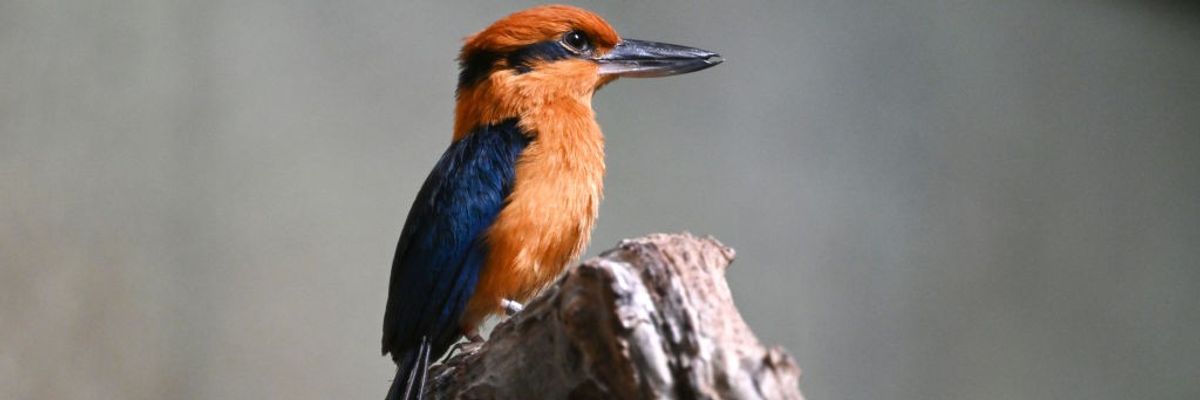
A male Guam kingfisher is seen at a zoo in Wichita, Kansas, in July 2024.
'The Fabric of Nature Is Unraveling,' Warns New Report on Wildlife Population Decline
"This is not just about wildlife," an expert said. "It's about the essential ecosystems that sustain human life."
Monitored populations of the world's vertebrate animals declined on average by 73% between 1970 and 2020, according to a major report released Wednesday by the World Wild Fund for Nature and the Zoological Society of London.
The 94-page report, 2024 Living Planet Report: A System in Peril, details the extent of loss for over 5,000 species of mammals, birds, fish, amphibians, and reptiles. The findings are based on studies of about 35,000 local populations of the studied species.
It's the latest version of a comprehensive report that has in the past been heavily cited by media, nonprofit, and government figures around the world. The previous version, published in 2022, found a 69% decline using data through 2018.
WWF released the new report, which is based on data in the Living Planet Index (LPI) maintained by ZSL, in advance of the COP16 global biodiversity summit that starts in Cali, Colombia on October 21.
"It really does indicate to us that the fabric of nature is unraveling,” Rebecca Shaw, WWF's chief scientist, told The Washington Post.
Monitored wildlife populations have decreased on average by 73% between 1970 and 2020, finds the latest Living Planet Index by our Institute of Zoology – the most comprehensive measure of vertebrate population trends across the globe. https://t.co/zJ7LBZC4mu pic.twitter.com/ZjVrHMotym
— ZSL (@OfficialZSL) October 10, 2024
The LPI, though seen by many as a key metric for following biodiversity loss, has been misinterpreted in the past and is not without its critics.
The findings don't mean that the total number of vertebrates or vertebrate species declined by 73%—rather, the figure shows an average change in population size. That is, in the index, a change in the population size of a very small population of, say, Guam kingfishers would have the same weight as a change in the population size of a far more populous animal.
A study published in June in Nature Communications questioned the mathematical techniques used by the LPI's authors and found that they had likely overstated vertebrate population decline. The LPI authors are preparing a rebuttal.
Some scientists, including Louise McRae, a ZSL researcher who works on the index, have suggested that it may in fact underestimate biodiversity loss because amphibian and reptile populations, which are struggling the most, are not fully represented in the database, as they're hard to monitor.
In any case, even the index's critics agree with the underlying argument that there is a crisis of biodiversity loss underway.
"This is unequivocal," Vox's Benji Jones wrote in an article that scrutinized the LPI. He continued:
Coral reefs are overheating and dying en masse. North America has lost some 3 billion birds. Insects are indeed vanishing. The rate of extinction is accelerating. In Hawaii, which has been called the extinction capital of the world, entire species of birds—and all the cultural heritage they carry—are blinking out as I write this.
WWF scientists emphasized that the biodiversity crisis is a crisis for humankind.
"This is not just about wildlife," Daudi Sumba, the group's chief conservation officer, said in a press call. "It's about the essential ecosystems that sustain human life."
Mike Barrett, a scientific adviser at WWF, agreed.
"Please don't just feel sad about the loss of nature," Barrett told the BBC. "Be aware that this is now a fundamental threat to humanity and we've really got to do something now."
Gerardo Ceballos, an ecologist at the National Autonomous University of Mexico, said this urgency was why the new report was useful.
"It shows us that we're still not doing enough," he told Vox. "The most important thing to understand is that unless we can save biodiversity there's no way we can save humanity."
Humans are indeed the cause of the biodiversity crisis. Habitat loss and degradation, "driven primarily by our food system," is the most reported threat to wildlife populations, WWF says. Other threats include overexploitation, invasive species, and climate change.
The United Nations Biodiversity Conference (COP16) in Cali is the first of its kind since December 2022, when the world's nations made a potentially historic agreement to protect 30% of the world's lands and waters by 2030—30x30, as it's called.
"The stakes couldn't be higher," The Nature Conservancy has written of the Cali summit. "The goal is to transform the commitments of the 2022 Kunming-Montreal Global Biodiversity Framework into actionable plans."
We are at a crossroads
This country and this world are at a monumental crossroads. In a few short weeks, US voters will have an opportunity to beat back the forces of fascism and confront the billionaires who are rigging the economy, our media system, and our democracy, making it increasingly impossible for ordinary people to get by. We’re not just talking about the election. We’re talking about what must be done once these fascist elements are vanquished from power. We need a bolder set of solutions than what either major party has so far been willing to offer and a working-class movement ready to fight like hell for it. Trump didn't emerge from nowhere. The conditions that fueled MAGA authoritarianism were created by decades of radical neoliberal economic policies and a corrupt political system dominated by corporate interests. They slashed taxes on the super-rich, promising that the benefits would trickle down. They said giveaways to the corporate titans would make life more affordable for the rest of us. It was all bullshit. And when a bitter, betrayed populace searches for someone to blame, right-wing demagogues have little trouble finding scapegoats. People know when they're being lied to, but you won't hear any of this from the corporate media. Only independent journalism—powered and funded by people who believe in building a better world—can deliver truly trustworthy daily news. Our Fall Campaign is underway, and we need your help. To power our newsroom through the rest of the year, we need to raise $125,000 by midnight on October 31. So if you share our vision, please contribute whatever you can to sustain our work. |
Monitored populations of the world's vertebrate animals declined on average by 73% between 1970 and 2020, according to a major report released Wednesday by the World Wild Fund for Nature and the Zoological Society of London.
The 94-page report, 2024 Living Planet Report: A System in Peril, details the extent of loss for over 5,000 species of mammals, birds, fish, amphibians, and reptiles. The findings are based on studies of about 35,000 local populations of the studied species.
It's the latest version of a comprehensive report that has in the past been heavily cited by media, nonprofit, and government figures around the world. The previous version, published in 2022, found a 69% decline using data through 2018.
WWF released the new report, which is based on data in the Living Planet Index (LPI) maintained by ZSL, in advance of the COP16 global biodiversity summit that starts in Cali, Colombia on October 21.
"It really does indicate to us that the fabric of nature is unraveling,” Rebecca Shaw, WWF's chief scientist, told The Washington Post.
Monitored wildlife populations have decreased on average by 73% between 1970 and 2020, finds the latest Living Planet Index by our Institute of Zoology – the most comprehensive measure of vertebrate population trends across the globe. https://t.co/zJ7LBZC4mu pic.twitter.com/ZjVrHMotym
— ZSL (@OfficialZSL) October 10, 2024
The LPI, though seen by many as a key metric for following biodiversity loss, has been misinterpreted in the past and is not without its critics.
The findings don't mean that the total number of vertebrates or vertebrate species declined by 73%—rather, the figure shows an average change in population size. That is, in the index, a change in the population size of a very small population of, say, Guam kingfishers would have the same weight as a change in the population size of a far more populous animal.
A study published in June in Nature Communications questioned the mathematical techniques used by the LPI's authors and found that they had likely overstated vertebrate population decline. The LPI authors are preparing a rebuttal.
Some scientists, including Louise McRae, a ZSL researcher who works on the index, have suggested that it may in fact underestimate biodiversity loss because amphibian and reptile populations, which are struggling the most, are not fully represented in the database, as they're hard to monitor.
In any case, even the index's critics agree with the underlying argument that there is a crisis of biodiversity loss underway.
"This is unequivocal," Vox's Benji Jones wrote in an article that scrutinized the LPI. He continued:
Coral reefs are overheating and dying en masse. North America has lost some 3 billion birds. Insects are indeed vanishing. The rate of extinction is accelerating. In Hawaii, which has been called the extinction capital of the world, entire species of birds—and all the cultural heritage they carry—are blinking out as I write this.
WWF scientists emphasized that the biodiversity crisis is a crisis for humankind.
"This is not just about wildlife," Daudi Sumba, the group's chief conservation officer, said in a press call. "It's about the essential ecosystems that sustain human life."
Mike Barrett, a scientific adviser at WWF, agreed.
"Please don't just feel sad about the loss of nature," Barrett told the BBC. "Be aware that this is now a fundamental threat to humanity and we've really got to do something now."
Gerardo Ceballos, an ecologist at the National Autonomous University of Mexico, said this urgency was why the new report was useful.
"It shows us that we're still not doing enough," he told Vox. "The most important thing to understand is that unless we can save biodiversity there's no way we can save humanity."
Humans are indeed the cause of the biodiversity crisis. Habitat loss and degradation, "driven primarily by our food system," is the most reported threat to wildlife populations, WWF says. Other threats include overexploitation, invasive species, and climate change.
The United Nations Biodiversity Conference (COP16) in Cali is the first of its kind since December 2022, when the world's nations made a potentially historic agreement to protect 30% of the world's lands and waters by 2030—30x30, as it's called.
"The stakes couldn't be higher," The Nature Conservancy has written of the Cali summit. "The goal is to transform the commitments of the 2022 Kunming-Montreal Global Biodiversity Framework into actionable plans."
Monitored populations of the world's vertebrate animals declined on average by 73% between 1970 and 2020, according to a major report released Wednesday by the World Wild Fund for Nature and the Zoological Society of London.
The 94-page report, 2024 Living Planet Report: A System in Peril, details the extent of loss for over 5,000 species of mammals, birds, fish, amphibians, and reptiles. The findings are based on studies of about 35,000 local populations of the studied species.
It's the latest version of a comprehensive report that has in the past been heavily cited by media, nonprofit, and government figures around the world. The previous version, published in 2022, found a 69% decline using data through 2018.
WWF released the new report, which is based on data in the Living Planet Index (LPI) maintained by ZSL, in advance of the COP16 global biodiversity summit that starts in Cali, Colombia on October 21.
"It really does indicate to us that the fabric of nature is unraveling,” Rebecca Shaw, WWF's chief scientist, told The Washington Post.
Monitored wildlife populations have decreased on average by 73% between 1970 and 2020, finds the latest Living Planet Index by our Institute of Zoology – the most comprehensive measure of vertebrate population trends across the globe. https://t.co/zJ7LBZC4mu pic.twitter.com/ZjVrHMotym
— ZSL (@OfficialZSL) October 10, 2024
The LPI, though seen by many as a key metric for following biodiversity loss, has been misinterpreted in the past and is not without its critics.
The findings don't mean that the total number of vertebrates or vertebrate species declined by 73%—rather, the figure shows an average change in population size. That is, in the index, a change in the population size of a very small population of, say, Guam kingfishers would have the same weight as a change in the population size of a far more populous animal.
A study published in June in Nature Communications questioned the mathematical techniques used by the LPI's authors and found that they had likely overstated vertebrate population decline. The LPI authors are preparing a rebuttal.
Some scientists, including Louise McRae, a ZSL researcher who works on the index, have suggested that it may in fact underestimate biodiversity loss because amphibian and reptile populations, which are struggling the most, are not fully represented in the database, as they're hard to monitor.
In any case, even the index's critics agree with the underlying argument that there is a crisis of biodiversity loss underway.
"This is unequivocal," Vox's Benji Jones wrote in an article that scrutinized the LPI. He continued:
Coral reefs are overheating and dying en masse. North America has lost some 3 billion birds. Insects are indeed vanishing. The rate of extinction is accelerating. In Hawaii, which has been called the extinction capital of the world, entire species of birds—and all the cultural heritage they carry—are blinking out as I write this.
WWF scientists emphasized that the biodiversity crisis is a crisis for humankind.
"This is not just about wildlife," Daudi Sumba, the group's chief conservation officer, said in a press call. "It's about the essential ecosystems that sustain human life."
Mike Barrett, a scientific adviser at WWF, agreed.
"Please don't just feel sad about the loss of nature," Barrett told the BBC. "Be aware that this is now a fundamental threat to humanity and we've really got to do something now."
Gerardo Ceballos, an ecologist at the National Autonomous University of Mexico, said this urgency was why the new report was useful.
"It shows us that we're still not doing enough," he told Vox. "The most important thing to understand is that unless we can save biodiversity there's no way we can save humanity."
Humans are indeed the cause of the biodiversity crisis. Habitat loss and degradation, "driven primarily by our food system," is the most reported threat to wildlife populations, WWF says. Other threats include overexploitation, invasive species, and climate change.
The United Nations Biodiversity Conference (COP16) in Cali is the first of its kind since December 2022, when the world's nations made a potentially historic agreement to protect 30% of the world's lands and waters by 2030—30x30, as it's called.
"The stakes couldn't be higher," The Nature Conservancy has written of the Cali summit. "The goal is to transform the commitments of the 2022 Kunming-Montreal Global Biodiversity Framework into actionable plans."