SUBSCRIBE TO OUR FREE NEWSLETTER
Daily news & progressive opinion—funded by the people, not the corporations—delivered straight to your inbox.
5
#000000
#FFFFFF
To donate by check, phone, or other method, see our More Ways to Give page.
Daily news & progressive opinion—funded by the people, not the corporations—delivered straight to your inbox.
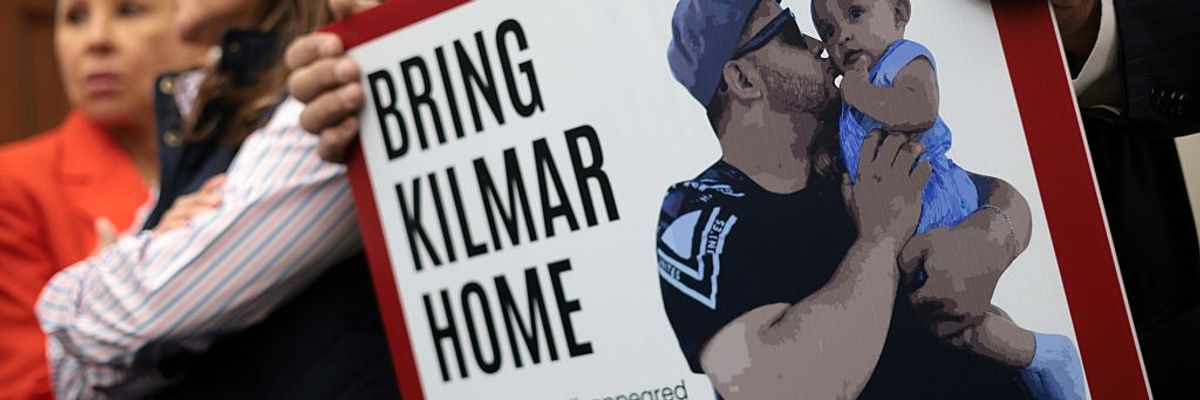
A member of the Congressional Hispanic Caucus holds a picture of Kilmar Abrego Garcia at Cannon House Office Building on April 9, 2025 in Washington, D.C.
The immigrant's legal team sought the decision to protect him from swift deportation.
Update (5:50 pm ET):
A magistrate judge on Wednesday paused Kilmar Abrego Garcia's release from federal custody, shortly after a U.S. district judge determined that he should be freed.
Magistrate Judge Barbara Holmes in the Middle District of Tennessee halted his release for 30 days. According to CNN, "Abrego Garcia's lawyers had made the request earlier this week in an effort to ensure removal proceedings wouldn't quickly begin once he's released from custody."
Earlier:
A federal judge on Wednesday had scathing words for the Trump administration as he ordered the government to release Kilmar Abrego Garcia, an immigrant wrongly sent to El Salvador's infamous Terrorism Confinement Center.
In his ruling, Judge Waverly Crenshaw of the United States District Court for the Middle District of Tennessee stated that the government's allegations that Abrego Garcia was a member of the gang MS-13 "border on fanciful" and were far from sufficient to prove that he is too dangerous to release ahead of his trial on human smuggling charges.
In fact, Crenshaw contended that proof of Abrego Garcia's gang affiliations are "entirely absent from the record" and further stated that "there is no evidence before the court that Abrego: has markings or tattoos showing gang affiliation; has working relationships with known MS-13 members; ever told any of the witnesses that he is a MS-13 member; or has ever been affiliated with any sort of gang activity."
The judge then picked apart testimony from cooperating witnesses who claimed that Abrego Garcia in the past had provided transportation to Salvadoran immigrants who were members of both MS-13 and of rival gang Barrio 18, which for years has engaged in a bloody feud with MS-13.
"This cuts against the already slim evidence demonstrating Abrego is a member of MS-13," wrote Crenshaw. "Based on the record before it, for the court to find that Abrego is member of or in affiliation with MS-13, it would have to make so many inferences from the government's proffered evidence in its favor that such conclusion would border on fanciful."
Shortly after Crenshaw's ruling, Judge Paula Xinis of the U.S. District Court for the District of Maryland issued an order that expressly prohibited Immigration and Customs Enforcement (ICE) officials from taking Abrego Garcia back into custody during the period leading up to his trial and said the government could not initiate deportation proceedings against him without going through standard due process.
Abrego Garcia was brought back to the United States last month after the Trump administration complied with a U.S. Supreme Court order to facilitate his return after it acknowledged months earlier that he had been improperly deported to El Salvador. Upon his return, the United States Department of Justice promptly hit him with human smuggling charges to which he has pleaded not guilty.
Dear Common Dreams reader, It’s been nearly 30 years since I co-founded Common Dreams with my late wife, Lina Newhouser. We had the radical notion that journalism should serve the public good, not corporate profits. It was clear to us from the outset what it would take to build such a project. No paid advertisements. No corporate sponsors. No millionaire publisher telling us what to think or do. Many people said we wouldn't last a year, but we proved those doubters wrong. Together with a tremendous team of journalists and dedicated staff, we built an independent media outlet free from the constraints of profits and corporate control. Our mission has always been simple: To inform. To inspire. To ignite change for the common good. Building Common Dreams was not easy. Our survival was never guaranteed. When you take on the most powerful forces—Wall Street greed, fossil fuel industry destruction, Big Tech lobbyists, and uber-rich oligarchs who have spent billions upon billions rigging the economy and democracy in their favor—the only bulwark you have is supporters who believe in your work. But here’s the urgent message from me today. It's never been this bad out there. And it's never been this hard to keep us going. At the very moment Common Dreams is most needed, the threats we face are intensifying. We need your support now more than ever. We don't accept corporate advertising and never will. We don't have a paywall because we don't think people should be blocked from critical news based on their ability to pay. Everything we do is funded by the donations of readers like you. When everyone does the little they can afford, we are strong. But if that support retreats or dries up, so do we. Will you donate now to make sure Common Dreams not only survives but thrives? —Craig Brown, Co-founder |
Update (5:50 pm ET):
A magistrate judge on Wednesday paused Kilmar Abrego Garcia's release from federal custody, shortly after a U.S. district judge determined that he should be freed.
Magistrate Judge Barbara Holmes in the Middle District of Tennessee halted his release for 30 days. According to CNN, "Abrego Garcia's lawyers had made the request earlier this week in an effort to ensure removal proceedings wouldn't quickly begin once he's released from custody."
Earlier:
A federal judge on Wednesday had scathing words for the Trump administration as he ordered the government to release Kilmar Abrego Garcia, an immigrant wrongly sent to El Salvador's infamous Terrorism Confinement Center.
In his ruling, Judge Waverly Crenshaw of the United States District Court for the Middle District of Tennessee stated that the government's allegations that Abrego Garcia was a member of the gang MS-13 "border on fanciful" and were far from sufficient to prove that he is too dangerous to release ahead of his trial on human smuggling charges.
In fact, Crenshaw contended that proof of Abrego Garcia's gang affiliations are "entirely absent from the record" and further stated that "there is no evidence before the court that Abrego: has markings or tattoos showing gang affiliation; has working relationships with known MS-13 members; ever told any of the witnesses that he is a MS-13 member; or has ever been affiliated with any sort of gang activity."
The judge then picked apart testimony from cooperating witnesses who claimed that Abrego Garcia in the past had provided transportation to Salvadoran immigrants who were members of both MS-13 and of rival gang Barrio 18, which for years has engaged in a bloody feud with MS-13.
"This cuts against the already slim evidence demonstrating Abrego is a member of MS-13," wrote Crenshaw. "Based on the record before it, for the court to find that Abrego is member of or in affiliation with MS-13, it would have to make so many inferences from the government's proffered evidence in its favor that such conclusion would border on fanciful."
Shortly after Crenshaw's ruling, Judge Paula Xinis of the U.S. District Court for the District of Maryland issued an order that expressly prohibited Immigration and Customs Enforcement (ICE) officials from taking Abrego Garcia back into custody during the period leading up to his trial and said the government could not initiate deportation proceedings against him without going through standard due process.
Abrego Garcia was brought back to the United States last month after the Trump administration complied with a U.S. Supreme Court order to facilitate his return after it acknowledged months earlier that he had been improperly deported to El Salvador. Upon his return, the United States Department of Justice promptly hit him with human smuggling charges to which he has pleaded not guilty.
Update (5:50 pm ET):
A magistrate judge on Wednesday paused Kilmar Abrego Garcia's release from federal custody, shortly after a U.S. district judge determined that he should be freed.
Magistrate Judge Barbara Holmes in the Middle District of Tennessee halted his release for 30 days. According to CNN, "Abrego Garcia's lawyers had made the request earlier this week in an effort to ensure removal proceedings wouldn't quickly begin once he's released from custody."
Earlier:
A federal judge on Wednesday had scathing words for the Trump administration as he ordered the government to release Kilmar Abrego Garcia, an immigrant wrongly sent to El Salvador's infamous Terrorism Confinement Center.
In his ruling, Judge Waverly Crenshaw of the United States District Court for the Middle District of Tennessee stated that the government's allegations that Abrego Garcia was a member of the gang MS-13 "border on fanciful" and were far from sufficient to prove that he is too dangerous to release ahead of his trial on human smuggling charges.
In fact, Crenshaw contended that proof of Abrego Garcia's gang affiliations are "entirely absent from the record" and further stated that "there is no evidence before the court that Abrego: has markings or tattoos showing gang affiliation; has working relationships with known MS-13 members; ever told any of the witnesses that he is a MS-13 member; or has ever been affiliated with any sort of gang activity."
The judge then picked apart testimony from cooperating witnesses who claimed that Abrego Garcia in the past had provided transportation to Salvadoran immigrants who were members of both MS-13 and of rival gang Barrio 18, which for years has engaged in a bloody feud with MS-13.
"This cuts against the already slim evidence demonstrating Abrego is a member of MS-13," wrote Crenshaw. "Based on the record before it, for the court to find that Abrego is member of or in affiliation with MS-13, it would have to make so many inferences from the government's proffered evidence in its favor that such conclusion would border on fanciful."
Shortly after Crenshaw's ruling, Judge Paula Xinis of the U.S. District Court for the District of Maryland issued an order that expressly prohibited Immigration and Customs Enforcement (ICE) officials from taking Abrego Garcia back into custody during the period leading up to his trial and said the government could not initiate deportation proceedings against him without going through standard due process.
Abrego Garcia was brought back to the United States last month after the Trump administration complied with a U.S. Supreme Court order to facilitate his return after it acknowledged months earlier that he had been improperly deported to El Salvador. Upon his return, the United States Department of Justice promptly hit him with human smuggling charges to which he has pleaded not guilty.