SUBSCRIBE TO OUR FREE NEWSLETTER
Daily news & progressive opinion—funded by the people, not the corporations—delivered straight to your inbox.
5
#000000
#FFFFFF
To donate by check, phone, or other method, see our More Ways to Give page.
Daily news & progressive opinion—funded by the people, not the corporations—delivered straight to your inbox.
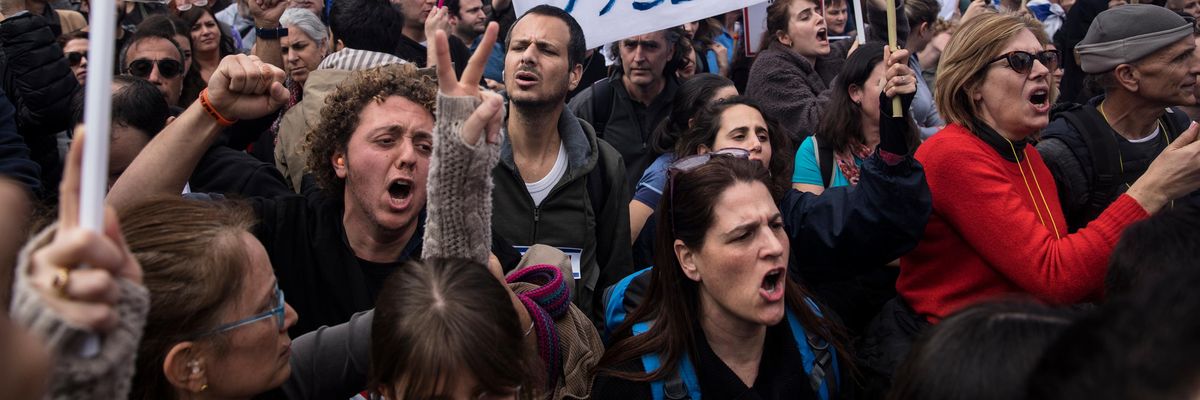
Protesters attend a massive demonstration in front of the Israeli parliament on February 13, 2023.
Around 100,000 Israelis took to the streets to protest the judicial overhaul, chanting, "No to dictatorship!"
Massive protests erupted in Israel on Monday as the country's far-right government, led by Prime Minister Benjamin Netanyahu, began advancing judicial reforms that would roll back judicial oversight of parliament and give lawmakers more control over Supreme Court appointments, proposed changes that opposition leader Yair Lapid decried as an attempt to impose a "dark dictatorship."
As demonstrations raged—with participants chanting "democracy!" and "no to dictatorship!"—chaos broke out inside the Israeli Knesset after a key committee voted to move ahead with part of the legislation backed by Netanyahu and right-wing Israeli Justice Minister Yariv Levin, who are aiming to virtually eliminate the Supreme Court's ability to strike down laws.
The vote, as The New York Times reported, "set off a fracas in the committee room after opposition lawmakers, one of them in tears, chanted against the decision, and some of them clambered over tables to confront the committee chair, Simcha Rothman, a government lawmaker."
Around 100,000 people took part in the Monday demonstrations against the proposed judicial overhaul, which the far-right government appears bent on ramming through despite public opposition and pleas from top officials—including Israeli President Isaac Herzog—to delay the legislation.
In a speech on Sunday, Herzog—who plays a largely ceremonial role—warned that "we are no longer in a political debate but on the brink of constitutional and social collapse."
Addressing demonstrators on Monday, Lapid expressed a similar fear, declaring, "We will not stay quiet as they destroy everything that is precious and sacred to us."
"Outwardly they grin sarcastically, saying that [the protests] won't change anything," Lapid said, "but inside they tremble, as rulers always tremble when they discover that there are people in front of them who are not willing to give up."
Monday's mass demonstrations came 24 hours after around 200,000 Israelis took to the streets to protest the policies of Israel's far-right government, which on Sunday granted retroactive "legalization" to nine settlements in the occupied West Bank and East Jerusalem.
The Times noted Monday that "many Arabs agree that the Supreme Court generally acts as a bulwark against attacks on minorities and has acted to restrain parts of Israel's settlement enterprise."
"But they also feel that Israel's democracy has for years been compromised by the Israeli occupation of the West Bank, where millions of Palestinians live under varying forms of Israeli control without voting or residency rights in Israel itself," the newspaper added.
Aida Touma-Sliman, an Arab lawmaker in Israel's parliament, told the Times that "democracy cannot exist while you're occupying other people."
Mansour Abbas, a member of the Israeli Knesset and head of the United Arab List, said his party supports the large-scale demonstrations against the judicial overhaul, which have been going on for weeks.
As Haaretz explained, the new legislation seeks to grant "the prime minister and his or her government—via the legislature they control—the power to override Supreme Court decisions."
"It also limits the court's ability to strike down legislation that infringes on human and civil rights, while giving the government complete control over judicial appointments," the outlet continued. "The battle will continue after Monday's vote. The legislation now moves to the full Knesset, where it will need to pass in three votes in the coming days or weeks. The protest movement is already preparing its next steps."
Dear Common Dreams reader, It’s been nearly 30 years since I co-founded Common Dreams with my late wife, Lina Newhouser. We had the radical notion that journalism should serve the public good, not corporate profits. It was clear to us from the outset what it would take to build such a project. No paid advertisements. No corporate sponsors. No millionaire publisher telling us what to think or do. Many people said we wouldn't last a year, but we proved those doubters wrong. Together with a tremendous team of journalists and dedicated staff, we built an independent media outlet free from the constraints of profits and corporate control. Our mission has always been simple: To inform. To inspire. To ignite change for the common good. Building Common Dreams was not easy. Our survival was never guaranteed. When you take on the most powerful forces—Wall Street greed, fossil fuel industry destruction, Big Tech lobbyists, and uber-rich oligarchs who have spent billions upon billions rigging the economy and democracy in their favor—the only bulwark you have is supporters who believe in your work. But here’s the urgent message from me today. It's never been this bad out there. And it's never been this hard to keep us going. At the very moment Common Dreams is most needed, the threats we face are intensifying. We need your support now more than ever. We don't accept corporate advertising and never will. We don't have a paywall because we don't think people should be blocked from critical news based on their ability to pay. Everything we do is funded by the donations of readers like you. When everyone does the little they can afford, we are strong. But if that support retreats or dries up, so do we. Will you donate now to make sure Common Dreams not only survives but thrives? —Craig Brown, Co-founder |
Massive protests erupted in Israel on Monday as the country's far-right government, led by Prime Minister Benjamin Netanyahu, began advancing judicial reforms that would roll back judicial oversight of parliament and give lawmakers more control over Supreme Court appointments, proposed changes that opposition leader Yair Lapid decried as an attempt to impose a "dark dictatorship."
As demonstrations raged—with participants chanting "democracy!" and "no to dictatorship!"—chaos broke out inside the Israeli Knesset after a key committee voted to move ahead with part of the legislation backed by Netanyahu and right-wing Israeli Justice Minister Yariv Levin, who are aiming to virtually eliminate the Supreme Court's ability to strike down laws.
The vote, as The New York Times reported, "set off a fracas in the committee room after opposition lawmakers, one of them in tears, chanted against the decision, and some of them clambered over tables to confront the committee chair, Simcha Rothman, a government lawmaker."
Around 100,000 people took part in the Monday demonstrations against the proposed judicial overhaul, which the far-right government appears bent on ramming through despite public opposition and pleas from top officials—including Israeli President Isaac Herzog—to delay the legislation.
In a speech on Sunday, Herzog—who plays a largely ceremonial role—warned that "we are no longer in a political debate but on the brink of constitutional and social collapse."
Addressing demonstrators on Monday, Lapid expressed a similar fear, declaring, "We will not stay quiet as they destroy everything that is precious and sacred to us."
"Outwardly they grin sarcastically, saying that [the protests] won't change anything," Lapid said, "but inside they tremble, as rulers always tremble when they discover that there are people in front of them who are not willing to give up."
Monday's mass demonstrations came 24 hours after around 200,000 Israelis took to the streets to protest the policies of Israel's far-right government, which on Sunday granted retroactive "legalization" to nine settlements in the occupied West Bank and East Jerusalem.
The Times noted Monday that "many Arabs agree that the Supreme Court generally acts as a bulwark against attacks on minorities and has acted to restrain parts of Israel's settlement enterprise."
"But they also feel that Israel's democracy has for years been compromised by the Israeli occupation of the West Bank, where millions of Palestinians live under varying forms of Israeli control without voting or residency rights in Israel itself," the newspaper added.
Aida Touma-Sliman, an Arab lawmaker in Israel's parliament, told the Times that "democracy cannot exist while you're occupying other people."
Mansour Abbas, a member of the Israeli Knesset and head of the United Arab List, said his party supports the large-scale demonstrations against the judicial overhaul, which have been going on for weeks.
As Haaretz explained, the new legislation seeks to grant "the prime minister and his or her government—via the legislature they control—the power to override Supreme Court decisions."
"It also limits the court's ability to strike down legislation that infringes on human and civil rights, while giving the government complete control over judicial appointments," the outlet continued. "The battle will continue after Monday's vote. The legislation now moves to the full Knesset, where it will need to pass in three votes in the coming days or weeks. The protest movement is already preparing its next steps."
Massive protests erupted in Israel on Monday as the country's far-right government, led by Prime Minister Benjamin Netanyahu, began advancing judicial reforms that would roll back judicial oversight of parliament and give lawmakers more control over Supreme Court appointments, proposed changes that opposition leader Yair Lapid decried as an attempt to impose a "dark dictatorship."
As demonstrations raged—with participants chanting "democracy!" and "no to dictatorship!"—chaos broke out inside the Israeli Knesset after a key committee voted to move ahead with part of the legislation backed by Netanyahu and right-wing Israeli Justice Minister Yariv Levin, who are aiming to virtually eliminate the Supreme Court's ability to strike down laws.
The vote, as The New York Times reported, "set off a fracas in the committee room after opposition lawmakers, one of them in tears, chanted against the decision, and some of them clambered over tables to confront the committee chair, Simcha Rothman, a government lawmaker."
Around 100,000 people took part in the Monday demonstrations against the proposed judicial overhaul, which the far-right government appears bent on ramming through despite public opposition and pleas from top officials—including Israeli President Isaac Herzog—to delay the legislation.
In a speech on Sunday, Herzog—who plays a largely ceremonial role—warned that "we are no longer in a political debate but on the brink of constitutional and social collapse."
Addressing demonstrators on Monday, Lapid expressed a similar fear, declaring, "We will not stay quiet as they destroy everything that is precious and sacred to us."
"Outwardly they grin sarcastically, saying that [the protests] won't change anything," Lapid said, "but inside they tremble, as rulers always tremble when they discover that there are people in front of them who are not willing to give up."
Monday's mass demonstrations came 24 hours after around 200,000 Israelis took to the streets to protest the policies of Israel's far-right government, which on Sunday granted retroactive "legalization" to nine settlements in the occupied West Bank and East Jerusalem.
The Times noted Monday that "many Arabs agree that the Supreme Court generally acts as a bulwark against attacks on minorities and has acted to restrain parts of Israel's settlement enterprise."
"But they also feel that Israel's democracy has for years been compromised by the Israeli occupation of the West Bank, where millions of Palestinians live under varying forms of Israeli control without voting or residency rights in Israel itself," the newspaper added.
Aida Touma-Sliman, an Arab lawmaker in Israel's parliament, told the Times that "democracy cannot exist while you're occupying other people."
Mansour Abbas, a member of the Israeli Knesset and head of the United Arab List, said his party supports the large-scale demonstrations against the judicial overhaul, which have been going on for weeks.
As Haaretz explained, the new legislation seeks to grant "the prime minister and his or her government—via the legislature they control—the power to override Supreme Court decisions."
"It also limits the court's ability to strike down legislation that infringes on human and civil rights, while giving the government complete control over judicial appointments," the outlet continued. "The battle will continue after Monday's vote. The legislation now moves to the full Knesset, where it will need to pass in three votes in the coming days or weeks. The protest movement is already preparing its next steps."