SUBSCRIBE TO OUR FREE NEWSLETTER
Daily news & progressive opinion—funded by the people, not the corporations—delivered straight to your inbox.
5
#000000
#FFFFFF
To donate by check, phone, or other method, see our More Ways to Give page.
Daily news & progressive opinion—funded by the people, not the corporations—delivered straight to your inbox.
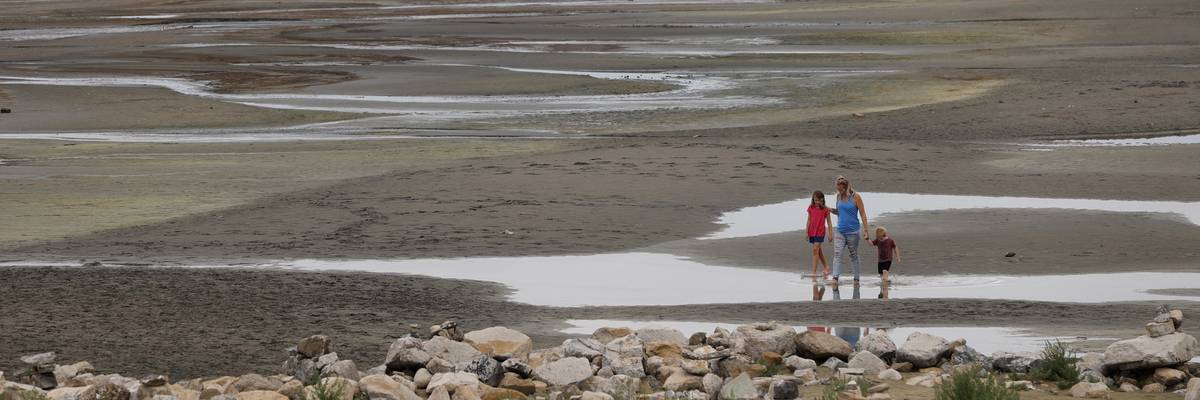
Park visitors walk along a section of the Great Salt Lake that used to be underwater at the Great Salt Lake State Park on August 2, 2021 near Magna, Utah. (Photo: Justin Sullivan/Getty Images)
"The lake's ecosystem is not only on the edge of collapse. It is collapsing," said one ecologist.
Scientists are warning Utah officials that the Great Salt Lake is shrinking far faster than experts previously believed, and calling for a major reduction in water consumption across the American West in order to prevent the lake from disappearing in the next five years.
Researchers at Brigham Young University (BYU) led more than 30 scientists from 11 universities and advocacy groups in a report released this week showing that the lake is currently at 37% of its former volume, with its rapid retreat driven by the historic drought that's continuing across the West.
Amid the climate crisis-fueled megadrought, the continued normal consumption of water in Utah and its neighboring states has led the Great Salt Lake to lose 40 billion gallons of water per year since 2020, reducing its surface level to 10 feet below what is considered the minimum safe level.
"Goodbye, Great Salt Lake," tweeted the Environmental Defense Fund on Friday.
Scientists previously have warned that increased average temperatures in Utah—where it is now about 4°F warmer than it was in the early 1900s—are to blame for a 9% reduction in the amount of water flowing into the lake from streams.
The authors of the BYU study are calling on Utah officials to authorize water releases from the state's reservoirs and cut water consumption by at least a third and as much as half to allow 2.5 million acre feet of water to reach the lake and prevent the collapse of its ecosystem as well as human exposure to dangerous sediments.
"This is a crisis," BYU ecologist Ben Abbott, a lead author of the report, told The Washington Post. "The ecosystem is on life support, [and] we need to have this emergency intervention to make sure it doesn't disappear."
The shrinking of the Great Salt Lake has already begun creating a new ecosystem that is toxic for the shrimp and flies that make it their habitat, due to the lack of freshwater flowing in. That has endangered millions of birds that stop at the lake as they migrate each year.
The loss of the lake may also already be exposing about 2.5 million people to sediments containing mercury, arsenic, and other toxins.
"Nanoparticles of dust have potential to cause just as much harm if they come from dry lake bed as from a tailpipe or a smokestack," Brian Moench, president of Utah Physicians for a Healthy Environment, told the Post. Last month, Moench's group applauded as Republican Gov. Spencer Cox's administration, under pressure from residents, walked back its position supporting a plan to allow a magnesium company to pump water from the Great Salt Lake.
Abbott called the rapid shrinking of the lake "honestly jaw-dropping."
"The lake's ecosystem is not only on the edge of collapse. It is collapsing," Abbott told CNN. "The lake is mostly lakebed right now."
Dear Common Dreams reader, It’s been nearly 30 years since I co-founded Common Dreams with my late wife, Lina Newhouser. We had the radical notion that journalism should serve the public good, not corporate profits. It was clear to us from the outset what it would take to build such a project. No paid advertisements. No corporate sponsors. No millionaire publisher telling us what to think or do. Many people said we wouldn't last a year, but we proved those doubters wrong. Together with a tremendous team of journalists and dedicated staff, we built an independent media outlet free from the constraints of profits and corporate control. Our mission has always been simple: To inform. To inspire. To ignite change for the common good. Building Common Dreams was not easy. Our survival was never guaranteed. When you take on the most powerful forces—Wall Street greed, fossil fuel industry destruction, Big Tech lobbyists, and uber-rich oligarchs who have spent billions upon billions rigging the economy and democracy in their favor—the only bulwark you have is supporters who believe in your work. But here’s the urgent message from me today. It's never been this bad out there. And it's never been this hard to keep us going. At the very moment Common Dreams is most needed, the threats we face are intensifying. We need your support now more than ever. We don't accept corporate advertising and never will. We don't have a paywall because we don't think people should be blocked from critical news based on their ability to pay. Everything we do is funded by the donations of readers like you. When everyone does the little they can afford, we are strong. But if that support retreats or dries up, so do we. Will you donate now to make sure Common Dreams not only survives but thrives? —Craig Brown, Co-founder |
Scientists are warning Utah officials that the Great Salt Lake is shrinking far faster than experts previously believed, and calling for a major reduction in water consumption across the American West in order to prevent the lake from disappearing in the next five years.
Researchers at Brigham Young University (BYU) led more than 30 scientists from 11 universities and advocacy groups in a report released this week showing that the lake is currently at 37% of its former volume, with its rapid retreat driven by the historic drought that's continuing across the West.
Amid the climate crisis-fueled megadrought, the continued normal consumption of water in Utah and its neighboring states has led the Great Salt Lake to lose 40 billion gallons of water per year since 2020, reducing its surface level to 10 feet below what is considered the minimum safe level.
"Goodbye, Great Salt Lake," tweeted the Environmental Defense Fund on Friday.
Scientists previously have warned that increased average temperatures in Utah—where it is now about 4°F warmer than it was in the early 1900s—are to blame for a 9% reduction in the amount of water flowing into the lake from streams.
The authors of the BYU study are calling on Utah officials to authorize water releases from the state's reservoirs and cut water consumption by at least a third and as much as half to allow 2.5 million acre feet of water to reach the lake and prevent the collapse of its ecosystem as well as human exposure to dangerous sediments.
"This is a crisis," BYU ecologist Ben Abbott, a lead author of the report, told The Washington Post. "The ecosystem is on life support, [and] we need to have this emergency intervention to make sure it doesn't disappear."
The shrinking of the Great Salt Lake has already begun creating a new ecosystem that is toxic for the shrimp and flies that make it their habitat, due to the lack of freshwater flowing in. That has endangered millions of birds that stop at the lake as they migrate each year.
The loss of the lake may also already be exposing about 2.5 million people to sediments containing mercury, arsenic, and other toxins.
"Nanoparticles of dust have potential to cause just as much harm if they come from dry lake bed as from a tailpipe or a smokestack," Brian Moench, president of Utah Physicians for a Healthy Environment, told the Post. Last month, Moench's group applauded as Republican Gov. Spencer Cox's administration, under pressure from residents, walked back its position supporting a plan to allow a magnesium company to pump water from the Great Salt Lake.
Abbott called the rapid shrinking of the lake "honestly jaw-dropping."
"The lake's ecosystem is not only on the edge of collapse. It is collapsing," Abbott told CNN. "The lake is mostly lakebed right now."
Scientists are warning Utah officials that the Great Salt Lake is shrinking far faster than experts previously believed, and calling for a major reduction in water consumption across the American West in order to prevent the lake from disappearing in the next five years.
Researchers at Brigham Young University (BYU) led more than 30 scientists from 11 universities and advocacy groups in a report released this week showing that the lake is currently at 37% of its former volume, with its rapid retreat driven by the historic drought that's continuing across the West.
Amid the climate crisis-fueled megadrought, the continued normal consumption of water in Utah and its neighboring states has led the Great Salt Lake to lose 40 billion gallons of water per year since 2020, reducing its surface level to 10 feet below what is considered the minimum safe level.
"Goodbye, Great Salt Lake," tweeted the Environmental Defense Fund on Friday.
Scientists previously have warned that increased average temperatures in Utah—where it is now about 4°F warmer than it was in the early 1900s—are to blame for a 9% reduction in the amount of water flowing into the lake from streams.
The authors of the BYU study are calling on Utah officials to authorize water releases from the state's reservoirs and cut water consumption by at least a third and as much as half to allow 2.5 million acre feet of water to reach the lake and prevent the collapse of its ecosystem as well as human exposure to dangerous sediments.
"This is a crisis," BYU ecologist Ben Abbott, a lead author of the report, told The Washington Post. "The ecosystem is on life support, [and] we need to have this emergency intervention to make sure it doesn't disappear."
The shrinking of the Great Salt Lake has already begun creating a new ecosystem that is toxic for the shrimp and flies that make it their habitat, due to the lack of freshwater flowing in. That has endangered millions of birds that stop at the lake as they migrate each year.
The loss of the lake may also already be exposing about 2.5 million people to sediments containing mercury, arsenic, and other toxins.
"Nanoparticles of dust have potential to cause just as much harm if they come from dry lake bed as from a tailpipe or a smokestack," Brian Moench, president of Utah Physicians for a Healthy Environment, told the Post. Last month, Moench's group applauded as Republican Gov. Spencer Cox's administration, under pressure from residents, walked back its position supporting a plan to allow a magnesium company to pump water from the Great Salt Lake.
Abbott called the rapid shrinking of the lake "honestly jaw-dropping."
"The lake's ecosystem is not only on the edge of collapse. It is collapsing," Abbott told CNN. "The lake is mostly lakebed right now."