SUBSCRIBE TO OUR FREE NEWSLETTER
Daily news & progressive opinion—funded by the people, not the corporations—delivered straight to your inbox.
5
#000000
#FFFFFF
To donate by check, phone, or other method, see our More Ways to Give page.
Daily news & progressive opinion—funded by the people, not the corporations—delivered straight to your inbox.
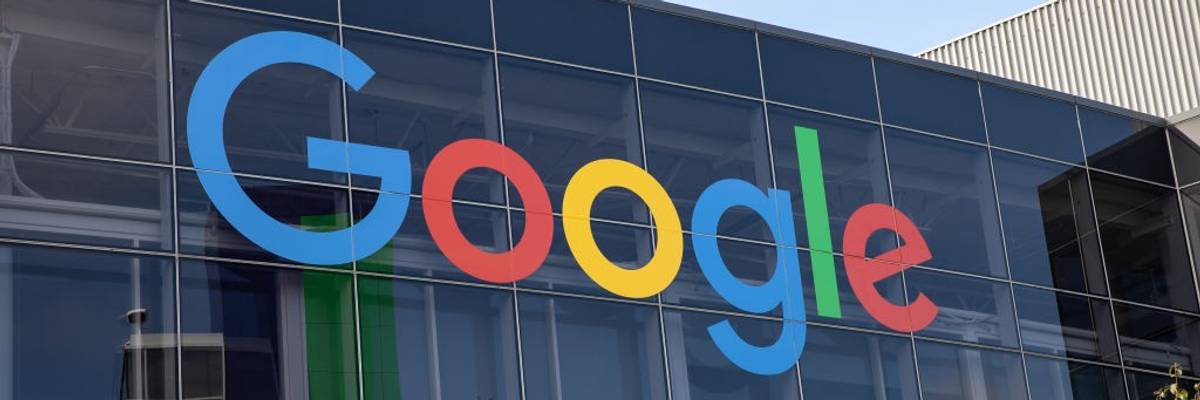
A photograph from September 2022 shows Google's headquarters in Mountain View, California.
Google's venture into nuclear-powered AI data centers follows Microsoft's push to reopen Three Mile Island to power its own.
Google announced on Monday that it had signed a deal to purchase energy from a set of yet-to-be-built small nuclear energy plants in order to power artificial intelligence.
Google signed a power-purchase agreement with Kairos Power, a California-based startup that will build four small modular reactors (SMRs) by 2035 for the Big Tech company's exclusive use.
AI data centers use astonishingly high levels of electricity, and Big Tech firms, which have made net-zero pledges, have recently been turning to nuclear power as a potentially carbon-free power source.
Though it doesn't emit greenhouse gases during operation, nuclear power comes with high risks and produces long-lasting radioactive waste; scientists and experts are divided on the wisdom of its use, and many environmental and justice-oriented groups are adamantly opposed.
Reinhard Uhrig, a climate and energy expert at WWF Austria, decried the new deal, arguing that renewable energies such as wind and solar are the best way to reduce emissions.
"This is BS, Google," Uhrig wrote on social media, citing an "unproven design."
This is BS @Google
Google goes #nuclear to power AI data centres, says "will see it start using the first reactor this decade"
->unproven design
->not approved by Nuclear Regulator
->and still needs to be built
proven: #renewables work to cut emissionshttps://t.co/FaMUG7Jj98
— Reinhard Uhrig (@reinharduhrig) October 15, 2024
The Google-Kairos deal calls for one 50-megawatt reactor to be online by 2030 and three more 75-megawatt reactors to be operational by 2035. That's far less than a typical conventional nuclear reactor, which produces about 1,000 megawatts of power.
The United States currently gets about 19% of its electricity from nuclear power. Tax credits included in the Inflation Reduction Act have spurred growth in the sector, with Big Tech showing a particular avarice for nuclear energy.
Last month, a deal was announced to reopen Three Mile Island to power Microsoft's AI data centers. Three Mile Island, which sits on the Susquehanna River in Pennsylvania, was the site of the worst nuclear disaster in U.S. history when a reactor partially melted down in 1979, for which final cleanup efforts are still ongoing. The plant shuttered in 2019 but, pending regulatory approvals, is scheduled to restart operations in 2028.
Renowned political activist Jane Fonda responded to news of the Three Mile Island reopening by declaring, in an op-ed in The Philadelphia Inquirer, that her "heart sank" and that nuclear is "not a good climate solution."
Google's nuclear play is more experimental than Microsoft's. There are only three operational SMRs in the world—the first opened in China in 2021—and none in North America. SMRs use molten fluoride salt as a coolant, rather than water.
Google and Kairos didn't release any financial details about the deal and the sites for the SMRs haven't been chosen yet. Kairos formed in 2016 with the backing of the U.S. Department of Energy. Google says the SMRs will provide "clean, round-the-clock" energy.
Google, which is owned by Alphabet, lost a major antitrust case in August and faces further federal scrutiny for acting as a monopoly.
Dear Common Dreams reader, It’s been nearly 30 years since I co-founded Common Dreams with my late wife, Lina Newhouser. We had the radical notion that journalism should serve the public good, not corporate profits. It was clear to us from the outset what it would take to build such a project. No paid advertisements. No corporate sponsors. No millionaire publisher telling us what to think or do. Many people said we wouldn't last a year, but we proved those doubters wrong. Together with a tremendous team of journalists and dedicated staff, we built an independent media outlet free from the constraints of profits and corporate control. Our mission has always been simple: To inform. To inspire. To ignite change for the common good. Building Common Dreams was not easy. Our survival was never guaranteed. When you take on the most powerful forces—Wall Street greed, fossil fuel industry destruction, Big Tech lobbyists, and uber-rich oligarchs who have spent billions upon billions rigging the economy and democracy in their favor—the only bulwark you have is supporters who believe in your work. But here’s the urgent message from me today. It's never been this bad out there. And it's never been this hard to keep us going. At the very moment Common Dreams is most needed, the threats we face are intensifying. We need your support now more than ever. We don't accept corporate advertising and never will. We don't have a paywall because we don't think people should be blocked from critical news based on their ability to pay. Everything we do is funded by the donations of readers like you. When everyone does the little they can afford, we are strong. But if that support retreats or dries up, so do we. Will you donate now to make sure Common Dreams not only survives but thrives? —Craig Brown, Co-founder |
Google announced on Monday that it had signed a deal to purchase energy from a set of yet-to-be-built small nuclear energy plants in order to power artificial intelligence.
Google signed a power-purchase agreement with Kairos Power, a California-based startup that will build four small modular reactors (SMRs) by 2035 for the Big Tech company's exclusive use.
AI data centers use astonishingly high levels of electricity, and Big Tech firms, which have made net-zero pledges, have recently been turning to nuclear power as a potentially carbon-free power source.
Though it doesn't emit greenhouse gases during operation, nuclear power comes with high risks and produces long-lasting radioactive waste; scientists and experts are divided on the wisdom of its use, and many environmental and justice-oriented groups are adamantly opposed.
Reinhard Uhrig, a climate and energy expert at WWF Austria, decried the new deal, arguing that renewable energies such as wind and solar are the best way to reduce emissions.
"This is BS, Google," Uhrig wrote on social media, citing an "unproven design."
This is BS @Google
Google goes #nuclear to power AI data centres, says "will see it start using the first reactor this decade"
->unproven design
->not approved by Nuclear Regulator
->and still needs to be built
proven: #renewables work to cut emissionshttps://t.co/FaMUG7Jj98
— Reinhard Uhrig (@reinharduhrig) October 15, 2024
The Google-Kairos deal calls for one 50-megawatt reactor to be online by 2030 and three more 75-megawatt reactors to be operational by 2035. That's far less than a typical conventional nuclear reactor, which produces about 1,000 megawatts of power.
The United States currently gets about 19% of its electricity from nuclear power. Tax credits included in the Inflation Reduction Act have spurred growth in the sector, with Big Tech showing a particular avarice for nuclear energy.
Last month, a deal was announced to reopen Three Mile Island to power Microsoft's AI data centers. Three Mile Island, which sits on the Susquehanna River in Pennsylvania, was the site of the worst nuclear disaster in U.S. history when a reactor partially melted down in 1979, for which final cleanup efforts are still ongoing. The plant shuttered in 2019 but, pending regulatory approvals, is scheduled to restart operations in 2028.
Renowned political activist Jane Fonda responded to news of the Three Mile Island reopening by declaring, in an op-ed in The Philadelphia Inquirer, that her "heart sank" and that nuclear is "not a good climate solution."
Google's nuclear play is more experimental than Microsoft's. There are only three operational SMRs in the world—the first opened in China in 2021—and none in North America. SMRs use molten fluoride salt as a coolant, rather than water.
Google and Kairos didn't release any financial details about the deal and the sites for the SMRs haven't been chosen yet. Kairos formed in 2016 with the backing of the U.S. Department of Energy. Google says the SMRs will provide "clean, round-the-clock" energy.
Google, which is owned by Alphabet, lost a major antitrust case in August and faces further federal scrutiny for acting as a monopoly.
Google announced on Monday that it had signed a deal to purchase energy from a set of yet-to-be-built small nuclear energy plants in order to power artificial intelligence.
Google signed a power-purchase agreement with Kairos Power, a California-based startup that will build four small modular reactors (SMRs) by 2035 for the Big Tech company's exclusive use.
AI data centers use astonishingly high levels of electricity, and Big Tech firms, which have made net-zero pledges, have recently been turning to nuclear power as a potentially carbon-free power source.
Though it doesn't emit greenhouse gases during operation, nuclear power comes with high risks and produces long-lasting radioactive waste; scientists and experts are divided on the wisdom of its use, and many environmental and justice-oriented groups are adamantly opposed.
Reinhard Uhrig, a climate and energy expert at WWF Austria, decried the new deal, arguing that renewable energies such as wind and solar are the best way to reduce emissions.
"This is BS, Google," Uhrig wrote on social media, citing an "unproven design."
This is BS @Google
Google goes #nuclear to power AI data centres, says "will see it start using the first reactor this decade"
->unproven design
->not approved by Nuclear Regulator
->and still needs to be built
proven: #renewables work to cut emissionshttps://t.co/FaMUG7Jj98
— Reinhard Uhrig (@reinharduhrig) October 15, 2024
The Google-Kairos deal calls for one 50-megawatt reactor to be online by 2030 and three more 75-megawatt reactors to be operational by 2035. That's far less than a typical conventional nuclear reactor, which produces about 1,000 megawatts of power.
The United States currently gets about 19% of its electricity from nuclear power. Tax credits included in the Inflation Reduction Act have spurred growth in the sector, with Big Tech showing a particular avarice for nuclear energy.
Last month, a deal was announced to reopen Three Mile Island to power Microsoft's AI data centers. Three Mile Island, which sits on the Susquehanna River in Pennsylvania, was the site of the worst nuclear disaster in U.S. history when a reactor partially melted down in 1979, for which final cleanup efforts are still ongoing. The plant shuttered in 2019 but, pending regulatory approvals, is scheduled to restart operations in 2028.
Renowned political activist Jane Fonda responded to news of the Three Mile Island reopening by declaring, in an op-ed in The Philadelphia Inquirer, that her "heart sank" and that nuclear is "not a good climate solution."
Google's nuclear play is more experimental than Microsoft's. There are only three operational SMRs in the world—the first opened in China in 2021—and none in North America. SMRs use molten fluoride salt as a coolant, rather than water.
Google and Kairos didn't release any financial details about the deal and the sites for the SMRs haven't been chosen yet. Kairos formed in 2016 with the backing of the U.S. Department of Energy. Google says the SMRs will provide "clean, round-the-clock" energy.
Google, which is owned by Alphabet, lost a major antitrust case in August and faces further federal scrutiny for acting as a monopoly.