SUBSCRIBE TO OUR FREE NEWSLETTER
Daily news & progressive opinion—funded by the people, not the corporations—delivered straight to your inbox.
5
#000000
#FFFFFF
To donate by check, phone, or other method, see our More Ways to Give page.
Daily news & progressive opinion—funded by the people, not the corporations—delivered straight to your inbox.
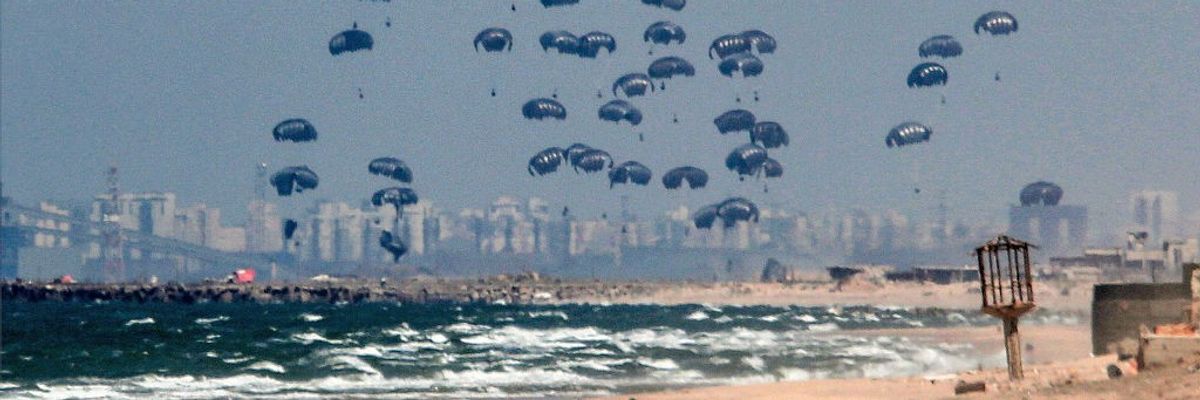
Airdropped humanitarian aid parcels float down on parachutes toward a beach near Gaza City on March 25, 2024.
One campaigner called the incident "another deadly example of why airdrops are not the answer to famine in Gaza."
Human rights defenders on Tuesday pointed to the drowning deaths of 12 Palestinians trying to retrieve humanitarian aid parcels airdropped off the Gaza shore as yet another reason why Israel must stop blocking aid from entering the embattled strip by land.
Video published on social media shows Palestinians running toward the Mediterranean Sea in Beit Lahia as aid parcels parachute downward. Eyewitness Abu Mohammad told CNN that the people who drowned "don't know how to swim."
"There were strong currents and all the parachutes fell in the water," Mohammad said. "People want to eat and are hungry. I haven't been able to receive anything."
Ramy Abdu, chair of the Geneva-based group Euro-Mediterranean Human Rights Monitor, said that some of the victims died after becoming entangled in parachute ropes.
BREAKING| 9 Palestinians drowned and 5 others missing in the Sea of Gaza while trying to get humanitarian airdrop aid due to falling into the sea. pic.twitter.com/tSPpbrKsTg
— PALESTINE ONLINE 🇵🇸 (@OnlinePalEng) March 26, 2024
According to the U.S. military—which along with Jordan, the United Arab Emirates, Egypt, Germany, the United Kingdom, and Singapore has been airdropping aid into Gaza—parachute malfunctions caused three of the 80 parcels dropped to land in the sea. The Pentagon did not say which country carried out the drop.
Earlier this month, five children were crushed to death and numerous other Palestinians were injured by U.S.-airdropped parcels on which the parachutes apparently malfunctioned.
The airdrops come amid widespread and increasingly deadly starvation in Gaza, where Israeli forces have been accused of using hunger as a weapon of war. Last month, Michael Fakhri, the United Nations special rapporteur on the right to food, called Israel's forced starvation of Gazans part of "a situation of genocide" in the besieged enclave, where more than 114,000 Palestinians have been killed or wounded by Israeli forces since October 7 and around 2 million people out of a population of 2.3 million have been forcibly displaced.
While Israel claims there are no limits on aid entering Gaza by land, Israeli officials said Monday that United Nations Relief and Works Agency for Palestine Refugees in the Near East trucks would be blocked from entering northern Gaza. Israeli forces have repeatedly attacked aid convoys and their police escorts, forcing UNRWA to suspend humanitarian deliveries.
Israeli forces have also on several occasions attacked starving Palestinians as they desperately attempt to get food for their families, including in the February 29 "
Flour Massacre" that left more than 870 Gazans dead or wounded.
Also blocking humanitarian aid from reaching starving Palestinians are Israeli civilians who have camped at border crossings to prevent convoys from entering Gaza. Last month, right-wing extremists set up a giant inflatable children's bouncy castle where aid trucks are meant to pass through the Kerem Shalom border crossing in an effort to lend a festive atmosphere to the action.
Medical Aid for Palestinians, a London-based humanitarian group, said Tuesday that "airdrops will not end famine and are a dangerous proposed 'solution.'"
Palestinians in Gaza expressed similar sentiments.
"We call for the opening of the crossings in a proper fashion," Mohammad told CNN, "but these humiliating methods are not acceptable."
Dear Common Dreams reader, It’s been nearly 30 years since I co-founded Common Dreams with my late wife, Lina Newhouser. We had the radical notion that journalism should serve the public good, not corporate profits. It was clear to us from the outset what it would take to build such a project. No paid advertisements. No corporate sponsors. No millionaire publisher telling us what to think or do. Many people said we wouldn't last a year, but we proved those doubters wrong. Together with a tremendous team of journalists and dedicated staff, we built an independent media outlet free from the constraints of profits and corporate control. Our mission has always been simple: To inform. To inspire. To ignite change for the common good. Building Common Dreams was not easy. Our survival was never guaranteed. When you take on the most powerful forces—Wall Street greed, fossil fuel industry destruction, Big Tech lobbyists, and uber-rich oligarchs who have spent billions upon billions rigging the economy and democracy in their favor—the only bulwark you have is supporters who believe in your work. But here’s the urgent message from me today. It's never been this bad out there. And it's never been this hard to keep us going. At the very moment Common Dreams is most needed, the threats we face are intensifying. We need your support now more than ever. We don't accept corporate advertising and never will. We don't have a paywall because we don't think people should be blocked from critical news based on their ability to pay. Everything we do is funded by the donations of readers like you. When everyone does the little they can afford, we are strong. But if that support retreats or dries up, so do we. Will you donate now to make sure Common Dreams not only survives but thrives? —Craig Brown, Co-founder |
Human rights defenders on Tuesday pointed to the drowning deaths of 12 Palestinians trying to retrieve humanitarian aid parcels airdropped off the Gaza shore as yet another reason why Israel must stop blocking aid from entering the embattled strip by land.
Video published on social media shows Palestinians running toward the Mediterranean Sea in Beit Lahia as aid parcels parachute downward. Eyewitness Abu Mohammad told CNN that the people who drowned "don't know how to swim."
"There were strong currents and all the parachutes fell in the water," Mohammad said. "People want to eat and are hungry. I haven't been able to receive anything."
Ramy Abdu, chair of the Geneva-based group Euro-Mediterranean Human Rights Monitor, said that some of the victims died after becoming entangled in parachute ropes.
BREAKING| 9 Palestinians drowned and 5 others missing in the Sea of Gaza while trying to get humanitarian airdrop aid due to falling into the sea. pic.twitter.com/tSPpbrKsTg
— PALESTINE ONLINE 🇵🇸 (@OnlinePalEng) March 26, 2024
According to the U.S. military—which along with Jordan, the United Arab Emirates, Egypt, Germany, the United Kingdom, and Singapore has been airdropping aid into Gaza—parachute malfunctions caused three of the 80 parcels dropped to land in the sea. The Pentagon did not say which country carried out the drop.
Earlier this month, five children were crushed to death and numerous other Palestinians were injured by U.S.-airdropped parcels on which the parachutes apparently malfunctioned.
The airdrops come amid widespread and increasingly deadly starvation in Gaza, where Israeli forces have been accused of using hunger as a weapon of war. Last month, Michael Fakhri, the United Nations special rapporteur on the right to food, called Israel's forced starvation of Gazans part of "a situation of genocide" in the besieged enclave, where more than 114,000 Palestinians have been killed or wounded by Israeli forces since October 7 and around 2 million people out of a population of 2.3 million have been forcibly displaced.
While Israel claims there are no limits on aid entering Gaza by land, Israeli officials said Monday that United Nations Relief and Works Agency for Palestine Refugees in the Near East trucks would be blocked from entering northern Gaza. Israeli forces have repeatedly attacked aid convoys and their police escorts, forcing UNRWA to suspend humanitarian deliveries.
Israeli forces have also on several occasions attacked starving Palestinians as they desperately attempt to get food for their families, including in the February 29 "
Flour Massacre" that left more than 870 Gazans dead or wounded.
Also blocking humanitarian aid from reaching starving Palestinians are Israeli civilians who have camped at border crossings to prevent convoys from entering Gaza. Last month, right-wing extremists set up a giant inflatable children's bouncy castle where aid trucks are meant to pass through the Kerem Shalom border crossing in an effort to lend a festive atmosphere to the action.
Medical Aid for Palestinians, a London-based humanitarian group, said Tuesday that "airdrops will not end famine and are a dangerous proposed 'solution.'"
Palestinians in Gaza expressed similar sentiments.
"We call for the opening of the crossings in a proper fashion," Mohammad told CNN, "but these humiliating methods are not acceptable."
Human rights defenders on Tuesday pointed to the drowning deaths of 12 Palestinians trying to retrieve humanitarian aid parcels airdropped off the Gaza shore as yet another reason why Israel must stop blocking aid from entering the embattled strip by land.
Video published on social media shows Palestinians running toward the Mediterranean Sea in Beit Lahia as aid parcels parachute downward. Eyewitness Abu Mohammad told CNN that the people who drowned "don't know how to swim."
"There were strong currents and all the parachutes fell in the water," Mohammad said. "People want to eat and are hungry. I haven't been able to receive anything."
Ramy Abdu, chair of the Geneva-based group Euro-Mediterranean Human Rights Monitor, said that some of the victims died after becoming entangled in parachute ropes.
BREAKING| 9 Palestinians drowned and 5 others missing in the Sea of Gaza while trying to get humanitarian airdrop aid due to falling into the sea. pic.twitter.com/tSPpbrKsTg
— PALESTINE ONLINE 🇵🇸 (@OnlinePalEng) March 26, 2024
According to the U.S. military—which along with Jordan, the United Arab Emirates, Egypt, Germany, the United Kingdom, and Singapore has been airdropping aid into Gaza—parachute malfunctions caused three of the 80 parcels dropped to land in the sea. The Pentagon did not say which country carried out the drop.
Earlier this month, five children were crushed to death and numerous other Palestinians were injured by U.S.-airdropped parcels on which the parachutes apparently malfunctioned.
The airdrops come amid widespread and increasingly deadly starvation in Gaza, where Israeli forces have been accused of using hunger as a weapon of war. Last month, Michael Fakhri, the United Nations special rapporteur on the right to food, called Israel's forced starvation of Gazans part of "a situation of genocide" in the besieged enclave, where more than 114,000 Palestinians have been killed or wounded by Israeli forces since October 7 and around 2 million people out of a population of 2.3 million have been forcibly displaced.
While Israel claims there are no limits on aid entering Gaza by land, Israeli officials said Monday that United Nations Relief and Works Agency for Palestine Refugees in the Near East trucks would be blocked from entering northern Gaza. Israeli forces have repeatedly attacked aid convoys and their police escorts, forcing UNRWA to suspend humanitarian deliveries.
Israeli forces have also on several occasions attacked starving Palestinians as they desperately attempt to get food for their families, including in the February 29 "
Flour Massacre" that left more than 870 Gazans dead or wounded.
Also blocking humanitarian aid from reaching starving Palestinians are Israeli civilians who have camped at border crossings to prevent convoys from entering Gaza. Last month, right-wing extremists set up a giant inflatable children's bouncy castle where aid trucks are meant to pass through the Kerem Shalom border crossing in an effort to lend a festive atmosphere to the action.
Medical Aid for Palestinians, a London-based humanitarian group, said Tuesday that "airdrops will not end famine and are a dangerous proposed 'solution.'"
Palestinians in Gaza expressed similar sentiments.
"We call for the opening of the crossings in a proper fashion," Mohammad told CNN, "but these humiliating methods are not acceptable."