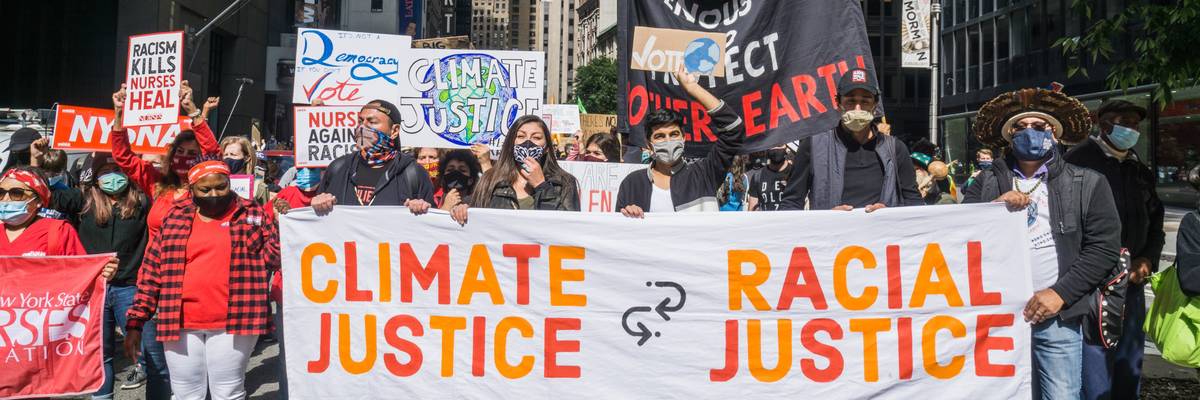
Climate and racial justice activists march in New York City on September 20, 2020.
Grassroots-Run Fund for Frontline Power Pours $5 Million Into US Climate Justice Groups
"That is how solidarity philanthropy works—we show up for each other," said one campaigner.
A grassroots climate justice fund on Monday announced its inaugural slate of grants totaling more than $5 million for 48 organizations working to tackle the worsening planetary emergency, while calling on "big green groups" to redirect investment to frontline climate initiatives.
The Fund for Frontline Power (F4FP) supports "community-based, equitable climate solutions that cut greenhouse gas emissions, facilitate resilience, strengthen local regenerative economies, and build power on the frontlines of the climate crisis."
More than 400 climate justice groups have applied for F4FP grants totaling over $60 million since the program's launch.
According to F4FP:
The Fund for Frontline Power is a leading example of "solidarity philanthropy" in action. Traditional philanthropy revolves around donors rather than recipients, imposing potential solutions from outside, and putting recipients in the position of having to "prove" that they are worthy of funding. In contrast, solidarity philanthropy centers leaders from impacted communities as experts and decision-makers—honoring their lived experience, following their lead, and trusting that they know best what their own communities need.
In order for a group to qualify for F4FP funding, it must:
- Have majority Black, Indigenous, or people of color (BIPOC) leadership among staff and board members;
- Be grassroots-based and prioritize serving BIPOC communities;
- Be a 501(c)(3) organization or sponsored by one;
- Demonstrate community work and partnerships; and
- Have a maximum annual budget not exceeding $1.5 million.
"We put meeting the needs of our fellow frontline communities at the heart of every decision we made—from designing the grantmaking process to selecting grantees," F4FP governing body member Julia Ho, founder of Solidarity Economy St. Louis and co-founder of STL Mutual Aid, said in a statement marking the $5 million milestone.
"The communities and places represented are only a small sample of the power and wisdom across frontline communities, and so are the impactful climate justice projects we are honored to fund," Ho added. "It was exciting to collaborate with fellow frontline leaders and learn about the wide range of innovative climate solutions envisioned and led by frontline communities."
Antonio Diaz, a director at People Organizing to Demand Environmental & Economic Rights (PODER) in San Francisco, said that "those of us serving on the governing body know from firsthand experience that smaller, community-based organizations are successfully working at the intersection of climate justice and racial justice to create equitable, practical climate solutions that are ready for immediate investment."
"Our solutions are grounded in justice, equity, sustainability, and systemic change," Diaz added.
Oscar Londoño, co-executive director of F4FP recipient WeCount!, a South Florida workers' campaign that helped win the nation's first countywide heat standard for outdoor workers, said that "in Miami-Dade County, we average 41 days per year with a heat index over 100."
"Our solutions are grounded in justice, equity, sustainability, and systemic change."
"But in a couple of decades, scientists say we'll have 141 days a year with a heat index over 100. That's a tremendous increase in risk for a state that already leads the nation in heat-related hospitalizations," Londoño added. "Our work will focus on ensuring that the food on our tables, the plants in our homes, and the buildings in our cities won't come at the cost of workers' health or lives."
Marion Gee, co-executive director of the Climate Justice Alliance—which supports the F4FP on fundraising and communications—called on "big green groups that received grants from the Bezos Earth Fund to redirect a portion of their funds to a pooled Fund for Frontline Power designed to move funding to powerful, yet under-resourced, frontline organizations."
Bezos Earth Fund is a $10 billion grant launched by multibillionaire Amazon.com founder Jeff Bezos that bills itself as "the largest philanthropic commitment ever to fight climate change and protect nature."
Seven Bezos Earth Fund recipients have contributed to F4FP: the Hive Fund for Climate & Gender Justice, ClimateWorks Foundation, Building Equity & Alignment for Environmental Justice, the Union of Concerned Scientists, Rocky Mountain Institute, the Natural Resources Defense Council, and the Solutions Project.
"That is how solidarity philanthropy works—we show up for each other," said Gloria Walton, who leads the Solutions Project. "Philanthropy needs to move in unity with the movements we support, and rapidly scale up our support while building greater trust through transparency and accountability."
We are at a crossroads
This country and this world are at a monumental crossroads. In a few short weeks, US voters will have an opportunity to beat back the forces of fascism and confront the billionaires who are rigging the economy, our media system, and our democracy, making it increasingly impossible for ordinary people to get by. We’re not just talking about the election. We’re talking about what must be done once these fascist elements are vanquished from power. We need a bolder set of solutions than what either major party has so far been willing to offer and a working-class movement ready to fight like hell for it. Trump didn't emerge from nowhere. The conditions that fueled MAGA authoritarianism were created by decades of radical neoliberal economic policies and a corrupt political system dominated by corporate interests. They slashed taxes on the super-rich, promising that the benefits would trickle down. They said giveaways to the corporate titans would make life more affordable for the rest of us. It was all bullshit. And when a bitter, betrayed populace searches for someone to blame, right-wing demagogues have little trouble finding scapegoats. People know when they're being lied to, but you won't hear any of this from the corporate media. Only independent journalism—powered and funded by people who believe in building a better world—can deliver truly trustworthy daily news. Our Fall Campaign is underway, and we need your help. To power our newsroom through the rest of the year, we need to raise $125,000 by midnight on October 31. So if you share our vision, please contribute whatever you can to sustain our work. |
A grassroots climate justice fund on Monday announced its inaugural slate of grants totaling more than $5 million for 48 organizations working to tackle the worsening planetary emergency, while calling on "big green groups" to redirect investment to frontline climate initiatives.
The Fund for Frontline Power (F4FP) supports "community-based, equitable climate solutions that cut greenhouse gas emissions, facilitate resilience, strengthen local regenerative economies, and build power on the frontlines of the climate crisis."
More than 400 climate justice groups have applied for F4FP grants totaling over $60 million since the program's launch.
According to F4FP:
The Fund for Frontline Power is a leading example of "solidarity philanthropy" in action. Traditional philanthropy revolves around donors rather than recipients, imposing potential solutions from outside, and putting recipients in the position of having to "prove" that they are worthy of funding. In contrast, solidarity philanthropy centers leaders from impacted communities as experts and decision-makers—honoring their lived experience, following their lead, and trusting that they know best what their own communities need.
In order for a group to qualify for F4FP funding, it must:
- Have majority Black, Indigenous, or people of color (BIPOC) leadership among staff and board members;
- Be grassroots-based and prioritize serving BIPOC communities;
- Be a 501(c)(3) organization or sponsored by one;
- Demonstrate community work and partnerships; and
- Have a maximum annual budget not exceeding $1.5 million.
"We put meeting the needs of our fellow frontline communities at the heart of every decision we made—from designing the grantmaking process to selecting grantees," F4FP governing body member Julia Ho, founder of Solidarity Economy St. Louis and co-founder of STL Mutual Aid, said in a statement marking the $5 million milestone.
"The communities and places represented are only a small sample of the power and wisdom across frontline communities, and so are the impactful climate justice projects we are honored to fund," Ho added. "It was exciting to collaborate with fellow frontline leaders and learn about the wide range of innovative climate solutions envisioned and led by frontline communities."
Antonio Diaz, a director at People Organizing to Demand Environmental & Economic Rights (PODER) in San Francisco, said that "those of us serving on the governing body know from firsthand experience that smaller, community-based organizations are successfully working at the intersection of climate justice and racial justice to create equitable, practical climate solutions that are ready for immediate investment."
"Our solutions are grounded in justice, equity, sustainability, and systemic change," Diaz added.
Oscar Londoño, co-executive director of F4FP recipient WeCount!, a South Florida workers' campaign that helped win the nation's first countywide heat standard for outdoor workers, said that "in Miami-Dade County, we average 41 days per year with a heat index over 100."
"Our solutions are grounded in justice, equity, sustainability, and systemic change."
"But in a couple of decades, scientists say we'll have 141 days a year with a heat index over 100. That's a tremendous increase in risk for a state that already leads the nation in heat-related hospitalizations," Londoño added. "Our work will focus on ensuring that the food on our tables, the plants in our homes, and the buildings in our cities won't come at the cost of workers' health or lives."
Marion Gee, co-executive director of the Climate Justice Alliance—which supports the F4FP on fundraising and communications—called on "big green groups that received grants from the Bezos Earth Fund to redirect a portion of their funds to a pooled Fund for Frontline Power designed to move funding to powerful, yet under-resourced, frontline organizations."
Bezos Earth Fund is a $10 billion grant launched by multibillionaire Amazon.com founder Jeff Bezos that bills itself as "the largest philanthropic commitment ever to fight climate change and protect nature."
Seven Bezos Earth Fund recipients have contributed to F4FP: the Hive Fund for Climate & Gender Justice, ClimateWorks Foundation, Building Equity & Alignment for Environmental Justice, the Union of Concerned Scientists, Rocky Mountain Institute, the Natural Resources Defense Council, and the Solutions Project.
"That is how solidarity philanthropy works—we show up for each other," said Gloria Walton, who leads the Solutions Project. "Philanthropy needs to move in unity with the movements we support, and rapidly scale up our support while building greater trust through transparency and accountability."
A grassroots climate justice fund on Monday announced its inaugural slate of grants totaling more than $5 million for 48 organizations working to tackle the worsening planetary emergency, while calling on "big green groups" to redirect investment to frontline climate initiatives.
The Fund for Frontline Power (F4FP) supports "community-based, equitable climate solutions that cut greenhouse gas emissions, facilitate resilience, strengthen local regenerative economies, and build power on the frontlines of the climate crisis."
More than 400 climate justice groups have applied for F4FP grants totaling over $60 million since the program's launch.
According to F4FP:
The Fund for Frontline Power is a leading example of "solidarity philanthropy" in action. Traditional philanthropy revolves around donors rather than recipients, imposing potential solutions from outside, and putting recipients in the position of having to "prove" that they are worthy of funding. In contrast, solidarity philanthropy centers leaders from impacted communities as experts and decision-makers—honoring their lived experience, following their lead, and trusting that they know best what their own communities need.
In order for a group to qualify for F4FP funding, it must:
- Have majority Black, Indigenous, or people of color (BIPOC) leadership among staff and board members;
- Be grassroots-based and prioritize serving BIPOC communities;
- Be a 501(c)(3) organization or sponsored by one;
- Demonstrate community work and partnerships; and
- Have a maximum annual budget not exceeding $1.5 million.
"We put meeting the needs of our fellow frontline communities at the heart of every decision we made—from designing the grantmaking process to selecting grantees," F4FP governing body member Julia Ho, founder of Solidarity Economy St. Louis and co-founder of STL Mutual Aid, said in a statement marking the $5 million milestone.
"The communities and places represented are only a small sample of the power and wisdom across frontline communities, and so are the impactful climate justice projects we are honored to fund," Ho added. "It was exciting to collaborate with fellow frontline leaders and learn about the wide range of innovative climate solutions envisioned and led by frontline communities."
Antonio Diaz, a director at People Organizing to Demand Environmental & Economic Rights (PODER) in San Francisco, said that "those of us serving on the governing body know from firsthand experience that smaller, community-based organizations are successfully working at the intersection of climate justice and racial justice to create equitable, practical climate solutions that are ready for immediate investment."
"Our solutions are grounded in justice, equity, sustainability, and systemic change," Diaz added.
Oscar Londoño, co-executive director of F4FP recipient WeCount!, a South Florida workers' campaign that helped win the nation's first countywide heat standard for outdoor workers, said that "in Miami-Dade County, we average 41 days per year with a heat index over 100."
"Our solutions are grounded in justice, equity, sustainability, and systemic change."
"But in a couple of decades, scientists say we'll have 141 days a year with a heat index over 100. That's a tremendous increase in risk for a state that already leads the nation in heat-related hospitalizations," Londoño added. "Our work will focus on ensuring that the food on our tables, the plants in our homes, and the buildings in our cities won't come at the cost of workers' health or lives."
Marion Gee, co-executive director of the Climate Justice Alliance—which supports the F4FP on fundraising and communications—called on "big green groups that received grants from the Bezos Earth Fund to redirect a portion of their funds to a pooled Fund for Frontline Power designed to move funding to powerful, yet under-resourced, frontline organizations."
Bezos Earth Fund is a $10 billion grant launched by multibillionaire Amazon.com founder Jeff Bezos that bills itself as "the largest philanthropic commitment ever to fight climate change and protect nature."
Seven Bezos Earth Fund recipients have contributed to F4FP: the Hive Fund for Climate & Gender Justice, ClimateWorks Foundation, Building Equity & Alignment for Environmental Justice, the Union of Concerned Scientists, Rocky Mountain Institute, the Natural Resources Defense Council, and the Solutions Project.
"That is how solidarity philanthropy works—we show up for each other," said Gloria Walton, who leads the Solutions Project. "Philanthropy needs to move in unity with the movements we support, and rapidly scale up our support while building greater trust through transparency and accountability."