
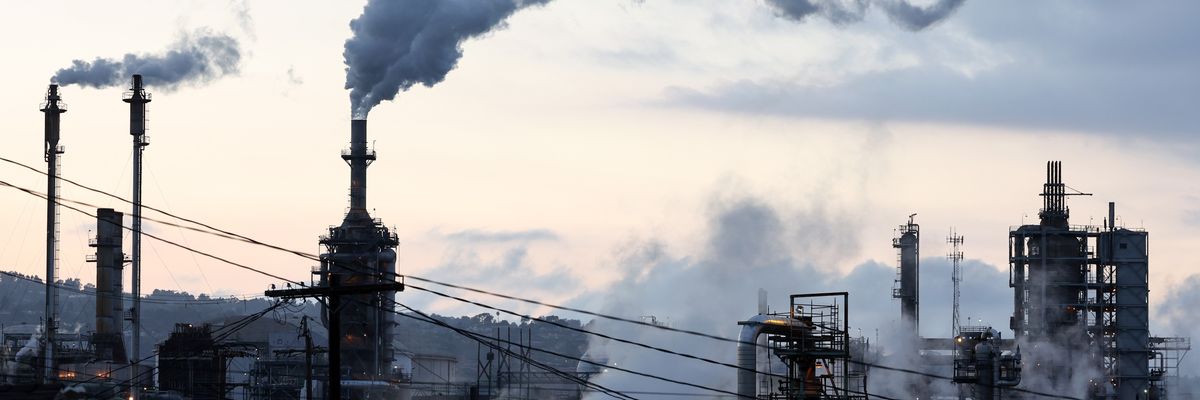
A Phillips 66 refinery stands beyond a residential street on November 28, 2022 in Wilmington, California.
Fossil Fuels Made Up 82% of Global Energy Consumption in 2022: New Data
"2022 saw some of the worst-ever impacts of climate change," said one expert, "yet we have to look hard for positive news on the energy transition."
Data published Monday shows that fossil fuels made up 82% of global energy consumption in 2022, another indication that the global transition away from planet-warming sources is moving far too slowly as rich nations continue burning oil, gas, and coal at an unsustainable pace.
The figures released by the Energy Institute show that because of the persistent "dominance of fossil fuels," global emissions from the energy sector grew 0.8% last year even as renewable energy consumption increased by 13%.
Juliet Davenport, president of the Energy Institute, said in a statement that “2022 saw some of the worst ever impacts of climate change—the devastating floods affecting millions in Pakistan, the record heat events across Europe and North America—yet we have to look hard for positive news on the energy transition in this new data."
“Despite further strong growth in wind and solar in the power sector, overall global energy-related greenhouse gas emissions increased again," said Davenport. "We are still heading in the opposite direction to that required by the Paris Agreement."
The new data was released days after a climate finance summit hosted by French President Emmanuel Macron ended without major action to relieve the debt burdens of poor frontline nations and force the fossil fuel industry to pay for the damage it has inflicted worldwide.
That conference was held months ahead of the critical COP28 summit in the United Arab Emirates, which will be overseen by the head of the country's national oil giant. Despite research indicating that wealthy countries—the primary drivers of global emissions—must end oil and gas production entirely by 2034 to keep warming within critical limits, nations have not even agreed to put a fossil fuel phaseout on the COP28 agenda.
Meanwhile, according to the new Energy Institute data, oil consumption continued to increase in 2022—up 2.9 million barrels per day compared to last year—and global coal use rose to its highest level since 2014.
"Despite record growth in renewables, the share of world energy still coming from fossil fuels remains stubbornly stuck at 82%."
There are some bright spots in the Statistical Review of World Energy, formerly a project of the oil giant BP. The Energy Institute, which released the latest version of the analysis in collaboration with KPMG and Kearney, noted that "2022 saw the largest-ever increase in wind and solar new build capacity."
"Together they reached a record 12% share of power generation," the analysis found, "with solar up 25% and wind up 13.5%. Renewables (excluding hydro) met 84% of net electricity demand growth in 2022."
But KPMG's Simon Virley said that "despite record growth in renewables, the share of world energy still coming from fossil fuels remains stubbornly stuck at 82%, which should act as a clarion call for governments to inject more urgency into the energy transition."
Climate scientist Bill McGuire echoed that concern on Twitter, writing that the "huge increase in renewables is being overwhelmed by growth in energy consumption."
"Climate armageddon here we come," McGuire wrote.
We are at a crossroads
This country and this world are at a monumental crossroads. In a few short weeks, US voters will have an opportunity to beat back the forces of fascism and confront the billionaires who are rigging the economy, our media system, and our democracy, making it increasingly impossible for ordinary people to get by. We’re not just talking about the election. We’re talking about what must be done once these fascist elements are vanquished from power. We need a bolder set of solutions than what either major party has so far been willing to offer and a working-class movement ready to fight like hell for it. Trump didn't emerge from nowhere. The conditions that fueled MAGA authoritarianism were created by decades of radical neoliberal economic policies and a corrupt political system dominated by corporate interests. They slashed taxes on the super-rich, promising that the benefits would trickle down. They said giveaways to the corporate titans would make life more affordable for the rest of us. It was all bullshit. And when a bitter, betrayed populace searches for someone to blame, right-wing demagogues have little trouble finding scapegoats. People know when they're being lied to, but you won't hear any of this from the corporate media. Only independent journalism—powered and funded by people who believe in building a better world—can deliver truly trustworthy daily news. Our Fall Campaign is underway, and we need your help. To power our newsroom through the rest of the year, we need to raise $125,000 by midnight on October 31. So if you share our vision, please contribute whatever you can to sustain our work. |
Data published Monday shows that fossil fuels made up 82% of global energy consumption in 2022, another indication that the global transition away from planet-warming sources is moving far too slowly as rich nations continue burning oil, gas, and coal at an unsustainable pace.
The figures released by the Energy Institute show that because of the persistent "dominance of fossil fuels," global emissions from the energy sector grew 0.8% last year even as renewable energy consumption increased by 13%.
Juliet Davenport, president of the Energy Institute, said in a statement that “2022 saw some of the worst ever impacts of climate change—the devastating floods affecting millions in Pakistan, the record heat events across Europe and North America—yet we have to look hard for positive news on the energy transition in this new data."
“Despite further strong growth in wind and solar in the power sector, overall global energy-related greenhouse gas emissions increased again," said Davenport. "We are still heading in the opposite direction to that required by the Paris Agreement."
The new data was released days after a climate finance summit hosted by French President Emmanuel Macron ended without major action to relieve the debt burdens of poor frontline nations and force the fossil fuel industry to pay for the damage it has inflicted worldwide.
That conference was held months ahead of the critical COP28 summit in the United Arab Emirates, which will be overseen by the head of the country's national oil giant. Despite research indicating that wealthy countries—the primary drivers of global emissions—must end oil and gas production entirely by 2034 to keep warming within critical limits, nations have not even agreed to put a fossil fuel phaseout on the COP28 agenda.
Meanwhile, according to the new Energy Institute data, oil consumption continued to increase in 2022—up 2.9 million barrels per day compared to last year—and global coal use rose to its highest level since 2014.
"Despite record growth in renewables, the share of world energy still coming from fossil fuels remains stubbornly stuck at 82%."
There are some bright spots in the Statistical Review of World Energy, formerly a project of the oil giant BP. The Energy Institute, which released the latest version of the analysis in collaboration with KPMG and Kearney, noted that "2022 saw the largest-ever increase in wind and solar new build capacity."
"Together they reached a record 12% share of power generation," the analysis found, "with solar up 25% and wind up 13.5%. Renewables (excluding hydro) met 84% of net electricity demand growth in 2022."
But KPMG's Simon Virley said that "despite record growth in renewables, the share of world energy still coming from fossil fuels remains stubbornly stuck at 82%, which should act as a clarion call for governments to inject more urgency into the energy transition."
Climate scientist Bill McGuire echoed that concern on Twitter, writing that the "huge increase in renewables is being overwhelmed by growth in energy consumption."
"Climate armageddon here we come," McGuire wrote.
Data published Monday shows that fossil fuels made up 82% of global energy consumption in 2022, another indication that the global transition away from planet-warming sources is moving far too slowly as rich nations continue burning oil, gas, and coal at an unsustainable pace.
The figures released by the Energy Institute show that because of the persistent "dominance of fossil fuels," global emissions from the energy sector grew 0.8% last year even as renewable energy consumption increased by 13%.
Juliet Davenport, president of the Energy Institute, said in a statement that “2022 saw some of the worst ever impacts of climate change—the devastating floods affecting millions in Pakistan, the record heat events across Europe and North America—yet we have to look hard for positive news on the energy transition in this new data."
“Despite further strong growth in wind and solar in the power sector, overall global energy-related greenhouse gas emissions increased again," said Davenport. "We are still heading in the opposite direction to that required by the Paris Agreement."
The new data was released days after a climate finance summit hosted by French President Emmanuel Macron ended without major action to relieve the debt burdens of poor frontline nations and force the fossil fuel industry to pay for the damage it has inflicted worldwide.
That conference was held months ahead of the critical COP28 summit in the United Arab Emirates, which will be overseen by the head of the country's national oil giant. Despite research indicating that wealthy countries—the primary drivers of global emissions—must end oil and gas production entirely by 2034 to keep warming within critical limits, nations have not even agreed to put a fossil fuel phaseout on the COP28 agenda.
Meanwhile, according to the new Energy Institute data, oil consumption continued to increase in 2022—up 2.9 million barrels per day compared to last year—and global coal use rose to its highest level since 2014.
"Despite record growth in renewables, the share of world energy still coming from fossil fuels remains stubbornly stuck at 82%."
There are some bright spots in the Statistical Review of World Energy, formerly a project of the oil giant BP. The Energy Institute, which released the latest version of the analysis in collaboration with KPMG and Kearney, noted that "2022 saw the largest-ever increase in wind and solar new build capacity."
"Together they reached a record 12% share of power generation," the analysis found, "with solar up 25% and wind up 13.5%. Renewables (excluding hydro) met 84% of net electricity demand growth in 2022."
But KPMG's Simon Virley said that "despite record growth in renewables, the share of world energy still coming from fossil fuels remains stubbornly stuck at 82%, which should act as a clarion call for governments to inject more urgency into the energy transition."
Climate scientist Bill McGuire echoed that concern on Twitter, writing that the "huge increase in renewables is being overwhelmed by growth in energy consumption."
"Climate armageddon here we come," McGuire wrote.