

SUBSCRIBE TO OUR FREE NEWSLETTER
Daily news & progressive opinion—funded by the people, not the corporations—delivered straight to your inbox.
5
#000000
#FFFFFF
To donate by check, phone, or other method, see our More Ways to Give page.
Daily news & progressive opinion—funded by the people, not the corporations—delivered straight to your inbox.
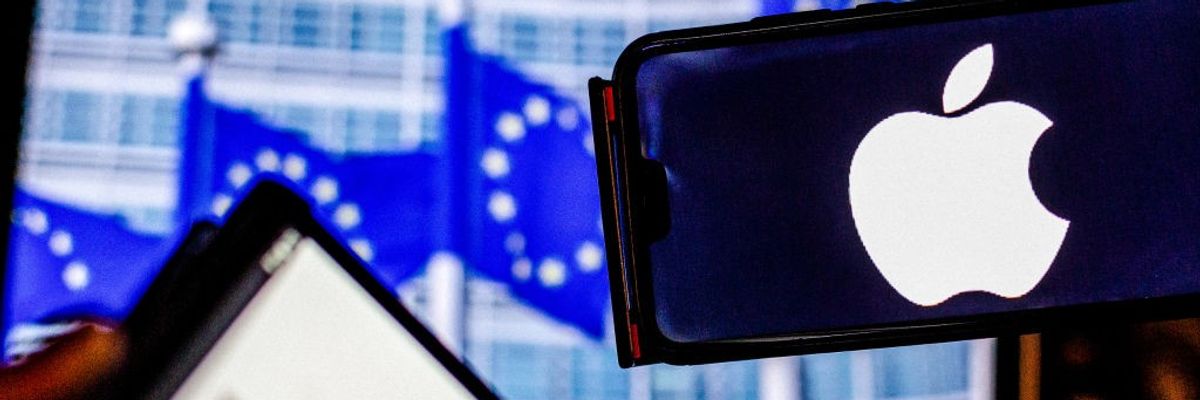
European Union regulators charged Apple with restricting competition in its App Store on June 24, 2024.
"For too long Apple has been squeezing out innovative companies—denying consumers new opportunities and choices," a European commissioner said.
European Union regulators on Monday filed preliminary charges against Apple for restricting competition in its App Store, the first case under a landmark antitrust law that came into full effect in March.
Apple's rules of engagement "prevent app developers from freely steering consumers to alternatives channels for offers and content," the European Commission (EC), the executive branch of the E.U. that handles antitrust regulation, wrote in a statement.
The commission's findings follow an investigation, announced in March, of Apple and other tech firms for non-compliance with the Digital Markets Act (DMA), which was designed to allow smaller tech companies to compete and lower prices for consumers.
"For too long Apple has been squeezing out innovative companies—denying consumers new opportunities and choices," Thierry Breton, a European commissioner responsible for digital markets, wrote on social media.
In a reference to Apple's slogan, "Think different," Breton quipped that it should be "Act different."
“Act different” should be their new slogan🍏
For too long @Apple has been squeezing out innovative companies — denying consumers new opportunities & choices.
Today we are taking further steps to ensure AppStore & iOS comply with #DMA pic.twitter.com/e741oV9r9l
— Thierry Breton (@ThierryBreton) June 24, 2024
The DMA was designed to prevent Big Tech firms from using their market power to dominate the industry.
"In football terms, this is about getting your players onto the pitch. Imagine how easy it would be for one of the teams to win their game tonight if they made sure that the rival team couldn't even get into the stadium. This is in fact what we often see in the digital world: many companies get stuck in their changing room," Margrethe Vestager, an EC official in charge of competition policy, said in a speech delivered Monday about the law.
The DMA was also designed to give regulators a way to streamline antitrust efforts so they don't get bogged down in years of litigation, a process that could be tested in the current Apple case.
The EC sent its findings to Apple on Monday and the company now has a chance to respond to the charges, with the commission scheduled to reach a final decision by next March. Monday's action was akin to the "halfway stage" in a traditional antitrust lawsuit in which a company is issued a statement of objection and a chance to reform its practices, The Guardian reported.
If the findings are finalized, Apple would have one year to comply or face a penalty of up to 10% of global revenues. The company took in $383 billion last year. However, E.U. regulators aim for dialogue that leads to compliance, rather than issuing a penalty, according to The Guardian.
The DMA has kept the EC busy. In addition to the charges, the commission also announced on Monday a new investigation into Apple's iOS business terms, including the "core technology fee" it charges for every download of the app after 1 million downloads in a year.
"The developers' community and consumers are eager to offer alternatives to the App Store," Vestager, the commission official, said regarding the newest probe. "We will investigate to ensure Apple does not undermine these efforts."
Big Tech companies including Apple, which have been deemed "gatekeepers" by E.U. regulators, have challenged the DMA in court to try to limit the law's scope.
Apple's antitrust battles are not limited to Europe. "The charges underscore the risk to the company's business from increased regulatory scrutiny around the world," The New York Times reported.
The U.S. Department of Justice and sixteen states filed a landmark antitrust suit against the company in March alleging that the company "illegally maintains a monopoly over smartphones by selectively imposing contractual restrictions on, and withholding critical access points from, developers." The United Kingdom and Japan have also recently investigated and taken legal action against the company.
Dear Common Dreams reader, It’s been nearly 30 years since I co-founded Common Dreams with my late wife, Lina Newhouser. We had the radical notion that journalism should serve the public good, not corporate profits. It was clear to us from the outset what it would take to build such a project. No paid advertisements. No corporate sponsors. No millionaire publisher telling us what to think or do. Many people said we wouldn't last a year, but we proved those doubters wrong. Together with a tremendous team of journalists and dedicated staff, we built an independent media outlet free from the constraints of profits and corporate control. Our mission has always been simple: To inform. To inspire. To ignite change for the common good. Building Common Dreams was not easy. Our survival was never guaranteed. When you take on the most powerful forces—Wall Street greed, fossil fuel industry destruction, Big Tech lobbyists, and uber-rich oligarchs who have spent billions upon billions rigging the economy and democracy in their favor—the only bulwark you have is supporters who believe in your work. But here’s the urgent message from me today. It's never been this bad out there. And it's never been this hard to keep us going. At the very moment Common Dreams is most needed, the threats we face are intensifying. We need your support now more than ever. We don't accept corporate advertising and never will. We don't have a paywall because we don't think people should be blocked from critical news based on their ability to pay. Everything we do is funded by the donations of readers like you. When everyone does the little they can afford, we are strong. But if that support retreats or dries up, so do we. Will you donate now to make sure Common Dreams not only survives but thrives? —Craig Brown, Co-founder |
European Union regulators on Monday filed preliminary charges against Apple for restricting competition in its App Store, the first case under a landmark antitrust law that came into full effect in March.
Apple's rules of engagement "prevent app developers from freely steering consumers to alternatives channels for offers and content," the European Commission (EC), the executive branch of the E.U. that handles antitrust regulation, wrote in a statement.
The commission's findings follow an investigation, announced in March, of Apple and other tech firms for non-compliance with the Digital Markets Act (DMA), which was designed to allow smaller tech companies to compete and lower prices for consumers.
"For too long Apple has been squeezing out innovative companies—denying consumers new opportunities and choices," Thierry Breton, a European commissioner responsible for digital markets, wrote on social media.
In a reference to Apple's slogan, "Think different," Breton quipped that it should be "Act different."
“Act different” should be their new slogan🍏
For too long @Apple has been squeezing out innovative companies — denying consumers new opportunities & choices.
Today we are taking further steps to ensure AppStore & iOS comply with #DMA pic.twitter.com/e741oV9r9l
— Thierry Breton (@ThierryBreton) June 24, 2024
The DMA was designed to prevent Big Tech firms from using their market power to dominate the industry.
"In football terms, this is about getting your players onto the pitch. Imagine how easy it would be for one of the teams to win their game tonight if they made sure that the rival team couldn't even get into the stadium. This is in fact what we often see in the digital world: many companies get stuck in their changing room," Margrethe Vestager, an EC official in charge of competition policy, said in a speech delivered Monday about the law.
The DMA was also designed to give regulators a way to streamline antitrust efforts so they don't get bogged down in years of litigation, a process that could be tested in the current Apple case.
The EC sent its findings to Apple on Monday and the company now has a chance to respond to the charges, with the commission scheduled to reach a final decision by next March. Monday's action was akin to the "halfway stage" in a traditional antitrust lawsuit in which a company is issued a statement of objection and a chance to reform its practices, The Guardian reported.
If the findings are finalized, Apple would have one year to comply or face a penalty of up to 10% of global revenues. The company took in $383 billion last year. However, E.U. regulators aim for dialogue that leads to compliance, rather than issuing a penalty, according to The Guardian.
The DMA has kept the EC busy. In addition to the charges, the commission also announced on Monday a new investigation into Apple's iOS business terms, including the "core technology fee" it charges for every download of the app after 1 million downloads in a year.
"The developers' community and consumers are eager to offer alternatives to the App Store," Vestager, the commission official, said regarding the newest probe. "We will investigate to ensure Apple does not undermine these efforts."
Big Tech companies including Apple, which have been deemed "gatekeepers" by E.U. regulators, have challenged the DMA in court to try to limit the law's scope.
Apple's antitrust battles are not limited to Europe. "The charges underscore the risk to the company's business from increased regulatory scrutiny around the world," The New York Times reported.
The U.S. Department of Justice and sixteen states filed a landmark antitrust suit against the company in March alleging that the company "illegally maintains a monopoly over smartphones by selectively imposing contractual restrictions on, and withholding critical access points from, developers." The United Kingdom and Japan have also recently investigated and taken legal action against the company.
European Union regulators on Monday filed preliminary charges against Apple for restricting competition in its App Store, the first case under a landmark antitrust law that came into full effect in March.
Apple's rules of engagement "prevent app developers from freely steering consumers to alternatives channels for offers and content," the European Commission (EC), the executive branch of the E.U. that handles antitrust regulation, wrote in a statement.
The commission's findings follow an investigation, announced in March, of Apple and other tech firms for non-compliance with the Digital Markets Act (DMA), which was designed to allow smaller tech companies to compete and lower prices for consumers.
"For too long Apple has been squeezing out innovative companies—denying consumers new opportunities and choices," Thierry Breton, a European commissioner responsible for digital markets, wrote on social media.
In a reference to Apple's slogan, "Think different," Breton quipped that it should be "Act different."
“Act different” should be their new slogan🍏
For too long @Apple has been squeezing out innovative companies — denying consumers new opportunities & choices.
Today we are taking further steps to ensure AppStore & iOS comply with #DMA pic.twitter.com/e741oV9r9l
— Thierry Breton (@ThierryBreton) June 24, 2024
The DMA was designed to prevent Big Tech firms from using their market power to dominate the industry.
"In football terms, this is about getting your players onto the pitch. Imagine how easy it would be for one of the teams to win their game tonight if they made sure that the rival team couldn't even get into the stadium. This is in fact what we often see in the digital world: many companies get stuck in their changing room," Margrethe Vestager, an EC official in charge of competition policy, said in a speech delivered Monday about the law.
The DMA was also designed to give regulators a way to streamline antitrust efforts so they don't get bogged down in years of litigation, a process that could be tested in the current Apple case.
The EC sent its findings to Apple on Monday and the company now has a chance to respond to the charges, with the commission scheduled to reach a final decision by next March. Monday's action was akin to the "halfway stage" in a traditional antitrust lawsuit in which a company is issued a statement of objection and a chance to reform its practices, The Guardian reported.
If the findings are finalized, Apple would have one year to comply or face a penalty of up to 10% of global revenues. The company took in $383 billion last year. However, E.U. regulators aim for dialogue that leads to compliance, rather than issuing a penalty, according to The Guardian.
The DMA has kept the EC busy. In addition to the charges, the commission also announced on Monday a new investigation into Apple's iOS business terms, including the "core technology fee" it charges for every download of the app after 1 million downloads in a year.
"The developers' community and consumers are eager to offer alternatives to the App Store," Vestager, the commission official, said regarding the newest probe. "We will investigate to ensure Apple does not undermine these efforts."
Big Tech companies including Apple, which have been deemed "gatekeepers" by E.U. regulators, have challenged the DMA in court to try to limit the law's scope.
Apple's antitrust battles are not limited to Europe. "The charges underscore the risk to the company's business from increased regulatory scrutiny around the world," The New York Times reported.
The U.S. Department of Justice and sixteen states filed a landmark antitrust suit against the company in March alleging that the company "illegally maintains a monopoly over smartphones by selectively imposing contractual restrictions on, and withholding critical access points from, developers." The United Kingdom and Japan have also recently investigated and taken legal action against the company.

