SUBSCRIBE TO OUR FREE NEWSLETTER
Daily news & progressive opinion—funded by the people, not the corporations—delivered straight to your inbox.
5
#000000
#FFFFFF
To donate by check, phone, or other method, see our More Ways to Give page.
Daily news & progressive opinion—funded by the people, not the corporations—delivered straight to your inbox.
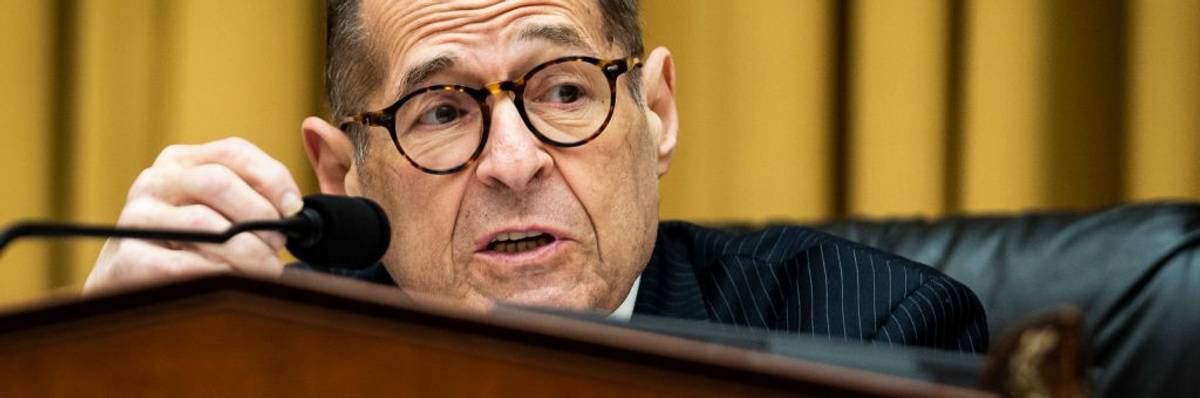
U.S. Rep. Jerry Nadler (D-N.Y.) speaks at a House Judiciary Committee hearing on Capitol Hill on April 28, 2022 in Washington, D.C.
"If Congress does not act, long-standing regulations that have protected consumers, workers, our environment, and public health and safety for years, even decades, could be newly challenged by corporations," said one advocate.
Recognizing the threat posed by a U.S. Supreme Court ruling handed down by the right-wing justices earlier this month, a pair of U.S. House Democrats on Thursday introduced the Corner Post Reversal Act.
Proposed by House Judiciary Committee Ranking Member Jerry Nadler (D-N.Y.) and Subcommittee on Administrative Law, Regulatory Reform, and Antitrust Ranking Member Lou Correa (D-Calif.), the bill would reverse the 6-3 decision in Corner Post Inc. v. Board of Governors of the Federal Reserve System.
The high court's conservative supermajority decided that the Administrative Procedures Act's (APA) statute of limitations period does not begin until a plaintiff is adversely affected by a regulation—making it much easier for corporations to sue government agencies.
"The Corner Post decision was an erroneous and power-hungry move by the MAGA majority on the court, that was intentionally dismissive of the will of Congress expressed in the Administrative Procedure Act," Nadler said in a statement. "The court has opened the floodgates to allow big corporations and private interests to object and challenge commonsense rules that protect our air, water, land, environment, food, medicines, labor, and children."
Correa similarly called out the high court for taking aim at the APA's statute of limitations, which "opened the door to unlimited challenges that may overburden our judicial system while harming Americans and small businesses."
"This piece of legislation is an important and essential step in reestablishing the certainty that comes from the finality that the six-year limitation provided," he added.
Specifically, as the congressmen's offices detailed, their bill:
"This bill, in conjunction with the Stop Corporate Capture Act," said Nadler, "addresses the need to protect longstanding and long-working rules established by administrative agencies and protect our federal system from arbitrary and frivolous attacks that would have been welcomed under the Corner Post holding."
The Stop Corporate Capture Act was introduced last year by Rep. Pramila Jayapal (D-Wash.), chair of the Congressional Progressive Caucus. She is also backing the bill introduced Thursday alongside Reps. Nanette Barragán (D-Calif.), Mary Gay Scanlon (D-Pa.), Eleanor Holmes Norton (D-D.C.), Summer Lee (D-Pa.), and Nikema Williams (D-Ga.).
"Public agencies exist to create rules and implement laws that protect the American people and their families from unsafe working conditions, dangerous food and drug products, and polluted water and air," said Jayapal. "It is imperative that our public agencies are able to enact measures to keep all Americans safe and healthy without being subject to constant lawsuits from bad actors."
The legislation—which is unlikely to get through the Republican-controlled House—is also supported by the Small Business Majority along with the Coalition for Sensible Safeguards, an alliance that includes the Center for American Progress, Earthjustice, and Public Citizen.
Lisa Gilbert, executive vice president of Public Citizen, stressed in a statement Thursday that "the Supreme Court's Corner Post decision makes Americans less safe" and argued the new bill "would prevent the disruptive impact" of the recent ruling.
"If Congress does not act," she added, "long-standing regulations that have protected consumers, workers, our environment, and public health and safety for years, even decades, could be newly challenged by corporations that want to boost their profits at the public's expense."
Dear Common Dreams reader, It’s been nearly 30 years since I co-founded Common Dreams with my late wife, Lina Newhouser. We had the radical notion that journalism should serve the public good, not corporate profits. It was clear to us from the outset what it would take to build such a project. No paid advertisements. No corporate sponsors. No millionaire publisher telling us what to think or do. Many people said we wouldn't last a year, but we proved those doubters wrong. Together with a tremendous team of journalists and dedicated staff, we built an independent media outlet free from the constraints of profits and corporate control. Our mission has always been simple: To inform. To inspire. To ignite change for the common good. Building Common Dreams was not easy. Our survival was never guaranteed. When you take on the most powerful forces—Wall Street greed, fossil fuel industry destruction, Big Tech lobbyists, and uber-rich oligarchs who have spent billions upon billions rigging the economy and democracy in their favor—the only bulwark you have is supporters who believe in your work. But here’s the urgent message from me today. It's never been this bad out there. And it's never been this hard to keep us going. At the very moment Common Dreams is most needed, the threats we face are intensifying. We need your support now more than ever. We don't accept corporate advertising and never will. We don't have a paywall because we don't think people should be blocked from critical news based on their ability to pay. Everything we do is funded by the donations of readers like you. When everyone does the little they can afford, we are strong. But if that support retreats or dries up, so do we. Will you donate now to make sure Common Dreams not only survives but thrives? —Craig Brown, Co-founder |
Recognizing the threat posed by a U.S. Supreme Court ruling handed down by the right-wing justices earlier this month, a pair of U.S. House Democrats on Thursday introduced the Corner Post Reversal Act.
Proposed by House Judiciary Committee Ranking Member Jerry Nadler (D-N.Y.) and Subcommittee on Administrative Law, Regulatory Reform, and Antitrust Ranking Member Lou Correa (D-Calif.), the bill would reverse the 6-3 decision in Corner Post Inc. v. Board of Governors of the Federal Reserve System.
The high court's conservative supermajority decided that the Administrative Procedures Act's (APA) statute of limitations period does not begin until a plaintiff is adversely affected by a regulation—making it much easier for corporations to sue government agencies.
"The Corner Post decision was an erroneous and power-hungry move by the MAGA majority on the court, that was intentionally dismissive of the will of Congress expressed in the Administrative Procedure Act," Nadler said in a statement. "The court has opened the floodgates to allow big corporations and private interests to object and challenge commonsense rules that protect our air, water, land, environment, food, medicines, labor, and children."
Correa similarly called out the high court for taking aim at the APA's statute of limitations, which "opened the door to unlimited challenges that may overburden our judicial system while harming Americans and small businesses."
"This piece of legislation is an important and essential step in reestablishing the certainty that comes from the finality that the six-year limitation provided," he added.
Specifically, as the congressmen's offices detailed, their bill:
"This bill, in conjunction with the Stop Corporate Capture Act," said Nadler, "addresses the need to protect longstanding and long-working rules established by administrative agencies and protect our federal system from arbitrary and frivolous attacks that would have been welcomed under the Corner Post holding."
The Stop Corporate Capture Act was introduced last year by Rep. Pramila Jayapal (D-Wash.), chair of the Congressional Progressive Caucus. She is also backing the bill introduced Thursday alongside Reps. Nanette Barragán (D-Calif.), Mary Gay Scanlon (D-Pa.), Eleanor Holmes Norton (D-D.C.), Summer Lee (D-Pa.), and Nikema Williams (D-Ga.).
"Public agencies exist to create rules and implement laws that protect the American people and their families from unsafe working conditions, dangerous food and drug products, and polluted water and air," said Jayapal. "It is imperative that our public agencies are able to enact measures to keep all Americans safe and healthy without being subject to constant lawsuits from bad actors."
The legislation—which is unlikely to get through the Republican-controlled House—is also supported by the Small Business Majority along with the Coalition for Sensible Safeguards, an alliance that includes the Center for American Progress, Earthjustice, and Public Citizen.
Lisa Gilbert, executive vice president of Public Citizen, stressed in a statement Thursday that "the Supreme Court's Corner Post decision makes Americans less safe" and argued the new bill "would prevent the disruptive impact" of the recent ruling.
"If Congress does not act," she added, "long-standing regulations that have protected consumers, workers, our environment, and public health and safety for years, even decades, could be newly challenged by corporations that want to boost their profits at the public's expense."
Recognizing the threat posed by a U.S. Supreme Court ruling handed down by the right-wing justices earlier this month, a pair of U.S. House Democrats on Thursday introduced the Corner Post Reversal Act.
Proposed by House Judiciary Committee Ranking Member Jerry Nadler (D-N.Y.) and Subcommittee on Administrative Law, Regulatory Reform, and Antitrust Ranking Member Lou Correa (D-Calif.), the bill would reverse the 6-3 decision in Corner Post Inc. v. Board of Governors of the Federal Reserve System.
The high court's conservative supermajority decided that the Administrative Procedures Act's (APA) statute of limitations period does not begin until a plaintiff is adversely affected by a regulation—making it much easier for corporations to sue government agencies.
"The Corner Post decision was an erroneous and power-hungry move by the MAGA majority on the court, that was intentionally dismissive of the will of Congress expressed in the Administrative Procedure Act," Nadler said in a statement. "The court has opened the floodgates to allow big corporations and private interests to object and challenge commonsense rules that protect our air, water, land, environment, food, medicines, labor, and children."
Correa similarly called out the high court for taking aim at the APA's statute of limitations, which "opened the door to unlimited challenges that may overburden our judicial system while harming Americans and small businesses."
"This piece of legislation is an important and essential step in reestablishing the certainty that comes from the finality that the six-year limitation provided," he added.
Specifically, as the congressmen's offices detailed, their bill:
"This bill, in conjunction with the Stop Corporate Capture Act," said Nadler, "addresses the need to protect longstanding and long-working rules established by administrative agencies and protect our federal system from arbitrary and frivolous attacks that would have been welcomed under the Corner Post holding."
The Stop Corporate Capture Act was introduced last year by Rep. Pramila Jayapal (D-Wash.), chair of the Congressional Progressive Caucus. She is also backing the bill introduced Thursday alongside Reps. Nanette Barragán (D-Calif.), Mary Gay Scanlon (D-Pa.), Eleanor Holmes Norton (D-D.C.), Summer Lee (D-Pa.), and Nikema Williams (D-Ga.).
"Public agencies exist to create rules and implement laws that protect the American people and their families from unsafe working conditions, dangerous food and drug products, and polluted water and air," said Jayapal. "It is imperative that our public agencies are able to enact measures to keep all Americans safe and healthy without being subject to constant lawsuits from bad actors."
The legislation—which is unlikely to get through the Republican-controlled House—is also supported by the Small Business Majority along with the Coalition for Sensible Safeguards, an alliance that includes the Center for American Progress, Earthjustice, and Public Citizen.
Lisa Gilbert, executive vice president of Public Citizen, stressed in a statement Thursday that "the Supreme Court's Corner Post decision makes Americans less safe" and argued the new bill "would prevent the disruptive impact" of the recent ruling.
"If Congress does not act," she added, "long-standing regulations that have protected consumers, workers, our environment, and public health and safety for years, even decades, could be newly challenged by corporations that want to boost their profits at the public's expense."