SUBSCRIBE TO OUR FREE NEWSLETTER
Daily news & progressive opinion—funded by the people, not the corporations—delivered straight to your inbox.
5
#000000
#FFFFFF
To donate by check, phone, or other method, see our More Ways to Give page.
Daily news & progressive opinion—funded by the people, not the corporations—delivered straight to your inbox.
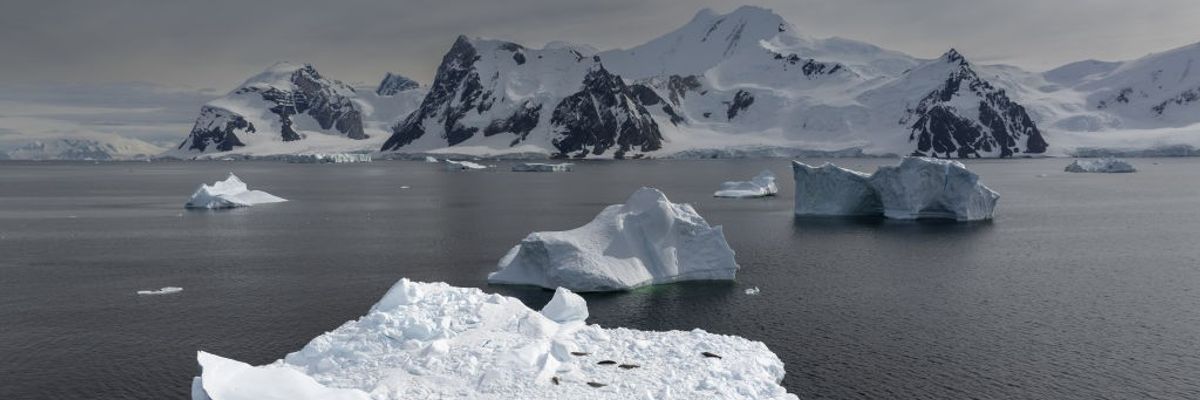
Seals rest on an ice mass in Antarctica in April 2024.
The long-lasting heatwave is an "eye-opening sign that climate change is starting to really transform the planet," a climate scientist said.
Antarctica is experiencing its second extreme heatwave in the last three years, with temperatures more than 50°F higher than normal, The Washington Post reported Wednesday.
The heatwave is notable not just for its intensity but also its timing and duration: It's hit during Antartica's winter and is expected to last. Temperatures of 36°F to 50°F above average are expected to persist up to 10 days, and July temperatures were already well above average before it began. The spiking temperatures were also spread across a large area, covering much of the continent, scientists said.
The world has faced exceptionally high temperatures in the last year, with 13 straight monthly heat records and counting, and the poles are warming at roughly twice the rate of the global average. Scientists say the changing conditions around Antarctica have increased the likelihood of higher winter temperatures on the continent.
"It is likely that having less sea ice and a warmer Southern Ocean around the Antarctic continent 'loads the dice' for warmer winter weather over Antarctica," Edward Blanchard, an atmospheric scientist at the University of Washington, told the Post.
Scientists warned that this heatwave was a sign of what's to come as the planet heats up thanks primarily to fossil fuel emissions.
"This historic warm spell in East Antarctica is an ominous example of the temperature spikes this polar climate could experience more of in a warming world," the Post reported.
Jonathan Overpeck, a climate scientist at the University of Michigan, said on social media that the heatwave is an "eye-opening sign that climate change is starting to really transform the planet."
In March 2022, Antarctica experienced the most intense heatwave in the planet's recorded history, with temperatures up to 72°F above normal. On-site scientists at the time wore shorts and removed their shirts to bask in the sun. The heatwave was the subject of intense scientific research in the two years that followed, with a 54-person team trying to decipher the causes, which they described as "head-hurting" in their complexity.
The 2022 heatwave contributed to reduced sea ice levels. Antarctica experienced the lowest summer and winter levels of sea ice ever recorded last year.
High temperatures in Antarctica are relative—this week's heatwave still had temperatures hovering at about minus-4°F. But sustained periods at such temperatures are highly unusual.
"The heatwave on the Antarctic Plateau is extraordinary more for its duration than for its intensity, although some values are notable," Stefano Di Battista, an expert on Antarctic temperatures, told the Post.
The heatwave is likely the result of changes in the stratosphere roughly 20 miles above ground, scientists said. At the South Pole, the stratosphere contains a polar vortex that is normally stable with cold temperatures and low pressure during the Antarctic winter, but a sudden stratospheric warming event occurred due to atmospheric wave activity, Amy Butler, an atmospheric scientist at the National Oceanic and Atmospheric Administration, told the Post.
Dear Common Dreams reader, It’s been nearly 30 years since I co-founded Common Dreams with my late wife, Lina Newhouser. We had the radical notion that journalism should serve the public good, not corporate profits. It was clear to us from the outset what it would take to build such a project. No paid advertisements. No corporate sponsors. No millionaire publisher telling us what to think or do. Many people said we wouldn't last a year, but we proved those doubters wrong. Together with a tremendous team of journalists and dedicated staff, we built an independent media outlet free from the constraints of profits and corporate control. Our mission has always been simple: To inform. To inspire. To ignite change for the common good. Building Common Dreams was not easy. Our survival was never guaranteed. When you take on the most powerful forces—Wall Street greed, fossil fuel industry destruction, Big Tech lobbyists, and uber-rich oligarchs who have spent billions upon billions rigging the economy and democracy in their favor—the only bulwark you have is supporters who believe in your work. But here’s the urgent message from me today. It's never been this bad out there. And it's never been this hard to keep us going. At the very moment Common Dreams is most needed, the threats we face are intensifying. We need your support now more than ever. We don't accept corporate advertising and never will. We don't have a paywall because we don't think people should be blocked from critical news based on their ability to pay. Everything we do is funded by the donations of readers like you. When everyone does the little they can afford, we are strong. But if that support retreats or dries up, so do we. Will you donate now to make sure Common Dreams not only survives but thrives? —Craig Brown, Co-founder |
Antarctica is experiencing its second extreme heatwave in the last three years, with temperatures more than 50°F higher than normal, The Washington Post reported Wednesday.
The heatwave is notable not just for its intensity but also its timing and duration: It's hit during Antartica's winter and is expected to last. Temperatures of 36°F to 50°F above average are expected to persist up to 10 days, and July temperatures were already well above average before it began. The spiking temperatures were also spread across a large area, covering much of the continent, scientists said.
The world has faced exceptionally high temperatures in the last year, with 13 straight monthly heat records and counting, and the poles are warming at roughly twice the rate of the global average. Scientists say the changing conditions around Antarctica have increased the likelihood of higher winter temperatures on the continent.
"It is likely that having less sea ice and a warmer Southern Ocean around the Antarctic continent 'loads the dice' for warmer winter weather over Antarctica," Edward Blanchard, an atmospheric scientist at the University of Washington, told the Post.
Scientists warned that this heatwave was a sign of what's to come as the planet heats up thanks primarily to fossil fuel emissions.
"This historic warm spell in East Antarctica is an ominous example of the temperature spikes this polar climate could experience more of in a warming world," the Post reported.
Jonathan Overpeck, a climate scientist at the University of Michigan, said on social media that the heatwave is an "eye-opening sign that climate change is starting to really transform the planet."
In March 2022, Antarctica experienced the most intense heatwave in the planet's recorded history, with temperatures up to 72°F above normal. On-site scientists at the time wore shorts and removed their shirts to bask in the sun. The heatwave was the subject of intense scientific research in the two years that followed, with a 54-person team trying to decipher the causes, which they described as "head-hurting" in their complexity.
The 2022 heatwave contributed to reduced sea ice levels. Antarctica experienced the lowest summer and winter levels of sea ice ever recorded last year.
High temperatures in Antarctica are relative—this week's heatwave still had temperatures hovering at about minus-4°F. But sustained periods at such temperatures are highly unusual.
"The heatwave on the Antarctic Plateau is extraordinary more for its duration than for its intensity, although some values are notable," Stefano Di Battista, an expert on Antarctic temperatures, told the Post.
The heatwave is likely the result of changes in the stratosphere roughly 20 miles above ground, scientists said. At the South Pole, the stratosphere contains a polar vortex that is normally stable with cold temperatures and low pressure during the Antarctic winter, but a sudden stratospheric warming event occurred due to atmospheric wave activity, Amy Butler, an atmospheric scientist at the National Oceanic and Atmospheric Administration, told the Post.
Antarctica is experiencing its second extreme heatwave in the last three years, with temperatures more than 50°F higher than normal, The Washington Post reported Wednesday.
The heatwave is notable not just for its intensity but also its timing and duration: It's hit during Antartica's winter and is expected to last. Temperatures of 36°F to 50°F above average are expected to persist up to 10 days, and July temperatures were already well above average before it began. The spiking temperatures were also spread across a large area, covering much of the continent, scientists said.
The world has faced exceptionally high temperatures in the last year, with 13 straight monthly heat records and counting, and the poles are warming at roughly twice the rate of the global average. Scientists say the changing conditions around Antarctica have increased the likelihood of higher winter temperatures on the continent.
"It is likely that having less sea ice and a warmer Southern Ocean around the Antarctic continent 'loads the dice' for warmer winter weather over Antarctica," Edward Blanchard, an atmospheric scientist at the University of Washington, told the Post.
Scientists warned that this heatwave was a sign of what's to come as the planet heats up thanks primarily to fossil fuel emissions.
"This historic warm spell in East Antarctica is an ominous example of the temperature spikes this polar climate could experience more of in a warming world," the Post reported.
Jonathan Overpeck, a climate scientist at the University of Michigan, said on social media that the heatwave is an "eye-opening sign that climate change is starting to really transform the planet."
In March 2022, Antarctica experienced the most intense heatwave in the planet's recorded history, with temperatures up to 72°F above normal. On-site scientists at the time wore shorts and removed their shirts to bask in the sun. The heatwave was the subject of intense scientific research in the two years that followed, with a 54-person team trying to decipher the causes, which they described as "head-hurting" in their complexity.
The 2022 heatwave contributed to reduced sea ice levels. Antarctica experienced the lowest summer and winter levels of sea ice ever recorded last year.
High temperatures in Antarctica are relative—this week's heatwave still had temperatures hovering at about minus-4°F. But sustained periods at such temperatures are highly unusual.
"The heatwave on the Antarctic Plateau is extraordinary more for its duration than for its intensity, although some values are notable," Stefano Di Battista, an expert on Antarctic temperatures, told the Post.
The heatwave is likely the result of changes in the stratosphere roughly 20 miles above ground, scientists said. At the South Pole, the stratosphere contains a polar vortex that is normally stable with cold temperatures and low pressure during the Antarctic winter, but a sudden stratospheric warming event occurred due to atmospheric wave activity, Amy Butler, an atmospheric scientist at the National Oceanic and Atmospheric Administration, told the Post.