

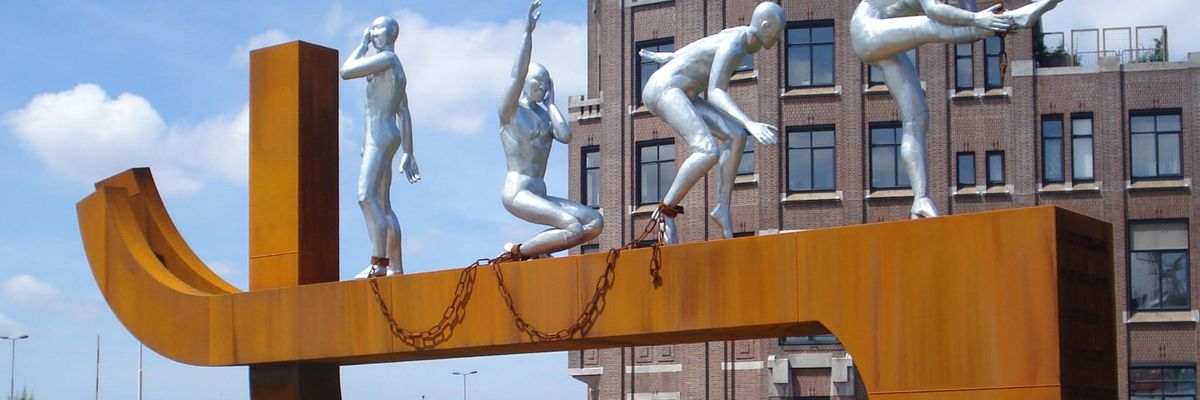
Rotterdam Kunstwerk Slavernij Monument stands in the port city of Rotterdam, an important hub in the Dutch slave trade. (Photo: Wikifrits/Wikimedia Commons)
Dutch Slavery Apology Dismissed by Black Activists as 'Neocolonial Belch'
"The Netherlands should learn lessons from Germany's botched reparations deal to address colonial crimes in Namibia, where the failure to consult with affected communities derailed the process," said one Human Rights Watch campaigner.
While many activists welcomed Monday's official apology by Netherlands Prime Minister Mark Rutte for his country's 250-year history of enslaving Africans, some Dutch advocates of African ancestry called the gesture ill-timed and insufficient.
"For centuries, the Dutch state and its representatives stimulated, preserved, and profited from slavery," Rutte, who represents the center-right People's Party for Freedom and Democracy, declared during a speech in The Hague. "For centuries, in the name of the Dutch state, human beings were made into commodities, exploited, and abused. For centuries, under Dutch state authority, human dignity was violated in the most horrific way possible."
The prime minister continued:
More than 600,000 enslaved African women, men, and children had been shipped to the American continent, in deplorable conditions, by Dutch slave traders. Most were taken to Suriname, but others were sent to Curacao, St. Eustatius, and other locations. They were wrenched from their families and stripped of their humanity. They were transported--and treated--like cattle. Often under the governmental authority of the Dutch West India Company.
In Asia, between 660,000 and over one million people--we don't even know exactly how many--were traded within the areas under the authority of the Dutch East India Company.
"The numbers are unimaginable," Rutte added. "The human suffering behind them, even more unimaginable."
The Netherlands abolished slavery on July 1, 1863--six months to the day after then-U.S. President Abraham Lincoln issued the Emancipation Proclamation. After abolition, the Dutch government compensated former slaveowners for their loss of property.
In addition to formally apologizing, the Dutch government said it will allocate EUR227 million ($241 million) to slavery education and a museum.
Some activists expressed disappointment with the amount, the fact that the money will not fund reparations, and that the apology came from the prime minister and not King Willem Alexander, whose House of Orange-Nassau ancestors ruled during the slavery era. Earlier this month, the king announced the launch of an independent study, led by Leiden University, to investigate the monarchy's role "in the context of colonial history."
"Whether the Dutch government apologizes for slavery or not today, the smug ignorance of the act itself is clear. By cheapening the meaning of an apology for a crime against humanity Rutte, and his accessories to the crime, hope to hollow out and stymie reparations calls," tweeted Quinsy Gario, an activist born in the Dutch Caribbean colony of Curacao, whose Indigenous Arawak and Caquetios inhabitants were enslaved en masse by Spaniards before the Dutch conquered the island and made it a hub of the trans-Atlantic slave trade.
"It's also clear that no arbitrarily chosen amount of money will do in lieu of systemic change," added Gario, who founded a campaign targeting the Low Countries Christmas tradition of wearing blackface to play the character Zwarte Piet, or Black Pete, a companion of Saint Nicholas. "The 200 million euros [that]... have been dangled in front of some organizations to make them fall in line is a pittance compared to the change that such an apology should mandate."
Roy Kaikusi Groenberg of the Honor and Recovery Foundation--a group focusing on Suriname, a former Dutch colony in South America--told Al Jazeera that "it takes two to tango--apologies have to be received," and that "the way the government is handling this, it's coming across as a neocolonial belch."
Other activists took exception with the timing of the apology, with Almaz Teffera, Human Rights Watch's Berlin-based researcher on racism in Europe, noting last week that "Surinamese and Caribbean groups, such as the Nationale Reparatie Commissie (National Reparations Commission) in Suriname... argued that July 1, marking 150 years since the abolition of slavery, would be a more appropriate date for an apology."
"The Netherlands should learn lessons from Germany's botched reparations deal to address colonial crimes in Namibia, where the failure to consult with affected communities derailed the process and resulted in a deal rejected by both people representatives and Namibia's government," Teffera asserted.
"A true reckoning of colonial crimes, including slavery and other forms of exploitation, requires reparations that serve as a form of accountability and acknowledge the impacts of colonialism today," she added. "Reparations can take many forms, including restitution, compensation, rehabilitation, satisfaction, and guarantees of nonrepetition. Listening to affected communities is an important step in determining what reparations should look like."
We are at a crossroads
This country and this world are at a monumental crossroads. In a few short weeks, US voters will have an opportunity to beat back the forces of fascism and confront the billionaires who are rigging the economy, our media system, and our democracy, making it increasingly impossible for ordinary people to get by. We’re not just talking about the election. We’re talking about what must be done once these fascist elements are vanquished from power. We need a bolder set of solutions than what either major party has so far been willing to offer and a working-class movement ready to fight like hell for it. Trump didn't emerge from nowhere. The conditions that fueled MAGA authoritarianism were created by decades of radical neoliberal economic policies and a corrupt political system dominated by corporate interests. They slashed taxes on the super-rich, promising that the benefits would trickle down. They said giveaways to the corporate titans would make life more affordable for the rest of us. It was all bullshit. And when a bitter, betrayed populace searches for someone to blame, right-wing demagogues have little trouble finding scapegoats. People know when they're being lied to, but you won't hear any of this from the corporate media. Only independent journalism—powered and funded by people who believe in building a better world—can deliver truly trustworthy daily news. Our Fall Campaign is underway, and we need your help. To power our newsroom through the rest of the year, we need to raise $125,000 by midnight on October 31. So if you share our vision, please contribute whatever you can to sustain our work. |
While many activists welcomed Monday's official apology by Netherlands Prime Minister Mark Rutte for his country's 250-year history of enslaving Africans, some Dutch advocates of African ancestry called the gesture ill-timed and insufficient.
"For centuries, the Dutch state and its representatives stimulated, preserved, and profited from slavery," Rutte, who represents the center-right People's Party for Freedom and Democracy, declared during a speech in The Hague. "For centuries, in the name of the Dutch state, human beings were made into commodities, exploited, and abused. For centuries, under Dutch state authority, human dignity was violated in the most horrific way possible."
The prime minister continued:
More than 600,000 enslaved African women, men, and children had been shipped to the American continent, in deplorable conditions, by Dutch slave traders. Most were taken to Suriname, but others were sent to Curacao, St. Eustatius, and other locations. They were wrenched from their families and stripped of their humanity. They were transported--and treated--like cattle. Often under the governmental authority of the Dutch West India Company.
In Asia, between 660,000 and over one million people--we don't even know exactly how many--were traded within the areas under the authority of the Dutch East India Company.
"The numbers are unimaginable," Rutte added. "The human suffering behind them, even more unimaginable."
The Netherlands abolished slavery on July 1, 1863--six months to the day after then-U.S. President Abraham Lincoln issued the Emancipation Proclamation. After abolition, the Dutch government compensated former slaveowners for their loss of property.
In addition to formally apologizing, the Dutch government said it will allocate EUR227 million ($241 million) to slavery education and a museum.
Some activists expressed disappointment with the amount, the fact that the money will not fund reparations, and that the apology came from the prime minister and not King Willem Alexander, whose House of Orange-Nassau ancestors ruled during the slavery era. Earlier this month, the king announced the launch of an independent study, led by Leiden University, to investigate the monarchy's role "in the context of colonial history."
"Whether the Dutch government apologizes for slavery or not today, the smug ignorance of the act itself is clear. By cheapening the meaning of an apology for a crime against humanity Rutte, and his accessories to the crime, hope to hollow out and stymie reparations calls," tweeted Quinsy Gario, an activist born in the Dutch Caribbean colony of Curacao, whose Indigenous Arawak and Caquetios inhabitants were enslaved en masse by Spaniards before the Dutch conquered the island and made it a hub of the trans-Atlantic slave trade.
"It's also clear that no arbitrarily chosen amount of money will do in lieu of systemic change," added Gario, who founded a campaign targeting the Low Countries Christmas tradition of wearing blackface to play the character Zwarte Piet, or Black Pete, a companion of Saint Nicholas. "The 200 million euros [that]... have been dangled in front of some organizations to make them fall in line is a pittance compared to the change that such an apology should mandate."
Roy Kaikusi Groenberg of the Honor and Recovery Foundation--a group focusing on Suriname, a former Dutch colony in South America--told Al Jazeera that "it takes two to tango--apologies have to be received," and that "the way the government is handling this, it's coming across as a neocolonial belch."
Other activists took exception with the timing of the apology, with Almaz Teffera, Human Rights Watch's Berlin-based researcher on racism in Europe, noting last week that "Surinamese and Caribbean groups, such as the Nationale Reparatie Commissie (National Reparations Commission) in Suriname... argued that July 1, marking 150 years since the abolition of slavery, would be a more appropriate date for an apology."
"The Netherlands should learn lessons from Germany's botched reparations deal to address colonial crimes in Namibia, where the failure to consult with affected communities derailed the process and resulted in a deal rejected by both people representatives and Namibia's government," Teffera asserted.
"A true reckoning of colonial crimes, including slavery and other forms of exploitation, requires reparations that serve as a form of accountability and acknowledge the impacts of colonialism today," she added. "Reparations can take many forms, including restitution, compensation, rehabilitation, satisfaction, and guarantees of nonrepetition. Listening to affected communities is an important step in determining what reparations should look like."
While many activists welcomed Monday's official apology by Netherlands Prime Minister Mark Rutte for his country's 250-year history of enslaving Africans, some Dutch advocates of African ancestry called the gesture ill-timed and insufficient.
"For centuries, the Dutch state and its representatives stimulated, preserved, and profited from slavery," Rutte, who represents the center-right People's Party for Freedom and Democracy, declared during a speech in The Hague. "For centuries, in the name of the Dutch state, human beings were made into commodities, exploited, and abused. For centuries, under Dutch state authority, human dignity was violated in the most horrific way possible."
The prime minister continued:
More than 600,000 enslaved African women, men, and children had been shipped to the American continent, in deplorable conditions, by Dutch slave traders. Most were taken to Suriname, but others were sent to Curacao, St. Eustatius, and other locations. They were wrenched from their families and stripped of their humanity. They were transported--and treated--like cattle. Often under the governmental authority of the Dutch West India Company.
In Asia, between 660,000 and over one million people--we don't even know exactly how many--were traded within the areas under the authority of the Dutch East India Company.
"The numbers are unimaginable," Rutte added. "The human suffering behind them, even more unimaginable."
The Netherlands abolished slavery on July 1, 1863--six months to the day after then-U.S. President Abraham Lincoln issued the Emancipation Proclamation. After abolition, the Dutch government compensated former slaveowners for their loss of property.
In addition to formally apologizing, the Dutch government said it will allocate EUR227 million ($241 million) to slavery education and a museum.
Some activists expressed disappointment with the amount, the fact that the money will not fund reparations, and that the apology came from the prime minister and not King Willem Alexander, whose House of Orange-Nassau ancestors ruled during the slavery era. Earlier this month, the king announced the launch of an independent study, led by Leiden University, to investigate the monarchy's role "in the context of colonial history."
"Whether the Dutch government apologizes for slavery or not today, the smug ignorance of the act itself is clear. By cheapening the meaning of an apology for a crime against humanity Rutte, and his accessories to the crime, hope to hollow out and stymie reparations calls," tweeted Quinsy Gario, an activist born in the Dutch Caribbean colony of Curacao, whose Indigenous Arawak and Caquetios inhabitants were enslaved en masse by Spaniards before the Dutch conquered the island and made it a hub of the trans-Atlantic slave trade.
"It's also clear that no arbitrarily chosen amount of money will do in lieu of systemic change," added Gario, who founded a campaign targeting the Low Countries Christmas tradition of wearing blackface to play the character Zwarte Piet, or Black Pete, a companion of Saint Nicholas. "The 200 million euros [that]... have been dangled in front of some organizations to make them fall in line is a pittance compared to the change that such an apology should mandate."
Roy Kaikusi Groenberg of the Honor and Recovery Foundation--a group focusing on Suriname, a former Dutch colony in South America--told Al Jazeera that "it takes two to tango--apologies have to be received," and that "the way the government is handling this, it's coming across as a neocolonial belch."
Other activists took exception with the timing of the apology, with Almaz Teffera, Human Rights Watch's Berlin-based researcher on racism in Europe, noting last week that "Surinamese and Caribbean groups, such as the Nationale Reparatie Commissie (National Reparations Commission) in Suriname... argued that July 1, marking 150 years since the abolition of slavery, would be a more appropriate date for an apology."
"The Netherlands should learn lessons from Germany's botched reparations deal to address colonial crimes in Namibia, where the failure to consult with affected communities derailed the process and resulted in a deal rejected by both people representatives and Namibia's government," Teffera asserted.
"A true reckoning of colonial crimes, including slavery and other forms of exploitation, requires reparations that serve as a form of accountability and acknowledge the impacts of colonialism today," she added. "Reparations can take many forms, including restitution, compensation, rehabilitation, satisfaction, and guarantees of nonrepetition. Listening to affected communities is an important step in determining what reparations should look like."