




SUBSCRIBE TO OUR FREE NEWSLETTER
Daily news & progressive opinion—funded by the people, not the corporations—delivered straight to your inbox.
5
#000000
#FFFFFF
To donate by check, phone, or other method, see our More Ways to Give page.
Daily news & progressive opinion—funded by the people, not the corporations—delivered straight to your inbox.
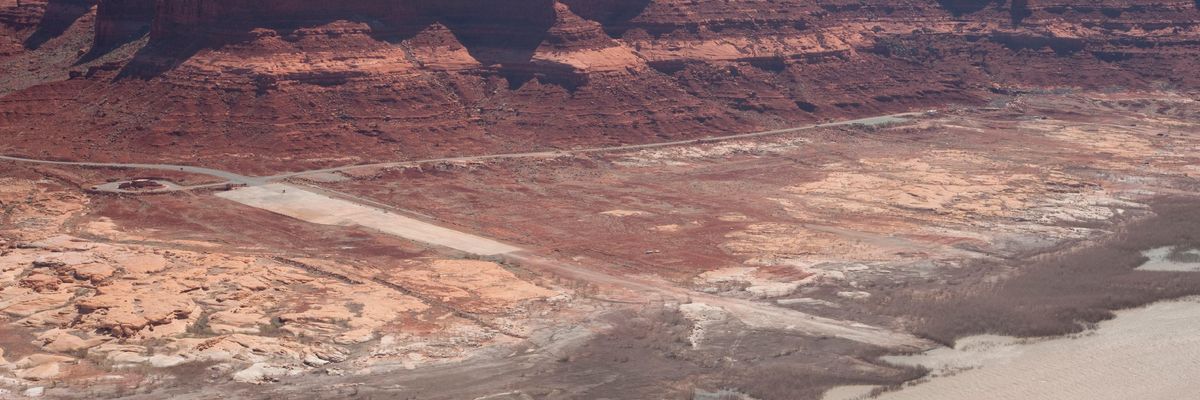
A stranded boat launch is seen in drought-stricken Lake Powell, Utah on May 2, 2022. (Photo: Marli Miller/UCG/Universal Images Group via Getty Images)
The catastrophic chain of events that water and power authorities are working to prepare for amid the desertification of the Colorado River basin would amount to a "complete doomsday scenario," harming water and electricity supplies for millions, according to new reporting from The Washington Post.
While the Biden administration earlier this year ordered water use cuts in Arizona, Nevada, and parts of Mexico that use water from the rapidly shrinking Colorado River, officials in the region are examining how they can keep Lake Powell and Lake Mead--the largest human-made reservoirs in the U.S.--from reaching dangerous "dead pool" status, in which water levels would drop so low that water no longer flows downstream.
"You're not going to have a river... It would be a catastrophe for the entire system."
According to the U.S. Bureau of Reclamation, with Lake Powell's surface already having fallen 170 feet, the reservoir is even closer to reaching "minimum power pool" status.
If water levels drop another 38 feet in Lake Powell, which is currently a quarter of its original size, the surface could approach the tops of eight underwater openings allowing Colorado River water to pass through the Glen Canyon Dam.
"The normally placid Lake Powell, the nation's second-largest reservoir, could suddenly transform into something resembling a funnel, with water circling the openings," reported the Post.
That would force turbines which supply 4.5 million people with electricity to shut down, likely triggering financial struggles for people across southwestern states. The standard rate for low-cost power generated by Glen Canyon Dam is $30 per megawatt hour, but with the dam already producing 40% less power than it originally did, customers this past summer faced prices as high as $1,000 per megawatt hour as they sought electricity on the open market.
The latest projections of the Bureau of Reclamation show that minimum power pool status could be reached as early as next July.
Tom Buschatzke, director of Arizona's Department of Water Resources, told the Post that dead pool status would amount to "an ecological disaster," with the region's agricultural sector cut off from a crucial irrigation source.
"You're not going to have a river" in the case of Lake Powell reaching dead pool, he said. "It would be a catastrophe for the entire system."
As government officials announced over the summer that water levels could approach the dam's underwater openings by next July, the Bureau of Reclamation also announced it was supporting studies to examine whether authorities could make modifications to the dam, such as drilling tunnels at river level.
"There was a time in my professional career that if anybody from Reclamation ever said that, they'd be fired on the spot," said Jack Schmidt, an expert on the river at Utah State University who worked on the U.S. Geological Survey during the Obama administration.
Schmidt told the Post that the fact such a possibility has been raised denotes "a huge sea change telling you how different the world is."
Jeff Goodell, author of the book The Water Will Come: Rising Seas, Sinking Cities, and the Remaking of the Civilized World, suggested that the aridification of the West--made 40% worse by planetary heating and the continued extraction of fossil fuels, according to one recent study--has left the Colorado River unable to provide water and power to the millions of people who have come to rely on it.
"The problem with massive projects like Lake Powell and the Glen Canyon Dam," tweeted Goodell, "is they were engineered for a climate that no longer exists and will never return (at least not on human timescales)."
Donald Trump’s attacks on democracy, justice, and a free press are escalating — putting everything we stand for at risk. We believe a better world is possible, but we can’t get there without your support. Common Dreams stands apart. We answer only to you — our readers, activists, and changemakers — not to billionaires or corporations. Our independence allows us to cover the vital stories that others won’t, spotlighting movements for peace, equality, and human rights. Right now, our work faces unprecedented challenges. Misinformation is spreading, journalists are under attack, and financial pressures are mounting. As a reader-supported, nonprofit newsroom, your support is crucial to keep this journalism alive. Whatever you can give — $10, $25, or $100 — helps us stay strong and responsive when the world needs us most. Together, we’ll continue to build the independent, courageous journalism our movement relies on. Thank you for being part of this community. |
The catastrophic chain of events that water and power authorities are working to prepare for amid the desertification of the Colorado River basin would amount to a "complete doomsday scenario," harming water and electricity supplies for millions, according to new reporting from The Washington Post.
While the Biden administration earlier this year ordered water use cuts in Arizona, Nevada, and parts of Mexico that use water from the rapidly shrinking Colorado River, officials in the region are examining how they can keep Lake Powell and Lake Mead--the largest human-made reservoirs in the U.S.--from reaching dangerous "dead pool" status, in which water levels would drop so low that water no longer flows downstream.
"You're not going to have a river... It would be a catastrophe for the entire system."
According to the U.S. Bureau of Reclamation, with Lake Powell's surface already having fallen 170 feet, the reservoir is even closer to reaching "minimum power pool" status.
If water levels drop another 38 feet in Lake Powell, which is currently a quarter of its original size, the surface could approach the tops of eight underwater openings allowing Colorado River water to pass through the Glen Canyon Dam.
"The normally placid Lake Powell, the nation's second-largest reservoir, could suddenly transform into something resembling a funnel, with water circling the openings," reported the Post.
That would force turbines which supply 4.5 million people with electricity to shut down, likely triggering financial struggles for people across southwestern states. The standard rate for low-cost power generated by Glen Canyon Dam is $30 per megawatt hour, but with the dam already producing 40% less power than it originally did, customers this past summer faced prices as high as $1,000 per megawatt hour as they sought electricity on the open market.
The latest projections of the Bureau of Reclamation show that minimum power pool status could be reached as early as next July.
Tom Buschatzke, director of Arizona's Department of Water Resources, told the Post that dead pool status would amount to "an ecological disaster," with the region's agricultural sector cut off from a crucial irrigation source.
"You're not going to have a river" in the case of Lake Powell reaching dead pool, he said. "It would be a catastrophe for the entire system."
As government officials announced over the summer that water levels could approach the dam's underwater openings by next July, the Bureau of Reclamation also announced it was supporting studies to examine whether authorities could make modifications to the dam, such as drilling tunnels at river level.
"There was a time in my professional career that if anybody from Reclamation ever said that, they'd be fired on the spot," said Jack Schmidt, an expert on the river at Utah State University who worked on the U.S. Geological Survey during the Obama administration.
Schmidt told the Post that the fact such a possibility has been raised denotes "a huge sea change telling you how different the world is."
Jeff Goodell, author of the book The Water Will Come: Rising Seas, Sinking Cities, and the Remaking of the Civilized World, suggested that the aridification of the West--made 40% worse by planetary heating and the continued extraction of fossil fuels, according to one recent study--has left the Colorado River unable to provide water and power to the millions of people who have come to rely on it.
"The problem with massive projects like Lake Powell and the Glen Canyon Dam," tweeted Goodell, "is they were engineered for a climate that no longer exists and will never return (at least not on human timescales)."
The catastrophic chain of events that water and power authorities are working to prepare for amid the desertification of the Colorado River basin would amount to a "complete doomsday scenario," harming water and electricity supplies for millions, according to new reporting from The Washington Post.
While the Biden administration earlier this year ordered water use cuts in Arizona, Nevada, and parts of Mexico that use water from the rapidly shrinking Colorado River, officials in the region are examining how they can keep Lake Powell and Lake Mead--the largest human-made reservoirs in the U.S.--from reaching dangerous "dead pool" status, in which water levels would drop so low that water no longer flows downstream.
"You're not going to have a river... It would be a catastrophe for the entire system."
According to the U.S. Bureau of Reclamation, with Lake Powell's surface already having fallen 170 feet, the reservoir is even closer to reaching "minimum power pool" status.
If water levels drop another 38 feet in Lake Powell, which is currently a quarter of its original size, the surface could approach the tops of eight underwater openings allowing Colorado River water to pass through the Glen Canyon Dam.
"The normally placid Lake Powell, the nation's second-largest reservoir, could suddenly transform into something resembling a funnel, with water circling the openings," reported the Post.
That would force turbines which supply 4.5 million people with electricity to shut down, likely triggering financial struggles for people across southwestern states. The standard rate for low-cost power generated by Glen Canyon Dam is $30 per megawatt hour, but with the dam already producing 40% less power than it originally did, customers this past summer faced prices as high as $1,000 per megawatt hour as they sought electricity on the open market.
The latest projections of the Bureau of Reclamation show that minimum power pool status could be reached as early as next July.
Tom Buschatzke, director of Arizona's Department of Water Resources, told the Post that dead pool status would amount to "an ecological disaster," with the region's agricultural sector cut off from a crucial irrigation source.
"You're not going to have a river" in the case of Lake Powell reaching dead pool, he said. "It would be a catastrophe for the entire system."
As government officials announced over the summer that water levels could approach the dam's underwater openings by next July, the Bureau of Reclamation also announced it was supporting studies to examine whether authorities could make modifications to the dam, such as drilling tunnels at river level.
"There was a time in my professional career that if anybody from Reclamation ever said that, they'd be fired on the spot," said Jack Schmidt, an expert on the river at Utah State University who worked on the U.S. Geological Survey during the Obama administration.
Schmidt told the Post that the fact such a possibility has been raised denotes "a huge sea change telling you how different the world is."
Jeff Goodell, author of the book The Water Will Come: Rising Seas, Sinking Cities, and the Remaking of the Civilized World, suggested that the aridification of the West--made 40% worse by planetary heating and the continued extraction of fossil fuels, according to one recent study--has left the Colorado River unable to provide water and power to the millions of people who have come to rely on it.
"The problem with massive projects like Lake Powell and the Glen Canyon Dam," tweeted Goodell, "is they were engineered for a climate that no longer exists and will never return (at least not on human timescales)."