SUBSCRIBE TO OUR FREE NEWSLETTER
Daily news & progressive opinion—funded by the people, not the corporations—delivered straight to your inbox.
5
#000000
#FFFFFF
To donate by check, phone, or other method, see our More Ways to Give page.
Daily news & progressive opinion—funded by the people, not the corporations—delivered straight to your inbox.
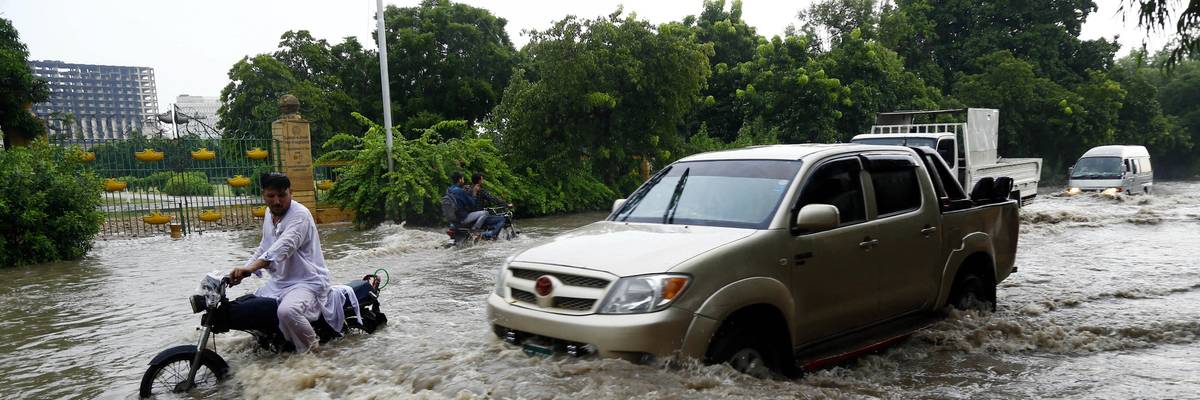
Vehicles move through flood water after heavy rain in the southern Pakistani port city of Karachi on September 12, 2022. (Photo: Str/Xinhua via Getty Images)
As global leaders prepare to meet in Egypt next week for the COP27 climate change summit, where wealthy countries' obligations to the Global South will be a central topic of discussion, the U.N. released a report Thursday detailing the major funding shortfall facing poor countries as they work to adapt to the unavoidable impacts of the climate crisis.
In the report, titled "Too Little, Too Slow: Climate Adaptation Failure Puts World at Risk," the U.N. Environment Program (UNEP) notes that "the adaptation finance gap in developing countries is likely five to ten times greater than current international adaptation finance flows and will only widen if we do not ramp up investments."
"People who follow adaptation won't be surprised to learn that global funding is falling short. But the magnitude of the shortfall is striking."
"People who follow adaptation won't be surprised to learn that global funding is falling short," said New York Times climate reporter Christopher Flavelle. "But the magnitude of the shortfall is striking."
In 2020, the governments of wealthy countries, which are responsible for far more planet-heating fossil fuel emissions than the Global South, provided $29 billion in climate adaptation finance--funds to help countries prepare and defend communities against floods like those that killed at least 1,700 people in Pakistan in recent months, build shelters to protect people from tropical cyclones, and develop agricultural systems that can cope with heatwaves and droughts.
That sum is just 4% higher than what was spent by wealthy countries in 2019, while the cost of climate adaptation is expected to rise as high as $340 billion per year by 2030. Wealthy governments pledged at the 2021 United Nations Climate Change Conference (COP26) that they would increase adaptation funding to $40 billion by 2025.
As the Times noted, the amount of climate adaptation funding spent by all wealthy countries in 2020 is nearly as much as the $33 billion Florida lawmakers called for to repair damage caused by Hurricane Ian this year.
"We need a global surge in adaptation investment to save millions of lives from climate carnage," U.N. Secretary-General Antonio Guterres told The Guardian Thursday. "Adaptation support today stands at less than one-tenth of [$340 billion]. The most vulnerable people and communities are paying the price and this is unacceptable."
UNEP executive director Inger Andersen warned that the world will "spend the coming decades in emergency response mode, dealing with disaster after disaster," unless the Global North invests heavily in helping countries adapt to the effects of the climate crisis that can no longer be avoided--while also drastically reducing the emissions that are fueling planetary heating and extreme weather, and providing "loss and damage" funding for countries that have already suffered climate impacts.
With the planet expected to warm by 2degC to 3degC by the end of the century, Andersen added, "the temperature ranges we are currently looking at over the decades to come will turn the climate impacts we are seeing now into knockout blows for generations to come."
"Climate change is landing blow after blow upon humanity, as we saw throughout 2022," Andersen told The Guardian. "We must get serious about adapting to climate change, and we must do it now."
UNEP emphasized that while wealthy countries must address the adaptation funding gap, "loss and damage must be addressed adequately."
Due to continued fossil fuel extraction, driven largely by the world's wealthiest countries, "in many places, it is too late for adaptation," Guterres told The Guardian. "COP27 must provide a clear and time-bound roadmap on closing the finance gap for addressing loss and damage. This will be a central litmus test for success at COP27."
Dear Common Dreams reader, It’s been nearly 30 years since I co-founded Common Dreams with my late wife, Lina Newhouser. We had the radical notion that journalism should serve the public good, not corporate profits. It was clear to us from the outset what it would take to build such a project. No paid advertisements. No corporate sponsors. No millionaire publisher telling us what to think or do. Many people said we wouldn't last a year, but we proved those doubters wrong. Together with a tremendous team of journalists and dedicated staff, we built an independent media outlet free from the constraints of profits and corporate control. Our mission has always been simple: To inform. To inspire. To ignite change for the common good. Building Common Dreams was not easy. Our survival was never guaranteed. When you take on the most powerful forces—Wall Street greed, fossil fuel industry destruction, Big Tech lobbyists, and uber-rich oligarchs who have spent billions upon billions rigging the economy and democracy in their favor—the only bulwark you have is supporters who believe in your work. But here’s the urgent message from me today. It's never been this bad out there. And it's never been this hard to keep us going. At the very moment Common Dreams is most needed, the threats we face are intensifying. We need your support now more than ever. We don't accept corporate advertising and never will. We don't have a paywall because we don't think people should be blocked from critical news based on their ability to pay. Everything we do is funded by the donations of readers like you. When everyone does the little they can afford, we are strong. But if that support retreats or dries up, so do we. Will you donate now to make sure Common Dreams not only survives but thrives? —Craig Brown, Co-founder |
As global leaders prepare to meet in Egypt next week for the COP27 climate change summit, where wealthy countries' obligations to the Global South will be a central topic of discussion, the U.N. released a report Thursday detailing the major funding shortfall facing poor countries as they work to adapt to the unavoidable impacts of the climate crisis.
In the report, titled "Too Little, Too Slow: Climate Adaptation Failure Puts World at Risk," the U.N. Environment Program (UNEP) notes that "the adaptation finance gap in developing countries is likely five to ten times greater than current international adaptation finance flows and will only widen if we do not ramp up investments."
"People who follow adaptation won't be surprised to learn that global funding is falling short. But the magnitude of the shortfall is striking."
"People who follow adaptation won't be surprised to learn that global funding is falling short," said New York Times climate reporter Christopher Flavelle. "But the magnitude of the shortfall is striking."
In 2020, the governments of wealthy countries, which are responsible for far more planet-heating fossil fuel emissions than the Global South, provided $29 billion in climate adaptation finance--funds to help countries prepare and defend communities against floods like those that killed at least 1,700 people in Pakistan in recent months, build shelters to protect people from tropical cyclones, and develop agricultural systems that can cope with heatwaves and droughts.
That sum is just 4% higher than what was spent by wealthy countries in 2019, while the cost of climate adaptation is expected to rise as high as $340 billion per year by 2030. Wealthy governments pledged at the 2021 United Nations Climate Change Conference (COP26) that they would increase adaptation funding to $40 billion by 2025.
As the Times noted, the amount of climate adaptation funding spent by all wealthy countries in 2020 is nearly as much as the $33 billion Florida lawmakers called for to repair damage caused by Hurricane Ian this year.
"We need a global surge in adaptation investment to save millions of lives from climate carnage," U.N. Secretary-General Antonio Guterres told The Guardian Thursday. "Adaptation support today stands at less than one-tenth of [$340 billion]. The most vulnerable people and communities are paying the price and this is unacceptable."
UNEP executive director Inger Andersen warned that the world will "spend the coming decades in emergency response mode, dealing with disaster after disaster," unless the Global North invests heavily in helping countries adapt to the effects of the climate crisis that can no longer be avoided--while also drastically reducing the emissions that are fueling planetary heating and extreme weather, and providing "loss and damage" funding for countries that have already suffered climate impacts.
With the planet expected to warm by 2degC to 3degC by the end of the century, Andersen added, "the temperature ranges we are currently looking at over the decades to come will turn the climate impacts we are seeing now into knockout blows for generations to come."
"Climate change is landing blow after blow upon humanity, as we saw throughout 2022," Andersen told The Guardian. "We must get serious about adapting to climate change, and we must do it now."
UNEP emphasized that while wealthy countries must address the adaptation funding gap, "loss and damage must be addressed adequately."
Due to continued fossil fuel extraction, driven largely by the world's wealthiest countries, "in many places, it is too late for adaptation," Guterres told The Guardian. "COP27 must provide a clear and time-bound roadmap on closing the finance gap for addressing loss and damage. This will be a central litmus test for success at COP27."
As global leaders prepare to meet in Egypt next week for the COP27 climate change summit, where wealthy countries' obligations to the Global South will be a central topic of discussion, the U.N. released a report Thursday detailing the major funding shortfall facing poor countries as they work to adapt to the unavoidable impacts of the climate crisis.
In the report, titled "Too Little, Too Slow: Climate Adaptation Failure Puts World at Risk," the U.N. Environment Program (UNEP) notes that "the adaptation finance gap in developing countries is likely five to ten times greater than current international adaptation finance flows and will only widen if we do not ramp up investments."
"People who follow adaptation won't be surprised to learn that global funding is falling short. But the magnitude of the shortfall is striking."
"People who follow adaptation won't be surprised to learn that global funding is falling short," said New York Times climate reporter Christopher Flavelle. "But the magnitude of the shortfall is striking."
In 2020, the governments of wealthy countries, which are responsible for far more planet-heating fossil fuel emissions than the Global South, provided $29 billion in climate adaptation finance--funds to help countries prepare and defend communities against floods like those that killed at least 1,700 people in Pakistan in recent months, build shelters to protect people from tropical cyclones, and develop agricultural systems that can cope with heatwaves and droughts.
That sum is just 4% higher than what was spent by wealthy countries in 2019, while the cost of climate adaptation is expected to rise as high as $340 billion per year by 2030. Wealthy governments pledged at the 2021 United Nations Climate Change Conference (COP26) that they would increase adaptation funding to $40 billion by 2025.
As the Times noted, the amount of climate adaptation funding spent by all wealthy countries in 2020 is nearly as much as the $33 billion Florida lawmakers called for to repair damage caused by Hurricane Ian this year.
"We need a global surge in adaptation investment to save millions of lives from climate carnage," U.N. Secretary-General Antonio Guterres told The Guardian Thursday. "Adaptation support today stands at less than one-tenth of [$340 billion]. The most vulnerable people and communities are paying the price and this is unacceptable."
UNEP executive director Inger Andersen warned that the world will "spend the coming decades in emergency response mode, dealing with disaster after disaster," unless the Global North invests heavily in helping countries adapt to the effects of the climate crisis that can no longer be avoided--while also drastically reducing the emissions that are fueling planetary heating and extreme weather, and providing "loss and damage" funding for countries that have already suffered climate impacts.
With the planet expected to warm by 2degC to 3degC by the end of the century, Andersen added, "the temperature ranges we are currently looking at over the decades to come will turn the climate impacts we are seeing now into knockout blows for generations to come."
"Climate change is landing blow after blow upon humanity, as we saw throughout 2022," Andersen told The Guardian. "We must get serious about adapting to climate change, and we must do it now."
UNEP emphasized that while wealthy countries must address the adaptation funding gap, "loss and damage must be addressed adequately."
Due to continued fossil fuel extraction, driven largely by the world's wealthiest countries, "in many places, it is too late for adaptation," Guterres told The Guardian. "COP27 must provide a clear and time-bound roadmap on closing the finance gap for addressing loss and damage. This will be a central litmus test for success at COP27."